Saved Bookmarks
This section includes InterviewSolutions, each offering curated multiple-choice questions to sharpen your knowledge and support exam preparation. Choose a topic below to get started.
| 37351. |
What is the probability of extracting from a pack of 36 cards (a normal pack with all the 2's, 3's, 4's, and 5's removed) (a) a spade card, (b) a red card, (c) a queen of any suit? |
|
Answer» |
|
| 37352. |
If retardation produced by air resistance of projectile is one-tenth of acceleration due to gravity, the time to reach maximum height: |
|
Answer» DECREASES by 11 percent `:.`Time of Flight `T=(usintheta)/(g+a)` Now `T=(usintheta)/(11g//10)=(10usintheta)/(11g)` Let t be the time of flight when only "g"is acting, then `t=(usintheta)/g` or `T=10/11xxt` % of decrease=`(t-T)/txx100` `=(t-10/11t)/t xx100=100/11=9.1%approx`9% |
|
| 37353. |
A conductor of length 0.1m is moving with a velocity of 4m/s in a uniform magnetic field of 2T as shown in the figure. Find the emf induced ? |
| Answer» SOLUTION :`E = BlV SIN 90^@ = (2)(0.1)(4) = 0.8` VOLT | |
| 37354. |
A magnetic needle has a magnetic moment of 5 xx 10^(-2) Am^(2) and moment of inertia 8xx10^(-6) kg m^(2). It has a period of oscillation of 2 s in a magnetic field vecB. The magnitude of magnetic field is approximately |
|
Answer» `3.2 xx 10^(-4) T ` ` B=(4 xx 10 xx 8 xx 10^(-6))/( 5 xx 10 ^(-2)xx 47 ) = 1.6 xx 10^(-3) T ` |
|
| 37355. |
For certain process the molar heat capacity of an ideal gas is found to be (C_v+R/2) , where C_v is the molar heat capacity of the same gas at constant volume. For the given process, it can be concluded that |
|
Answer» PV=CONSTANT |
|
| 37356. |
Atomic mass number of an element is 232 and its atomic number is 90. The end product, of this radioactive element is an isotope of lead (""_(82)^(208)Pb). The number of alpha and beta particles emitted is : |
|
Answer» `alpha =3 and BETA=3` Then `4X=(232-208) & (2x-y)=90-82` `x=6""alpha=6` `y=4""beta=4` |
|
| 37357. |
A ring of radius 5 m is lying in the x-y plane and is carrying current of 1 A in anticlockwise sense. If a uniform magnetic field overset-B=3hati+4hatj is switched on, then the coordinates of point about which the loop will lift up is: |
|
Answer» (3,4) |
|
| 37358. |
In a p - n junction diode the forward bias resistance is low as compared to the reverse bias resistance. Give reason. |
| Answer» Solution :In forward BIAS the thickness of depletion region decreases and barrier potential is LOWERED and consequently forward bias resistance is LOW as compared to the reverse bias CONDITION in which depletion region broadened and barrier potential is RAISED. | |
| 37359. |
When a U^(238) nucleus originally at rest decays by emitting an alpha -particle having a speed 'u', the recoil speed of the residual nucleus is : |
|
Answer» `(-4u)/(234)` `234v+4u=0` `v=(-4v)/(234)` So recoil speed is `(4u)/(234)` |
|
| 37360. |
As you read this page (on paper or manitor screen), acosmic ray proton passes along the left-right width of the page with relative speed v and a total energy of 23.16 nJ. According to your measurements, that left-right width is 21.0 cm. (a) What is the width according to the proton's reference frame? How much time did the passage take according to (b) your frame and (c ) the proton's frame? |
|
Answer» |
|
| 37361. |
A capacitor of 20mu F and charged to 200V is connected parallel with parallel with another capacitor of 10muF and charged to 400V. Find the common potential. |
|
Answer» SOLUTION :Data supplied, `C_(1)=20 muF, =20 xx 10^(-6)F, C_(2)=10muF=10 xx 10^(-6)F, V_(t)=200V, " "V_(2)=400V` `Q_(1)=C_(1)V_(1), Q_(2)=C_(2)V_(2) and Q=CV` `C=C_(1)+C_(2)` `V=Q/C =(C_(1)V_(1)+C_(2)V_(2))/(C_(1)+C_(2))` Common potential, `V=((20 xx 200+10 xx 400) xx 10^(-6))/((20+10) xx 10^(-6)) =(4000 +4000)/(30)=(8000)/(30)=266.7"volts"` |
|
| 37362. |
A fruit which is at 20 m above a lake suddenly detaches from the tree.A fish inside the lake , in the line of fall of fruit,is looking at fruit when fruit is at 12.8 m above the water surface.Speed of fruit as observed by fish (μ_(water)=4/3 and g=10m/s^2) |
|
Answer» 6 m/s |
|
| 37363. |
A charge Q is to be divided into two parts q and (Q-q) such that the force between them is maximum at a certain distance. The value of q is |
|
Answer» Q/3 |
|
| 37364. |
Three point charges Q_(1), Q_(2) and Q_(3) in that order are placed equally spaced along a striaght line. Q_(2) and Q_(3) are equal in magnitude but opposite is sign. If the net force on Q_(3) is zero, the value ofQ_(1) is |
|
Answer» `Q_(1) = |Q_(3)|` |
|
| 37365. |
Two junction diodes, one of germanium (Ge) and other of silicon (Si) are connected as shown in fig to a battery of 12V and a load resistance 10kOmega. The germanium diode conducts at 0.3V and silicon diode at 0.7V. When current flows in the circuit, the potential of terminal Y will be |
|
Answer» Solution : The GE diode conducts for a p.d of 0.3V, therefore the current PASSES through it and the SI diode do not conduct. HENCE the potential of terminal `Y = 12-0.3 = 11.7V` |
|
| 37366. |
A parallel plate capacitor with circular plates of radius 1 m has a capacitance of 1 nF. At t = 0, it is connected for charging in series with a resistor R = 1 M Omega across a 2V battery (Fig. 8.3). Calculate the magnetic field at a point P, halfway between the centre and the periphery of the plates, after t = 10^(-3) s. (The charge on the capacitor at time t is q (t) = CV [1 – exp (–t// tau)], where the time constant tau is equal to CR.) |
|
Answer» Solution :The time constant of the CR circuit is `TAU = CR = 10^(-3) s`. Then, we have `q(t)=CV [1-"exp"(-t//tau)]` `=2XX10^(-9)[1-"exp "(-t//10^(-3))]` The ELECTRIC field in between the plates at time t is `E=(q(t))/(epsi_(0)A)=(q)/(pi epsi_(0)), A= pi (1)^(2) m^(2)`= area of the plates. Consider now a circular loop of radius (1/2) m parallel to the plates passing through P. The magnetic field B at all points on the loop is along the loop and of the same value. The flux `Phi_(E)` through this loop is `Phi_(E)=Exx` area of the loop `=E xx pi xx((1)/(2))^(2)=(pi E)/(4) =(q)/(4 epsi_(0))` The displacement current `i_(d) =epsi_(0)"" (d Phi_(E))/(dt) =(1)/(4)""(dq)/(dt) =0.5 xx10^(-6)" exp "(-1)` at `t=10^(-3)s`. Now, applying Ampere-Maxwell law to the loop, we get `B xx 2 pi xx((1)/(2))= mu_(0) (i_(c)+i_(d))=mu_(0)(0+i_(d))=0.5xx10^(-6) mu_(0)" exp"(-1)` or, `B=0.74xx10^(-13) T` |
|
| 37367. |
The optical path difference between two identical waves, starting from a monochromatic source in the same phase, and arriving at a point on a screen s 100.5lamda. Is the point dark or bright? |
|
Answer» BRIGHT point |
|
| 37368. |
What is diffraction ? |
| Answer» Solution :The spreding of WAVES that PASS through opening or move part an OBSTACLE is called diffraction . | |
| 37369. |
For which angle of incidence reflected ray is completely polarised ? |
| Answer» SOLUTION :Brewster.s ANGLE | |
| 37370. |
Define the term ‘decay constant’ of a radioactive sample. The rate of disintegration of a given radioactive nucleus is 10000 disintegrations/s and 5000 disintegrations/s after 20 h and 30 h respectively from start. Calculate the half-life and initial number of nuclei at t = 0. |
|
Answer» Solution :DECAY CONSTANT of a radioactive ELEMENT is the reciprocal of the time during which the number of nuclides left undecayed is `1/e` times the original number. As per question at time `t_(1) =20h`, decay rate `R_(1) = 10000s^(-1)` and at time `t_(2) = 30h`, decay rate `R_(2) =5000s^(-1)` Thus during the time `t_(2)- t_(1) = (30 - 20) h= 10h`, the decay rate falls to one HALF i.e., `R_(2)/R_(1) = 5000/10000= 1/2` Thus by definition of half-life period it is clear that `T_(1/2) =10h` If the initial decay rate by `R_(0)` at time t = 0, then `t_(1) = 20 h=2T_(1/2)` and hence `R_(1)=(1/2)^(2)=R_(0)/4 IMPLIES R_(0)=4R_(1)=4xx10000=40000s^(-1)` `since R_(0)=-lambdaN_(0) implies N_(0)=R_(0)/(lambda)=(R_(0)xxT_(1/2))/0.693=((40000s^(-1))xx(10h))/0.693=(40000xx10xx60xx60)/0.693=2.08xx10^(10)` |
|
| 37371. |
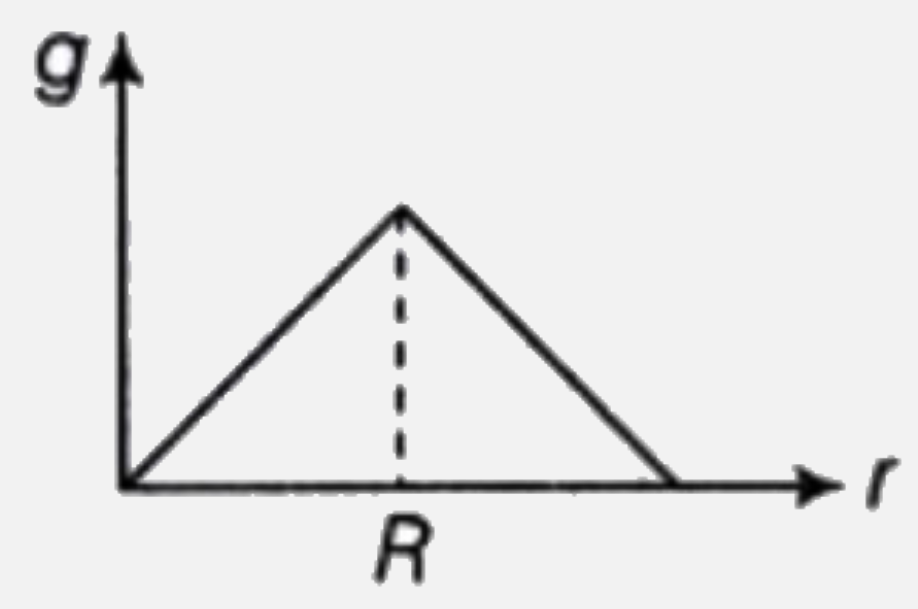
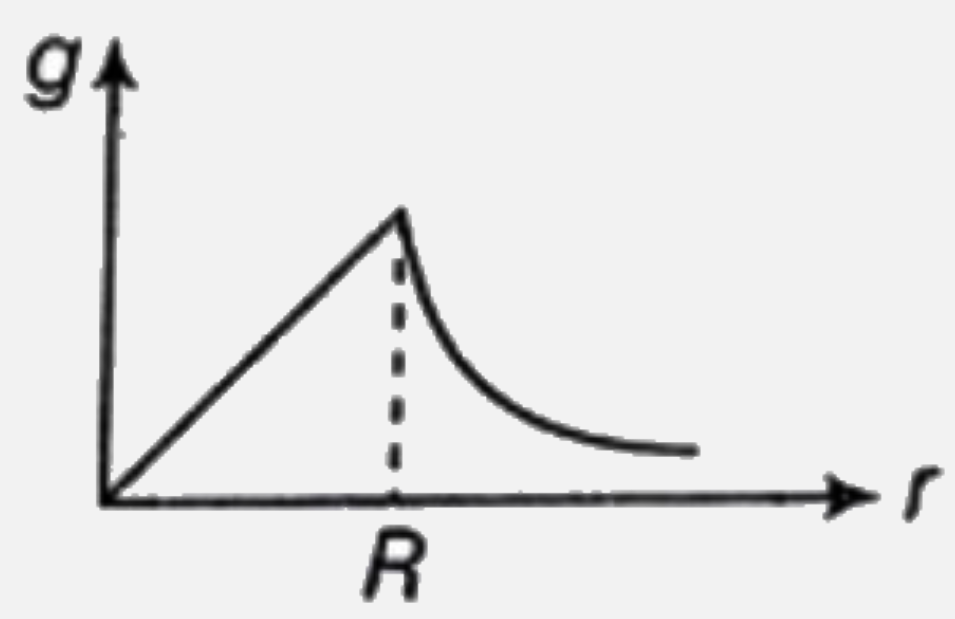
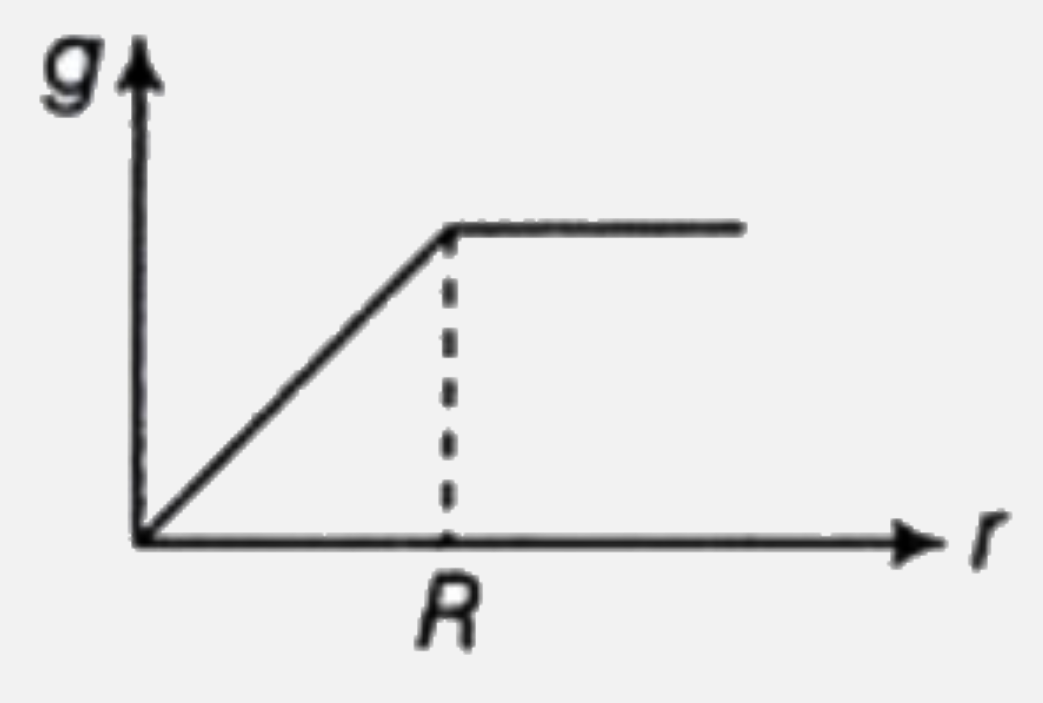
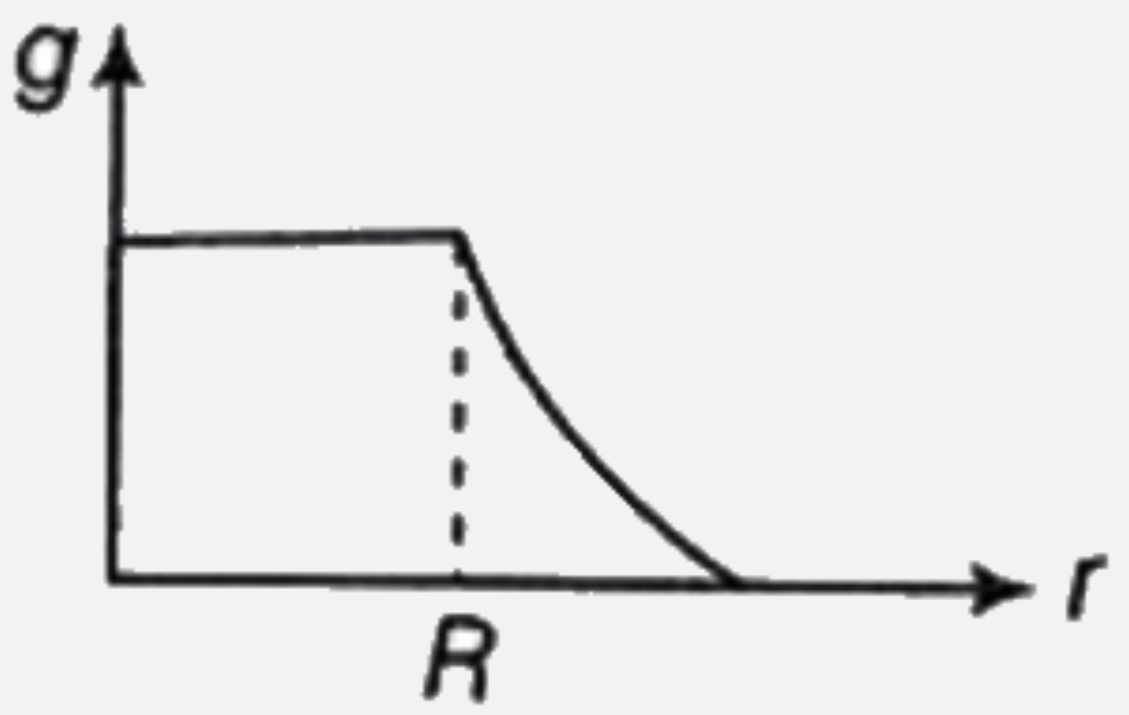
Which of the following graphs correctly represents the variation of g on the - Earth? |
|
Answer»
|
|
| 37372. |
………………..current attract and …………………currents repel. |
| Answer» SOLUTION :PARALLEL, ANTIPARALLEL | |
| 37373. |
What red or violet light has more RI ? |
| Answer» SOLUTION :Light of all WAVELENGTHS are reduced in glass. VIOLET light travels slower than RED light. RI of violet light GT RI of red light. | |
| 37374. |
The ionization energy of a hydrogen atom is epsi_(ion)=13.6eV. Yet the ionization of hydrogen atoms is observed at temperatures for which the average kinetic energy is much less. How can this fact be explained? |
Answer» Solution :Usually the computations are carried out using the relation  . This, however, yields too large a value for the temperature: . This, however, yields too large a value for the temperature:  In fact, IONIZATION takes place at lower temperatures. The reason is the Maxwellian molecular speed distribution, according to which in equilibrium conditions there is ALWAYS a noticeable percentage of MOLECULES with speeds exceeding the average. For example, from Table 25.1it may be SEEN that `(9)/(368)~~2,5%` of the molecules have a speed more than three times the average. This means that nine times greater than the average kinetic energy of the molecules. |
|
| 37375. |
A bar magnet of magnetic moment m is placed in the position of stable equillibrium in a uniform magnetic field B. Work done in ratating it through an angle 180^@ is |
| Answer» Answer :C | |
| 37376. |
The resolving power of an optical instrument is decided by : |
|
Answer» Newton's CORPUSCULAR THEROY of LIGHT |
|
| 37377. |
An electrical charge is a : |
|
Answer» Scalar quantity |
|
| 37378. |
A step down transformer convert a voltage of 2200 V into 220V in the transmission line. Number of turns in the primary coil is 5000. Efficiency of transformer is 90% and its output power is 8kW. Calculate (i) the number of turns in the secondary coil, (ii) input power. |
| Answer» SOLUTION :(i) 500 (II) 8.9 KW | |
| 37379. |
किस प्रकार के परागकण कीट परागित पुष्प में पाये जाते हैं- |
|
Answer» हल्के तथा चिपचिपे |
|
| 37380. |
The maximum number of possible interference maxima when slit separation is equal to 4 times the wevelenght of light used in a double slit experiment is |
|
Answer» 8 Given that `d=4lambda,beta=(lambdaD)/(4lambda)=(D)/(4)`. NORMALLY D is the order of metres (0.5 to 1M?) `beta` is very LARGE . The number of orders that can be accomodated is less than one for normal screen . No option given. |
|
| 37381. |
Charge over a nonconducting ring is distributed so that the linear charge density varies as lambda = lambda_0sin theta. What is the direction of force on a charge q_0 placed at the center? |
|
Answer» along 1 if `q_0` is positive and 2 if `q_0` is NEGATIVE. HENCE direction of electric Beld `E_("NE")` at `O` due to CHARGE distribution is in downward direction, If `q_(0)` is ` 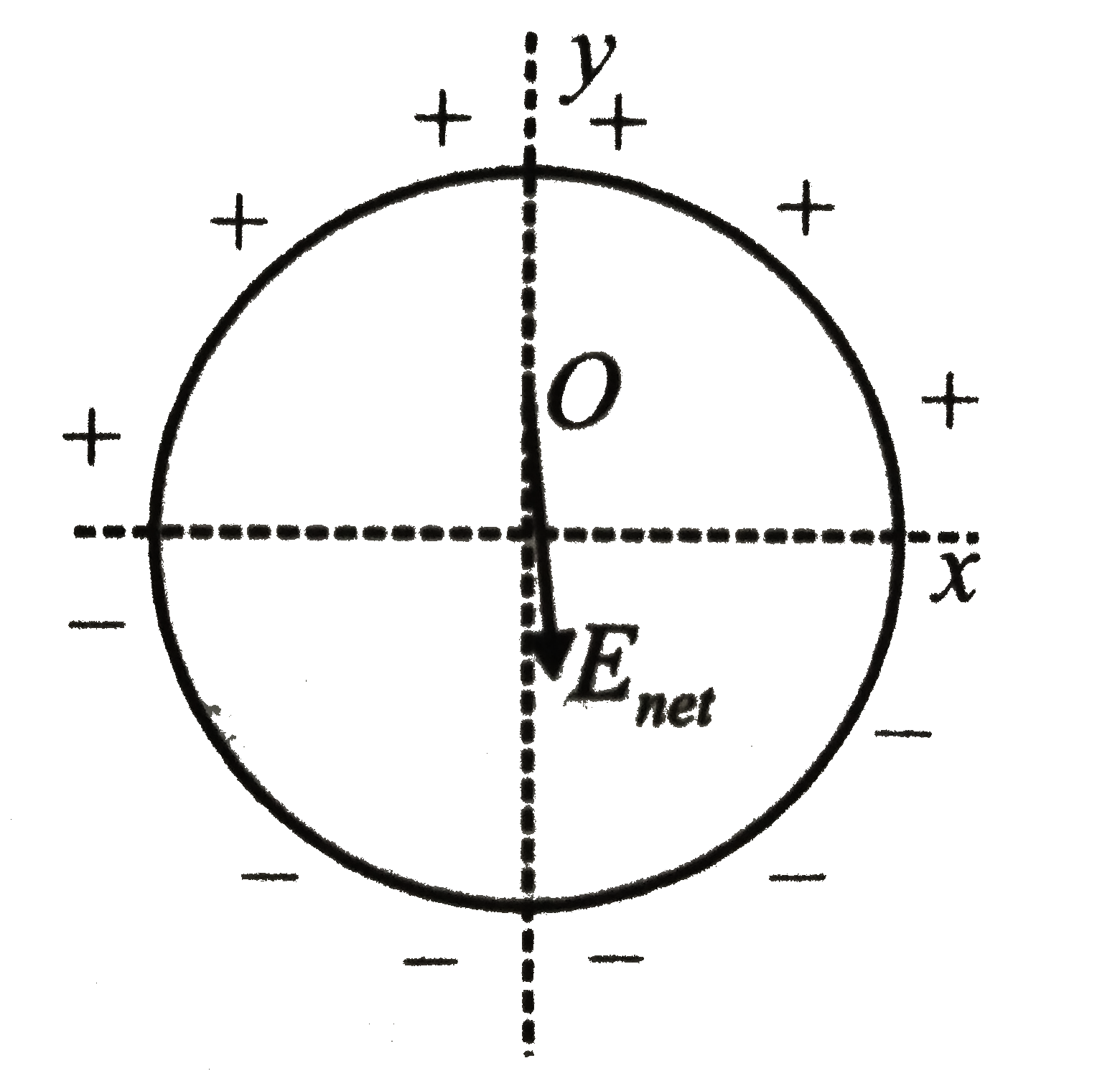
|
|
| 37382. |
माना A={a,b,c,}, B={b,c,d}, C={a,b,d,e} तो An(BUC) है |
| Answer» ANSWER :B | |
| 37383. |
The P.E. of a spring is E_(P) when is stretched through 1cm. When stretched through 2 cm, ils P.E. is |
| Answer» Solution :`(U_(2))/(U_(1))=(x_(2)^(2))/(x_(1)^(2))impliesU_(2)=((2)^(2))/(1^(2))xxE_(P)=4E_(P)` | |
| 37384. |
(a) Draw a circuit diagram of a meter bridge used to determine the unknown resistance R of a given wire. Hence derive the expression for R in terms of the known resistance S. (b) What does the term 'end error' in a metre bridge circuit mean and how is it corrected ? How will the balancing point be affected, if the positions of the battery and galvanometer are interchanged in a metre bridge experiment ? Give reason for your answer. |
|
Answer» <P> Solution :We know that,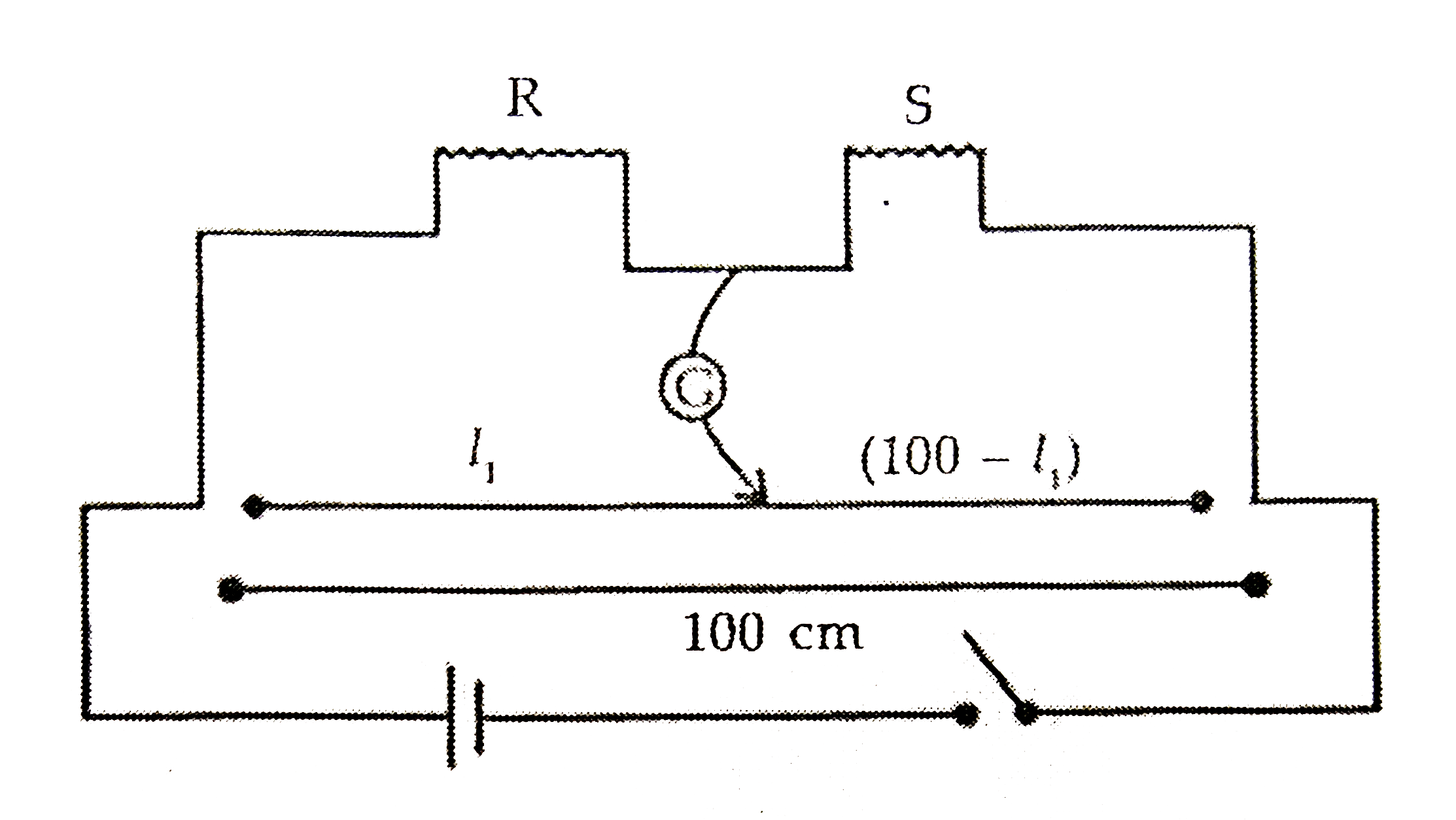 `P/Q = R/S` (POTENTIOMETER) Here,`""l_(1)/(100-l_(1)) = P/Q` ` rArr"" l_(1)/(100-l_(1)) = R/S` or `"" R=S[l_(1)/(100 - l_(1))]` (b) Theshifting of zero of thescale at different points, as well as thestray resistance give rise to enderror in metre BRIDGE wire. This error arises due to non-uniformity of metre wire. Correction can be estimated by including known resistances `P_(1) and Q_(1)` in thetwo ENDS andfinding the null point. If galvanometer and battery are interchanged, there is no effect on the position of balance point. |
|
| 37385. |
A smooth steel ball is moving to and fro about the lowest position of a frictionless hemispherical bowl. The ball attains a maximum height of 20 cm on either side of O. If g = 10 ms-2, and mass of the body is 5g, the speed of the ball when it passes through O will be: |
|
Answer» `sqrt(3) ms^(-1)` |
|
| 37386. |
Moment of interia of a thin uniform rod rotating about the perpendicular axis passing through its center is I. If the same rod is bent into a ring and its moment of inertia about its diameter is |
|
Answer» `8pi^(2)//3` when rod is BENT into a ring then RADIUS of ring is r `therefore 2pir=limpliesr=(l)/(2pi)` Moment of inertia of ring about its diameter is `I.=(1)/(2)mr^(2)=(1)/(2)m(l^(2))/(4pi^(2))` `therefore (I)/(I.)=(1)/(12)ml^(2)//(ml^(2))/(8pi^(2))=(2pi^(2))/(3)` |
|
| 37387. |
Electrical potential energy is given by U=W=? |
|
Answer» |
|
| 37389. |
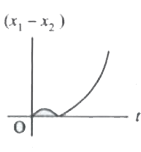
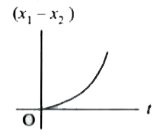
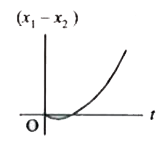
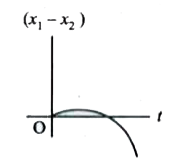
A body is at rest at x = 0. At t = 0, it starts moving in the positive x-direction with a constant acceleration. At the same instant another body passes through x = 0 moving in the positive x-direction with a constant speed. The position of the first body is given by X_(1) (r) after time t and that of the second body by x_(2) (r) after the same time interval. Which of the following graphs correctly describes (x_(1) - x_(2) ) as a function of time t? |
|
Answer»
For SECOND body, `x_(2)=v_(2)t` `:.x_(2)=1/2at^(2)-VT` When `vt>1/2at^(2)` then `x_(1)-x_(2)` is -ve and when `1/2at^(2)>vt` then `x_(1)-x_(2)` Is +ve. |
|
| 37390. |
Find the Q-value and the kinetic energy of the emitted alpha - particle in the alpha - decay of ._(86)^(220)Rn. Given m (._(88)^(226)Ra)=226.02540 u, m (._(86)^(222)Rn)=222.01750 u, m (._(86)^(222)Rn)=220.01137 u, m (._(84)^(216)Po) = 216.00189 u. |
|
Answer» SOLUTION :PROCEEDING as above, in CASE of `._(86)RN^(220)` Q = 6.41 MeV K.E of a particle `= ((A-4)Q)/(A) = ((220-4))/(220)xx6.41 = 6.29 MeV` |
|
| 37391. |
A marble block of mass 2 kg lying on ice when given a velocity of6 m//s is stopped by friction in 10 s. Then the coefficient of friction is - |
|
Answer» 0.02 |
|
| 37392. |
A uniform magnetic field is restricted with a region of radius r. The magnetic field change with time at a rate vec(dB/dt). Loop 1 of radius Rgtr encloses the region r and loop 2 of radius R is outside the region of magnetic field as shown in the figure below. then the e.m.f. genrated is ] |
|
Answer» `-(VEC(dB))/(DT)PIR^(2)` in LOOP `1` and zero in loop `2` `e_("ind")=-A((dvecB)/(dt))cos0^(@)=-pir^(2)((dvecB)/(dt))` for loop `2,e_("ind")=0` has no FLUX linkage |
|
| 37393. |
The angular speed of a fly-wheel starting from rest reaches a speed of 240 rpm is 4s.Its angular acceleration would be |
|
Answer» `PI/2 rad/s^2` |
|
| 37394. |
State the essential condition for diffraction of light to take place. Use Huygens' principal to explain diffraction of light due to a narrow single slit and the formation of a pattern of fringes obtained on screen. Sketch the pattern of fringes formed due to diffraction at a single slit showing variation of intensity with angle theta. What are coherent sources of light ? Why are coherent sources required to obtain sustained interference pattern ? |
| Answer» SOLUTION :REFERE to `NCERT` | |
| 37395. |
A circular loop of radius R, carrying current I, lies in xy plane with its centre at origin. The total magnetic flux density at centre is : |
|
Answer» directly PROPORTIONAL to `I^(2)` |
|
| 37396. |
A coducting rod of mass m=0.3kg and length l=4m can slide without friction on two parallel conducting rails. The conducting rails are connected via an inductancce L=3Mh. This system is placed in a region containing uniform magnetic field B=1T pointing into the plane. if the rod is given an initial velocity v_(0)=2m//s, it oscillates with an amplituude Acm. Find the value of 2A |
|
Answer» `m(dv)/(dt)=-IBL` `implies(d^(2)v)/(dt^(2))=-((B^(2)l^(2))/(mL))v` `impliesv=v_(0)cos(omegat)` with `omega=(Bl)/(SQRT(mL))` Thus, `(DX)/(dt)=v_(0)cos(omegat)` `impliesx=(v_(0))/(omega) sin omegat` `2A=(2v_(0))/(omega)=3CM` |
|
| 37397. |
A body of mass 2.0 kg, force to travel in the x-direction, is subjected to a force directed in the positive x -direction that varies with position as shown in the graph. The force does 9.0 J of work on the body as it moves from x=0 to x=5.0 meters. What is the value of F at x=1.0 meters? |
|
Answer» Solution :LET value of `F` at `n=1` m be `F_(1)` workdone`=`Area of `F-x` curve `rArrF_(1)((4+2)/(2))=9 rArrF_(1)=3N` |
|
| 37398. |
A carbon resistor of (47+-4.7)k Omega to be marked with rings of different colours for its identification. The colour code sequence will be |
|
Answer» Yellow-Green- VIOLET GOLD |
|
| 37399. |
If a simple harmonic oscillator has got a displacement of 0.02 m and acceleration equal to 2m//s^2 at any time the angular frequency of the oscillator is equal to |
|
Answer» 0.1 rad/sec |
|
| 37400. |
Calculate the emiter current and collector voltage of the circuit given in Fig. 5.13 |
|
Answer» |
|