

Saved Bookmarks
This section includes InterviewSolutions, each offering curated multiple-choice questions to sharpen your knowledge and support exam preparation. Choose a topic below to get started.
| 43601. |
Choose the correct alternative from the clues given at the end of the each statement: An atom has a nearly continuous mass distribution in a .......... but has a highly non-uniform mass distribution in .......... (Thomson’s model/ Rutherford’s model.) |
| Answer» SOLUTION :THOMSON’s MODEL, RUTHERFORD’s model | |
| 43602. |
Two circular coils can be arranged in any of the three situations as shown in figure. Their mutual inductance (M) will be .. |
|
Answer» Maximum in SITUATION (1) |
|
| 43603. |
At a place horizontal and vertical componernts of B_H= 3^(1/2)G deg5 West of North..B_v=1 G vetically upward.Then, angle of inclination and declination are respectively earth's magnetic feld are as follows |
|
Answer» `60^0`, `5^0` W |
|
| 43604. |
The correct sequence of embryogenic in dicot seed is |
|
Answer» ZYGOTE, PROEMBRYO, GLOBULAR, heart-shaped and MATURE embryo |
|
| 43605. |
Find the magnitude of magnetic force on the frame, as shown. The magnetic field acting as shown: |
|
Answer» ZERO |
|
| 43606. |
Distinguish between intrinsic and extrinsic semiconductors. |
Answer» SOLUTION :
|
|
| 43607. |
What is the source temperature of the Carnot engine required to get 70% efficiency ? Given, sink temperature = 27^(@)C. |
|
Answer» `1000^(@)C` Efficiency `eta=70%` Sink temperature `T_(1)=27^(@)C+273=300 K` Source temperature `T_(2)=?` As we KNOW that efficiency is given by `eta=1-(T_(2))/(T_(1))` `70% =1-(300)/(T_(1))` `(70)/(100)=1-(300)/(T_(1))` `(300)/(T_(1))=1-0.7` `T_(1)=(300)/(0.3)` =1000 K or `T_(1)=1000-273` `=727^(@)C`. So, correct choice is (d). |
|
| 43608. |
Which effect could not be explained by wave theory ? |
| Answer» SOLUTION :PHOTO ELECTRIC EFFECT, COMPTON effect. | |
| 43609. |
What did Ron Forbes advise (suggest, HATE ) Evelyn? |
|
Answer» FORGET MUSIC |
|
| 43610. |
The torque experienced by a current loop in a magnetic field is vector form is given by i=_____. |
| Answer» SOLUTION :`[oversettoMxxoversettoB]` | |
| 43611. |
A ring angled isosceles prism KLM of refractive index n_(1) is placed inside a rectangular block PQRS of refractive index n_(2) as shown in the adjoining Fig. The rectangular box is surrounded by a medium of refractive index n_(3). A ray of light AB enters the rectangular block normally. Depending upon the relationships between n_(1), n_(2) and n_(3). it takes one of the four possible paths. What is the condition for light ray to proceed along the path no. 4 (i.e., path ABCEF)? |
|
Answer» Solution :The ray no. 4 bends towards normal while undergoing REFRACTION at C. So we conclude that `n_(2) gt n_(1)`. HOWEVER, while undergoing refraction at E the ray bends away from the normal. Hence `n_(3) LT n_(2)`. So this situation is possible only if `n_(2) gt n_(1) and n_(2) gt n_(3)`. |
|
| 43612. |
A progressive sound wave of equation Y_1=4sin20pi(30t-x/lambda) produces 10 beats per sec with another wave. The equation of the other wave is |
|
Answer» `Y_2=4sin20pi(32t-x/lamda)` |
|
| 43613. |
What P.D. must be applied to stop the fastest photo electron emitted by a nickel surface when illuminated by ultraviolet light of wave length 2000^(@)A. The work function of nickel is 5 eV |
|
Answer» 5 V |
|
| 43614. |
The Fundamental frequency of a pipe closed at one end is in unison with the second overtone of anopen pipe.Calculate the ratio of the length of their air columns. Ignore the end correction. |
|
Answer» SOLUTION :Pipe closed at one end : fundamental frequency`n_(C)= v/(4L_(c))` Pipe open at both ends : fundamental frequency `n_(0) = v/(2L_(0)) ` In this case, the frequency of the second overtone =` (3v)/(2L_(0))` By the data = `v/(4L_(c))= (3v)/(2L_(0)= L_(0)/L_(c)= ( 4xx 3)/2` ` L_(0)/L_(c) = 5 or L_c/L_o = 1/6 ` This is the REQUIRED RATIO. |
|
| 43615. |
The radius of theinnermostelectron orbit of a hydrogenatomis 5.3 xx 10^(-11)m . Whatare theradii of the n = 2 and n = 3 orbits? |
|
Answer» SOLUTION :It is given that RADIUS of the innermost (n = 1) electron orbit of HYDROGEN ATOM `r_(1) =5.3 xx 10^(-11) m` and `therefore`Radii of the orbit corresponding to `n=2, r_(2)= (2)^(2) xx r_(1) = 4 xx 5.3 xx 10^(-11) m = 2.12 xx 10^(-10) m` and radii of the orbit corresponding to `n=3, r_(3) = (3)^(2) xx r_(1) - 9 xx 5.3 xx 10^(-11) m = 4.77 xx 10^(-11) m` |
|
| 43616. |
Whenthe width of slit aperture is increased by keeping 'd' as constant in Young's experiment |
|
Answer» Fringe width will increase |
|
| 43617. |
The length of a solenoid is 0.1 m and its diameter is very small. A wire is wound over in two layers. The number of turns in the inner layer is 50 and that on the outer layer is 40. The s trength of current flowing in two layers in the same direction is 3 ampere. The magnetic induction in the middle of the solenoid will be |
|
Answer» `3.4xx10^(-3)T` |
|
| 43618. |
Four plates of equal area A are separated by equal distances d and are arranged as .in figure. The equivalent capacity : |
|
Answer» `(2epsilon_0A)/d` |
|
| 43619. |
Ifl_1,l_2,l_3 are the lengths of the emitter, base and collection of a transistor then: |
|
Answer» `I-I_2=I_3` |
|
| 43620. |
State Bohr's third postulate for hydrogen (H_(2) atom. Derive Bohr's formula for the wave number. Obtain expressions for longest and shortest wavelength of spectral lines in utaviolet region for hydrogen atom. The photoelectric current in a photoelectric cell can be reduced to zero by a stopping potential of 1.8 volt. Monochromatic light of wavelength 2200Å is incident on the cathode. Find the maximum kinetic energy of the photoelectrons in joules. [Charge on electron =1.6xx10^(-19)C] |
|
Answer» Solution :Bohr' third postulate : when an electron jupms from higher energy level to LOWER energy level, it RADIATES energy in the form of quanta or photons. The energy of the quantum of electromagnetic radiation i.e., the photon emitted is equal to the energy difference of the two states. Let `E_(i)` is the energy of the electron in a hydrogen atom when it is in on orbit with the principal quantum number `n_(i)` and `E_(F)` is its energy in an orbit with principal quantum number `n_(f)` then `E_(i)=-(me^(4))/(8epsilon_(0)^(2)h^(2)n_(i)^(2))` `E_(f)=-(me^(4))/(8epsilon_(0)^(2)h^(2)n_(f)^(2))` Energy radiated when the electron jumps from higher energy level to lower energy level, `E_(i)-E_(f)=(me^(4))/(8epsilon_(0)^(2)h^(2))((1)/(n_(f)^(2))-(1)/(n_(i)^(2)))` This energy is emitted in the form of a quantum of radiation with energy `hv`. `:. hv=(me^(4))/(8epsilon_(0)^(2)h^(2))((1)/(n_(f)^(2))-(1)/(n_(i)^(2)))` `:. (1)/(lambda)=(me^(4))/(8epsilon_(0)^(2)h^(3)c)((1)/(n_(f)^(2))-(1)/(n_(i)^(2)))` `:. (1)/(lambda)=R((1)/(n_(f)^(2))-(1)/(n_(i)^(2)))` where, `R=(me^(4))/(8epsilon_(0)^(2)h^(3)c)` is called Rydberg's constant. For longest wavelength in ULTRAVIOLET REGION, `(1)/(lambda_(1))=R((1)/(1^(2))-(1)/(2^(2)))` `lambda_(L)=(4)/(3R)` For shortest wavelength in ultraviolet region, `(1)/(lambda_(s))=R((1)/(1^(2))-(1)/(oo^(2)))` `lambda_(S)=(1)/(R )` Numerical: Given : `V_(0)=1.8` volt, `lambfa=2200Å` `K.E._((max))=eV_(0)` `=1.6xx10^(-19)xx1.8=2.88xx10^(-19)J`. |
|
| 43621. |
A battery of 120 V and internal resistance r = 0.5 Omega is used to charge a 110 V cell in the circuit shown in the figure. find the range of values of R for which the cell will never get charged. |
|
Answer» |
|
| 43622. |
What is first advice of the father to son? |
|
Answer» HOPE for best |
|
| 43623. |
An oscillatory circuit is made up of a 100mumuF capacitor and a 64muH coil with resistance of 1.0 ohm. Find the natural frequency, the period of oscillations and the Q-factor of the circuit. |
|
Answer» |
|
| 43624. |
A capacitor (0.2F) is charged to 600V. After removing the charge battery it is connected across another capacitor (1.0 farad). The voltage across the capacitor changes from 600V |
|
Answer» 100 V |
|
| 43625. |
Can we consider spectacles as visual instrument? |
| Answer» SOLUTION :The instrument which helps us to VISUALISE an object is called a visual instrument . In that sense spectacles can be called visual instrument. If we have some error in our eyes, we USE spectacles to rectify that error and make our VISION CLEARER. Hence, spectacles can be considered as visual instrument. | |
| 43626. |
The main difference in the phenomenon of interference and diffraction is that |
|
Answer» diffraction is due to interaction of light from the same WAVEFRONT whereas INTERFERENCE is the interaction of waves from wave isolated sources |
|
| 43627. |
Hole is |
|
Answer» an ANTIPARTICLE of electron. |
|
| 43628. |
If the hydrogen atoms are excited to states with principal quantum number n, then the number of possible emission lines is : |
|
Answer» N |
|
| 43629. |
the thickness is doubled keeping V and l constant |
| Answer» SOLUTION :REMAINS the same.Drift VELOCITY is INDEPENDENT of the THICKNESS. | |
| 43630. |
Explain why elemental semiconductors cannot be used to make visible LEDs? |
| Answer» SOLUTION :For visible LEDs,the RADIATIONS emitted from the energy band gap must lie in the RANGE of visible region. But in case of elemental SEMICONDUCTOR,the radiation emitted lie in the range of infrared region. | |
| 43631. |
The activity of a radioactive sample is measured as N_(0) counts per minute at t= 0 and N//e_(0) counts per minute at t = 5 minutes. The time (in minutes) at which the activity reduces to one fourth of its value is |
|
Answer» `log_(3)""(4)/(5)` |
|
| 43632. |
Assertion:Neutrons penetrate matter more readily as compared to protons. Reason:A neutron has no charge . |
|
Answer» If both assertion and reason are true and reason is the correct EXPLANATION of assertion . |
|
| 43633. |
In a hydrogen atom, the electron and proton are bound at a distance of about 0.53 Å (a) Estimate the potential energy of the system in eV, taking the zero of the potential energy at infinite separation of the electron from proton. (b) What is the minimum work required to free the electron, given that its kinetic energy in the orbit is half the magnitude of potential energy obtained in (a)? (c) What are the answers to (a) and (b) above if the zero of potential energy is taken at 1.06 Å separation? |
|
Answer» Solution :(a) `-27.2` EV, (B) 13.6 eV ( C) `-13.6` eV, 13.6 eV. Note in the LATTER CHOICE the total energy of the hydrogen atom is zero. |
|
| 43634. |
(a) A comb run through one’s dry hair attracts small bits of paper. Why? What happens if the hair is wet or if it is a rainy day? (Remember, a paper does not conduct electricity.) (b) Ordinary rubber is an insulator. But special rubber tyres of aircraft are made slightly conducting. Why is this necessary? (c) Vehicles carrying inflammable materials usually have metallic ropes touching the ground during motion. Why? (d) A bird perches on a bare high power line, and nothing happens to the bird. A man standing on the ground touches the same line and gets a fatal shock. Why? |
|
Answer» Solution :When a bird perches on a bare high power LINE, no potential difference DEVELOPED and the CURRENT is not flowing through the body of bird and hence no fatal shock exist. But a MAN standing on the ground touch as the same line, the potential difference developed between wire and EARTH. Hence, electric current flow into the body of man and gets a fatal shock. |
|
| 43635. |
Two waves of wavelength 2m and 2.02 m respectively, moving with the same velocity, superpose to produce 2 beats per sec. The velocity of the wave is : |
|
Answer» 400.0 m/s |
|
| 43636. |
What is rectification ? Withrelevant circuit diagram and waveforms , explain the working of p-n junction diode as a full wave rectifier . |
| Answer» SOLUTION :The PROCESS of CONVERTING AC (alternating current ) to pulsating DC is called RECTIFICATION. | |
| 43637. |
Assume that two deuteron nuclei in the core of fusion reactor at temperature T are moving towards each other, each with kinetic energy 1.5 KT, when the separation between them is large enough to neglect Coulomb potential energy. Also neglect any interaction from other particles in the core. The minimum temperature T required for them to reach a separation of 4 xx 10^(-15) m is in the range. |
|
Answer» `1.0 xx 10^(9) K LT T lt 2.0 xx 10^(9)K` `e^(2)/(4pi epsi_(0))=1.44 xx 10^(-9)eVm` K.E. of TWO deutrons `=2 xx 1.5kT` =3kT This K.E. has to overcome the potential energy of the nucleus. `RARR 3kT =(1)/(4pi epsi_(0)) e^(2)/r` `T=1/k. 1/(3 xx r).(e^(2))/(4piepsi_(0))` `T=(1.44 xx 10^(-9))/(8.6 xx 10^(-5)) xx (1)/(3 xx 4 xx 10^(-15))` `T=1.39 xx 10^(9)K` |
|
| 43638. |
A body freely falling from rest has a velocity v after it falls through a height h . The distance it has to fall down further for it's velocity to become double is |
|
Answer» H |
|
| 43639. |
At a certain palce the horizotnal component of earthmag field is B_(0) and angle ofdip is 45^(@)the resulatant field intensity at that placewill be |
|
Answer» `B_(0)` |
|
| 43640. |
Identify the wrong statement in the following Coulomb.s law correctly describes the electric force that |
|
Answer» BINDS the electrons of an atom to its NUCLEUS |
|
| 43641. |
in the previous question, suppose the switch is again opened at t=0, then time constant of discharging circuit is: |
|
Answer» `(L)/(R_(1))` `R_(1)` and `R_(2)` in series, so TIME constant is `(L)/(R_(1)+R_(2))`. 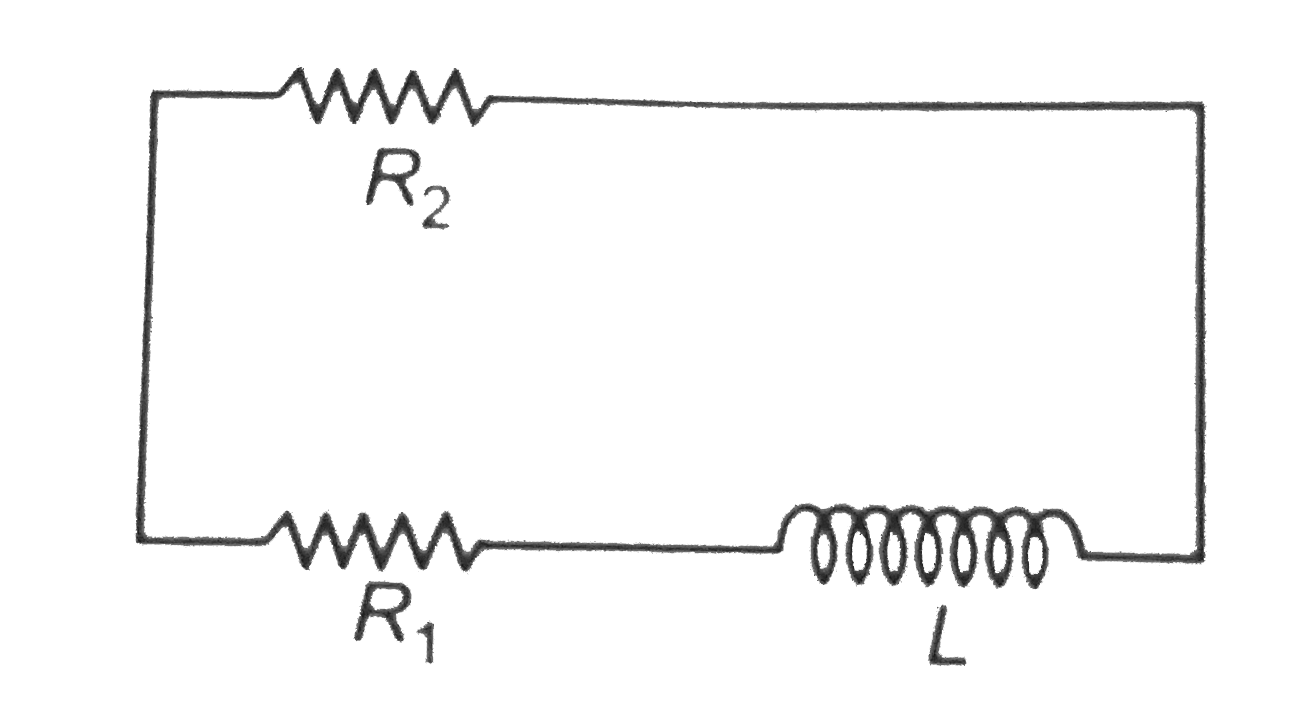
|
|
| 43642. |
(a) Draw the ray diagram showing refraction of ray of light through a glass prism. Derive the expression for the refractive index n of the material of prism in terms of the angle A ray angle of minimum deviation delta_m (b) A ray of light PQ enters an isosceles right angles prism ABC of refractive index 1.5 as shown in figure . (i) Trace the path of the ray through the prism . (ii) What will be the effect on the path of the ray if refractive index of the prism is 1.4 ? |
|
Answer» Solution :(a) Refraction of light rays through a prism has been shown below . Here `anglei` is the incidence angle at first surface of prism and `anglee` is the angle of emergence from the second surface `angler_1 and angler_2` are the RESPECTIVE refraction angles at the two faces and `angledelta` is the angle of deviation. Now in `DeltaQMR, "" angler_1 + angler_2 + angleM=180^@ ""...(i)` and in quadrilateral AQMR, `"" angleA+90^@ + angleM +90^@=360^@` or `angleA + angleM = 180^@ ""...(ii) ` 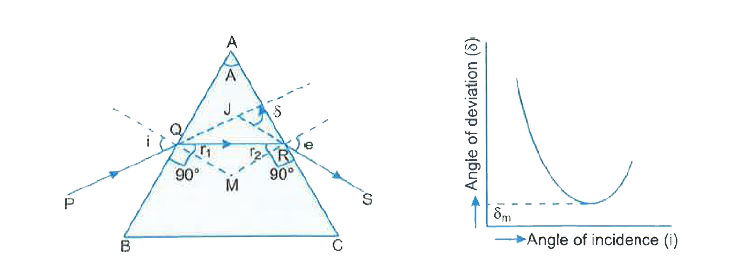 Comparing (i) and e(ii), we get `angler_(1) + angler_(2) = angleA ""...(III)` Now in `DeltaJQR angledelta=angleJQR+ angleJRQ` `=(anglei-angler_1)(anglee-angler_2)=angler+anglee-(angler_(1)+angler_(2))=anglei+anglee-angleA` `implies anglei+ anglee=angleA+angledelta""....(iv)` A graph showing variation in angle of deviation `(delta)` withvariation in angle of incidence (i)is also shown below . As minimum deviation position CORRESPONDS to only one angle of incidence, it means that for minimum deviation position `anglei=anglee` and also `angler_(1) = angler_(2) =r` (say) . So in minimum deviation position , we have `:. angleA=angler_(1) +angler_(2)=angler+angler=2angler " or "angler=(A/2)` and `angleA+angledelta_(m)=anglei+anglee=anglei+anglei=2anglei"or " anglei=((A+delta_m)/2)` `:.` Refractive of prism `n=(sini)/(sinr)=(SIN((A+delta_m)/2))/(sin(A/2))` (b) (i) Complete path of the ray through the prism has been traced. Since critical angle of prism is `i_(c) = sin^(-1)(1/(1.5))=42^@` , the light ray undergoes total internal REFLECTION two times as shown . 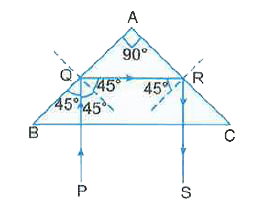 (ii) If refractive index of prism is n = 1.4 , then critical angle `i_(c)=sin^(-1)(1/(1.4)) = 45.6^@`. In that case the light ray will be refracted into air at point Q and deviates away from the normal as shown below . 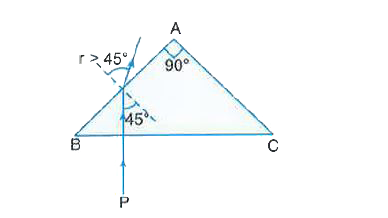
|
|
| 43643. |
In the circuit shown in the figure, each capacitor has a capacity of 3 mu F. The equivalent capacity between A and B is |
|
Answer» `3//4 MUF ` |
|
| 43644. |
A rifle bullet loses half of its velocity in penetrating 24 cm in a wooden plank. The further distance covered by the bullet in coming to rest is: |
|
Answer» 8 CM `(x_(1))/(x_(2))=([v^2-(v^2)/4])/([v^2/4-0])=3/4v^2xx4/v^2=3/1` `(x_(1))/(x_(2))=3/1implies (24)/(x_(2))=3/1implies x_(2)=8` cm. |
|
| 43645. |
An imaginaryy atom whose energy levels are shown here undergoes an Auger transition. This implies that the x-ray photon emitted during transition from L to K state is absorbed by another electron in M shell and it comes out of the atom. Calculate the initial energy of the Auger electron as in fig. |
| Answer» SOLUTION :`2.67xx10^(-15)J` | |
| 43646. |
The spherical shell has radius r. The potential difference V is between centre to distnnce 3r. The electric field at a distance 3r will be ........ |
|
Answer» `(V)/(6r)` `:. V= V_(1)-V_(2)` `= kq [(1)/(r) -(1)/(3r)]` `= kq[(2)/(3r)]` `:. (3Vr)/(2) = kq` 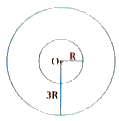 Now `E= (kq)/((3r)^(2))=(3Vr)/(2)xx(1)/(9R^(2))=(V)/(6r)` |
|
| 43647. |
If the earth shrinks such that its mass does not change but radius decreases to one quarter of its original value then one complete day will take. |
|
Answer» 96 h By the CONSERVATION of angular momentum `(2)/(3)" MR"^(2)(2pi)/(T)=(2)/(5)M((R )/(4))^(2)(2pi)/(T.)` `rArr T.=(T)/(16)=(24)/(16)=1.5`h |
|
| 43648. |
The apparent depth of water in cylindrical water tank of diameter 2R cm is reducing at the rate of x cm/minute when water drained out at a constant rate. The amount of watr drained in c.c. per minute in (n_(1)= refractive index of air n_(2)= refractive index of water) |
|
Answer» `x PI R^(2)n_(1)//n_(2)` |
|
| 43649. |
Position of particle is given by S = t^3 – 2t^2 + 5t + 4 (a) Find the position of particle at t = 1 sec (b) Find the first derivative of S at t = 1 sec (c) Find the second derivative of S t = 1 sec |
|
Answer» |
|
| 43650. |
Two resistances of 100 ohm and 200 ohm are connected in series with a battery of emf 4 volt and negligible internal resistance. A voltmeter of resistance 200 ohm is used to measure voltage across the two resistances separately. Calculate the voltage indicated. |
Answer» Solution : When the voltmeter is connected across `R_(1) (= 100Omega), 100 Omega` and voltmeter RESISTANCE `200Omega` will be in parallel resulting in `R_(1).=(R_(1)xxr)/((R_(1)+r))=(100xx200)/((100+200))=200/3Omega` Now, in the circuit this `R_(1).` is in series with `R_(2) ( = 200 Omega)` and in series potential divides in PROPORTION to resistance so potential difference across `R_(1).`, i.e., either `R_(1)` or voltmeter (as the two are in parallel) will be `V_(1).=(R_(1).)/((R_(1).+R_(2)))V=((200//3))/((200//3)+200)xx4=1` VOLT Similarly, if voltmeter is connected across `R_(2)(= 200Omega)` `R_(2).=(R_(2)xxr)/((R_(2)xxr))=(200xx200)/((200+200))=100Omega` So that, `V_(2).=(R_(2).)/((R_(2).+R_(1)))V=100/((100+100))xx4=2` volt |
|