Saved Bookmarks
This section includes 7 InterviewSolutions, each offering curated multiple-choice questions to sharpen your Current Affairs knowledge and support exam preparation. Choose a topic below to get started.
| 1. |
Additionof water to 3-methylbut-1-ene in the presence of dil. H_(2)SO_(4) gives mainly |
|
Answer» 3-Methylbutan-1-ol `CH_(3)-underset((2^(@)))(underset(CH_(3))underset(|)(CH))-overset(+)(CH)=CH_(3)overset("Hydride SHIFT")rarr` `CH_(3)-underset(3^(@))underset(CH_(3))underset(|)overset(+)(C)-CH_(2)-CH_(3)overset(OH^(-))rarrunderset("2-Methylbutan-2-ol")(CH_(3)-underset(CH_(3))underset(|)overset(OH)overset(|)(C)-CH_(2)-CH_(3))` |
|
| 2. |
Addition of surface to water leads . |
|
Answer» An increase in ANGLE of contact |
|
| 3. |
Addition of sulphuric acid in alkene and addition of sulphuric acid in alkene with addition reaction. |
|
Answer» SOLUTION :Dissociation of sulphuric acid `(H_(2)SO_(4) hArr H^(DELTA+)O^(delta-)SO_(3)H)` fragement are `H^(delta+)` and `HSO_(4)^(-)` or `""^(-)OSO_(3)H` positive and negative radicals on `pi`-bond as per Markovnikov rule electrophilic ADDITION reaction. (i) `H_(2)SO_(4) rarr overset(+)(H)+bar(O)SO_(2)OH`  (ii) Propene is reacted with`H_(2)SO_(4)` where `overset(+)(H)` is electrophilic species. More stable carbocation `CH_(3)overset(+)(C)HCH_(3)` is formed first, negative part hydrogen sulfate, is added as addition product and formed ISOPROPYL hydrogen sulphare.  This reaction occurs at normal temperature and ractants are added in ratio 1:1 and formation of alkyl hydrogen sulpare. |
|
| 4. |
Addition of sodium hydroxide solution to a weak acid (HA) results in a buffer of pH 6 . If ionisation constant of HA is 10^(-5) , the ratio of salt to acid concentration in the buffer solution will be |
|
Answer» `10 : 1` |
|
| 5. |
Addition of phposphate and nitrate/feticlizers in to water leads to |
|
Answer» Increased GROWTH of decomposers |
|
| 6. |
Addition of ozone to acetylene gives a product which is |
|
Answer» monocyclic |
|
| 7. |
Addition of phosphate fertilizers into water leads to |
|
Answer» Increased growth of DECOMPOSERS |
|
| 8. |
Addition of mineral acid to an aqueous solution of borax, the following compound is formed : |
|
Answer» boron hydride `Na_(2)B_(4)O_(7) +H_(2)SO_(4) rarr underset(" Orthoboric acid ") (4H_(3)BO_(3)) + Na_(2)SO_(4)` |
|
| 9. |
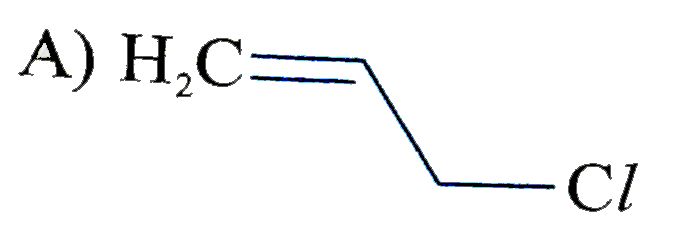
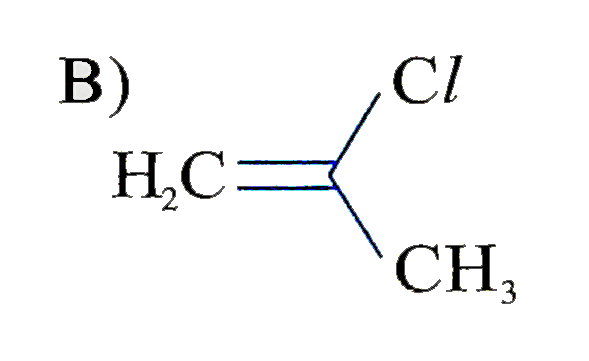
Addition of HX on alkene proceed through formation of carbocation . This reaction is follows Markovnikov's rule. According to markovnikov's rule addition of electrophile occurs on that carbon of alkene which have more number of -H atom Ph-CH = CH_2 underset(HX)to underset("(major)")(Ph-overset(x)overset(|)CH-CH_3) + underset("(minor)")(Ph-CH_2-CH_2-X) Which of the following alkenes will give markovnikov's reaction ? |
|
Answer» `F_3 C - CH =CH_2 OVERSET(HCL)to` B) `H_3^(oplus)N - CH - CH_2 overset(HCl)to H_3overset(oplus)N -CH_2 - Cl`. Because `NH_3 -CH-CH_3` unstable due to powerful - I effect of `NH_3` group C) `NO_2 - CH - CH_2 NO_2 - CH_2 - Br ` Because `NO_2 - overset(oplus)CH_2 - CH_3` is unstabledue to -I effect to `NO_2` group D)  is more STABLE I effect `-CH_3` groups and .9. hypen conjugative structures |
|
| 10. |
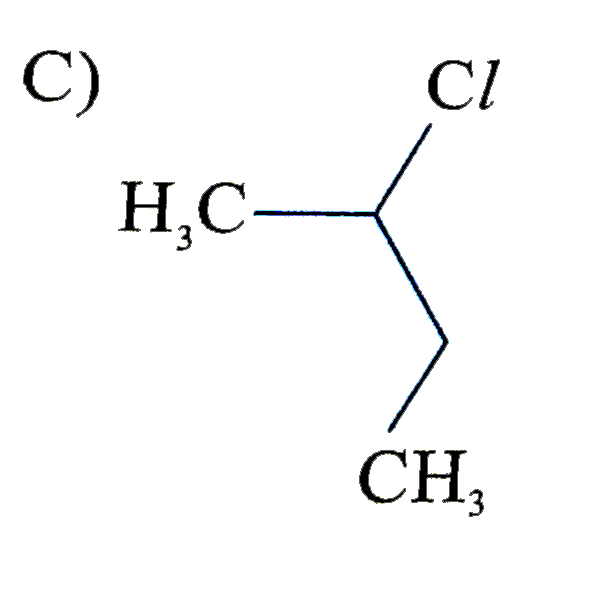
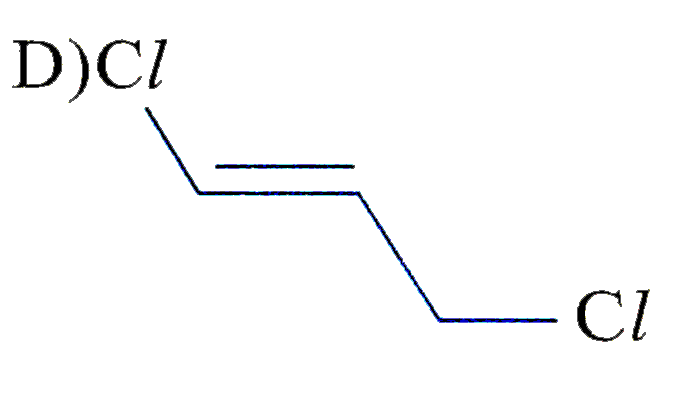
Addition of HX on alkene proceed through formation of carbocation . This reaction is follows Markovnikov's rule. According to markovnikov's rule addition of electrophile occurs on that carbon of alkene which have more number of -H atom Ph-CH = CH_2 underset(HX)to underset("(major)")(Ph-overset(x)overset(|)CH-CH_3) + underset("(minor)")(Ph-CH_2-CH_2-X) Which of the following alkenes can produce diastereomers |
|
Answer» `CH_3-CH=CH-CH_3` A) Is not optically active B) is not optically active C) Is optically active D) Is not optically active 
|
|
| 11. |
Addition of HOCl to allyl alcohol gives |
|
Answer» 2-Chloropropane-1, 3-diol 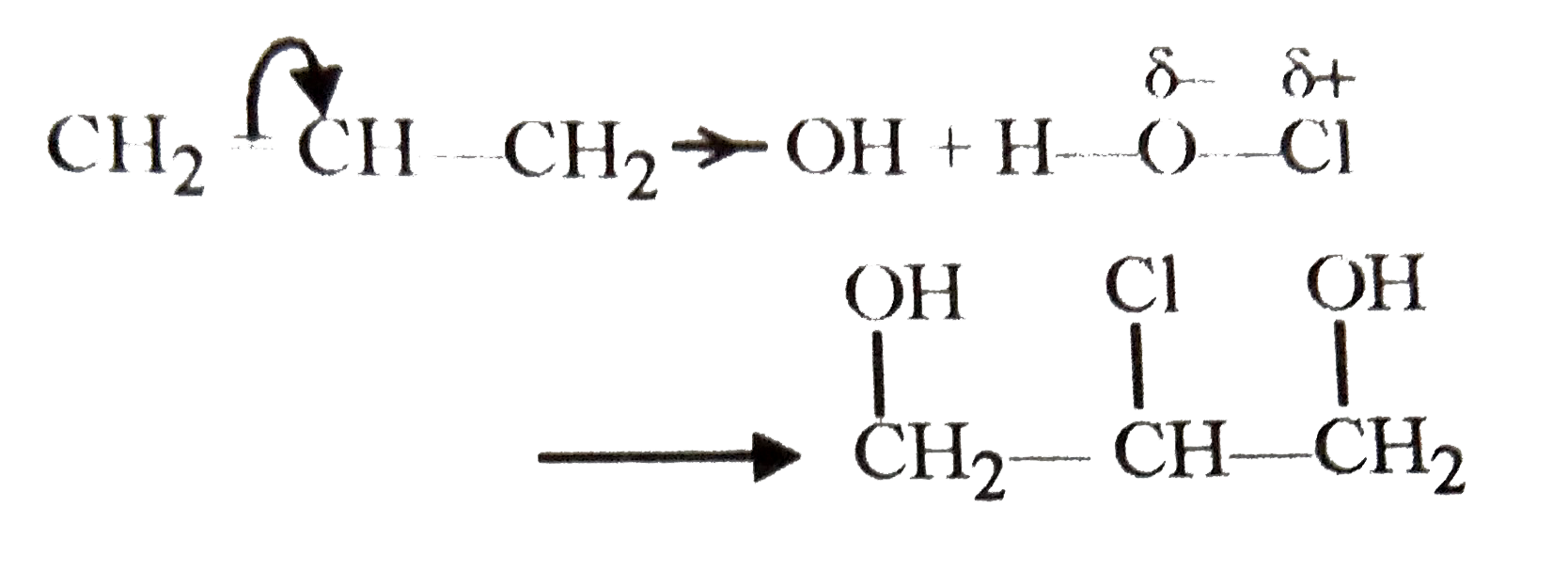
|
|
| 12. |
Addition of HBr to propene yields 2-bromopropane, while inpresence of benzoyl peroxide, the same reaction yields 1-bromopropane. Explain and give mechanism. |
Answer» SOLUTION :Addition of HBr to propene is an ionic electrophilic addition REACTION in which the electrophile, i.e., `H^+` first ADDS to give a more stable `2^@` carbocation. In the 2nd second, the carbocation is rapidly attacked by the nucleophile `Br^-` ION to give 2-bromopropane 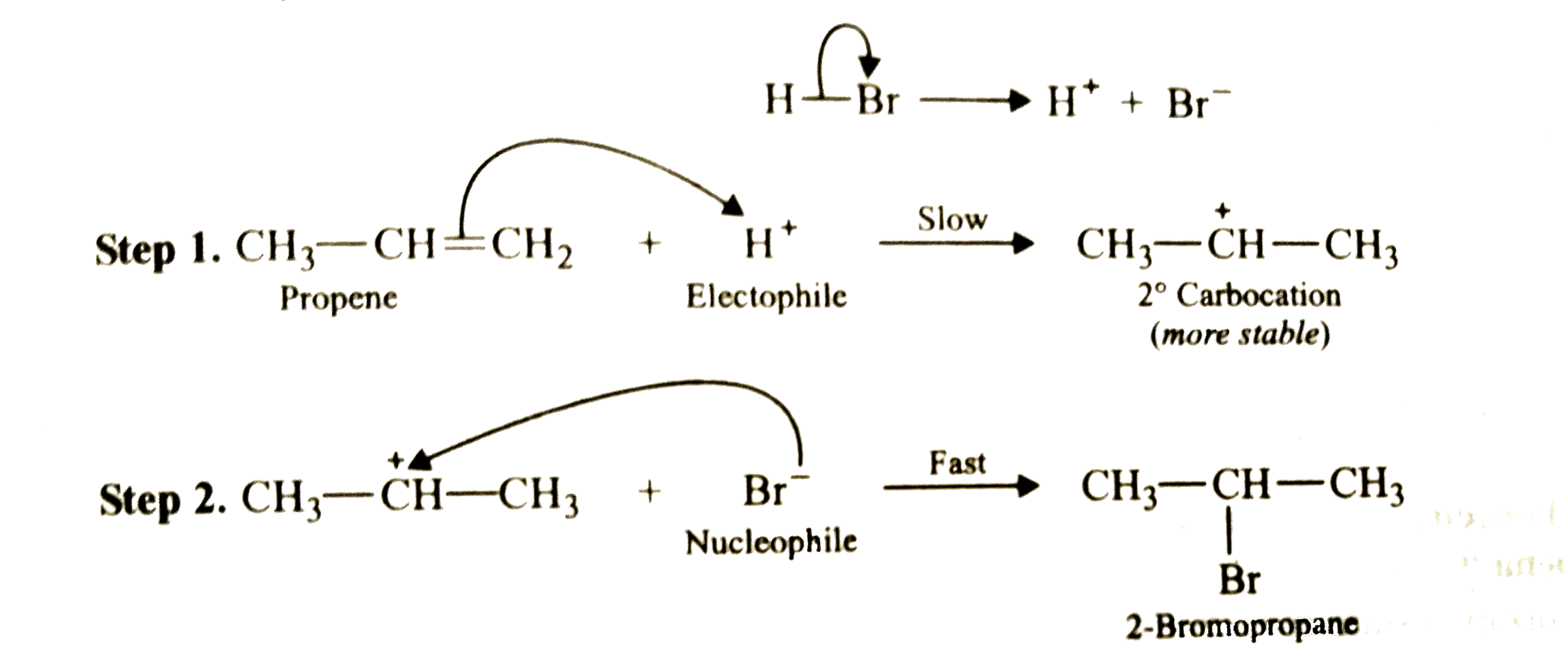 In presence of benzoyl peroxide , the reaction is still electrophilic but the electrophile here is a `oversetdot(Br)` free radical which is obtained by the action of benzoyl peroxide on HBr 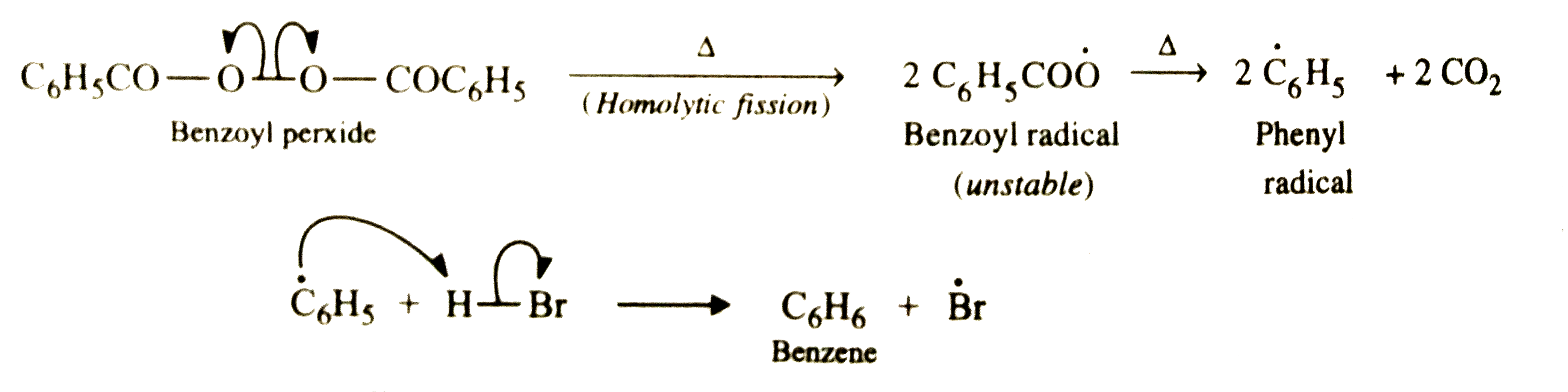 In the first step, `oversetdot(Br)` radical adds to propene in such a way as to generate a more stable `2^@` radical . In the second step, the free radical thus obtained rapidly abstracts a hydrogen atom from HBr to give 1-bromopropane. 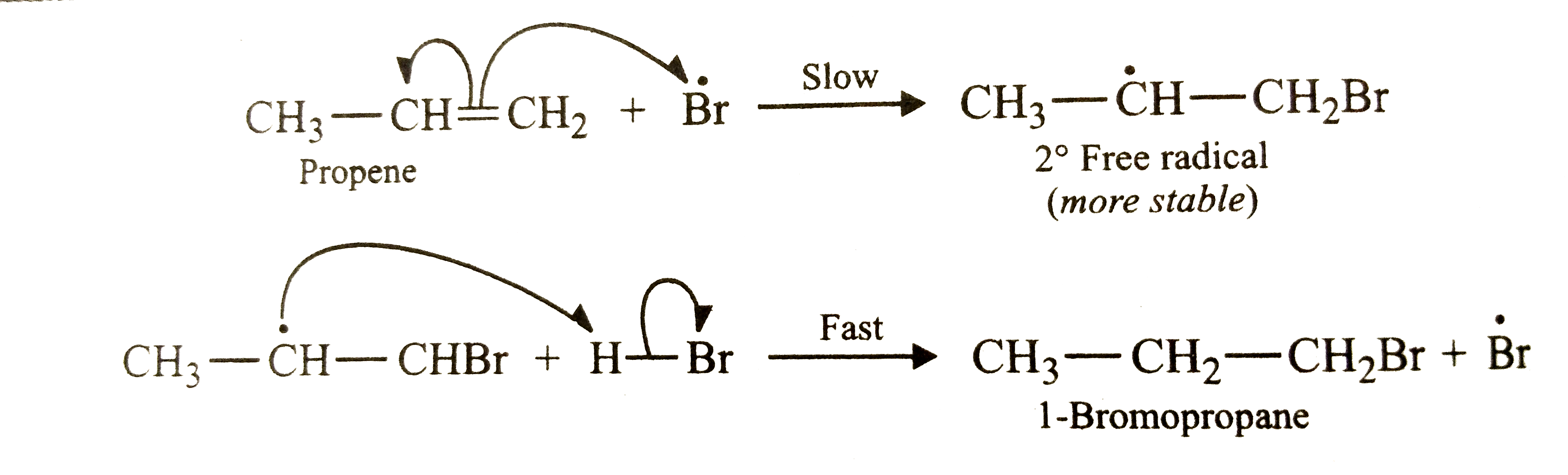 it is evident that although both reactions (i.e., in presence or absence of benzoyl peroxide ) are electrophilic addition but it is due to different order or sequence of addition of H and Br atoms which gives different PRODUCTS. |
|
| 13. |
Addition of HBr to propene yields 2-bromopropane, while in the presence of benzoyl peroxide, the same reaction yields 1-bromopropane. Explain and give mechanism. |
| Answer» SOLUTION :ADDITION to UNSYMMETRICAL ALKENES. | |
| 14. |
Addition of HBr to propene yields 2-bromo-propene, while in the presence of benzoyl peroxide, the same reaction yields 1-bromo-propane. Explain and give mechanism. |
|
Answer» SOLUTION :(a) Addition to HBR to propene, yields 2-bromo-propane and it is electrophilic addition reaction. (B) Addition to Hbr to propene in PRESENCE of peroxide, forms 1-bromopropane, it is free-radical addition reaction. |
|
| 15. |
Addition of HBr to propene gives 2 - bromo propane, this reaction is intiated by |
|
Answer» `H^(o+)`<BR>`Br^(-)` |
|
| 16. |
Addition of HBr to 2-butene gives two products while that of HBr to 1-buane gives three products . Explain why ? |
Answer» SOLUTION :Addition of HBr to 2-butene gives 2-bromobutane which being a chiral molecule EXISTS as two STEREOISOMERS ( I and II) .<BR> 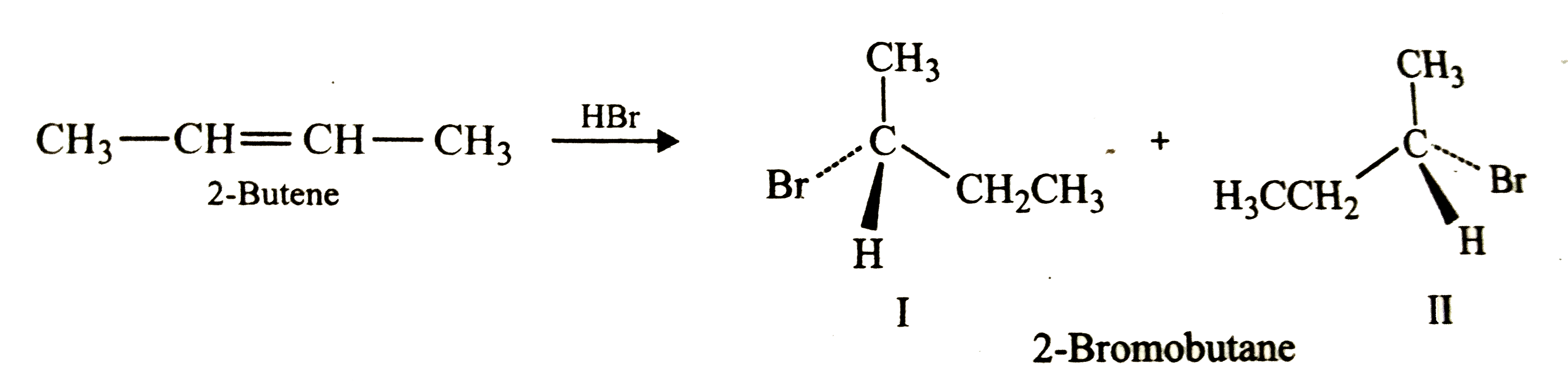 In contrast, 1-butene is an unsymmetrical molecule, therefore , it gives two products, i.e., 2-bromobutane (major product ) and 1-bromobutane (minor product). Since 2-bromobutane is a chiral molecule, it exists as two stereoisomers (I+II) as shown below above . While 1-bromobutane being a achiral molecule exists as such (III). `underset"1-Butene"(CH_3-CH_2-CH=CH_2) overset"HBr"to underset"I+II"(CH_3-CH_2-undersetunderset(Br)|overset**CH-CH_3)+underset"III"(CH_3CH_2CH_2CH_2-Br)` Thus, in all three products (I, II and III ) are FORMED. |
|
| 17. |
Addition of HBr to 2-pentene gives |
|
Answer» 2-bromopentane only 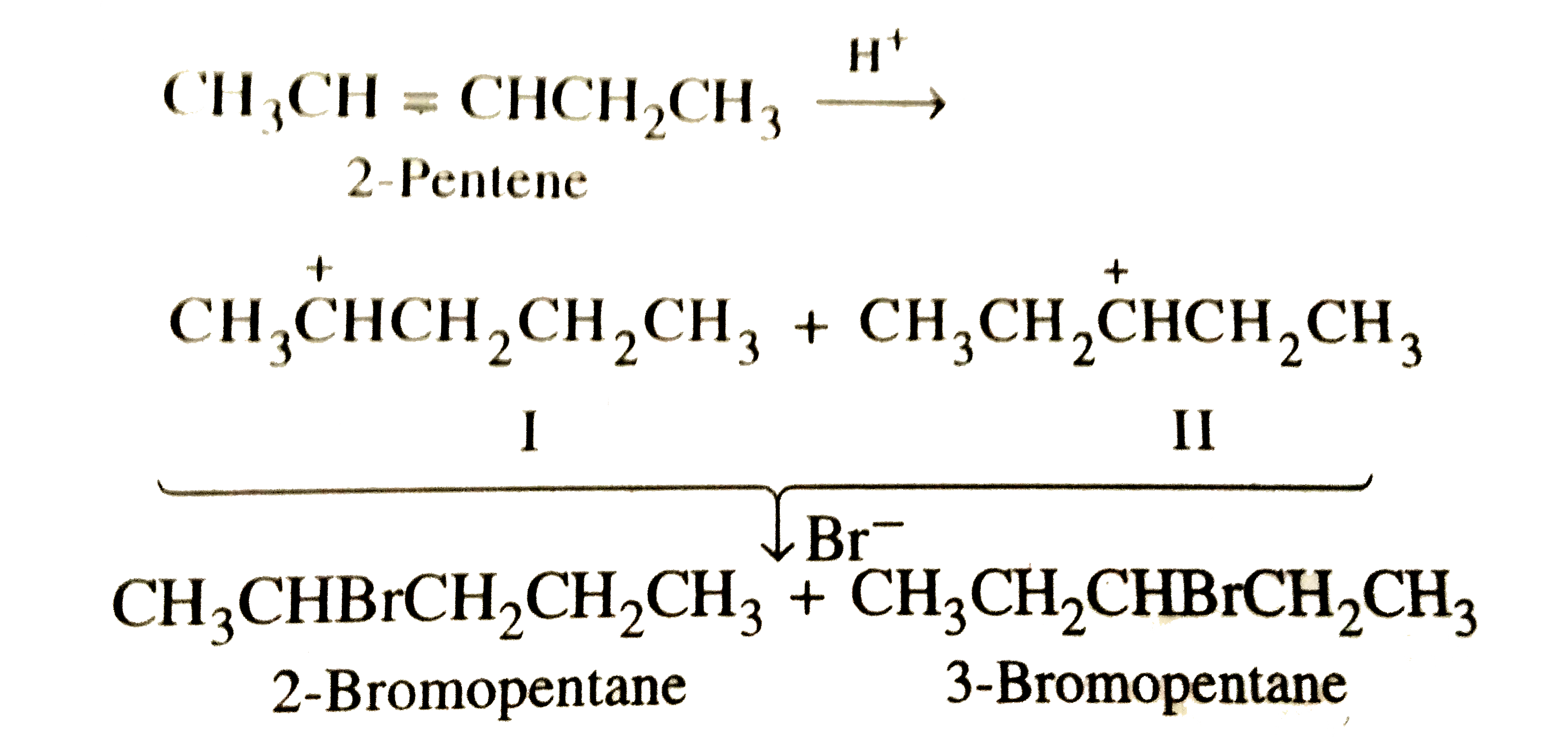 which are almost equally stable since CARBOCATION (I) is stabilized by five (3+2) HYPERCONJUGATION structures and carbocation (II) is stabilized by FOUR (2+2) hyperconjugation structures . Therefore , nucleophilic ATTACK on these gives the coresponding bromoalkanes in almost equal amounts . Of course , the yield of 2-bromopentane will be slightly more than that of 3-bromopentane. |
|
| 18. |
Addition of H_(2)O into alkene. |
|
Answer» SOLUTION :`H_(2)O` means `overset(+delta)(H) overset(-delta)(OH)`. Alkene reacts with `H_(2)SO_(4)`, an addition of `H_(2)O, -OH` (alcohol) is formed. This reaction is addition of `H_(2)O` or dydrolysis of alkene or FORMATION of alocohol from alkene. This reaction is electrophilic addition reaction. markonikov rule is applied. `underset("Ethene")(CH_(2)=CH_(2))+H_(2)O underset((H_(2)SO_(4)))overset(100^(@)C H^(+), Delta)rarr underset("ETHANOL")(CH_(3)-CH_(2)OH)` `underset("PROPENE")(CH_(3)CH=CH_(2))+H_(2)O underset(H_(2)SO_(4))overset(373 K H^(+))rarr underset("Propane-2-ol")(CH_(3)-underset(OH)underset(|)(CH)-CH_(3))` `underset("2-Methyl prepene")(CH_(3)-underset(CH_(3))underset(|)(C)=CH_(2)+H_(2)O)underset(H_(2)SO_(4))overset(H^(+))rarr underset("2-Methyl prepane-2-ol")(CH_(3)-underset(CH_(3))underset(|)overset(OH)overset(|)(C)-CH_(3))` |
|
| 19. |
Addition of H_2 to 2-butyne in presence of Lindlar's catalyst . Gives cis-2-butene while with Na/in liq. NH_3 gives trans-2-butene.Why so ? Explain. |
|
Answer» Solution :In presence of Lindlar's catalyst (Pd deposited over `BaSO_4` and partially POISONED by addition of S or quinoline), `H_2` gets first absorbed over the catalyst as H atoms and then transferred to the same face of 2-butyne giving cis-2-butene. HOWEVER, in CASE of Na in liquid `NH_3`, (Birch REDUCTION), the reduction OCCURS through two electron transfers and two proton transfer giving trans-2-butene . |
|
| 20. |
Addition of catalyst in a system |
|
Answer» INCREASES equilibrium CONCENTRATIONS |
|
| 21. |
Addition of bromine to cis-3 hexene gives |
|
Answer» RACEMIC dibromide |
|
| 22. |
Addition of bromine to buta-1,3- diene gives |
|
Answer» 1,2- ADDITION product only 
|
|
| 23. |
Addition of BrC CI_(3) to propene in the presence of peroxides gives 3-bromo-1, 1, 1-trichloro-2-methylpropane. |
| Answer» SOLUTION :False: `CH_(3)CH=CH_(2) underset(ROOR)overset(BrC Cl_(3)) underset("2-Bromo-1, 1, 1-trichlorobutane")(CH_(3)underset(BR)underset(|)CH-CH_(2)C Cl_(3))` | |
| 24. |
Addition of Br, takes place redily with |
|
Answer» `CH_(2)=CH_(2)` |
|
| 25. |
Addition of I mole of N_(2) is made to an equilibrium mixture of PCl_(5) in a piston fittcd cylinder. Which of the following is correct. |
|
Answer» No effect on equilibrium constant `K_c` or `K_p` |
|
| 27. |
Add : (i) 93.4 + 4.03 (ii) 77.86, 14.12 and 5.7 |
|
Answer» The CORRECT ANSWER is 97.4 (Digit 3 is to be DELETED) (ii) Add : `{:(77.86),(14.12),(" 5.7"),(bar(97.68)):}` The correct answer is 97.7 (Digit 6 has been ROUNDED off to 7) |
|
| 28. |
Add 6.65xx10^(4) and 8.95xx10^(3). |
|
Answer» SOLUTION :Exponent is MADE same for the both NUMBERS `6.65 XX 10^(4) +0.895 xx 10^(4)=7.545 xx 10^(4)` |
|
| 29. |
Add 18.11, 12.0 and 2.021 and report the result in significant figures. |
|
Answer» SOLUTION :18.11+12.0+2.021 = 32.131 Here, 12.0 has ONE digit after the decimal POINT and the result should be REPORTED only up to one digit after decimal point. Hence round off the result to 32.1 NUMBER of significant figures is 3 |
|
| 30. |
Adam's catalyst is |
|
Answer» Platinum |
|
| 31. |
Adamantive is the crystalline form of |
|
Answer» Aluminium |
|
| 32. |
Acyl halide is formed by reacting PCl_(5) with |
|
Answer» Alcohol |
|
| 33. |
Active species involved in the process C_6H_6 rarr C_6 H_5SO_3H is |
|
Answer» `SO_3` |
|
| 34. |
Active mass of 5.6 lit N_2 at STP |
|
Answer» 22.4M |
|
| 35. |
Active mass of 0.64g SO_(2) in 10 lit vessel is |
|
Answer» `10^(-2)` M |
|
| 36. |
Action of water or dilute mineral acids on metals can give..... |
|
Answer» MONO hydrogen |
|
| 37. |
Action of nitrous acid on ethylamine gives |
|
Answer» `C_(2)H_(6)` |
|
| 38. |
Action of caustic acid soda on aluminium hydroxide gives a compound having formula |
|
Answer» `Al_(2)(OH)_(4)` |
|
| 39. |
Action of acetylene on dilute H_(2)SO_(4)gives |
|
Answer» ACETIC acid |
|
| 40. |
Action of a heterogeneous catalyst depends upon |
|
Answer» mass |
|
| 41. |
Across theperiod , Ionisation energy _________ |
|
Answer» increases |
|
| 42. |
Acidity or alkalinity of a solution depend upon the concentration of hydrogen ion relative to that of hydroxyl ions. The product of hydrogen ion & hydroxyl ion concentration is given by K_(w) = [H^(+)][OH^(-)] the valueof which depends only on the temperature & not on the individual ionic concentration. If the concentratoin of hydrogen ions exceeds that of the hydroxyl ions, the solution is said to be acidic, whereas, if concentrations of hydroxyl ion exceeds that of the hydrogen ions, the solution is said to be alkaline. The pH corresponding to the acidic and alkaline solutions at 25^(@)C will be less than and greter than seven, respectively. To confirm the above facts 0.5 M CH_(3)COOH is taken fro the experiments. [Given : K_(a) of acetic acid = 1.8 xx 10^(-5)] To what volume at 25^(@)C must 1 dm^(3) of this solution be diluted in order to double the pH |
|
Answer» `3.37 XX 10^(4) DM^(3)` Amount of water to be added `= V_(2) - V_(1)` |
|
| 43. |
Acidity or alkalinity of a solution depend upon the concentration of hydrogen ion relative to that of hydroxyl ions. The product of hydrogen ion & hydroxyl ion concentration is given by K_(w) = [H^(+)][OH^(-)] the valueof which depends only on the temperature & not on the individual ionic concentration. If the concentratoin of hydrogen ions exceeds that of the hydroxyl ions, the solution is said to be acidic, whereas, if concentrations of hydroxyl ion exceeds that of the hydrogen ions, the solution is said to be alkaline. The pH corresponding to the acidic and alkaline solutions at 25^(@)C will be less than and greter than seven, respectively. To confirm the above facts 0.5 M CH_(3)COOH is taken fro the experiments. [Given : K_(a) of acetic acid = 1.8 xx 10^(-5)] pH of the solution will be:- |
|
Answer» `2.52` `k_(a) = 1.8 XX 10^(-5)` `c = 5 xx 10^(-1) M` `:. [H^(+)] = sqrt(1.8 xx 10^(-5) xx 5 xx 10^(-2)) = sqrt(9 xx 10^(-6)) = 3 xx 10^(-3)` |
|
| 44. |
Acidity of phenol was explained by ..... |
|
Answer» I EFFECT |
|
| 46. |
Acidity of BF_3 can be explained on the basis of which of the following concepts ? |
|
Answer» Arrhenius concept |
|
| 47. |
Acidity of BF_(3) can be explained on the basis of which of the following concepts? |
|
Answer» ARRHENIUS concept |
|
| 48. |
Acidity of acetylene, water and ammonia decreases in the order _______ |
|
Answer» |
|
| 49. |
Acidified solution of chromic acid on treatment with H_2O_2 yields. |
|
Answer» `CrO_3+H_2O+O_2` |
|
| 50. |
Acidified KMnO_(4) oxidizes acid to CO_(2). What is the volume ( in litre) of 10^(-4) M KMnO_(4) required to completely oxidize 0.5 litre of 10^(-2) M oxalic acid in acid medium ? |
|
Answer» 125 `(M_(1)V_(1))/(n_(1))(KMnO_(4))=(M_(2)V_(2))/(n_(2)){:((COOH,),(|"",),(COOH,)):}` `(10^(-4)xxV_(1))/(2)=(10^(-2)xx0.5)/(5)` `V_(1)=20 L` |
|