Saved Bookmarks
This section includes 7 InterviewSolutions, each offering curated multiple-choice questions to sharpen your Current Affairs knowledge and support exam preparation. Choose a topic below to get started.
| 1. |
Acidified Acidified K_(2)Cr_(2)O_(7) solution turns green when Na_(2)SO_(3) is added it this is due to the formation of |
|
Answer» `Cr_(2)(SO_(4))_(3)` |
|
| 2. |
Acidic potessium dichromate oxidises 2-Butene to |
|
Answer» butan-2-one |
|
| 3. |
Acidic nature of the similar oxides of a group from top to bottom |
|
Answer» INCREASES |
|
| 4. |
Acidic hydrolysis of acetamide gives |
|
Answer» Acetaldehyde |
|
| 6. |
Acidrainis causedby thepresence of X andY in air . X, Yrespectively |
|
Answer» `NO_2` |
|
| 7. |
Acid rain is known to contain some acids.Name these acids and where from they come in rain ? |
|
Answer» Solution :Acid rain contains `H_2 CO_3, HNO_3 and H_2 SO_4` . `H_2 CO_3` is formed by the dissolution of `CO_2` of the air in which the water vapour present. `CO_2 + H_2 O to H_2 CO_3` Forest fire and lightning are the natural are the natural source of NITRIC oxide (NO) . Nitrogen oxides are also produced by combustion engines , aircraft , furnaces , incinerators , industrial PLANTS . Nitric oxide slowly reacts with atmospheric AIRAND produce `NO_2 . NO_2` dissolves in water to form `HNO_3`. `3NO_2 + H_2 O hArr 2HNO_3 + NO` SULPHUR oxides are produced by the burning of fossil fuels and in extraction of metals from their sulphide ORES etc. Sulphur dioxide also produces sulphuric acid in the similar way. `SO_2+ O_2 + H_2 O underset("Metal oxide")overset("Soot particles")to H_2 SO_4 + [O]` |
|
| 8. |
Acid rain is known to contain some acids. Name these acids and where from they come in rain ? |
| Answer» Solution :Acid rain contains `H_2SO_4, HNO_3` and `H_2CO_3` (ALONG with SMALL amount of HCL acid). `H_2CO_3` is formed due to DISSOLUTION of `CO_2` of the AIR in water. `HNO_3` is formed by oxidation of nitric oxide (NO) present in the air to `NO_2` and `NO_3` and subsequent dissolution in water. `H_2SO_4` is formed by oxidation of `SO_2` present in the air to `SO_3` and then its dissolution in water | |
| 9. |
Acid rain contains ___ and_______ and has a pH of _____ |
|
Answer» |
|
| 10. |
Acid present in tomatoes is |
|
Answer» LACTIC acid |
|
| 12. |
Acid catalyzed hydrolysis of ethyl acetate by water is an example of ___________. |
|
Answer» HETEROGENEOUS catalysis |
|
| 13. |
Acid-catalysed hydration of alkenes except ethene leads to the formation of |
|
Answer» primary alcohol `underset"Ethene"(CH_2=CH_2)underset((ii)H_3O^+)overset((i)Conc. H_2SO_4)to underset"Ethanol"(CH_3CH_2OH)` `underset"Propene"(CH_3-CH=CH_2)underset((ii)H_3O^+)overset((i)Conc. H_2SO_4)to underset(2^@ "Alcohol")(CH_3-CHOH-CH_3)` `underset"2-Methylpropene"(CH_3-oversetoverset(CH_3)|C=CH_2)underset((ii)H_3O^+)overset(Conc. H_2SO_4)to underset(3^@ "Alcohol")((CH_3)_3COH)` Thus , either `2^@` or `3^@` alcohol is formed. |
|
| 14. |
Acid catalysed hydration of alkenes, except ethene, leads to the formation of |
|
Answer» primary alcohol `underset("Ethene")(CH_(2)=CH_(2))underset((ii) H_(2)O, "boil")overset((i) conc. H_(2)SO_(4))rarr underset(1^(@) "alcohol")(CH_(3)CH_(2)OH)` `R-CH=CH_(2)underset((ii) H_(2)O, "boil")overset((i) conc. H_(2)SO_(4))rarr underset(2^(@)"alcohol")(RCHOHCH_(2))` `R-overset(R')overset(|)(C)-CH_(2)underset((ii) H_(2)O, "boil")overset((i) conc. H_(2)SO_(4))rarr underset(3^(@) "alcohol")(R-underset(OH)underset(|)overset(R)overset(|)(C)=CH_(3))` |
|
| 15. |
Acid catalysed hydration of alkene is an example for |
|
Answer» free radical substitution |
|
| 16. |
Acid catalysed dehydration of 2-pentanol would give |
|
Answer» 1-pentene as a major PRODUCT |
|
| 17. |
Acid base theories are important to understand the role of many substances in different reactions. Different theories are in practice which have advantages as well as limitations at their level. We always consider most convenient theory under the given conditions. Which of the following is strong conjugate base |
|
Answer» `F^(-) ` <BR>` Cl^(-) ` |
|
| 18. |
Acid base theories are important to understand the role of many substances in different reactions. Different theories are in practice which have advantages as well as limitations at their level. We always consider most convenient theory under the given conditions. Which of the following is not Bronsted base |
|
Answer» `HS^(-) ` |
|
| 19. |
Acid base indicators are either weak organic acids or weak organic bases. Indicator change colour in dilute solution when the hydronium ion concentration reachesa particular value. For example, phenopthalein is a colour less substance in any aqueous solution with a pH less than 8.3 in between the pH range8.3 to 10, transaction of colour (colourless to pink) takes place and if pH of solution is greater than 10, then solution colour is dark pin. Considering an acid indicator HIn, base In^(-) can be represented as : HIn hArr H^(+) + In^(-) acidic form basic form pH of solution can be computed as : pH = pK_(In) + "log" ([In^(-)])/([HIn]) In general, transition of colour takes place in between the pH range pK_(In) +-1 If an indicator is to be used in an acid base titration having an equivalence point in pH range 8 to 10, the indicator must |
|
Answer» be a WEAK base |
|
| 20. |
Acid base indicators are either weak organic acids or weak organic bases. Indicator change colour in dilute solution when the hydronium ion concentration reachesa particular value. For example, phenopthalein is a colour less substance in any aqueous solution with a pH less than 8.3 in between the pH range8.3 to 10, transaction of colour (colourless to pink) takes place and if pH of solution is greater than 10, then solution colour is dark pin. Considering an acid indicator HIn, base In^(-) can be represented as : HIn hArr H^(+) + In^(-) acidic form basic form pH of solution can be computed as : pH = pK_(In) + "log" ([In^(-)])/([HIn]) In general, transition of colour takes place in between the pH range pK_(In) +-1Which of the following indicator is most suitable for titration of HBr with strong base: |
|
Answer» PHENOLPHTHALEIN `(8.3 - 10)` |
|
| 21. |
Acid base theories are important to understand the role of many substances in different reactions. Different theories are in practice which have advantages as well as limitations at their level. We always consider most convenient theory under the given conditions. Which of the following is not Arrhenius acid |
|
Answer» `H_3PO_4` ` H_3BO_3 ` is a LEWIS ACID |
|
| 22. |
Acid base indicators are either weak organic acids or weak organic bases. Indicator change colour in dilute solution when the hydronium ion concentration reachesa particular value. For example, phenopthalein is a colour less substance in any aqueous solution with a pH less than 8.3 in between the pH range8.3 to 10, transaction of colour (colourless to pink) takes place and if pH of solution is greater than 10, then solution colour is dark pin. Considering an acid indicator HIn, base In^(-) can be represented as : HIn hArr H^(+) + In^(-) acidic form basic form pH of solution can be computed as : pH = pK_(In) + "log" ([In^(-)])/([HIn]) In general, transition of colour takes place in between the pH range pK_(In) +-1 The ionization constant of an indicator is 5 xx 10^(-5) at 25^(0)C. Its acid form is deep orange while its basic is yellow colour in aqeous solution. which of the following statement is true for this indicator |
|
Answer» The work range of the indicator is `3.3` to `5.3` |
|
| 23. |
Acid base indicators are either weak organic acids or weak organic bases. Indicator change colour in dilute solution when the hydronium ion concentration reachesa particular value. For example, phenopthalein is a colour less substance in any aqueous solution with a pH less than 8.3 in between the pH range8.3 to 10, transaction of colour (colourless to pink) takes place and if pH of solution is greater than 10, then solution colour is dark pin. Considering an acid indicator HIn, base In^(-) can be represented as : HIn hArr H^(+) + In^(-) acidic form basic form pH of solution can be computed as : pH = pK_(In) + "log" ([In^(-)])/([HIn]) In general, transition of colour takes place in between the pH range pK_(In) +-1 Select the correct statement among the following |
|
Answer» In the complete IONISATION of indicator its `pH = pK_(In)` |
|
| 24. |
Acid base indicators are either weak organic acids or weak organic bases. Indicator change colour in dilute solution when the hydronium ion concentration reachesa particular value. For example, phenopthalein is a colour less substance in any aqueous solution with a pH less than 8.3 in between the pH range8.3 to 10, transaction of colour (colourless to pink) takes place and if pH of solution is greater than 10, then solution colour is dark pin. Considering an acid indicator HIn, base In^(-) can be represented as : HIn hArr H^(+) + In^(-) acidic form basic form pH of solution can be computed as : pH = pK_(In) + "log" ([In^(-)])/([HIn]) In general, transition of colour takes place in between the pH range pK_(In) +-1 An indicator is a weak acid and pH range is 4.0 to 6.0. If indicator is 50% ionized in a given solution then what is ionization consatant of the acid? |
|
Answer» `10^(-4)` |
|
| 25. |
Acid acept electron pair in reaction, this according to which principle ? |
|
Answer» Arrhenious |
|
| 26. |
Acic base + Redox titration 1^(st)titration : M/10 reacts with oxalic acid as well as H_(2)SO_4according to equation H_(2)C_(2)O_4 + NaOH rarrNa_(2)C_(2)O_4 + H_(2)O, H_(2)SO_(4)) + NaOH rarr Na_(2)SO_(4) + H_(2)O 2^(nd)titration : The mixture solution is titrated with M/10KMnO_4 solution which will reacts with oxalic acid (redox titration) in the presence of H_(2)SO_(4) H_(2)C_(2)O_(4) + underset(("Purple"))(KMnO_4)+H_(2)SO_(4) rarr K_(2)SO_(4) +underset(("Colourless"))( MnSO_4)+H_2O+CO_2 The reactionof oxalic acid with KMnO_4is very slow therefore the oxalic acid solution is heated to 60-70^@Cinitially. Once the reation has started, its rate automatically increases. MnO_4^(-)acts as an oxidising agent. MnO_(4)^(-)overset(H^(+))rarrunderset("colourless")(Mn^(++),MnO_(4)^(--),MnO_(4) underset(H_2O)rarroverset("Brown ppt")(MnO_2) If 1.34 gm Na_(2)C_2O_4dissolve in 50 ml of water this solution is titrated with KMnO_4The volume of KMnO_4used is |
| Answer» Solution :USE `(V_1M_1)/(n_1) = (V_2M_2)/n_2` | |
| 27. |
Acic base + Redox titration 1^(st)titration : M/10 reacts with oxalic acid as well as H_(2)SO_4according to equation H_(2)C_(2)O_4 + NaOH rarrNa_(2)C_(2)O_4 + H_(2)O, H_(2)SO_(4)) + NaOH rarr Na_(2)SO_(4) + H_(2)O 2^(nd)titration : The mixture solution is titrated with M/10KMnO_4 solution which will reacts with oxalic acid (redox titration) in the presence of H_(2)SO_(4) H_(2)C_(2)O_(4) + underset(("Purple"))(KMnO_4)+H_(2)SO_(4) rarr K_(2)SO_(4) +underset(("Colourless"))( MnSO_4)+H_2O+CO_2 The reactionof oxalic acid with KMnO_4is very slow therefore the oxalic acid solution is heated to 60-70^@Cinitially. Once the reation has started, its rate automatically increases. MnO_4^(-)acts as an oxidising agent. MnO_(4)^(-)overset(H^(+))rarrunderset("colourless")(Mn^(++),MnO_(4)^(--),MnO_(4) underset(H_2O)rarroverset("Brown ppt")(MnO_2)Which statement is wrong? |
|
Answer» In NaOH titration phenolphthalein indicator will be suitable |
|
| 28. |
Acic base + Redox titration 1^(st)titration : M/10 reacts with oxalic acid as well as H_(2)SO_4according to equation H_(2)C_(2)O_4 + NaOH rarrNa_(2)C_(2)O_4 + H_(2)O, H_(2)SO_(4) + NaOH rarr Na_(2)SO_(4) + H_(2)O 2^(nd)titration : The mixture solution is titrated with M/10KMnO_4 solution which will reacts with oxalic acid (redox titration) in the presence of H_(2)SO_(4) H_(2)C_(2)O_(4) + underset(("Purple"))(KMnO_4)+H_(2)SO_(4) rarr K_(2)SO_(4) +underset(("Colourless"))( MnSO_4)+H_2O+CO_2 The reactionof oxalic acid with KMnO_4is very slow therefore the oxalic acid solution is heated to 60-70^@Cinitially. Once the reation has started, its rate automatically increases. MnO_4^(-)acts as an oxidising agent. MnO_(4)^(-)overset(H^(+))rarrunderset("colourless")(Mn^(++),MnO_(4)^(--),MnO_(4) underset(H_2O)rarroverset("Brown ppt")(MnO_2) In the permanganate titration, the solution of reductant is always made acidic by adding H_2SO_4rather than HCl or HNO_3because |
|
Answer» HCl is a reducing agent and it may get oxidised itself resulting into decrease in the volume of `KMnO_4`equivalent to the reducing agent under ESTIMATION. |
|
| 30. |
Acetylenic hydrogens are acidic because |
|
Answer» SIGMA electron density of C-H bond in acetylene is nearer to CARBON, which has 50% s-character. |
|
| 31. |
Acetylene upon ozonolysis gives |
|
Answer» |
|
| 32. |
Acetylene reacts with HCN in the presence of Ba(CN)_2 to yield |
|
Answer» 1, 1-dicyanoethane |
|
| 33. |
Acetylene reacts with ammonical AgNO_(3) forming |
|
Answer» SILVER acetylene |
|
| 34. |
Acetylene is used as an anaesthetic under the name of |
|
Answer» Narcylene |
|
| 35. |
Acetylene is treatedwith dilutehydrochloricacid inpresenceof HgCI_(2) |
Answer» Solution : Undertheseconditions additio of `H_(2)O` doesnot occuracrossthe doublebond.Instead`CI^(-)` beinga strongernucleophilethan `H_(2)O` , attacks the `PI`- complexformedbetweenacetylene and`HG^(2+)` ionsThisis FOLLOWED byaddition of aprotonto yieldvinylchlorideas shown below : 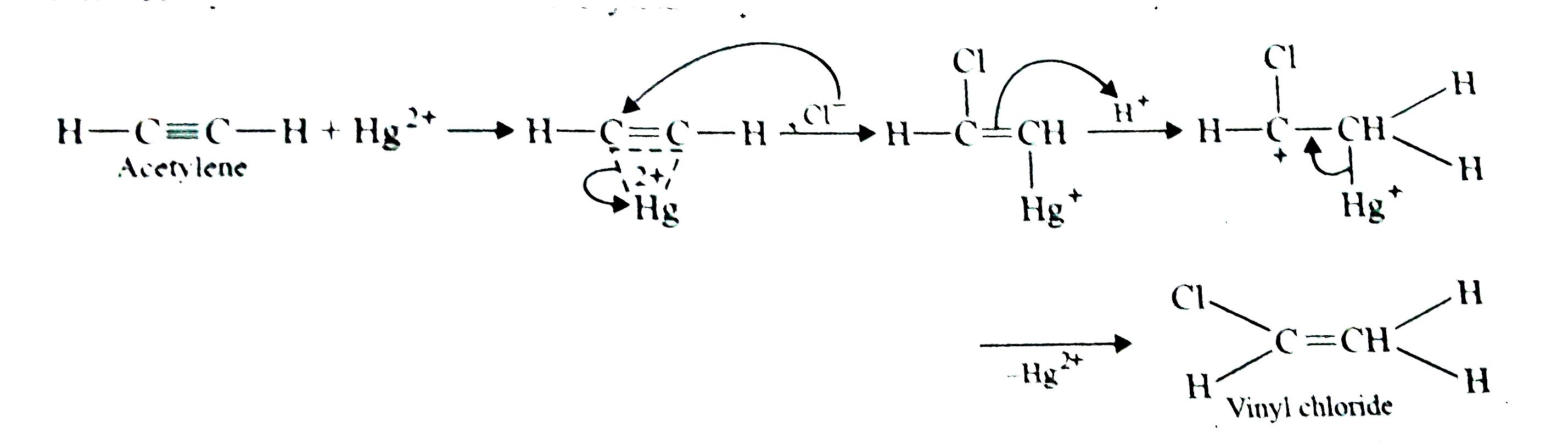
|
|
| 36. |
Acetylene is said to be acidic ? Does it mean that it turns blue litmus red ? |
| Answer» Solution : In organic chemistry, the TERM acidity is used in a wider SENSE. It implies that a particular hydrogen can be abstracted by a base which may be a very weak or a very strong base. ACETYLENE is a weak ACID EVEN weaker than `H_2O` and hence it does not turn blue litmus red. | |
| 37. |
Acetylene is produced by the action of water on |
|
Answer» `Be_(2)C` |
|
| 38. |
Acetylene is oxidised by permanganate in acidic solutions to liberate carbondioxide. |
|
Answer» Solution :a) The IONIC skeleton equation is written as `C_(2)H_(2)+MnO_(4)^(-)overset(H^(+))rarrCO_(2)+Mn^(2+)` b) Writing oxidation numbers `overset(-1)(C_(2))overset(+1)(H_(2))+overset(+7)(Mn)overset(-2)(O_(4)^(-))rarroverset(+4)(C)overset(-2)(O_(2))+overset(+2)(Mn^(+2))` c) Locating atoms undergoing change in oxidation numbers `overset(-1)(C_(2))H_(2)+overset(+7)(Mn)O_(4)^(-)rarroverset(+4)CO_(2)+overset(+2)(Mn^(+2))` d) Dividing the reaction into two two halves and balancing in acidic medium, separately Oxidation half - reaction : `C_(2)H_(2)rarrCO_(2)` Step : 1 Balance carbon atoms `_(2)H_(2)rarr2CO_(2)` Step 2 : Balance oxygen atoms `C_(2)H_(2)+4H_(2)Orarr2CO_(2)` Step 3 : Balance hydrogen atoms `C_(2)H_(2)+4H_(2)Krarr2CO_(2)+10H^(+)` Step 4 : Balance charge `C_(2)H_(2)+4H_(2)Orarr2CO_(2)+10H^(+)+10e^(-)".....(a)"` Reduction half - reaction : `MnO_(4)^(-)rarMn^(2+)` Step 1 : Balance oxygen atoms `MnO_(4)^(-)rarrMn^(2+)+4H_(2)O` Step 2 : Balance hydrogen atoms `MnO_(4^(-)+8H^(+)rarrMn^(2+)+4H_(2)O` Step3 : Balance charge `MnO_(4)^(-)+8H^(+)+5e^(-)rarr Mn^(2+)+4H_(2)O"...(b)"` e) Equalising the ELECTRON and ADDING the two halves `"eq(a) "xx1+"eq(b)"xx"2, we get"` `{:(C_(2)H_(2)+4H_(2)Orarr2CO_(2)+10H^(+)+10e^(-)),(2MnO_(4)^(-)+16H^(+)+10e^(-)rarr2Mn^(2+)+8H_(2)O),(bar(C_(2)H_(2)+2MnO_(4)^(-)+6H^(+)rarr"")),(""2CO_(2)+2Mn^(2+)+4H_(2)O):}` This is BALANCED equation. |
|
| 39. |
Acetylene is acidic but it does not react with sodium hydroxide or potassium hydroxide. Give reason. |
| Answer» Solution :Acetylene is very weak acid. The value of dissociation constant, K is NEAR about `10^(-25)`. Thus, it does not REACT with alkalies like NaOH or KOH, but reacts with very strong base like sodamide `(NaNH_(2))`. | |
| 40. |
Acetylene gives |
|
Answer» White precipitate with `AgNO_(3)` and red precipitate with `Cu_(2)Cl_(2)` `CH-=underset(("Ammonical"))(CH=CuCl_(2)) rarr CU -underset("Red ppt.")(C-=C-Cu)` |
|
| 41. |
Acetylene is a linear molecule. State true or false. |
|
Answer» |
|
| 42. |
Acetylene does not react with |
|
Answer» Na |
|
| 43. |
Acetylene can be prepared from |
|
Answer» POTASSIUM fumerate |
|
| 44. |
Acetylene can be obtained by the electrolysis of the following compound |
|
Answer» POTASSIUM fumerate |
|
| 45. |
Acetylene can be prepared from calcium carbonate by a series of reactions. The mass of 80% calcium carbonate required to prepare 2 moles of acetylene is |
|
Answer» 200g |
|
| 46. |
Acetophenone is obtained when |
|
Answer» BENZOYL chloride is treated with dimethylcadmium (C) `CH_(3)COCl + C_(6)H_(6) overset("ANHY". AlCl_(3))rarr C_(6)H_(5)COCH_(3) + HCl` |
|
| 47. |
Acetone will be obtained on ozonolysis of |
|
Answer» 1-pentene |
|
| 48. |
Acetone underset((ii)H_2O //H^(-1))overset((i) CH_3 Mgl)to X. X is ……………………… . |
|
Answer» 2-propanol |
|
| 49. |
acetone underset((ii)H_(2)O //H^(-))overset((i)CH_(3)MgI)toX, X is |
|
Answer» 2-propanol |
|
| 50. |
Acetone is the major product in : I) H_2C = C = CH_2 overset( overset(oplus)(H_3O))toII) H_3C - C -= overset(Hg^(+2)// H_2SO_4)to III) H_3C - C -= underset(H_2O_2// overset(Ɵ)(O)H) overset(BH_3, THF)to |
|
Answer» I |
|