Saved Bookmarks
This section includes 7 InterviewSolutions, each offering curated multiple-choice questions to sharpen your Current Affairs knowledge and support exam preparation. Choose a topic below to get started.
| 1. |
Draw the M.O diagram for oxygen molecule and calculate its bond order and show that O_(2) is paramagnetic. |
|
Answer» SOLUTION :(i) Electronic configuration of O atom is `1S^(2) 2s^(2) 2p^(4)` (ii) Electronic configuration of `O_(2)` molecule is `sigma 1s^(2) sigma^(**) 1s^(2) sigma^(**)2s^(2) sigma2p_(x)^(2) pi 2p_(y)^(2) pi2p_(z)^(2) pi^(**)2p_(y)^(1) pi^(**) 2p_(z)^(1)` (iii) Bond order `= (N_(b) - N_(a))/(2) = (10-6)/(2) =2` (iv) Molecule has two unpaired ELECTRONS, hence it is paramagnetic. 
|
|
| 2. |
Draw the M.O diagram for oxygen molecule calculate its bond order and show that O_(2) is paramagnetic. |
|
Answer» Solution :(i) ELECTRONIC configuration of O atom is `1s^(2)2s^(2)2p^(4)` (ii) Electronic configuration of `O_(2)` molecule is `sigma 1s^(2)" "sigma**1s^(2)" "sigma2s^(2)" "sigma**2s^(2)" "sigma2p_(x)^(2)" "pi2p_(Z)^(2)" "pi**2p_(y)^(1)" " pi**2p_(z)^(1)` (iii) Bond order `=(N_(B)-N_(a))/(2)=(10 - 6 )/(2)=2` (iv) Mole cule has two unpaired electrons, hence it is paramagnetic. |
|
| 3. |
Draw the MO diagram for acetylide ion C_(2)^(2-) and calculate its bond order. |
|
Answer» Solution :Acetylide ion, `C_(2)^(2-)` in ACETYLENE: `UNDERSET(1s^(2)" "2s^(2)" "2p^(4))(C)rarrunderset(1s^(2)" "2s^(2)" "2p^(2))(C^(2-)+2e)` Electronic configuration of `C_(2)^(2-)` ion is : `SIGMA 1s^(2) sigma **1s^(2)sigma1s^(2) pi2p_(x)^(2)pi2p_(y)^(2)` 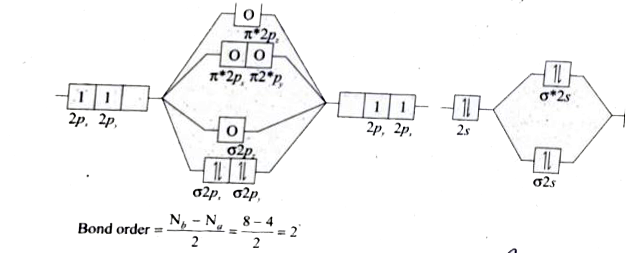 Bond order `= (N_(B)-N_(a))/(2)=(8-4)/(2)=2` |
|
| 4. |
Draw the MO diagram for acetylide ion C_(2)^(2-) and calculate its bond order . |
|
Answer» Solution :Acetylide ION `C_(2)^(2-)` in acetylide `CtoC^(2) + 2E^(-)` `1s^(2) 2s^(2) 2p^(4) "" 1s^(2)2s^(2) 2p^(2)` ELECTRONIC configuration of `C^(2-)` ion is : ` sigma_(1s)^(2) , sigma_(1s)^(**2) , sigma_(1s)^(2) , pi_(2p_(x))^(2), pi_(2p_(Z))^(2)`  Bond order `(N_(B) - N_(a))/2 = (8 - 4)/ 2 = 2` |
|
| 5. |
Drawthe Lewisstructures of the following molecules and ions and ions and tell in which case/casesthe octet rule is violatedCO_(2), SO_(2), BeCl_(2), NH_(3), AlCl_(3), PCl_(5), CO_(3)^(2-) |
Answer» Solution :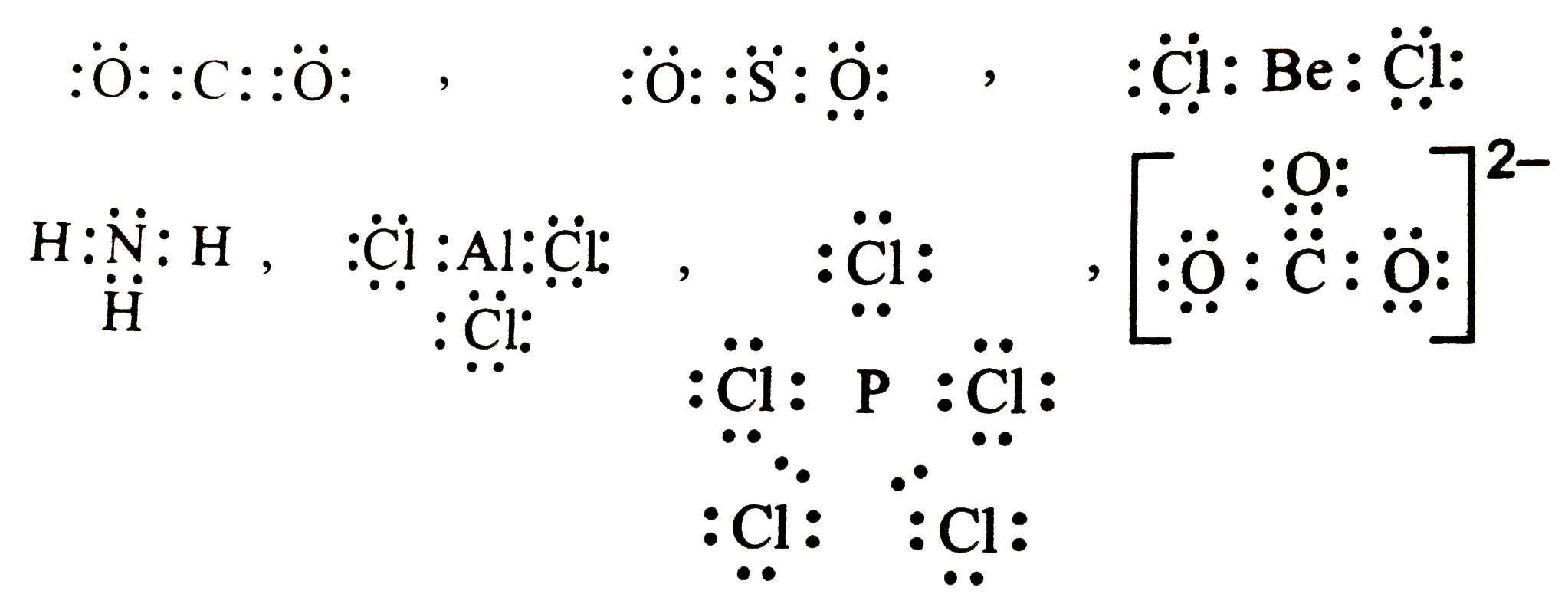 The OCTET RULE is violated in CASE of ` BeCl_(2), AlCl_(3) and PCl_(5)`. |
|
| 6. |
Draw the Lewis structures of the species : CN^(-), I_(3)^(-), C_(3) O_(2)(carbon suboxide), HN_(3) (hydrazonic acid ). |
|
Answer» Solution :(i) `CN^(-) [: C:::N:]^(-)` (ii) `I_(3)^(-) [:UNDERSET(. .)overset(. .)I-underset(. .)overset(. . . .)I-underset(. .)overset(. .)I:]^(-)underset("AcceptorDonor")(("":underset(. .)overset(. . )I-underset(. .)overset(. . )I:+:underset(. .)overset(. .)I:"")^(-)),i.e., [I-IlarrI]^(-)` (III) `C_(3) O_(2) [:overset(. .)O= C = C = C = overset(. . )O:]` (iv) `HN_(3) [ H-overset(. . )N=overset(+)N=underset(. .)overset(-)N: harr H-underset(. .)overset(-)overset(. .)N-overset(+)N-=N:]` |
|
| 8. |
Draw the Lewis structures for the following molecules and ions: H_2S,SiCl_4,BeF_2,CO_3^2, HCOOH |
Answer» SOLUTION :
|
|
| 9. |
Draw the Lewis structures for the following molecules and ions: H_(2)S, "SiCl"_(4), BeF_(2), CO_(3)^(2-), HCOOH |
Answer» SOLUTION :
|
|
| 10. |
Draw the lewis structures for the following molecules and ions: H_(2)S, SiCl_(4), BeF_(2), CO_(3)^(2-), HCOOH. |
Answer» SOLUTION :  . .
|
|
| 11. |
Draw the Lewis structures for the following molecules and ions : H_(2) S , SiCl_(4), BeF_(2) , CO_(3)^(2-) , HCOOH |
Answer» SOLUTION :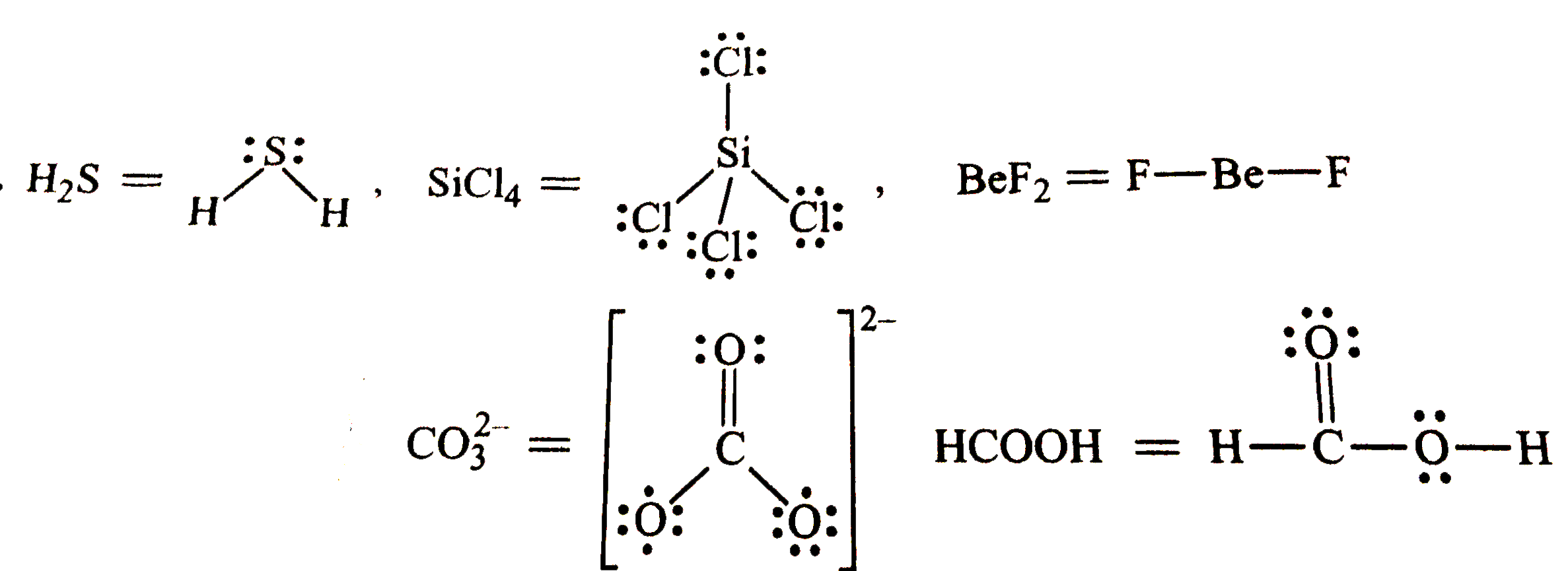
|
|
| 12. |
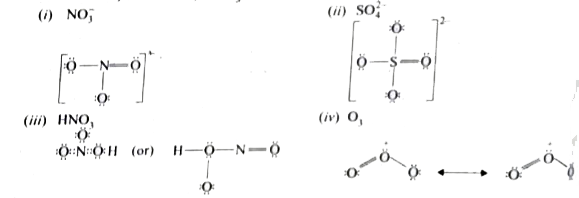
Draw the Lewis structures for the following. (i) SO_(4)^(2-) (ii)O_(3) |
Answer» SOLUTION : (i) `SO_(4)^(2-)`
|
|
| 13. |
Draw the lewis structures for (i) Nitrous acid (HN0_(2)) (ii) Phosphoric acid (iii) Sulphur troxide (SO_(3)) |
Answer» SOLUTION :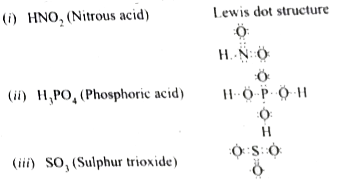
|
|
| 14. |
Draw the Lewis dot structures for sulphurtrioxide. |
Answer» SOLUTION :LEWIS DOT STRUCTURE for `SO_(3)` 
|
|
| 15. |
Draw the Lewis structure of N, C, O and He. |
|
Answer» Solution :`*underset(.)OVERSET(..)N*` Lewis Structure of Nitrogen atom Similarly , Lewis dot structure of carbon, oxygen can be drawn as shown below. `*underset(.)overset(.)C*""*underset(.)overset(..)O*` Lewis Structures of C & O atoms Only EXCEPTION to this is helium which has only two electrons in its VALENCE shell which is REPRESENTED as a pair of DOTS (duet) . `overset(..)He` Lewis Structures of He atoms |
|
| 16. |
Draw the lewis structure of (i) Nitrogen (ii) Carbon (iii) Oxygen. |
|
Answer» Solution :`*UNDERSET(*)OVERSET(* *)N*` Lewis structure of nitrogen ATOM `* underset(*)overset(*)C* *underset(*)overset(* *)O:` Lewis structure of C & O atoms |
|
| 17. |
Draw the lewis structure of (i) Ammonia (ii) Methane (iii) Dinitrogen pentoxide |
Answer» SOLUTION :
|
|
| 18. |
Draw the lewis structure of PCl_(5) and SF_(6) |
Answer» SOLUTION :
|
|
| 19. |
Draw the Lewis dot structure of HCNmolecule. |
|
Answer» Solution :Solution . STEP .1. Total NUMBER of valence electons in HCN = 1 + 4 + 5 = 10 `(""_(1)H= 1, ""_(6)C= 2 , 4,""_(7)N =2 ,5)` Step 2. Skeletal structure is HCN(C is least electronegative). Step 3. Putting ONE shared pair of electons between H and C and between C and N, and the remaining as LONE pairs, we have  In the structure, duplet of H is complete but octets of CAND N are not complete .Hence, multiple bonding is required between C and N. Octets of C and N will be complete if three is triple bond between C and N. Thus.  . .
|
|
| 20. |
Draw the Lewis dot structure ofCO_(3)^(2-) ion . |
|
Answer» Solution :Solution . Step .1 . Total number of valence electons of ` CO_(3)= 4 + 3 xx6 = 22 (""_(6)C= 2 ,4,""_(8)O= 2, 6)` Step 2 . Total number of electrons to be distributed in ` CO_(3)""^(2-) = 22 + 2 ` (for two units - ve charge) = 24 Step 3. The skeletal sturcture of ` CO_(2)` is `O OVERSET (O) C O` Step 4. Putting one SHARED pair of electrons between each C and O and completing the OCTETS of OXYGEN, we have 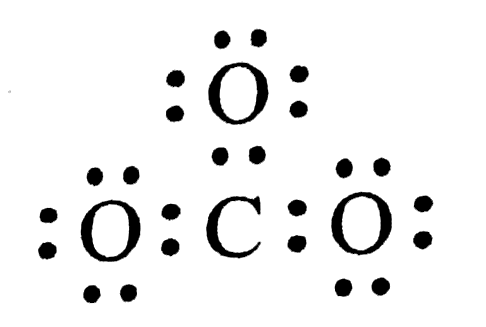 In this structure, octet of C is not complete. Hence, multiple bonding is required between C and one of the O- atoms, Drawing a double BOND between C and one O-atom serves the purpose `(PR_CHE_01_XI_C04_SLV_004_S02)` |
|
| 21. |
Draw the Lewis dot structure for the following . (i) SO_(3)""(ii) NH_(3)""(iii) CH_(4)""(iv) N_(2)O_(5)""(v) HNO_(3) |
Answer» SOLUTION :
|
|
| 22. |
Draw the Lewis dot structure of CO molecule. |
|
Answer» Solution :Solution. Stop . TOTAL number of valence electrons in ` CO = 4 + 6 = 10 (""_(6) C = 2, 4, ""_(6)C = 2, 4, ""_(8)O= 2, 6)` Step 2. Skeletal structure is CO. Step 3. PUTTING asingle bond between C and O, i.e., one shared pair of electrons between C and O, and the remaining 8 electrons as 3 long pairs on O to COMPLETE its octet and 1 lone pair on C, we have  Step 4. As in this structure , octet of C is not complete, MULTIPLE bonding is required between C and O . Toltbgt Complele the octet of C, triple bond is required between C and O . We should , therefore, shift two lone pairs on O as shared pairsbetween C and O so that sctet of both C and O remains comlete. thus , the structure should be  |
|
| 23. |
Draw the lewis structure for Sulphur troxide (SO_(3)) |
Answer» SOLUTION :SULPHUR troxide `(SO_(3))` 
|
|
| 24. |
Draw the hyperconjugation resonance structure of (a) CH_(3)CH= CH_(2) (b) CH_(3) overset(+)(C )H_(2) (c ) CH_(3)CH_(2) overset(+)(C )H_(2) |
| Answer» Solution :`H- UNDERSET(underset(H)(|))overset(overset(H)(|))(C )-underset(underset(H)(|))overset(overset(H)(|))(C )-underset(underset(H)(|))overset(+)(C )-H HARR H-underset(underset(H)(|))overset(overset(H)(|))(C )-underset(underset(H)(|))overset(H^(+))(C )= underset(underset(H)(|))(C )- H harr H- underset(underset(H)(|))overset(overset(H)(|))(C )- underset(H^(+))overset(overset(H)(|))(C )= underset(underset(H)(|))(C )- H` | |
| 25. |
Draw the lewis structure for Phosphoric acid |
Answer» SOLUTION :PHOSPHORIC acid `(H_(3)PO_(4))` : 
|
|
| 26. |
Draw the lewis structure for Nitrous acid (HNO_(2)) |
|
Answer» SOLUTION :Nitrous ACID `(HNO_(2))` : Lwis DOT structure 
|
|
| 27. |
Draw the geometrical isomers of above compound. |
Answer» SOLUTION :
|
|
| 28. |
Draw the formulae of the following compounds and write their IUPAC names : |
Answer» SOLUTION :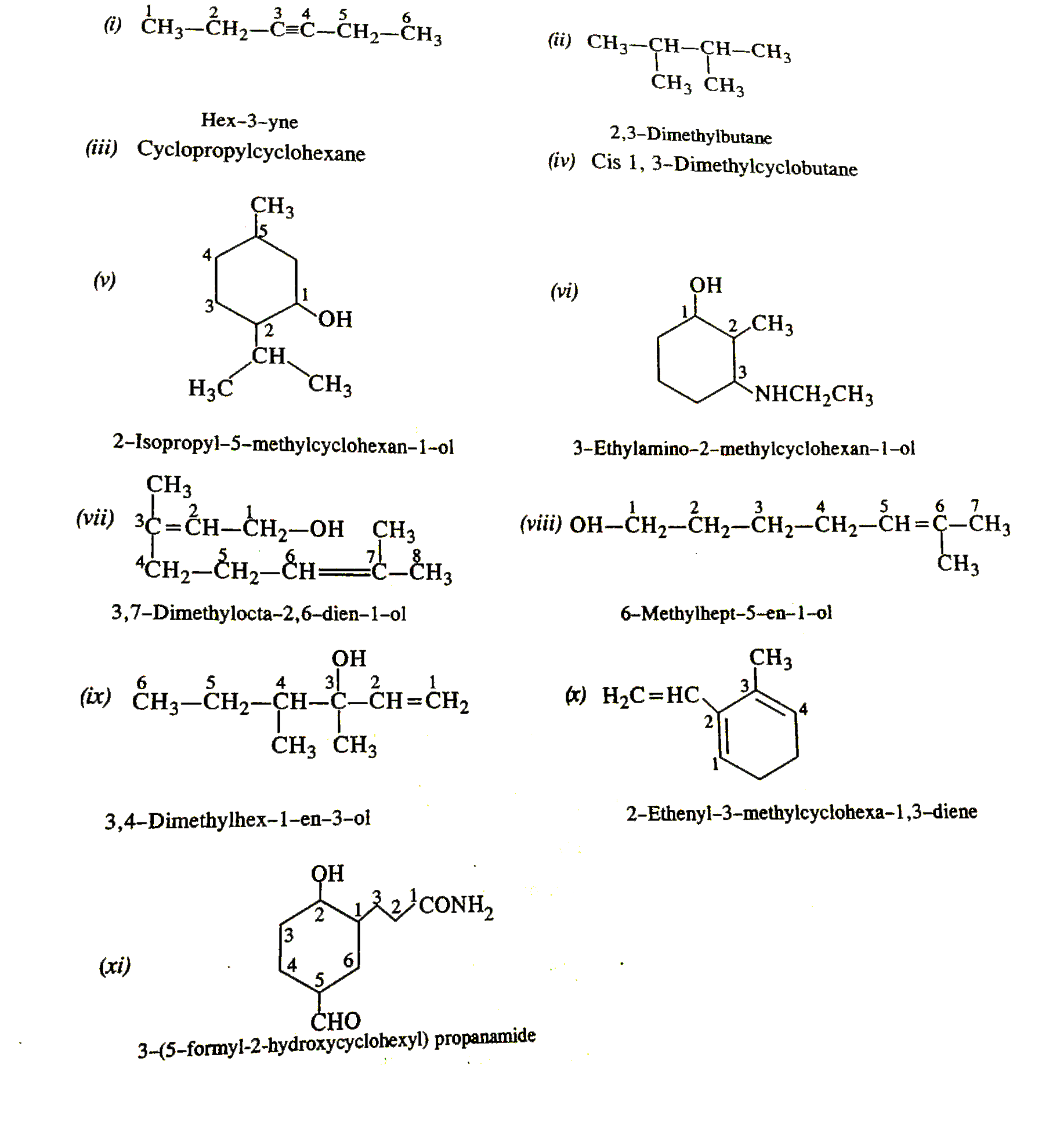
|
|
| 29. |
Draw the first six members of the carboxylic acid homologous series. |
|
Answer» SOLUTION :(i) HCOOH (ii) `CH_(3)COOH` (iii) `CH_(3)-CH_(2)COOH` (iv) `CH_(3)-CH_(2)-CH_(2)COOH` (v) `CH_(3)-CH_(2)-CH_(2)-CH_(2)COOH` (vi) `CH_(3)-CH_(2)-CH_(2)-CH_(2)-CH_(2)-COOH` |
|
| 30. |
Draw the fisher projection formula for tartaric acid. |
Answer» SOLUTION :
|
|
| 31. |
Draw the dash line structure, condensed structure and bond line structure of 1,3-dimethyl cyclopentane. |
Answer» SOLUTION :
|
|
| 32. |
Draw the conformations of ethane usingnewman projectionformula method |
Answer» SOLUTION :
|
|
| 33. |
Draw the complete structures of bromomethane, bromoethane, 2 -bromopropane and tertbutyl bromide. Arrange them in order of increasing steric hindrance. |
|
Answer» Solution :(i) Bromomethane, `CH_3 Br: H- UNDERSET(underset(H)|)overset(overset(H)|)C - Br` (ii) Bromoethane, `CH_3 CH_2 Br:H - underset(underset(H)|)overset(overset(H)|)C - underset(underset(H)|)overset(overset(H)|)C - Br` (iii) 2- Bromopropane, `CH_3 CH Br CH_3 : H - underset(underset(H)|)overset(overset(H)|)C- underset(underset(Br)|)overset(overset(H)|)C - underset(underset(H)|)overset(overset(H)|)C- H` (IV) tert-Butyl bromide, `(CH_3)_3 Br: H- underset(underset(H)|)overset(overset(H)|)C - underset(underset(H-underset(underset(H)|)C-H)|)overset(overset(H-overset(overset(H)|)C-H)|)C - Br` Increasing order of STERIC hindrance : Bromomethane < Bromoethane < 2-Bromopropane < tert-Butyl bromide. |
|
| 34. |
Draw the complete structural formula, condensed structure and bond line structure of (i) n-propanol (ii) 1, 3-butadiene. |
Answer» SOLUTION :
|
|
| 35. |
Draw the cis, trans isomeric structures of 1,3-butadiene. |
Answer» SOLUTION :
|
|
| 36. |
Draw the cis and trans structures of hex-2-ene. Which isomer will have higher b.p. and why? |
Answer» SOLUTION : cis-Hex-2-ene has a higher dipole moment than trans-Hex2-ene. DUE to higher dipole moment, it will have a stronger dipole-dipole interaction as COMPARED to trans-Hex-2-ene. Consequently, the cis-Hex-2-ene will have a higher BOILING POINT. |
|
| 37. |
Draw the cis and trans structures of hex-2-ene. Which isomer will have higher b.p. and why ? |
Answer» Solution :`CH_(3)CH=CHCH_(2)CH_(2)CH_(3)` is hex-2-ene. Their geometrical isomers are as FOLLOWS :  Boiling of cis-isomer is more.  `{:("Cis-Hex-2-ene",|,"Dipole moment is more."),("Trans-Hex-2-ene","Dipole moment is more.",),(THEREFORE " Boiling point is more",therefore " Boiling point is less",):}` Where , boiling point `prop` dipole moment `(mu)` `therefore` cis-isomer boiling point `GT` boiling point of trans. Boiling point, ions in liquid `prop` boiling point Negative meltingpoint `prop` INTERNUCLEAR force `therefore` Tras MELTING point is more. |
|
| 38. |
Draw the cis-and trans-structures for hex-2-ene. Which isomer will have higher b.p. and why ? |
Answer» Solution :The STRUCTURES of cis-and trans-isomer of hex-2-ene are :  The boiling point of a molecule DEPENDS upon dipole-dipole interactions. Since cis-isomer has HIGHER dipole moments , THEREFORE, it has higher boiling point. |
|
| 39. |
Draw structures of all the acyclic isomeric ethers corresponding to the molecular formula C_(5)H_(12)O. |
|
Answer» Solution :D.B.E. = 1/2 [5(4-2) + 12 (1-2) + 1 (2-2)] + 1 = 0. Since D.B.E. = 0. therefore, `C_(5)H_(12)O` REPRESENTS only SATURATED ETHERS. The following six isomers are possible. 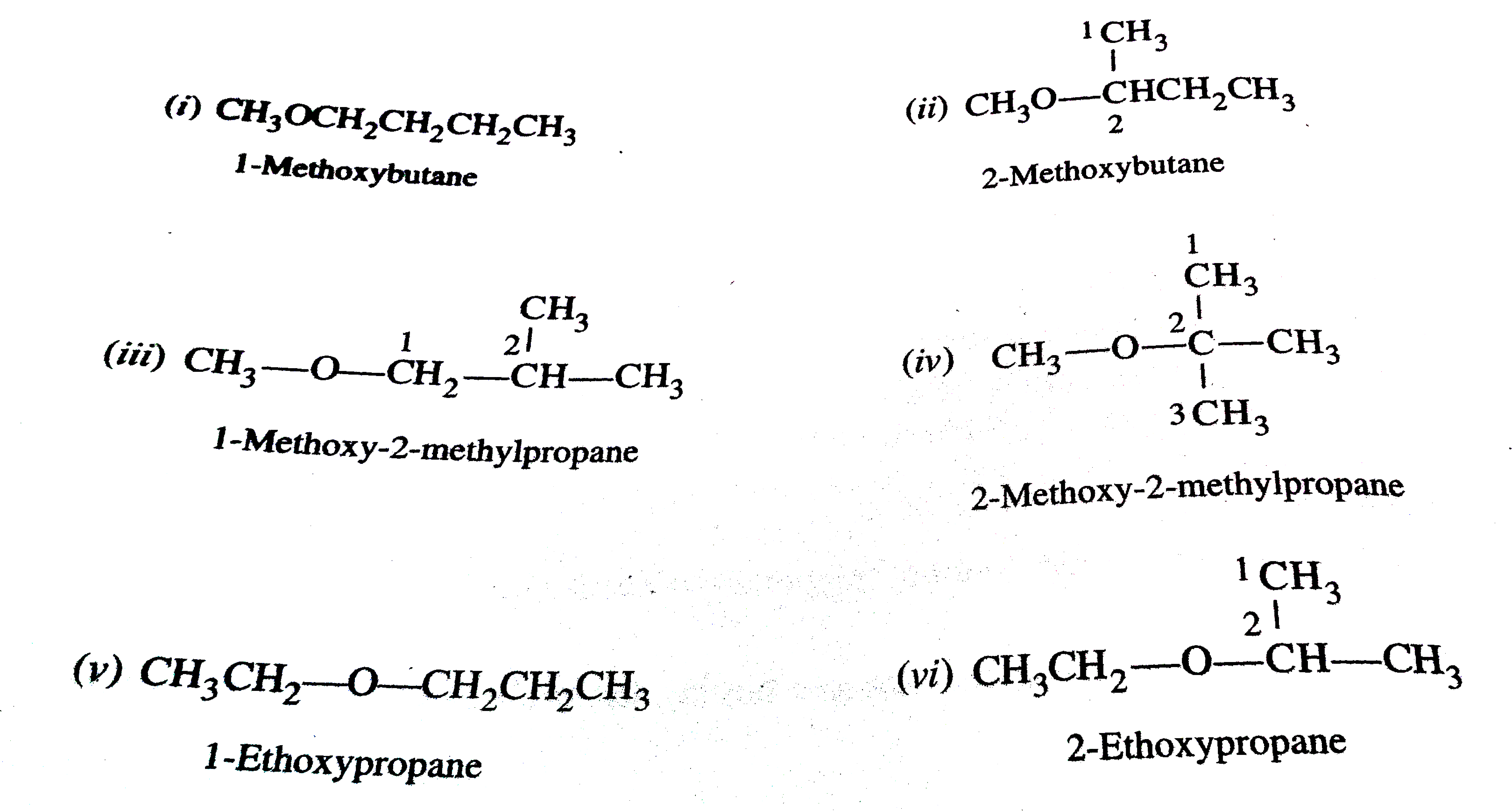
|
|
| 40. |
Draw structure of diboren. |
Answer» SOLUTION :
|
|
| 41. |
Draw structure of Al_2Cl_6 and give uses of AlCl_3. |
Answer» Solution : USE : Being a Lewis acid, it ACT as CATALYST in Friedal craft ALKYLATION and acylation and also in electrophilic aromatic substitution REACTION. |
|
| 42. |
Draw orbital diagrams for atoms with the following electronic configurations. 1s^(2) 2s^(2) 2p^(6) 3s^(2) 3p^(6) 4s^(2) 3d^(7) |
Answer» SOLUTION :
|
|
| 43. |
Draw orbital diagrams for atoms with the following electronic configurations. 1s^(2) 2s^(2) 2p^(6) 3s^(2) 3p^(5) |
Answer» SOLUTION :
|
|
| 44. |
Draw orbital diagrams for atoms with the following electronic configurations. 1s^(2) 2s^(2) 2p^(5) |
Answer» SOLUTION :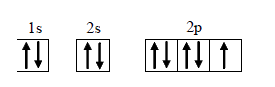
|
|
| 45. |
Draw Newman projection formulae staggered forms of butane and compare their stability. |
Answer» SOLUTION :Newman.s PROJECTIONS of BUTANE are : 
|
|
| 46. |
Draw Lewis structures of following molecules and ions. H_(2)S, SiCl_(4), BeF_(2), CO_(3)^(2-), HCOOH |
Answer» SOLUTION :
|
|
| 47. |
Draw MO diagram of CO and calculate its bond order . |
|
Answer» Solution :(i) ELECTRONIC configuration of C ATOM: `1s^(2) 2s^(2)2P^(2)` Electronic configuration of O atom: `1s^(2)2s^(2)2p^(4)` (ii) Electronic configuration of CO molecule is: `sigma 1s^(2)" " sigma ** 1s^(2)" "sigma2s^(2)" "sigma**2s^(2)" "pi 2p_(y)^(2)" "pi2p_(z)^(2)" "sigma2p_(x)^(2)` (iii) Bond order `= (N_(b)- N_(a))/(2)(10-4)/(2)=3` (iv) Molecule has no unpaired ELECTRON, hence it is DIAMAGNETIC. |
|
| 48. |
Draw Lewis Structures for the following molecules. (a) H_(2)S "(b) " SiCl_(4) (c) BeF_(2) " and" (d) HCOOH |
|
Answer» |
|
| 49. |
Draw graph of volume (V) against Temperature (T) n^(+) constant pressure (P) and explain. |
|
Answer» Solution :GRAPH is straight LINE & positive slop. `THEREFORE V prop T ""`……(constant p and v) Graph indicated that ..At constant PRESSURE VOLUME of fixed amount of any gas is directly proportional to its Absolute temperature... 
|
|
| 50. |
Draw formulas for the first five members of each homologous series beginning with the following compounds. (a) HCOOH (b) CH_(3)COCH_(3) (c ) H- CH = CH_(2) |
|
Answer» Solution :(a) (i) HCOOH (ii) `CH_(3)COOH` (iii) `CH_(3)-CH_(2)-COOH` (iv) `CH_(3)-CH_(2)-CH_(2)-COOH` (V) `CH_(3)-CH_(2)-CH_(2)-CH_(2)-COOH` (b) (i) `CH_(3)COCH_(3)` (ii) `CH_(3)COCH_(2)CH_(3)` (iii) `CH_(3)COCH_(2)CH_(2)CH_(3)` (iv) `CH_(3)COCH_(2)CH_(2)CH_(2)CH_(3)` (v) `CH_(3)COCH_(2)CH_(2)CH_(2)CH_(2)CH_(3)` (c ) (i) `H-CH= CH_(2)` (ii) `CH_(3)-CH= CH_(2)` (iii) `CH_(3)-CH_(2)-CH= CH_(2)` (iv) `CH_(3)-CH_(2)-CH_(2)-CH= CH_(2)` (v) `CH_(3)- CH_(2) - CH_(2) - CH_(2) - CH= CH_(2)` |
|