

Saved Bookmarks
This section includes 7 InterviewSolutions, each offering curated multiple-choice questions to sharpen your Current Affairs knowledge and support exam preparation. Choose a topic below to get started.
| 1. |
If the temperature of the wire is increased, then the Young's modulus will |
|
Answer» remain the same |
|
| 2. |
The relation between linear velocity and angular velocity of a body moving in a circle is |
|
Answer» SOLUTION :Consider an object moving along a circle of radius r. In a TIME `DELTA t`, the object travels an arc distance `Delta s`as shown in the figure .The corresponding angle subtended is `Delta theta` . In terms of`Delta theta, Delta s`can written as `Delta s = r Delta theta` In a time t , `(Delta s)/(Delta t) = r""(Delta theta)/(Delta t)` In the LIMIT ` Delta t to 0` , the above equation becomes `(ds)/(dt) = ROMEGA"" . . . (1)` Here `(ds)/(dt)`is linear speed (v)that is tangential to the circle and `omega`is angular speed. So equation (1) becomes ` v = r omega` 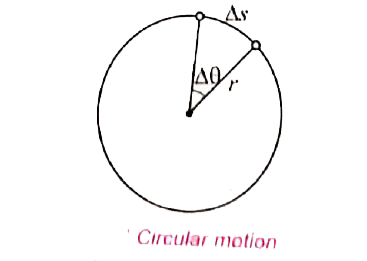
|
|
| 3. |
The carbide tips of the cutting teeth of a circulars aware 9.2 cm from the axis ofrotation, (a) The no-load speed of the saw,whenit is not cutting anything, is 5000 rev/min.Why is its no-load power output negligible ? (b) While cutting lumber, the angular speed of the saw slows to 2500 rev/min, and the power output is 2.1 hp. What is the tangential force that the wood exerts on the carbide tips. |
|
Answer» |
|
| 4. |
Calculate how many times more intense is 90 dB sound compared to 40 dB sound? |
|
Answer» Solution :Given DATA: `L=log(I)/(I_(0))=logI-logI_(0)` We get`90 dB = 9B=logI_(1)-logI_(0)`...(1) `40dB=4B=logI_(2)-logI_(0)`...(2) Subtract (2) from (1) `-50dB=5B=logI_(1)-logI_(2)` `5=log_(10)((I_(1))/(I_(2)))` `(I_(1))/(I_(2))=10^(5)` |
|
| 5. |
Two equal and opposite forces act on a rigid body at a certain distance. Then |
| Answer» SOLUTION :When the LINES of ACTION do not COINCIDE. | |
| 6. |
A body of mass 2 kg initially at rest moves under the action of an applied horizontal force of 7N on a table with coefficient of kinetic friction = 0.1. Compute the Work done by the net force on the body in 10s. |
| Answer» SOLUTION :`635 J` WORK done by the NET force on a body equals CHANGE in its kinetic ENERGY. | |
| 7. |
A body of mass 2 kg initially at rest moves under the action of an applied horizontal force of 7N on a table with coefficient of kinetic friction = 0.1. Compute the Work done by friction in 10s. |
| Answer» SOLUTION :`-247 J` WORK done by the net force on a body equals change in its kinetic ENERGY. | |
| 8. |
A body of mass 2 kg initially at rest moves under the action of an applied horizontal force of 7N on a table with coefficient of kinetic friction = 0.1. Compute the Work done by the applied force in 10s. |
| Answer» Solution :`882 J` Work done by the net force on a body equals change in its KINETIC ENERGY. | |
| 9. |
A closed cylindrical tube containing some water (not filling the entire tube) is rotated about a perpendicular bisector, the moment of inertia of water about the axis |
|
Answer» increase |
|
| 10. |
The potential energy of a molecule on the surface of a liquid compared to that of a molecules inside the liquid is ……………. . |
| Answer» Answer :C | |
| 11. |
A body of mass 2 kg initially at rest moves under the action of an applied horizontal force of 7N on a table with coefficient of kinetic friction = 0.1. Compute the Change in kinetic energy of the body in 10s. |
| Answer» SOLUTION :`635 J` Work DONE by the net FORCE on a body equals CHANGE in its kinetic energy. | |
| 12. |
Consider Example 6.8 taking the coefficient of friction, u, to be 0.5 and calculate the maximum compression of the spring. |
|
Answer» Solution :In presence of friction, both the spring force and the frictional force act so as to oppose the compression of the spring as shown in Fig. 6.9. We invoke the work-energy theorem, rather than the conservation of mechanical energy. The change in kinetic energy is `triangleK= K_(f)-K_(t)= 0-(1)/(2)mv^(2)` The work done by the net force is `W= -(1)/(2)kx_(m)^(2)- mu mg x_(m)` Equatting we have `(1)/(2)mv^(2)= (1)/(2)k x_(m)^(2)+ mu mg x_(m)` Now `mu mg= 0.5xx10^(3)xx10= 5xx 10^(3)N` (TAKING `g= 10.0 ms^(-2)`). After rearranging the above equation we obtain the following quadratic equation in the unknown `x_(m)`. `kx_(m)^(2)+ 2 mu mg x_(m)- mv^(2)= O` `x_(m)=(-mu mg+[mu^(2)m^(2)g^(2)+mkv^(2)]^(1/2))/(k)` where we take the POSITIVE square root since `x_(m)` is positive. PUTTING in numerical values we obtain `x_(m)= 1.35m` which, as expected, is less than the result in Example 6.8. If the TWO forces on the body consist of a conservative force `F_(c )` and a non-conservative force `F_(nc)`, the conservation of mechanical energy formula will have to be modified. By the WE theorem `(F_(c )+F_(nc)) trianglex= triangleK` But `F_(c ) triangle x= -triangle V` Hence, `triangle(K+V)= F_(nc) triangle x` `triangle E= F_(nc) trianglex` where E is the total mechanical energy. Over the path this ASSUMES the form `E_(f)-E_(t)= W_(nc)` where `W_(nc)` is the total work done by the non-conservative forces over the path. Note that unlike the conservative force, `W_(nc)` depends on the particular path i to f. 
|
|
| 13. |
(A) : The tendency of skidding or overturning is quardrupled, when a cyclist doubles his speed of turning. (R ) :Angle of bending of a cyclist bicycle increases as velocity of increases |
|
Answer» Both 'A' and 'R' and TRUE and 'R' is the correct EXPLANTATION of 'A' |
|
| 14. |
(A): Elastomers does not obey Hooke's law.(R): For elastomers, stress-strain curve is non linear. |
|
Answer» Both (A) and (R) are TRUE and (R) is the CORRECT EXPLANATION of (A) |
|
| 15. |
At a given volume and temperature, the pressure of a gas ……….. . |
|
Answer» varies INVERSELY as its mass |
|
| 16. |
In Fig. 98 m and H=98 m. A rigid uniform sphere starts from the point A from rest and rolls down the track without slipping and reaches the horizontal right hand end B, What is the distance to the right of the point C at which the sphere strikes the horizontal base line ?(given h=29.4) |
| Answer» SOLUTION :`mgh =(7//10)MV^(2), v=sqrt(9.8 XX 68.6 xx 10//7) = 31 m//s, t = sqrt(2 xx 29.4//9.8) = 2.4 s`. DISTANCE `=31 xx 2.4 = 74.4`m | |
| 17. |
A body at 50^(@)C cools in a surroundings maintained at 30^(@)C. The temperature at which the rate of cooling is half that of the beginning is |
|
Answer» `16.3^(0)C` |
|
| 18. |
The electrical resistance in ohms of a certain thermometer varies with temperature according to the approximate law : R=R_(0)[1+alpha(T-T_(0))] The resitance is 101.6" "Omega at the triple-point of water 273.16 K, and 165.5" "Omega at the normal melting point of lead (600.5 K). What is the temperature when the resistance is 123.4" "Omega ? |
|
Answer» SOLUTION :`R=R_(0)[1+alpha(T-T_(0))]` `:.R-R_(0)=R_(0)xx5xx10^(-3)(T-T_(0))` `:.T-T_(0)=(R-R_(0))/(5XX10^(-3)R_(0))` At triple POINT of water : `T_(1)-T_(0)=(R_(1)-R_(0))/(5xx10^(-3)R_(0))` . . .(1) and at triple point of LEAT : `T_(2)-T_(0)=(R_(2)-R_(0))/(5xx10^(-3)R_(0))`. . . (2) By taking ratio of eauation (2) to equation (1), `(T_(2)-T_(0))/(T_(1)-T_(0))=(R_(2)-R_(0))/(R_(1)-R_(0))` Here `R_(0)=101.6Omega to` resistance at temp. of triple point `T_(0)=273.16K` `R_(1)=165.5Omega to` temp. `T_(1)=600.5K` `R_(2)=123.4Omega to T_(2)=?` `:.(T_(2)-273.16)/(600.5-273.16)=(123.4-101.6)/(165.5-101.6)` `:.(T_(2)-273.16)/(327.34)=(21.8)/(63.9)` `:.T_(2)~~385K` |
|
| 19. |
The escape velocity of a body on the earth's surface is V_e. A body is thrown vertically up with a speed of (kV_e) (k lt 1). The maximum height reached by the body above the earth is |
|
Answer» `R((K^2)/(1-k^2))` |
|
| 20. |
Obtain the relation between potential energy and force for conservative force . |
|
Answer» Solution :Suppose that a body undergoes displacement `Deltax` under the action of a conservative force F . ` :. ` Work done by this force , `W = F Delta` but ACCORDING to work ENERGY THEOREM , `W = DeltaK ` ` :. DeltaK = F Deltax` Now from the law of CONSERVATION of mechanical energy . `DeltaK + DeltaV = 0 ` ` :. F DeltaX + DeltaV = 0 ` ` :. F Deltax + DeltaV = 0 ` ` :. F = DeltaV ` `Deltax` HENCE , in the case of conservative force , force will be obtained by taking negative derivative of potential energy w.r.t to displacement . |
|
| 21. |
A particle is moving along a circular path. The angular velocity, linear velocity, angular acceleration, and centripetal acceleration of the particle at any instant respectively are vecw,vecv,vecalpha,veca_(c). Which of the following relation is not correct ? |
|
Answer» `VEC OMEGA _|_ vec v` |
|
| 22. |
In a harbour ,wind is blowing at the speed of 27 km //hand the flag on the mast of a boat anchored in the harbour flutters along the N-E direction . If the boat starts moving at a speed of 51 km//h to the north , what is the direction of the flag on the mast of the boat ? |
Answer» Solution :As the flag FLUTTERS in the N-E direction , the wind must be flowing in the N-E direction. When the boat start moving , the flag will flutter in the direction ofrelative velocity of wind w.r.t. boat .  `|vecv_(w)|=72 km //h` `|vecv_(b)|=51 km//h` If `beta` is the angle between `vec v_(w) and -vecv_(b)` `tan beta =(51 sin135 ^(@))/(72+51 cos 130^(@))` `=((51xx1 sqrt2))/(72-51xx1sqrt2)` `=131.1//51.1=0.9965` `therefore beta=tan^(-1) (1.0038)=45.1^(@)`(with S-E) `therefore` Angle with respect to direction of east `=45.1-45^(@)=0.1` (with east) Hence , the direction of the flag is almost towards east . |
|
| 23. |
(A) : A large soap bubble expands while a small bubble shrinks, when they are connected to each other by a capillary tube. (R ) : The excess pressure inside bubble (or drop) is inversely proportional to the radius. |
|
Answer» Both (A) and (R ) are TRUE and (R ) is the CORRECT EXPLANATION of (A) |
|
| 24. |
(A) : In an elastic collision of two billiard balls, the total kinetic energy is conserved during the short time of oscillation of the balls (i.e., when they are in contact).(R ) : Energy spent against friction does follow the laws o conservation of energy. |
|
Answer» Both (A) and (R ) are TRUE and (R ) is the correct EXPLANATION of (A) |
|
| 25. |
A wheel is subjected to uniform angular acceleration about its axis. Initially its angular velocity is zero, In the first 2s, it rotates through an angle theta_(1), In the next 2s, it routes through an additional angle theta_(2). The ratio of (theta_(2))/(theta_(1)) |
|
Answer» 1 |
|
| 26. |
Given that int (dx)/(sqrt(2ax - x^2)) = a^n sin^(-1) [(x-a)/(a)]where aconstant. Using dimensional analysis, the value of n is |
| Answer» Answer :B | |
| 27. |
Water flows through a horizontal tube as shown in figure. If the difference of height of water column in the vertical tubes in 2cm and the areas of corss-section at A and B are 4 cm^(2) respectively. Find the rate of flow of water across any section. . |
|
Answer» `p_(A)+(1)/(2)rho v_(A)^(2)+rhogh_(A)=p_(B)+(1)/(2)rhov_(B)^(2)+rho gh_(B) (h_(A)=h_(B))` `or, (1)/(2)rho v_(B)^(2)-(1)/(2)rho v_(A)^(2)=rhog (h_(A)=h_(B))` or `v_(B)^(2)-v_(A)^(2)=2g (h_(A)=h_(B))` `=2xx10xx0.02` or `v_(B)^(2) -v_(A)^(2) = 0.4 m^(2)//s^(2)`....(i) `v_(A)A_(A)=v_(B)A_(B)` or, `4v_(A)=2v_(B)` `:. v_(B)=2v_(A)` ...(ii) SOLVING EQS, (i) and (ii), we get `v_(A)=0.363 m//s` VOLUME Flow rate`=v_(A)A_(A)` `=(0.365)(4xx10^(-4))` `=1.46xx10^(-4) m^(3)//s=146cm^(3)//s`. |
|
| 28. |
A body is revolving in a vertical circle with constant mechanical energy. The speed of he body at the highest point is sqrt(2rg). The speed of the body at the lowest point is |
|
Answer» `sqrt(7 gr)` |
|
| 29. |
The radius of earth is about 6400 km and that of mars is 3200 km. The mass of the earth is about 10 times mass of mars. An object weights 200 N the surface of earth its weight on the surface of mars will be .......... |
|
Answer» Solution :`implies` Let Weight on earth is `W_e` and acceleration of gravity `g_e` and weight on mass is `W_m` and accelerationof gravity `g_m` `:. (W_m)/(W_g)=(gm)/("ge")` `= (GM_m//R_m^2)/(GM_e//R_e^2)` `= (M_m)/M_e xx(R_e/(R_m))^2` `=(1/10)xx((6400)/3200)^2` `=1/10 xx 4` `:. W_m = 4/10 xx W_g` `:. W_m =4/10 xx 200` `:. W_m = 80 N` |
|
| 30. |
Find the rotational kinetic energy of a ring of mass 9 kg and radius 3 m rotating with 240 rpm about an axis passing through its centre and perependicualr to its plane. |
|
Answer» Solution :The rotational KINETIC ENERGY is, `KE=(1)/(2) IOMEGA^(2)` the moment of inertin of the ring is `I=MR^(2)` `I=9xx3^(2)=9xx9=81 kg m^(2)` the angular speed of the ring is, `omega=240 pm =(240xx2pi)/(60) "rad" s^(-1)` `KE=(1)/(2)xx81xx((240xx2pi)/(60))=(1)/(2)xx81xx(8pi)^(2)` `KE=(1)/(2)xx81xx64xx(pi)^(2)=2592xx(pi)^(2)` `KE ~~25920 J "" :. (pi)^(2)=10` `KE~~25.9250 KJ` |
|
| 31. |
Three rods of lengths 20cm each and area of cross-section 1cm^(2) are joined to form a triangle ABC. The conductivities of the rods are K_(AB)=50J//m-s-^(0)C,K_(BC)=200J//m-s-""^(0)C and K_(AC)=400J//m-s-""^(0)C. The junctions A, B and C are maintained at 40^(@)C,80^(@)C and 80oC respectively. The rate of heat flowing through the rod AB is __________ W |
|
Answer» |
|
| 32. |
List and explainany two application of angle of repose |
|
Answer» Solution :(i)antilonsmakesandtrapsin SUCHA waythatwhen ainsectenterstheedgeof thetrap , itstartsto slidetowardsthe bottomwhere the antilon hideitself. The angleof INCLINATION of sandtrapis madeto beequalto angleof repose. (ii) CHILDRENARE foundof playingon slidingboard . Whenthe angleof inclinationof theboardis greater than the angleofrepose . Sliding will GBE easierat thesametime ifinclinationangle is muchlargerthanthe angleof repose, thenthe sliderwillreachthe bottomatgreaterspeedand gethurt. |
|
| 33. |
A uniform rod of length Lhasa mass per unit length lambda and area of cross-section A. The elongation in the rod is l due to its own weight. If it is suspended fromthe ceiling of a room, the Young's modulus of the rod is |
|
Answer» `( 2 LAMBDA G L^(2) )/( Al)` |
|
| 34. |
The angular speed of hour hand of a watch is …………. rad s^(-1). |
|
Answer» `(pi)/(43200)` |
|
| 35. |
. A body is moving unidirectionally under the influence of a source of constant power supplying energy. Which of the diagrams shown below correctly shows the displacement time curve for its motion ? |
|
Answer»
|
|
| 36. |
A constant torque of 1000 Nm turns a wheel of of M.I 200kg m^(2) about an axis through centre. The angular velocity after 3s is |
|
Answer» `15 rad s^(-1)` |
|
| 37. |
For a surface mlecule a. the net on it is zero b. there is a net downward force c. the potential energy is less than of a molecule inside d. the potential energy is more than that of a molecule inside |
|
Answer» Both A & B are correct |
|
| 38. |
A sitar wire is replaced by another wire of same length and material but of three times the earlier radius. If the tension in the wire remains the same, by what factor will the frequency change? |
|
Answer» Solution :We have, `mu =(M)/(L) = (V rho )/( L ) = (AL rho )/( L ) = A rho` `therefore mu = (PIR ^(2) ) rho ` Now, we have, `f = (1)/(2L) sqrt ((T)/( mu))` `therefore f = (1)/(2L) sqrt ((T)/( pi r ^(2) rho ))implies f prop (1)/( r )` `( because ` other FACTORS are constants) `therefore (f_(1))/( f _(2)) = (r _(2))/( r _(1)) = (3)/(1) (because r _(2) = 3R _(1))` `therefore f_(2) = ((1)/(3)) f _(1)` |
|
| 39. |
A bus starts from rest accelerating uniformly with 4ms^(-1)at t =10s a stone is dropped out of a window of the bus 2mhigh what are the (i) magnitude of velocity and (ii) accelearatio of the stone at 10.2 s take g=10 ms^(-2) |
|
Answer» Solution :Given Acceleration`=4ms^(-2)` Time=- 10s (i)horizontalvelocityof the busor the stoneat t= 10 is `v_(x) = U +at = 0 + 4 xx 10` forverticalmotionof THESTONE `u= 0a=g= 10 ms^(-2)t =10.2-10=0.2s` `v_(y)=0+10 xx 0.22ms^(-2)` Magnitudeof teh resultantvelocityof the stone is `v= sqrt( v^(2) + v^(2)) = sqrt(40^(2) +2^(2))` (ii) Afterteh stoneis droppeditsaccelerationalonghorizontal is ZERO. it has only averticalacceleration of `10 ms^(-2)` |
|
| 40. |
Match the pairs in two lists give below{:(,"List - I",,"List - II"),((a),"Gravitational force",(e ),"decreases"),((b),"Frictional force",(f),"conservative force"),((c ),"KE of a dropped",(g),"nonconservative body force"),((d),"PE of a dropped",(h),"increases body"):} |
|
Answer» a-f, B-h, c-g, d-e |
|
| 41. |
A ball dropped on to the floor from a height of 10 m rebounds to a height of 2.5 m. If the ball is in contact with the floor for 0.02s, its average acceleration during contact is |
|
Answer» `2100ms^(-2)` |
|
| 42. |
Two bulbs of 100 c.c and 200 c.c capacity, contain the same gas at same temperature and pressure are connected by a capillary tube of negligible volume. Initially both were at 0^(0)C. Now the te,nperature of the bigger bulb is raised to 100^(0)C and that of the smaller bulb being kept at 0^(0)C. If the initial pressure was 76 cm of mercury, what is the final pressure? |
|
Answer» Solution :Let P be the initial PRESSURE of the bulbs and `P^(1)` be the final pressure. Initial temperature of the bulbs be T. The final temperatures of the bulbs of volume `V_(1) and V_(2)` be `T_(1) and T_(2) `respectively. By ideal GAS equation, as mass of the gas in the bulbs remains constant `(P_(1)V_(1))/(T ) + (P_(2)V_(2))/(T) = (P^(1)V_(1))/(T_(1)) + (P^(1)V_(2))/(T_(2))` `(P)/(T) (V_(1) + V_(2)) = P^(1) ((V_(1))/(T_(1)) + (V_(2))/(T_(2)) )(because P_(1) = P_(2) = P ) ` `(76)/(273) (100 + 200 ) = P^(1) ((100)/(273) + (200)/(373))` `(76 xx 300)/(273) = p^(1) xx 100 ((919)/(273 xx 373))` `P^(1) = (76 xx 3 xx 373)/(919) = 92.53` cm |
|
| 43. |
Assertion : A wooden plank is floating in two liquids as shown. Net force applied by liquid-1 on plank is zero. Reason : Contribution in upthrust due to liquid -1 is V_(1)rho_(1)g. Where V_(1)= volume immersed in liquid -1 and rho_(1) is the is the density of liquid -1. |
|
Answer» If both ASSERTION and REASON are CORRECT and Reason is the correct explanation of Assertion. |
|
| 44. |
The latent heat of viporisation of water is 2240J if the work done in the process of vaporisation of 1g is 168J the increase in internal energy is |
|
Answer» 2072J |
|
| 45. |
A glass bulb of volume 250 c.c is completely filled with mercury at 20°C. The temperature of the system is raised to 100°c. If the coefficient of linear expansion of glass is 9 xx 10^(-6)//^(@) C and coefficient of absolute expansion of mercury is 1.8 xx 10^(-1)//^(@) C. the volume of mercury that overflows is nearly |
|
Answer» `3.06 c.c` |
|
| 46. |
A car starts from rest and moves with uniform acceleration 'a'. At the same instant from the same point a bike crosses with a uniform velocity 'u'. When and where will they meet? What is the velocity of car with respect to the bike at the time of meeting? |
|
Answer» Solution :Let the car and bike will meet after coving a DISTANCE S in a time .t. SEC. For car `S=(1)/(2)at^(2)……(1)` for bike `s=UT……(2)` Since they cover same distance `ut=(1)/(2)at^(2)impliest=(2u)/(a)` The car and bike will meet after a time of `(2u)/(a)` sec. The VELOCITY of car after .t. sec is `V_(car)=at=a((2u)/(a))=2u` The velocity of car w.r.t bike is `V_(rel)=2u-u=u`. |
|
| 47. |
(a) Find the moment of inertia of a sphere about a tangent to the sphere, given the moment of inertia of the sphere about any of its diameters to be 2MR^(2)//5, where M is the mass of the sphere and R is the radius of the sphere. (b) Given the moment of inertia of a disc of mass M and radius R about any of its diameters to be MR^(2)//4, find its moment of inertia about an axis normal to the disc and passing through a point on its edge. |
| Answer» SOLUTION :(a) `7//5 MR^(2)` (B) `3//2 MR^(2)` | |
| 48. |
Estimate the speed of sound in air at standard temperature and pressure. Athe mass of 1 mole of air is 29.0 xx 10^(-3) kg. |
|
Answer» Solution :We know that 1 mole of any gas occupies 22.4 litres at STP. Therefore, density of air at STP is : `rho_(o) = ("mass of mole of air")// ("volume of one mole of air at STP")` `= (29.0 XX 10^(-3) kg)/(22.4 xx 10^(-3) m^(3))` `= 1.29 kg m^(-3)` According to Newton.s formula for the speed of sound in a medium, we get for the speed of sound in air at STP, `v = [(1.01 xx 10^(5) N m^(-2))/(1/29 kg m^(-3))]^(1//2) = 280 m s^(-1)` (15.23) |
|
| 49. |
(A) : Artificial satellite is a freely falling body. (R) : In a satellite, everything inside it has acceleration towards centre of earth which exactly equal to 'g' at that position |
|
Answer» Both (A) and (R) are true and (R) is the CORRECT EXPLANATION of (A) |
|
| 50. |
The two ends of a metal rod are maintained at temperatures 100^(@)C and 110^(@)C. The rate of heat flow in the rod is found to be 4.0 J/s. If the ends are now maintained at temperatures 200^(@)C and 210^(@)C, the rate of flow of heat will be |
|
Answer» 16.8 j/s Case `(i) (d theta_(1))/(dt )= k(110-100) = kxx10 --- (i)` Case (ii) `(d theta_(2))/(dt)= k(210-200) = kxx10 --- (ii) ` From (i) & (ii) `(d theta_(1))/(dt) = (d theta_(2))/(dt) = 4.0 ` j/s |
|


