

Saved Bookmarks
This section includes 7 InterviewSolutions, each offering curated multiple-choice questions to sharpen your Current Affairs knowledge and support exam preparation. Choose a topic below to get started.
| 1. |
Rain is falling vertically with a speed of 35 m s^(-1) . A woman rides a bicycle with a speed of12 m s^(-1) in east to west direction. In which direction should she hold her umbrella ? |
|
Answer» `sin^(-1)((12)/(35))` `tan theta = (v_(w))/(v_(r)) = (12)/(35) or theta = tan^(-1) ((12)/(35))` 
|
|
| 2. |
In a hollow sphere the maximum height with respect to the lowest point at which a particle remains in equilibrium, is one-tenth of the radius of the sphere. What is the coefficient of friction between the sphere and the particle? |
|
Answer» |
|
| 3. |
The techniques used to study the crystal structure of various rocks are...... |
|
Answer» x-ray DIFFRACTION |
|
| 4. |
In a car race , car A takes a time of t s less than car B at finish and passes the finishing point with a velocity v m//s morn than thecar B . Assuming that the cars start from rest and travel with constant accelerations a_(1) "and " a_(2) respectively, show that v=tsqrt(a_(1)a_(2)). |
|
Answer» SOLUTION :The DISTANCE covered by both the cars is the same . Thus , `s_(1)=s_(2)=s`. If the cars TAKE time `t_(1)"and"t_(2)` for the race and their velocities at the FINISH be `v_(1)"and"v_(2)`, then it is given that `v_(1)/2t_(1)=s`…….(1) and`v_(2)/2t_(2)=s`.....(2) `:. v_(1)/t_(2)=v_(2)/t_(1)=(v_(1)-v_(2))/(t_(2)-t_(1))=v/t`......(3) `(v/t)^(2)=(v_(1)v_(2))/(t_(2)t_(1))=v_(1)/t_(1) v_(2)/t_(2)`......(4) `:. v/t=sqrt(a_(1)a_(2))rArrv=tsqrt(a_(1)a_(2))` |
|
| 5. |
Length and cross sectional area of a wire are 5 m and 2.5 mm^(2). Calculate work required to be done to increase its length by 1 mm. Young's modulus of material of wire =2 xx 10 ^(11) Nm ^(-2) |
|
Answer» Solution :Here l = 5m `Delta l = 1mm = 10 ^(-3) m` `A = 2.5 mm ^(2) =2.5 xx 10 ^(-6) m ^(2)` `Y=2 xx 10 ^(11) Nm ^(-2)` Work to be done `W = 1/2` stress `xx` strain `xx` volume `=1/2 xx Y xx (epsi_(l)) ^(2) xx Al` `1/2 xx` Young MODULUS but `epsi _(l) =(Delta l )/(l) = (10 ^(-3))/(5) and ` volume `V = Al = 2.5 xx 10 ^(-6) xx 5 = 12.5 xx 10 ^(-6) m^(3)` `therefore W -1/2 xx 2 xx 10^(11) xx (( 10 ^(-3))/( 5 )) ^(2) xx 12.5 xx 10 ^(-6) ` `= 10 ^(11) xx (10 ^(-6))/(25) xx 12.5 xx 10 ^(-6)` `= 0.5 xx 10 ^(-1)` `therefore W =5 xx 10 ^(-2) J` |
|
| 6. |
Calculate the force acting on a body which changes the momentum of the body at the rate of 1kg - m //s^2 |
|
Answer» SOLUTION :As F = RATE CHANGE of MOMENTUM ` F = 1kg-m//s^2` |
|
| 7. |
A uniform rope of length 5m is on a smooth horizontal surface. It is being pulled by a horizontal force of 20 N at one end. The ratio of tension at a distance of 2m from force end to tension at a distance of 2m from free end is, |
|
Answer» `1:1` |
|
| 8. |
Water is nowing through a horizontal pipe of varying cross-section. At a certain point where the velocity is 0-24 m/s the pressure of water is 0-010 metre of mercury. What is the pressure at a point where the velocity is 0-48 m/s? |
|
Answer» Solution :For horizontal FLOW. The Bernoulli.s EQUATION is, ` ""(P_1)/(rho)+(1)/(2)v_1^(2)= (P_2)/(rho)+(1)/(2)v_2^(2) ` Densityof water = ` rho = 1000 KG //m^(-3)` `"" P_1= h_1dg, h_1= 0.010 m` Density of mercury `= d= 13.6 XX 10 ^(-3)= 13600 kg//m^(-3)` `""P_2 = h_2dg` ` (h_1dg)/(rho )+(1)/(2) v_1^(2)= (h_2dg)/(rho)+(1)/(2) v_2^(2)` ` ""h_2 =h_1 +(rho)/(2dg)(v_1^(2) -v_2^(2)) ` ` ""= 0.010 +(10^(3))/( 2xx 13600 xx 9.8) (0.24^(2)- 0.48 ^(2))` ` "" =0.010 - 0.000648` ` "" = 0.0094` m |
|
| 9. |
A string of length 3l is connected to a fixed cylinder whose top view is shown in Fig. The string is initially slack. The other end of the string (connected to a marble) is moving at a constant velocity of 10 m//s as shown. The string will get stretched at some instant and impulsive tension occurs in the string. If hinge is exerting a force of 40000 N for 0.25 ms on the cylinder to bear up the impact of impulsive tension, then mark the correct statements. (Take string to be light, breaking tension of the string is 2x10^5N) |
|
Answer» The angle made by the VELOCITY of marble with the length of string when it is just stretched is`60^(@)` 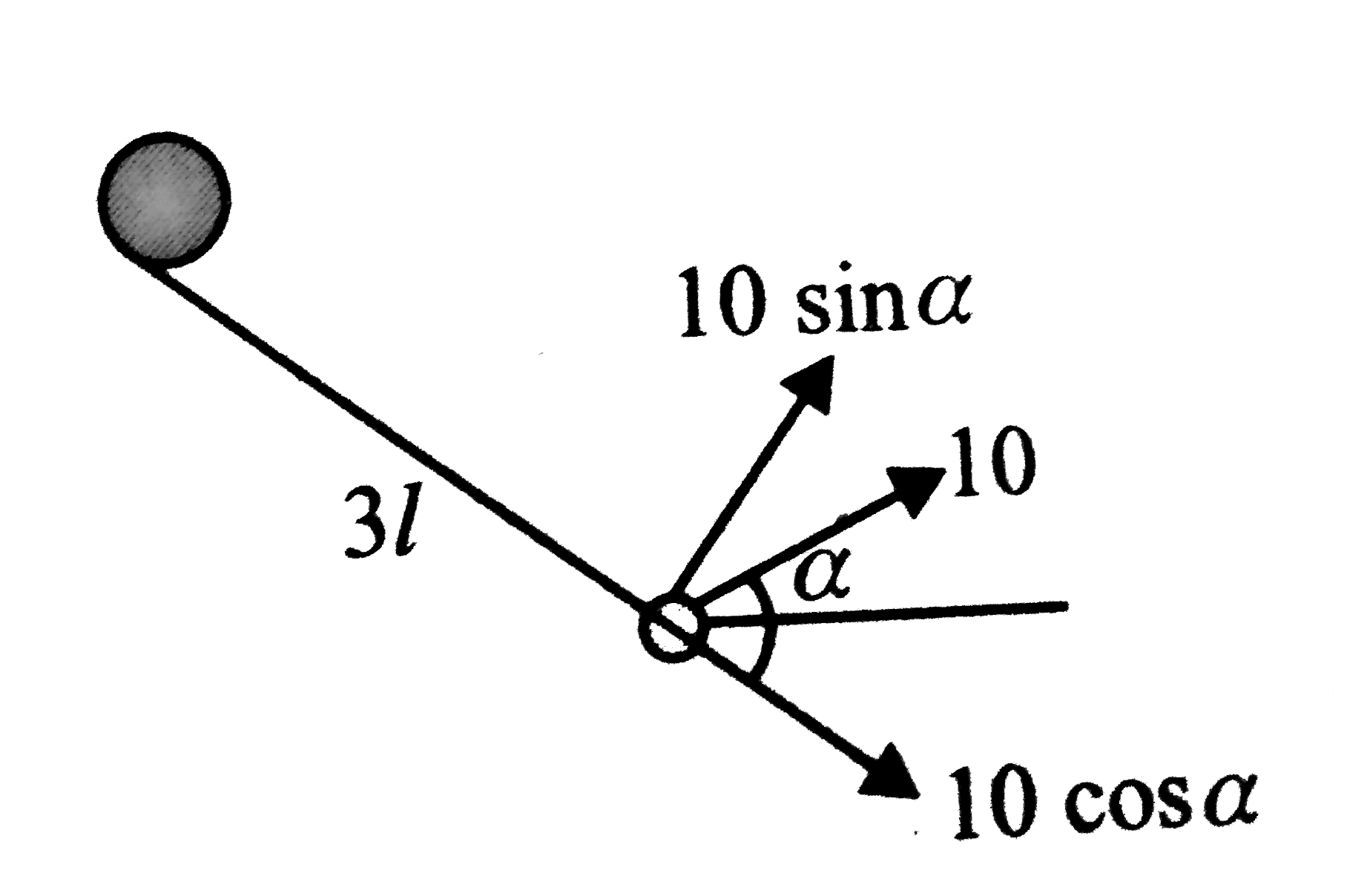 `|vecJ|=40000xx0.25x10^(-3)=10N` s along the string. For marble, `J=0-(2xx10cosalpha)` As final velocity of marble along the string is ZERO Putting `J=10Ns`, we get `alpha=60^(@)` The string wraps up AROUND the cylinder and marble MOVES in a circular path of varying radius with speed `10 sin alpha =5sqrt3 m//s`. The speed remain costasnt as only the tension force is present which is perpedicular to the velocity of the marble. For string to break, the impulsive tension has to be `ge2xx10^5N` `40000x0.25xx10^(-3)ge2xx10^(5)xx/_\t` `/_\tle0.05ms` |
|
| 10. |
Two identical billiard balls undergo an oblique elastic collision. Initially, one of the balls is stationary. If the initially stationary ball after collision moves in a direction which makes an angle of 37^(@) with direction of initial motion of the moving ball, then the angle through which initially moving ball will be deflected is |
|
Answer» `37^(@)` Alternative method I: Just LIKE in previous question, you can proceed using centre of mass FRAME of reference. Alternative method II: Using basic equation of conservation of momentum, conservation of energy and coefficient of restitution, you can have the desired result. |
|
| 11. |
A glass rod of diameter d_1 = 1.5mm is inserted symmetrically into a glass capillary with inside diameter d_2 = 2.0 mm . Then the whole arrangement is vertically oriented and brought in contact with the surface of water. To what height in cm will be water rise in the capillary? (surface tension T = 75 xx 10^(-3)N/m)) |
|
Answer» |
|
| 12. |
Which one of the following plots represents the variation of gravitational field on a particle with distance r due to a thin spherical shell of radius R? (r is measured from the centre of the spherical shell) |
|
Answer»
Inside the shell, F = 0 (for `rltR`) On the surface of the shell, `F=(GM)/(r^2)` (for r = R) OUTSIDE the shell, `F=(GM)/(r^2)` (for `RGTR`) The variation of F with distance r from the CENTRE is as shown in the figure (b). |
|
| 13. |
Aprojectile is projected with (3 hat(i) + 4 hat(j)+5 hat(k))ms^(-1). Point of projection is taken as origin and East, North , vertically upward directions are taken as positive x, y, z-directions respectively. (g=10ms^(-2)) All the units are in SI system Its displacement when it hits the XY-plane is : |
|
Answer» `( 3 hat(i) + 4 hat(J))/(5)` |
|
| 14. |
Aprojectile is projected with (3 hat(i) + 4 hat(j)+5 hat(k))ms^(-1). Point of projection is taken as origin and East, North , vertically upward directions are taken as positive x, y, z-directions respectively. (g=10ms^(-2)) All the units are in SI system Location of particle when it is at its maximum height is |
|
Answer» `1/2 (3 HAT(i) + 4 hat(J) + 5 hat(k))` |
|
| 16. |
A stepped cylinder having mass 50 kg and a radius of gyration (K) of 0.30 m. The radii R_(1) and R_(2) are respectively 0.3 m and 0.6 m. A pull T equal to 200 N is exerted on the rope attached to inner cylinder. The coefficient of static and dynamic friction between cylinder and ground are 0.1 and 0.08 respectively. |
|
Answer» the ANGULAR accelerationis `2.67 rads^(-2)` `T[R_(2)-R_(1)]=[MK^(2)+MR_(2)^(2)]alpha` `alpha=(200(0.6-0.3))/(50(0.362+0.6^(2)))=2.67rad//s` using Newton's IInd law `T-f=MR_(2)alpha` `f=(T-MR_(2)alpha)=[200-5xx0.6xx8/3]=120N` Now `F_("max")=musmg=0.1xx50xx10=50N` `f_(k)=mu_(s)Mg=0.08xx50xx10=40N` `Ma=T+40impliesa=-3.2m//s^(2)` |
|
| 17. |
A satellite is revolving around the earth in a circular orbit with a uniform speed. If the gravitational force suddenly disappears, then the satellite will |
|
Answer» continueto move in the same orbit with that SPEED |
|
| 18. |
In the figure shown a sinusoidal wave is generated at the end A the wave travels along positive x-axis and during its motion it encounter another string BD at the junction 'B' at x=0.The density of string AB and BC are rho "and" 9rhorespectively and their radii of cross sections are 2r"and"r. The wave function amplitude and wavelength of incident wave are respectively "y"_(p) A_(i)"and"lambda_(r) Similarly for reflected and transmitted wave these peremeters are "y"_(r),A_(r),lambda_(r)"and"y_(i),A_(i),lambda_(i) Which of the following statement regarding phase difference Deltaphi between waves at x=0 is true? |
|
Answer» `Deltaphi=0,`between `y_(i)` and `y_(R)` |
|
| 19. |
In the figure shown a sinusoidal wave is generated at the end A the wave travels along positive x-axis and during its motion it encounter another string BD at the junction 'B' at x=0.The density of string AB and BC are rho "and" 9rhorespectively and their radii of cross sections are 2r"and"r. The wave function amplitude and wavelength of incident wave are respectively "y"_(p) A_(i)"and"lambda_(r) Similarly for reflected and transmitted wave these peremeters are "y"_(r),A_(r),lambda_(r)"and"y_(i),A_(i),lambda_(i) The ratio of wavelengths lambda_(r) "to" lambda_(i) (i.e.lambda_(r):lambda_(t)) will be |
|
Answer» `1:1` |
|
| 20. |
A particle of mass m is projected at an angle of 45^(@) with the horizontal. At the highest point of its motion (h), what will be its angular momentum with respect to the point of projection? |
|
Answer» Solution :At any point, the horizontal COMPONENT of velocity of the particle `= v_(x)` = vcos`45^(@)= (v)/(sqrt(2))`, the vertical velocity at the highest point =0 If the time taken by the particle to reach the highest point is t, then 0 = v`sin 45^(@)` - gt or, `t=(v)/(sqrt(2 g))` [ initial vertical velocity = v sin`45^(@) ] "" cdots (1)` If the maximum height attained ish, then h = v sin`45^(@).t-(1)/(2)"gt"^(2)= (v)/(sqrt(2)).(v)/(sqrt(2)g)-(1)/(2)g.(v^(2))/(2g^(2))` `=(v^(2))/(2 g)-(v^(2))/(4 g)=(v^(2))/(4 g)""cdots(2)` `:.` ANGULAR momentum of the particle with respect to the point of projection `=mvxxh=(mv)/(sqrt(2)).(v^(2))/(4 g)=(mv^(3))/(4 sqrt(2g))` From EQUATION (2) we get, `v^(2)= 4 gh or, v = sqrt(gh)` `:.` The angular momentum of the particle about the point of projection `=(m)/(4sqrt(2g)).8.(gh)^(3//2)=mh sqrt(2gh)` |
|
| 21. |
The escape speed of an object from the earth is 11.2km/s. Define escape speed of an object. |
| Answer» SOLUTION :The MINIMUM speed with which a body is to projected so that it MAY escape from the earth.s gravitational field PERMANENTLY | |
| 22. |
In the figure shown a sinusoidal wave is generated at the end A the wave travels along positive x-axis and during its motion it encounter another string BD at the junction 'B' at x=0.The density of string AB and BC are rho "and" 9rhorespectively and their radii of cross sections are 2r"and"r. The wave function amplitude and wavelength of incident wave are respectively "y"_(p) A_(i)"and"lambda_(r) Similarly for reflected and transmitted wave these peremeters are "y"_(r),A_(r),lambda_(r)"and"y_(i),A_(i),lambda_(i) The ratio of amplitudes A_(r) "to" A_(r) "is"(i.e.A_(r):A_(t)) will be |
|
Answer» `1:1` |
|
| 23. |
A man carries a load of 50 kg to a height of 40 m is 25s. If the power of the man is 1568 W, the mass of the man is |
|
Answer» 20 kg |
|
| 24. |
In an orbital motion, the angular momentum vector is …………. |
|
Answer» along the radius VECTOR  In orbital motion, the angular momentum vector is perpendicular to the plane in which the rotational motion TAKE place and its sense is given by the right hand rule. The angular momentum of a body is `vecL=I.vecomega`. When the fingers of right hand point in the DIRECTION of motion, the thumb is the direction of `vecL` (angular momentum) so, vector of angular momentum is perpendicular to plane of orbit. |
|
| 25. |
Two balls are dropped from the same height at two different places A and B where the acceleration due to gravities are g_A and g_B. The body at .B. takes t. seconds less to reach the ground and strikes the ground with a velocity greater than at .A" by v m/s. Then the value of .v/t. is |
|
Answer» `(1)/SQRT(g_(A)g_(B))` |
|
| 26. |
A cylinderical rod of length l=2m & density (rho)/(2) floats vertically in a liquid of density rho as shown in figure (i). Show that it performs SHM when pulled slightly up & released find its time period. Neglect change in liquid level. (ii). Find the time taken by the rod to completely immerse when released from position shown in (b). Assume that it remains vertical throughout its motion (take g=pi^(2)m//s^(2)) |
|
Answer» (II). 1SEC |
|
| 27. |
In the above problem, calculate the moment of inertia about an axis passing through point Q and perpendicular to the plane of square. |
|
Answer» |
|
| 28. |
A beaker filled with water at 4.^@C overflow if the temperature is decreased or increased.Why? |
| Answer» Solution :This is because water has maximum DENSITY at `4^@C`. So it expands whether it is heated above `4^@C` or cooled below `4^@C`. | |
| 29. |
Equtions of linear motion ae given in Column-I and equations of angular motion are given in Column-II. Match them properly : {:(Column-I,Column-II),((1)W=FDeltax,(a) P=tauomega),((2) P=Fv,(b) W=tauDeltatheta),(,(c)L=Iomega):} |
|
Answer» |
|
| 30. |
A uniform cylindrical rod of length L and cross-sectional area by forces as shown in figure. The elongation produced in the rod is |
|
Answer» `(3F L)/(8 AY)` `DeltaL_(1)=(F_(1)L_(1))/(AY)=(3Fxx(2)/(3)L)/(AY)=2(FL)/(AY)` Total elongation PRODUCED in the rod is `DeltaL=DeltaL_(1)+DeltaL_(2)=2(FL)/(AY)+(2)/(3)(FL)/(AY)` `therefore DeltaL=(8)/(3)(FL)/(AY)` |
|
| 31. |
Find the terminal velocity of a drop of rain water of radius 0.01 mm. Given etafor air = 1.8 xx 10^(-5) N.S.m^(-2) and density of air = 1.21 kg m^(-3) ? |
| Answer» SOLUTION :`0.12 MS^(-1)` | |
| 32. |
A body initially at rest undergoes one dimensional motion with constance acceleration. The power delivered to it at time t is proportional to |
|
Answer» `t^(1//2)` |
|
| 33. |
A ringrollsonhorizontalwithoutslipping. Provethat itstranslationalkineticenergyis equalto rotationalkineticenergy. |
|
Answer» SOLUTION :if themassof theringis mand itsradiusis rthenmoment of INERITA, `I = m r ^(2) ` LINEAR VELOCITY( v )= angularvelocity`( omega )xx `radius or` v= omgear ` ` therefore` translationalkineticenergy, ` E_(1)= (1)/(2)mv^(2)m ( omegar)^(2)= (1)/(2) momega ^(2)r^(2)` Rotaionalkinetic energy, `E_(2) =(1)/(2)I omega^(2)= (1)/(2) m r^(2). omega ^(2)= (1)/(2)m omega ^(2)r ^(2) ` `thereforeE_(1)= E_(2)` |
|
| 34. |
An object is placed at 20cm from a convex mirror of focal length 10cm the image formed by a mirror is |
|
Answer» REAL and at 20CM from the mirror |
|
| 35. |
A bomb of mass 50 kg at rest explodes into two pieces of masses 40 kg and 10 kg. The velocity of bigger pieces is zero then velocity of smaller piece is ………. ms^(-1). |
|
Answer» 10 `THEREFORE 50(10)=40xx0+10xxv_(2)` `therefore 500=10v_(2)` `therefore v_(2)=50m//s` |
|
| 36. |
A disc revolves with a speed of 33 1/3rev/min. 3 and has radius of 15 cm. Two coins are placed at 4 cm and 14 cm away from the centre of the record. If the co-efficient of friction between the coins and the record is 0.15 which of the coins will revolve with the record ? |
| Answer» Solution :For the coin to revolve with the DISC, the force of friction should be enough to provide thenecessary centripital force `i.e (mv^2)/( r) lt= mu MG ` . Now `v = r OMEGA` , where ` omega = (2pi)/( T)` is the angular FREQUENCY of the disc.For a given `mu` and `omega` , the condition is `r lt= mu g// omega^2 ` .The condition is SATISFIED by the nearer coin ( 4 cm from the centre). | |
| 37. |
Adjacent graph is drawn for particle along straight line motion, where a-acceleration and v-velocity. The displacement of particle from rest till it acquires velocity sqrt2 ms^(-1) is s. Find the value of 2s (in m). |
|
Answer» |
|
| 38. |
A uniform rod AB of mass 2kg and length 4m is kept vertically on the smooth horizontal floor with its end A in contact with floor. On slightly disturbing rod, it comes into motion such that end A is always maintaining contact with smooth horizontal floor. Then distance (in m) travelled by centre of mass of rod during time interval in which its other end B strikes the smooth floor will be _________ |
|
Answer» 2 |
|
| 39. |
If mean radius of earth is R, its angular velocity is omega and the acceleration due to gravity at the surface of the earth is g. Then the cube of the radius of the orbit of geostationary satellite will be |
|
Answer» `(R^(2)g)/(omega^(2))` `(2pi)/(T)=omega` `:. omegar^(3//2)=sqrt(GM)or r^(3) =(GM)/(omega^(2))=(gR^(2))/(omega^(2))` |
|
| 40. |
Twenty identical cubical blocks each of mass 100 gm and of side 10cm are lying on a horizontal surface. Work done in piling them one above the other is, (g = 10ms^(-2)) |
| Answer» Answer :C | |
| 41. |
A vessel constant oxygen at 400K . Another similar vessel constains an equal mass of hydrogen at 300K. The ration of the rms speed of molecules of hydrogen and oxygen is |
|
Answer» `4/3` |
|
| 42. |
The rear side of a truck is open and a box of 40 kg mass is placed 5 m away from the open end as shown in Fig. 5.22. The coefficient of friction between the box the surface below it is 0.15. On a straight road, the truck starts from rest and accelerates with 2m S^(-2). The distance from the starting point does the box fall the truck is (Ignore the size of the box). |
| Answer» ANSWER :A | |
| 43. |
A large open top container of negligible mass and uniform cross sectional area .A. has a small hole of cross sectional area .a. in its side wall near the bottom. The container is kept over a smooth horizontal floor and contains a liquid of density rho.and mass mo. Assuming that the liquid starts flowing through the hole the acceleration of the container will be |
|
Answer» `(2AG)/(A)` |
|
| 44. |
A cyclist rides round a curved path of radius 10m at a speed 18 kmph. If the cycle and the rider together have a mass of 100 kg, the frictional force the ground exerts on the wheel is (g=10 ms^(2)) |
| Answer» ANSWER :A | |
| 45. |
Given below are some functions of x and to represent the displacement of an elastic wave. (i) y = 5 cos(4x) sin (20t) (ii) y = 4 sin (5x - (t)/(2)) + 3 cos (5x - (t)/(2)) (iii)y = 10 cos {(252 -250)pi t] cos {(252 +250)pi t] (iv) y = 100 cos (100 pi t + 0.5 x) State which of these represent (a) a travelling wave along-x direction (b) a stationary wave (c) beats (d) a travelling wave along + x direction. Give reasons for your answers. |
|
Answer» Solution :(a) Wave equation `y =100 cos (100 pi t + 0.5 X)` REPRESENTS a wave propagating along -X direction `(because ` coefficient of x is positive) (b) Stationary wave is `y = 5 cos (4x ) sin ( 20t)` (`because ` it has the form `y = 2 a cos (kx ) sin (omega t ) )` (c) Equation of resultant wave in the phenomenon called "Beats" is `y = 10 [ (252 -250)pi t ] cos [(252 +250)pit ]` (d) Equation of wave propagationg along +X direction is, `y = 4 sin (5x - (t)/(2)) + 3 cos( 5x - (t)/(2)) ` `THEREFORE y = 4 [ sin { - ((t)/(2) - 5x ) }] + 3 [ cos { - ((t)/(2) - 5x )}]` `therefore y =- 4sin ((t)/(2) - 5x )+ 3 cos ((t)/(2) - 5x )` `(because sin (-THETA ) =- sin theta and cos (-theta) = cos theta )` In above equation coefficient of x is negative and so it indicates wave propagating along +X direction. |
|
| 46. |
An ideal gas at 13^(0)C , is heated to double its volume at constant pressure. Find the final temperature of the gas. |
|
Answer» Solution :Initial temperature `t_(1) = 13^(0)` C `T_(1) = 13 + 273 = 286 `K Initial volume `V_(1) = V `, final Volume `V_(2) = 2V` Final temperature `t_(2)` = ? From Charles.law at constant pressure `(V_(1))/(T_(1)) = (V_(2))/(T_(2)) rArr T_(2) = (V_(2))/(V_(1)) T_(1) = (2V)/(V) XX 286 = ` 572 k Final temperature, `t_(2) = 572 - 273 = 299^(0)` C |
|
| 47. |
Zeroth law of thermodynamics was formulated by |
|
Answer» CLAUSIUS |
|
| 48. |
A cylindrical tank of base area A has a small hole of area .a. at the bottom. At time t = 0, a tap starts to supply water into the tank at a constant rate cm^(3)//s |
|
Answer» maximum level of water `(h_(max))` in the tank is `(alpha^(2))/(ga^(2))` |
|
| 49. |
If heat is supplied to a solid, its |
|
Answer» must increase |
|
| 50. |
(A) : First law of Thermodynamics explainswhy entire heat can not be converted intomechanical work. (R): It is impossible to convert heat completelyinto work without rejecting heat tosurroundings. |
|
Answer» If both (A) and (R) are TRUE and (R) is thecorrect explanation of (A) |
|


