

Saved Bookmarks
This section includes 7 InterviewSolutions, each offering curated multiple-choice questions to sharpen your Current Affairs knowledge and support exam preparation. Choose a topic below to get started.
| 1. |
Two wires are tied on a sonometer. The tensions, the lengths, the diameters and the densities of the materials of the two wires are in the ratio 8 : 1 , 36 : 35 , 4 : 1 and 1 : 2 , respectively. Find out the number of beats produced per second when the two wires are vibrated simultaneously.Given, the frequency of the wire emitting a tone of higher pitch is 360 Hz . |
|
Answer» Solution :Mass per unit length of wire, `m=(pid^(2))/(4)rho ` , where d= diameter of the wire and `rho` = DENSITY of the material. `:.`Fundamental frequency. `n = (1) /(2L) sqrt((T)/(m)) = (1)/(2l) sqrt((4Y)/(pi d^(2)rho)) = (1)/(ld) sqrt((T)/(pi rho))` So,for the two wires, `(n_(1))/(n_(2)) = (l_(2))/(l_(1))*(d_(2))/(d_(1))*sqrt((T_(1))/(T_(2))*(rho_(2))/(rho_(1)))=(35)/(36) xx (1)/(4) xx sqrt((8)/(1)xx(2)/(1)) = (35)/(36)` Clearly, `n_(2) gt n_(1)` so the pitch of the tone EMITTED by the 2nd wire is higher . Here, `n_(2)= 360` Hz `:.(n_(1))/(360) = (35)/(36)or , n_(1) = 350 ` Hz ` :.`Number of beats per second = 360 - 350 = 10. |
|
| 2. |
(A) If refractive index of one medium is equal to refractive index of second medium, the beam does not bend at the interface ( R) the bending of light at the inrface of media does not depend on refractive indices of media. |
|
Answer» Both A and R are TRUE and R is the CORRECT EXPLANATION of A |
|
| 3. |
In the question number 62. the maximum height attained by the ball is |
|
Answer» 11.25 m `H=(u^(2)sin^(2)theta)/(2g)=((30)^(2)sin^(2)30^(@))/(2XX10)=11.25m` |
|
| 4. |
A piece of wood floats in water kept in a beaker moves with a vertical acceleration a, the wood will |
|
Answer» sink DEEPER in the liquid if a is upward |
|
| 5. |
The relation between the escape velocity and orbital velocity v_(0) is given by |
|
Answer» `V_(E) = sqrt(2)V_(0)` |
|
| 6. |
When you walk on the tiled floor where water is spilled, you are likely to slip . Why ? |
| Answer» Solution :We tend to SLIP on water spilled tiles because surface of the water reduces the amount of RUBBING against it by ANOTHER OBJECT by making it SLIDE. | |
| 7. |
For a progressive wave y = Asin(kx-wt), ratio of maximum velocity of a particle to the velocity of wave is.... |
|
Answer» <P>`omega A` |
|
| 8. |
Melting of ice under atmospheric pressure is a) Isothermal process b) Isobaric process c) Adiabatic process |
|
Answer» both a and B are CORRECT |
|
| 9. |
If a particle elastically collides obliquely with a particle of same mass at rest then show that they move perpendicular to each other after collision in two dimension. |
Answer» Solution :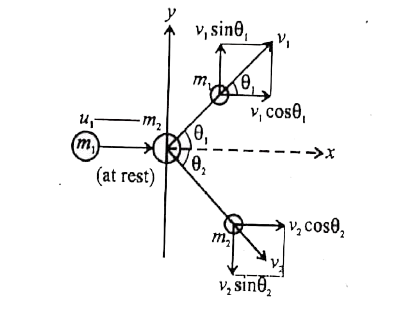 After the COLLISION, the rectangular components of the momentum of `m_(1)` are (i) `m_(1)v_(1)costheta`, along positive x axis (II) `m_(1)v_(1)sintheta`, along positive y axis After the collision, the rectangular components of themomentum of `m_(2)` are (i) `m_(2)v_(2)costheta`, along positive x axis `m_(2)v_(2)sintheta`, along positive y axis Applying the law of conservation of momentum along x axis we get, `m_(1)u_(1)=m_(1)v_(1)costheta_(1)+m_(2)v_(2)costheta_(2)""...(1)` The initial momentum of `m_(1)` or `m_(2)` along y axis is ZERO. Applying the principle of conservation of momentum along y axis we get, `0=m_(1)thetasintheta_(1)+m_(2)v_(2)sintheta_(2)....(2)` In this problem, a particle elastically collides OBLIQUELY with a particle of same mass at rest. So the two particles are identical. `therefore m_(1)=m_(2)=m` (say) By conservation of kinetic energy for elastic collision we get, `(1)/(2)m u_(1)^(2)=(1)/(2)mv_(1)^(2)+(1)/(2)mv_(2)^(2)[becauseu_(2)=0]` Dividing by `(1)/(2)m_(2)` we get `therefore u_(1)=v_(1)^(2)+v_(2)^(2)""...(3)` By conservation of linear momentum we get `mvecu_(1)=mvecv_(1)+mvecv_(2)` Dividing by m we get `vecu_(1)=vecv_(1)+vecv_(2)""...(4)` Then `vecu_(1).vecu_(1)=(vecv_(1)+vecv_(2))(vecv_(1)+vecv_(2))` `=vecv_(1).vecv_(1)+vecv_(1).vecv_(2)+vecv_(2).vecv_(1)+vecv_(2).vecv_(2)` or `u_(1)^(2)=v_(1)^(2)+v_(2)^(2)+2vecv_(1)vecv_(2)""...(5)` But from (3) `v_(1)^(2)+v_(2)^(2)=u_(1)^(2)` `therefore` Equation (5) becomes `u_(1)^(2)=u_(1)^(2)+2vecv_(1)vecv_(2)` `therefore vecv_(1)vecv_(2)=0` This shows that the angle between `vecv_(1) and vecv_(2)` is `90^(@)`. Hence two identical particles move perpendicular to each other after collision in two dimensions. |
|
| 10. |
If a body of mass 36gm moves with S.H.M of amplitude A=13 cm and period T = 12sec. At a time t = 0 the displacement is x = +13cm. The shortest time of passage from x= +6.5cm to x = - 6.5 is |
|
Answer» 4 sec |
|
| 11. |
The escape velocity of a body on the earth's surface is v_e. A body is thrownup with a speed of kv_(e), where k gt 1, Assuming that the sun and planets do not influence the motion of the body, then the velocity of the body at the infinite distance in |
|
Answer» `(v_e)/(sqrt(K^(2)-1))` |
|
| 12. |
Three masses of 16 kg, 8 kg and 4kg are placed in contact as shown in Figure. If a force of 140 N is applied on 4kg mass, then the force on 16kg will be |
| Answer» Solution :`F=ma, a=(F)/(m_(1)+m_(2)+m_(3))` | |
| 13. |
How does the value of modulus of elasticity change due to increase in temperature? |
| Answer» Solution :In most CASES, the value of elastic MODULUS DECREASES slightly due to increase in temperature. | |
| 14. |
the presseure inside th receiver of an air pump is reduced to 1/4 of the initial pressure after 3 strokes. What will be the pressure after8 strokes ? |
|
Answer» |
|
| 15. |
5 moles of Hydrogen (gamma =(7)/(5)) initially at STP are compressed adiabatically so that its temperature becomes 400^(@)C. The increase in the internal energy of the gas in kilo-joule is [R =8.30 J mol^(-1)K^(-1)] |
|
Answer» 21.55 |
|
| 16. |
(A) In multiplication or division, the final result should retain only that many significant figures as are there in the original number with the least number of significant figures. (B) In addition or subtraction the final result should retain only that many decimal places as are there in the number with the least number of decial places. |
|
Answer» Only A is correct |
|
| 17. |
A cylinder of mass 10 kg and radius 15 cm is rolling perfectly on a plane of inclination 30^(@). The coefficient of static friction is mu_(k)=0.25 (a) How much is the force of friction acting on the cylinder ? (b) What is the work done against friction during rolling? (c) If the inclination of plane is increased, at what value of does the cylinder begin to skid and not roll perfectly? |
| Answer» SOLUTION :(a)6.4N,(B)0,(C)`37^(@)` | |
| 18. |
(A) Collision doesn't require physical contact (B) Collision between sub atomic particles is elastic (C ) Collision between macroscopic bodies is generally inelastic |
|
Answer» A and C are true |
|
| 19. |
If the law of gravitation, instead of being inverse square law, becomes an inverse cube law |
|
Answer» planets will not have elliptic orbits `F = (GMm)/r^2 = (m^2)/r` `:.` v = orbtial speed `=sqrt(GM)/r implies v prop 1/r` Time period of revolution of planet, `T= (2pir)/v = (2pir)/((sqrtGM)/r) = (2pir^2)/(sqrt(GM))` `T^(2) prop r^4` Hence, orbit will not be ELLIPTICAL. [for elliptical orbit `T_2 prop r^3` ] As force `F = ((GM)/r^2) m = gm ` where `g. = (GM)/r^2` As g., acceleration due to gravity is constant, hence path followed by a projectile will be approximately parabolic. |
|
| 20. |
Trajectory of particle in projectile motion is y=(x-x^(2)//80), x and y are in metre. Projectile range is on horizontal plane. |
|
Answer» `y=(x-(x^(2))/(80)), theta=45^(@)` `U^(2)=800` `u=sqrt(800)` `u_(y)=u_(y)-gt` `u_(y)=20-10` `u_(y)=10 , v_(x)=20` `tan theta=(1)/(2) rArr theta=tan^(-1)((1)/(2))` |
|
| 21. |
Asserion: Magnitude of the resultant of two vectors may be less than the magnitude of either vector. Reason: The resultant of two vectors is obtained by means of law of parallelogram of Vectors. |
|
Answer» `R = SQRT(a^(2) + b^(2) + 2AB cos THETA)` which is less than both a and b, when they are nearly EQUAL. |
|
| 22. |
A semicircular ring of mass m and radius r is relesed from rest in the position shown with its lower edge resting on a horizontal surface. Minimum coefficient of static friction mu_(s) which is necessary to prevent any initial slipping of the ring is x/10, value of x is |
|
Answer» 2 |
|
| 23. |
The force between two objects decreases by 36% when the distance between them is increased by 4 m. Find the original distance between them. |
| Answer» SOLUTION :ORIGINAL DISTANCE = 16M | |
| 24. |
A circular disc is rotating about its own axis at uniform angular velocity omega. The disc is subjected to uniform angular retardation by which its angular velocity is decreased to omega//2 during 120 rotations., The number of rotations further made by it before coming to rest is |
|
Answer» 120 |
|
| 25. |
{:(1.,"The bullet fired from Gun",-,"a)","Bernoull's theorem"),(2.,"Cricket player catches the ball", -,"b)", "Resonance"),(3.,"Breaking of glass due to sound",-,"c)","Illustration of impulse"),(4.,"Venturimeter",-,"d)","Projectile"):} |
|
Answer» `{:("(1)","(2)","(3)","(4)"),( b, C, d, a):}` |
|
| 26. |
A particle at rest starts moving in a horizontal straight line with uniform acceleration The ratio of the distance covered during the fourth and the third second is |
|
Answer» `(4)/(3)` Distance travelled during 4th second `S_(1)=(1)/(2)a(8-1)` Distance travelled during 3rd second `S_(2)=(1)/(2)a(6-1)` `:.(S_(1))/(S_(2))=(7)/(5)` |
|
| 27. |
The binding energy of a satellite of mass m in a orbit radius r is (R = radius of earth, g = acceleration due to gravity) |
|
Answer» `(MGR^(2))/(r)` |
|
| 28. |
By accepting a equation of friction force F=mgsintheta{(k^(2))/(k^(2)+R^(2))} derive an expression for the static friction of rolling body from the slope. |
|
Answer» SOLUTION :As shown in figure the normal reaction N nad `mgcostheta` BALANCE each other `therefore N=mgcostheta""......(6)` Taking the ratio of equation (5) and (6) `(F)/(N)=[(K^(2))/(k^(2)+R^(2))]TANTHETA` But `(F)/(N)=mu_(s)` (co-efficient of static friction) `therefore mu_(s)={(k^(2))/(k^(2)+R^(2))}tantheta` `={(1)/(1+(R^(2))/(k^(2)))}tantheta""....(7)` |
|
| 29. |
Two bars A and B of circular cross section and of same volume made of same material are subjected to tension. If the diameter of A is half that of B and if the force applied to both the rods is the same and it is in the elastic limit the ratio of extension of A to that of B will be |
|
Answer» 16 |
|
| 30. |
In measuring .g. usinga simple pendulum a student makes a positive error of 1% in length of pendulum and a negative error of 3% in the value of time period. Percentage error in measurement of value of g is |
| Answer» Answer :C | |
| 31. |
A satellite is moving in a circular orbit around the earth with a speed equalt to half the escape speed from the earth. If .R. is the radius of the earth, then the height of the satellite above the surface of the earth is |
|
Answer» R/2 |
|
| 32. |
Taking velocity, time and force as the fundamental quantities, find the dimensions of mass. |
|
Answer» Solution :`"FORCE "="Mass"XX"ACCELERATION"` `="Mass "xx("Velovity")/("Time")` `"orMass "=("Force"xx"Time")/("Velocity")` `THEREFORE "[Mass] "[FTV^(-1)]` |
|
| 33. |
The mean distance of a planet from the sun is apprximately 1/4 times that of earth from the sun. Find the number of years required for planet to make one revolution about the sun. |
|
Answer» SOLUTION :Given `r_(P)=1/2r_(E)` and `T_(E)=1` yr From Kepler.s third law `T^(2) alpha r^(3)` `((T_(P))/(T_(E)))^(2)=((r_(P))/(r_(E)))^(3)impliesT_(P)=T_(E)((r_(P))/(r_(E)))^(3/2)` `T_(P)=(1)((r_(E))/(4r_(E)))^(3/2)=(1/4)^(3//2)=0.125` yrs |
|
| 34. |
(M)/(Vr) has the dimensions of (M= Magnetic moment, V= Velocity, r= radius) |
|
Answer» POLE strength |
|
| 35. |
A uniform rod of length b can be balanced as shown in figure. The lower end of the rod is resting against a vertical wall. The coefficient of friction between the rod and the wall and that between the rod and the support at A is mu. Distance of support from the wall is a. (a) Find the ratio (a)/(b) if the maximum value of theta is theta_(1). (b) Find the ratio (a)/(b) if the minimum value of theta is theta_(2). |
|
Answer» (b) `(a)/(b) = (1)/(2) sin^(2) theta_(2) [(1 - mu^(2)) sin theta_(2) + 2 mu cos theta_(2)]` |
|
| 36. |
(A) : There are some passengers in a stastionary compartment. A physical fight takes place between them because of different opinions. The position of c.m of system will not change.(R ) : The fight between passengers is internal force. |
|
Answer» Both (A) and (R ) are true and (R ) is the correct EXPLANATION of (A) |
|
| 37. |
A particle executes simple harmonic motion with an amplitude A. The period of oscillation is T. The minimum time taken by the particle to travel half of the amplitude form the equilibrium position is……….. |
|
Answer» `(T)/(2)` `y= a SIN ((2pi)/(T))t` For `y= (a)/(2), (a)/(2)= a sin ((2pi)/(T))t` `therefore (1)/(2)= sin (PI)/(6) = sin [((2pi)/(T))t]` `therefore t((2pi)/(T))= (pi)/(6)` `therefore t= (T)/(12)` is minimum. |
|
| 38. |
Which two of the following five physical parameter have the same dimension |
|
Answer» (a) and (d) |
|
| 39. |
In first case a srpings of ofrce constant K is fixed at one end a block of mass m is attahced to its other end and is placed on a horizontal frictionaless surface . In second case ,a similar springs with both ends free has a block of mass m attached to each of its ends. Each mass is streched by teh same force F in both the cases . If the mass in first released , then which of the following statement is true? |
|
Answer» The maximum extension of springs is equal in both cases .  The given situation is First case :  Second case : Maximum extension x produced in a spring is given by `F = kx` `rArr x = K//x` Time period of oscillation is `T = 2pisqrt((m)/(K))` In first case , one end is fixed to the wall. So, when force F is applied to block at FREE end in the direction shown, the spring is STRETCHED by exerting a force on the wall which is turn exerts ss equal and opposite reaction force no the spring. So, as a result, every coil of the spring is elongated, producing net extension x. In second case, both ends are free, so reaction force is absent. So, when force F is applied at each end in opposite directions, every coil of the spring is not elongated.  The mid point of coil is not elongated. This is equivalent to two springs, each of length l/2 are joined together at O. Now force applied at end A will produce an extension x//2 in OA and similarly force F applied at end B produces extension x/2 in part OA. `THEREFORE` The total extension in spring =`(x)/(2)+ (x)/(2) = x` so, in both first and second case, maximum extension produced is same. Option (a) is correct. For half spring OA or OB, force constant= 2K , `therefore` Time period, `T. = 2pisqrt((m)/(2K))` `rArr T = (T)/(sqrt(2))` |
|
| 40. |
A hemispherical bowl of radius r is rotated with an angular velocity omega about a vertical axis passing through its centre. An object with the same angular velocity remaining attached with the inner surface of the bowl. The straight line joining the body and the centre of the bowl makes an angle 45^(@) with the vertical. The coefficient of friction between the body and the bowl is 0.2, Assuming the body is just about to move down along curved surface of the bowl, prove that omega^(2) r = 0.943 g. |
|
Answer» Solution :The hemisphere is rotated about the vertical AXIS AO with an angular velocity `omega`. The forces acting on the BODY at point P are shown in the . When the body is just about to move down. mg = n cos`THETA + mu "n cos " theta` or, `""mg = n(cos theta + mu sin theta)""`...(1) and `"" m omega^(2) r sin theta = n sin theta - mu" n sin" theta ` or,`""m omega^(2) r = n(1 - cot theta)""`...(2) From (1) and (2), we get ` (omega^(2) r)/(g) = (1 - mu cot theta)/( cos theta + mu sin theta)` = `(1 - 0.2 cot 45^(@))/(cos45^(@) + 0.2 sin 45^(@) ) [ because mu = 0.2 and theta = 45^(@) ]` `therefore "" omega^(2) r = 0.943 g` 
|
|
| 41. |
Two similar equal magnetic poles when separated by a distance of 1 m, |
| Answer» Answer :D | |
| 42. |
A tank is filled with water upto a height H. A hole is punched in one of the walls at a depth h_1below the water surface. (a) Find the distance from the foot of the wall at which the stream strikes the floor. (6) Is it possible to make second hole at another depth so that this second stream also has the same range? If so find its depth ? |
|
Answer» Solution : Using Torricelli.s theorem the VELOCITY of efflux ` v= sqrt( 2gh ) ` Let R be the horizontal distance covered in a time inerval t. ` "" R= vt = sqrt( 2gh_1)` t The vertical height covered in the time t is `H - h_1` ` ""s = ut +(1)/(2)at ^(2)= 0 xx t +(1)/(2)gt^(2)` ` "" t= sqrt((2s)/(g))= sqrt( (2(H-h_1))/( g))` ` R = sqrt( 2gh_1) xx sqrt((2(H-h_1))/( g)) =2 sqrt(h_1(H-h_1))` Let the SECOND hole be directed at a depth h, below the free surface of water. Then the new range is ` 2sqrt(h_2( H-h_2)).`by the above procedure. ` ""R = 2 sqrt( h_1( H-h_1)) = 2 sqrt( h_2(H-h_2))` ` "" h_1H= h_1^(2)=h_2 H- h_2^(2)` `( h_2-h_1)(H-h_2-h_1)= 0 ` ` "" h_2= h_1 or h_2= H-h_1` The second hole is at a depth `H- h_1` from the free surface of water so that its ALSO gives the same range. |
|
| 43. |
A body moves along a circular path of radius 5m. The coefficient of friction between the surface of the path and body is 0.5. The angular velocity is radian s^(-1) with which the body should move so that it does not leave the path is (g=10 ms^(-2)) |
|
Answer» 4 |
|
| 44. |
A projectile is fired with kinetic energy 1kJ. If the range is maximum, what is its kinetic energy, at the highest point ? |
|
Answer» Solution :Here `(1)/(2)mv^(2)=1kJ=1000J,theta=45^(@)` At the highest POINT K.E. `=(1)/(2)m(vcostheta)^(2)=(1)/(2)(mv^(2))/(2)=(100)/(2)=500J` |
|
| 45. |
A drilling machine is used to drill a hole in a 10 kg metal block. Power of the drilling machine is 1 KW and it is used for 5 minutes. If 40% of the work done by the drilling machine is converted into heat in the metal block, the rise in its temperature is (specific heat -0.12 cal gm ""^(-1)""^(@) C^(-1) and J = 4.2J//"Cal" ) |
|
Answer» `20^(@) C` |
|
| 46. |
Usingnewton 's laws calculate the tension acting on the mango haging from a tree |
|
Answer» Solution :(i) A suitableinertial coordinatesystemis selectedto analysethe problem.formost of the casewe cantakeEarthas aninertialcoordinatesystem. (ii) Identifythe systemto whichNewton'slawsneedto beapplied. (iii) The freebodydiagram is drawn (IV)Oncethe forcesactingon thesystemareidentifiedand THEFREE bodydiargramisdrawn , applyNewton'ssecondlaw. It the lefthandsideof teh equation, therighthandsideof equation WHICHIS theproductof massandacceleration .Hereacceleratin shouldalsobe in vectornotation. (V )IfAccelerationis giventhen theforcecan becalculated. If theforce is givenaccelerationcan becalculated.  By followingthe abovesteps: The inertialcoordinatesystemon the groundis fixedas shownin the figure.  Theforces actingon themangoare (i) Gravitationalforceexertedby the Earthon themangoactingdownwardsalongnegativey -axis. (ii)tensionactgsupwardsalongpositivey-axis Thefree bodydiagramfor themangois shon in thefigure  heremg isthe magnitudeof the gravitationalforceand `(-hat(j))` representsthe unitvectorin negativey direction Sincethe mangois at rest withrespect to ustheaccelerationis ZERO`(vec(a)= 0)` By comparingthe componentson bothsidesof theaboveequationwe get `T- mg = 0` Mass of the mangom= 400gandg=9.8 `ms^(-2)` Tensionactingon themangois`T= 0.4 xx 9.8= 3.92 N` |
|
| 47. |
How many light years are there in one meter? |
|
Answer» Solution :`"1 light YEAR"=9.46xx10^(15)m` `"1 METER "=(1)/(9.46xx10^(15))` `=1.057xx10^(-16)" light year."` |
|
| 48. |
At what height above the earth's surface, the value of g is half of its value on the earth's surface? Its given radius is 6400km. |
|
Answer» G |
|
| 49. |
The velocity of a body revolving in a vertical circle of radius 'r' at the lowest point sqrt(7gr). The ratio of maximum to minimum tensions in the string is |
| Answer» ANSWER :B | |
| 50. |
A particle slides along a track with elevated ends and a flat central part as shown in Fig. The flat part has a length l = 3.0 m. The curved portions of the track are frictionless. For the flat part the coefficient of kinetic friction is mu_(k)=0.20, the particle is released at point A which is at height h = 1.5 m above the flat part of the track. Where does the particle finally come to rest ? |
|
Answer» Solution :As initial Mechanical Energy (ME) of the particle is mgh and FINAL is zero, so loss in ME = mgh. This ME is LOST in doing work against FRICTION in the flat part, so loss in ME = WD against friction `mgh = mu mgs`  i.e., `s=(h)/(mu)=(1.5)/(0.2)=7.5m` After starting from B the particle will reach C and then will rise up till the remaining KE at C is converted into potential energy. It will then again DESCEND and at C will have the same value as it had when ascending, but now it will move from C to B , the same will be repeated and finally the particle will come to rest at E such that `BC+CB+BE=7.5=3+3+BE=7.5` B = 1.5 So the particle comes to rest at the centre of the flat part. |
|