

Saved Bookmarks
This section includes 7 InterviewSolutions, each offering curated multiple-choice questions to sharpen your Current Affairs knowledge and support exam preparation. Choose a topic below to get started.
| 1. |
A small sphere of radius r and density rho falls from rest in a viscous liquid of density gamma and coefficient of viscous eta. Due to friction heat is produced. The rate of production of heat when the sphere has acquired the terminal velocity is proportional to |
|
Answer» `r^2` |
|
| 2. |
The path difference between the two waves y_(1) = a_(1) sin (omega t - (2pi x)/(lambda)) and y_(2) = a_(2) cos (omega t - (2pi x)/(lambda) + phi) is ………. |
|
Answer» `(lambda)/(2pi)"" PHI` |
|
| 3. |
A circular disc of mass 300 gm and radius 20 cm can roate freely about a vertical axis passing through its centre of O.A small inset of mass 100 gm is initially stationary) the insect starts walking from rest along the rim of the disc with such a time varying relative velocity that the disc rotates in the opposite direction with a constant angular acceleration = 2 pi rad//s^(2). After some time T, the insect is back at the point A. By what angle has the disc rotated till now , as seen by a stationary earth observer ? Also find the time T. |
Answer» 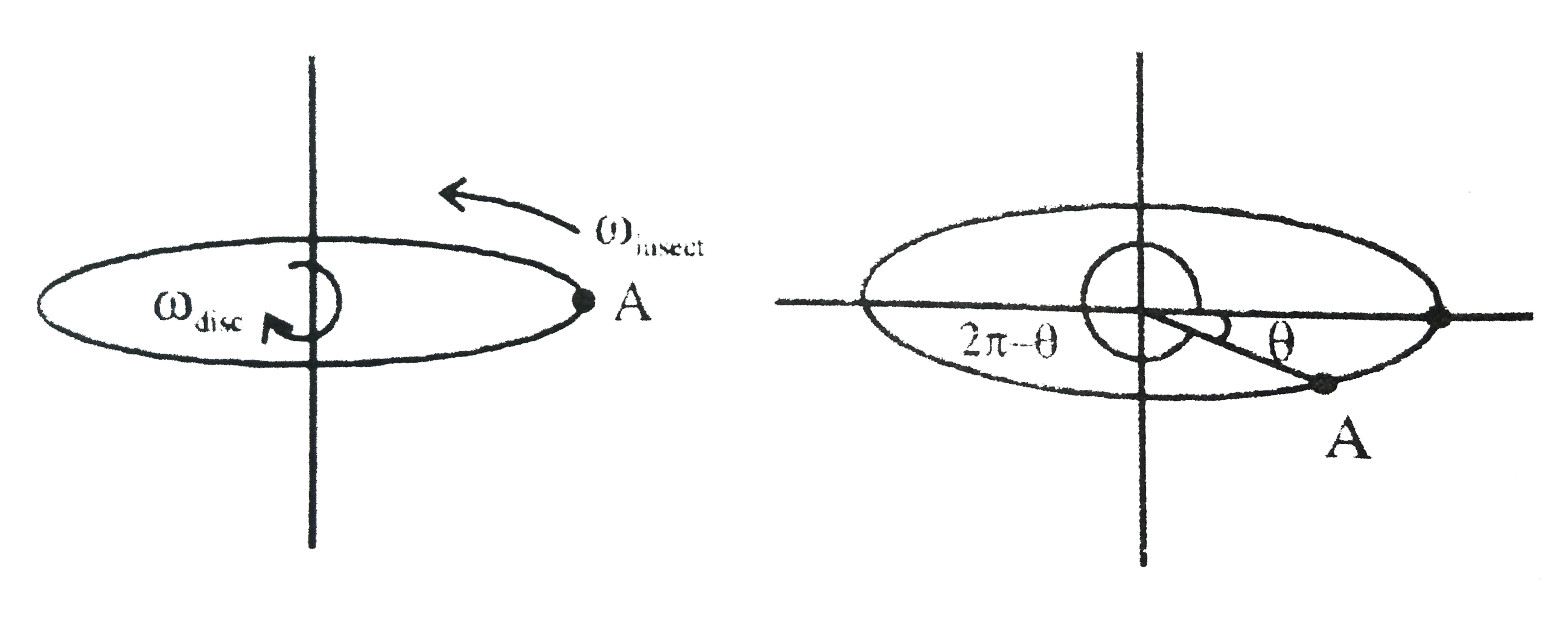 `I_("disc") omega_("disc") = I_("insect") omega_("insect") rArr I_("disc") alpha_("disc") = I_("insect") alpha_("insect")` `(1)/(2) xx(0.3) xx(0.2)^(2) xx 2 PI = (0.1) xx (2)^(2) xx alpha_("insect")` `alpha_("insect") = 3 pi RAD//sec^(2)` Angular covered by disc `= THETA`, so angle covered by insect `= 2 pi - theta` For disc `theta = (1)/(2) alpha_(disc) T^(2)` `theta = (1)/(2) xx 2 pi T^(2) rArr T^(2) = theta//pi` For insect `2 pi - theta = (1)/(2) alpha_(insect) T^(2)` From equation (1) and (2) `2PI - theta = (1)/(2) xx 3 pi xx (theta)/(pi) rArr 2 pi -theta = (3 theta)/(2)` `theta = (4 pi)/(5) rad`. |
|
| 4. |
What is effect due to latitude on the acceleration due to gravity of any place on the earth? |
| Answer» Solution :`implies` As we MOVE from EQUATOR to POLES, latitude increases hence g increases. | |
| 5. |
A man standing near a railway line hears the whistle of an engine, which has a velocity of 20 ms^(-1) What frequency does the man hear , when the engine is coming towards and going away from him, if the true frequency of the whistle is 1000 Hz.Speed of sound in air =340 ms^(-1). |
|
Answer» |
|
| 6. |
The’ raincoats are made water proof by coating with a material, which |
| Answer» Solution :The ANGLE of CONTACT between water and the MATERIAL of the rain coat is OBTUSE. So the rain water does not wet the rain coat. | |
| 7. |
Let us assume that our galaxy consists of 2.5 × 10^(11) stars each of one solar mass. How long will a star at a distance of 50,000 ly from the galactic centre take to complete one revolution? Take the diameter of the Milky Way to be 10^(5) ly. |
| Answer» SOLUTION :`3.54 ×x 10^(8)` YEARS. | |
| 8. |
A large ice berg melts at the base and not at the top because |
|
Answer» The base of the iceberg is slightly warm |
|
| 9. |
A rod of length 1.05 m having negligible mass is supported at its ends by two wires of steel (wire A) and aluminium (wire B) of equal lengths as shown in figure. The cross-sectional areas of wires A and B are 1.0 mm^(2) and 2.0 mm^(2), respectively. At what point along the rod should a mass m be suspended in order to produce (a) equal stresses and (b) equal strains in both steel and aluminium wires. |
|
Answer» Solution :Let system 1 for streel and 2 for aluminium, Length of steel WIRE `A, l _(1) = l` Area of cross section of steel wire `A _(1) = 1 mm ^(2)` Young.s modulus of steel wire `Y_(1) = 2 xx 10 ^(11) Nm ^(-2)` 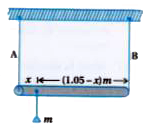 Length of aluminium `l _(2) =l` Area of cross-section `A _(2) =2mm ^(2)` Young.s modulus `Y_(2) = 7 xx 10 ^(10) Nm ^(-2)` (a) Let mass m be suspended from the rod at distance x from the end. Let `F_(1) and F_(2)` be the tension in two wires and there is equal stress in two wires then, `therefore (F _(1))/(A _(1)) = (F_(2))/(A _(2))` `therefore (F _(1))/(F_(2)) = (A_(1))/(A_(2))` `therefore (F _(1))/(F_(2)) = 1/2 ""...(1)` Taking MOMENT of forces about the point of suspension of mass from the rod. `F_(1) x =F_(2) (1.05 -x)` `therefore (F_(1))/(F _(2))= (1.05 -x)/(x)` `therefore 1/2 = (1.05 -x)/(x) ""[because` From equation (1)] `therefore x =2.1 -2x` `therefore 3x =2.1` `therefore x =0.7 m or x = 70 cm` (B) Let mass m be suspended from the rod at distance x from the end. There is equal STRAIN in two wires, `Y = (F //A)/( EPSI _(l ))` where `epsi _(l) =` longitudinal strain `therefore epsi _(l) = (F)/(AY)` `therefore` For steel wire `: (epsi _(l)) _(1) = (F_(1))/( A _(1) Y_(1))` For aluminium wire `: (epsi _(l)) _(1) = (F_(1))/( A _(1) Y_(1))` For aluminium wire `: (epsi _(l)) _(2) = (F_(2))/(A_(2) Y_(2))` but `(epsi l ) _(1) = (epsi _(l)) _(2)` `therefore (F._(1))/(A _(1) Y _(1)) =(F._(2))/(A _(2) Y_(2))` `therefore (F ._(1))/(F ._(2)) = (A_(1)Y _(1))/( A _(2) Y _(2))` `= 1/2 xx (2 xx 10 ^(11))/( 7 xx 10 ^(10))` `(F._(1))/(F ._(2)) = (10)/(7)""...(2)` Taking moment of force about the point of suspension of mass from the rod, `F._(1) x = F ._(2) (1.05 -x)` `therefore (F._(1))/(F._(2)) = (1.05 -x)/(x)` `(10)/(7) = (1.05 -x)/(x) ""[because `From equation (2)] `therefore 10 x =7.35 -7x` `therefore 17 x -7.35` `therefore x = (7.35)/(17) =0.43235 m or ~~43.2 cm` |
|
| 10. |
The wavelength of maximum energy released during an atomic explosion was 2.93xx10^(-10)m. Given that Wein's constant is 2.93xx10^(-3)m-K, the maximum temperature attained must be of the order of |
|
Answer» `10^(-7)` K |
|
| 11. |
A physical quantity 'P'is given by P = in_0L(DeltaV)/(Deltat), where in_(0) is electric permittivity, L is length, DeltaV is potential difference and Delta t is time interval. The dimensional formula of P is same as that of |
|
Answer» RESISTANCE |
|
| 12. |
From the top of a tower of height 100m a 10 gm block is dropped freely and a 6gm bullet is fired vertically upwards from the foot of the tower with velocity 100ms^(-1) simultaneously. They collide and stick together. The common velocity after collision is (g = 10 ms^(-2)) |
| Answer» Answer :A | |
| 13. |
In certain ranges of a piano keyboard , more than one string is tuned to the same note to provide extra loudness . For example , the note at 110 Hz has two strings at this frequency . If one string slips from its normal tension of 600 N "to" 540 N , what beat frequency is heard when the hammer strikes the two strings simultaneously ? |
|
Answer» Solution :Directly noticeable beat frequencies are usually only a few hertz , so we should not except a frequency much greater than this . Combining the VELOCITY and the tension equations `v = f lambda and v = sqrt (T//mu)` , we find that the frequency is ` f= sqrt((T)/( mu lambda^(2)))` Since ` mu and lambda ` are constant , we can apply that equation to both frequencies , and then DIVIDE the two equaitons to GET the proportion . ` (f_(1))/(f_(2)) = sqrt ((T_(1))/(T_(2)))` With ` f_(1) = 110 HZ , T_(1) = 600 N , and T_(2) = 540 N , we have f_(2) = ( 110 Hz) sqrt(( 540 N))/( 600 N) = 104.4 Hz` The beat frequency is `f_(b) = { f_(1) - f_(2)| = 110 Hz - 104.4 Hz = 5.6 Hz` As excepted , the beat frequency is only a few cycles per second . |
|
| 14. |
Force constants of two wires A and B of the same material are k and 2k respectively. If the two wires are stretched equally, then the ratio of workdone in stretching (W_A//W_B)is |
|
Answer» `1/4` |
|
| 15. |
What is the value of the refractive index fora 90^@-45^@-45^@ prism which is used to deviate a beam through 90^@ by total internal reflection? |
|
Answer» Solution :At face AB the ray of light suffers no deviation if the INCIDENT normally. At face AC, the light ray UNDERGOES TIR, so angle of incidence at the face AC is greater than critical angle `45^@ gt C, sin 45^@ gt sin C, 1/SQRT2 gt 1/mu, mu gt sqrt2` 
|
|
| 16. |
Discuss the effect of rolling on inclined plane and derive the expression for the acceleration. |
|
Answer» Solution :Acceleration of the rolling object : (i) From the figure, it is seen that the component of gravitatinal force (mg cos`theta`) perpendicular to inclined plane is balanced by the normal force N. Therefore, the component of GRAVITATIONAL force (mg sin`theta`) parallel to inclined plane and the frictional force f, combinely causes the motion. (iii) For translational motion, `mg sin theta - f = ma""...(1)` (IV) For rotational motion, let us take a torque with respect to the center of the object. mg sin`theta` cannot make any torque as it PASSES through the center of the object, but the frictional force f can set a torque as, `tau = Rf` (v) But we know, `tau = I alpha`, thus, `Rf = I alpha` (vi) Substituting, the ANGULAR acceleration `alpha = (a)/(R)` and the moment of inertia `I = mK^(2)`, we get, `Rf = mK^(2) (a)/(R)` `f = ma ((K^(2))/(R^(2)))""...(2)` (vii) Substituting equation (2) in (1), we have, `mg sin theta - ma ((K^(2))/(R^(2)))=ma` `mg sin theta = ma + ma ((K^(2))/(R^(2)))` `a (1+(K^(2))/(R^(2))) = g sin theta` (vii) After REWRITING it for acceleration, we get `a = (g sin theta)/((1 + (K^(2))/(R^(2))))` |
|
| 17. |
Which of the following diagrams does not represent a streamline flow ? |
|
Answer»
|
|
| 18. |
Which of the following functions of time represent (a) simple harmonic motion and (b) periodic but not simple harmonic? Give the period for each case. I) sinomegat-cosomegat 2) sin^(2)omegat |
|
Answer» Solution :`sinomegat-COSOMEGAT= sqrt(2)[(1)/(sqrt(2))sinomegat-(1)/(sqrt(2))cosomegat]= sqrt(2)[sinomegatcos((pi)/(4))-cosomegatsin((pi)/(4))]= sqrt(2)sin(omegat-pi//4)` This function REPRESENTS a simple HARMONIC motion having a period `T= (2pi)/(omega)` and a PHASE angle `(pi//4)` or `(7pi//4)` 2) `sin^(2)omegat= (1-cos2omegat)/(2)= (1)/(2)-(1)/(2)cos2omegat` The function is periodic having a period `T = T//omega`. It also represents a harmonic motion with the point of EQUILIBRIUM occurring at `1//2` instead of zero. |
|
| 19. |
The centripetal force is |
|
Answer» `(mv^2)/(R )` |
|
| 20. |
PV = nRT holds good for a) Isobaric process b) lsochoric process c) Isothermal process d) Adiabatic process |
| Answer» ANSWER :D | |
| 21. |
If you place your hands on a wooden and a metal chair at the same temperature, lower than your body temperature, which of them do you find hotter? |
| Answer» SOLUTION :The WOODEN CHAIR. | |
| 22. |
If a stone of mass 0.25 kg tied to a string executes uniform circular motion with a speed of 2 ms^(-1)of radius 3 m, what is the magnitude of tensional force acting on the stone? |
| Answer» SOLUTION :`F_(cp) = (14 xx (2)^2)/(3) = 0.333 N` | |
| 23. |
Two blocks A and B of masses 2m & m are corrected by a massless and inextensible string, The magnitudes of acceleration of A and B immediately after the string is cut are ………………. |
|
Answer» `(g)/(2),g` `2ma_(A) = 3 mg - 2 mg` `a_(A) = (mg)/(2m) = (a)/(2)` FBD of .m. `ma_(B) = mg` `a_(B) = g` 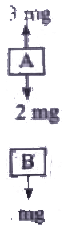
|
|
| 24. |
Two particles of masses m_1 and m_2 are joined by a light rigid rod of length r. The system rotates at an angular speed omega about an axis through the centre of mass of the system and perpendicular to the rod. Show that the angular momentum of the system is L=mur^2omega where mu is the reduced mass of the system defined as mu=(m_1m_2)/(m_1+m_2) |
|
Answer» SOLUTION :`L = Iomega, I = m_(1)r_(1)^(2) + m_(2)r_(2)^(2), l=r=r_(1)+r_(2)` `m_(1)r_(1) = m_(2)r_(2)=m_(2)(r-r_(1)), r_(1)=m_(2)r//m_(1) + m_(2)` `r_(2) = m_(1)r//m_(1) + m_(2),I =m_(1)m_(2)r^(2)//m_(1) + m_(2) = MUR^(2)`, Here `r=l, L = Iomega = MUL^(2)OMEGA` |
|
| 25. |
Two satellites of same mass of a planet in circular orbits have periods of revolution 32 days and 256 days. If the radius of the orbitof the first is R, then the |
|
Answer» RADIUS of the orbitof the SECOND is 8R |
|
| 26. |
An object falls freely from rest. It covers the same distance in last second. Which is covered in first 3 seconds, then in .............., it will reach the ground. |
|
Answer» 3s `therefore` Distance covered in `n^(th)` second, `therefore In d _(n) = V _(0) + g/2 (2n -1) , v _(0) =0` `therefore d _(n) = (10)/(2) (2n -1)` `therefore d _(n) = 10 n -5 ""..(i)` and distance covered in first three seconds, `S_(3) = v _(0) t +1/2 g t ^(2) and v_(0) =0, t = 3s, g = 10 MS ^(-2)` `therefore S_(3) =0 xx 3 + 1/2 xx 10 xx 9` `therefore S_(3) = 45M""...(ii)` For given condition `d_(n) = S_(3)` `therefore 10 n - 5=45` `therefore 10n=50` `therefore n = 5s` |
|
| 27. |
The dimensional formula for moment of couple is |
|
Answer» `M^(1)L^(2)T^(-1)` |
|
| 28. |
A 40 N block is supported by two ropes. One rope is horizontal and the other makes an angle of 30^(@) with the ceiling. The tension in the rope attached to the ceiling is approximately : |
| Answer» Solution :`T_(1)=F cos theta, T_(2)=F sin theta, T=sqrt(T_(1)^(2)+T_(2)^(2))` | |
| 29. |
If I is moment of inertia of a disc about an axis passing through its centre then change in moment of inertia due to smal change in its temperatureDeltat is (alpha is coefficient of linear expansion). |
|
Answer» Solution :LET `I=(MR^(2))/(2)` then `DELTAI=(M)/(2) 2R DeltaR` `(DeltaI)/(I)=(MR DeltaR)/(MR^(2)//2)=2(DeltaR)/(R )` but `(DeltaR)/(R )=ALPHA Deltat RARR (DeltaI)/(I)=2alpha DeltaT and DeltaI=2I alpha Deltat`. |
|
| 30. |
Check the correctness of the equation W=1/2mv^(2)-1/2"mu"^(2) using the dimensional analysis, where W is the work done, m is the mass of body,u-its initial velocity and v its final velocity. |
|
Answer» |
|
| 31. |
A square frame of side 8 cm is dipped in soap solution and then removed so that a thin film forms on it. What will be the force acting on each side of the frame due to surface tension ? Surface tension, T=26.5 dyn. Cm^-1 |
| Answer» SOLUTION :`424 DYN` | |
| 32. |
The refractive index of a material of a plano concave lens is 5//3 the radius of curvature is 0.3m. The focal length of the lens in air is |
|
Answer» `-0.45 m` |
|
| 33. |
Calculate the thermal efficiency and compression ratio of a petrol engine, if the suction temperature was 375 K and the temperature at the end of the compression was 577 K (y = 1.41) |
| Answer» SOLUTION :`T _(1) = 375 K,T _(2) =572 K, eta = 1 - [1// T _(2) //T_(1)] = 1 - (1//1.538) = 0. 35 RHO = ((T _(2))/( T _(1))) ^((1)/( gamma -1)) = 2.8` | |
| 34. |
(I) If the speed of the object in a circular motion is not constant, it is called a non - uniform circular motion. (II) Acceleration which is acting away from the centre of the circle is called Centripetal Acceleration. Which statement is in correct? |
|
Answer» I only |
|
| 35. |
The angular speed of the minutes arm of a dock is |
|
Answer» `pi/30radS^-1` |
|
| 36. |
An infinitely along rod lies along the axis of a concave mirror of focal length f. the near end of the rod is at a distance u gt f from the mirror. Its image will have a length. |
|
Answer» `(UF)/(u-f)` |
|
| 37. |
Find the angular momentum of a satellite of mass m moving round the earth of mass m if its orbital radius is r, assuming it to be circular. Express it in terms of G, M, m and r, where G is the universal gravitational constant ? |
| Answer» Solution :`L = mvr, GMm//R^(2) =mv^(2)//r, V =(GM//r)^(1//2), L =m xx (GMllr)^(1//2) xx r =(GMm^(2)r)^(1//2)` | |
| 38. |
A car is moving with a uniform velocity along a horizontal road. Does the engne of car do any work in this instance ? |
| Answer» SOLUTION :Force of friction actsopposite to the direction of motion of THECAR. Force applied by the engine of the car against friction maintains its UNIFORM velocity . This force is doing work as displacement occurs against frication. If F= force of friction and v=velocity of the car, work done in 1s by the engine = force of friction `xx` constant velocity=fv. | |
| 39. |
Though the statement quated above may be disputed. Most physicists do have a feeling that the great laws of physics are at once simple and beautiful. Some of the notable physicists. Besides Dirac, who have articulated this feeling are : Einstein, Bohr, Heisenberg, Chandresekhar and Feynman. You are urged to make special efforts to get accesss to the geneal books and writings by these and other great masters of physics. (See the Bibliograhy at the end of this book). Their writings are truly inspiring ! |
|
Answer» Solution :Genera books on Physics make an interesting reading. Students are advised to consult a good Library. `Surely, you are JOKING, Mr. Feynman' by Feynman in one of the books that WOULD amuse the students some other interesting books are : Physics for the INQUIRING mind by EM Rogers , Physics, Foundations and Forntiers by G. GAMOW , THIRTY years that shook Physcis by G. Gamow , Physics can be Fun by Perelman. |
|
| 40. |
The mass of a hoop of radius 0.30 m is 2kg. It rolls along a horizontal floor so that its centre of mass has a speed of 2 m/s. What is the work done to stop it ? |
| Answer» SOLUTION :Work `=(1//2)mv^(2) + (1//2)IOMEGA^(2)=(1//2)mv^(2) xx (V^(2)//R^(2)) =mv^(2) = 8 J` | |
| 41. |
What will happen to potentialenergy of a spring when it is compressed ? |
| Answer» SOLUTION :POTENTIAL energywill increasebecause WORK is doneon the SPRING in COMPRESSING it . | |
| 42. |
Two particles each of mass 1kg are separated by a distance of 1m in a gravitational field. The work done to increase the seperation between them to 2m is |
|
Answer» G |
|
| 44. |
Two moles of an ideal monoatomic gas occupies a volume V at 27^@ C. The gas expands adiabatically to a volume 2 V. Calculate (a) the final temperature of the gas and (b) change on its internal energy. |
|
Answer» (a)189 K (b)2.7 kJ `PV^gamma` =constant and equation of state of gas `PV=muRT` `therefore (PV^gamma)/(PV)="constant"/(muRT)` `therefore V^(gamma-1) = "constant"/T` [`because mu R`= constant] `therefore V^(gamma-1) PROP 1/T` `therefore (V_1/V_2)^(gamma-1)=T_2/T_1` `therefore T_2=T_1xx(V_1/V_2)^(gamma-1)` `=300xx(1/2)^(5/3-1)` `=300xx(0.5)^(2/3)` =189 K Change in internal energy , `DeltaU=(mu f R DeltaT)/2` `=2xx3/2xx8.314xx(189-300)` =3 x 8.314 x (-111) =- 333 x 8.314 =-2768 J `therefore DeltaU APPROX` -2.7 KJ (almost near value) |
|
| 45. |
Beats are not observed for light waves, because |
|
Answer» there is no difference in VELOCITIES of two light WAVES |
|
| 46. |
Anticeptics have low surface tension. Why? |
| Answer» Solution :To SPREAD over larger SURFACE area, anticeptics should have LOW surface TENSION. | |
| 47. |
A aeroplane is flying at a constanct horizontal velocity of 600 km/hr at an elevation of 6km towards a point directly above the target onthe earth's surface. At a approprate time, the pilot releases a ball so that it strikes the taraget at the earth. The ball will appear to be falling : |
|
Answer» on a parabolic path at seen by PILOT in the plane |
|
| 48. |
A rectangular box lies on a rough inclined surface. The coefficient of friction between the surface and the box is mu . Let the mass of the box be m.(a) At what angle of inclination thetaof the plane to the horizontal will the box just start to slide down the plane?(b) What is the force acting on the box down the plane, if the angle of inclination of the plane is increased to agttheta. (c) What is the force needed to be applied upwards along the plane to make the box either remain stationary or just move up with uniform speed?(d) What is the force needed to be applied upwards along the plane to mu_kkgf make the box move up the plane with acceleration a? |
Answer» Solution : (a) When the box just starts SLIDING `mu = tan theta" or"theta = tan^(-1)mu` (B)FORCE ACTING on the box down the plane ` = mg (SIN alpha - mu cos alpha)` (c) Force needed mg `(sin alpha + u cos alpha)` (d) Force needed `= mg (sin alpha + u cos alpha ) + ma` . |
|
| 49. |
Add the numbers 8.31, 13.151," and "0.0039 and express the result to an appropriate number of significant figures. |
|
Answer» SOLUTION :`8.31+13.151+0.0039=21.4649= 21.47` Here, 8.31 has least NUMBER of decimal place (TWO). So, the result is ALSO rounded off up to second place of decimal. |
|
| 50. |
Consider the partition to be rigidly fixed so that it does not move. When equilibrium is achieved, the finaltemperature of the gases will be |
|
Answer» 550 K |
|


