

Saved Bookmarks
This section includes 7 InterviewSolutions, each offering curated multiple-choice questions to sharpen your Current Affairs knowledge and support exam preparation. Choose a topic below to get started.
| 1. |
A block of mass 1 kg is fastended to one end of a wire of cross-sectional area 2 mm^(2) and is rotated in a verticalcircle of radius 20 cm. The speed of the block at the bottom of the circle is 3.5 ms^(-1). Find the elongation of the wire when the block is at the top of the circle. |
|
Answer» Solution : i) Tension at the BOTTOM of the circle, `T = (mv^2)/(r ) + MG= (1 xx (3.5)^2)/(0.2) + 1 xx 9.8` ` = 61.25 + 9.8 = 71.05 N` This tension in the STRING is equal to the force, F i.e., F=71.05N, L =r=0.2m. The increase in length, ` e = (FL)/(AY) = (71.05 xx 0.2)/(2 xx 10^(-6) xx 2 xx 10^11)` ` = 3.553 xx 10^(-5) m` ii) Tension at the top of the circle,T = Tension at the bottom - 6 mg `= 71.05 - 6XX 1 xx 9.8 = 71.05 - 58.8 = 12.25 N.` F= 12.25 N, L = 0.2 m. The increase in length ` = (FL)/(AY)` ` = (12.25 xx 0.2)/(2 xx 10^(-6) xx 2 xx 10^11)` ` = 0.6125 xx 10^(-5) m` |
|
| 2. |
A mobile phone lies along the principal axis of a concave mirror , as shown in Fig. Shown by suitable diagram, the formation of its image. Explain why the magnification is not uniform. Will the distortion of image depend on the location of the phone with respect to the mirror? |
| Answer» Solution :The RAY diagram for the formation of the image of the phone is SHOWN in FIG. The image of the part which is on the plane perpendicular to PRINCIPAL AXIS will be on the same plane. It will be of the same size, i.e., `B.C=BC`. You can youself realise why the image is distorted. | |
| 3. |
Three identical thin rods each of length l and mass M are joined together to form a letter H. What is the moment of inertia of the system about one of the sides of H? |
|
Answer» `(1)/(6) ML^2` `I = I_(A) + I_(B) + I_(C) =0 + ((Ml^2)/(12)+ (Ml^2)/(4)) + Ml^(2) = (4)/(3) Ml^(2)` 
|
|
| 4. |
In the above problem the horizontal distance between the two fragments when their velocity vectors are perpendicular to each other is |
|
Answer» 10M |
|
| 5. |
If the coefficient of real expansion of a liquid is 7.4xx 10^(-4)// ^(@)C, and the coefficient of apparent expansion of a liquid is 7.4 xx 10^(-4)//^(@)C. Find the coefficient of linear expansion of the material of the vessel. |
| Answer» Solution :`9 XX 10 ^(-6) // ^(@)C` | |
| 6. |
Give, potential difference V = (8 + 0.5) V and current I = (2 + 0.2) A. The value of resistance R is |
|
Answer» `(4 pm 16.25%)` |
|
| 7. |
(A): A steel wire of natural length 'l' breaks, when elongated by length 'x'. If original length is halved and elongated by x/2 it breaks. (R): Breaking force is directly proportional to the length of the wire |
|
Answer» Both (A) and (R) are TRUE and (R) is the correct EXPLANATION of (A) |
|
| 8. |
Does a hydraulic press work, if the liquid used in it is replaced by a gas? |
| Answer» Solution :The thrust applied will no doubt be multiplied if the liquid USED in a hydraulic press is replaced by a gas. But, due to the GREATER COMPRESSIBILITY of a gas, the thrust developed on the larger piston will bot be LARGE enough. For this reason, the press cannot be used for EFFICIENT pressing. | |
| 9. |
If the paticle is moving along a straight line given by the relation s=2-3t+4t^(3) where s is in cms., and t in sec. its average velocity during the third sec is |
|
Answer» 73 cm/s |
|
| 10. |
Vector vecA is 2 cm long and is 60^(@)above th e x-axis in the first quadrant, vector vecB is 2cm long and is 60^(0)below the x-axis in the fourth quadrant . Find vecA+vecB. |
|
Answer» SOLUTION :`vecR=vecA+vecB` `R=2 cos 60^(0)HATI+2sin60hatj+2 cos 60hati-2sin60hatj` `vecR = 4COS 60^(0)hati = 2hati` `:. 2cm `, ALONG x-axis 
|
|
| 11. |
A hot body is placed in cooler surroundings. When the body temperature is 75^(@)C, the rate of cooling is 4^(@)C/ min. When it is 55^(@)C, the rate of cooling is 2^(0)C/ min. The temperature of the surroundings is |
| Answer» Answer :D | |
| 12. |
Why are the springs made of steel and not of copper ? |
| Answer» Solution :The Young.s MODULUS of steel is more than the Young.s modulus of COPPER and Young.s modulus is the MEASURE of elasticity of material. Hence steel is used for making springs. | |
| 13. |
What is the acceleration of the blockandtrolley system shown in a Fig.(a), if the coefficient of kinetic friction between the trolley and the surface is 0.04? What is the tension in the string? (Take g = 10 m s^(-2) ).Neglect the mass of the string. |
|
Answer» Solution :As the string is INEXTENSIBLE and the pully is smooth, the 3 kg block and the 20 kg trolley both have same magnitude of acceleration.Applying second law to motion of the block (Fig. (b)) `30 - T = 3a` Apply the second law to motion of the trolley (Fig. (c)), `T - f_k = 20a` `f_k = mu_k N` ` mu_k = 0.04` `N = 20 xx 10` = 200N Thus the equation for the motion of the trolley is `T - 0.04 xx 200 = 20 a " or" T - 8 = 20a ` These EQUATIONS give a ` = 22/23 ms^(-2) = 0.96 ms^(-2)`and T = 27.1 N |
|
| 14. |
Set the drifts suffered by boat in increasing order. (a) d=1000 m V_(R)=2m//s V_(b)=4m//s (b) d=500 m V_(R)=1m//s V_(b) =6 m//s (c) d=100m V_(R) =6m//s V_(b)=6 m//s ( d width of river V_(R)velocity of river V_(b)veclocity of boat). The boat moves perpendicular to bank of the river |
| Answer» Answer :C | |
| 15. |
A body of mass 5kg starts from the origin with an initial velocity vecu=30hati+40hatjms^(-1). If a constant force vecF=-(hati+5hatj)N acts on the body, the time in which the y-component of the velocity becomes zero is |
|
Answer» 5s |
|
| 16. |
State and explain zeroth law of thermodynamics . |
| Answer» Solution :If two bodies are in THERMAL EQUILLIBRIUM separately with a THIRD body then they are in thermal equillibrium with each other . | |
| 17. |
In electricity consumption, 1 unit means …... J work. |
|
Answer» |
|
| 18. |
Jupiter is at a distance of 824.7 million km from the Earth. Its angular diameter is measured to be 35.72". Calculate the diameter of Jupiter. |
|
Answer» Solution :`THETA = 35.72..` l" = `4.85 XX 10^(-6)` radian `rArr 35.72.. = 35.72 xx 4.85 xx 10^(-6)` rad `d = Dtheta = 824.7 xx 35.72 xx 4.85 xx 10^(-6) = 1.4287 xx 10^(5)` KM |
|
| 19. |
What is rotational motion? Explain it with example. |
|
Answer» Solution :Here rigid body as a solid metallic or wooden cylinder. This cylinder shifts from the top of bottom of the inclined plane and thus it has TRANSLATION motion. All its particles are not moving with the same velocity at any instant. The particle NEAR from the axis of cylinder has less velocity and particles for AWAY from the axis of cylinder has more velocity. Such type of cylinder velocity is not pure translation it has combined velocity of rotation with it. The line along which the body is fixed is termed as its axis of rotation, its motion known as rotational motion. If all the paticles motion of a rigid body move along circular PATH and the centre of all these circles fall on a definite straight line then the motion of the body is called rotational motion. If all the particles of a rigid body perform circular motion and the CENTRES of these circles are steady on a definate straight line called axis of rotation. Examples of rotation motion : A ceiling fan, a potter.s wheel, a giant wheel in a fair, a marry-go-round etc. |
|
| 20. |
(A) : With increase in temperature, elastic property of a substance decreases(R): Elasticity is due to intermolecular forces which decrease with increase of intermolecular distance |
|
Answer» Both (A) and (R) are TRUE and (R) is the CORRECT explanation of (A) |
|
| 21. |
Show that if the force acting on the particleis zeroits momentum remains unchaged |
|
Answer» <P> Solution :`VEC(F ) =(vec( dp))/(DT)`As `vec(F ) = 0::.(vec(d p))/( dt ) =0 " (or)"vec(p )=`constant |
|
| 22. |
The celling of a long hall is 25 m high What is the maximum horizontal distance that a ball thrown with a speed of 40 " ms "^(-1) can go without hitting the ceiling of the hall ? |
|
Answer» |
|
| 23. |
A mass of 2 kg oscillates on a spring with force constant 50 N/m. By what factor does the frequency of oscillation decrease when a damping force with constant b=12 is introduced? |
|
Answer» DECREASES by 10 % |
|
| 24. |
A boat of mass 80 kg is floating on still water. A dog of mass 20 kg on the boat is at a distance of 10 m from the shore. The dog moves on the boat by a distance of 2m towards the shore. The distance of the dog from the shore is |
|
Answer» 11.6 m |
|
| 25. |
A block of mass 4 kg is placed on a rough horizontal plane. A time dependent horizontal force F = kt acts on the block (k = 2 N/s). Find the frictional force between the block and the plane at t = 2 second and t = 5 second (mu = 0.2) |
|
Answer» SOLUTION :When t=2sec F=4N `f_(ms)=mu" mg"=0.2xx4xx10=8N` `:. Fltf_(ms) :."friction"=4N` When t=5sec F=2(5)=10N, `Fgtf :." friction"=8N` |
|
| 26. |
Automobiles are provided with shock absorbers why |
| Answer» SOLUTION :whenthere ISA bumpon theroada suddenforceis transferredto thevehcile. Theshockabsorberprolongsthe periodof TRANSFER offorceon tothe BODYOF the rider. Vehiclesswithoutshocksabsorberswill humanthe bodydue tothisreason. | |
| 27. |
In question number 7,the temperatureof other interfaces(in .^(@)C) is |
|
Answer» `26.5, 0.5` and `T_(2) = 0+ (Ht_(1))/(K_(1)A_(1)) = 0.52^(@)C` |
|
| 28. |
A particle of mass 1 kg is executing SHM with an amplitude of 1m and time period pis. Calculate the kinetic energy of the particle at the moment when the displacement is 0.8m from mean position? |
|
Answer» SOLUTION :`omega= (2pi)/(T)= (2pi)/(pi)= 2s` we have `V= omegasqrt(A^(2)-x^(2))= 2sqrt((1)^(2)-(0.8)^(2))= 2 xx 0.6 = 1.2m//s` `"KINETIC ENERGY"= (1)/(2)mv^(2)= (1)/(2)xx 1xx (1.2)^(2)= 0.72J` |
|
| 29. |
Canthe givenheatenergybecompletely converted to workin a cyclicprocess? Ifnot ,whencan theheat cancompletelyconvertedto work ? |
|
Answer» Solution :ACCORDING to first law of thermodynamics WORK can be completely converted into heat. Since the SYSTEM COMES back to the initial stage, the CHANGE in the internal energy is zero. In cyclic process, heat can flow in to system and heat flow out of the system. The net heat transferred to the system is equal to work done by the gas. `Q_("net") = Q_("in") -Q_("out")= W"(for a cyclic process)"` |
|
| 30. |
Identify the pair whose dimensions are equal. |
|
Answer» TORQUE and work |
|
| 31. |
An object O is placed in front of a small plane mirror M_1 and a large convex mirror M_2 of focal length f. The distance between O and M_1 is x and the distance between M_1 and M_2 is y. The images of O formed by M_1 and M_2 coincide. The magnitude of f is |
|
Answer» `x-y` |
|
| 32. |
m_(1) and m_(2) are separated by distance 'r' M.I. of system about axis passing through centre of mass perpendicular to 'r' is ______ |
|
Answer» `m_(1)R^(2)` |
|
| 33. |
In measuring 'g' using a simple pendulum a student makes a positive error of 1% in length of pendulum and a negative error of 3% in the value of time period. Percentage error in measurement of value of g is |
|
Answer» 0.02 |
|
| 34. |
When 8 droplets of water of radius 1 mm each combine into one, then the energy evolved is approximately equal to 7 xx 10^(-6)J. Find the value of x. |
|
Answer» Solution :`S=0.07 N//m, r=1 mm =1 XX 10^(-3)m` Let R=radius of big drop `4/3 pi R^(3)=8 xx 4/3 PIR^(3)` `R=2r =2 xx 10^(-3)m` Surface area of bigger drop `=4piR^(2)` `=4pi xx (2 xx 10^(-3))^(2)` `=4pi xx 4 xx 10^(-6)m^(2)` `=16 pi xx 10^(-6) m^(2)` Surface area of 8 small drops `=8 xx 4pi xx (1 xx 10^(-3))^(2)` `=32 pi xx 10^(-6) m^(2)` `triangleA=` decreases in surface area `=(32 pi xx 10^(-6) -16pi xx 10^(-6))` `=16 pi xx 10^(-6) m^(2)` Energy evolved `="Surface Tesnion "xx " decreases in surface area"` `=0.06 xx 16pi xx 10^(-6)` `=0.96 pi xx 10^(-6)J=1pi xx 10^(-6) H` |
|
| 35. |
Two discs of same moment of inertia rotating about their regular axis passing through centre and perpendicular to the plane of disc with angular velocities omega_(1) and omega_(2) . They are brought into contact face to face coinciding the axis of rotation . The expression for loss of energy during this process is |
|
Answer» `(1)/(4) I (omega_1 - omega_2)^(2)` Let `omega` be angular speed of the combined system . Final angular momentum = `2 I omega` Final angular momentum = `2 I omega` `THEREFORE` According to conservation of angular momentum `I omega_(1) + I omega_(2) = 2 I omegaor omega = (omega_(1) + omega_(2))/(2)` Initial ROTATIONAL KINETIC ENERGY , `E_(1) = (1)/(2) I (omega_(1)^(2) + omega_(2)^(2))` Final rotational kinetic energy `E_(F) = (1)/(2) (2 I) omega^(2) = (1)/(2) (2I) ((omega_(1) + omega_(2))/(2))^(2) = (1)/(4) I (omega_(1) + omega_(2))^(2)` `therefore` Loss of energy `Delta E= E_(i) - E_(f)` `= (1)/(2) (omega_(1)^(2) + omega_(2)^(2))- (1)/(4) (omega_(1)^(2) + omega_(2) ^(2) + 2omega_(1) omega_(2))` `= (1)/(4) [ omega_(1)^(2) + omega_(2) ^(2) - 2 omega_(1) omega_(2)] = (1)/(4) (omega_(1) - omega_(2))^(2)` |
|
| 36. |
A police jeep, approaching a right-angled intersection from the north, is chasing a speeding car that has turned the corner and is now moving straight east. When the jeep is 0.6km north of the intersection and the car is 0.8km to the east, the police determine with radar that the distance between them and the car is increasing at 20kmh^-1. If the jeep is moving at 60kmh^-1 at the instant of measurement, what is the speed of the car? |
Answer» Solution :We draw a diagram of the CAR and jeep in the coordinate PLANE, using the positive X-axis as the eastbound highway and the positive y-axis as the northbound highway(figure). Let x be the position of car at time t. 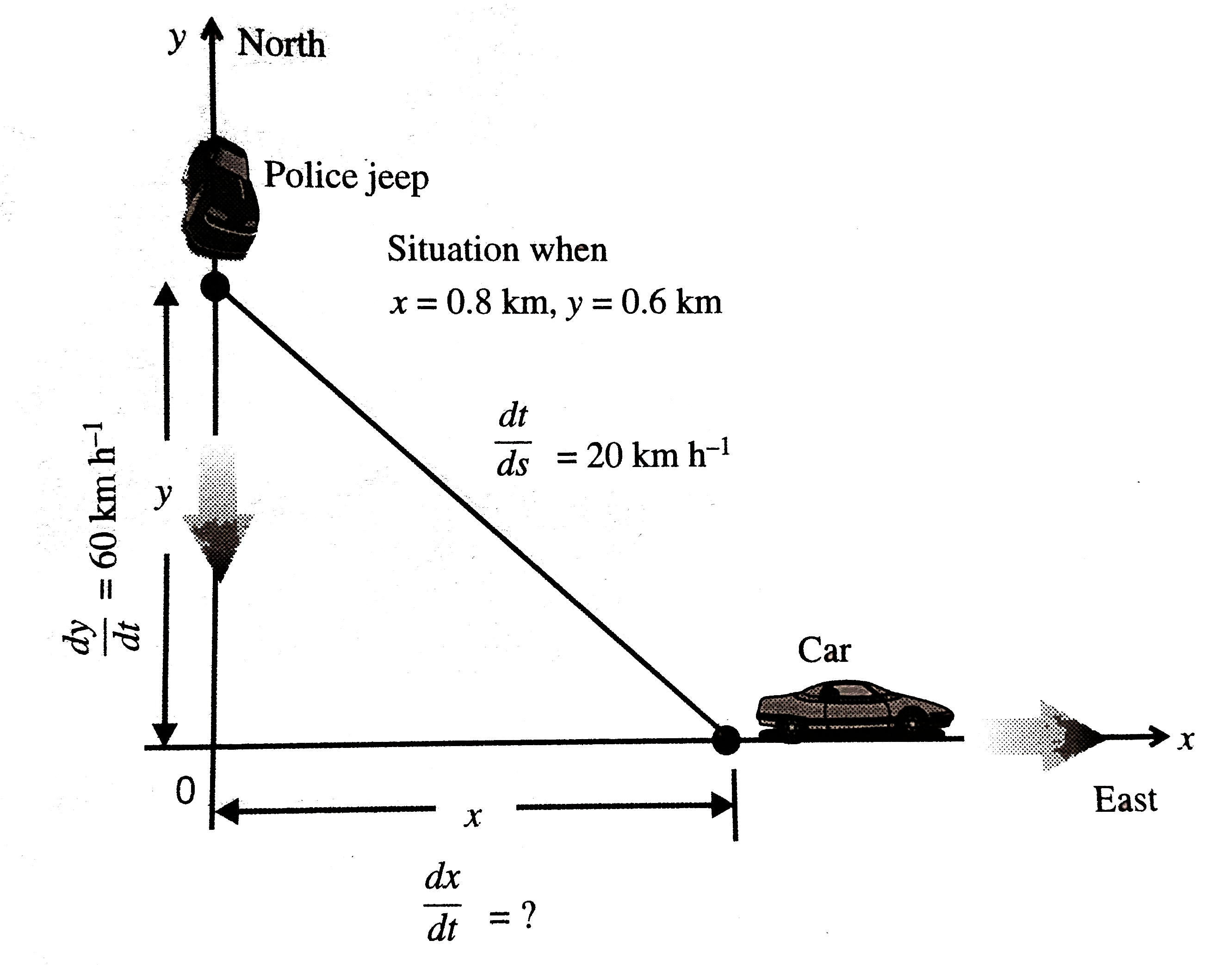 y=position of jeep at time t, s=distance between can and jeep at time t. We assume x,y and s to be differentiable functions of t. `x=0.8km`, `y=0.6km`, `(dy)/(dt)=-60kmh^-1` `(ds)/(dt)=20kmh^-1` (`dy//dt` is negative because y is decreasing.) The variables are related as: `s^2=x^2+y^2` ...(i) (Pythagorean theorem) Differentiate Eq. (i) with respect to t, we get `(ds^2)/(dt)=(dx^2)/(dt)+(dy^2)/(dt)=(ds^2)/(ds)*(ds)/(dt)=2s(ds)/(dt)` Similarly, `(dx^2)/(dt)=(dx^2)/(dx)*(dx)/(dt)=2x(dx)/(dt)` and similarly `(dy^2)/(dt)=(dy^2)/(dy)*(dy)/(dt)=2Y(dy)/(dt)` `2s(ds)/(dt)=2x(dx)/(dt)+2y(dy)/(dt)` Chain rule, `(ds)/(dt)=1/s(x(dx)/(dt)+y(dy)/(dt))` `=(1)/(sqrt(x^2+y^2))(x(dx)/(dt)+y(dy)/(dt))` Evaluate, with `x=0.8km`, `y=0.6km`, `dy//dt=-60kmh^-1`, `ds//dt=20kmh^-1`, and solve for `dx//dt`. `20=(1)/(sqrt(underbrace((0.8)^2+(0.6)^2)))(0.8(dx)/(dt)+(0.6)(-60))` `implies 20=0.8(dx)/(dt)-36implies(dx)/(dt)=(20+36)/(0.8)=70` |
|
| 37. |
A sphere is rotating about a diameter |
|
Answer» The PARTICLES on the surface of the sphere do not have any LINEAR accelerations |
|
| 38. |
Two particles A and B of equal mass m each are attached by a string of length 21 and initally placed over a smooth horizontal table in the position shown in figure Particle B is projected across the table with speed u perpendicular to AB as shown in figure. Find the velocities of the particles after the string becomes taut and the magnitude of the impulsive tension. |
Answer» Solution :When the string beomes taut , both particles move with equal velocity component v in the DIRECTON AB.. Perpendicular to AB. there is no impulse on either particle, velocity components in this direction are therefore UNCHANGED.  Using conservation of momentum in the direction `AB.. 0 +m u sin 60^(@) = mv + mv` (or) `v = (sqrt3)/(4) u` therefore, just after the jerk (i) Velocity of mass `A = (sqrt3)/(4) u` along AB. (II) Velocity of mass `B = SQRT (( u cos 60 ^(@) ) ^(2) + (( sqrt3)/( 4) u )^(2)) = (sqrt7)/(4) u` in a direction inclined to AB. at an ange `tan ^(-1) (( u cos 60 ^(@) )/(v)) , i.e., at tan ^(-1) ((2)/(sqrt3)) ` The magnitude of impulsive tension (J) can be calculated by considering the change of in momentum of one of the particles. For the mass A, in the direction `AB. , J = mv - 0 (or) J = (sqrt3)/(4) m u` |
|
| 39. |
The density of a non-uniform rod of length 1 m is given by rho(x)=a(1+bx^(2)) where, a and b are constants and 0lexle1. The centre of mass of the rod will be at ……….. |
|
Answer» `(3(2+b))/(4(3+b))` if `b=0`, then `rho(x)=a` = constant Hence, centre of mass will be at MIDDLE of the rod, `x=0.5m`. Only (A) gives 0.5. |
|
| 40. |
Imagine a light planet is revolving round a very massive star in a circular orbit of radius R with a time period of revolution T. If the gravitational force of attraction between the star and planetis propostional to R^(-n), then T^(2) is propostional to |
|
Answer» `R^(n+1)` |
|
| 41. |
A body of mass M is being pulled by a string of mass m with a force P applied at one end. The force exerted by the string on the body is |
|
Answer» <P>`(PM)/((M+m))` |
|
| 42. |
One mole of an ideal gas at temperature T_1 expands according to the law (P/V) = constant. If thework done when the final temperature becomes T_2 is (xR/8) (T_2-T_1)then find x = ? |
|
Answer» |
|
| 43. |
A satellite S moving in an elliptical orbit around the earth the mass of satellite is very small compared to the mass of the earth then |
|
Answer» The acceleration of S is always directed TOWARDS centre of earth |
|
| 44. |
The rubber cord of a catapult has a cross sectional area 1"mm"^(2) and total unstretched length 10cm. It is stretched to 12cm and then released to project a missile of mass 5gm. Taking Y for rubber 5 xx 10^(8) "Nm"^(-2) calculate the velocity of projection.... |
| Answer» Answer :B | |
| 45. |
A stone is projected from the ground with a velocity of 14ms^(-1) one second later it clears a wall 2m high. The angle of projection is (g = 10 ms^(-2)) |
|
Answer» `45^(@)` |
|
| 46. |
Consider that an ideal gas (n moles) is expanding in a process given by P=f(V), which passes through a point(V_(0),P_(0)). Show that the gas is absorbing heat at (P_(0),V_(0))if the slope of the curve P=f (V) is larger than the slope of the adiabat passing through (P_(0), V_(0)). |
|
Answer» Solution :Slope of `P=f(V)`, curve at `(V_(0) , P_(0))= f(V_(0))` Slope of ADIABAT at `(V_(0) P_(0))` `=k(-gamma) V_(0)^(-1-gamma)= -gammaP_(0)//V_(0)` Now heat absorbed in the process P = f(V) `dQ = dU +dW = nC_(v)dT +PdV` Since `T=(1//nR) PV=(1//nR) V f(V)` `dT = (1//nR) [f(V)+Vf.(V)]dV` Thus `(dQ)/(dV)underset(V=V_(0))("" ) =(CV)/(R )[f(V_(0))+V_(0)f.(V_(0))]+f(V_(0))` `=[(1)/(gamma-1)+1]f(V_(0)) +(V_(0)f.(V_(0)))/(gamma-1)` `=(gamma)/(gamma-1)P_(0) +(V_(0))/(gamma-1)f.(V_(0))` Heat is absorbed when `dQ//dV GT 0` when gas EXPANDS, that is when `gammaP_(0) +V_(0) f.(V_(0)) gt 0` `f.(V_(0)) gt -gammaP_(0)//V_(0)` |
|
| 47. |
Two non -mixing liquids of densities rho and np (ngt1) are put in container . The height of each liquidis h.A solid cylinder of length L and density d is put in this container . The cylinder floats with its axis vertical and length PL(Plt1) in the denser liquid .The density d is equal to ....... |
|
Answer» <P>`[2+(n+1)P]RHO` `ALDG=(1-P)ALrhog+(PLA)nrhog` `therefored=(1-P)rho+Pnrho` `=rho-Prho+nPrho` `=rho[1-Prho(1-n)]` `=[1+(n-1)P]rho` 
|
|
| 48. |
Kinetic theory of gases is based on the |
|
Answer» MOLECULAR PICTURE of matter |
|
| 49. |
Which of the following statements is true ? (i) A car of mass M is tied by one end of a massless rope of length 10 m. The other end of the rope is in the hands of a man of mass M. The entire system is on a smooth horizontal surface.The man is at x = 0 and the cart at x = 10 m. If the man pulls the cart by the rope, the man and the cart will meet at the point x = 5 m. (ii) Two spherical bodies of mass M and 5 M and radii R and 2 R, respectively , are released in free space with initial separation between their centers equal to 12 R. If they attract each other due to the gravitational force only , then the distance covered by the smaller body just before collision is 7.5 R. (iii) Two skaters A and B , having masses 40 kg and 60 kg , respectively stand facing each other 10 m apart on a horizontal smooth surface. They pull on a rope stretched between them , the distance covered by A, when skaters meet is 6 m. (iv) A ballon (mass M) is attached to light rope of length L. To the other end of the rope a boy (mass m) is hanging in air. The system is at rest. The distance travelled by the balloon (in downward direction) when the boy touches the ballon is (ML)/(M + m). |
|
Answer» `(i),(ii)` (i) `Mx_(1) = Mx_(2) , x_(1) + x_(2) = L rArr x_(1) = x_(2) = (L)/(2) = 5 m` (ii) `Mx = 5 M( 9 R - x) rArr x = 7.5 R` `40 x = 60(10 - x) rArr x = 6 m` (iv) `Mx = m(L - x) rArr x = (mL)/(M + m)` 
|
|
| 50. |
Textbooks on scinence may give you a worng impression that studying science is dry and all too serious and that scientist are absent - minded introverts who never laugh or grin. This image of science and scientists is patentlyfalse. Scientists, like any other group of humans, have their share of humorists, and many have led their lives with a great sense of fun and adventure, even as they seriously pursued their scinetific work. Two great physicists of this genre are Gamow and Feynman. You will enjoy reading their books listed in the Bibliography. |
|
Answer» Solution :True, scientist like any other grup of HUMANS have their SHARE of HUMORISTS , lively, jovial fun LOVING adventurists people. Some of them are absent minded introvent too. Students are advised to go through books by two great Physcists, Feynman and Gamow to REALISE this view. |
|