

Saved Bookmarks
This section includes 7 InterviewSolutions, each offering curated multiple-choice questions to sharpen your Current Affairs knowledge and support exam preparation. Choose a topic below to get started.
| 1. |
A body is sliding down a plane at an angle of inclination theta . mu is the coefficient of friction. What is the acceleration of the body? |
|
Answer» |
|
| 2. |
A bomb moving in a parabolic path explodes into two fragments of equal masses. The accelaration of the centre of mass of the fragments when both are in air is equal to |
|
Answer» `g//2` |
|
| 3. |
C_v and C_pdenote the molar specific heat capacities of a gas at constant volume and constantpressure, respectively. Then |
|
Answer» `C_p - C_v`is larger for a diatomic ideal gas than for a MONOATOMIC ideal gas |
|
| 4. |
A particle is in linear simple harmonic motion between two points, A and B, 10 cm apart. Take the directionn from A to B as the positive direction and give the signs of velocity, acceleration and force on the particle wen it is 1. at the end A 2. at the end B 3. at the mid point of AB going towards A, 4. at 2 cm away from B going towards A, 5. at 3 cm away from A going towards B, and 6. at 6 cm away from B going towards A. |
Answer» Solution : 1. At the end A particle is at extreme position hence velocity is ZERO. As it is acted up on by RESTORING force TOWARDS MEAN position its acceleration and force acting on it are positive 2. At the end B velocity =0, acceleration and force are negative 3. At the mid point of AB (at mean position O)velocity is maximum andnegative as the particle moves towards A. acceleration and force are zero.  Velocity is negative, acceleration and force are positive. |
|
| 5. |
When a cube is floating in water, 20% of the cube is outside the water. When the same cube is placed in another liquid, 35% of the cube is outside the liquid. The density of the liquid gcm^(-3) is |
| Answer» Answer :A | |
| 6. |
Find the number of significant figures in the following (i) 1234 N (ii) 0.012 (iii) 1.530xx10^(8)m |
|
Answer» |
|
| 7. |
At the vertices of an equilateral triangle of side a, three particles each of mass m are kept. Find the gravitational potential and the gravitational field at the centroid of the triangle. |
Answer» SOLUTION :Here AB =BC=CA =a [Fig.1.10], perpendiculars drawn from the POINTS A,B and C on respective opposite sides meet at the centroid O and Proceed to bisect the sides BC,CA and AB respectively.  Let AO =BO =CO =r From `Delta ABD ,AD =asin 60^@=sqrt(3)/(2)a` ALSO `AO =2/3AD` `therefore r=2/3xxsqrt(3)/2a=a/sqrt(3)`. Hence , the gravitational potential at the centroid O is `V=-(Gm)/r +(-Gm)/r+(-Gm)/r=-(3Gm)/(a/sqrt(3))=-(3sqrt(3)Gm)/a` Let the gravitational FIELD intensities at O due to masses at A,B and C be `F_A` (direction from O to A), `F_B` (direction from O to B) and `F_C` (directed from O to C ) respectively [Fig.1.11] .  `therefore F_A=(Gm)/(r^2)=F_B=F_C` Resolving the intensities along and perpendicular to the direction of AO ,we get, `F_A-F_B cos 60^@-F_C cos 60^@=F_A-(F_B)/(2)-(F_C)/(2)=0` `[because F_B=F_C=F_A]` and `0+F_C sin 60^@-F_Bsin 60^@=(F_Csqrt(3))/2-(F_Bsqrt(3))/2=0` `[because F_B=F_C]` Hence the gravitational field intensity at the centroid of the triangle =0. |
|
| 8. |
Precisemeasurements of phsysical quantites area need of science. For example, to accertain the speed of an aircraft, one must have an accurte method to find its positions at clsely separted instants of time. This was the actual motivation behind the discovery of radar in World War II. Think of different examples in modern science where precise measurements of length, time mass etc. are needed. Also, wherever you can, give a quantitative idea of the precision needed. |
|
Answer» Solution :Preciese measurements of physcial quantites like LENGTH, mass and time are the primary requirements fro development fo quatitative laws of Physics or any other science. For example in the measurement of DISTANCE of moon form earth by Laser beam, very accurate measurement of time taken is required. Similoarly, for measuring distance, elevation and velocity of an aeroplane by Radar method, time measruement has to be accurate. For MEASURIG distance of nearby stars, accurate measurement of parallax angle is required. in the field of crystallography, precise measurement of lenght is needed to determine interatomic distaances. USING a mass spectrometer. the precision measurement of masses of ATOMS are made. |
|
| 9. |
You are asked to design a shaving mirror assuming that a person keeps it 10cm from his face and views the magnified image of the face at the closest comfortable distance of 25cm. The radius of curvature of the mirror would then be: |
|
Answer» 24CM |
|
| 10. |
A spring mass system is held at rest at height H from the ground with the spring in relaxed state. Find the minimum value of H so that the sytem has a tendency to rebound after hitting the ground. (Here mass m_(2) is stick with ground after collision i.e. between m_(2) and ground perfect inelastic collision) |
|
Answer» `(m_(2)g)/K((2m_(1)+m_(2))/(2m_(1)))` |
|
| 11. |
For a planet revolving around sun, if a and b are the respective semi-major and semi-minor then the Square of its time period is proportional to |
|
Answer» `((a + B)/(2))^(3)` |
|
| 12. |
Displacement (y) of a body is represented byy = pt + qt^(2) - rt^(3)wherep,q and r are constants of motion. The velocity of the body when its acceleration is 0 : |
|
Answer» `p + (q^(2))/(2r)` Velocity ` v = (dy)/(dt) = p + 2qt - 3rt^(2) "". . . (1)` Acceleration is ` a = (d^(2)y)/(dr^(2) )= 2Q - 6rt` When acceleration = 0 2q - 6rt = 0 `t = (2q)/(6r) = (q)/(3r)` Substituting the value of t in the EQUATION (1) we get , `v = p + 2q ((q)/(3r)) - 3r xx ((q)/(3r))^(2)` `:. v = p + (2q^(2))/(3r) - (3rq^(2))/(9r^(2))` Velocity`v = p + (2q^(2))/(3r) - (q^(2))/(3r)` `v = p + ((2q^(2) - q^(2))/(3r)) = p + (q^(2))/(3r)` |
|
| 13. |
The figure shows a conducting cylinder containing gas and closed by a movable piston. The cylinder is submerged in an ice-water mixture The piston is quickly pushed down from position (1) to position (2) . The piston is held at position (2) until the gas is again at 0^@Cand then is slowly raised back to position (1) p-V diagram for the above process will be |
|
Answer»
|
|
| 14. |
What is the effect of change in temperature on the Young's modulus ? |
| Answer» Solution :With RISE in temperature STRAIN INCREASES hence Stress from formula `Y= ("Stress")/("Strain"),`Young.s modulus Strain DECREASES and when temperature decreases Young.s modulus increases. | |
| 15. |
Of the following the vector quantity is |
|
Answer» Time |
|
| 16. |
A lorry and a car of mass ratio 4 : 1 are moving with KE in the ratio 3 : 2 on a horizontal road. Now brakes are applied andbraking forces produced are in the ratio 1 : 2. Then the ratio of stopping timings of lorry and car is |
|
Answer» `1 : 1` |
|
| 17. |
A man of mass 40kg in standing on a uniform plank of mass 60kg lying on horizontal frictionless ice. The masn walks from one end to the other end of the plank. The distance walked by the man relative to ice is (given length of plank =5m) |
| Answer» Answer :B | |
| 18. |
A car is moving in a circular horizontal track of radius 10m with a constant speed of 10 ms^(-1). A plumb bob is suspended from the roof of the car by a string of length lm. The angle made by the string with vertical is (g=10ms^(-2)) |
|
Answer» `0^(@)` |
|
| 19. |
Two identical hollow spheres roll down two inclined planes of same height but of different angles of inclination. Then, they reach the bottom |
|
Answer» with same SPEEDS and in same time |
|
| 20. |
The principal section of a glass prism is an isosceles triangle ABC with AB = AC. The face AC is silvered. A ray of light is incident normally on the face AB and after two reflections, it emerges from the base BC perpendicular to the base. Angle BAC of the prism’ is |
| Answer» Answer :B | |
| 21. |
An iron ball has an air space in it, the ball weights ong kg in air and O-6 kg in water. Find the volume of the air space. Density of iron is 7200 kg m ^(-3). |
|
Answer» Solution :Volume of AIR space = (Volume of iron ball with air sapce- Volume of iron alone ) Loss of weight of ball = ` W_("air") - W_("WATER") ` `""=1-0.6 = 0..4 kg f ` Loss of weight of ball = weight of water displaced ` "" 0.4 ( kg f )= V xx d (kg f )` where ` "" d- ` DENSITY of water Volume of iron ball with air space = `V = (0.4 )/(1000)= 0.4 xx 10 ^(-3)m^(-3)` Volume or iron alone = ` ("mass")/( " density")` ` ""=(1)/( 7200)= 0.138 xx 10 ^(-3) m^(3)` ` therefore "" ` Volume of air space =(Volume of iron ball with air space -Volume of iron alone) ` ""= 0.4 xx 10^(-3)- 0.138 xx 10 ^(-3)` ` "" = 0.262 xx 10 ^(-3)m^(3)` |
|
| 22. |
The resultant of two equal forces is 141.4N when thet are mutually perpendicular. When they are inclined at an angle 120^(@), then the resultant force will be |
|
Answer» 100 N |
|
| 23. |
How force of gravity F varies inside the earth at distance r( r ltR_e). |
|
Answer» |
|
| 24. |
The diameter of the steel ball is measured using a vernier caliper which has divisions of 0.1 cm on its main scale nad 10 division of its vernier scale match 9 division on the main scale. Three such measurements for a ball are as follows. If the zero error is 0.03cm, then mean corrected diameter is ............. cm. |
|
Answer» 0.56 `ZE=-0.03cm` 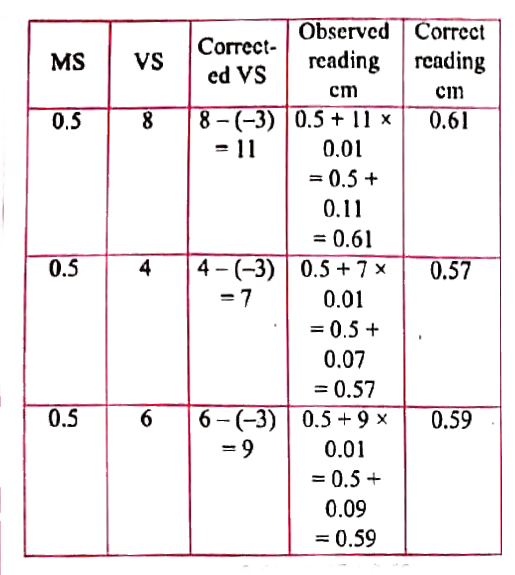 `"Mean "=(0.61+0.57+0.59)/(3)` `=1.77` `therefore"Mean CORRECTED diameter"=0.59cm` |
|
| 25. |
A quantity that measures……….of the body is called………..of the body. |
| Answer» SOLUTION :ROTATIONAL INERTIA , MOMENT of inertia. | |
| 26. |
In oblique projection horizontal range of the projectile is |
|
Answer» `(u^(2)SIN^(2)theta)/(2G)` |
|
| 27. |
What are intensive andextensivevariables ? Giveexamples. |
|
Answer» Solution :EXTENSIVE variable depends on the size or mass of the SYSTEM. Example : Volume, total mass, entropy, internal energy, heat capacity etc. Intensive variables do not depend on the size or mass of the system. Example: Temperature, PRESSURE, specific heat capacity, DENSITY etc. |
|
| 28. |
Which of the following functions of time represent (a) simple harmonic motion and b. periodic but not simple harmonic? Give the period for each case. (1) sin omega t -cos omega t 2. sin^(2)omega t |
|
Answer» Solution :1. `SIN omega t -cos omega t =SQRT(2)[1/(sqrt(2)) sin omega t-1/(sqrt(2))cos omegat]` `=sqrt(2)[sin omega t "cos"(pi)/4-cos omega t "sin"(pi)/4]` `=sqrt(2)sin(omega t-pi//4)` This FUNCTION represents a simple harmonic motion having a period `T=(2pi)/(omega)` and a phae angle `(-pi//4)` or `(7pi//4)` 2. `sin^(2)omegat=(1-cos2omegat)/2=1/2-1/2cos 2omegat` The function is periodic having a period `T=pi//3omega`. It also represents a haromonic motion with the point ofequilibrium OCCURRING at 1/2 instead of zero. |
|
| 29. |
A uniform rod of mass m and length L is standing on a smooth horizontal surface. A slight disturbance causes the lower end to slip on the smooth surface and the rod starts, falling. Find the velocity of centre of mass of the rod when it makes an anglethetawith horizontal. |
|
Answer» SOLUTION :As the surfac is smooth ,loss in gravitational potential ENERGY of the rod=gain in rotational kinetic energy about IC. `mgh=(I)/(2)Iomega^(2)`(I is MOMENT of INERTIA about IC) `h=(L)/(2)(1-sintheta)` and `I=((mL^(2))/(12)+(mL^(2))/(4)COS^(2)theta)` On substituting these values we get `omega=sqrt((12g(1-sintheta))/(L(1+3 cos^(2)theta)))` and `V_(cm=((L)/(2)costheta)omega` 
|
|
| 30. |
The radius of the earth is 6.37 xx 10^(6) m and its mean density is 5.5 xx 10^(3) "kg m"^(-3) and G = 6.67 xx 10^(-11) "N-m"^(2) kg^(-2) Find the gravitational potential on the surface of the earth. |
|
Answer» |
|
| 31. |
Find the kinetic energy when 2 gm bullet moves with the velocity of 500 m/s . |
| Answer» SOLUTION :KINETIC ENERGY `=1/2 mv^(2) = 250` Joule | |
| 32. |
450g water at 40^@Cwas kept a calorimeter of water equivalent 50g . 25 g ice at 0^@C is added and simultaneously 5g steam at 100^@Cwas passed to the calorimeter. The final temperature of the calorimeter will be (L_("ice")=80 "cal/g" ,L_("steam")=540cal//g) |
| Answer» Answer :C | |
| 33. |
A sphere of radius 0.1 m and mass 8 pi kg is attached to the lower end of a steel wire of length 5 m and diameter 10^-3m. The wire is suspended from 5.22 m high ceiling of a room. When the sphere is made to swing as a simple pendulam. It just grazes the floor at the lowest point. Given Young's modulus of steel is 1.994 times 10^11 N.m^-2 The tension in the wire at the mean position when the sphere is oscillating is |
|
Answer» `199.4 PI N` |
|
| 34. |
In the HCl molecule, the separation between the nuclei of two atoms is about 1.27 A (1 A = 10^(-10)m). Find the approximate location of the CM. of the molecule, given that a chlorine atom is about 35.5 times as massive as a hydrogen atom and nearly all the mass of an atom is concentrated in its nucleus. |
|
Answer» Solution :HYDROGEN ATOM is assumed to be at the origin `x_(1) = 0, m _(1)=m, x_(2) = 1.27A` `=1.27 XX 10^(-10) m` `m_(2) = 35.5` m The POSITION of centre of mass `x=(m_(1)x_(1) + m_(2)x_(2))/(m_(1) + m_(2)) = (m xx 0 + 35.5 m xx 1.27 xx 10^(-10))/(m + 35.5 m)` `=(45.08 xx 10^(-10)m)/(36.5 m) = (45.08 xx 10^(-10))/(36.5) = (45.08 xx 10^(-10))/(36.5)` `=1.24 xx 10^(-10)` m |
|
| 35. |
A sphere of radius 0.1 m and mass 8 pi kg is attached to the lower end of a steel wire of length 5 m and diameter 10^-3m. The wire is suspended from 5.22 m high ceiling of a room. When the sphere is made to swing as a simple pendulam. It just grazes the floor at the lowest point. Given Young's modulus of steel is 1.994 times 10^11 N.m^-2 What is the extension of the wire at the mean position when the sphere is oscillating? |
|
Answer» 0.01 m |
|
| 36. |
The work done in splitting a drop of water of 1 m radius in 10^(6) droplets is (S.T of water 72xx10^(-3)J//m^(2)) |
|
Answer» `9.98xx10^(-5)J` |
|
| 37. |
What happens to the object at rest if (i) f_(s)=0 (ii) f_(s)=f_("ext") (iii) f_(s)="max" |
|
Answer» Solution :(i) if theobjectis atrestand soexternalforce is APPLID on the objectthe staticfrictionactingon theobject is zero`(f_(s)= 0)` (ii) If the objectis at restand there ISAN externalforceappliedparallelto thesurfacethen THEFORCE of staticfrictionactingon theobjectis exactlyequal tothe externalforceappliedon theobject`(f_(s)= F_(ex))`Butstill the STATICFRICTION`f_(s) ` islessthan `mu_(s) N` (iii) Whenobjectbeginsto sidethe staticfriction`(f_(s))`actingon theobjectattainsmaximum. |
|
| 38. |
what is law of conservation of charge ? |
| Answer» SOLUTION :it STATES that ,"cahrges are NEITHER created and destroyed but they are simply transferred from one to ANOTHER " | |
| 39. |
A metal block is heated through 10^@Ctill the volumeof it changes by 0.31%. Calculate the coefficient of linear expansion of block. |
|
Answer» SOLUTION :`(DELTA V)/(V) = (0.31)/(100)` ` Delta T = 10^@C` As` Delta V = gamma V Delta T` ` (Delta V)/(V) = gamma Delta T` ` rArr gamma = (Delta V)/(V Delta T) = (0.31)/(100 xx 10)- 0.00031` As`alpha = gamma / 3 = (0.00031)/(3) = 0.0001^@C^(-1)` |
|
| 40. |
The bob of a pendulum is released from a horizontal position. If the length of the pendulum is 1.5m, what is the speed with which the bob arrives at the lowermost point, given that it dissipated 5% of its initial energy against air resistance? |
| Answer» SOLUTION :`= 5.3 MS^(-1)` | |
| 41. |
Density of a material in GGS system is 4g//cm^(3). If length 10 cm and mass 10g are accepted as new system of unit, then density, in new unit system will be…… |
|
Answer» `0.4` `M_(1)=1g,M_(2)=100g` `L_(1)=1cm,L_(2)=10CM` `T_(1)=1s""T_(2)=1s` Dimensional formula of density `=M^(1)L^(-3)T^(0)` `:.n_(1)M_(1)^(1)L_(1)^(-3)T_(1)^(0)=n_(2)M_(2)^(1)L_(2)^(-3)T_(2)^(0)` `:.n_(2)=n_(1)((M_(1))/(M_(2)))^(1)((L_(1))/(L_(2)))^(-3)` `=4((1)/(100))^(1)((1)/(10))^(-3)` `=4xx(1)/(100)xx(10)^(3)` =40 UNITS |
|
| 42. |
State Bernoulli's principle. From conservation of energy in a fluid flow through a tube, arrive at Bernoulli's equation. Give an application of Bernoulli's theorem. |
|
Answer» Solution :In an ideal fluid, sum of PRESSURE, POTENTIAL, KINETIC energy PER unit mass. Remains constant. Application : SPINNING ball |
|
| 43. |
Ramesh with mass of 65 kg stands on a spring balance in a lift. If the lift moves in upward direction with an acceleration of 3 m/s^(2), then the weight of Ramesh will becom e........ |
|
Answer» Solution :`W=mg (g+a)` `=65 (10+3)` `65 XX 13` `845 N` |
|
| 44. |
If a liquid rises to the same height in two capillaries of the same material at the same temperature, then |
|
Answer» the WEIGHT of liquid in both capillaries must be equal |
|
| 45. |
A variable force, given by the 2-dimensional vector F = (3x^2 hati + 4hatj), acts on a particle. The force is in newton and x is in metre. What is the change in the kinetic energy of the particle as it moves from the point with coordinates (2, 3) to (3, 0)? (The coordinates are in metres) |
|
Answer» `-7J` `VECR= XHATI + y hati :. dvec(r) = dx hati + dy hatj` WORK done, `W= int vecF . Dvecr` `= int_((2,3))^((3,0))(3x^2 hati + 4 hatj).(dx hati + dyhatj)` `= int_((2,3))^((3,0)) 3x^2 dx + 4dy = int_((2,3))^((3,0)) d(x^3 + 4y)` `= [x^3 + 4y[_((2,3))^((3,0)) = 3^3 + 4 xx 0 - (2^3 + 4 xx 3)` `= 27 xx 0 - (8 + 12) = 27 - 20= _7 J`. Accroding to work energy theroram, Change in the kinetic energy = Work done , `W = + 7 J`. |
|
| 46. |
As stone of mass .m. is projected from a rubber catpult of of length .l. and cross-sectional area A stretched by an amount .e.. If Y be the young.s modulus of rubber then findthe velocity of projection of stone? |
|
Answer» Solution :STRAIN energy =` 1/2 F.e` As the stone is RELEASED, the strain energy in the catpult appears in the FORM of KINETIC energy of the stone. |
|
| 47. |
At a certain height a shell at rest explodes into two equal fragments. One of the fragments receives a horizontal velocity u. The time interval after which, the velocity vectors will be inclined at 120^(@) to each other is |
|
Answer» `(u)/(SQRT(3)g)` |
|
| 48. |
When a bullet is fired at a glass window, it creates a round hole on the glass pane without shattering the whole pane. But when we throw a stone, the glass pane shatters. Explain. |
| Answer» Solution :The interatomic forces between the molecules of a substance are much higher in solids compared to that in liquids and gases. If a part of a solid is set in motion, the neighbouring PARTS also try to be in motion due to this interatomic force. If the speeds of different parts are different, the body breaks. In this case, the speed of the BULLET is much higher than the speed of the piece of stone thrown. the bullet, THEREFORE, REMAINS in contact with the glass for a very short time. In this short period of time, only the part of the glass that comes in direct contant with the bullet gets into a state of motion while the other parts remain STATIC due to inertia. Hence, only a small bullet-sized round hole is formed in the glass pane. But the stone, because of its lower velocity, remains in contact with the glass for a longer period and can impact its momentum to a large area of the glass. thus, within this time, other parts also acquire different speeds and so, the glass shatters. | |
| 49. |
A train is moving with a uniform velocity of (2hat(i) - hat(j) + 4hat(k)) ms^(-1). If the force required to overcome friction is (hat(i) - 3hat(i) + 2hat(k)) N, the power of the engine is |
| Answer» Answer :C | |


