

Saved Bookmarks
This section includes 7 InterviewSolutions, each offering curated multiple-choice questions to sharpen your Current Affairs knowledge and support exam preparation. Choose a topic below to get started.
| 1. |
The value G is CGS system is 6.67xx10^(-8) dyne cm^(2)g^(-2). Calcualte the value in SI units. |
|
Answer» Solution :As `F=G(m_(1)m_(2))/(r^(2))` `G=(F.r^(2))/(m_(1)m_(2))` `[G=(MLT^(-2)L^(2))/(MM)=M^(-1)L^(3)T^(-2)` `therefore a=-1, b=3, c=-2` 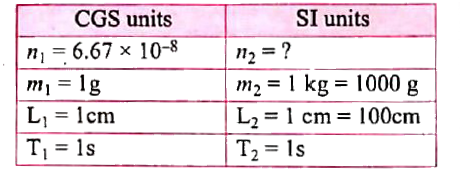 `therefore n_(2)=n_(1)[(M_(1))/(M_(2))]^(a)[(L_(1))/(L_(2))]^(h)[(T_(1))/(T_(2))]^(c )` `=6.67xx10^(-8)[(1)/(1000)]^(-1)[(1)/(100)]^(3)[(1)/(1)]^(-2)` `=6.67xx10^(-11)` HENCE in SI units, `G=6.67xx10^(-11)NM^(2)kg^(-2)` |
|
| 2. |
A lump of iron of mass 2 kg is heated from 40^(@)C" to "1000^(@)C. If the heat supplied is 192 k cal, find its thermal capacity. Find also the specific heat of iron. |
|
Answer» Solution :Heat supplied `DeltaQ=192kcal=192xx10^(3)xx4.2J,` mass m = 2 kg , rise in TEMPERATURE `Deltat=1000-40=960^(@)C`. a) Thermal capacity of the LUMP of iron = `(DeltaQ)/(Deltat)=(192xx10^(3)xx4.2)/(960)=840J//K=` b) Specific heat of iron s = `(DeltaQ)/(mDeltat)=840/2=420Jkg^(-1)K^(-1)` |
|
| 3. |
The measured value of physical quantity expressed to infinite number of decimal places is called |
|
Answer» PRACTICAL value |
|
| 4. |
In the above ques., the height to which the lift takes the passenger is |
|
Answer» `3.6` METERS |
|
| 5. |
The position of a particle at time 't' is given by the equation : x(t) = (V_(0))/(A) (1- e^(A t)) V_(0)= constant and A gt 0 Dimensions of V_(0) and A respectively are: |
|
Answer» `M^(0)LT^(0) and T^(-1)` |
|
| 6. |
Three vectors satisfy the relation vec(A).vec(B)=0 and vec(A).vec(C )=0, then vec(A) is parallel to |
|
Answer» `VEC(C )` |
|
| 7. |
The adjacent sides of a parallelogram are vecP=2i-3j+k and vecQ=-2i+4j- What is the area of the parallelogram ? |
| Answer» Answer :C | |
| 8. |
If the force and the displacement are in the same direction, then the work done is: |
|
Answer» positive |
|
| 9. |
The result after adding 3.8xx10^(-6) to 4.2xx10^(-5) with due regard to significant figures is |
|
Answer» `4.85xx10^(-5)` |
|
| 10. |
Factors on which radius of gyration of the body depends. |
|
Answer» SOLUTION :(i) Position and DIRECTION of the axis of ROTATION. (ii) Distribution of MASS. |
|
| 11. |
In Poiseuille's method of determination of viscosity , what is the physical quantity that requires greater accuracy in measurement?Formula eta = (pi P r^4)/(8 VI) |
| Answer» SOLUTION :The inner radius of the capillary tube apperars with a 4TH POWER in the equation . So if there is an error it becomes 4times . Hence inner radius must be MEASURED with high accuracy. | |
| 12. |
Two forces P and 2P are acting at an angle theta. If thesquare of the resultant of them is equal to half of the sum of the squares of their magnitude then theta is |
|
Answer» `sin^(-1) ((5)/(8))` |
|
| 13. |
One end of a uniform rod of mass m and length l is clamped. The rod lies on a smooth horizontal surface and rotates on it about the clamped end at a uniform angular velocity omega. The force exerted by the clamp on the rod has a horizontal component. |
|
Answer» `m omega^(2)l` |
|
| 14. |
What focal length should the reading spectacles wave for a person for whom the least distance of distinct vision of 50cm? |
| Answer» Answer :B | |
| 15. |
A batsman deflects a ball by an angle of 60^(@) without changing its initial speed of 20 ms^(-1). What is the impulse imparted to the ball if its mass is 0.30 kg ? |
|
Answer» |
|
| 16. |
Explain propagation of sound waves in air. |
|
Answer» Solution :As the sound wave passes through air, compression and expansion of small regions of air medium take place periodically TURN by turn, along the direction of propagation of wave. A small region of air medium in which air particles tend to move towards each other, causing increase in density `(DeltaP)` and hence increase in pressure `(DeltaP),` because according to ideal gas equation we have `PV = nRT implies P ((M )/(rho))= nRT (because rho = (M)/(V)) implies P = ((n RT)/(M)) rho implies` At CONSTANT TEMPERATURE `Delta P prop Delta P.`  In such a HIGH prcssure region, where density is increased temporarily, "Condensation" or "Compression" is said to be formed. It is shown by symbol C in above figure. Now, since pressure is force exerted normally (perpendicularly) on unit area, restoring force is developed in above region, which is directly proportional to displacement of a particle from its mean position. Consequently, air particles in above region tend to move outward (parallel to direction of propagation of wave) towards adjoining region on left & right, causing compressions in them. When this happens, density of air in the middle region (from where air particles have moved out) decreases temporarily. In such a low pressure region, "rarefaction" or "expansion" is said to have be formed. It is shown by symbol R in above figure. As explained above, each small region of air medium coming successively in a direction away from origin of sound, undergoes compression and rarefaction periodically. This is how disturbance moves away from source of sound, which indicates propagation of sound waves which are mechanical and longitudinal. |
|
| 17. |
Two harmonic oscillators starts oscillating simultaneously in the same direction. Their time 5T periods are T and (5T)/8respectively. The phase 8difference between them, when second oscillator has completed one oscillation , will be |
|
Answer» `pi` |
|
| 18. |
For the same total mass, which of the following will have the largest moment of inertia about an axis passing through the centre of gravity and perpendicular to theof body? |
|
Answer» a RING o radius `l` |
|
| 19. |
An object is released from rest. The time it takes to final through a distance h and the speed of the object as it falls through this distance are measured with a pendulum clock. The entire apparatus is taken on the moon and the experiment is repeated the measured times are same the measured speed are samethe actual time in the fall are equal the actual speeds are equal moon and the experiment is repeatedthe measured times are same the measured speed are same the acrual time in the fall are equal the actual speeds are equal. |
| Answer» Answer :A | |
| 20. |
Explain that simple harmonic motion is the projection of uniform circular motion on a diameter of the reference circle and obtain the velocity and acceleration. |
|
Answer» Solution :Let a particle is moving with a constant angular speed `omega` in an anti-clockwise direction on a circular path having center O and radius A. At time t particle is at P and its PHASE is `THETA= omega t+ phi," where "phi=` initial phase. The linear velocity of particle at P position `PQ= A omega` According to figure In `trianglePNQ`, projection of `vec(PQ)` in X-direction `PN= PQ sin theta` `therefore vec(PN)= -A omega sin theta` `therefore P.Q. = -A omega cos (omega t+ phi)` `therefore V(t)= -A omega cos (omega t+ phi)` ACCELERATION : Acceleration of particle at P toward centre `A omega^(2) = PR` According to figure In `trianglePMR`, projection of `vec(PR)` on X-direction `MR= PR cos theta` `P.R.= A omega^(2) cos (omega t+ phi)` `therefore a(t) = -A omega^(2) cos (omega t+phi)` Since velocity and acceleration are in negative X-direction, so it.s negative sign is present. 
|
|
| 21. |
A source of sound S emitting waves of frequency 100 Hz and an observer 0 are located at some distance from each other. The source is moving with a speed of 19.4 ms^(-1) at an angle of 60^(@)with the source observer line as shown in the figure. The observer is at rest. The apparent frequency observed by the observer (velocity of sound in air 330 ms^(-1)) is ...... |
Answer» Solution : We have, `(f _(L))/( v + v _()) = (f _(S))/( v + v _(S))` `THEREFORE (f _(L))/( 330 + 0) = (100)/( 330 -9.7)` `therefore f _(L) = 330 XX (100)/(320.3) = 103.03 Hz` |
|
| 22. |
In that absence of gravity rise in a capillary tube provided there is no gravity acting on it? |
|
Answer» Solution :In the absence of gravity, these is no resistance against the rise of a liquid in a capillary TUBE to surface tension, So, If the length of the capillary tube is infinite, WATER will rise to that infinite height. Again, if the tube is of finite length, water fill it up completely. Even if water SPILLS out, due to capillary ACTION, more water will be drawn into the tube to fill it completely. Capillary rise, `h=(2Tcostheta)/(r rho g)` In absence of gravity, g = 0. So, `hto oo`. |
|
| 23. |
A scientist says that the efficiency of his heat engine which operates at source temperature 127°C and sink temperature 27°C is 26%, then |
|
Answer» It is impossible |
|
| 24. |
Reaction time : When a situation demands our immediate action, it takes some time before we really respond. Reaction time is the time a person takes to observe, think and act. For example, if a person is driving and suddenly a boy appears on the road, then the time elapsed before he slams the brakes of the car is the reaction time. Reaction time depends on complexity of the situation and on an individual. You can measure your reaction time by a simple experiment. Take a ruler and ask your friend to drop it vertically through the gap between your thumb and forefinger (Fig.). After you catch it, find the distance d travelled by the ruler. In a particular case, d was found to be 21.0 cm. Estimate reaction time. |
|
Answer» Solution :The ruler drops under FREE fall. Therefore, `upsilon_(0)=0`, and `a = – g = –9.8 MS^(-2)`. The distance travelled d and the reaction TIME `t_(r )` are related by `d=-(1)/(2)g t_(r )^(2)` Or,`t_(r )= SQRT((2d)/(g))s` Given d = 21.0 cm and `g=9.8 ms^(-2)` the reaction time is `t_(r )=sqrt((2xx 0.21)/(9.8))s~= 0.2 s`. |
|
| 25. |
Thermal power of density W is generated uniformly inside a sphere of radius R and thermal conductivity lamda. Find the temperature distribution along the radius of the sphere in the steady state of it when its outer surface is at temperature T_(0). |
|
Answer» |
|
| 26. |
Two blocks 1 and 2, each having mass m, are placed on a smooth table connected to three identical springs as shown in the figure. Each spring has a force constant K. Initially, all springs are relaxed. The system is disturbed and starts moving. Letx_(1) " and " x_(2) represent the displacements of the two blocks from their respective mean positions. (a) Prove that the quantity A = x_(1) + x_(2) varies sinusoidally and calculate its angularfrequency wa. (b) Prove that the quantity B = x_(1) - x_(2) varies sinusoidally and calculate its angular frequency wb. (c) Prove that motion of block 1 is superposition of two SHMs. Write frequency of the component SHMs. |
|
Answer» (b)` omega_(b)=sqrt((3K)/(m))` `(c ) omega_(a) " and " omega_(b)` |
|
| 27. |
A satellite S is moving in an elliptical orbit around the Earth. The mass of the satellite is very small compared to the mass of the Earth.Then, which one of the following statements is correct? |
|
Answer» the LINEAR momentum of S REMAINS constant in the MAGNITUDE |
|
| 28. |
A planet of mass .m. moves around the Sun along an ellipse so that its minimum distance from the sun is equal to r and Maximum distance .R.. The period of revolution around the Sun is (mass of the sun = M) |
|
Answer» `2pisqrt(((r + R)^(3))/(2GM))` |
|
| 29. |
When a stress of 10^(8) Nm ^(-2) is applied to a suspended wire its length increases by 1 mm. Calculate Young's modulus of wire. |
| Answer» Solution :`Y= (F //A)/( Delta L //) = (1 xx 10 ^(8))/( 10 ^(-3)) = 10 ^(11) Nm ^(-2)` | |
| 30. |
Three equal masses m are placed at the three corners of an equilateral triangle of side a. The force exerted by this system on another particle of mass m placed at the mid-point of a side. |
|
Answer» Solution :If m is placed at the mid point of a side .AB. Then `vec(F_(OA)) = (4Gm^(2))/(a^(2))` in OA DIRECTION and `vec(F_(OB)) = (4Gm^(2))/(a^(2))` in O1B direction  SINCE both are equal in OPPOSITE, cancel each other `vec(F_(OC)) = (Gm^(2))/(((sqrt(3))/(2)a)^(2)) = (4Gm^(2))/(3a^(2))` in OC direction `therefore` Net gravitational FORCE on `m = (4Gm^(2))/(3a^(2))` |
|
| 31. |
Imagine a new planet having the same density as that of earth but it is 3 times bigger than the earth in size. If the acceleration due to gravity of the surface of earth is g and that on the surface of the new planet is g', then .......... |
|
Answer» `g ' = g/9` MASS `M = rho (4/3 piR^3)` , wehre `rho ` = Density `:. G = (G(4/3 pi R^3)rho)/(R^2)` `:. G = 4/3 pi Grrho` `("For NEW PLANET ")/("For earth")=(g.)/(g) =(4/3piGR.rho)/(4/3piGRrho)` For new planent `R. = 3R` `(g.)/g=(3R)/(R) = 3` `:. g. = 3g` |
|
| 32. |
An aeroplane flying horizontally at an altitude of 480m with a speed of 180 kmph drops a bomb. The horizontal distance at which it hits the ground is |
| Answer» Answer :A | |
| 33. |
The dimensional formula of a pseudo force is |
|
Answer» `M^(0) L^(0) T^(-1)` |
|
| 34. |
A glass tuble of uniform internal radius (r) has a valve separating the two indential ends. Intially, the valve is in a tightly closed positioni. End 1 has a hemisphreical soap bubbleof radis r. End 2 has sub hemispherical soap bubble as shown in figure. Just after opening the valve |
|
Answer» Airfrom END1 folows towards END 2. No change in the volume of the SOAP BUBBLE |
|
| 35. |
The displacement of a particle performing SHM x= 3sin 2t+4 cos 2t. The amplitude and maximum velocity of a particle respectively are…………. |
|
Answer» Solution :`x= 3 sin 2t + 4 cos 2t` `a_(1)= 3, a_(2)= 4" and "PHI= (pi)/(2)` `THEREFORE A= SQRT(a_(1)^(2)+a_(2)^(2))= sqrt(3^(2)+4^(2))= 5` unit `implies v_("max")= A omega` `= 5xx 2 = 10`. |
|
| 36. |
The length of a simple pendulum executing simple harmonic motion is increased by 21%. The percentage increase in the time period of the pendulum of increased length is………… |
|
Answer» SOLUTION :In `T= 2pi sqrt((l)/(m)), 2pi` and g are constant, `T propto sqrt(l)` `therefore (T_2)/(T_1)= sqrt((l_2)/(l_2))` `= sqrt((1.21 l_(1))/(l_1))= sqrt(1.21)= 1.1` Hence, percentage INCREASE in the TIME period `=(T_(2)-T_(1))/(T_1)xx 100` `=(1.1-1.0)xx 100` `= 10%`. |
|
| 37. |
A seconds pendulum oscillates with an amplitude of 0.4 m. If the mass of the pendulum is 0.2 kg find (i) KE at the mean position, (ii) PE at the extreme position, (iii) PE at the displacement 0.2m and (iv) KE at the displacement 0.2 m. |
|
Answer» Solution :Time period of seconds pendulum T=2s Angular frequency `omega= (2pi)/(T)= (2pi)/(2)= pi rads^(-1)` Amplitude of the pendulum A = 0.4m, MASS of the pendulum = m 0.2 kg. (i) K.E at the mean POSITION = `K.E_(" max")= (1)/(2)momega^(2)A^(2)= (1)/(2)xx 0.2 xx pi^(2) xx (0.4)^(2)= 0.1578J` (II) P.E at the EXTREME position = `P.E_(" max")= (1)/(2)m^(2)omega^(2)A^(2)= (1)/(2)xx 0.2 xx pi^(2) xx (0.4)^(2)= 0. 1578J` (iii)P.E at the displacement 0.2m `= (1)/(2)momega^(2)y^(2)= (1)/(2)xx 0.2 xx pi^(2) xx (0.2)^(2)= 0.03944J` (iv) K.E at the displacement 0.2 `m= (1)/(2)xx m^(2)omega^(2)(A^(2)-y^(2))= (1)/(2) xx 0.2 xx pi^(2) ((0.4)^(2)-(0.2)^(2))= 0.11832J` |
|
| 38. |
The system shown in the figure is in equilibrium at rest . The spring and string are massless Now the string is cut . Find the acceleration of the blocks just after the string is cut |
|
Answer» Solution :Under equilibrium of MASS m T= mg. Now the string is CUT , Therefore T=mg FORCE is decreased on mass m upwards and downwards on mass 2m. `:.` Acceleration of `(mg)/m=g` Acceleration of `2m=(3mg-2mg)/(2m)=g/2` 
|
|
| 39. |
Moment of inertia of a thin hollow sphere about an axis passing through the center along its diameter is |
|
Answer» `(2)/(3)MR^(2)` |
|
| 40. |
The diameter of a wire measured in an experiment was 0.022cm, 0.023cm, 0.026cm, 0.025cm, 0.024cm" and "0.025cm find (i) the mean value of diameter (ii) absolute error in a each measurment (iii) percentage error. |
|
Answer» Solution :(i) Mean DIAMETER `d_(m)=(0.022+0.023+0.026+0.025+0.024+0.025)/(6)` `=0.02416 cm` `d_(m)= 0.024cm` [Rounded off to 2 significant figures] (II) Absolute errors in the different measurment are `triangled_(1)= d_(m)-d_(1)` `=0.024-0.022 = 0.002cm` `triangled_(2)= d_(m)-d_(2)` `=0.024-0.023= 0.001cm` `triangled_(3)= d_(m)-d_(3)` `=0.024-0.026= -0.002cm` `triangled_(4)= d_(m)-d_(4)` `=0.024-0.025= -0.001cm` `triangled_(5)= d_(m)-d_(5)` `=0.024-0.024=0` `triangled_(6)=d_(m)-d_(6)` `=0.024-0.025= -0.001cm`. (iii) Absolute errors `=(sum|triangled_(i)|)/(6)` `=(0.002+0.001+0.002+0.001+0.001+0)/(6)` `=0.0012=0.001` (Rounded off to 1 significiant figure) PERCENTAGE error `=("Absolute error")/(d_m)xx100` `=(0.001)/(0.024)xx100` `=4.2%= 4%` (Rounded off to 1 significant figure). |
|
| 41. |
In one of the satellites of Jupiter has an orbital period of 1.769 days and the radius of the orbit is 4.22 xx 10^8 m. Show that the mass of Jupiter is about one-thousandth that of the sun. |
|
Answer» Solution :`implies`Orbital PERIOD of Jupiter T = 1.769 days = `= 1.769 XX 24 xx 3600 s` `= 1.528 xx 10^5 s` Radius of satellite, ` r = 4.22 xx 10^(8) m` ` G = 6.67 xx 10^(-11)Nm^(2)//KG^(2)` Mass of sun `= 2 xx 10^(30)`kg Suppose mass of Jupiter = `M_J` Centripetal = GRAVITATIONAL FORCE `:. (mv^2)/r = (GM_J.m)/r^2` `:. v^2 =(GM_J)/r` but `v = r omega` `:. r^(2)omega^2=(GM_J)/r` `:. omega^2=(GM_J)/r^3 ""[ :. omega=(2pi)/T]` `:. (4pi^2)/T^2=(GM_J)/r^3` `:. M_(J) = (4pi^2r^3)/(T^2G)` `:. M_J = (4 xx (3.14 )^2 xx(4.22xx10^8)^3)/((1.528xx10^5)^2xx6.67 xx10^(-11))` `~~ 1.903 xx 10^(27)kg ` `~~ 2 xx 10^(27) kg ` `:. M_J = M_s/1000` |
|
| 42. |
A certain mass of gas is carriedfrom A to B, along three paths via ACB, ADB and AEB. Indicate the path along which the work done is (a) Maximum (b) Minimum. |
|
Answer» Solution :WORK done by a GAS DEPENDS on the area enclosed between the P-V curve and the volume axis. (a) The area enclosed by curve ACB is maximum. Hence work done is maximum along path ACB. (b) The area enclosed by curve AEB is minimum. Hence work done is minimum along path AEB. |
|
| 43. |
(i) Find the adiabatic exponent gamma for mixture of mu_1 moles of monoatomic gas and mu_2 moles of a diatomic gas at normal temperature. (ii) An oxygen molecule is travelling in air at 300 K and 1 atm , and the diameter of oxygen molecule is 1.2xx10^(-10) m . Calculate the mean free path of oxygen molecule. |
|
Answer» Solution :`GAMMA=1/(sqrt2pind^(2))` We have to find the number density n by usin IDEAL GAS law `n=N/V=P/(kT)=(101.3xx10^(3))/(1.381xx10^(-23)xx300)=2.499xx10^(25)"molecules/m"^(3)` `gamma =1/(sqrt2xxpixx2.449xx10^(25)xx(1.2xx10^(-10))^(2))=1/(15.65xx10^(5))` `gamma=0.63xx10^(-6)m` |
|
| 44. |
A body is thrown up with a velocity 29.23ms^(-1) distance travelled in last second of upward motion is |
|
Answer» 2.3 m |
|
| 45. |
If the unit of power is million erg/minute, the unit of force is 1000 dyne and the unit of length is 5/3 cm then the unit of time is (in second) |
|
Answer» 10 |
|
| 46. |
A man drags a block through 10 mon rough surface (mu=0.5). A force of sqrt(3) kN acting at 30^@ to the horizontal. The work done by applied force is |
|
Answer» zero  The component of applied force F in the direction of MOTION is `F cos 30^@.` The work done by the applied force is `W = (F cos 30^@)S = SQRT(3) XX 10^(3) xx (sqrt3)/(2) xx 10 J = 15 xx 10^3 J = 15 kJ` |
|
| 47. |
When travelling freely a train is subjected to resistances which vary directly as the velocity and at 9= kph this is equal to 1 percent of the weight of the train. The brakes when applied create a further resistance equal to l//16th of the weight of the train. If the brakes are suddenly applied when the velocity is 90kph find the time and distance travelled before the train comes to rest. |
|
Answer» |
|
| 48. |
Displacement time equation of particle execution SHM is x=Asin(omegat +(pi)/6). Find the time taken by the particle to go directly from x=-A/2 to x=+A/2 |
|
Answer» Solution :PERIOD of oscillation is `T=(2pi)/(omega)` Now TIME TAKEN in GOING from mean position to `x=A/2` or from `x=A/2` to mean position comes out to be `T/12`. Therefore the DESIRED time will be `t=2(T/12)=T/6=(pi)/(3pomega)` |
|
| 49. |
In an organ pipe ( may be closed or open of 99 cm length standing wave is setup , whose equation is given by longitudinal displacement xi = (0.1 mm) cos ( 2pi)/( 0.8) ( y + 1 cm) cos 2 pi (400) t where y is measured from the top of the tube in metres and t in second. Here 1 cm is th end correction. Equation of the standing wave in terms of excess pressure is - (Bulk modulus of air B = 5 xx 10^(5) N//m^(2)) |
|
Answer» `P_(ex) = (125 pN//m^(2)) sin ( 2PI)/(0.8) ( y + 1 cm) COS 2 pi (400 t)` `= ( 5 xx 10^(5)) xx (0.1 xx 10^(-3)) ( 2pi)/(0.8) sin ( 2pi)/( 0.8)` `(y + 1 cm) cos2 p(400) t` `= (125 pi N//m^(2)) sin ( 2pi)/(0.8) ( y + 1 cm) cos 2 pi (400 t)` |
|
| 50. |
In an organ pipe ( may be closed or open of 99 cm length standing wave is setup , whose equation is given by longitudinal displacement xi = (0.1 mm) cos ( 2pi)/( 0.8) ( y + 1 cm) cos 2 pi (400) t where y is measured from the top of the tube in metres and t "in second". Here 1 cm is th end correction. The upper end and the lower end of the tube are respectively : |
|
Answer» OPEN - closed end correction is `1 cm`. So at `y = - 1 cm`. `(0.1 mm) cos ( 2 pi)/(0.8) ( - 1 cm + 1 cm) = ( 0.1 mm) cos (0) =` ANTINODE So upper end is open. At lower end `y = 99 cm = 0.99 m` `= (0.1 mm) cos ( 2 pi)/( 0.8) (0.99 + 0.01)` ` = 0.01 cos ( 5 pi)/(2) = 0 rArr` Node So tube is open closed. |
|