

Saved Bookmarks
This section includes 7 InterviewSolutions, each offering curated multiple-choice questions to sharpen your Current Affairs knowledge and support exam preparation. Choose a topic below to get started.
| 1. |
A capillary tube is dipped in water. Calculate the weight of water raised in capillary above the normal level due to capillary action. Surface tension of water is 72 dyne cmº. The radius of capillary tube is 0.3 mm. |
|
Answer» SOLUTION :r=0.3 mm=0.03 cm `T=72"dyne cm"^(-1)` `p=1 g cm^(-3)` `theta=0^(@), g =980 cms^(-2)` `h=(2T COS theta)/(rpg)` `=(2 xx 72 xx 1)/(0.03 xx 1 xx 980)=4.8cm` Weight of water raised `=mg=pir^(2) HPG` `=3.14 xx (0.03)^(2) xx 4.8 xx 1 xx 980` =13.29 dyne =0.01 GWT |
|
| 2. |
A mass 'M' is suspended from a spring of negligible mass. The spring is pulled a little and then released so that the mass executes SHM of time period 'T'. If the mass is increased by ‘m’, time period become (5T)/3 then the ratio of (m/M) is |
| Answer» ANSWER :C | |
| 3. |
How is acceleration due to gravity affected by rotation of earth about its axis ? |
| Answer» Solution :DUE to rotation of earth about its axis effective ACCELERATION due to gravity decreases. This effect SEEMS zero at poles and MAXIMUM at equator. | |
| 4. |
If two masses m_1 and m_2 (m_1gtm_2)tied to string moving over a frictionless pulley, then acceleration of masses |
|
Answer» `(m_1 - m_2)/(G)` |
|
| 5. |
The position of an object moving along x-axis is given by x =a + bt ^(2) where a8.5 m, b=2.5 ms ^(-2) and t is and t = 2.0 s. What is the average velocity between t = 2.0 s and t = 4.0s? |
|
Answer» Solution :In notation of differential calculus, the VELOCITY is `upsilon = (dx)/(dt)=(d)/(dt)(a+bt^(2))=2b t=5.0 t MS^(-1)` At t = 0 s, `"" upsilon = 0 ms^(-1)`and at t = 2.0 s, `upsilon =10 ms^(-1)`. Average velocity `=(x(4.0)-x(2.0))/(4.0-2.0)` `=(a+16b-a-4b)/(2.0)=6.0xx B` `=6.0xx2.5=15 ms^(-1)`. |
|
| 6. |
A cubical block of iron,5 cm on each side is floating in mercury taken in a vessel. What is the height of the block above mercury level. |
|
Answer» SOLUTION :From the law of floatation `V_(b)rho_(b)=V_("in")rho_(L)` `:.(5)^(3)xx(7.2)=(5^(2)xx(13.6)` `:.x=2.65cm` Then the HEIGHT of the BLOCK above mercury LEVEL `=5cm-x=2.35cm` |
|
| 7. |
S_(1) and S_(2) are two loudspeakers with the same frequency of 165 Hz and acoustic output 1.2 xx 10^(-3) and 1.8 xx 10^(-3) watt respectively. They vibrate in the same phase. P is a point at a distance 4 m from S_(1) and 3 m from S_(2). (a) How are the phases of the two waves arriving at P related ? (b) What is the intensity of P if S_(1) is turned off (S_(2) " on")? (c) What is the intensity of sound at P if S_(2) is turmed off ? (d) What is the intensity at P with S_(1) and S_(2) on ? [Hint : For phase relationship see example 6 of chapter 1. Intensity is inversely proportional to square of the distance] |
|
Answer» |
|
| 8. |
A staircase contains three steps each 10 cm high and 20 cm wide as shown in the figure. What should be the minimum horizontal velocity of a ball rolling off the uppermost plane so as to hit directly the edge of the lowest plane ? [g = 10 m//s^(2)] |
|
Answer» Solution :h = 30 cm `S = 60 cm = vsqrt((2h)/(50))` `= vsqrt((2 xx 30)/(1000)) = vsqrt((3)/(50))` `therefore v = (60)/(100) SQRT((50)/(3)) = (3)/(5) xx 5sqrt((2)/(3)) = sqrt(3) xx sqrt(2)` `= 2.45m//s` 
|
|
| 9. |
On a hot way, a car is left in sunlight with all windows closed. Explain why it is considerably warner than outside, after sometime. |
| Answer» Solution :Glass transmits 50% of heat radiation coming from a hot source LIKE sun but does not allow the radiation from moderately hot BODIES to PASS through it. | |
| 10. |
Which of the following forces tends to stop the moving object |
|
Answer» frictional FORCE acting on the VEHICLE is along NEGATIVE X direction |
|
| 11. |
Two equal spheres A and B lie on a smooth horizontal circular groove at opposite ends of a diameter. At time t = 0, A is projected along the groove and it first impinges on B at time t = T_(1) and again at time t = T_(2). If e is the coefficient of restitution, the ratio T_(2)//T_(1) is |
|
Answer» `2/e` `(v_(2)-v_(1))/u_(1)=eimpliesv_(2)-v_(1)-eu_1` 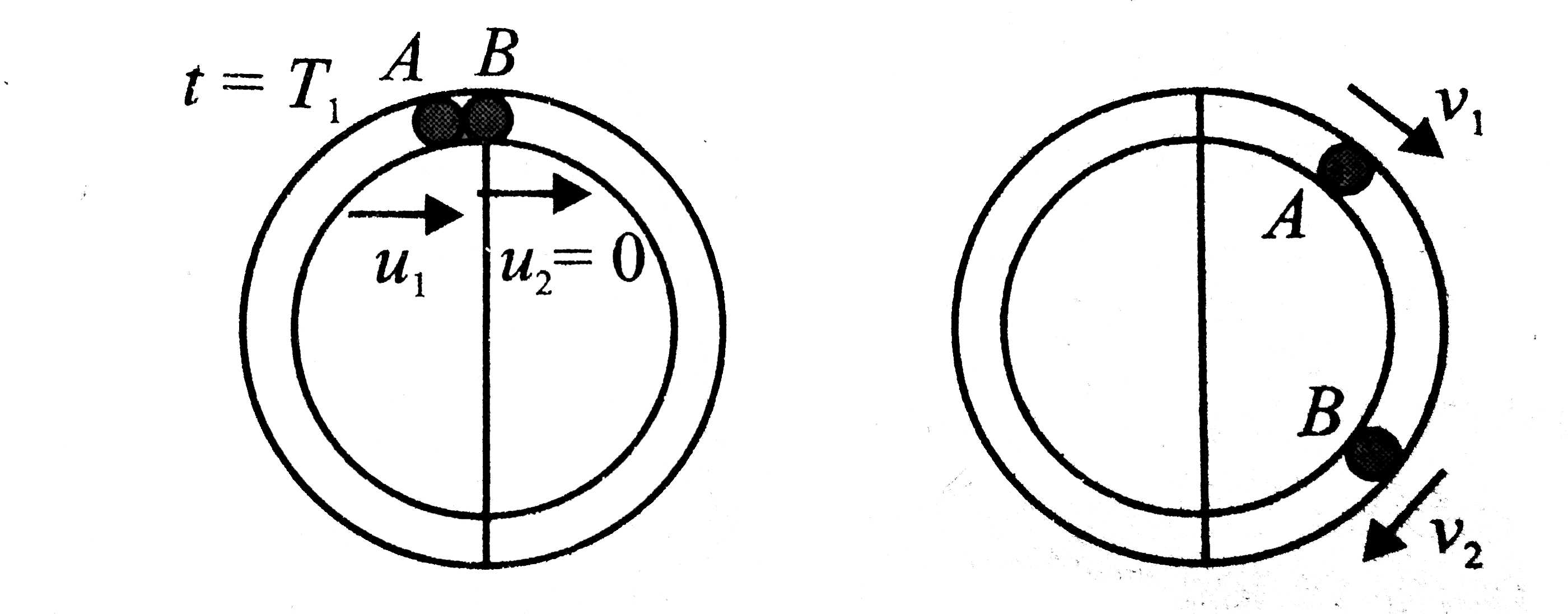 TIME TAKEN to collide `A` and `B` again is `T_(2)-T_(1)=(2piR)/(v_(2)-v_(1)) implies T_(2)-T_(1)=(2piR)/(eu_(1))`………..ii Dividing ii by i, we get `T_(2)/T_(1)=(2+e)/e` |
|
| 12. |
The units of measurement of ……………….. And …………….. Are called …………….. . |
|
Answer» |
|
| 13. |
What is the type of force that acts on a spring? Explain work energy theorem with respect to a spring. |
|
Answer» Solution :The type of force that acts on a spring is a CONSERVATIVE force and as well as a variable force. The force law also called as Hooke's law with respect to the force on the spring `f_(s)=-KX` where k - is known as the spring constant in `Nm^(-1)` and x - is elongation. For a compression the displacement will be '-x' so that `F_(s)=+kx`. For extension `W_(s)=underset(0)overset(x_(m))intF_(s)dx=-underset(0)overset(x_(m))intkxdx=-(kx_(m)^(2))/(2)` The work done by the spring force for displacement `x_(i)` to `x_(F)` is given by `W_(s)=-underset(x_(i))overset(x_(f))intkxdx=-(k)/(2)(x_(i)-x_(f))` It is clear that if the spring returns to initial state W = 0. Since there is no loss in the ENERGY, and the force is retrieved, the force is conservative. Using `(1)/(2)mv_(m)^(2)=(1)/(2)kx_(m)^(2)` We get `v_(m)=sqrt((k)/(m)).x_(m)` |
|
| 14. |
Identify the correct order in which the values of M.I. decreases for the following(i) M.I. of solid sphere of mass .M. and radius .R. about its diameter of rotation(ii) M.I. of uniform ring of mass .M. and radius .R. about its tangent perpendicular to its plane(iii) M.I. of uniform dise of mass .M. and radius .R. about its diameter (iv) M.I. of a uniform solid cylinder of mass M about its own axis of rotation. |
| Answer» Answer :C | |
| 15. |
(a) A steel tank has internal volume V_0 (= 100 litre). It contains half water( volume = (V_0)/2 )and half kerosene oil at temperature theta_(1) = 10^(@)C Calculate the mass of kerosene that flows out of the tank at temperature of theta_(2)=40^(@)C. Coefficient of cubical expansion for different substances are: gamma_(k)=10^(-3).^(@)C^(-1), gamma_(w)=2xx10^(-4) .^(@)C^(-1), gamma_("steel")=1.2xx10^(-5).^(@)C^(-1). density of kerosene at 10^(@)C is rho_(1)=0.8 kg /litre. (b) In the last problem the height of water in the container at theta_(1)=10^(@)C is H_1 = 1.0 m. Find the height of water at theta_(2) = 40^(@)C. |
|
Answer» (b) `(H_(1)[1+gamma_(w)Delta theta])/([1+2/3gamma_(s)Delta theta]) =1.0057 m` |
|
| 16. |
A force of 3kg wt is sufficient to pull a block of 4kgwt over a flat surface. What is the angle of friction ? |
|
Answer» |
|
| 17. |
In the pervious question (6), the magnitude of the momentum transferred during the hit is |
|
Answer» ZERO Magnitude =`|Deltap|=sqrt((0.9)^(2)+(1.2)^(2))` `=sqrt(0.81+1.44)=1.5 kg ms^(-1)` |
|
| 18. |
A body .x. with a momentum .p. collides with another identical stationary body .y. one dime-nsionally. During the collision .y. gives an impulse .J. to the body .x.. Then the coefficient of restitution is |
|
Answer» `(2J)/(P)-1` |
|
| 19. |
Which order of harmonics is missing or absent in case of stationary sound waves produced in a closed pipe ? |
| Answer» SOLUTION :EVEN ORDER of harmonics is MISSING or absent. (In case of closed pipe, possible harmonics are `f_(1) , 3f_(1) , 5f_(1) , 7f_(1) …` where `f _(1) = (v)/(4L))` | |
| 20. |
Air is expanded isentropically in a nozzle from 13.8 bar to 150^@Cto a pressure of 6.9 bar. The inletvelocity to the nozzle is very small and the process occurs in steady state, steady flow conditions. The exist velocity from nozzle, when inlet velocity is 10 ms^(-1)is found to be k xx130 ms^(-1). Find thevalue of k, assuming nozzle is horizontal, also take C_p = 1.005. |
|
Answer» |
|
| 21. |
A flywheel rotates with a uniform angular acceleration. Its angular velocity increases from 20 pi rad/s to 40 pi rad/s in 10 seconds. How many rotations did it make in this period? |
|
Answer» 80 or `alpha = 2pi "rad/s"^(2)` As `omega^(2) - omega_(0)^(2) = 2 alpha theta implies (40pi)^(2) - (20PI)^(2) = 2 xx 2 pi theta` or `theta = (1200 pi^(2))/(4 pi) = 300 pi` No. of ROTATIONS COMPLETED = `(theta)/(2pi) = (300 pi)/(2pi) = 150` |
|
| 22. |
If the third harmonics of a closed organ pipe is equal to the fundamental frequency of an open organ pipe , compute the length of the open organ pipe if the length of the closed organ pipe is 30 cm |
|
Answer» Solution :Let `l_(2)` be the length of the OPEN organ pipe , with `l_1 = 30` cm the length of the closed organ pipe . It is given that the third harmonic of closed pipe is equal to the fundamental FREQUENCY of open organ pipe . The third harmonic of a closed organ pipe is `f_(2) = (v)/(lambda_(2)) = (3v)/( 4 l_(1)) = 3f_(1)` The fundamental frequency of open organ pipe is `f_(1) = (v)/(lambda_(1)) = (v)/(2 l_(2))` Therefore , `(v)/(2l_(2)) = (3v)/(4l_(1)) implies l_(2) = (2l_(1))/(3) = 20` cm |
|
| 23. |
Define calorie and standard calorie. |
|
Answer» Solution :CALORIE : It is DEFINED as the AMOUNT of HEAT energy required to rise the temperature of 1 gram of water through `1^@`C . Magnitude of calorie slightly changes with the value of initial temperature taken. Mean `5^@`C calorie or standard calorie : It is defined as the amount of heat energy required to rise the temperature of 1 gram of water from `14.5^@ C, `to `15.5^@`C. |
|
| 24. |
The unit of length conventent on the atomic scale is known asan angstrom and is denoted by Å: 1Å = 10^(10) m. The size of a hydrogen atom is about 0.5Å. What is the total atomic volume in m^(-3) of a mole of hydrogen atoms ? |
| Answer» SOLUTION :`~=3XX10^(-7) m^(3)` | |
| 25. |
For a constant volume gas thermometer, one should fill the gas at |
|
Answer» HIGH TEMPERATURE and high pressure |
|
| 26. |
Two painters are working from a wooden hoard 5 m long suspended from the top of a building by two ropes attached to the ends of the plank. Either rope can withstand a maximum tension of 1040 N. Painter A of mass 80 kg is working at a distance of 1 m from one end. Painter B of mass 60 kg is working at a distance of x in from the centre of mass of the board on the other side. Take mass of the board as 20 kg and g = 10ms^(-2). The range of x so that both the painters can work safely is |
|
Answer» `1/3ltxlt11/6`  Take momnet about `O` `T_(1)xx2.5+600x` `T_(2)xx2.5+800xx1.5` `T_(1)=1040-120x` and `T_(2)=560+120x` For safe WORKING `T_(1)lt1040 N` and `T_(2)lt1040Nxgt0` and `XLT2`, so the RANGE is `0ltxlt2.` |
|
| 27. |
A locomotive of mass m starts moving so that its velocity varies according to the law v = alpha sqrt(s), where alpha is a constant and .s. is the distance covered. Find the total work done by all the forces on the locomotive during first .t. second after the begining of motion. |
|
Answer» SOLUTION :Given, velocity `v = alpha s^(1//2)` Acceleration, `a = (dv)/(dt) = (d)/(dt) (alpha s^(1//2)) = (1)/(2) alpha s^(-1//2) ((ds)/(dt)) = (1)/(2) alpha s^(-1//2) v = (1)/(2) alpha s^(-1//2) (alpha s^(1//2)) = (alpha^(2))/(2)` Now force, `F = ma = (m alpha^(2))/(2)`. Distance covered by locomotive in first t SECOND `s = ut + (1)/(2) at^(2) = 0 + (1)/(2) ((alpha^(2))/(2))t^(2) = (alpha^(2)t^(2))/(4)`, Work done, `W = FS = (m alpha^(2))/(2) xx (alpha^(2)t^(2))/(4) = (m alpha^(4) t^(2))/(8)`. |
|
| 28. |
At 27^(@)C, two moles of an ideal mono-atomic gas occupy a volume V. The gas expands adiabatically to a volume 2V. Calculate (a) final temperature of the gas (b) change in its internal energy and (c ) the work done by the gas during the process. (R = 8.31 J/mol K) |
|
Answer» Solution :(a) In case of adiabatic change, `PV^(R ) =` const. with `PV=nRT` So that `T_(1)V_(1)^(gamma-1)=T_(2)V_(2)^(gamma-1)` [with `gamma=(5//3)`] i.e., `300xx v^(2//3) = T(2V)^(2//3) or T=300//(2)^(2//3) = 189K` (b) As `DeltaU=nC_(v)DeltaT = (nR DeltaT)/(gamma-1) [ "as" C_(v)=(R )/((gamma-1))]` So, `DeltaU=(2xx8.31 xx (189-300))/(((5)/(3)-1)) = -2767.23J` Negative SIGN means internal energy DECREASES. (c ) Accordingto FIRST law of thermodynamics, `DeltaQ=DeltaU+DELTAW` and as for adiabatic change `DeltaQ= 0 rArr DeltaW = - DeltaW = 2767.23J` |
|
| 29. |
Find the decrease in the volume of a simple of water from the following data. Initial volume =2000 cm^(-2) , initial pressure =10^(5) Nm^(-2) , final pressure =10^(6) N^(-1)m^(2). |
|
Answer» SOLUTION :Bulk MODULUS `B=(1)/("COMPRESSIBILITY")=(1)/(25xx10^(-11))=4xx10^(9)` and `B=(-Deltap)/(DeltaV//V)` `therefore` DECREASE in the volume `DeltaV=-(DeltapV)/(B)=((10^(6)-10^(5))(2000xx10^(-6)))/(4xx10^(9))` `=4.5xx10^(-7)m^(3)=4.5xx10^(-7)10^(6) cm^(3)=0.45 cm^(3)` |
|
| 30. |
Cutting of ice by a taut thread is more feasible than with a taut metal string. Explain |
| Answer» Solution :As the metal string RUN below the surface, the pressure on TOP of the string will be LESS than at the bottom of the string. SINCE the pressure is relieved, WATER freezes back to ice. This phenomenon is called regelation. There will be an exchange of heat between the metal string and ice. Whereas, there will be no exchange of heat between the thread and ice. Heance it is feasible to cut ice with the thread | |
| 31. |
If vectors vecA and vecB are 3i-4j+5k and 2i + 3j - 4k respectively then find the unit vector parallel to vecA + vecB |
| Answer» SOLUTION :`((5i-j+k))/SQRT(27)` HINT: `HATN=(vecA+vecB)/(|vecA+vecB|)` | |
| 32. |
The pressure of a gas in a vessel is 80 cm of Hg. Now 25% of the same gas is also introduced into the same vessel. If the process is done at the same temperature, find the final pressure of the gas. |
|
Answer» <P> Solution : Initial pressure of gas `(P_(1) )`=80 cm of HgInitial mass of the gas `(m_(1))`= m Final mass of the gas `(m_(2)) = m + (m)/(4) = (5M)/(4)` Final pressure of the gas `(P_(2)) = ? ` At constant volume and TEMPERATURE , According to ideal gas equation , `(P_(1))/(m_(1)) = (P_(2))/(m_(2))` `RARR P_(2) = (m_(2))/(m_(1)) P_(1) = (5 m//4)/(m) xx 80` `= (5)/(4) xx 80 = 100 " cm of Hg, " therefore P_(2) = 100` cm of Hg |
|
| 33. |
The first & second stage of two stage rocket separately weigh 100 kg and 10 kg and contain 800kg and 90kg fuel respectively. If the exhaust velocity of gases is 2 km/sec then velocity of rocket after second stage is (nearly) (log_(10)5 =0.6990)(neglect gravity) |
|
Answer» `7.8 XX 10^3 m//s` |
|
| 34. |
The value of co-efficient of static friction (mu_(s)) is in the range between. |
|
Answer» 0.01 to 1.5 |
|
| 35. |
Transmission by optical fibres is an important method in communications. By total internal reflection. Light is made to travel only along the core. However, the intensity falls-off exponentially with distance and is given by, I = I_(0)^(e-alphax), where alpha is absorption coefficient. Then the correct graph for intensity vs distance is |
|
Answer»
|
|
| 36. |
When a capillary tube is dipped into a liquid the liquid neither rises nor falls in the capillary |
|
Answer» the SURFACE TENSION of liquid must be zero<BR>contact angle must be `90^(@)` |
|
| 37. |
Each object shown in column I has mass 2m. The ring has mass m and radius R. The other components rod, lamina have total mass m. The shaded part in any figure represent a lamina axis I and II are in plane of figure, moment of inertia about their axis is represented by I_(1), I_(2). Moment of inertia about axis through O and perpendicular to plane of figure is give by I_(0). |
|
Answer» |
|
| 38. |
Time taken by the rolling object in inclined plane to reach its bottom is |
|
Answer» `SQRT((1+(k^(2))/(R^(2)))/(g sin^(2) theta))` |
|
| 39. |
A block of mass 5kg is lying on a rough horizontal surface. The coefficient of static and kinetic friction are 0.3 and 0.1 and g=10 ms^(-2) The frictional force on the block is |
| Answer» ANSWER :D | |
| 40. |
The fundamental frequency of a stretched string is V_(0). If the length is reduced by 35% and tension increased by 69% the fundamental frequency will be |
|
Answer» `0.2V_(0)` |
|
| 41. |
A bullet of mass 0.04kg travelling horizontally at 100 m/s hits a stationary block of wood of mass 8kg, passes through it and emerges horizontally with a speed of 40 m/s. If the block is free to move on a smooth horizontal plane, what is the speed with which it moves after the bullet had passed through it? |
|
Answer» |
|
| 42. |
A body is projectedhorizontally from the top of a tower of height 10 m with a velocity 10 m/s. Its velocity after 1 second is |
|
Answer» `10 HAT(i) - 10 hat(j)` |
|
| 43. |
A small particle of mass m//10 is moving horizontally at a height of 3R//2 from ground with velocity 10m//s. A perfectly inelastic collision occurs at point P of surface. The mass m of sphere is R. (m = 10 Kg and R = 0.1 m) (Assume all surfaces to be smooth). Answer the following questions. Speed of shpere just after collision is |
|
Answer» `27//43 m//s`  Let `v^(1)` be the velocity of sphere after COLLISION `J cos 30 = 10v^(1)rArr J = (20 v^(1))/(sqrt(3))` `J = (m)/(10)(10 cos 30)-(m)/(10)(v^(1) cos 30^(@))` `rArr` speed of the sphere `v^(1) = (30)/(43) ms^(-1)` speed of particle in TANGENTIAL direction remains same `10 sin 30 = 5ms^(-1)` speed of partile `= sqrt((5)^(2)+[((30)/(43))cos 30])^(2)` `=5.26 ms^(-1)` |
|
| 44. |
A particle moves along y=sqrt(1-x^(2)) between the points (0,-1)m and (0,1)m under the influence of a force vecF=(y^(2)i+x^(2)j)N. Below which path particle moving |
|
Answer» SEMI ellipse |
|
| 45. |
A particle moves along y=sqrt(1-x^(2)) between the points (0,-1)m and (0,1)m under the influence of a force vecF=(y^(2)i+x^(2)j)N. Work done on the particle by the force vecF is |
| Answer» ANSWER :D | |
| 46. |
On increasing the temperature of a substance gradually, which of the following colours will be noticed by you |
|
Answer» White |
|
| 47. |
A tyre pumped to a pressure of 6 atmosphere suddenly burst. Room termperature is 25^(@)C. Calculate the temperature of escaping air. |
|
Answer» Solution :From `P_(1)^(1-gamma) T_(1)^(gamma)= P_(2)^(1-gamma) T_(2)^(gamma)` , Here, `P_(1)=6 " atm " P_(2)=1 " atm" ` `T_(1)=273+25=298K , gamma=1.4` `(6)^(1-1.4) (298)^(1.4) = (1)^(1-1.4) T_(2)^(1.4)` `T_(2)=[(298)^(1.4)/(6^(0.4))]^(1/1.4)=(298)^(1.4/1.4)/(6)^(0.4/1.4)=298/(6)^(2/7)` USING logarithms log `T_(2)=2.4742-2/7(0.7782)` `=2.4742-0,2209=2.2533`. ANTI log of `202533=178.7` `:. T_(2)=178.7 K rArr t_(2)=178.7-273=-94.3^(@) C` . |
|
| 48. |
At the bottom edge of a smooth wall, an inclined plane is kept at an angle of 45^(0). A uniform ladder of length l and mass M rests on the inclined plane against the wall such that it is perpendicular to the incline. If 1/n, Is the minimum coefficient of friction with ''B'' necessary so that the ladder does not slip on the incline. n = ? |
|
Answer» |
|
| 49. |
Name the four process taking place in Carnot cycle. Draw indicator diagram of Carnot cycle. |
| Answer» SOLUTION :ISOTHERMAL EXPANSION, ADIABATIC expansion, isothermal COMPRESSION, adiabatic compression. | |
| 50. |
A balloon filled with hydrogen has a volume of 1000 litres and its mass is 1 kg. what would be the volume of the block of very light material which it can just lift? One litre of material has mass of 91.3 gram. (Density of air = 1.3 gram//litre). |
|
Answer» SOLUTION :Let V and M be the volume and MASS of the balloon respectively. Let `upsilon_(1) , m_(1)` and `rho_(1)` be the volume , mass and density of the block to be filled. Here, `V = 1000` litres`= 1000 xx 10^(-3)m^(3) = 1m^(3)`, `rho_(1) = 91.3 G//litre = 91.3 kg m^(-3)`, `rho_(a) = 1.3 g//litre = 1.3 kg m^(-3)`, TOTAL volume of the balloon and block = `V + upsilon_(1)`. The volume of air displaced = `(V +upsilon_(1))`. If `rho_(a)` is teh density of air, then weight of air displaced The balloon can lift the block if Weight of balloon and block = weight of air displaced i.e., `(M+m_(1))g = (V + upsilon_(1)) rho_(a)g` `or (M+upsilon_(1)rho_(1))g = (V+upsilon_(1))rho_(a)g` This gives, `upsilon_(1) = (Vrho_(a)-M)/(rho_(1)-rho_(a)) = (1xx1.3-1)/(91.3 = 1.3) = 0.3/90 m^(3)` `=(0.3 xx 1000)/(90) litre = 3.33litres`. |
|
