

Saved Bookmarks
This section includes 7 InterviewSolutions, each offering curated multiple-choice questions to sharpen your Current Affairs knowledge and support exam preparation. Choose a topic below to get started.
| 1. |
1 minute of arc is equal to........... |
|
Answer» `1.745xx10^(-2)` RAD |
|
| 2. |
A stationary body of mass 3 kg explodes into three equal pieces. Two of the pieces fly off at right angles to each other, one with a velocity 2 hatjm//s and the other with a velocity 3 hatjm//s. If the explosion takes place in 10^(-5) sec, the average force acting on the third piece in Newtons is: |
|
Answer» <P>`(2hati+3hatj)10^(-5)` |
|
| 3. |
A body projected from the ground reaches a point 'X' in its path after 3 seconds and from there it reaches the ground after further 6 seconds. The vertical distance of the point 'X' from the ground is (acceleration due to gravity = 10ms^(-2)) |
|
Answer» 30m |
|
| 4. |
When two corks , one small and one big are taken into a vessel filled with water and released which cork will come fast on the surface of water ? Why ? |
| Answer» Solution :BIGGER cork , because as the weight of itis higher the mass of displaced WATER due to it ,so the buoyant force also INCREASES on it .HENCE ,its SPEED is faster. | |
| 5. |
Find the centre of mass of a triangular lamina. |
Answer» Solution :The lamina `(∆LMN)` may be subdivided into NARROW strips each parallel to the base (MN) as shown in Fig. 7.10 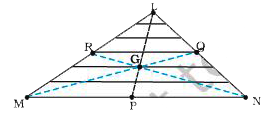 By symmetry each strip has its centre of mass at its midpoint. If we join the midpoint of all the strips we GET the median LP. The centre of mass of the triangle as a whole THEREFORE, has to lie on the median LP. Similarly, we can argue that it lies on the median MQ and NR. This means the centre of mass lies on the point of concurrence of the medians, i.e. on the CENTROID G of the triangle. |
|
| 6. |
A glass full of hot milk is poured on the table. It begins to cool gradually. Which of the following is correct ? |
|
Answer» |
|
| 7. |
Two inclined frictionless tracks, one gradual and the other steep meet at A from where two stones are allowed to slide down from rest, one on each track (Fig. 6.16). Will the stones reach the bottom at the same time? Will they reach there with the same speed? Explain. Given theta_(1)= 30^(@), theta_(2)= 60^(@)" and "h= 10m, what are the speeds and times taken by the two stones? |
|
Answer» Solution :No, the stone on the STEEP plane REACHES the BOTTOM earlier, YES, they reach with the same speed V, [since `mgh= (1"/"2)mv^(2)`] `v_(B)= v_(c )= 14.1 ms^(-1), t_(B)= 2sqrt(2)s, t_(c )= 2sqrt(2)s`. |
|
| 8. |
Explainwith example how earth can be treated as bothinertial and non inertial frame of reference |
| Answer» Solution :Earth is not REALLY aninertial framebecause ofitsself -rotationandorbitalmotion . But theserotationaleffectsof Earthcan beignoredfor themotioninvolvedin our day- to -daylife,for EXAMPLEOF a simple PENDULUMIS measuredin thephysicslaboratorytheEarthselfrotation has verynegligibleeffecton it. InthiswayEarthcan betreatedas aninertialframe .BUTAT thesametimeto ANALYSE the motionof satellitesand wind | |
| 9. |
An air bubble in a glass slab with refractive index 1.5(near normal incidence) is 5cm deep when viewed from one surface and 3cm deep when viewed from the opposite face. The thickness (in cm) of the slab is |
|
Answer» 8 |
|
| 10. |
A man pulls a lawn roller through a distance of 20 m with a force of 20 kg weight. If he applies the force at an angle of 60^(@) with the ground, calculate the power developed if he takes 1 min in doing so. |
|
Answer» |
|
| 11. |
The potential energy of the moving particle along x-axis is given by U=20+5sin (4pix)where U is in joule and x is in metre under the action of conservative force. |
|
Answer» If mechanical ENERGY is 20 J, then at x=7/8m, particle is at equilibrum |
|
| 12. |
Give the equation for the value of g at a height h above the surface of the earth. How does it change at small heights ? |
| Answer» Solution :Acceleration DUE to gravity ‘g. at a HEIGHT ‘h. above the ground is `g_h = (GM)/((R+h)^2)`for small HEIGHTS (i.e.,h< < R). `g_h = g (1 - (2h)/(R))` | |
| 13. |
A bodyof mass 20 kg is moving along a straight line with a linear momentum of 240 kg ms^(-1). Ifa constant force of 20 N acts for 5s opposite to direction of motion, the work done by the force during this time is |
|
Answer» 950 J |
|
| 14. |
The direction of projectile at certain instant is inclined at angle alpha to the horizontal. After t sec, if it is inclined at an angle beta then the horizontal component of velocity is |
|
Answer» `(G)/(TAN alpha - tan beta)` |
|
| 15. |
Two moles of an ideal monoatomic gas at 27^@Coccupies a volume of V. If the gas is expandedadiabatically to the volume 2V, then the work done by the gas will be |
|
Answer» -2767.23J |
|
| 16. |
A mass which has finite value with Zero dimension is called _________ |
|
Answer» POINT mass |
|
| 17. |
Moment of inertia of a thin uniform hollow cylinder about an axis of the cylinder is |
|
Answer» `MR^(2)` |
|
| 18. |
Two wires A and B have equal lengths and are made of the same material but diameter of A is twice that of wire B. Then for a given load a) The extension of B will be four times that of A b) The extensions of A and B will be equal c) The strain in B is four times that in A d) The strains in A and B will be equal |
|
Answer» Both a and C are CORRECT |
|
| 19. |
One mole of a montomic ideal gas is taken along two cyclic processesE rarrFrarrGrarrE and E rarrFrarrHrarrEas shown in the PV diagram. The processes involved are purely isochoric, isobaric, isothermal or adiabatic. "Match the paths in List I with the magnitudes of the work done in List II and select the correct answer using the codes given below the lists. {:("List"-I,"List"-II),((P)G to E,(1)160P_(0)V_(0)In2),((Q)GtoH,(2)36P_(0)V_(0)),((R)FtoH,(3)24 P_(0)V_(0)),((S)FtoG,(4)31P_(0)V_(0)):} {:(,"P","Q","R","S"),((A), "4", "3" , "2" , "1"),((B),"4", "3", "1", "2"),((C),"3", "1", "2", "4"),((D),"1", "3", "2", "4"):} |
|
Answer» |
|
| 20. |
In case of a falling body of radius r through a viscous medium with a terminal velocity v, |
|
Answer» `V PROP R` |
|
| 21. |
Graph shows a hypothetical speed distribution. for a sample of N gas particles ( for v gt v_(0), ( d N )/(d V) = 0 ) |
|
Answer» The VALUE of `v_0` is `2N` |
|
| 22. |
The length of a second's pendulum on the surface of the Earth is 0.9 m. The length of the same pendulum on surface of planet X such that the acceleration of the planet X is n time greater than the Earth is |
|
Answer» 0.9n |
|
| 23. |
State theorem of perpendicular axes on moment of inertia. Derive an expression to find the moment of inertia of a circular disc about one of its diameters with the help of a neat diagram. |
Answer» SOLUTION :
|
|
| 24. |
A disc of mass 100g and radius 10cm has a projection on its circumference. The mass of projection is negligible. A 20g bit of putty moving tangential to the disc with a velocity of "5ms"^(-1) strikes the projection and sticks to it. The angular velocity of disc is |
|
Answer» `14.29" RADS"^(-1)` |
|
| 25. |
A smooth hollow cone whose vertical angle is 2alpha with its axis vertical and vertex downwards revolves about its axis eta time per seconds. A particle is placed on the inner surface of cone so that it rotates with same speed. The radius of rotation for the particle is : |
|
Answer» `g cot ALPHA//4pi^(2)eta^(2)` |
|
| 26. |
The system in Fig. is released from rest from the position shown. After blocks have moved distance H//3. collar B is removed and block A and C continue to move. The speed of C just before it strikes the ground is |
|
Answer» `4/3sqrt(gH)` `a_(1)=(2mg)/(3m)=(2g)/3` velocity at the TIME when the collar is removed: `v_(1)=sqrt(2a_(1)H/3)` Acceleration after the collar is removed `a_(2)=(MG)/(2m)=g/2` Final velocity `=v_(2)^(2)=v_(1)^(2)+2a_(2)H` `=(2a_(1)H)/3+(2g)/2H=2/3 (2g)/3H+gH` `implies v_(2)=sqrt((13gH)/3` |
|
| 27. |
The angle of contact at the interface of water-glass is 0^(@), Ethylalcohol-glass is 0^(@), Mercury-glass is 140^(@) and Methyliodide-glass is 30^(@). A glass caplillary is put in a trough containing one of these four liquids. It is trough containing one of these four liquids. It is observed that the meniscus is convex. The liquid in the through is |
|
Answer» Water |
|
| 28. |
A tuning fork of frequency 384 Hz produces the 1st and the 2nd resonances with air columns of a pipe closed at one end at lengths 22 cm and 67 cm, respectively. Find out the velocity of sound in air, and the end error for the open endof the tube |
|
Answer» Solution :Velocityof sound in air V = 2n` (l_(2) - l_(1)) = 2 XX 384 xx (67 - 22) = 2 xx 384 xx 45 ` = `34560 cm . S^(-1)` END error,`c = (1)/(2) (l_(2) - 3l_(1)) = (1)/(2)(67 - 3 xx 22)` ` = (1)/(2) xx 1 = 0 . 5 cm`. |
|
| 29. |
An engine pumps water through a hose pipe. Water passes, through the pipe and leaves it with a velocity of 2 m/s. The mass per unit length of water in the pipe is 100 kg//m. What is the power of the engine ? |
|
Answer» 400 W Mass per unit LENGTH of WATER, `mu = 100 kg//m` Velocity of water, `v = 2 m//s` Power of the engine, `P = mu v^3` `= (100 kg//m) (2 m//s)^3 = 800 W`. |
|
| 30. |
A uniform thin rod AB of length L has linear mass density ""^(1//4)x =a + (bx)/L where x is measured from A. If the CM of the rod lies at a distance of (7/12 L) from A, then a and b related as: |
|
Answer» a=2b |
|
| 31. |
Suppose we go 200 km above and below the surface of the Earth, what are the g values at these two points? In which case, is the value of g small? |
|
Answer» Solution :`g . g (1 - d/(R_(E))) "" [ (d= 200 km = 200 xx10^(3)),(R_(E ) = 6371 xx10^(3)m)] ` ` g (1 - (200 xx10^(3))/(6371 xx10^(3))) = g ( 1 - 0.0314 ) = g (0.9686 ) ` ` g . = 0.96 g ` VARIATION of g. with ALTITUDE ` g . = g (1 - (2H)/(R_(E))) "" [h = 200 km = 200 xx10^(3)m ] ` ` = g ( 1 - (2xx200 xx10^(3))/(6371 xx10^(3))) = g (1- 2 ( 0.03 14)) = g (0.9372 )` ` g . = 0.93 g ` |
|
| 32. |
Two objects A and B have same shape and area. The Emissivity of A is 0.2 and that of B is 0.8. Each radiates same power. The ratio of their absolute temperatures is |
|
Answer» `2:1` |
|
| 33. |
One fourth length of a spring of force constant k is cut away. The force constant of the remaining spring will be what ? |
|
Answer» Solution :USING `k propto (1)/(l)` Here, one FOURTH length is cut, so the length of remaining PART is `(3)/(4)l` `therefore (k_2)/(k_1)= (l_1)/(l_2)= (l)/((3)/(4)l)= (4)/(3)` `therefore k_(2)= (4)/(3)k`. |
|
| 34. |
The volume occupied by 8gm of oxygen at S.T.P is |
|
Answer» 11.2 LT |
|
| 35. |
The state of motion is realative .Explain? |
| Answer» Solution :Rest and MOTION are relative STATE of motion is relative with respect to PERSON OBSERVING the state motion being at rest. | |
| 36. |
The maximum errors in. the measurement of the mass and the length of a cube are 3% and 2% respectively. Determine the percentage error in the calculated result of its density. |
| Answer» SOLUTION :`RHO=(MASS(m))/(volume(V))=m/l^3`(Deltarho)/rhoxx100=(DELTAM)/mxx100+3xx(Deltal)/lxx100=3+3xx2=9%` | |
| 37. |
The first law of thermodynamics confirms the law of …………….. . |
|
Answer» CONSERVATION of momentum |
|
| 38. |
Find the centre of mass of the water molecule. Given that the m_(0) = 16m_(H)the distance between the oxygen atoms and hydrogen atom is 1.02° A and (the angle made by .the two hydrogen atoms with the oxygen atom is 105^(@) |
| Answer» Solution :`X = SUM mx//sum m=0+2m_(H) XX 1.02 cos 52.5//2 m_(H) + m_(o) = 0.069 m, y = sum my//summ =0` | |
| 39. |
A 50 N boy hangs from it, as shown inFig. 2 (c ) .35 (a). Find the senstion in the two parts of the rope. |
|
Answer» Solution :Resolving tension `T_(1) and T_(2)` into tworectangular components we have `T_(1) cos 15^(0)` acts horizontally and `T_(1) sin 30^(0)` vertically upwards `T_(1) cos 15^(0)` acts horizontally and `T_(2) sin 30^(0)` vertically upwards. As the system is in EQUILIBRIUM, so `T_91) cos `30^(0) =T_(2) cos 15^(0) or T_(1) XX 0.8660 =T_(20 xx 0.9659` or `T_(1) =(0.9659)/(0.8660) T_(2) =1.11T_(2)` and `T_(1) sin 30^(0) _T_(2) sin 15^(0) =W or 1.11 T_(2) xx 1/2 + T_(20 xx 0.2588 =50` or `0.55 T_(2) +0. 25 88 T_92) =50` or `0.8 T_(2) =50` or `T_(2) =50//0 .8 =62 .50 N` `T_(1) =1.11 xx 62 .50 =69 .37 N`  . . Alternative solution `In Fig. 2(c ). 35 (b0 , `alpha= 90^(0) +15 ^(0) =105^(0)` `beta =90^(0) +30^(0) =120^(0)` and `gamma=180^(0)- (30^(0) +15^(0)) =135^(0)`. Using Lami`s Theorem, we have T_(1)/(sin alpha) T_(2)/(sinbrta) =W/(sin gamma)` :. T_(1) =W xx (sin alpha)/(sin gamma) =50 xx (sin 105^(0))/(sin 135^(0)) =50 xx (sin 75^(0))/(sin 45^(0)) =(50 xx 0. 9659)/(0.7071) =68.3 N` T_(2) =(W sin beta )/(sin gamma) =(50 sin 120^(0))/(sin 135^(0)( =(50 xx sin 60^(0))/(sin 45^(0)) =(50 xx 8660)/(0.7071) =61.24 N`. 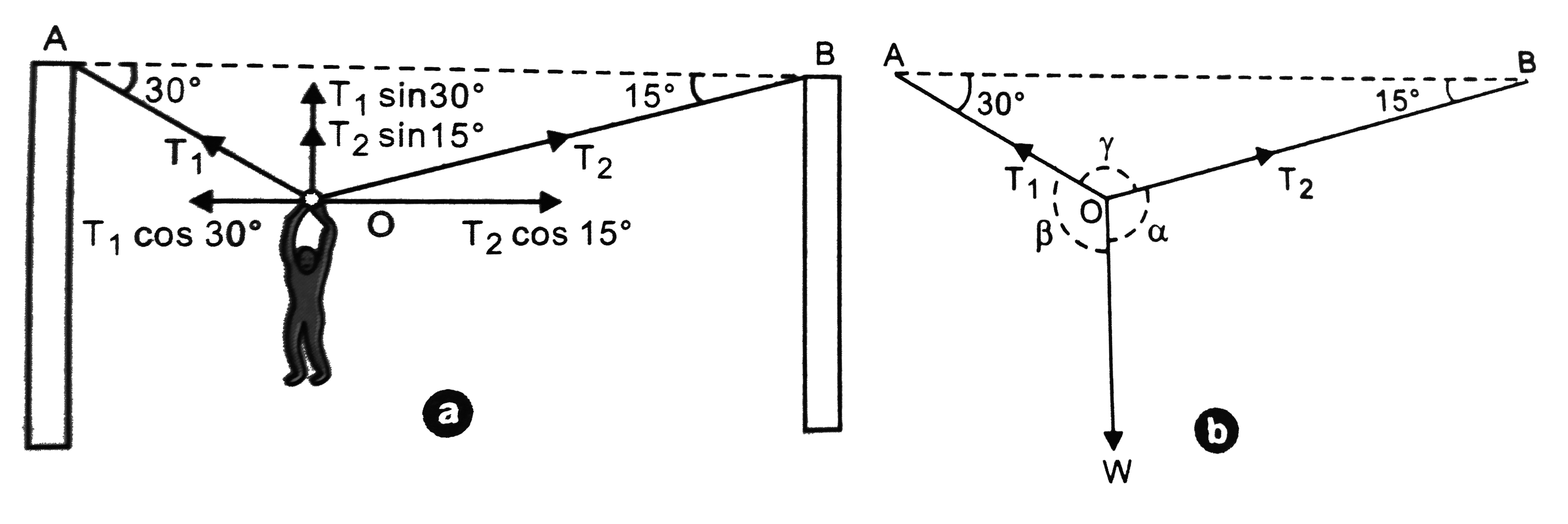
|
|
| 40. |
n identical cubes each of mass 'm' and side 'l' are on the horizontal surface. Then the minimum amount of work done to arrange them one on the other is |
|
Answer» NMGL |
|
| 41. |
In a SHM at which point velocity and acceleration is zero? |
| Answer» Solution :The velocity is zero at the ends POINT of PATH and acceleration is zero at MEAN POSITION. | |
| 42. |
Angle between linear and angular momentum for particle performing rotational motion is …... . |
|
Answer» |
|
| 43. |
A 5kg rifle fires a 5g bullet with a speed of 500 m*s^(-1). (iii) Find the ratio of the distance, the rifle moves backward while the bullet is in the barrel to the distance the bullet moves forward. |
|
Answer» |
|
| 44. |
Explainthe conservative of mechanical energy for a free fall body . |
Answer» Solution :Let a ball of mass m being dropped from a cliff of height H as shown in figure .  The total mechanical energies `E_(0),E_(h) and E_(H)` of the ball at the indicated heights , zero (ground level ) h and H respectively are . Total mechanical ENERGY at height H , `E_(H) =mgH +1/2 mv^(2)` but a maximum height v = 0 Total energy at h height , `E_(h)` = POTENTIAL energy + kinetic energy ` = mgh+1/2 mv_(h)^(2) ( :."velocity of ball at height h = "v_(h))` Total energy at ground , `E_(0) =/2 mv_(f)^(2)` where `v_(f)` is the final velocity of ball when it hit the ground . From the conservation of mechanical energy at height H , `E_(H) =E_(0)` ` :.mgH = 1/2 mv_(f)^(2)` where `v_(f)` is the final velocity of ball when it hit the ground . From the conservation of mechanical energy at height H , `E_(H) =E_(0)` ` :. mgH = 1/2 mv_(f)^(2)` ` :. v_(f) = sqrt(2gH)` From the conservation of mechanical energy at H and h . `E_(H) =E_(h)` ` :. mgH =mgh + 1/2 mv_(f)^(2)` ` :. mgH =mgh +1/2mv_(f)^(2)` ` :. GH -gh =1/2 v_(f)^(2)` ` :. 2g(H-h)=v_(f)^(2)` ` :. v_(f)=sqrt(2g(H-h))` At the height H , the energy is purely potential energy at height h and is fully kinetic at ground level . HENCE , this illustrates the conservation of mechanical energy for a free fall body . |
|
| 45. |
Thermal conductivity of air is less than that of felt but felt is a better heat insulator in comparison to air. Why ? |
| Answer» Solution :In FELT there are fine HOLES packed with air. SINCE the air is trapped, it cannot MOVE. Hence there cannot be any convection in felt. The thermal conductivity of air is less than that of felt. But convection current can set up in open air, which causes the transfer of HEAT. So felt is a better heat insulator. | |
| 46. |
If |vecAxxvecB|=AB, then angle between vecA and vecB will be zero. |
|
Answer» |
|
| 47. |
If a metal wire is stretched a little beyond its elastic limit (or yield point), and released, it will |
|
Answer» LOSE its ELASTIC PROPERTY completely |
|
| 48. |
A tram is moving with an acceleration of 49 cms.^(-2). If 50% of the engine power is used up to overcome friction and the remaining 50% is spent for increasing velocity, coefficient of friction between the wheel and the track should be |
|
Answer» 0.3 |
|
| 49. |
A rod AB of length 2 m and mass 2 kg is lying on a smooth horizontal x-y plane with its centre at origin O as shown in figure. An impulse J of magnitude 10 N-s is applied perpendicular to AB at A. The distance of point P from centre of the rod which is at rest just after impact is |
|
Answer» `(2)/(3)` m |
|
| 50. |
A rod AB of length 2 m and mass 2 kg is lying on a smooth horizontal x-y plane with its centre at origin O as shown in figure. An impulse J of magnitude 10 N-s is applied perpendicular to AB at A. Co-ordinates of point A of the rod after time t=(pi)/(45) s will be |
|
Answer» `[((pi)/(9)+(SQRT(3))/(2))m,(1)/(2)m]` |
|