

Saved Bookmarks
This section includes 7 InterviewSolutions, each offering curated multiple-choice questions to sharpen your Current Affairs knowledge and support exam preparation. Choose a topic below to get started.
| 1. |
A block B is suspended from a cable that is attached to the block at E, wraps around three pulleys and is tied to the back of a truck D. Ifthe tmck starts from rest when x_(D) is zero and moves forward with a constant acceleration of a_(P)=3//2 m//s^(2), if the speed of the block at the instant x_(D)=3 m is : |
|
Answer» `1/5 m//s` |
|
| 2. |
(A) : When there is no external torque moment of inertia of a rotating body changes, its angular momentum remain conserved, but its kinetic energy changes.(R ) : Angular momentum does not depend upon moment of inertia of the body. |
|
Answer» Both (A) and (R ) are true and (R ) is the CORRECT EXPLANATION of (A) |
|
| 3. |
Define amplitude of SHMand draw two different SHM in one figure having for two different amplitudes. |
|
Answer» Solution :Amplitude : The magnitude of maximum displacement of the particle executing SHM. OR The maximum displacement of oscillator on either side of mean position is called amplitude of the SHO. The sign of amplitude is ..A.. or ..a.. and its SI unit is m. DIMENSIONAL formula is `[M^(0)L^(1)T^(0)]`. The displacement of SHM particle changes between two EXTREME points +A and -A. The plot of displacement as a function of time with `phi= 0` for different amplitudes are shown in below FIGURE.  From `x(t)= A cos omega t" and "x(t)= B cos omega t`, from `t=0, (T)/(4), (T)/(2), (3T)/(4), T, (5T)/(4), (3T)/(2), (7T)/(4),"........"` obtained displacement with the CURVE 1 and 2 having amplitudes A and B respectively. |
|
| 4. |
The masses of A,B and C in the figure (Fig. 5.24) are m_(A)=4 kg, m_(B)=2 kg and m_(C)=3 kg. The mass of the movable pulley is 1 kg. Show that the acceleration of A is (9g)/(49) |
|
Answer» |
|
| 5. |
A solid cyclinder of mass M and radius 'R' is mounted on a frictionless horizontal axle so that it can freely rotate about this axis. A string of negligible mass is wrapped round the cylinder and a body of mass 'm' is hung from the string. The mass is released from rest. Find the tension in the string and the angular speed of cylinder as the mass falls a distance h |
|
Answer» SOLUTION :The acceleration .a. of the falling body is GIVEN by `mg-T=ma`………..`(1)` Torque on the cylinder is `tau=TR=IALPHA` `:.T=(Ialpha)/(R )=((MR^(2))/(2))((a)/(R^(2)))`. `[ :. alpha=(a)/(R )]` or `T=(Ma)/(2)`………..`(2)` from `(1)` and `(2)` `T=(MMG)/((M+2m))` from CONSEVATION of energy, we have `mgh=(1)/(2)mv(2)+(1)/(2)Iomega^(2)` `=(1)/(2)m(Romega)^(2)+(1)/(2)((MR^(2))/(2))omega^(2)` on solving `omega=[(4mgh)/((M+2m)R^(2))]^((1)/(2))` 
|
|
| 6. |
The quantities a, b, c are measured as 3.21, 4.253, 7.2346. The sum (a + b + c) with proper significant digits is.............. |
|
Answer» 14.6976 |
|
| 7. |
The speed of water in a river is 4 kmph and the speed of boat in still water is 8 kmph. If the same boat is used to travel a distance of 16km in the river from A and B downstram and back from B to A Find the total time taken by the boat (in Hr) |
|
Answer» `8//3` |
|
| 8. |
An unknown planet orbits the Sun with distance twice the semi major axis distance of the Earth's orbit. If the Earth's time period is T_(2), what is the time period of this unknown planet. |
|
Answer» SOLUTION :Given:`a_(2)=2a_(1)` To find:`T_(2)=??` Formula:`T^(2)PROPA^(3)" "rArrTprop(a)^(3//2)` `T_(2)prop(2a_1)^(3//2)` `prop(2)^(3//2)(a_1)^(3//2)` `T_(2)prop2sqrt(2)T_(1)` `thereforeT_(2)=(2sqrt(2))T_(1)` |
|
| 9. |
If x=(a sin theta+b cos theta )/(a+b), then |
|
Answer» the dimensions of `x` and `a` are same `:.[x]=[(a sin theta)/(a+b)]=[(b cos theta)/(a+b)]` or `[x]=` DIMENSIONLESS |
|
| 10. |
A thin uniform circular disc of mass M and radius R is rotating in a horizontal plane about an axis passing through its centre and perpendicular to its plane with an angular velocity omega. Another disc of same dimensions but of mass M/4 is placed gently on the first disc coaxially. The angular velocity of the system now is |
|
Answer» `(2 omega)/(sqrt2)` `therefore I_(1) omega_(1) = I_(2) omega_(2)` or `omega_(2) = (I_(1) omega_(1))/(I_(2)) = (((1)/(2) MR^(2)) omega)/ (((1)/(2) MR^(2) + (1)/(2) (M)/(4) R^(2))) = (4omega)/(5)` |
|
| 11. |
Four identical bricks are kept one over another in such a way that a part of each brick is projected out of the brick below it. For equilibrium of the system, how much of the three upper bricks can be extended out? |
| Answer» Solution :`(1)/(2)` of the topmost, `(1)/(4)` th of the second ONE and `(1)/(6)` th of the third | |
| 12. |
State Pascal's law.Give the construction and working of Hydraulic brakes. |
|
Answer» <P> Solution :In case (a) PRESSURE head, h = + 20 CM of HgAbsolute Pressure = P + h = 76 + 20 = 96 cm of Hg. GAUGE Pressure = h = 20 cm of Hg. In case (b) Pressure Head h = – 18 cm of Hg Absolute Pressure = 76 – 18 = 58 cm of Hg Gauge Pressure = h = – 18 cm of Hg |
|
| 13. |
A man of 50 kg is standing on a weighing machine in a lift. As the lift moves with a constant acceleration, the weighing machine registers the man's weight as 45 kg. State whether the lift is ascending or descending. Give reasons for your answer. What is the acceleration of the lift? [ g = 9.8 m cdot s^(-2) ] |
|
Answer» Solution :The weighing machine shows a reading lower than the real weight of the man. So, the LIFT is descending with as acceleration, because in such cases, apparent weight R = m(g - a) `LT` MG. The downward acceleration a = g - `( R)/(m) = 9.8 - (45 XX 9.8)/(50) = 0.98 "m"cdot s^(-2)`. |
|
| 14. |
(a) A car starts moving (at point A) on a horizontal circular track and moves in anticlockwise sense. The speed of the car is made to increase uniformly. The car slips just after point D. The figure shows the friction force (f) acting on the car at points A, B, C and D. The length of the arrow indicates the magnitude of the friction and it is given that angleD gtangleB gt angleC. At which point (A, B, C or D) the friction forces represented is certainly wrong ? (b) A particle is moving along an expanding spiral (shown in fig) such that the normal force on the particle [i.e., component of force perpendicular to the path of the particle] remains constant in magnitude. The possible direction of acceleration(veca)of the particle has been shown at three points A, B and C on its path. At which of these points the direction of acceleration has been represented correctly. (c) A particle is moving in XY plane with a velocity . vecv = 4hati + 2thatj ms^(-1) .Calculate its rate of change of speed and normal acceleration at t = 2 s. |
|
Answer» (B) At C (c) `SQRT(2) m//s^(2) "and" sqrt(2)m//s^(2)` |
|
| 15. |
When an isolated gas expands againstvacuum, then its a) Internal energy increases b) No work is done c) Internal energy remains same |
|
Answer» both a and B are TRUE |
|
| 16. |
When a planet moves around the sun (a) its angular momentum remains constant (b) its move faster when it is near to the sun (c) its total energy increases when it goes near to the sun (d) its potential energy decreases when it goes near to the sun |
|
Answer» only a & B are TRUE |
|
| 17. |
A physical quantity P is given by P = (a^(2)b^(2))/(cd). If the percentage errors of measurement in a,b,c,d are 1%, 2%, 3%, 4%respectively, then calculate the percentage error in the calculatioon of P. |
|
Answer» 0.14 `(3 xx 1 %) + (2 xx 2 %) + 3 % + 4 %` = 14 % |
|
| 18. |
Two SHMs are given by Y_1 = Asin (pi/2 t + phi) and Y_2 = B sin ((2pi)/3 t + phi). The phase difference between two after '1' sec is |
|
Answer» `PI` |
|
| 19. |
(A): Strain is a unitless quantity. (R): Strain is equivalent to force. |
|
Answer» Both (A) and (R) are true and (R) is the CORRECT EXPLANATION of (A) |
|
| 20. |
Prove F = - (dV)/(dx) for conservative force . |
|
Answer» Solution :Suppose that a body undergoes displacement `DELTAX` under the action of a conservative force F . ` :. ` Work done by this force , `W = F Delta` but ACCORDING to work energy THEOREM , `W = DeltaK ` ` :. DeltaK = F Deltax` Now from the law of conservation of mechanical energy . `DeltaK + DeltaV = 0 ` ` :. F DeltaX + DeltaV = 0 ` ` :. F Deltax + DeltaV = 0 ` ` :. F = DeltaV ` `Deltax` Hence , in the case of conservative force , force will be obtained by taking negative DERIVATIVE of potential energy w.r.t to displacement . |
|
| 21. |
Keeping the mass of earth as constant, if its radius is reduced to 1//4^(th) of its initial value, then the period of revolution of earth about its own axis and passing through the centre, in hours, is. Assume earth to be a solid sphere and its initial period of rotation as 24 hrs. |
|
Answer» `1.5` |
|
| 22. |
How does speed os sound wave depend on the absolute temperature of ari ? |
| Answer» SOLUTION :`V prop sqrtT` (Where T = ABSOLUTE temperatue of AIR) | |
| 23. |
Displacment time graph of a particle moving in the straight line is as shown in figure. Select the correct alterntive(s) |
|
Answer» work don by all forces in REGION AB is not zero |
|
| 24. |
One mole of a monoatomic ideal gas undergoes the process A rarr B in the given P-V diagram. What is the specific heat for this process ? |
|
Answer» Solution :Specific heat `C= (DELTAQ)/(DeltaT)=1/(DeltaT)(DeltaU+W)=C_(v)+W/(DeltaT)` For the GIVEN process `W=4V_(0)(9P_(0))/2=18P_(0)V_(0)` `( :. W="area of "P-V" GRAPH")" Also", DeltaT=T_(2)-T_(1)` `=((6P_(0))(5V_(0)))/R-((3P_(0))V_(0))/R=(27P_(0)V_(0))/R and C_(v)=3/2R` `:. C=C_(v)+W/(DeltaT)=(3R)/2+(18P_(0)V_(0))/([(27P_(0)V_(0))/R]` `=(3R)/2+(2R)/3=(13R)/6` |
|
| 25. |
If the vectors vec(P) = a hat(i) + a hat(j) + 3 hat(k) and vec(Q) = a hat(i) - 2hat(j)- hat(k) are perpendicular to each other then the positive value of .a. is |
|
Answer» Zero |
|
| 26. |
A uniform hollow shere has internal radiusa and external radius b. Take the potential at infinity to be zero. Density ofhte materialof the sphere is rho The gravitational potential at a point on the outer surface is |
|
Answer» `(-4)/(3)piGrhob^(2)` |
|
| 27. |
A plane mirror placed at the origin has hat(i) as the normal vector to its reflecting surface. The mirror beings to translate with a velocity hat(i) + hat(j) + hat(k). At the same time an object which was initially at hat(i) + hat(j) starts moving with a velocity (hat(i)+hat(j)) m//s Now choose the correct options. |
|
Answer» Initial POSITION of the image will be `-hat(i)+hat(J)` |
|
| 28. |
The acceleration -displacement graph of a particle moving in a straight line is as shown alongside . Initial velocity of particle is zero Find the velocity of the particle when displacement of the particle is ,s=12m. |
|
Answer» |
|
| 29. |
In a steady flow velocity of the fluid at each point remains identical with time . |
|
Answer» |
|
| 30. |
(A): An adiabatic process is an isoentropic process. (R ): Change in entropy is zero in case of adiabatic process. |
|
Answer» Both (A) and(R ) are TRUE and (R ) is the correct explanation of (A) |
|
| 31. |
W hen body is said to be in equilibrium condition ? |
| Answer» SOLUTION :Whenresultantofall forcesactingon BODYIS ZEROIT ISSAIDTO be in EQUILIBRIUM | |
| 32. |
Obtain graphically and mathematically work done by a variable force. |
|
Answer» Solution :(i) When the component of a VARIABLE force F acts on a body, the small work done (dW) by the force in producing a small displacement dr is given by the relation `dw = (f cos theta) dr` [F cos `theta` is the component of the variable force F] where, F and `theta` are variables. (II)The TOTAL work done for a displacement from initial position `r_(i)` to FINAL position `r_(f)` is given by the relation, `W = int_(r_(i))^(r_(f))dW = int_(r_(i))^(r_(f))F cos theta dr ""`.....(1) (iii) A graphical representation of the work done by a variable force is shown in Figure 1. The area under the graph is the work done by the variable force. 
|
|
| 33. |
A cylindrical piece of cork of density rho, base area A and height h, floats in a liquid of density rho_(1). The cork is depressed slightly and then released. Show that the cork oscillates up and down simple harmonically, with a period T=2pisqrt((hrho)/(rho_(1)g)), where 'rho' is the density of the cork. |
Answer» Solution :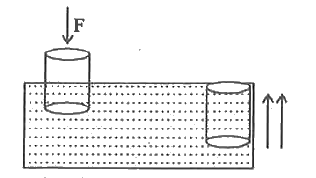 RESTORING force `=-` WEIGHT of liquid DISPLACED `=-(rho_(1)Ay)g` Applied force `F=ma` `"i.e."F=(rhoAh)a` `"Hence,"rhoAha=-rhoAyg` `"or"(y)/(a)=|(-rhoh)/(rho_(1)g)|` We know that period of oscillation, `T=2pisqrt(("displacement")/("accelertion"))""therefore T=2pisqrt((RHO)/(rho_(1)g))` If `.rho.` of the FLOATING body is equal to the density of liquid then, `T=2pisqrt((h)/(g)).` |
|
| 34. |
A particle moves through angular displacement thetaon a circular path of radius' r'. The linear displacement will be: |
|
Answer» `2r sin ((THETA)/(2))` |
|
| 35. |
The average work done by a human heart while it beats once is 0.5 J. Calcute the power used by heart if it beats 72 times in a minute. |
|
Answer» Solution :The WORK done PER beat = 0.5 J Total work done, ` W = 72xx0.5 J = 36 `(for 72 BEATS) POWER = `("Work done")/("TIME") = 36/60 = 0.6 W ` |
|
| 36. |
A thin brass rectangular sheet of sides 10 cm and 5 cm is heated in a furnace to 500^(@) C and taken out. How much electric power is needed to maintain the sheet at this temperature ? Its emissivity is 0.25. |
|
Answer» |
|
| 37. |
A ball of mass m hits a floor with a speed v making an angle of incidence theta with the normal. The coefficient of restitution is .e.. Find the speed of the reflected ball and the angle of reflection of the ball. |
|
Answer» Solution :Suppose the angle of reflection is `theta.` and the speed after the COLLISION is v.. The floor exerts a force on the BALL ALONG the normal during the collision. There is no force parallel to the surface. Thus, the parallel component of the velocity of the ball remains unchanged. This gives v. in `theta .` = v sin `theta ""` ......(i) For the components normal to the floor, the velocity of separation is v. cos `theta.` and the velocity of APPROACH is v cos `theta`.  Hence, v. cos `theta.` = EV cos `theta ""` .....(ii) From (i) and (ii), `v. = v sqrt(sin^(2)theta+e^(2)cos^(2)theta)` and `tan theta. = (tan theta)/(e ) rArr e = (tan theta)/(tan theta^(1))` |
|
| 38. |
A cart loaded with sand moves along a horizontal floor due to constant force F, coinciding in direciton with the velocity of cart. In the process the sand spills through a hole in the bottom with a constant rate mu kgs^(-1). If at the initial moment t = 0 the cart with loaded sand has the mass m_(0) and its velocity was equal to zero (beglect friction). Then |
|
Answer» the acceleration of the cart at time t is `(F)/(m_(0)-mu t)` |
|
| 39. |
The function sin^(2)(omegat) represents |
|
Answer» a SIMPLE HARMONIC motion with a period `pi//omega` This is an SHM with period `(2pi)/(2OMEGA)=(pi)/(omega)`. Its equilibrium position is at `(1)/(2)` instead of zero. |
|
| 40. |
Density remaining constant, if earth contracts to half of its present radius, duration of the day would be (in minutes). |
| Answer» ANSWER :A | |
| 41. |
The potential energy of a harmonic oscillator of mass 2 kg in its mean position is 5J. If its total energy is 9J and its amplitude is 0.01m, find its time period |
|
Answer» Solution :`(1)/(2)kA^(2)= (9-5)= 4J` `:. K= (8)/(A^(2))= (8)/(0.01)^(2)= 8 xx 10^(4)N//m` `T= 2pisqrt((m)/(k))= 2pisqrt((2)/(8 xx 10^(4)))= (PI)/(100) s` |
|
| 42. |
The projection of a vector vec(r ) = 3 hat(i) + hat(j ) + 2 hat(k) on the x-y plane has magnitude |
| Answer» ANSWER :D | |
| 43. |
At 0 K, which of the following properties of a gas will be zero ? |
|
Answer» Potential ENERGY |
|
| 44. |
The angular momentum of rotating body is increased by 20 %. What will be the increase in its rotational kinetic energy ? |
|
Answer» SOLUTION :KINETIC energy K.E. `=(L^(2))/(2I)""EalphaL^(2)` `(E+DeltaE)/(E)=((120)/(100))^(2)` (or) `(DeltaE)/(E)=0.44` `(DeltaE)/(E)xx100=44%` |
|
| 45. |
A uniform hollow shere has internal radiusa and external radius b. Take the potential at infinity to be zero. Density ofhte materialof the sphere is rho |
|
Answer» `(4)/(3)(Gpirho(R^(3)-a^(3)))/(r^(2))` |
|
| 46. |
One mole of an ideal gas is taken in a Carnot engine working between 27^(@)C and 227^(@)C. The useful work done in one cycle is 600 J. calculate the ratio of volume of gas at the end and beginning of the isothermal expansion. Given 8.3 J mole .^(-1) K^(-1). |
|
Answer» |
|
| 47. |
In a dark room with ambient temperature T_(0), a black body is kept at a temperature T. Keeping the temperature of the black body constant (at T), sun rays are allowed to fall on the black body through a hole in the roof of the dark room. Assuming that there is no change in the ambient temperature of the room, which of the following statements are correct ? |
|
Answer» The quantity of radiation absorbed by the black BODY in unit time will INCREASE |
|
| 48. |
An iceberg is floating partially immersed in sea water. The density of sea water is 1.03gem and that of ice is 0.92 gmc^(-1). The approximate percentage of total volume of iceberg above the level of sea water is |
|
Answer» 8 |
|
| 49. |
In a dark room with ambient temperature T_(0), a black body is kept at a temperature T. Keeping the temperature of the black body constant (at T), sun rays are allowed to fall on the black body through a hole in the roof of the dark room. Assuming that there is no change in the ambient temperature of the room, which of the following statement(s) is/are correct ? |
|
Answer» the quantity of radiation absorbed by the blackbody in unit time will INCREASE |
|
| 50. |
A solid sphere linear velocity V_(0)=4m//s and angular velocity omega_(0)=9 rad/s as shown. Ground on which it is moving is smooth. It collides (e=1) with rough wall of coefficient of friction mu. Radius of sphere is 1m and mass is 2kg. |
|
Answer» If the sphere ROLLS without SLIPPING after collision, `mu=0.25` |
|