

Saved Bookmarks
This section includes 7 InterviewSolutions, each offering curated multiple-choice questions to sharpen your Current Affairs knowledge and support exam preparation. Choose a topic below to get started.
| 1. |
n-type semiconductor is |
|
Answer» positive charged |
|
| 2. |
The temperature of Helium gas is raised by 10^(@)C at constant volume. Heat supplied to gas may be taken partly as translational and partly as rotational kinetic energies. Their respective shares are : |
|
Answer» 60%, 40% Thus, CORRECT choice is (B). |
|
| 3. |
State Ampere's circuital law, expressing it in the integral form. |
|
Answer» Solution :Ampere.s circuital LAW states that for an open surface with a BOUNDARY, the INTEGRAL of the product of tangential component of magnetic field for an element and the length of element is equal to `mu_0` times the total current passing through the surface. Mathematically, `OINT B_t dl = oint vecB . vec(dl) = mu_0 I` Where I is the current through the surface. the integral is taken over the closed loop coinciding with the boundary C of the loop. As per sign convention followed, let the fingers of the right hand be curled in the boundary is traversed in the loop integral `oint vecB. vec(dl)`, then the direction of the given thumb gives the sense in which the current I is regarded as positive. 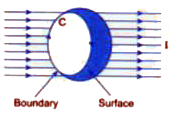
|
|
| 5. |
A potentiometer wire of length 100 cm has resis tance of 10 ohms. It is connected in series with a resistance R and a cell of emf 2V and negligible in ternal resistance. The circuit is as shown below.- Why is it prefered over a voltmeter ? |
| Answer» SOLUTION :The POTENTIAL difference between TWO points of a current carrying conductor is DIRECTLY proportional to the length of wire between two points. | |
| 6. |
A potentiometer wire of length 100 cm has resis tance of 10 ohms. It is connected in series with a resistance R and a cell of emf 2V and negligible in ternal resistance. The circuit is as shown below. What is the resistance of 40 cm length of the potentiometer wire ? |
| Answer» SOLUTION :Resistance PER UNIT length = 10Ω/100cm = 0.1Ω/cm Resistance of 40cm WIRE = 40 x.1 = 4 Ω. | |
| 7. |
A potentiometer wire of length 100 cm has resis tance of 10 ohms. It is connected in series with a resistance R and a cell of emf 2V and negligible in ternal resistance. The circuit is as shown below. -If a source of emf 10 milli volts is balanced by a length of 40cm of the potentiometer wire, find the value of the external resisatnce |
| Answer» Solution :Potentiometer MEASURES emf without DRAWING CURRENT from the cell (null method) | |
| 8. |
Derive an expression for De Broglie wavelength. |
|
Answer» SOLUTION :An electron of mass m is accelerated through a potential difference of V volt. The kinetic energy ACQUIRED by the electron is given by `(1)/(2) mv^(2) = EV` Therefore, the speed v of the electron is `v = sqrt((2eV)/(m))` Hence, the de Broglie wavelength of the electron is `lambda = (h)/(mv) = (h)/(sqrt(2 EMV))` Substituting the known values in the above equation, we get `lambda = (6.626 xx 10^(-34))/(sqrt(2V xx 1.6 xx 10^(-19) xx 9.11 xx 10^(-31)))` `lambda = (12.27 xx 10^(-10))/(sqrt(V))"meter" (or) lambda = (12.27)/(sqrt(V)) Å` For example, if an electron is accelerated through a potential difference of 100 V, then its de Broglie wavelength is 1.227 `Å`. Since the kinetic energy of the electron, K = eV, then the de Broglie wavelength associated with electron can be also written as `lambda = (h)/(sqrt(2mK))` |
|
| 9. |
A transformer cannot work on D.C. Why? |
| Answer» Solution : If D.C voltage is APPLIED, then magnetic FLUX linked with the coil will not vary with TIME and hence there is no induced emf. Hence the REASON. | |
| 10. |
How does the angular separation of interference fringes change in Young's experiment, if the distance between the slits is increased ? |
| Answer» SOLUTION :The angular SEPARATION of INTERFERENCE fringes `(ALPHA=(lamda)/(d))` decreases as the distance .d. between the slits is INCREASED. | |
| 11. |
Find the value of pi/53.2 with due regard to significant figures. |
|
Answer» SOLUTION :Out of the two numbers 53.2 has three SIGNIFICANT digits. So `pi` should be written with 3+1 =4 significant figures. `pi =3.1415= 3.142 ` (as 1 is odd it is raised by one). Now `(3.142)/(53.2)= 0.0590601` This is to be rounded off to three significant figures 0.059060= 0.0591 |
|
| 12. |
Define electric dipole moment. Is it a scalar or a vector ? Derive the expression for the electric field of a dipole at a point on the equatorial line of the dipole. |
|
Answer» Solution :For definition of dipole moment, see point Number 29 under the heading "Chapter At a Glance"Dipole moment is a vector. LET us calculate the electrostatic field at a point P on the equatorial line at a DISTANCE .r. form mid- point O of an electric dipole AB. Obviously, `""|oversetto (E_A) |=|oversetto (E_B)| =(1)/(4 pi in _0).(q)/( (a^(2) + r^(2))) ` Resultant field at POINTP is `oversetto E =oversetto (E_A) +oversetto (E_B) ` Let us RESOLVE ` oversetto (E_A) and oversetto (E_B) ` along and perpendicular to the dipole axis. We find that components `E_A sin theta and E_B sin theta ` nullify each other and hence ` |oversetto E| =(oversetto (E_A) +oversetto (E_B)) cos theta =2 .(1)/(4 pi in _0) .(q)/((a^(2) + r^(2)) ).(a)/(sqrt(a^(2) +r^(2)) ) ` where p=q.2a =dipole moment of electric dipole This DIRECTION of ` oversetto E ` is opposite to that of ` oversetto p i.e. , oversetto E =-(oversetto p)/( 4 pi in _0( r^(2) +a^(2)) ^(3//2)) ` If` r gt gt a , `then teh above relation may be modified as ` "" oversetto E =-(oversetto p)/( 4 pi in _0 r^(3)) ` ` (##U_LIK_SP_PHY_XII_C01_E10_002_S01.png" width="80%"> |
|
| 13. |
A conducting rod of mass M and length L can oscillate like a pendulum in a vertical plane about point O. The lower end of the rod glides smoothly on a circular conducting arc of radius L. The circular arc is connected to point O of the rod through a capacitor of capacitance C. The entire device is kept in a uniform horizontal magnetic field B directed into the plane of the Figure. Disregard resistance of any component. The rod is deflected through a small angle theta_(0) from vertical position and released at time t = 0. (a) Write the deflection angle (theta) of the rod as a function of time t. (b) If the capacitor is replaced with a resistor what kind of motion do you expect?Give qualitative description only. |
|
Answer» (b) Oscillations die after some time. |
|
| 14. |
एक जीवन प्रक्रिया है जो जीव के जीने के लिये आवश्यक नहीं है परन्तु स्पिशीज के अस्तित्व के लिये आवश्यक है। |
|
Answer» वृद्धि |
|
| 15. |
Five identical conducting plates each of face area .A. are arranged as shown in figure. If a potential. difference of.V._(0)is created between plate A and C then the charge on plate .E. will be [Given C = (epsilon_0A)/d ] |
|
Answer» `(3CV_0)/8` |
|
| 16. |
In series LCR circuit voltage leads the current. When (Given that omega_(0) = resonant angular frequency) |
|
Answer» `OMEGA LT omega_(0)` |
|
| 17. |
A radio active element of mass number 208 at rest disintegrates by emitting an prop -particle. If E is the energy of the emitted prop -particle, the energy of disintegration |
| Answer» Answer :A | |
| 18. |
(a) Show that an a.c. circuit containing a pure inductor, the voltage is ahead of current by p/2in phase. (b) A horizontal straight wire of length Lextending from east to westis falling with speed v at right angles to the horizontal component of Earth's magnetic field B. (i) Write the expression for the instantaneous value of the e.m.f. induced in the wire. (ii) What is the direction of the e.m.f.? (iii) Which end of the wire is at the higher potential? |
|
Answer» Solution :(a) `epsilon=epsilon_(0)SIN omegat` `epsilon-L (di)/(dt)=0` `""(di)/(dt)=(epsilon)/(L)=(epsilon_(0))/(L)sin omegat` `""underset(0)overset(1)int (di)/(dt)dt=(epsi_(0))/(L)underset(0)overset(1)int sin omegat` `""i=(epsi_(0))/(OMEGAL) COS omegat` 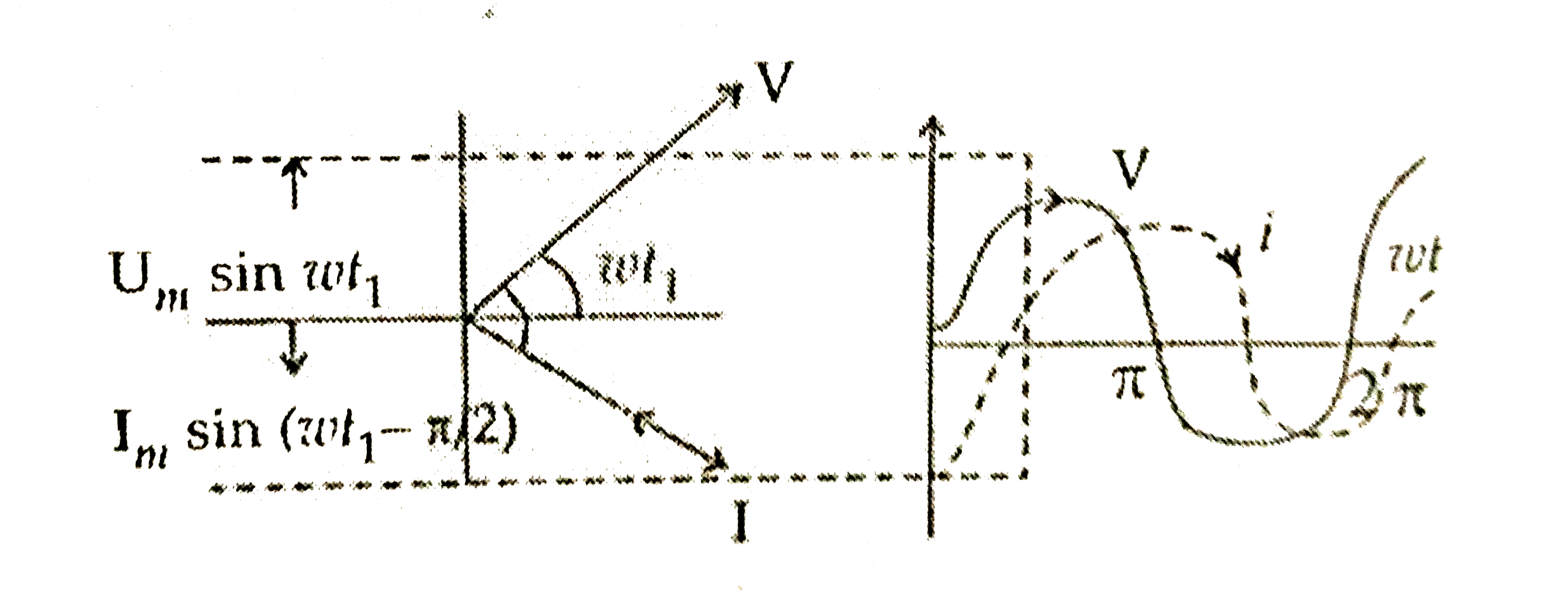 `(epsi_(0))/(X_(L))sin(omegat-pi//2),X_(L)=omegaL` (b) 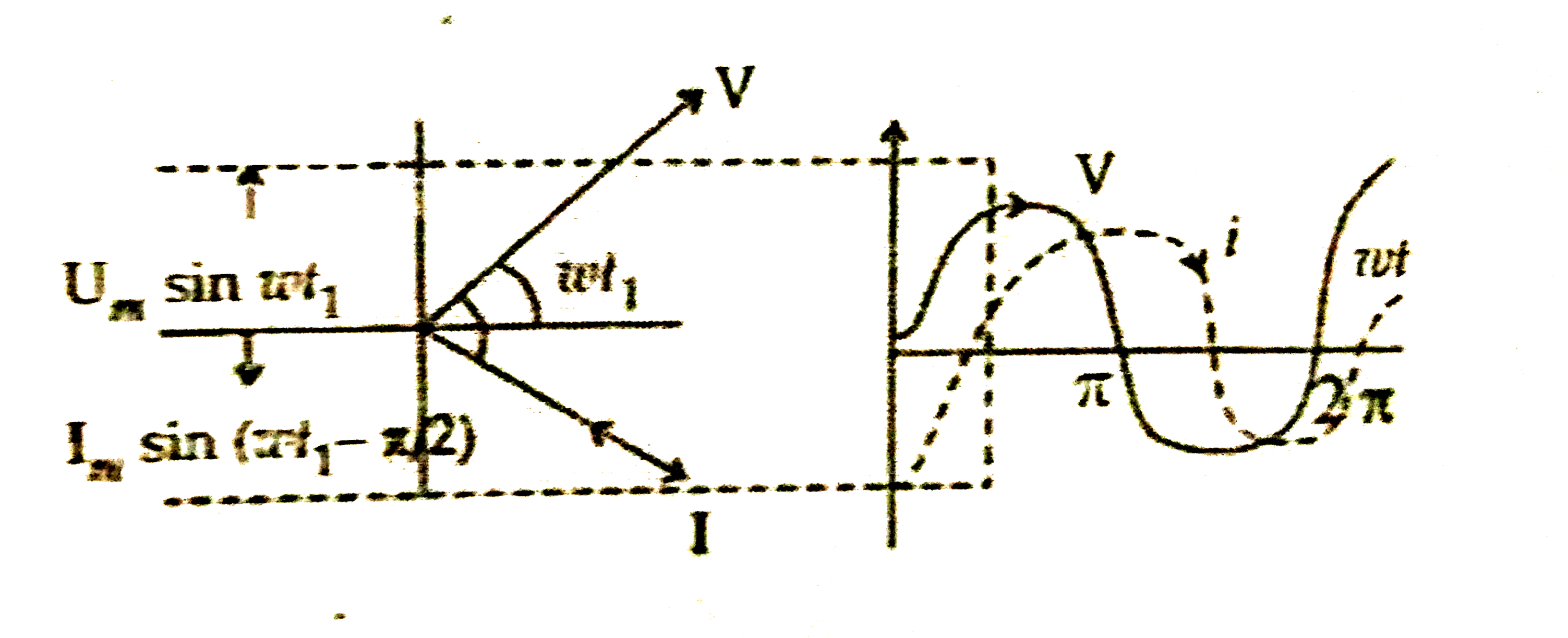 (i) Horizontal component along AB is .....(i) `AL=H=R cos delta ""(i)` vertical component along AD is `AM=V=R sin delta ""(ii)` Square (i) and (ii), and add `H^(2)+V^(2)+R^(2)(cos^(2)delta +sin^(2)delta)=R^(2)` `therefore ""R=sqrt(H^(2)+V^(2))........(III)` Dividing (ii) by (i), we get `(R sin delta)/(R cos delta)=(V)/(H)="Or "tandelta=(V)/(H)` .......(iv) The value of horizontal component H=R cos `delta` is different at different places. At the magnetic poles, `delta=90^(@)` Horizontal component (H) can be measured using a vibration magnetometer and a deflection magnetometer. The value of H at a place on the surfae of earth is the order of `3.2xx10^(-5)`tesla. (ii) The DIRECTION of the e.m.f. from the south to north. (iii) Wire 1is the higher potential than wire 2. |
|
| 19. |
Figure shows two parallel plate capacitors with fixed plates and connected to two batteriers. The separation between the plates is the same for the two capacitors. The plates are rectangular in shape with width b and lengths l_1 and l_2. The left half of the dielectric slab has a dielectric constant K_1and the right half K_2Neglecting any friction, find the ratio of the emf of the left battery to that of the right battary for which the dielectric slab may remain in equilibrium |
|
Answer» `SQRT((K_2-1)/(K_1-1))` |
|
| 20. |
Why there is a need for modulation ? |
|
Answer» Solution :1. To REDUCE the size of the ANTENNA 2. Effective power RADIATED by the antenna 3. Mixing up of signals from different transmitters |
|
| 21. |
A simple harmonic oscillator has a frequency of 2.5 Hz and an amplitude of 0.05m. What is the period of the oscillations? |
|
Answer» 0.4s |
|
| 22. |
(b) Magnetic field lines can be entirely confined within the core of a toroid, but not within a straight solenoid. Why ? |
| Answer» Solution :(b) If we assume MAGNETIC field LINES of a straight SOLENOID to be confined within the solenoid then `oint overset(to) (B) . overset(to)(d) a NE 0` for a closed surface around its two ends which is against Gauss.s law for magnetism. Hence, magnetic field lines of a solenoid cannot be confined within itself. | |
| 23. |
Velocity and acceleration of a particle at time to aret vecu (2hati+3hatj)m/s and veca = (4hatj +2hatj) m//s^(2) respectively. Find the velocity and displacement of particle at |
|
Answer» SOLUTION :Here acceleration `veca=(4hati+2hatj)m//s^(2)` is constant so, we can apply `vecv= vecu+vec (at) and vecs= uvect+(1)/(2) vec (at)^(2)` substituting the proper values, we get `vecv=(2hati+3haj)+(2) (4hati+2hatj)=(hati+7hatj) m//s and` `vecs=(2) (2hati+3hatj)+(1)/(2)(2)^(2)(4hati+2hatj)=(12hatI+10 HATJ)` therefore velocity and displacement of PARTICLE at t=2s are `(10 hati+7 hatj) m//s and (12 hati+10 hatj)` m respectively. |
|
| 24. |
यदि n(A)=21,n(B)=8,n(AnnB)=4 तो n(AuuB) का मान ज्ञात कीजिए। |
|
Answer» 25 |
|
| 25. |
The capacity of a parallel plate capacitor is 10 muF, when the distance between its plates is 8 cm. If the distance between the plates is reduced to 4 cm, the new capacity of the parallel plate capacitor will be |
|
Answer» `5 mu F` `rArr C. = C.d/(d.) = 10mu F xx (8 cm)/(4 cm) = 20 muF` |
|
| 26. |
Which of the two : moving material particle is concerned with de-Broglie hypothesis ? |
| Answer» Solution :Moving material PARTICLE is concerned with DE Broglie hypothesis. | |
| 27. |
Figure shows the trajectory of a projectile fired at an angle theta with the horizontal. The elevation angle of the highest point as seen from the point of launching is varphi. The relation between varphi and theta is : |
|
Answer» `tanvarphi=1/2tantheta` `tanphi=1/2tantheta` |
|
| 28. |
Two bodies of masses m_(1) and m_(2) are attached to the two ends of a string. The passes over a pulley of mass m and radius R. if m_(1)gtm_(2) . The acceleration the system will be |
|
Answer» `(m_(1)-m_(2))/(m_(1)+m_(2))G`  `m_(1)g-T_(1)=m_(1)a` `T_(2)-m_(2)g=m_(2)a""....(II)` `:. (T_(1)-T_(2))+(m_(1)+m_(2))a=(m_(1)-m_(2))g` `rArrT_(1)-T_(2)=(m_(1)-m_(2))g-(m_(1)+m_(2))a` `"" tau=(T_(1)-T_(2))R=Ialpha` `"" =(1//2)mR^(2)(a//R)"" ....(iii)` `rArr(T_(1)-T_(2))=(1//2)ma"" ....(IV)` From (iii) and (iv) `"" (1//2)ma=(m_(1)-m_(2))g-(m_(1)+m_(2))a` `rArr a=(m_(1)-m_(2))/(m_(1)+m_(2)+(m//2))g` |
|
| 29. |
On what factors capacitance of a capacitor depends ' and where capacitors are used. |
|
Answer» |
|
| 30. |
When the dipole is aligned parallel to the field, its electric potential energy is |
|
Answer» |
|
| 31. |
Unpolarised light is incident from air on a plane surface of a material of refractive index .mu.. At a particular angle of incidence .I., it is found that the reflected and refracted rays are perpendicular to each other. Which of the following options is correct for this situation? |
|
Answer» REFLECTED light is polarized with its electric vector parallel to the plane of INCIDENCE |
|
| 32. |
In a circular parallel plate capacitor radius of each plate is 5 cm and they are separated by a distance of 2mm. Calculate the capacitance and the energy stored. When it is charged by connectig battery of 200 V. (given epsilon_(0) = 8.854 xx 10^(-12) Fm^(-1)) |
|
Answer» SOLUTION :Radius `r = 5 cm = 5 xx 10^(-2)m` `d = 2 xx 10^(-3)m` : voltage applied = 200 V `epsilon_(0) = 8.8754 xx 10^(-12) Fm^(-1)` `A = pi r^(2) = 3.142 xx (5 xx 10^(-2))^(2) = 0.007855 m^(2)` `C = (epsilon_(0)A)/(d)` `C = (8.854 xx 10^(-12) xx 0.007855)/(2 xx 10^(-3)) = 34.8 xx 10^(-12)F` `U = (1)/(2)C V^(2)` `U = (1)/(2) xx 34.8 xx 10^(-12)xx(200)^(2) = 6.96 xx 10^(-7)J` |
|
| 33. |
The refractive index of the core of an optical fibre is mu_2and that of the cladding is mu_1 . The angle of incidence on the face of the core so that the light ray just under goes total internal reflection at the cladding is |
|
Answer» `SIN^(-1) (mu_1/mu_2)` |
|
| 34. |
In Bohr's atomic model, the electrons do not fall into the nucleus because |
|
Answer» The space between the nucleus and the ATOMIC boundary is filled with ether. |
|
| 35. |
What is oscillatory motion ? |
|
Answer» |
|
| 36. |
A flat plate is moving normal to its plane through a gas under the action of a constant force F. The gas is kept at a very low pressure. The speed of the plate v is much less than the average speed u of the gas molecules. Which of the following options is/are true ? |
|
Answer» The pressure difference between the leading and trailing faces of the plate is proportional to `Delta P_0` (forward) `= 2m_0 (u +v)` `Delta P_0 `(Rear) ` = 2m_0 (u -= v)` Let the rates of collision with front and rear surfaces be `R_1`and `R_2`RESPECTIVELY So, `R_1 ALPHA (u + v)` `R_2 alpha ( u - v)` Force = `Delta P. R.` So,`F_1 = R_1 2m_0 (u + v),F_2 = R_2 .2m_0 (u - v)` So,`F_1 - F_2 alpha 2m_0 (u +v)^@ - 2m_0 (u-v)^2` `alpha 2m_0 [4uv]` `alpha uv` So, (A) is correct Clearly, the net force due to gas is proportion toi.e. it is variable HENCE acceleration of plate is variable. Finally the plate will start moving with terminal VELOCITY. Hence (C) is correct. Resistive force `= Delta P.A prop V""RARR"Hence (D) is correct "` 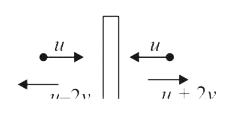
|
|
| 37. |
Find B at centre C in the following cases: |
|
Answer» (ii) `B=B_(1)+B_(2)+(mu_(0)l)/(2R)xx1/2=(mu_(0)l)/(4R.)1/R=(mu_(0)l)/(4R)(1+1/pi)` (III) `B=B_(1)+B_(2)+B_(3)=2B_(1)+B_(2)=(2xx(mu_(0)l)/(4pi)I/R)+((mu_(0)I)/(2R)xx1/2)=(mu_(0)I)/(2R)(1/2+1/pi)` (iv) `B=B_(1)+B_(2)=(mu_(0))/(2A)xx1/2+(mu_(0))/(2b)xx1/2=(mu_(0)I)/4(1/a+1/b)` (v) `B=B_(1)-B_(2)=((mu_(0))/(2a)xx1/2+(mu_(0))/(2b)xx1/2)=(mu_(0)I)/4(1/a-1/b)` (vi)`B=B_(1)-B_(2)=(mu_(0)I)/(2R)-(mu_(0)I)/(2piR)=(mu_(0)I)/(2R)(1-1/pi)` (VII)`B=B_(1)+B_(2)=(mu_(0)I)/(2R)-(mu_(0)I)/(2piR)=(mu_(0)I)/(2R)(1+1/pi)` (viii)`B=B_(1)-B_(2)=(mu_(0)I)/(2a)-(mu_(0)I)/(2b)xxtheta/(2pi)=(mu_(0)Itheta)/(4pi)(1/a-1/b)` |
|
| 38. |
The energy and momentum of an electron are related to the frequency and wavelength of the associated matter wave by the relations : E=hv" "p=(h)/(lamda). But while the value of lamda is physically significant, the value of v (and therefore, the value of the phase speed vlamda) has no physical significance. why? |
|
Answer» <P> Solution :The absolute vlaue of energy E and any particle is arbitrary with zero level of energy FIXED at our convenience but absolute value of momentum p is always fixed for a given frame of reference.hence, while `lamda=(h)/(p)` is physically SIGNIFICANT, value of `v=(E)/(h)` for matter wave of an electron has no DIRECT physical meaning. the phase speed `vlamda` is likewise not physically significant. |
|
| 39. |
A converging lens is kept coaxially in contact with diverging lens -- both the lenses being of equal focal lengths. What is the focal length of the combination? |
|
Answer» |
|
| 40. |
the reagent used for the seperation of acetaldehyde from acetophenon is- |
|
Answer» `NaHSO_(3)` 
|
|
| 41. |
One of the following is exothermic reaction. This is |
|
Answer» ELECTROLYSIS of water |
|
| 42. |
Define forward bias. |
| Answer» Solution :If the POSITIVE TERMINAL of the external VOLTAGE source is CONNECTED to the p-side and the negative terminal to the n-side, it is called forward bias. If the positive terminal of the battery is connected to the n-side and the negative potential to the p-side, the junction is said to be reverse BIASED. | |
| 43. |
In a galvanometer. a current or lμA produces a deflection of 20 divisions. It has a resistance of 10Omega. If the galvanometer has 50 divisions on its scale and a shunt of 2.5Omega is connected across the galvanometer, the maximum current that the Galvanometer can measure now is |
|
Answer» `12.5muA` |
|
| 44. |
Draw Wheatstone bridge and write the condition for balance. |
Answer» Solution :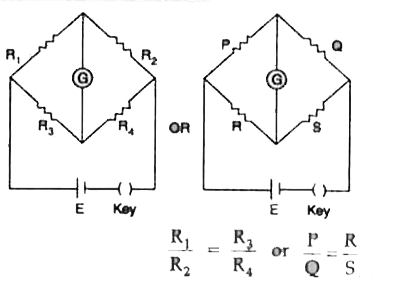 `(R _(1))/( R _(2)) = (R _(3))/( R_(4)) or ( P)/(Q) = (R)/(S)` or ` I _(G) =0` or p.d. across the galvanometer is zero. |
|
| 45. |
A bar magnet of length 0.1 m has pole strength of 50Am. Calculate the magentic field at a distance of 0.2 m from its centre on its equatorial line. |
|
Answer» Solution :Length of the MAGNET `,2l=0.1 m or l = 0.05 m` Distanceof the point on EQUATORIAL line , d = 0.2 m Pole strength , m = 50Am Magnetic induction on the equatorial line of a bar magnet is , ` B = (mu_0)/(4pi) ( m)/((d^(2) + l^(2))^(3//2))=(mu_0)/(4pi)(m(2l))/((d^(2) + l^(2))^(3//2))` `B=(4pi xx 10^(-7))/(4pi) xx (50 xx 0.1)/([(0.2)^(2) + (0.05)^(2)]^(3//2))` `=5.7 xx 10^(-5)T` |
|
| 46. |
A transpar ent rod 40 cm long is cut flat at one end and rounded to a hemispherical surface 12 cm radius at the other end. A small object is embedded within the rod along its axis and half way between its ends. When viewed from the flat end of the rod, the object appears 10 cm deep. What is its apparent depth when viewed from the curved end? |
|
Answer» Solution :Case I: When the object is viewed from the flat surface:Real depth of the object = 20 cm Apparent depth = 10 cm Using, `mu=("Real Depth")/("Apparent Depth")` We have`mu=20/10=2` Case II: When the object is viewed through the CURVED surface: Here therefraction is TAKING PLACE at the single curved surface.So we will use `mu_(2)/v -mu_(1)/u=(mu_(2)-mu_(1))/R` Here, `mu_(1)=2, mu_(2)=1,u=-20cm,v=?,R=-12cm` `1/v-2/((-20))=(1-2)/(-12)` `1/v=1/12 - 1/10` `1/v=(10-12)/120 = (-2)/120` `impliesv=60cm` Hence the object appears 60 cm deep from the curve surface. 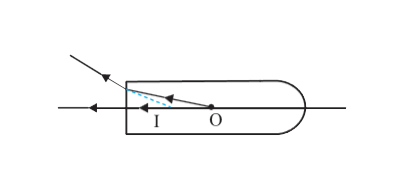 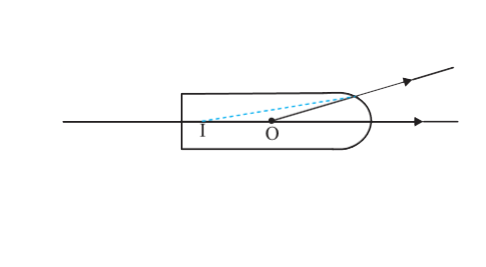
|
|
| 47. |
If Set A has n elements, How many proper subsets are there of A- |
|
Answer» `2^n` |
|
| 48. |
If the size of the particle scattering the light is smaller than the wavelength of incident light then the scattering is called ...... scattering. |
| Answer» Solution :Rayleigh | |
| 49. |
If x=(acostheta+bcostheta)/(a+b), then |
|
Answer» `x` has the same dimensions as `a` and `b` As `sintheta` and `COSTHETA` have no dimensions `:.x=(a+b)/(a+b)i.e.`no dimensions HENCE `(c )` is the RIGHT CHOICE. |
|
| 50. |
A longitudinal progressive wave is given by the equation y = 5 xx 10^(2) sin pi (400 1 + 1)m. Find (i) amplitude (ii) frequency (iii) wave length and (iv) velocity of the wave (W) velocity and acceleration of particle at x=(1)/(6)m-at=0.1 a(vi) maximum particle velocity and accelerdion. |
|
Answer» Solution :Comparing with the general equation of the progressive wave `y=A sin (OMEGA+ kx)` we FIND `omega=400 piand k= pi `, we find (i) `A=5xx10^(-2)m` (ii) `f=(omega)/(2pi)=(400pi)/(2pi)=200 Hz` (iii) `lambda=(2pi)/(k)=(2pi)/(pi)=2m` `(iv) v=(omega)/(k)=(400pi)/(pi)=400 ms^(-1)` (v) `v_(p)= A omega cos (omega t+kx)=10 sqrt(3) pi ms^(-1)` `a_(p)=A omega^(2) sin (omegat+kx)=-4xx10^(-4) ms^(-2)` `(vi) V_(max)=A omega =20 pi ms^(-1)` |
|