

Saved Bookmarks
This section includes 7 InterviewSolutions, each offering curated multiple-choice questions to sharpen your Current Affairs knowledge and support exam preparation. Choose a topic below to get started.
| 1. |
In the circuit figure, the voltmeter reads 30 V. The resistance of the voltmeter is |
| Answer» Answer :A | |
| 2. |
The instantaneous value of an alternating current is given by I = 50 sin100 pit. It will achieve a value of 25 A after a time interval of : |
|
Answer» `1/300` SEC |
|
| 3. |
What is the current I in the circuit shown in adjoining Fig. ? |
|
Answer» 2A `1/R = 1/2 + (1)/((2 + 2 + 2)) = 1/2 + 1/6 rArr R = 1.5 Omega` ` THEREFORE I = (3V)/(1.5 Omega) = 2A` |
|
| 4. |
Two coherent oint sourcesS_(1) and S_(2)vibratingin phaseemitlightof wavelngth lambda. The separation between the sources is 2lambda.Consider a line passing through S_(2)and perpendicular to the S_(1)S_(2)Whatis the smallestdistancefrom S_(2) where a minimum of intensity occurs ? |
|
Answer» `(5lambda)/2 ` |
|
| 5. |
Which of the following statements is/are correct for potentiometer circuit ? |
|
Answer» Sensitivity varies inversely with the length of the POTENTIOMETER wire |
|
| 6. |
यदिf:RrarrR,f(x)=(x^2 +4)/(x^2+x) द्वारा परिभाषित है। सही उत्तर चुनिए |
|
Answer» एकैकी |
|
| 7. |
The electric field strength depends only on the x, y, and z coordinates according to the law E = (a(xhati+yhatj+zhatk))/(x^2+y^2+z^2)^3//2, wherea = 280 Nm^2C^(-1) is a constant. If the potential difference between (3,2,6) and (0,3,4) is x^2. What is the value of x. |
|
Answer» Solution :`vecE=(avecr)/(r^(2))` `V=(-a)/(r)` `triangleV=(a)/(r_(2))-(a)/(r_(1))=(a)/(5)-(a)/(7)=(2a)/(35)=2XX(280)/(35)=16V=4^(2)` |
|
| 8. |
When hydrogen atom is in its first excited level, its radius is ______ of the Bohr radius. |
|
Answer» twice `r_(2) = (2)^(2) r_(0) = 4r_(0)` |
|
| 9. |
Figure shows plane waves refracted for air to water. What is the refractive index of water with respect to air ? |
|
Answer» a/e |
|
| 10. |
The efficiency of an ideal heat engine can be100% if the sink (exhaust temperature) is at the temperature of ’ |
|
Answer» the source |
|
| 11. |
In a moving coil galvanometer, there is a coil of copper having number of insulated turns N, each of area A. The coil is suspended in a radial magnetic field B. The moment of inertia of the coil about its rotational axis is I. The scale divisions in the galvanometer are n and resistance of the coil is R. The voltage sensitivity of the galvanometer (in rad/volt) is |
|
Answer» `(pi)/(3R)` |
|
| 12. |
The equation of two interfering waves are y_(1) =b_(1)cos omegat and y_(2) =bcos(omegat + phi) respectively. Destructive interference will take place at the point of observation for the following value of phi. |
|
Answer» `0^(@)` |
|
| 13. |
(a) Obtain Lens Maker's formulausing the expression (n_(2))/( v) - ( n_(1))/( u ) = ((n_(2) - n_(1)))/( R ) Here the ray of light propagating from a rarer medium of refractive index ( n_(1)) to a denser medium of refractive index ( n_(2)) is incident on the convex side of spherical refracting surface of radius of curvature R. (b) Draw a ray diagram to show the image formation by a concave mirror when the object is kept between its focus and the pole. Using this diagram , derive the magnification formula for the image formed. |
Answer» Solution :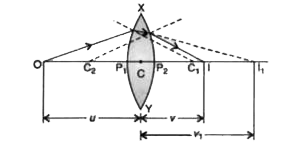 For refraction at the first SURFACE `(n_(2))/( v_(1)) - ( n_(1))/( u ) = ( n_(2) - n_(1))/( R_(1))`...(i) For the second surface, `I_(1)` acts as a virtual object ( located in the denser medium ) whose final real image is formed in the rarer medium at I. so for refraction at this surface, we have `(n_(1))/( v) - ( n_(2))/( v_(1) ) = ( n_(1) - n_(2))/( R_(1))`...(ii) From equations (i) and (ii) , `(1)/(v) - ( 1)/(u) = ((n_(2))/(n_(1))-1) ((1)/( R_(1)) - ( 1)/( R_(2)))` The point, where image of an object, located at infinity is formed, is called the focus F, of the lens and the distance f gives its focal length. so for u `= oo, , v = + f ` `rArr (1)/( f) = (( n_(2))/(n_(1) ) - 1) ((1)/( R_(1)) - ( 1)/( R_(2)))` (B) 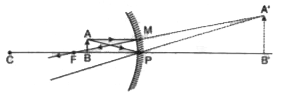 `Delta ABP` is similar to `DELA A.B.P` So `(A.B.)/( AB) = ( B.P)/( BP )` Nor `A.B. = I, AB =0, B.P= +v` and `BP = - u` So magnification `m = ( I )/( O ) = - ( v )/( u )` |
|
| 14. |
A inifinite length current carrying wire is placed in x,y plane parallel to y axis as shown in figure. (All charges projected in region l) |
|
Answer» A positively charged particle PROJECTED along y axis will get deflected along z axis `=qv_(0)ixxB(-k)=qv_(0)BJ` |
|
| 15. |
In Youngs double slit experiment, to increase the fringe width |
|
Answer» Solution :Experimental setup (i) Wavelenght from `S_(1) and S_(2)` spread out and overlapping takes place to the right side of double slit. When a screen is placed at a distance of about I meter from the slits, alternate bright and dark fringes which are equally spaced appear on the screen. These are called interference fringes or bands. (ii) Using an eyepiece the fringes can be seen directly. At the center point O on the screen, WAVES from `S_(1) and S-(2)` travel equal distances and arrive in phase. These two wavesconstructively interfere and bright FRINGE is observed at O. This is called central bright fringe. (iii) The fringes DISAPPEAR and there is unifrom illumination on the screen when one of the slits is covered. This shows clearly tha the band are due to interference. Equation for path difference (i) Let d be the distance between the double slits`S_(1) and S_(2)` which act as coherent sources of wavelenght `lambda`. A screen is placed parallel to the double slit at a distance D from it. The mid - point of `S_(1) and S_(2)` is C and the midpoint of the screen O is equidstant from `S_(1) and S_(2)`. P is any point at a distance y from O. (ii) The waves from `S_(1) and S_(2)` meet at P either inphase or out of - phase depending upon the pathdifference between the two waves. (iii) The path differcne `delta` between the light waves from `S_(1) and S_(2)` to the point P is, `delta = S_(2)P - S_(1)P` A perpendicular is drpped from the point `S_(1)` to the line `S_(2)`P at Mto find the difference more precisey. `delta = S_(2) P - MP = S_(2)M` The angular position of the pointfromC is `theta, angle OCP = theta`. From the geometry, the angles `angleOCP and angle S_(2)S_(1)M` are equal. `angleOCP = angle S_(2)S_(1)M = theta` In right angle triangle `DeltaS_(1)S_(2)M`, t he path difference, `S_(2)M = d sin theta` `delta = d sin theta` If the angle `theta` is small, `sin theta = sin theta = theta`, From the right angle triangle `Delta OCP, TAN theta = (y)/(D)` The path difference, `delta = (dy)/(D)`  
|
|
| 16. |
In a balanced Wheatstone's network, galvanometer and cell are interchanged. Will the network be still balanced? |
|
Answer» |
|
| 17. |
When was End Child Slavery Week organised ? |
|
Answer» 19th November to 25TH November |
|
| 18. |
A motor car moving with uniform acceleration covers two successive kilometre in 30 second and 20 second respectively. Then the acceleration of motor car is: |
|
Answer» `3 MS^(-2)` |
|
| 19. |
A beaker is placed on the top of a coin. The top of the beaker is closed with an opaque body with a small hole. View the coin from an angle , slowly add water through the hole while continuing to view the coin from the same angle. Repeat the procedure using cooking oil. a.What happens when water is continuously added ? b. What about the heights of water and oil, when con completely disappears ? c.In which liquid, the coin is concealed best with minimum height? Why? d. What is the valation between opitieal angle and refrective index. ? |
|
Answer» Solution :COIN appears to be RAISED. B. Height of the oil is less than that of water. c. Since the CRITICAL ANGLE of oil is less than that of water, objectdisappears more earily in oil d. `n= (1)/(sini_(e))` |
|
| 20. |
The ratio of densities of nitrogen and oxygen is 14 : 16. The temperature at which the speed of sound in nitrogen will be same as that in oxygen at 55°C is: |
| Answer» Answer :D | |
| 21. |
calculate the magnetic field inside and outside of the long solenoid using ampere's circuital law. |
|
Answer» Solution :MAGNETIC field due to a long current carrying solenoid:onsider a solenoid of lenth L having N turns The diametre of the solenoid is assumed to be much smaller when compared to its LENGTH and coil is wound very closely. In order to calculate the magnetic field at any point inside the solenoid, we use Amperes circuital law. Consider a rectangular loop abcd. Then from Ampère.s circuital law,`ointvecB।dvecl=mu_0I_(enclosed)=mu_0xx(" total current enclosed by Amperian loop")` The left side of the equation is `ointvecB।dvecl= overset(b)underset(a (int)vecB।dvecl+overset(c)underset(b)(int)vecB।dvecl+overset(d)underset(c)(int)vecB।dvecl+overset(a)underset(d)(int)vecB।dvec` SINCE the elemental lengths along bc and da are PERPENDICULAR to the magnetic field which is along the axis of the solenoid, the integrals `overset(c)underset(b)(int)vecB।dvecloverset(c)underset(b)(int)abs(vecB)abs(dvecl)cos90^@=0,overset(a)underset(b)(int)vecB।dvecl0` Since the magnetic field outside the solenoid is zero, the integral`overset(d)underset(c)(int)vecB।dvecl=0` for the path along ab,the intergral is `overset(b)underset(a)(int)vecB।dvecl=Boverset(b)underset(a)(int)dlcos0^0=Boverset(b)underset(a)(int)dl` where the length of the loop ab is h। But the CHOICE of length of the loop ab is arbitrary। We can take very large loop such that it is equal to the length of the solenoid L। Therefore the integral is `overset(b)underset(a)(int)vecB।dvecl=BL` Let N I be the current passing through the solenoid of N turns, then `overset(b)underset(a)(int)vecB।dvecl=BL=mu_0NIimpliesB=mu_0(NI)/L` The number of turns per unit is given length is given by`NI/(L)=n`,then `B=mu_0(nLI)/L=mu_0nI` Since n is a constant for a give solenoid and `mu_0`is also constant.For a fixed current I,the magnetic field inside the solenoid is also a constant. 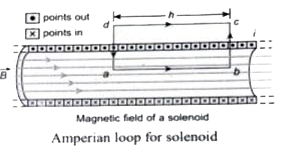
|
|
| 22. |
Natural monochromatic light of intensity I_(0) falls on a system of two Polaroids between which a crystalline plate is inserted,cut parallel to its optical axis. The plate introduces a phase difference delta between the ordinary and extraodianry rays. demonstrate that the intensity of light transmitted through that sysytem is equal to I = (1)/(2)I_(0)[cos^(2)(varphi - varphi') - sin 2varphi. sin 2varphi' sin^(2)(delta//2)], where varphi and varphi' are the angles between the optical axis of the crystal and the principle directions of the Polaroids. In particular, consider the cases of crossed and parallel Polaroids. |
|
Answer» Solution :Light emerging from the first polaroid is plane polarized with amplitude `A` where `N_(1)` is the principle direction of the polaroid and a vibration of amplitude can be resolved into two vibration : `E` wave vibration along the optic axis of amplitude `A cos varphi` and the `O` wave with vibration perpendicular to the optic axis and having an amplitude `A SIN varphi`. These acquire a phase difference `delta` on PASSING through the plane. The second polaroid transmits the components `A cos varphi cos varphi'` and `A sin varphi sin varphi'` What emerges from the second polaroid is a set of two plane polarized waves in the same direction and same plane of polarization but phase difference `delta`. They interfere and PRODUCE a wave of amplitude squared `R^(2) = A^(2) [cos^(2) varphi cos^(2) varphi' + sin^(2)varphi sin^(2) varphi' + 2cos varphi cos varphi' sin varphi sin varphi' cos delta]`, using `cos^(2) (varphi - varphi') = (cos varphi cos varphi' + sin varphi sin varphi')^(2)` `= cos^(2)varphi cos^(2)varphi' + sin^(2)varphi sin^(2) varphi' + 2cosvarphi cosvarphi' sinvarphi sin varphi'` we easily find `R^(2) = A^(2) [cos^(2)( varphi -varphi') - sin 2varphi sin2 varphi' sin^(2)((delta)/(2))]` Now `A^(2) = I_(0)//2` and `R^(2) = I` so the result is `I = (1)/(2)I_(0) [cos^(2)( varphi -varphi') -sin 2 varphi sin2varphi' sin^(2) ((delta)/(2))]` Special cases :- Crossed polaroids : Here ` varphi -varphi' = 90^(@)` or`varphi' =varphi - 90^(@)` and `2 varphi' = 2 varphi - 180^(@)` Thus in this case `I = I_(bot) = (1)/(2)I_(0)sin^(2)2 varphi sin^(2) ((delta)/(2))` Parallel polaroids : Here ` varphi =varphi'` and `I = I_(||) = (1)/(2)I_(0) (1-sin^(2)2 varphi sin^(2)((delta)/(2)))` with `delta = (2pi)/(LAMBDA)Delta`, the conditions for the maximum and minimum are easily found to be that shown in the answer. 
|
|
| 23. |
An electric dipole with dipole moment 4 xx 10^(-9) Cm is aligned at 30° with the direction of a uniform electric field of magnitude 5 xx 10^4 NC^(-1). Calculate the magnitude of the torque acting on the dipole. |
|
Answer» Solution :TORQUE exerted on given DIPOLE, `vec(tau) = vecp xx vecE` `therefore tau = pEsin THETA` `=(4 xx 10^(-9)) (5 xx 10^(4))SIN 30^(@)` `tau = 10^(-4) Nm` (In the direction of `vecp xx vecE`) |
|
| 24. |
Find the threshold energy of gamma quantum required to form (a) an electron-positron pair in the field of a stationary electron, (b) a pair of pions of opposite signs in the field of a stationary proton. |
|
Answer» Solution :The fromula of problem 3.02 GIVES `E_(TH)=((Sigmam_(i))^(2)-M^(2))/(2M)c^(2)` when the projectile is a photon (a) For `gamma+e^(-)rarre^(-)+e^(-)+e^(+)` `E_(th)=(8m_(e )^(2)-m_(e )^(2))/(2m_(e ))c^(2)= 4m_(e )c^(2)= 2.04MeV` (b) For `gamma+prarrp+PI^(+)pi^(-)` `E_(th)=((M_(p)+2m_(pi))^(2)-M_(P)^(2))/(2M_(p))=(4m_(pi)M_(p)+4m_(pi)^(2))/(2M_(P))c^(2)=2(m_(x)+(m_(x)^(2))/(M_(P)))c^(2)= 320.8MeV` |
|
| 25. |
Obtain an expression for orbital magnetic moment of an electron rotating about the nucleus in an atom and explain Gyromagnetic ratio. |
Answer» Solution :1. Hydrogen Bohr model is shown in figure.  2. The electron of charge (-e) performs uniform circular motion around a stationary heavy nucleus of charge (+ ze). This constitutes a current I, where, `I=e/T""...(1)` and T is the time period of revolution. 3. Let r be the orbital radius of the electron and v the orbital speed. Then, `v=(2pir)/T` `thereforeT=(2pir)/v""...(2)` 4. Substitute equation (2) in (1), `I=(ev)/(2pir)""...(3)` (5) There will be a magnetic moment usually denoted by `mu_(l)` associated with this circulating current, generally `mu_(l)` is given by, `mu_(l)=IA` `mu_(l)=I(pir^(2))` = `(ev)/(2pir)(pir^(2))` `mu_(l)=(evr)/2""...(4)` 6. The direction of this magnetic moment is into the plane of the paper in figure. (This follows from the right hand rule discussed earlier and the fact that the NEGATIVELY charged electron is moving anticlockwise, LEADING to a clockwise current). 7. Multiplying and dividing the right hand side of the above expression by the electron mass `m_(e)` we have, `mu_(l)=e/(2m_(e))(m_(e)vr)` but `m_(e)vr` = angular momentum of orbital electron `(becausevecl=vecrxxvecp=l=rp sintheta=rm_(e)vsin90^(@)=m_(e)vr)` `thereforemu_(l)=e/(2m_(e))(l)""...(5)` 8. Vectorially, `vecmu_(l)=(-e)/(2m_(e))(vecl)""...(6)` 9. The negative sign indicates that the angular momentum of the electron is opposite in direction to the magnetic moment. 10. Instead of electron with charge (-e), if we had taken a particle with charge (+ q) the angular momentum and magnetic moment WOULD be in the same direction. 11. From equation (5), we can take ratio of `mu_(l)ANDL`, then `mu_(l)/l=e/(2m_(e))""...(7)` This ratio is CALLED gyromagnetic ratio which is constant having value `8.8xx10^(10)C//kg` for an electron which has been verified by experiment. |
|
| 26. |
The distance between a point source of light and a screen which is 60 cm is increased to 180 cm . The intensity on the screen as compared with the original intensity will be |
|
Answer» `(1//9)` TIMES |
|
| 27. |
Why do stable nuclie never have more protons than neutrons? |
| Answer» Solution :As is known, protons are positively charged and REPEL eachother electrically. In nuclei with more than 10 protons or so, the force of repulstion becomes too large. Therefore, excess of NEUTRONS is required for stability. This isbecause neutrons produce only ATTRACTIVE (nuclear) force amongst them. | |
| 28. |
Using Searle's apparatus while determining the Young's modulus of a wire, a girl is taking measurements of different parameters : Length of the wire, L, is 30 cm, which is measured with a millimeter scale , diameter of the wire, d, is 1 mm, which is measured with a screw gauge. (Least count of the screw gause is 0.01 mm, least count of the spherometer attached to the apparatus frame is 0.005 mm, spherometer attached to the apparatus frame is 0.005 mm , spherometer measured the extension e of the wire , W is the weight of the loads.)The load versus extension graph should be (if the extension is in elastic limit) |
|
Answer» STRAIGHT LINE |
|
| 29. |
Draw a neat labelled diagram of the setup in the Davisson and Germer experiment for diffraction of electron waves. Calculate the mass defect of{:(59),(27):}Co which has a nucleus of mass58 . 933 u. |
Answer» Solution :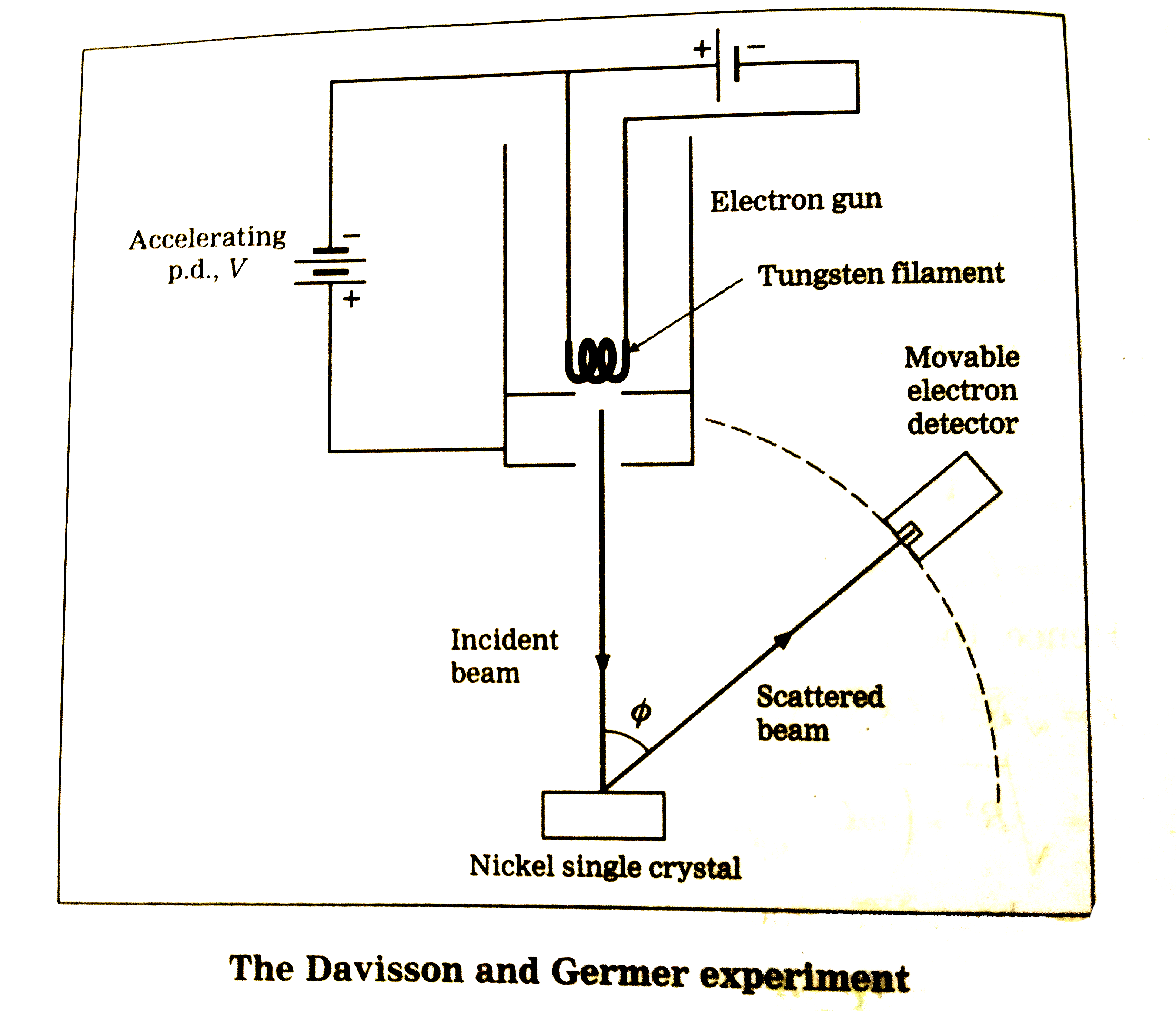 Data : `m_(p) = 1.0078 u, m_(N) = 1.0087 u, m_(Co) = 58.933 `u For`{:(59),(27):}Co`A = 59, Z = 27 ` :. N = A - Z = 59 - 27 = 32` Themass DEFECT, `DELTAM = (Zm_(rho)+Nm_(n)) - m_(Co)` ` = (27 xx 1.0078 + 32 xx 1.00 87) - 58.933` ` = (27.2106 + 32.2784) - 58.933` ` = 59 .4890 - 58.933 = 0.556` u |
|
| 30. |
State Gauss's theoram in electric field at a point due to a uniformaly charged infinite plane thin sheet. |
|
Answer» Solution :For Gauss. THEOREM , see point number 47 under the heading "Chapter At A Glance"Consider an infinite thin plane sheet having a surface density ` sigma. ` To find electric field at a point Psituated at a normal DISTANCE r from the sheet , consider an imaginary cylinder of cross-section ara ds around point P and length 2R, passing through the sheet ,as the Gaussian surface. From symmetry consideration , only side faces1 and 2 of cylinder contribute towards the flux because here ` oversetto E and hatn ` parallel but the curved surface of cylinder does not contributed towards the flux because here `oversetto Eand hatn ` are mutually perpendicular. ` therefore ` Total electric flux ` phi_in =2 E ds` As per Gauss theorem total electric flux `pi_in =(1)/( in_0)` (charge encloesd)`=(1)/( in _0) .(sigma ds) ` Comparing (i) and (ii) , we get ` 2 E ds =(sigma)/( in_0) . ds RARR E= ( sigma)/( 2 in _0)` Thus, the electric field at a point due to a uniformalycharged infinite plane sheet is independent of the distance from it . Vectorially ` oversetto (E) =(sigma)/(2 in _0) hatr ` Thus for (i)positively charged sheet electric field `oversetto E ` is directed outwards and for (ii)negatively charged sheet the field is directed inwards. 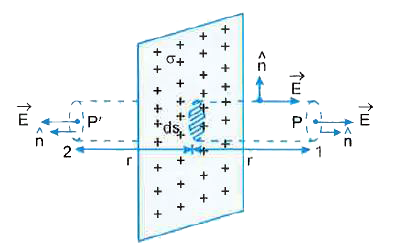
|
|
| 31. |
What significant figures signify? |
| Answer» Solution :The significant figures is DEFINED the figure in a given number which can be realised . For example, if the RADIUS measured by screw gauge is 3.423 cm, the number of significant figures in the measurement is 4. Greater is the number of significant figures in a measurement, smaller is the percentage error. Hence, it should be remembered that the limit of ACCURACY of a MEASURING instrument is equal to the LEAST count of the instrument. | |
| 32. |
A rear view mirror of a vehicle is cylindrical having radius of curvature 10cm and length of arc of curved surface is 10cm. Find the field of view in radian, if it is assume that the eye of the drive is at a large distance from the mirror. |
|
Answer» `0.5` 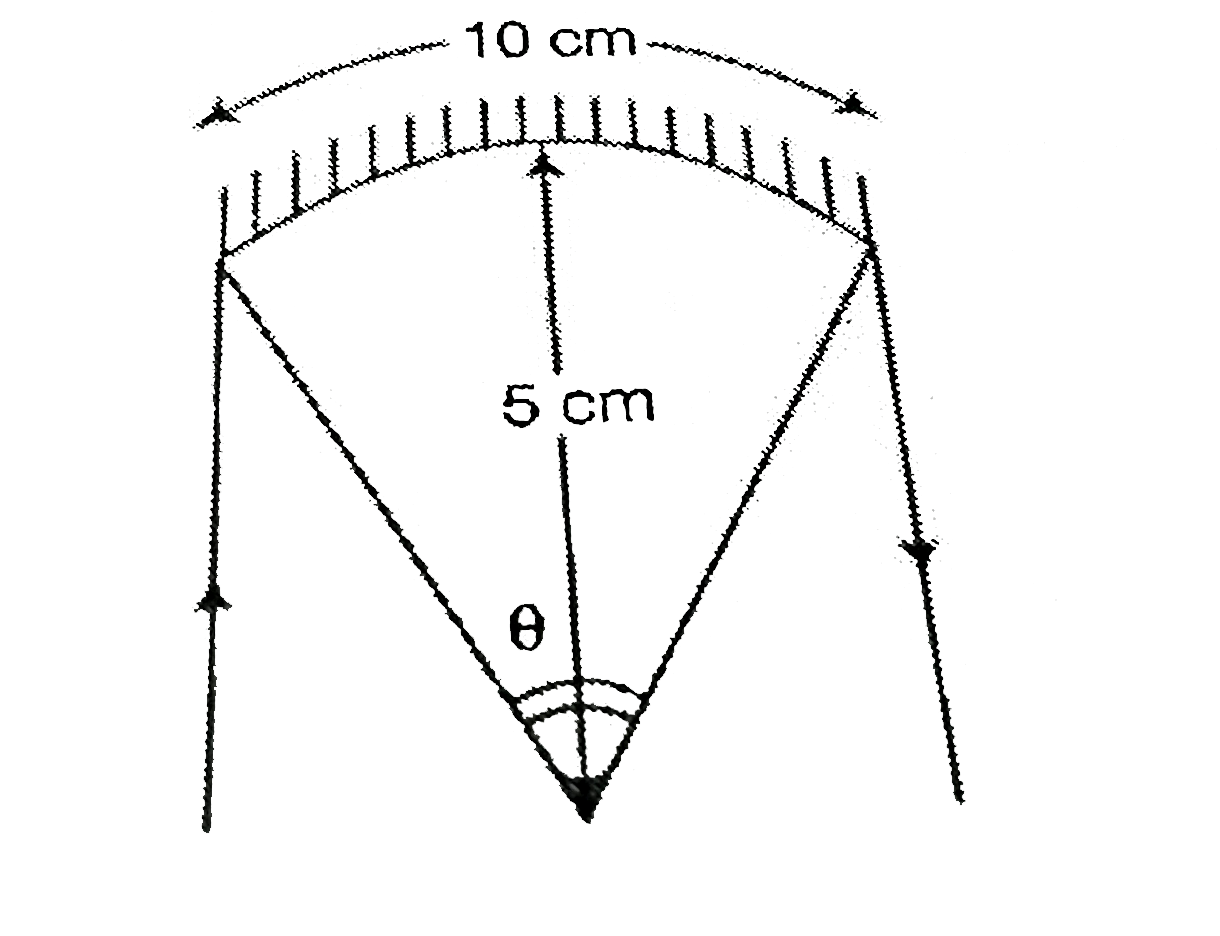
|
|
| 33. |
The area of the plates of a capacitor is 50cm^(2) each and the separation between them is 1mm. The space between the plates is filled with a material of dielectric constant 4. the capacitor, initially uncharged, is connected to a battery of EMF 50 V. the work done by the battery until the capacitor gets completely charged is (in muJ). |
|
Answer» 0.22 Work DONE by the BATTERY, `W=CV^(2)=((16)/(9)xx10^(-10))(50)^(2)=0.44muJ`. |
|
| 34. |
What is the meaning of the term 'avian'? |
|
Answer» A PERSON who flies |
|
| 35. |
If force F, acceleration A and time T are basic physical quantities, the dimensions of energy are : |
|
Answer» `[F^(2)A^(-1)T]` THUS the correct answer is `(b)`. |
|
| 36. |
A ray of light is incident on a glass sphere of refractive index 3/2. What should be the angle of incidence so that the ray which enters the sphere does not come out of the sphere ? |
|
Answer» `tan^(-1) (2//3)` |
|
| 37. |
A1.00 xx10^(-2) m^3 flask contains 0.0160 kg of oxygen gas,O_2at 770^@C. What is the pressure exerted on the inner walls of the flask by the oxygen gas? (The atomic mass of O is 15.9994 u.) |
|
Answer» `3.19 XX 10^(4) Pa` |
|
| 38. |
The longer side of a rectangle is twice the length of its shorter side .A charge q is kept at one vertex.The maximum electric potential due to that charge at any other vertex is V, then the minimum electric potential at any other vertex will be |
|
Answer» <P>`2V` |
|
| 39. |
A carrier wave of peak voltage 12 V is used to transmit a message signal. The peak voltage of the modulating signal in order to have a modulation index of 75% is |
|
Answer» 6V As `m U=(A_(m))/(A_(c))` or `A_(m)=muxxA_(c)=9V` |
|
| 40. |
For photo electron emission from certain metal the cut off frequency is v. if radiation of frequency 2v impinges on the metal plate,the maximum possible velocity of the emitted electron will : (m is mass of electron) |
|
Answer» `SQRT hv/2m` |
|
| 41. |
The pulley arrangements of figures (a) and (b) are identical. The mass of the rope is negligible. In figure (a), the mass m is lifted up by attaching a mass 2m to the other end of the rope. In figure(b), m is lifted up by pulling the other end of the rope with a constant downward force F = 2 mg. Calculate the accelerations in the two cases. |
Answer» Solution :In figure (a), for the motion of MASS m, T-mg=ma....... (1)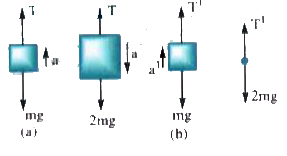 For motion of MASS2 m figure (B) 2mg -T= (2m)a ........ (2) Adding equation (1) and (2), we GET 2mg - mg = 2ma + ma, mg = 3ma, a = g/3 (b) In figure `T^(1) - mg=ma^(1)` But `T^(1) = 2mg , :. 2mg - mg = a^(1)`, Therefore `a^(1)=g` |
|
| 42. |
An object is placed 40 cm from a convex lens of focal length 30 cm. If a concave lens of focal length 50 cm is introduced between the convex lens and the image formed such that it is 20 cm from the convex lens, find the change in the position of the image. |
|
Answer» Solution :Given data: For the CONVEX lens,` f_10 = +30 cm` and Object DISTANCE `u_1` = -40 cm, therefore, Formula : `(1)/(f_1)= (1)/(v_1) - (1)/(u_1)` ` (1)/(+30) = (1)/(v_1) - (1)/(-40)` ` (1)/(v_1) = 1/30 -1/40 = 1/120` ` rArr v_1 = + 120 cm` a REAL IMAGE is formed. On introducing a concave lens, ` f_2 = -50cm` and ` u_2 = 120 - 20 = + 100 cm`from the concave lens ` (1)/(f_2) = (1)//(v_2) - (1)/(u_2)` `(1)/(-50) = (1)/(v_2) - (1)/(+ 100)` ` therefore(1)/(v_2) = 1/50 + 1/100 = - 1/100` ` v_2 = -100 cm` |
|
| 43. |
If a liquid is poured in a U tube and if a magnetic field is appliedto the liquid in one arm of theU tubeand if the liquid meniscusis seen to risethenit indicates that the liquid is |
|
Answer» paramagnetic |
|
| 44. |
n identical cells each of emf epsilon and lnternal resistance r are connected in parallel with resistor R. The current nowing through resistor R is .......... |
|
Answer» `(n epsilon)/(R + NR)` TOTAL resistance of circuit = R + `(r)/(n) ` CURRENT I = `(epsilon)/(R + (r)/(n)) = (n epsilon)/(nR + r)` |
|
| 45. |
A conducting square frame of side 'a' and a long straight wire carrying current I are located in the same plane as shown in the figure. The frame moves to the right with a constant velocity 'V'. The emf induced in the frame will be proportional to : |
|
Answer» `1/x^2` Inside (2) magnitude of induced emf is `epsilon_2=B_2 Vl` Induced emf value in frame `EPSILON=epsilon_1-epsilon_2` [Side (1) is NEAR to wire and `B PROP 1/r`] `THEREFORE epsilon=Vl (B_1-B_2)` `therefore epsilon prop (B_1-B_2)` but `B_1 prop 1/(x-a/2)` and `B_2 prop 1/(x+a/2)` `therefore epsilon prop (1/(x-a/2)-1/(x+a/2))` `therefore epsilon prop (2/(2x-a) -2/(2x+a))` `therefore epsilon prop (1/(2x-a)-1/(2x+a))` ( `because` 2 constant) |
|
| 46. |
Explain the construction and working of a full wave rectifier. |
|
Answer» Solution :The positive and negative half cycles of the AC input signal pass through the full wave rectifier circuit and HENCE it is called the full wave rectifier. Construction : (i) It consists of two p-n junction diodes, a center tapped transformer, and a load resistor (`R_1`). (II) The centre is usually taken as the ground or zero voltage reference point. (iii) Due to the centre tap transformer, the output voltage rectified by each diode is only one half of the total secondary voltage. 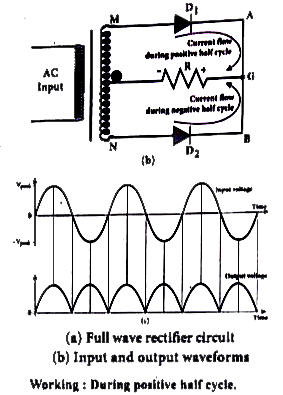 Working : During positive half cycle. (i) When the positive half cycle of the ac input signal passes through the circuit, terminal MIS positive, G is at zero potential and N is at negative potential. (ii) This forward biases diode `D_1`, and reverse biases diode `D_2`. (iii) Hence, being forward biased, diode `D_1`, conducts and current flows along the path `MD_(1)AGC` (iv) As a result, positive half cycle of the voltage appears across RL in the direction G to C. During negative half cycle. (i) When the negative half cycle of the ac input signal passes through the circuit, terminal N is positive, G is at zero potential and M is at negative potential. (ii) This forward biases diode `D_1`, and reverse biases diode `D_2`. Hence, being forward biased, diode `D_2`, conducts and current flows along the path `ND_(2),BGC`. (iii) As a result, negative half cycle of the voltage appears across `R_L`, in the same direction from G to C. (iv) Hence in a full wave rectifier both postive and negative half cycles of the inpur signal pass through the circuit in the same irection. Though both positive and negative half cycles of ac input are rectified, the output is still PULSATING wave. (v) The efficiency (`eta`) of full wave rectifier is twice that of a half wave rectifier and is found to be 81.2 %. It is because both the positive and negative half cycles of the ac input source are rectified. |
|
| 47. |
A convex lens is in contact with concave lens. The magnitude of the ratio of their focal length is 2/3. Their equivalent focal length is 30 cm. Their individual focal lengths ar |
|
Answer» `-75CM, 50 CM` |
|
| 48. |
Find the work done in blowing a soap bubble of radius 0.02 m. S.T. of soap solution is 25 xx 10^-3 N/m |
|
Answer» `2.5 XX 10^-4 J` |
|
| 49. |
What is principle axis ? |
| Answer» Solution :The streight LINE JOINING the CENTRE of CURVATURE and pole. | |
| 50. |
Paragraph: The rest energy of a block is E_(0). Relative to inertial observer O, the block is moving with speed v so that sqrt(1-v^(2)//c^(2))=1//4. Observer O finds that the block takes 12s to go from A to B. How long would this time interval appear to be to an observer riding on the block? |
|
Answer» 3s |
|