Saved Bookmarks
This section includes 7 InterviewSolutions, each offering curated multiple-choice questions to sharpen your Current Affairs knowledge and support exam preparation. Choose a topic below to get started.
| 1. |
Three identical parallel conducting plates A, B and C are placed as shown. Switches S_1 and S_2 are open, and can connect A and C to earth when closed. +Q charges is given to B. |
|
Answer» If `S_1`is closed with `S_2` open, a charge of amount Q will PASS through `S_1`. When EITHER `A` or `C` is EARTHED (but not both together), a parallel plate capcitor is formed with`B`, with `+-Q` charges on the inner surfaces. (The other plate, which is not earthed, PLAYS no role.) Hence, charge of amount `+Q` flows to the earth. When both are earthedtogether, `A` and `C` effectively become connected. The plates now FORM two capacitors in paralle, with capacitances in the ration `1:2`, and hence share charge `Q` in the same ratio. `C_(1)=(epsilon_(0)A)/(2d),C_(2)=(epsilon_(0)A)/(d)(C_(1))/(C_(2))=(1)/(2)` Now we can write `(q_(1))/(q_(2))=(C_(1))/(C_(2))=(1)/(2)` because potential difference of both the capacitors is same and `q_(1)+q_(2)=Q`. Solving these, we get `q_(1)=Q//3,q_(2)=2Q//3`. 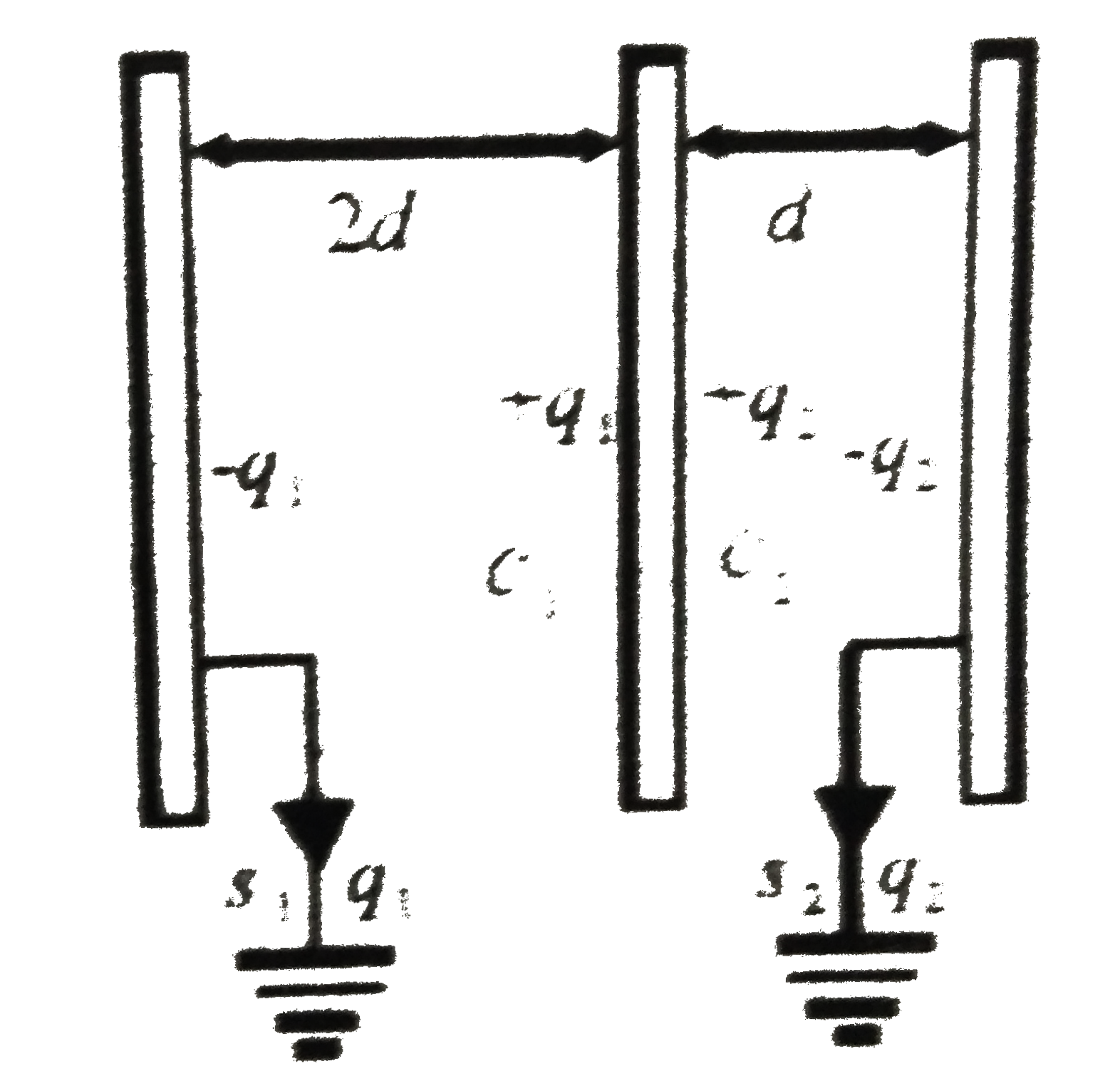
|
|
| 2. |
In the diffraction at a single slit, if the red light is replaced by blue light, then |
|
Answer» FRINGES will be narrower |
|
| 3. |
Usingthe Rydbergformula, calculatethe wavelengthof thefirstfourspectrallinesin theLymanseries of thehydrogenspectrum . |
|
Answer» Solution :Therhdbergformulais ` ( hc )/( lamda _(if ))= (M e^4 ) /( 8 epsi_(0)^(2) h^2) ((1)/(n_(f)^(2))-(1)/( n_(i)^(2)))` Thewavelengthof thefirstfourlinesin theLyman seriescorrespond totransitions from `n_i =2` `3,4,5,` to ` n_f=1`we knowthat ` (me^4 )/( 8 epsi_(0)^(2) h^2)= 13.6 eV =21 .76 xx 10^(-19) J` therefore ` lamda_(11) = ( hc )/( 21.76xx 10^(-19) ((1)/(1) - (1)/(n_(i)^(2)))` =`( 6.625 xx 10^(-34) xx 3 xx 10^8xx n_(i)^(2) )/( 21.76xx 10^(-19) xx (n_i ^2-1))=(0.9134 n_(i)^(2) )/( (n_i ^(2)-1) ) xx 10^(-7) = ( 913 .4 n_(i)^(2 ) Å )/((n_(i)^(2) -1))` substiting`n_i = 2,3,4,5` we get `lamda_(21) = 1218 Å, lamda_(41) = 1028,lamda_(41) = 974.3Å ` and ` lamda_(51)951 .4 Å ` |
|
| 4. |
Which of the following is not transducer ? |
|
Answer» LOUDSPEAKER |
|
| 5. |
1L=.............cm^3 |
|
Answer» 10 |
|
| 6. |
A motor car is travelling at 20 m/sec on a circular road of radius 400m. Its speed is increasing at the rate of 3 m/sec^2. What is its acceleration- |
|
Answer» `2.9 m/sec^2` |
|
| 7. |
The workdone in moving a positve charge on an equipotenial surface is |
| Answer» | |
| 8. |
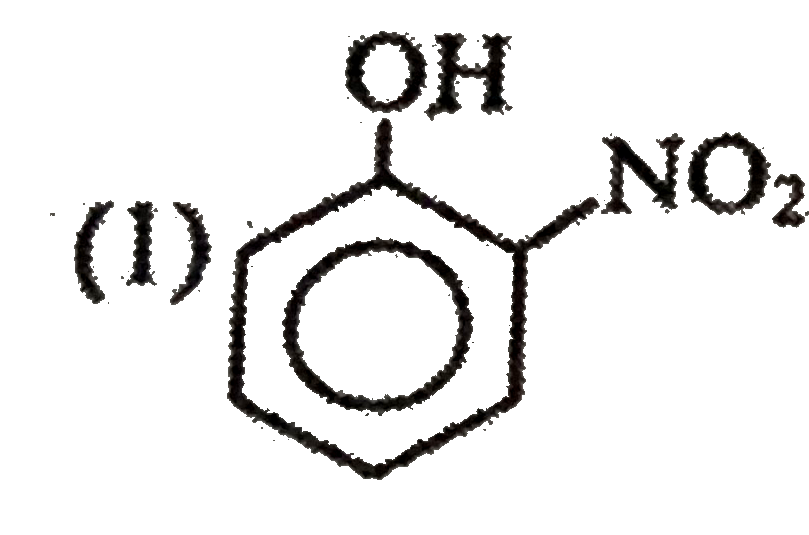
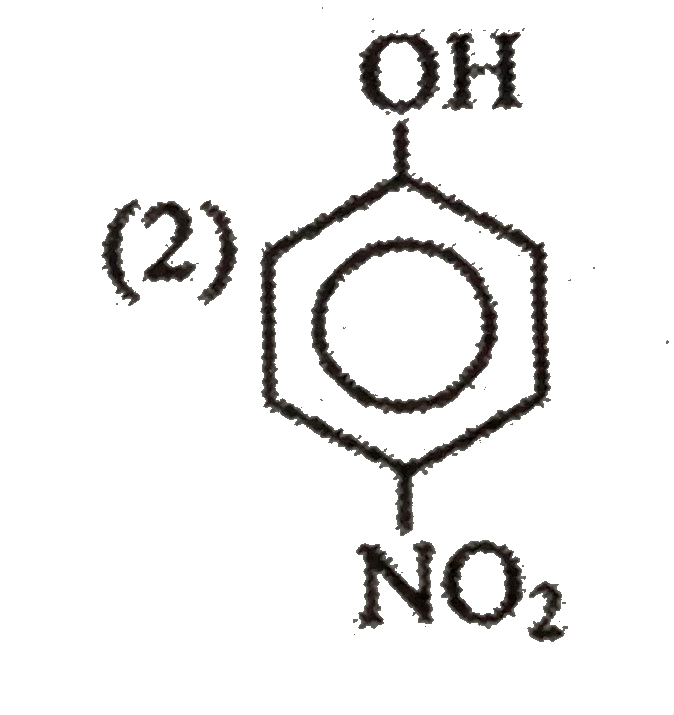
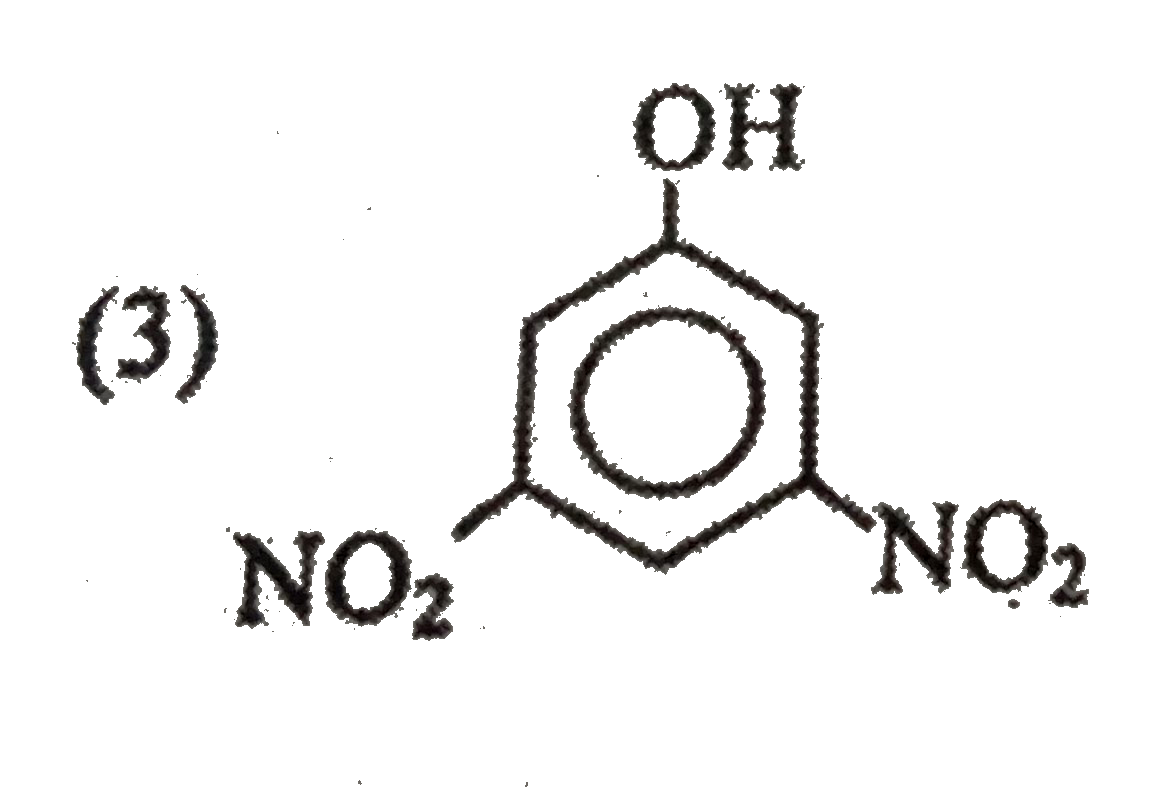
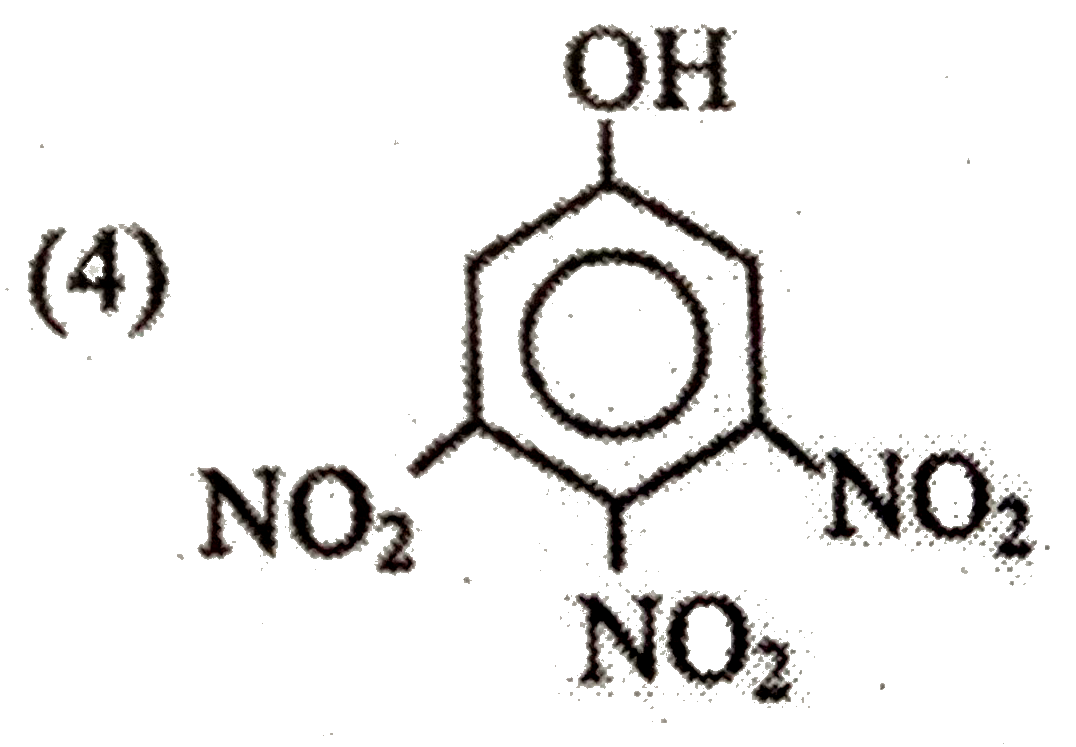
The most steam volatile compoud is |
|
Answer»
|
|
| 9. |
In a Young's interference experimental arrangement incident yellow light is composed of two wavelengths 5890 Å and 5895 do A. Distance between the slits is 1 mm and the screen is placed 1 m away.Order upto which fringes can be seen on the screen will be : |
|
Answer» 384 `therefore (lambda_(2))/(lambda_(1)) = ( n+ 1/2)/n` `therefore n = 589` |
|
| 10. |
(A) : Propagation of electromagnetic waves as microwaves is better than that as sky waves. (R) : Microwaves have frequencies 100 GHz to 300 GHz with very good directional properties. |
|
Answer» Both 'A' and 'R' are true and 'R' is the CORRECT EXPLANATION of 'A'. |
|
| 11. |
Derive an expression of affective resistance of four resistors connected in parallel. |
Answer» Solution :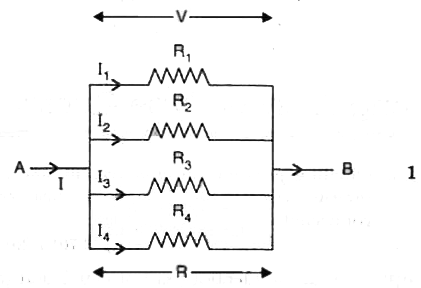 A CURRENT I enterining the combination gets dvided into `I _(1), I _(2), I _(3) and I_(4)` through `R_(1), R_(2), R_(3) and R_(4)` respectively. such that `I=I_(1) + I_(2) + I_(3) +I_(4)` By Ohm.s law `I_(1)= (V)/(R_(1)), I _(2) = (V)/(R_(2)), I _(3) = (V)/(R_(3)) , I _(4) = (V)/(R_(4)) and I = (v)/(R_(P))` where `R_(P)` is the equivalent of effective RESISTANCE of the paralel CONBINATION. `therefore (V)/( R _(P)) = (V)/( R _(2)) + (V)/( R _(2)) + (V)/( R _(3)) + (V)/( R _(4))` `(1)/( R _(P)) =(1)/( R _(1)) + (1)/( R _(2)) + (1)/( R _(3)) + ( 1 )/( R _(4))` |
|
| 12. |
A hydrogen atom in a state of binding energy 0.85 eV makes a transtition to a state of excitation energy of 10.2 eV. (i) What is the initial state of hydrogen atom? (ii) What is the final state of hydrogen atom ? (iii) What is the wavelength of the photon emitted ? |
|
Answer» Solution :Let `n_(1)` be initial state of electron. Then `E_(1)=-(13.6)/(n_(1)^(2))eV` Here `E_(1)=-0.85eV`, THEREFORE `-0.85=-(13.6)/(n_(1)^(2))` or `n_(1)=4` |
|
| 13. |
It is believed that the universe is expanding and hence the distant starsare receding from us . Light from such a star will show |
|
Answer» SHIFT in frequency TOWARDS longer WAVELENGTH |
|
| 14. |
A pendulum clock and a digitical clock both are synchronized to beep correct time at temperature 20^(@)C in the mornign on 1st March,2003. At 12:00 noon temperature increases to 40^(@)C and remains constant for three months. Now on Ist June, 2003 at 12:00 noon temperature drops to 10^(@)C and remains constant for a very long duration. Find the date and time on which both the clocks will again be synchronized for a moment. |
|
Answer» Solution :As a digital clock (if ideal) always keeps correct time. But on increasing temperatureon 1st March 12:00 noon , the pendulum clock SLOWS doen and start loosing time. We know that tiem lost by a pendulum clock per second is given as `DELTAT=1/2 alpha DeltaT` [If `alpha` is the coefficient of linear expansioin for the material of pendulum] `=1/2 alpha(20)` In three months (March +April+May=92 days) it looses time `Deltat_(92"days")=1/2xxalphaxx20xx92xx86400` One 1st June, 12:00 noon temperature drops to `10^(@)C` which is `10^(@) ` less then the temperatrue at which clock keeps correct time, thus now clock starts gaining time andif after N days it gains exactly the time lost during previous three months, it SHOWS right time again for a moment. Thus time gained by the clock in N days in `deltat_("N days")=1/2 alpha(10)xxNxx86400` We have `deltat_(92"days")` (lost)`=deltat_("N days")` (ganined) or `2/2xxalphaxx90xx92xx86400=1/2xxalphaxx10xxNxx86400` or `N=184` days Thus after 184 days from 1st June 2003, pendulum clock will SHOW correct tiem and bothteh clocks will be in synchronization for a moment and after 184 days means the DATE si 2nd Dec. 2003 and time is 12:00 noon. |
|
| 15. |
Some elementary particle theories suggest that the proton may be unstable , with a half life ge10^32 yr. How long woud you expect to wait for one proton in your body to decay (consider that your body is all water) ? |
|
Answer» |
|
| 16. |
A rectangular loop PQMN with movable arm PQ of length 10 cm and resistance 2 Omega is placed in a uniform magnetic field of 0.1 T acting perpendicular to the plane of the loop as shown in Fig. 6.37. The resistance of the arm MN, NP and MQ are negligible. Calculate (i) the emf induced in the arm PQ, and (ii) current induced in the loop when arm PQ is moved with velocity 20 ms^(-1). |
|
Answer» Solution :Here `B = 0.1 T, l = 10 cm = 0.1 m, v = 20 ms^(-1)` and resistance `R = 2 Omega`. (i) `THEREFORE` Induced emf in the ARM `PQ, VAREPSILON = Blv = 0.1 xx 0.1 xx 20 = 0.2 V` (II)The current induced in the loop,`I = varepsilon/R=(0.2)/2= 0.1A` |
|
| 17. |
Plane polarized light incidents on tourmaline plate. vecE vectors make 45^(@) with optic axis of plate. Then % difference in magnitudes o initial and final intensities of vecE vectors is ....... |
|
Answer» 0.19 `I=I_(0)xx(1)/(2) "" :. I=(I_(0))/(2)` `:. (I_(0)-I)/(I_(0))xx100=(I_(0)-(I_(0))/(2))/(I_(0)) xx100%` `=(1)/(2)xx100=50%` |
|
| 19. |
A thin rod of 5 cm length is kept along the axis of a concave mirror of 10 cm focal length such that its image is real and magnified and one end touches to rod. Its magnification will be |
| Answer» ANSWER :B | |
| 20. |
Suppose the spheres A and B in Exercise 1.12 have identical sizes. A third sphere of the same size but unchanged is brought in contact with the first , then brought in contact with the second, and finally removed from both. What is the new force of repulsion between A and B ? |
|
Answer» Solution : INITIALLY Coulombian force exerted between `q_(A)` and `q_(B)` `F = K(q_(A).q_(B))/r^(2)`……(1) Final charges on A and C, `q_(A)^(.) = q_(C )^(.) = (q_(A) + 0)/2 = q_(A)/2` Most final charges on C and B, `q_(C)^(..) = q_(B)^(.) = (q_( C)^(.) + q_(B))/2 = (q_(A)/2 + q_(B))/2 = (q_(A) + 2q_(B))/4`........(2) Final Coulombian force between A and B, `F. k(q_(A)^(.).q_(B)^(.))/r^(2)` (If SEPARATION between A and B remains same) `THEREFORE F. = k(q_(A)/2)(q_(A) + 2q_(B))/4)/r^(2)` `therefore F. = 1/8 xx k xx (q_(A))(q_(A) + 2q_(B))/r^(2)` `=1/8 xx k (q_(A))(3q_(B))/r^(2), (therefore q_(A) = q_(B))` `=3/8 k (q_(A).q_(B))/r^(2)` `=3/8 F` `=3/8 xx 1.521 xx 10^(-2)` `therefore F. = 5.704 xx 10^(-3) N` (Repulsive) |
|
| 21. |
Let the x-y plane be the boundary between two transparent media. Medium 1 in Z gt= 0has a refractive index of sqrt2and medium 2 with z < 0 has a refractive index of sqrt3. A ray of light in medium 1 given by the vector vecA = 6 sqrt3i + 8 sqrt3j - 10 hatkis incident on the plane of separation. The angle of refraction in medium 2 is |
| Answer» ANSWER :A | |
| 22. |
A particle of a mass m is located in a three-dimensional cubic potential well with absoulutely impenetrable walls. The side of the cube is equal to a Find: (a) the proper value of the energy of the particel, (b) the energy difference between the third and fourth levels, (c )the energy of the sixth level and the number of states (the degree of degeneracy) corresponding to that level. |
|
Answer» Solution :We PROCEED axactly as in (6.81). The wave function is chosen in the from `Psi(x,y,z)=A sin k_(1) sink_(2)y sink_(3)z`. (The ORIGIN is at one corner of the box and the axes of coordinates are ALONG the edges.)The boundary CONDITIONS are that `Psi=0` for `x=0,x=a,y=0,y=a,z=0,z=a` This gives `k_(1)=(n_(1)pi)/(a),k_(2)=(n_(2)pi)/(a)=k_(3)(n_(3)pi)/(a)` The energy eigenvalues are `E(n_(1),n_(2),n_(3))=(pi_(2) ħ^(2))/(2ma^(2))(n_(1)^(2)+n_(2)^(2)+n_(3))` The first level is `(1,1,1)`. The second has `(1,1,2),(1,2,1)`&`(2,1,1)`. The third level is `(1,2,2) or (2,1,2) or (2,2,1)`. Its energy is `(pi^(2) ħ^(2))/(2ma^(2))` The fourth energy level is `(1,1,3)` or `(1,3,1)` or `(3,1,1)` Its energy is `E=(11pi^(2) ħ^(2))/(2ma^(2))` (b) Thus `Delta=E_(4)-E_(3)=( ħ^(2)pi^(2))/(ma^(2))` (c )The FIFTH level is `(2,2,2)`. The sixth level is `(1,2,3),(1,3,2),(2,1,3),(2,1,3),(2,3,1),(3,1,2),(3,2,1)` `(7 ħ^(2)pi^(2))/(ma^(2))` and its degree of degeneracy is `6`(six). |
|
| 23. |
State Biot-Savart's law. |
|
Answer» Solution :The MAGNITUDE of magnetic field d`vec(B) ` at a point P at a distance r from the small elemental length taken on a conductor carrying current varies (i) directly as the STRENGTH of the current I (ii) directly as the magenitude of the length ELEMENT d`vec(L)` (iii)directly as the sine of the angle (SAY, `theta`) between d `vec(l) and hat(r)` . (iv) inversely as the square of the distance between the point P and length element d `vec(l)`. this is e`xx`pressed as . `d B prop ("I dl")/(r^(2)) sin theta` |
|
| 24. |
Yucca plant is pollinated by |
|
Answer» A SPECIES of MOTH (PRONUBA) |
|
| 25. |
Transverse waves are generated in two uniform wires A and B of the same material by attaching their free ends to a vibrating source of frequency 200 Hz. The Area of cross section of A is half that of B while tension on A is twice than on B. The ratio of wavelengths of the transverse waves in A and B is |
|
Answer» `1: SQRT2` |
|
| 26. |
In a biprism experiment , a monochromatic light of wavelength6 xx 10^(-7) m is used . The distance between the slit and the prism is 10 cm and that between the biprismand the eyepiece is 65 cm . If the distance between two consecutive dark bands is 0.03 m . calculate the distance between the two virtual images of the slits . |
|
Answer» |
|
| 27. |
An aeroplane executes a horizontalloop at a speed of 720 kmph with its wings banked at 45^(@). What is the radius of the loop ? Take g=10ms^(-1). |
|
Answer» 4 km `TAN theta = (v^(2))/(RG)` or `R = (v^(2))/(g XX tan theta) = (200^(2))/(10 xx 1) = 4 km` |
|
| 28. |
Find the dimensional formula of epsilon_0 . |
|
Answer» SOLUTION :`epsilon_0=Coulomb/newton m^2 ` ` epsilon_0=(1)/(KF)XX(q_1q_2)/r^2=M^-1L^-3T^4` |
|
| 29. |
In which case is the power being delivered by a given progressive sinusoidal wave on a givenstring is doubled? Material of the string is unchanged. |
|
Answer» The wave amplitude is doubled (keeping the FREQUENCY the same). |
|
| 30. |
Give features of force on charge particle inside magnetic field. |
|
Answer» Solution :1. Magnetic force acted upon q electric charge moving with `vecv` velocity in magnetic field `vecB` is given by, `vecF_(m)=q(vecvxxvecB)` `thereforeF_(m)=qvBsintheta` where `theta` is angle between `vecvandvecB`. 2. Features : (i) It depends on `q,vecvandvecB` charge of the particle, the velocity and the magnetic field. 3. Force on a negative charge is opposite to that on a positive charge so we can write as `vecF_(m)=q(vecBxxvecv)`. (ii) `F_(m)=qvBsinthetaorvecF_(m)=q(vecvxxvecB)or|vecF_(m)|=qvBsintheta` which is vector product of velocity and magnetic field. So, if `theta=0^(@)ortheta=180^(@)`, then `F_(m)=qvBsin0^(@)=0orF_(m)=qvBsin180^(@)=0`  4. The force acts in a direction PERPENDICULAR to both the velocity and the magnetic field. Its direction is given by the SCREW rule or right hand rule as illustrated in figure (a) and (b). 5. Diagram (a) is for positive charge and diagram (b) is for negative charge. (iii) The magnetic force is zero if charge is not moving as then v = 0. `therefore` In magnetic force `F_(m)=qvBsintheta" "v=0`, then `thereforeF_(m)=0` THUS, only a moving charge feels the magnetic force but static charge does not. |
|
| 31. |
For the unisexual flower, the steps in artificial hybridization are |
|
Answer» BAGGING, POLLINATION, rebagging |
|
| 32. |
In forward bias, the width of potential barrier, in a pn junction diode |
|
Answer» INCREASE |
|
| 33. |
A tube with thin but uniform cross section has two arms, one straight, othe shaped as a semicircle of radius r. Initially both arms carry an ideal fluid upto a height R. Now the equilibrium is disturbed by pushing the fluid in the left arm by a small amount. Fluid is the released and allowed oscillate. Neglect any friction or viscous forces. If the period of oscillations is found to be T=pisqrt((nR)/(3g)(pi+n)), find the integer value n |
|
Answer» `implies(d^(2)x)/(dt^(2))=-((GX)/R)((3//2)/((pi)/2+2))` `implies T=pi sqrt((4R(pi+4))/(3g))` |
|
| 34. |
The velocity of an electron in the second orbit of ten times ionised sodium atom (Z=11) is v. The velocity of electron in its fifth orbit is: |
|
Answer» Solution :`v=Z/N. C/(137) alpha (Z)/(n)," for some Z"` `v alpha 1/n` `v_(2)/v_(2)= n_(1)/n_(2) RARR v_(2)=n_(1)/n_(2) v_(1)=2/5v` |
|
| 35. |
In the previous problem , calculate the maximum kinetic of electrons emitted when intensity of light incident on the metal is increased to double ? |
|
Answer» |
|
| 36. |
While measuring the speed of sound by performing a resonance column experiment, a student gets the first resonance condition at a column length of 18 cm during winter. Repeating the same experiment during summer, she measures the column length to be x cm for the second resonance. Then |
|
Answer» `18 gt x ` |
|
| 37. |
Two wires of A and B with cirular cross section made up of the same material with equal lengths.Suppose R_(A)=3R_(B), then what is the ratio of radius of wire A to that of B ? |
|
Answer» a) 3 |
|
| 38. |
A point source of monochromatic light is situated at the centre of a circle.What is the phase differencebetween the lightwaves passing through the end points of any diameter ? |
| Answer» ANSWER :D | |
| 39. |
What is the electric potential at a distance of 9 cm from 3 nC ? |
|
Answer» Solution :`V = 9 xx 10^(9) xx (q)/(r) ""(because V = (1)/(4pi epsilon_(0))(q)/(r))` `V = (9 xx 10^(9) xx 3 xx 10^(-9))/(9 xx 10^(-2)) = 300 V` |
|
| 40. |
The mass of a 10 m long wire is 100 grams. If a tension of 100 N is applied, calculate the time taken by a transverse wave to travel from one end to the other end of the wire. |
|
Answer» 0.5 s |
|
| 41. |
A point charge Q has been placed at a point outside a neutral spherical conductor. The induced charge density at point P on the surface of the conductor is -sigma The distance of point P from the point charge Q is 2R (where R is radius of the conductor). Find the magnitude and direction of electric field at a point outside the conductor that is very close to its surface near P. |
|
Answer» |
|
| 42. |
A 50 mH coil carries a current of 2 A. The energy stored in the coil is |
|
Answer» 1 J |
|
| 43. |
In any ac circuit, is the applied instantaneous voltage equal to the algebraic sum of the instantaneous voltages across the series elements of the circuit? Is the same true for rms voltage? |
|
Answer» Solution :Yes, `V = v_(R ) + v_(L ) + v_(C ) `holds GOOD for instantaneous values. For rms voltage, `V_(rms) CANCEL( = ) ( V_(rms) )_(R )+ ( V_(rms))_(L) +( V_(rms))_(C )` because voltage ACROSS DIFFERENT elements are not in same phase. |
|
| 44. |
Deduce an expression for the distance at which T.V. signals can directly be received from a T.V. tower of height h. |
|
Answer» Solution :Let `AB` be a T.V. tower of height `h` above the earth. `T.V.` signal is received within a CIRCLE of `CQ=QD` on the surface of earth. Let `R` be the RADIUS of the earth. Let `CQ=QD=d` and `AB=h`. `:. OB=R+h` In rt. `/_d` triangle `OCB,` `OB^(2)=OC^(2)+BC^(2)` `(R+h)^(2)=R^(2)+d^(2)` `d^(2)=(R+h)^(2)-R^(2)` `=R^(2)+h^(2)+2Rh-R^(2)` or `d^(2)=h^(2)+2Rh` Since `h^(2)` can be neglected as compared to `2hR` `:.d^(2)=2Rh` or `d=sqrt(2hR)` or `h=(d^(2))/(2R).`  Area COVERED by T.V. signal `=pid^(2)` `=pi2hR=2pihR` POPULATION covered = Area covered `XX` Population density Since `dpropsqrt(h,)( :.2R` is constant ) So greater the height of T.V. transmitting antenna, grater is its range. |
|
| 45. |
Electrons emitted with negligible speed from an electron gun are accelerated through a potential difference V along the x-axis. These electrons emerge from a narrow hole into a uniform magnetic field Bdirected along this axis. However. Some of the electrons emerging from the hole make slightly divergent angles as shown in . show that these paraxial electrons are refocussed on the x-axis at a distance sqrt(8pi^2 mV)/(eB^2). |
|
Answer» Solution :Givemagnetic field = B, Potential different = V, ltbr. MASS of electron = m, Charge = q Let electtric field be `E' = (V)/r` `v^(2) = 2 xx a xx s`[u = 0)` TIME taken by particle to cover the are A since the accinis along'y'AXIS it travel along - axis in uniformvelocity Therform`S = v xx t` . |
|
| 47. |
A suscepibility of a certain magneticmaterial is 400 what is the class of the magnetic material |
|
Answer» DIAMAGNETIC |
|
| 48. |
Out of the following pairs of forces, the resultant of which cannot be 4 Newton |
| Answer» Answer :D | |
| 49. |
In the figure shown in YDSE, a parallel beam of light is incident on the slit from a medium of refractive index n_1. The wavelength of light in this medium is lambda_(1). A transparent glass of thickness t and of refractive index n_(3) is put in front of one of the slits. The medium between the screen and the plane of the slits is n_(2). The phase difference between the light waves reaching point .O. (symmetrically relative to the slit is |
|
Answer» SOLUTION :`PHI= (2PI)/(lambda_2)((n_3)/(n_2)-1)t= (2pi)/(n_(1)lambda_(1))n_(2)((n_(3)-n_(2))/(n_2))t` `(therefore n_(1)lambda_(1)= n_(2)lambda_(2))""phi= (2pi)/(n_(1)lambda_(1))(n_(3)-n_(2))t`. |
|
| 50. |
There is a container ABCD which is accelerating towards right, at the rate of g/2m//s^(2). Container is filled completely by a liquid of relative density 3. A small ball of relative density 1 is released from rest with respect to the container at point A of the container. At what distance from the end point B, the ball will hit to the top surface of the container. |
|
Answer» `2M`  `:.` DISTANCE from `B=5m` |
|