

Saved Bookmarks
This section includes 7 InterviewSolutions, each offering curated multiple-choice questions to sharpen your Current Affairs knowledge and support exam preparation. Choose a topic below to get started.
| 1. |
Theresistance of 1A ammeter is 0.018ohm. To convert it into 10A ammeter, the shunt resistance required will be: |
|
Answer» 0.18 |
|
| 2. |
The resistance of a carbon resistor of colour code Red-Red Green Silver is (in k Omega) |
|
Answer» `22 00pm 5%` |
|
| 3. |
A solenoid has 50 turns and radius 2 cm, diameter of wire is 2x 10^(-4) m, current through it when it is joined with battery of 10V is ... Resistivity of material.2*10^-6 Ωm. |
|
Answer» I = `(V)/(R)` `THEREFORE I = (VA)/(rho l)` `therefore I =(V xx pi r^(2))/(rho xx 2 pi RN) "" [ because A = pi r^(2)] ` `therefore I = (10 xx (10^(-4) )^(2))/(4.4 xx 10^(-8) xx 2 xx 2 xx 10^(-2) xx 50) = (1)/(0.88)` `thereforeI = 1.136 `A `therefore I = 1.14A ` |
|
| 4. |
The magnitude of electric intensity at a distance .x. from a charge .q. is E. An identical charge is placed at a distance .2x. from it. Then the magnitude of the force it experience is |
| Answer» ANSWER :D | |
| 5. |
What is the speed of light in glass of refractive index 1.5 if the velocity of light in the free space is 3 x 10^8 ms^-1? |
|
Answer» `2xx10^-8`s |
|
| 7. |
Find the output of the ideal operational amplifier shown in the figure for each of the following input signals V_(I n)= 0.8sin( omega t + 70 ^@)V V_(I n ) = 0.8sin( omegat+ 75 ^@ ) V |
|
Answer» SOLUTION :Thegainofthe AMPLIFIER`A_v=-(R_f)/(R_(I n)) = (-39 xx 10^3)/( 15 xx 10^3)` `=-2.6` `V_0=-2.6 ( 4- SINOMEGAT. V) =- 10.4+ 2.6sin OMEGA t V` |
|
| 8. |
In Figure, sources A and B emit long-range radio waves of wavelength 400 m, with the phase of the emission from A ahead of that from source B by 90.0^(@). The distance r_(A) from A to detector D is greater than the corresponding distance r_(B) by 150 m. What is the phase difference of the waves at D? |
| Answer» SOLUTION :0.785 rad | |
| 9. |
Three capacitors are connected as shown in the figure . The potential at point O is equal to |
| Answer» Answer :D | |
| 10. |
The spacebetween the electrodes of a parallel-plate capacitor is filled witha uniformpoorlyconducting mediumof conductivitysigma and permittivity epsilon. The capacitorplates shaped as rounddiscs are separtedby a distance d. Neglectingthe edgeeffects, find the magnetic fieldstrength betweenthe plates at a distance r fromtheiraxis ifan ac voltage V = V_(m) cos omega tis appliedto the capacitor. |
|
Answer» Solution :The electricfield between the plates can be written as, `E = Re (V_(m))/(d) e^(I omega t)`, insteadof `(V_(m))/(d) cos omega t`. The gives RISE to a conductioncurrent, `j_(e) = sigmaE = Re (sigma)/(d) V_(m) e^(I omega t)` and a displacementcurrent, `j_(d) = (DEL D)/(del t) = Re epsilon_(0) epsilon i omega (V_(m))/(d) e^(i omega t)` The totalcurrent is, `j_(T) = (V_(m))/(d) sqrt(sigma^(2) + (epsilon_(0) epsilon omega)^(2)) cos (omega t + alpha)` where, `tan alpha = (sigma)/(epsilon_(0) epsilon omega)` on takingthe real PART ofthe resultant. The correspondingmagneticfieldis obtainedby usingcircularion THEOREM, `H.2pi r= pi r^(2) j_(r)` or, `H = H_(m) cos(omega t + alpha)`, where, `H_(m) = (r V_(m))/(2d) sqrt(sigma^(2) + (epsilon_(0) epsilon omega)^(2))` |
|
| 11. |
The wavelength lambda_(e )of an electron and lambda_(p) of a photon of same energy E are related by |
|
Answer» `lambda_p prop lambda_e` `therefore`i.e. `lambda_e prop 1/sqrtE RARR lambda_e^2 prop 1/E` …(1) de-Broglie wavelength of PROTON `lambda_p=(hc)/E` `lambda_p prop 1/E` …(2) From (1) and (2) `lambda_e^2 prop lambda_p` i.e., `lambda_p prop lambda_e^2` |
|
| 12. |
Where have we come from to build our nation? |
|
Answer» From TOWNS and cities |
|
| 13. |
Liquied oxygen remains suspended between twopolefaces of a magnet because its is |
|
Answer» diamagnetic |
|
| 14. |
In a biprism experiment , the distance of the 15 th bright band from the centre of the interference pattern is 6 mm . Calculate the distance of the 25th bright band and 31st dark band . |
|
Answer» |
|
| 15. |
The equation of mation for a body executing S.H.M. is given by y=1.5sin(10 pi t+5). The frequency is given by : |
|
Answer» Solution :`y=1.5sin(10PI t+5)` `y=r SIN(omegat+phi)` `omega=10pi` `2piv=10pi` `v=5` Hz. Socorrectchoice is (a). |
|
| 16. |
The number of photons of wavelength 13.2A^(@)in 6J of energy is (h=6.6xx10^(-34)J.s) |
|
Answer» `2xx10^(12)` `:.n=(6xx13.2xx10^(-10))/(6.6xx10^(-34)xx3xx10^(8))` or `n=4xx10^(16)` |
|
| 17. |
Momentum of photon with frequencyf will be …..(where c is velocity of light) |
|
Answer» `(hf)/(c^(2))` |
|
| 18. |
In a traingle the proper length of each side equals a. Find the perimeter of this triangle in the reference frame moving relative to it with a constant velocity V along one of its (a) bisectors, (b) sides. Investigate the results obtained at V lt lt c and Vrarr c, where c is the velocity of light. |
|
Answer» SOLUTION :(a) In the FRAME in which the traingle is at rest the space COORDINATES of the vertices are `(000)`, `(asqrt3/2, +a/2, 0)(asqrt3/2, -a/2, 0)`, all MEASURED at the same time t. In the moving frame the CORRESPONDING coordinates at time `t^'` are `A: (vt^', 0, 0), B: (a/2sqrt3sqrt(1-beta^2)+vt^', a/2, 0)` and `C: (a/2sqrt3sqrt(1-beta^2)+vt^', -a/2,0)` The perimeter P is then `P=a+2a(3/4(1-beta^2)+1/4)^(1//2)=a(1+sqrt(4-3beta^2))` (b) The coordinates in the first frame are shown at time t. The coordinates in the moving frame are,  `A: (vt^', 0, 0), B: (a/2sqrt(1-beta^2)+vt^', asqrt3/2, 0), C: (asqrt(1-beta^2)+vt^', 0, 0)` The perimeter P is then `P=asqrt(1-beta^2)+a/2[1-beta^2+3]^(1//2)xx2=a(sqrt(1-beta^2)+sqrt(4-beta^2))` here `beta=V/c` |
|
| 19. |
The component of a vector vec(r ) along X-axis will have maximum value only if: |
|
Answer» `vec(R )` acts ALONG positive Y-axis. |
|
| 20. |
A uniform semicircular ring of mass m and radius r is hinged at end A so that it can rotate freely about end A in the vertical plane as shown in the figure. Calculate angle made by line AB with vertical in equilibrium position and time period of small oscillation of ring. |
| Answer» SOLUTION :`tan^(-1) ((2)/(pi)), 2PI SQRT((2pi r)/(g sqrt(pi^(2) + 4)))` | |
| 21. |
The electric field at a distance R due to charge q is E. If the same charge is placed on the copper sphere of radius R, the electric field at a distance 2R from the centre of spherical conductor will be : |
|
Answer» 0.25 E |
|
| 22. |
The output of OR gate is 1 |
|
Answer» if both INPUTS are zero |
|
| 23. |
A moving electron approaches another electron. What would be the change in the potential energy of this system ? |
|
Answer» Remains constant `U=(k(-e)(-e))/(R) ` `= (ke^(2))/(r)` where `ke^(2)` is constant `:. U PROP (1)/(r)` `:.` As r decreses U increases. |
|
| 24. |
Answer the following questions regarding earth's magnetism In which direction would a compass free to move in the vertical place point to , if located right on the geomagnetic north or south pole ? |
| Answer» Solution :The geomagnetic NORTH pole is ACTUALLY a SOUTH pole .So the north pole of a compass needle WOULD point vertically downwards . Similarly , the south pole of the needle would point vertically downwards at the geomagnetic south pole . | |
| 25. |
A square coil of side 10 cm has 20 turns and carries a current of 12 A. The coil is suspended vertically. The normal to the plane of the coil makes an angle of 30^@ with the direction of a uniform horizontal magnetic field. If the torque experienced by the coil equals 0.96 N - m, find the magnitude of the magnetic field. |
|
Answer» Solution :Here side of square `l = 10 cm = 0.1 m`, HENCE area of coil `A = (0.1)^(2) = 0.01 m^(2)`, CURRENT `I = 12 A`, torque `tau = 0.96 N-m, theta = 30^@` and number of turns in coil N = 20. From relation `tau = NIAB sin theta,` we have `B = (tau)/(NIA sin theta) = (0.96)/(20 xx 12 xx 0.01 xx sin 30^(@)) = 0.8 T`. |
|
| 26. |
मान लीजिए कि f(x)=3x द्वारा परिभाषित फलन F:Rrarr Rहै। सही उत्तर चुनिए |
|
Answer» F एकैकी आच्छादक है। |
|
| 27. |
The viscosity eta of a gas depends on the long - range attractive part of the intermolecular force, which varies with molecular separation r according to F=mur^(-n) where n is a number and mu is a constant. If eta is a function of the mass m of the molecules, their mean speed v, and the constant mu then which of the following is correct - |
|
Answer» `ETA PROP m^(N+1) v^(n+3)MU^(n-2)` |
|
| 28. |
An astronomical telescope is to be designed to have a magnifying power of 50 in normal adjustment. If the length of the tube is 102 cm, find the powers of the objective and the eyepiece. |
|
Answer» |
|
| 29. |
(A): Exothermic chemical reactions under lie conventional energy sources. Hear the energies involved are in the range of ev. (R): Atomic energy level spacings are of the order ev. |
|
Answer» Both .A. and .R. are TRUE and .R. is the correct EXPLANATION of .A. |
|
| 30. |
Which of the following is the largest when the height attained by the projectile is the greatest: |
|
Answer» Range |
|
| 31. |
The teacher shows a thin lens and a thick lens. a. Which of these lens forms more enlarged image ? b. Which lens has greater focal length? |
| Answer» SOLUTION :a. THIN LENSB. Thin LENS | |
| 32. |
A simple pendulum with charged bob is oscillating with time period T and let theta be the angular displacement. If the uniform magnetic fieldis switched ON in a direction perpendicular to the plane of oscillation then |
|
Answer» TIME PERIOD will DECREASE but `theta` will REMAIN constant |
|
| 33. |
A parallel plate capacitor is to be designed using a dielectric of dielectric constant 5, so as to have a dielectric strength of 10^(9) Vm^(-1). If the voltage rating of the capacitor is 12 kV, the minimum area of each plate required to have a capacitance of 80 pF is ......... |
|
Answer» `10.5XX10^(-6) m^(2)` `:. D=(V)/(E)` `C= (K in_(0)A)/(d)` `:. A = (Cd)/(K in_(0))` `= (CV)/(KE in_(0))` `=(80xx10^(-12)xx12xx10^(3))/(5xx10^(9)xx8.85xx10^(-12))` `=21.69xx10^(-6)` `= 21.7xx10^(-6) m^(2)` Second Method : Q = CV `sigma A = CV` `:. sigma = (CV)/(A)` `E = (E_(0))/(K) ` but `E_(0)= (sigma)/(in_(0))` `:. E= (sigma)/(K in_(0))` From (1) `E = (CV)/(AK in_(0))` `:. A =(CV)/(EK in_(0))` `=(80xx10^(-12)xx12xx10^(3))/(5xx10^(9)xx8.85xx10^(-12))` `:. A = 21.69xx10^(-6)` `:. A = 21.7xx10^(-6) m^(2)` |
|
| 34. |
An air bubble in a jar of water shines brightly due to phenomenon of refraction. |
| Answer» SOLUTION :An air bubble in a jar of water SHINES brightly DUE to phenomenon of TOTAL internal reflection. | |
| 35. |
Identify the following electromagnetic radiations as per the wavelengths given below. Write one application of each. (a) 10^(-3) nm (b) 10^(-3)m (c ) 1nm |
|
Answer» Solution :(a) `GAMMA`-RAYS - used in medicine to destroy cancer cells. (b) Microwaves - used for radar system for AIRCRAFT navigation. (c) X-rays – used for studying crystal structure. (b) 103 m (c) 1 nm |
|
| 36. |
A point mass initially at rest moves along x-axis. Its acceleration varies with time as a = 6t+ 5 ms. If it starts from origin, the distance covered by it in 1 s is |
|
Answer» 3 m `(dv)/(dt)=6t+5` or dv=(6t+5) dt, Intergrating `v=(6t^(2))/(2)+5t=3T^(2)+5t` `DS(3t^(2)+5t)dt` `s=(3t^(3))/(3)+(5t^(2))/(2)` `(s)_(t)=(3xx1xx1)/(3)+(5)/(2)1xx1=3.5` |
|
| 37. |
A positive charge Q is uniformly distribut along a circular ring of radius R. A small tc charge q is placed at the centre of the ring per figure, Then |
|
Answer» If q gt 0 and is displaced away from th centre in the plane of the ring, it will b pushed back towards the centre. Hence, no effect on Q by q. TWO cases are possible due to attraction ano repulsion between Q and q. Case 1 : If q is positive then repulsion will be there between Q and q. This will push q towards centre. Case 2 : If q is negative, then attraction will be there between Q and q. This will pull q towards surface and hence it will not TURN back to centre. |
|
| 38. |
A particle of mass m is connected with a string of length 2 meter. Other end of the string is fixed with a point O at a height 1 m above the ground. The particle is thrown from some point in such a way that it strikes the ground (perfectly inelastic) with velocity v_(0) at an angle 37^(@) with vertical just below O. |
|
Answer» <P>P-2, Q-3, R-1, S-4 `R=(v^(2))/(a_(_|_))=(v_(0)^(2))/(g sin 37^(@))=(5v_(0)^(2))/(3g)` 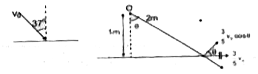 (B)from figure, `cos theta=(1)/(2)rArr theta = 60^(@)` after string becomes taut particle motion will seize along the string DUE to impulse. Just after impulse velocity of particle is `(3)/(5)v_(0)cos theta = (3)/(10)v_(0)` perpendicular to the string from conservation of mechanical energy , `(1)/(2)m((3)/(10)v_(0))^(2)=(1)/(2)m(sqrt(2G))^(2)+2mg(1+cos 60)` simplifying, `v_(0)=(20sqrt(2g))/(3)m//s` (C ) `W_(G)=-2mg(1+cos 60^(@))=-3 mg` `therefore - W_(G)=3 mg` (D) At highest point velocity will be perpendicular to gravitational force `therefore P = vec(F)vec(V)=0` |
|
| 39. |
Two balls with charges 5muC and 10muCare at a distance of 1 m from each other. In order to reduce the distance between them to 0.5 m what amount of work should be done? |
|
Answer» |
|
| 40. |
What did Bhagat Singh and others do while going towards gallows? |
|
Answer» SANG songs |
|
| 41. |
If a diamagnetic substance is brought near the north or the south pole of a bar magnet, it is |
|
Answer» Repelled by the north POLE and ATTRACTED by the south pole |
|
| 42. |
A piece of copper and the other of germanium are cooled from the room temperature to 80 K, then which of the following would be a correct statement ? |
|
Answer» RESISTANCE of each INCREASES. |
|
| 43. |
When alphais the angle between plane of the coil and magnetic field vecB, flux linked with the coil is given byphi =____ |
|
Answer» AB `therefore phi=vecA.vecB` `=AB cos(90^@-alpha)` `=AB sin alpha` `therefore phi=|vecAxxvecB|` |
|
| 44. |
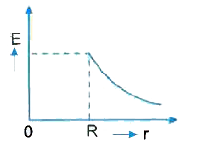
Which of the following graph represents the variation of electric field E due to a thin charged spherical shell of radius R as a function of the distance r from the centre of the shell? |
|
Answer»
|
|
| 45. |
Intensity of secondary waves is directly proportional to ...... |
|
Answer» `SIN^(2) THETA` |
|
| 46. |
Find magnitude and direction of magnetic field at point P in the following cases. (a) (b) P is the centre of square. (c) P is the centre of equilateral triangle. (d) P is the centre of regular hexagon. (e) P is the centre of rectangular loop. (f) (g) A long wire carrying a current i is bent to from a plane angle theta. Find magnetic field at a point on the bisector of this angle is situated at a distance d from vertex. (h) A long, straight wire carriers a current i. Let B_(1) be the magnetic field at a point P at a distance d from the wire. consider a section of length l of this wire such that the point P lies on a perpendicular bisector of the sector. Let B_(2) be the magnetic field at this point due to this section only. find the value of d//l so that B_(2) differes from B_(1) by 1%. |
Answer» Solution :(a) 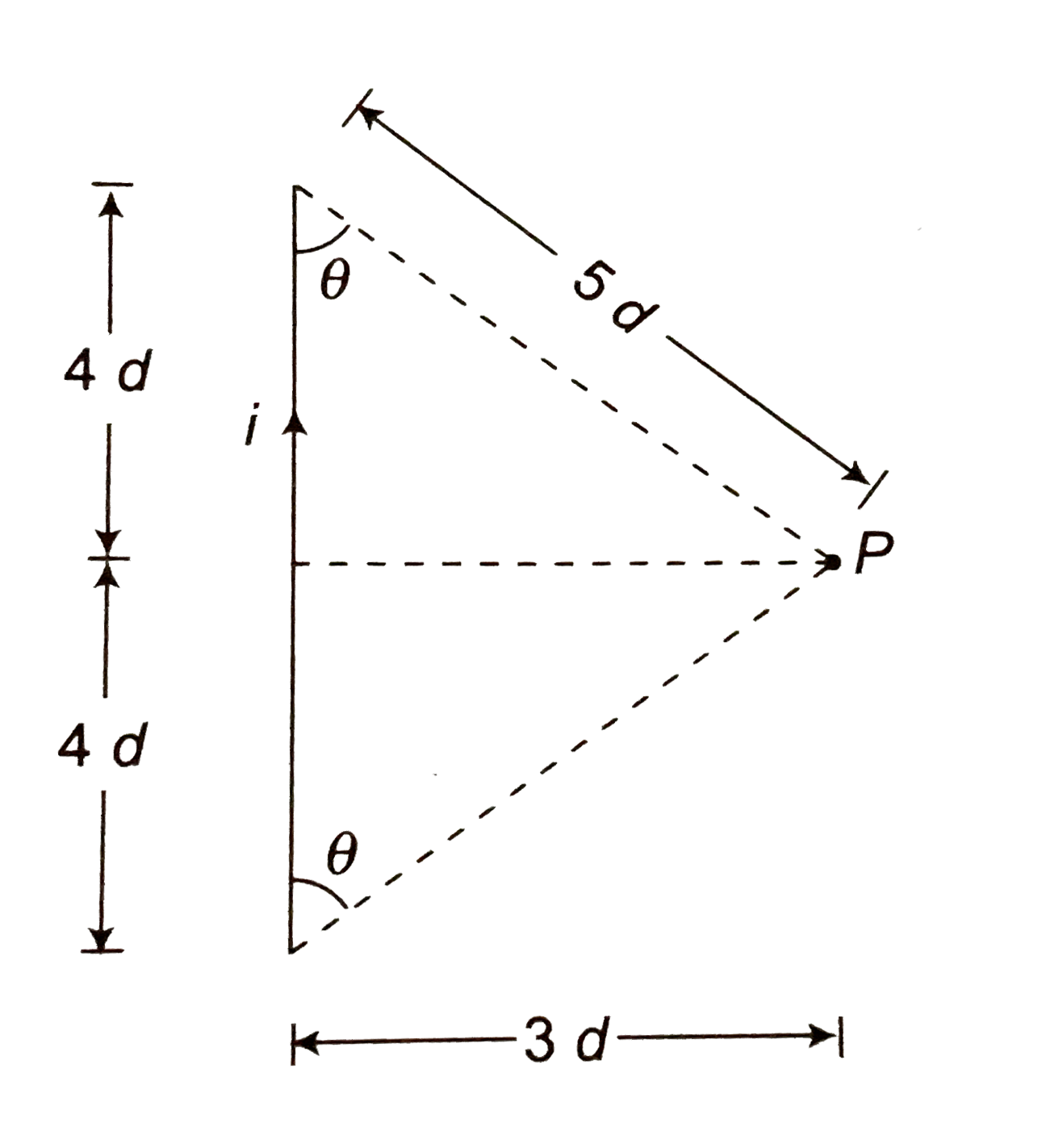 `B_(P)=(mu_(0)i)/(4pid')[cos theta_(1)+cos theta_(2)]` `=(mu_(0)i)/(4pi(3d))[cos theta+cos theta]` `=(mu_(0)i)/(6pid) cos theta` `cos theta=4/5` `B_(P)=(mu_(0)i)/(6pid) .4/5=(2mu_(0)i)/(15pid) ox`. (b) 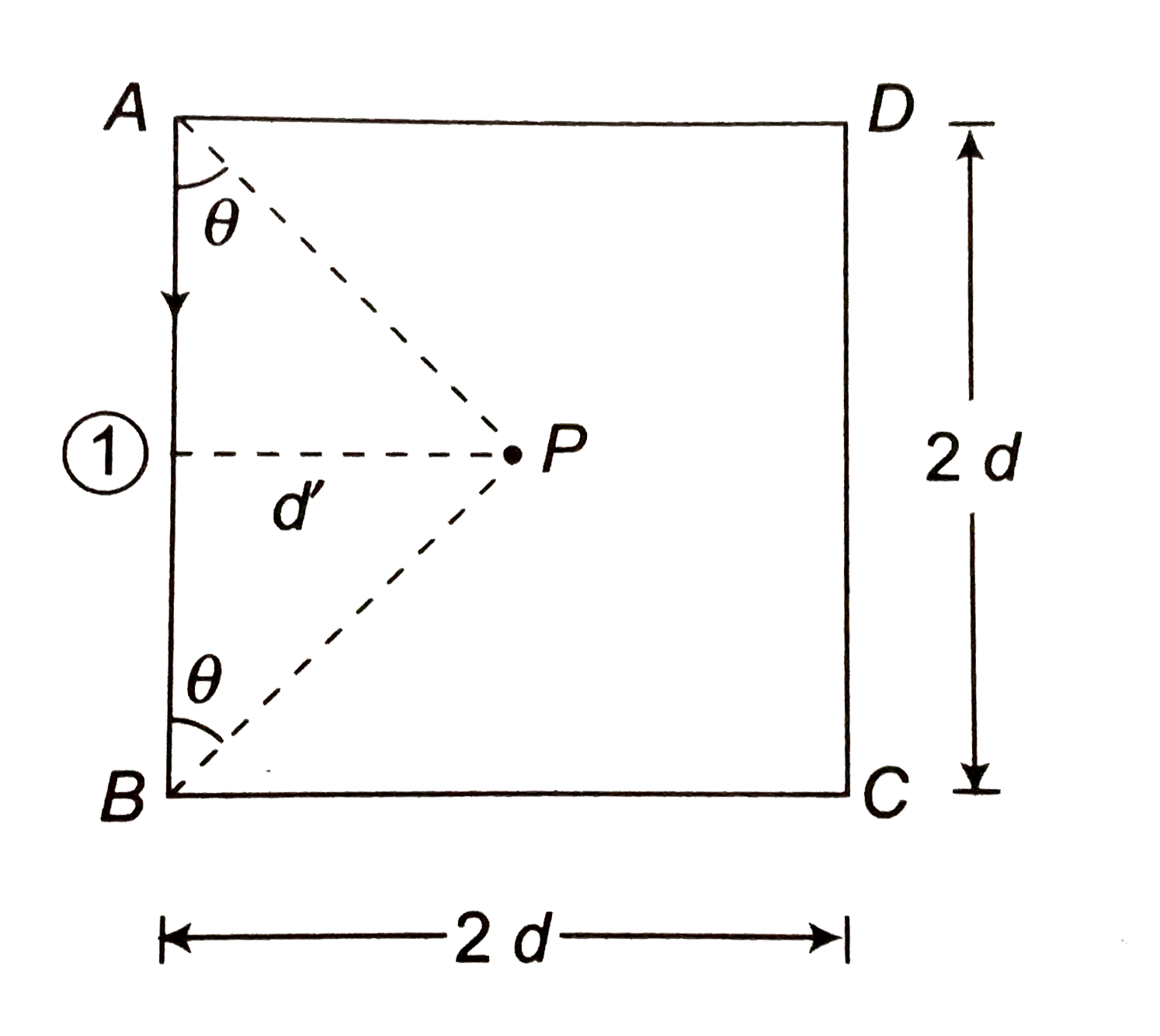 Magnetic field at `P` DUE to one side of SQUARE, say `AB` `B_(1)=(mu_(0)i)/(4pid')(cos theta+cos theta)` `d'=d, theta=45^(@)` `=(mu_(0)i)/(4pid).2.(1)/(sqrt(2))=(mu_(0)i)/(2sqrt(2)pid)` Magnetic field due to square loop `B_(p) = 4B_(1) = (sqrt2mu_(0)i)/(pi d)` Since current anticlockwise, magnetic field at `P` will be outside the plane of paper. `B_(P)=(sqrt(2)mu_(0)i)/(pid), o.` (c) 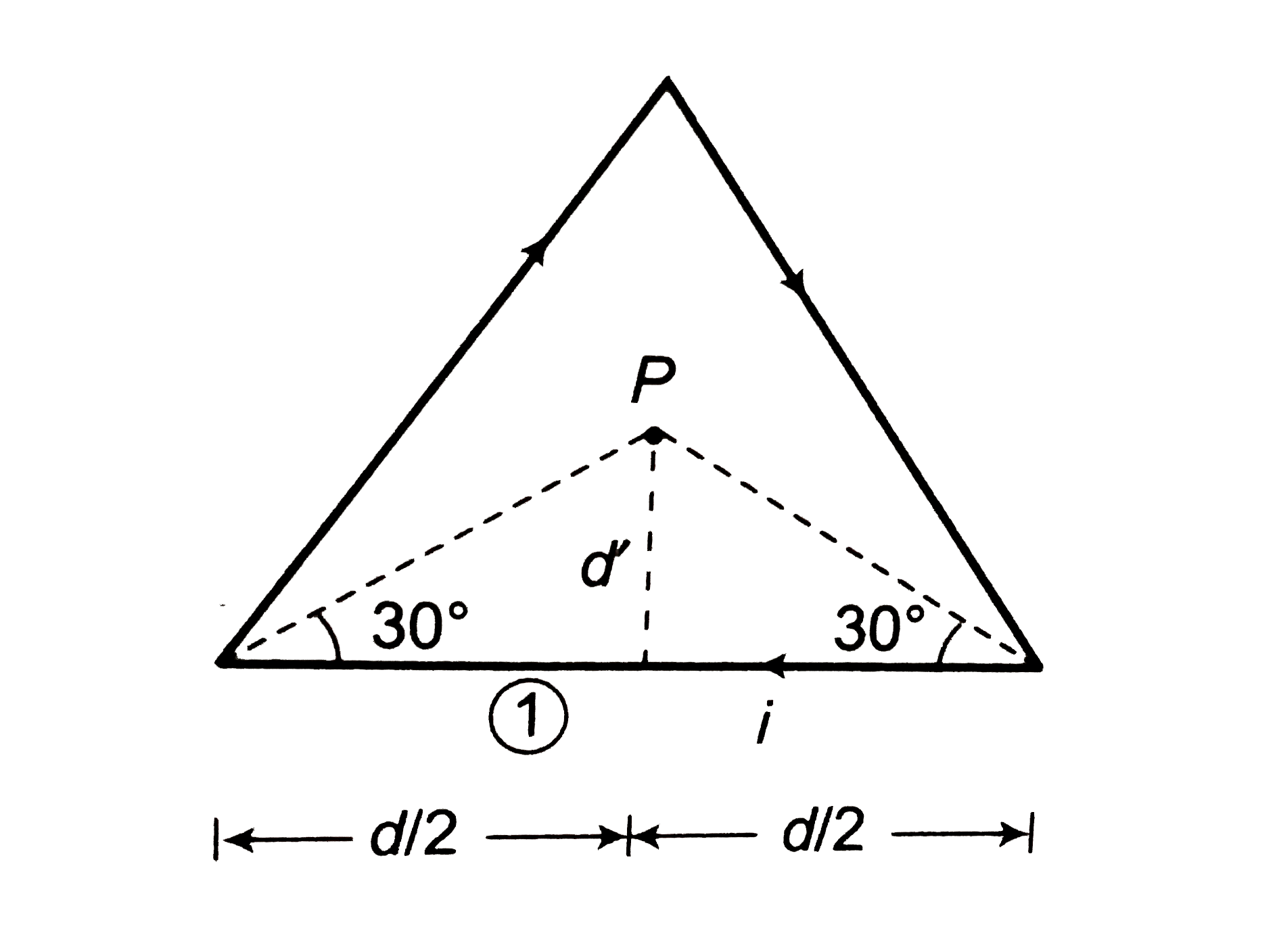 `tan 30^(@) =(d')/(d//2) implies d'=d/(2sqrt(3))` `theta_(1)=theta_(2)=30^(@)` `B_(1)=(mu_(0)i)/(4pid')[cos30^(@)+cos30^(@)]` `=(mu_(0)i)/(4pi.d/(2sqrt(3))).2 (sqrt(3))/2=(3mu_(0)i)/(2pid)` Magnetic field at `P` due to triangular loop `B_(P)=3B_(1)=(9mu_(0)i)/(2pid)` Since current is clockwise, magnetic field at `P` inside the plane of paper. `B_(p)=(9mu_(0)i)/(2pid)` Since current is clockwise, magnetic field at `P` inside the plane of paper. `B_(p)=(9mu_(0)i)/(2pid), ox` (d) 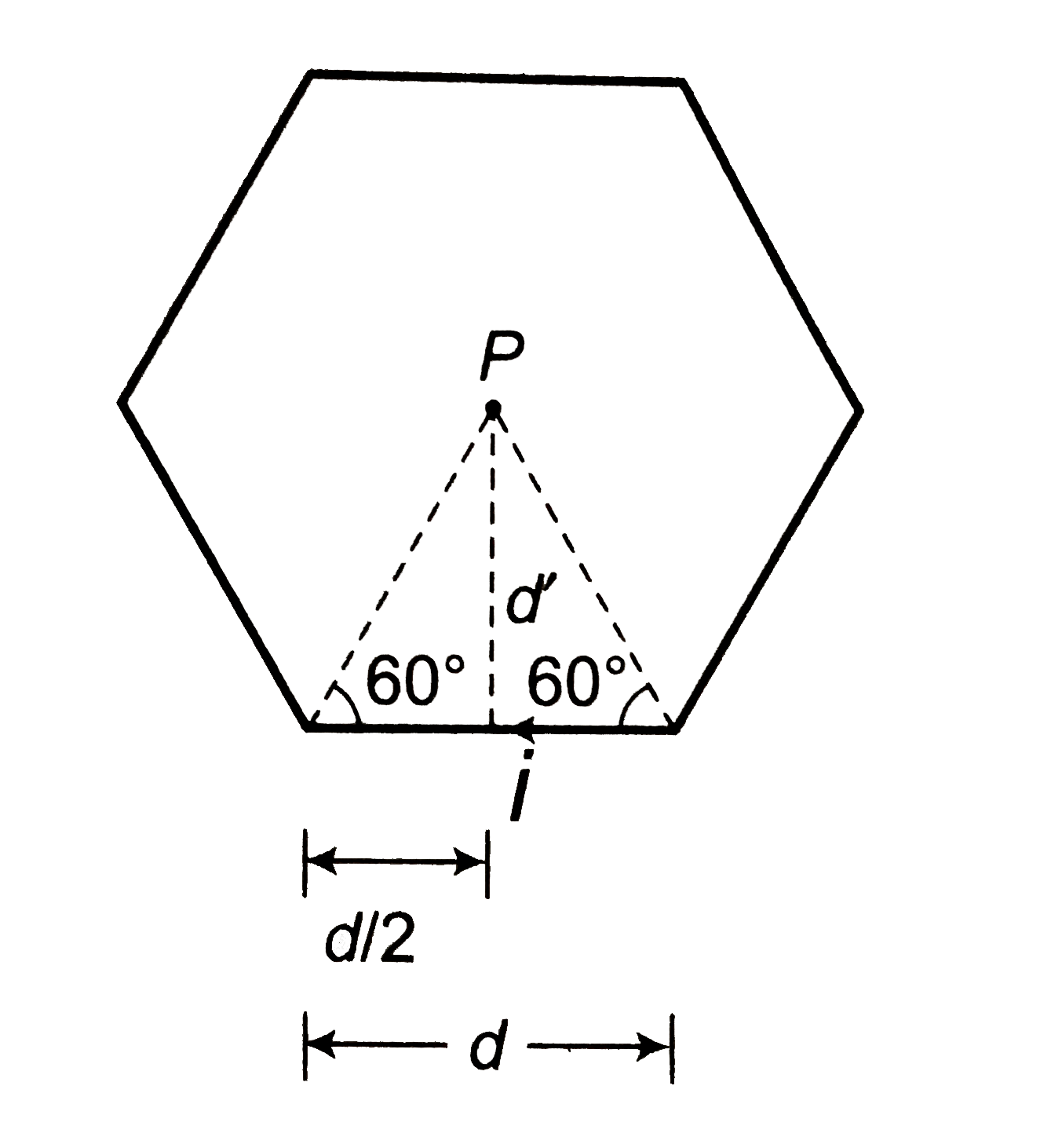 `B_(1)=(mu_(0)i)/(4pid')(cos 60^(@)+cos 60^(@))` `=(mu_(0)i)/(4pi.d/2tan 60^(@)).2 cos 60^(@)` `=(mu_(0)i)/(2pidsqrt(3))` `B_(P)=6B_(1)=(sqrt(3)mu_(0)i)/(pid), ox` (e) 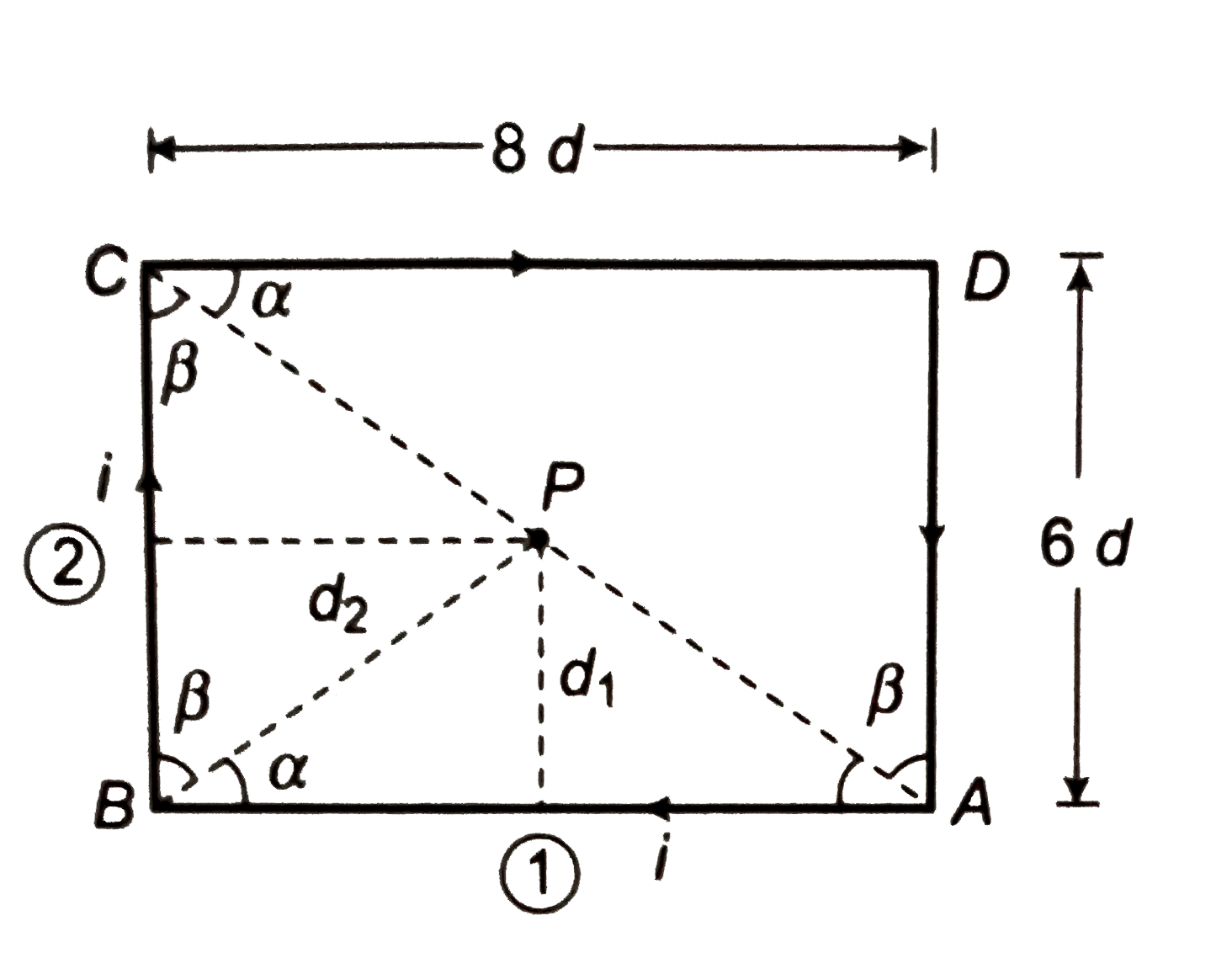 From `TRIANGLEADC,AC=10d` `cos alpha =(8D)/(10d)=4/5, cos beta=(6d)/(10d)=3/5` `d_(1)=3d, d_(2)=4d` `B_(1)=(mu_(0)i)/(4pid_(1))(cos alpha+cos alpha)` `=(mu_(0)i)/(4pi.3d)xx2xx4/5=(2mu_(0)i)/(15pid)` `B_(2)=(mu_(0)i)/(4pid_(2))(cos beta+cos beta)` `=(mu_(0)i)/(4pi.4d)xx2xx3/5=(3mu_(0)i)/(40pid)` `B_(P)=2(B_(1)+B_(2))=2((2mu_(0)i)/(15pid)+(3mu_(0)i)/(40pid))` `=(2mu_(0)i)/(pid)(2/15+3/40=(16+9)/120)` `=(5mu_(0)i)/(12pid), ox` (f) 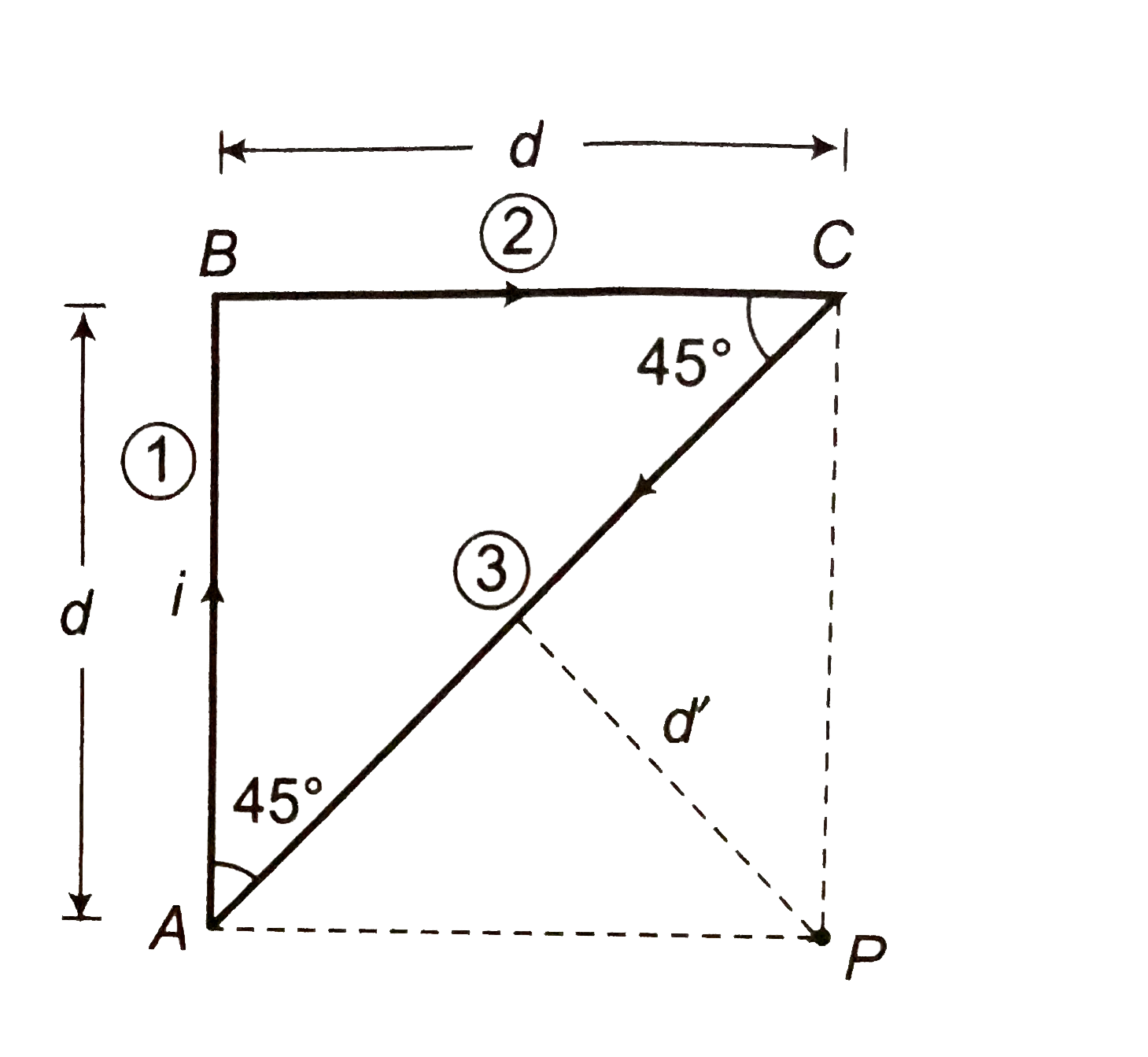 Magnetic field at `P` Due to `AB:` 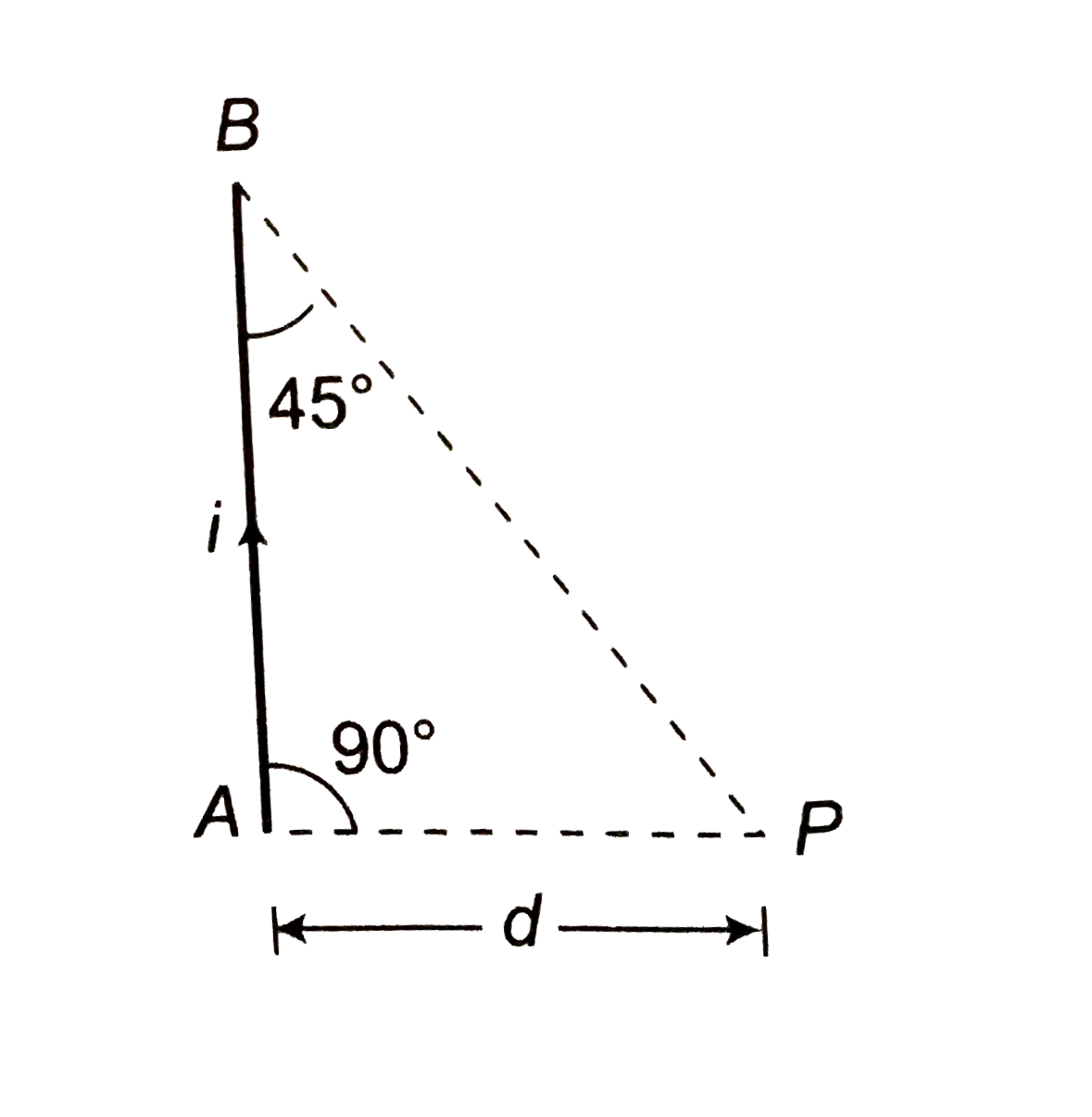 `B_(1)=(mu_(0)i)/(4pid_(2))(cos 90^(@)+cos 45^(@))` `=(mu_(0)i)/(4sqrt(2)pid), ox` Due to `BC` 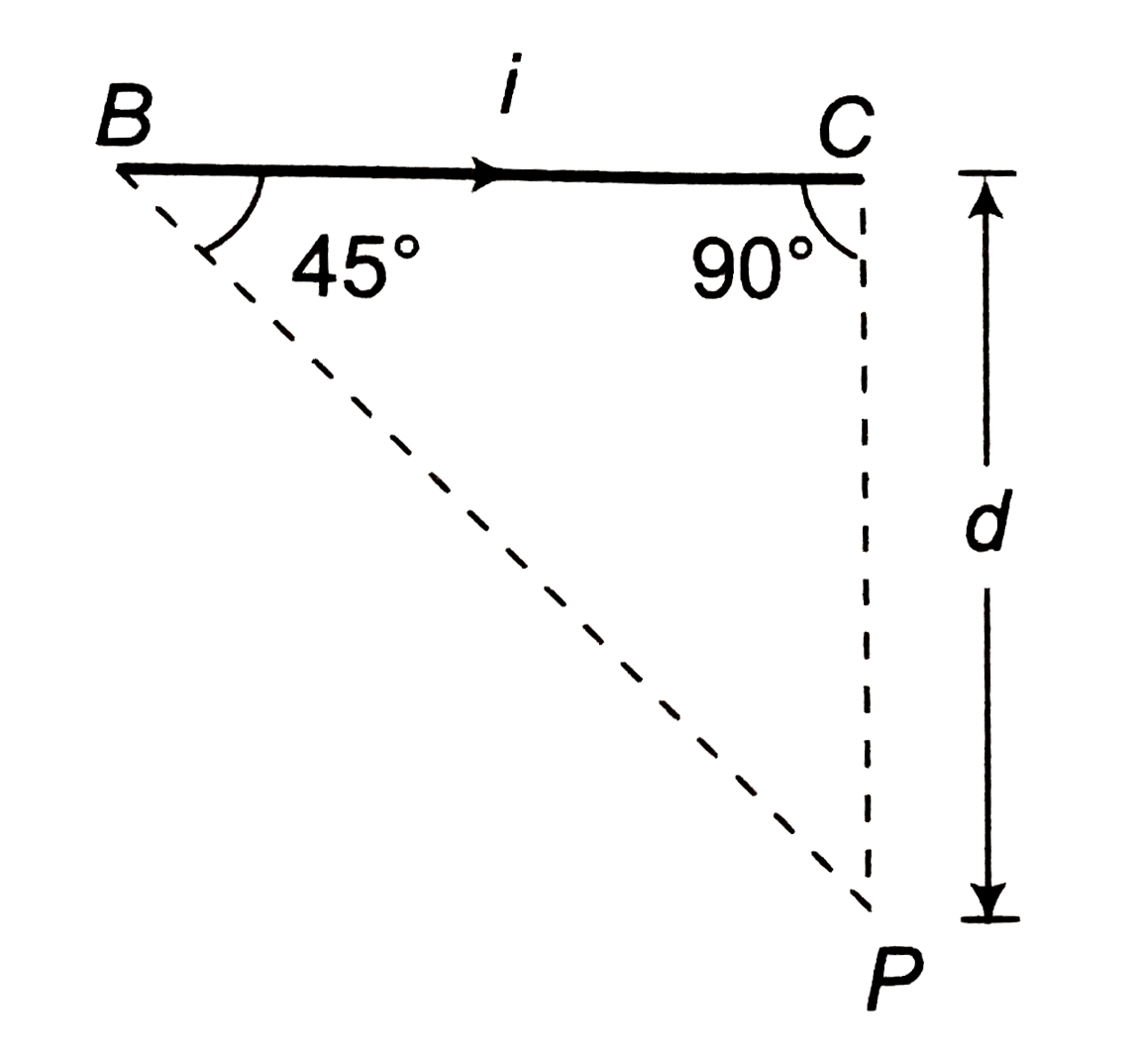 `B_(2)=(mu_(0)i)/(4pid_(2))(cos 45^(@)+cos 90^(@))` `=(mu_(0)i)/(4sqrt(2)pid), ox` Due to `CA` 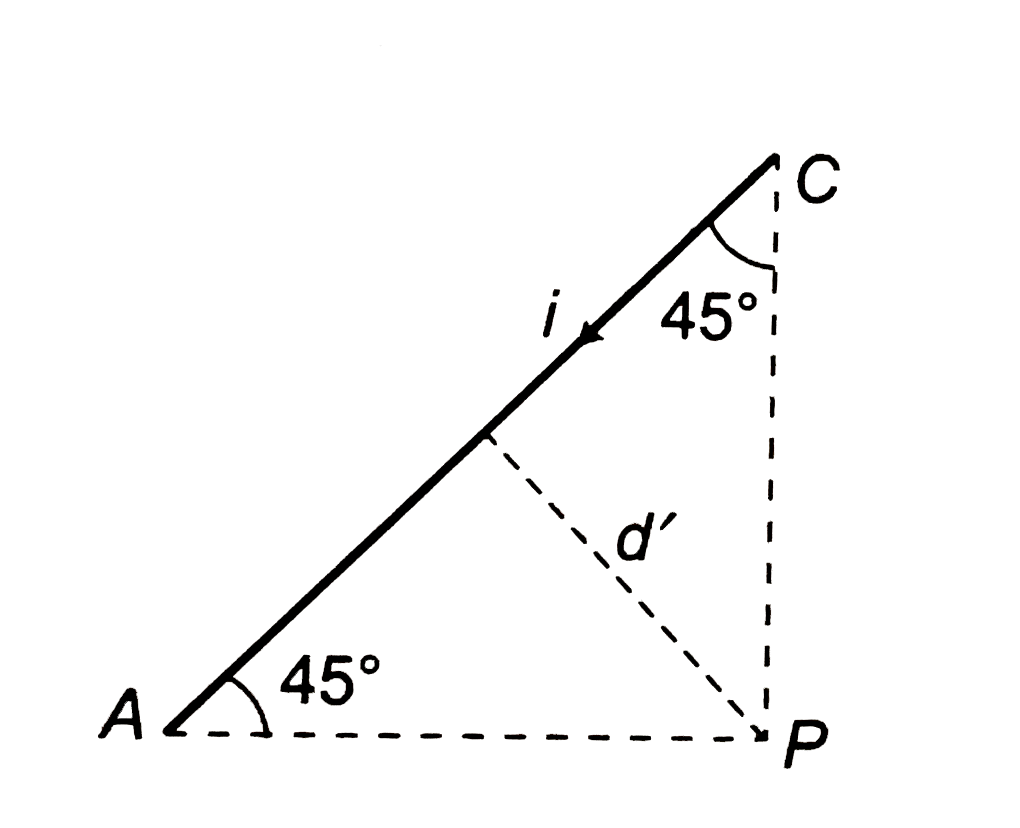 `B_(3)=(mu_(0)i)/(4pid')(cos 45^(@)+cos 45^(@))` `=(mu_(0)i)/(4pi.d/(sqrt(2)))xx2xx1/(sqrt(2))=(mu_(0)i)/(2pid), o.` `B_(3)gt(B_(1)+B_(2))` `B_(P)=B_(3)-(B_(1)+B_(2))` `=(mu_(0)i)/(2pid)-(mu_(0)i)/(2sqrt(2)pid)=(mu_(0)i)/(4pid)(2-sqrt(2)), o.` (g) 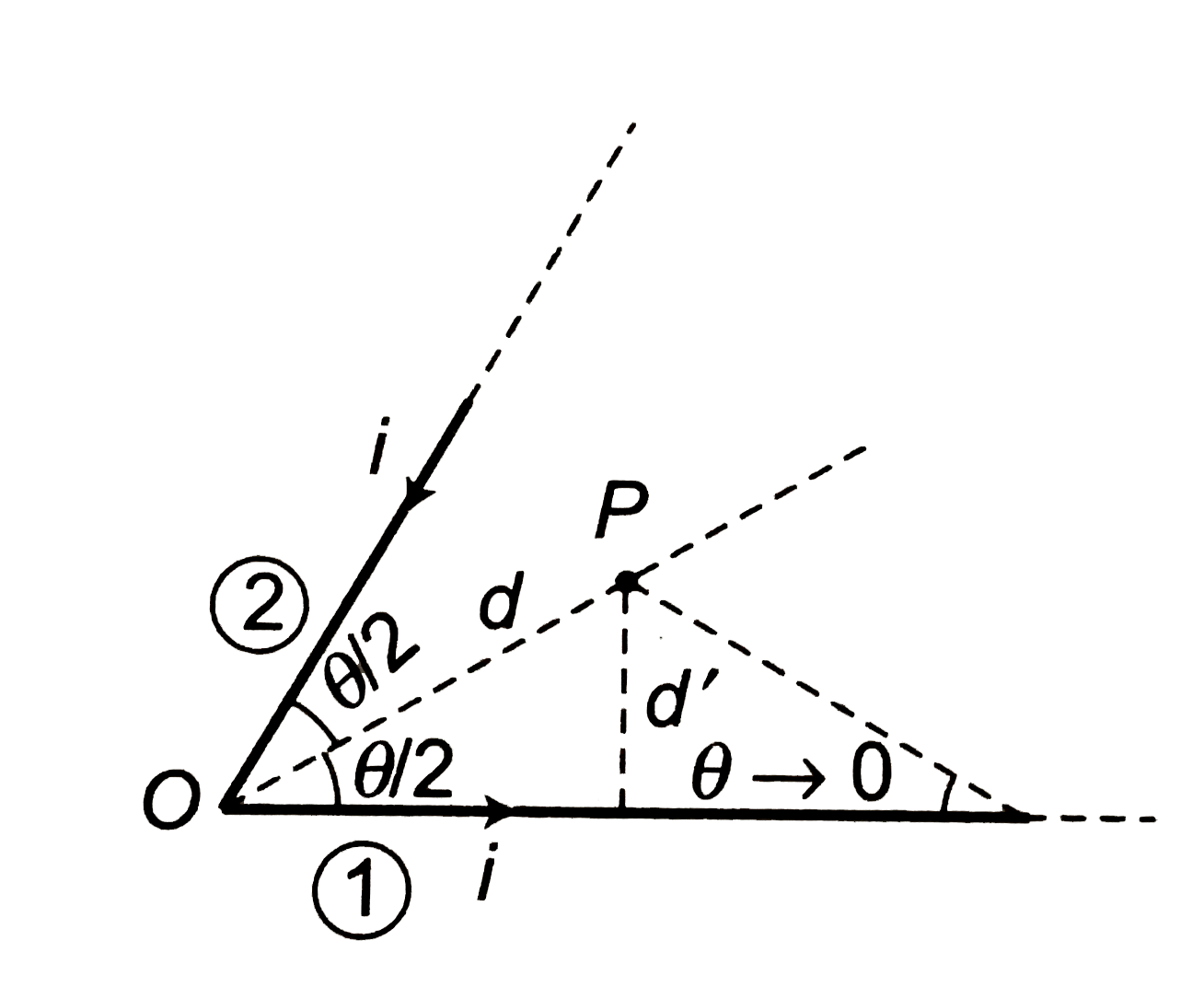 `d'=d sin.(theta)/(2)` `B_(1)=(mu_(0)i)/(4pid')(cos. (theta)/(2)+cos 0)` `=(mu_(0)i)/(4pid sin.(theta)/(2))(1+cos.(theta)/(2))` `=(mu_(0)i)/(4pid(2sin.(theta)/(4)cos.(theta)/(4)))(1+2cos^(2).(theta)/(4)-1)` `=(mu_(0)i)/(4pid)cot.(theta)/(4)=B_(2), o.` `B_(P)=B_(1)+B_(2)=2B_(1)` `=(mu_(0)i)/(2pid)cot.(theta)/(4), o.` (H) 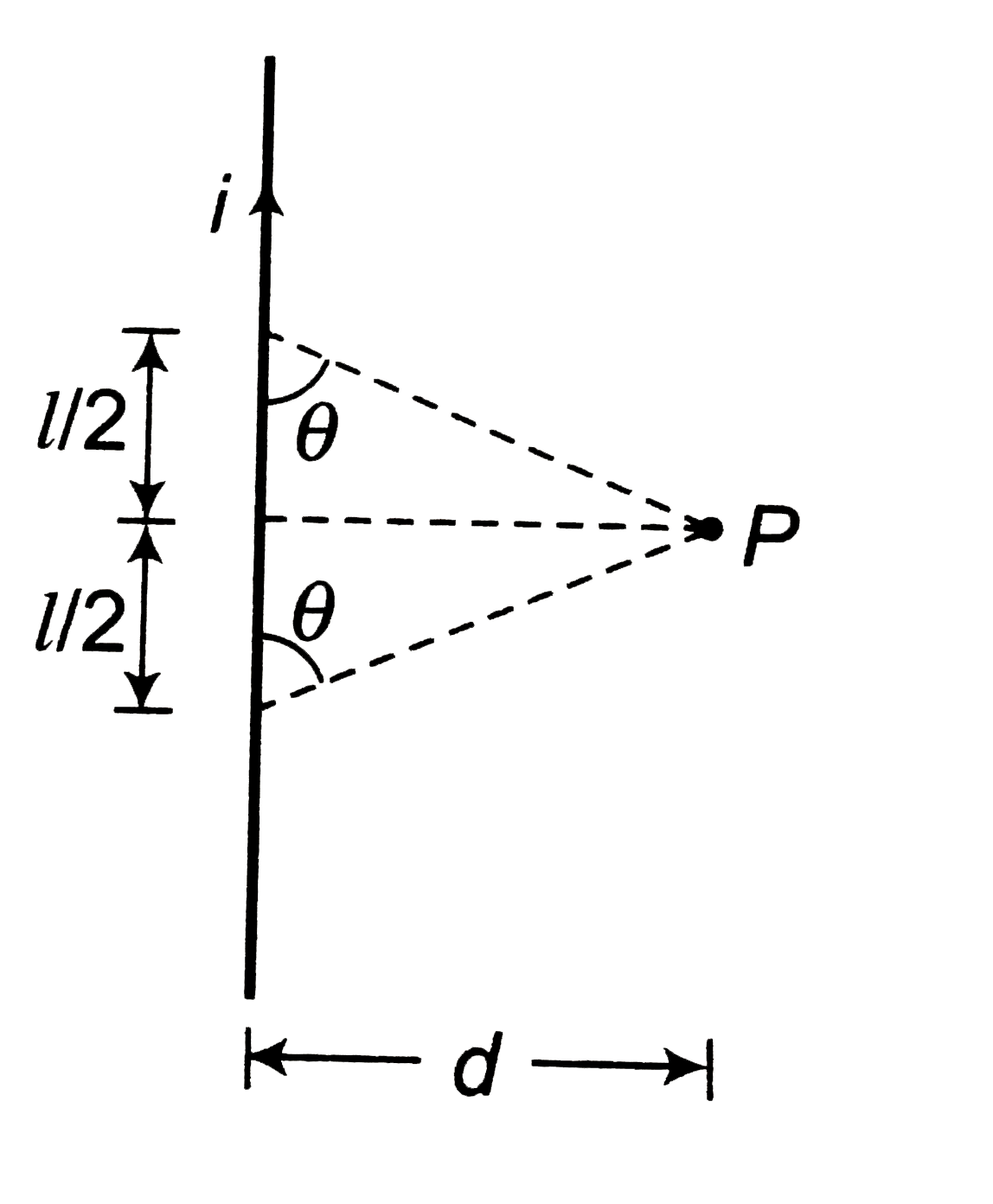 `B_(1)=(mu_(0)i)/(2pid)` `B_(2)=(mu_(0)i)/(4pid)(cos theta+cos theta)` `cos theta=(l//2)/(sqrt((l//2)^(2)+d^(2))) = l/(sqrt(l^(2)+4d^(2)))` `B_(1)gtB_(2)` `B_(1)-B_(2)=1/100B_(1)` `99/100 B_(1)=B_(2)` `99/100xx(mu_(0)i)/(2pid)=(mu_(0)i)/(4pid)xx2xxl/(sqrt(l^(2)+4d^(2)))` `(99)sqrt(l^(2)+4d^(2))=100l` `(99)^(2)(l^(2)+4d^(2))=(100^(2))l^(2)` `(99)^(2)4d^(2)=(100^(2)-99^(2))l^(2)` `(d^(2))/(l^(2))=((199)(1))/((99)^(2)xx4)` `d/l=0.07` |
|
| 47. |
Two coaxial solenoids are made by winding thin insulated wire over a pipe of cross sectional area A= 10cm^2 and length = 20 cm. If one of the solenoids has 300 turns and the other 400 turns, their mutual inductance is |
|
Answer» `2.4 xx 10^(-5) H` |
|
| 48. |
Derive an expression for the energy stored in a charged parallel plate capacitor. |
|
Answer» SOLUTION :Let at a particular instant charge on the plate of CAPACITOR be q and its POTENTIAL difference be `q/C.` If an additional charge dq is GIVEN to the capacitor plate, work done for it is given by `dW=(q/C).dq` Therefore, whole process of charging from 0 to Q requires a work `W = int_0^Q (qdp)/C = 1/C [q^2/2]_0^Q = Q^2/(2C)` This work done is stored as the electrostatic potential ENERGY of the charged capacitor. Hence, potential energy of charged capacitor `u = Q^2/(2C)` But Q=CV, where V be the potential difference between the plates of capacitur, hence `u = (Q^2)/(2C) =1/2QV =1/2 CV^2` |
|
| 49. |
An electron's position is given by vecr=3.00hati-4.00t^(2)hatj+2.00hatk, with t in seconds and vecr in meters. (a) In unit-vector notation, what is the electron's velocity vecr(t)? At t = 3.00 s, what is vecv (b) in unitvector notation and as ( c) a magnitude and (d) an angle relative to the positive direction of the x axis? |
| Answer» Solution :(a) `(3.00m//s)hati-(8.00tm//s)hatj,` (b) `(3.00hati-24.0hatj)m//s,` ( C) 24.2 m/s, (d) `82.9^(@)` measured CLOCKWISE from the +X direction, or `277^(@)` COUNTERCLOCKWISE from +x) | |
| 50. |
In a parallel plate capacitor with air between the plates, each has an area 8xx10^(-3)m^(2) and distance between the plates is 2 mm. Calculate the capacitance of the capacitor. If this capacitor is connected to a 50 V supply, what is the charge on each plate of the capacitor? (Absolute permittivity of free space =8.85xx10^(-12)Fm^(-1)) |
|
Answer» Solution :Given `A=8xx10^(-3) m^2, d=2xx10^(-3)`m `C_"air"`=? V=50 V , Q=? `e_0=8.85xx10^(-2) Fm^(-1)` 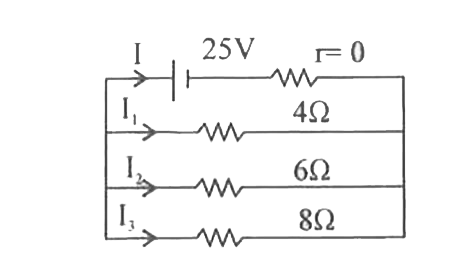 WKT electricalcapacitanceof an air CAPACITOR `C=(epsilon_0A)/d` i.e.,`C=(8.85xx10^(-2) xx8xx10^(-3))/(2xx10^(-3))` i.e.,`C=35.416xx10^(-2)` (farad) Also, WKT Q=chargean the capacitor =CV i.e.,`Q=35.416xx10^(-12)xx50` `=1770.8xx10^(-12)` C `Q=1.771xx10^(-9)` C(Coulomb ) |
|

 ` <br><img src=)