

Saved Bookmarks
This section includes 7 InterviewSolutions, each offering curated multiple-choice questions to sharpen your Current Affairs knowledge and support exam preparation. Choose a topic below to get started.
| 1. |
An automobile engine develops a power of 100 Killowalt, when rotating at a speed of 30 rev/sec. What torque does it deliver ? |
|
Answer» Solution :In translation MOTION `P=Fxxv` in rotational motion` P=to U OMEGA` `THEREFORE` to `u=P//omega =(100xx1000)//(2pixx30)=5000//pi` |
|
| 2. |
The Electric field is given by vec( E)= (vec( F))/(q_(0)), here the test charge .q_(0). should be (a) Infinitesimally small and positive (b) Infinitesimally small and negative |
|
Answer» only a |
|
| 3. |
A body is moving on a curved path with constant speed what is the nature of its acceleration ? |
| Answer» SOLUTION :The ACCELERATION is PERPENDICULAR to the DIRECTION of MOTION. | |
| 4. |
A block is pushed across a floor by a constant force that is applied at downward angle theta (Fig. 6-33). Figure 6-53 gives the acceleration magnitude a versus a range of values for the coefficient of kinetic friction mu_(k) between block and floor: a_(1) = 3.0 m//s^(2) mu_(2) = 0.20, and mu_(k3) = 0.40. What is the value of theta ? |
| Answer» SOLUTION :`theta=60^(@)` | |
| 5. |
The beautiful diatoms and desmids are placed under |
|
Answer» Chrysophytes |
|
| 6. |
What is the physical quantity same for X - rays of wavelength 10^(-10)m, red light of wavelength 6800 Å and radiowaves of wavelength 500 m ? |
| Answer» Solution :The SPEED in VACUUM is the same for all are `c=3xx10^(8)MS^(-1)`. (Electromagnetic WAVES). | |
| 7. |
A convex lens made up of material of refractive index mu_(1), is immersed in a medium of refractive index mu_(2) as shown in the figure. The relation between mu_(1) and mu_(2) is |
|
Answer» `mu_(1)ltmu_(2)` |
|
| 8. |
A wire is moving in a magnetic field of B. If the cross section area of wire becomes double, then what will be the change in the direction of induced emf: |
|
Answer» No change |
|
| 9. |
A biconvex thin lens prepared from glass of refractive index mu_(2)=3/2. The two conducting surfaces have equal radii of 20 cm each. One of the surface is silvered from outside to make it reflecting. It is placed in a medium of refractive index mu_(1)=5/3. If acts as a |
|
Answer» converting mirror |
|
| 11. |
फलन f व्युत्क्रमणीय होगा यदि f |
|
Answer» एकैकी है। |
|
| 12. |
An electric dipole consists of two opposite charges of magnitude 2xx10^(-6)C, separated by 4.0 cm. the dipole is placed in an external field of 10^(5)NC^(-1) find the work done by an external agent to turn the dipole thorugh 180^(@) |
|
Answer» |
|
| 13. |
Determine electric field at point P or O in the following cases , take (1)/( 4 pi in_(0)). (Q)/(d^(2)) = E_(0). (a) (b) |
|
Answer» Solution :(a)Electric field at `P` : Due to `9 Q , E_(1) = (1)/( 4 pi in_(0)) .(9 Q)/((3d)^(2)) = (1)/( 4 pi in_(0)) (Q)/(d^(2)) = E_(0)`, towards right Due to `4 Q , E_(2) = (1)/( 4 pi in_(0)) . (4 Q)/((2d)^(2)) = E_(0)`, towards right Due to `-Q , E_(3) = (1)/( 4 pi in_(0)) . (Q)/(d^(2)) = E_(0)` , towards left Resultant field at `P`: `E_(p) = E_(1) + E_(2) - E_(3) = E_(0)` , towards right (b) Electric field at `P` : Due to `3 Q , E_(1) = (1)/(4 pi in_(0)) . (3 Q)/(d^(2)) = 3 E_(0)`, downward Due to `- 4 Q , E_(2) = (1)/( 4 pi in_(0)) .( 4 Q)/(d^(2)) = 4 E_(0)`, towards right `E_(p) = sqrt(E_(1)^(2) + E_(2)^(2)) = 5 E_(0)` `tan alpha = (3 E_(0))/( 4 E_(0)) = (3)/(4) rArr alpha = tan^(-1) (3//4)` (c ) Electric field at `P`: `Q at A , E_(1) = (1)/( 4 pi in_(0)) . (Q)/( d^(2)) = E_(0)` , ALONG `AP` `Q at B , E_(2) = E_(0)` , along `BP` `E_(p) = E_(0) cos 30^(@) xx 2 = sqrt(3) E_(0)` (d) At `P`: `4 Q , E_(1) = (1)/(4 pi in_(0)) . ( 4 Q)/((2 d)^(2)) = E_(0)` , along `BP` `-2 Q` at left TOP , `E_(2) = (1)/( 4 pi in_(0)) . (2 Q)/((sqrt(2) d)^(2)) = E_(0)` , along `PA` `- 2Q` at right bottom , `E_(3) = (1)/( 4 pi in_(0)) . (2 Q)/((sqrt(2) d)^(2)) = E_(0)` , along `PC` The resultant of `E_(2)` and `E_(3)` is `sqrt(2) E_(0)` at angle `45^(@)` with either `E_(2) or E_(3)`. Net electric field at `P , (sqrt(2) - 1) E_(0)` , at angle `45^(@)` (e) Electric field at `O`: `9 Q` at `A , E_(1) = (1)/( 4 pi in_(0)) .(9 Q)/((5d)^(2)) = (9E_(0))/(25)` , along `AO` `-9 Q` at B , `E_(2) = (9E_(0))/(25)`, along `OB` `-16 Q` at `C , E_(3) = (1)/(4 pi in_(0)).(16 Q)/((5d)^(2)) = (16 E_(0))/(25)` , along `OC` `16 Q at D , E_(4) = (16 E_(0))/(25)` , along `DO` `cos alpha = (8 d)/(10 d) = (4)/(5)` `E_(p) = E_(0) cos alpha xx 2 = E_(0) xx (4)/(5) xx 2 = (8 E_(0))/(5)` Alternatively : The direction of electric fields due to `16 Q` and `- 9 Q` is same and these charges are placed at same separation from `O` , so we can combine these charges as `(16 Q + 9 Q)` or `(-9Q - 16Q)`. (f) The electric fields at `O` by pairs `(Q ,Q) ,(-Q , -Q)` is zero `E_(0) = (1)/(4 pi in_(0)) . (5 Q)/(d^(2)) = 5 E_(0)` , towards left 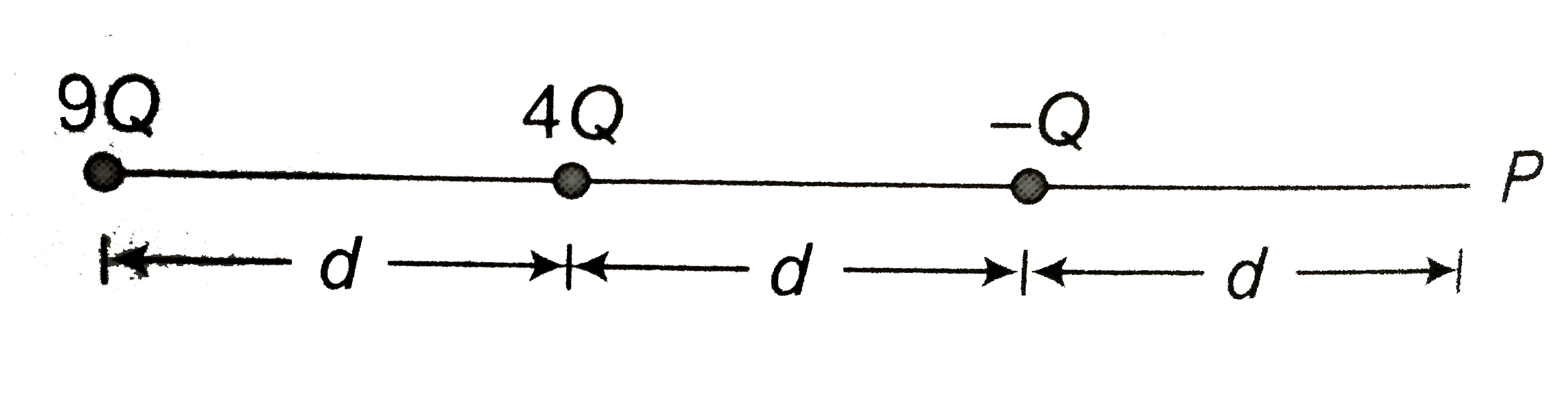 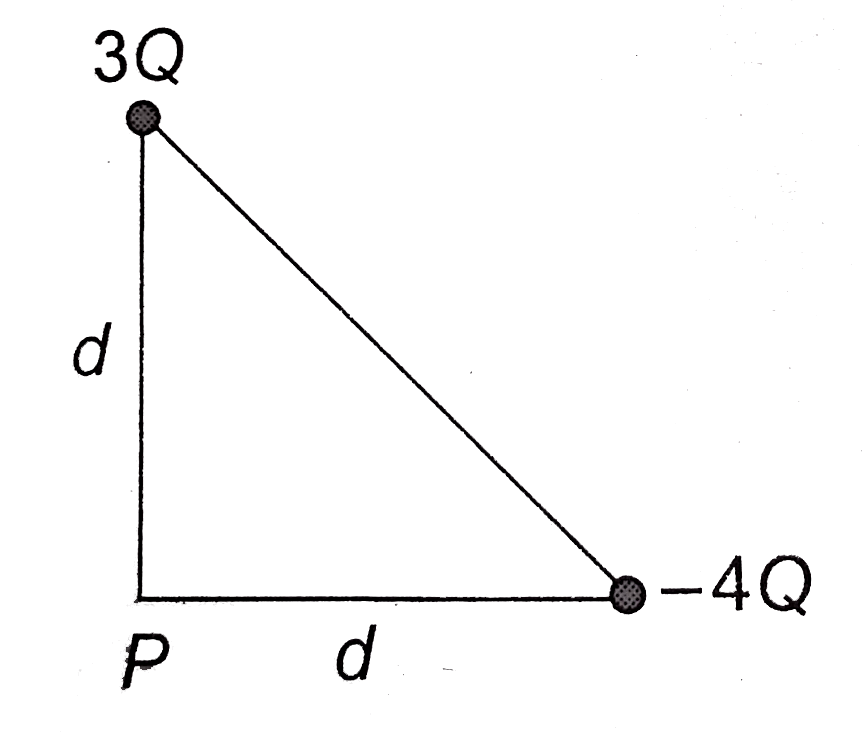 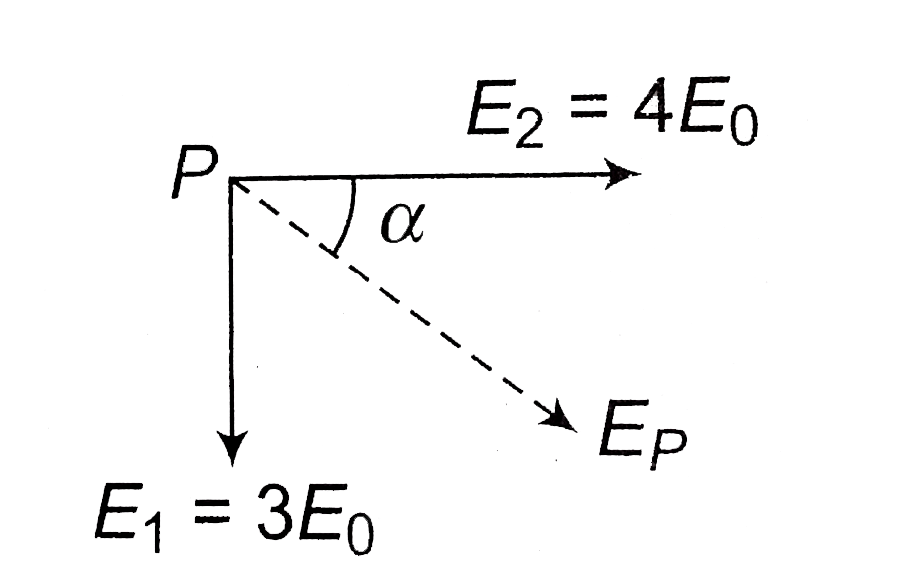 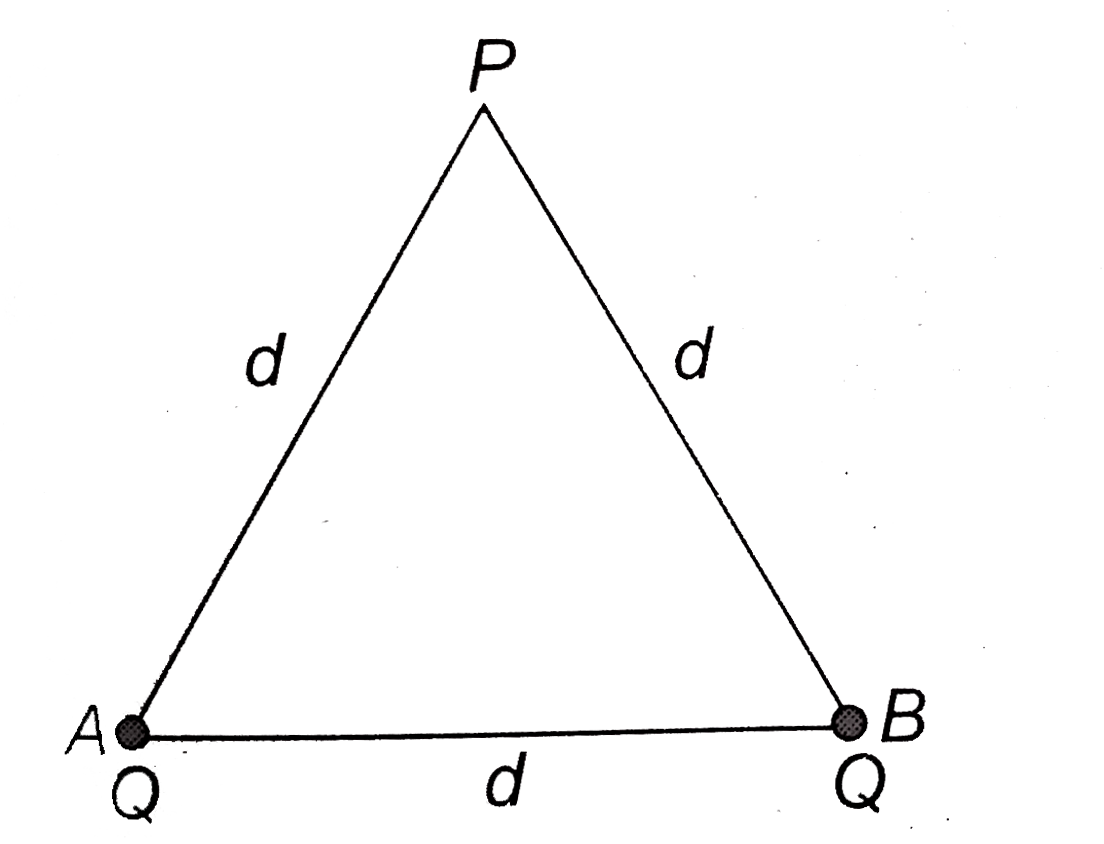 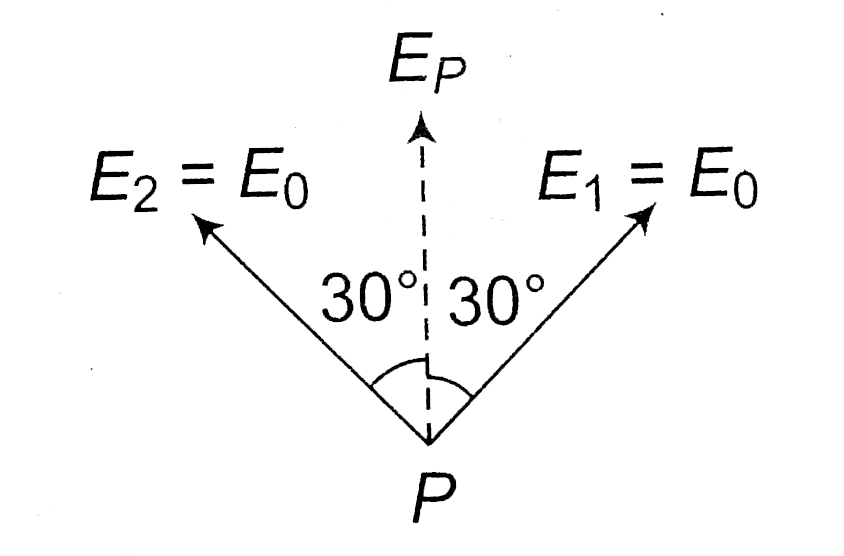 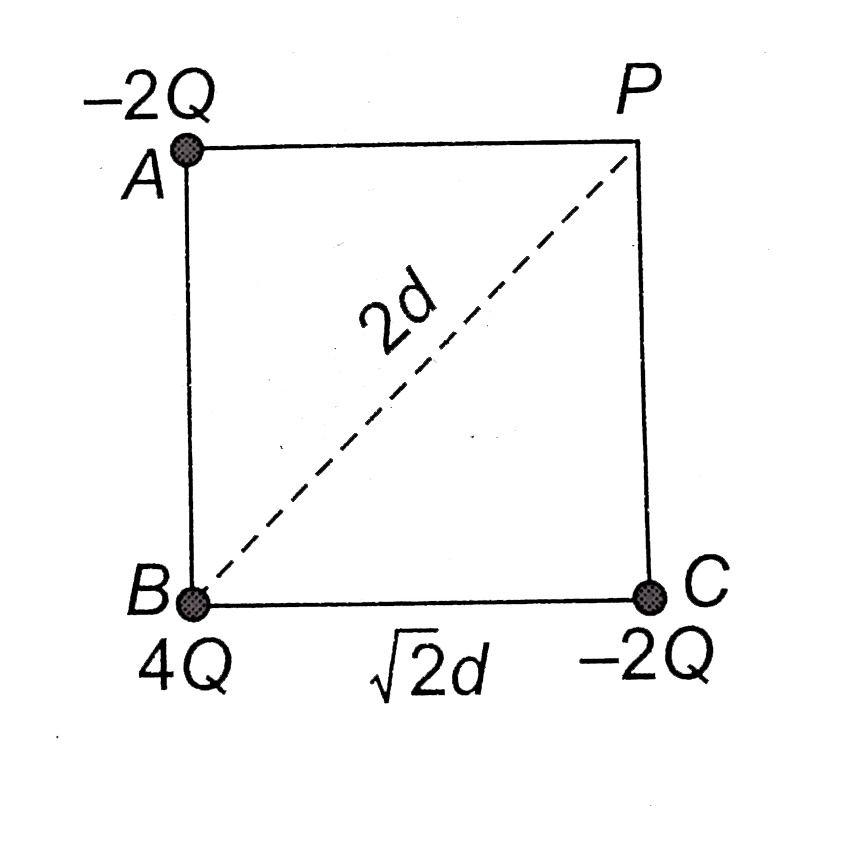 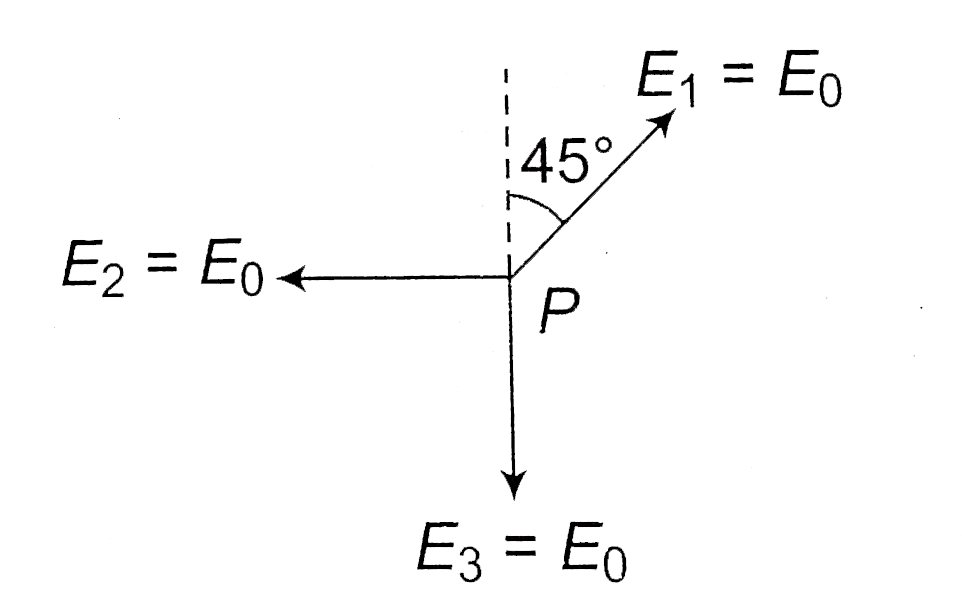 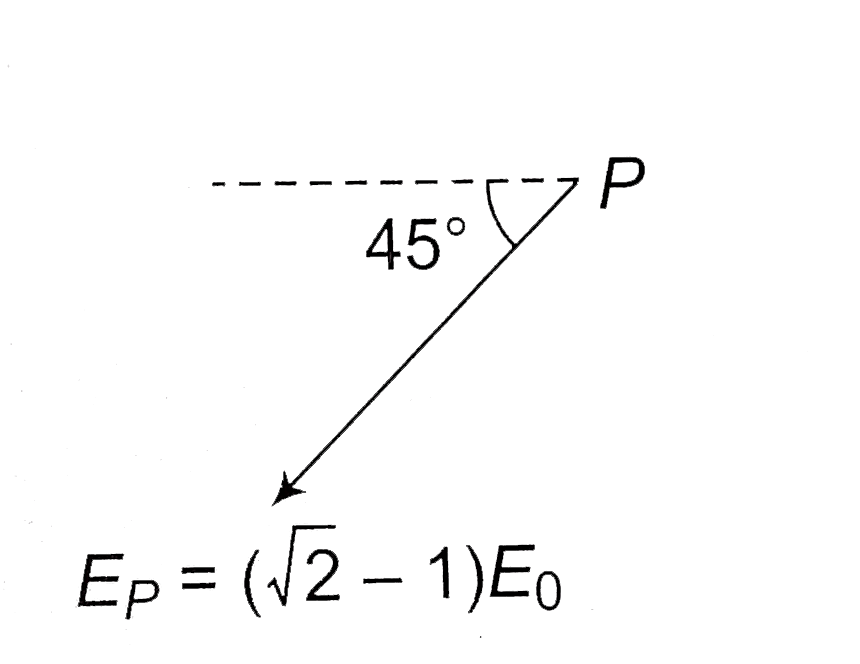 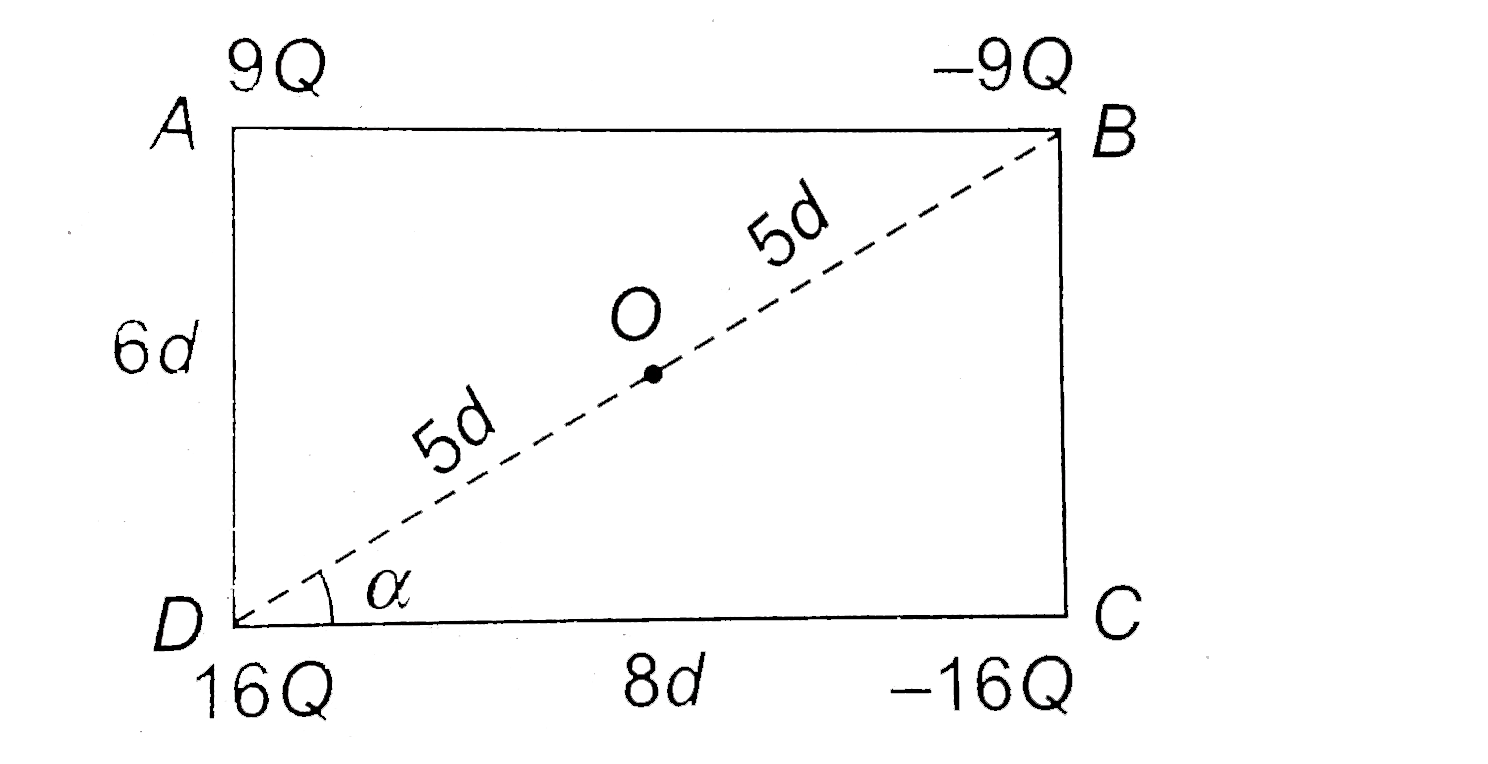  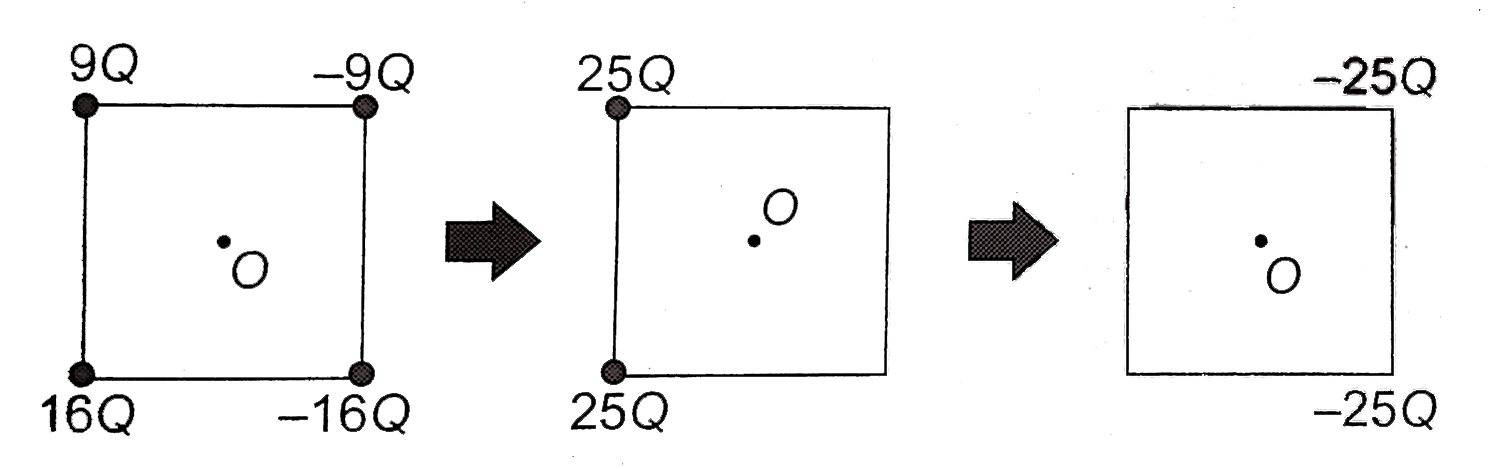 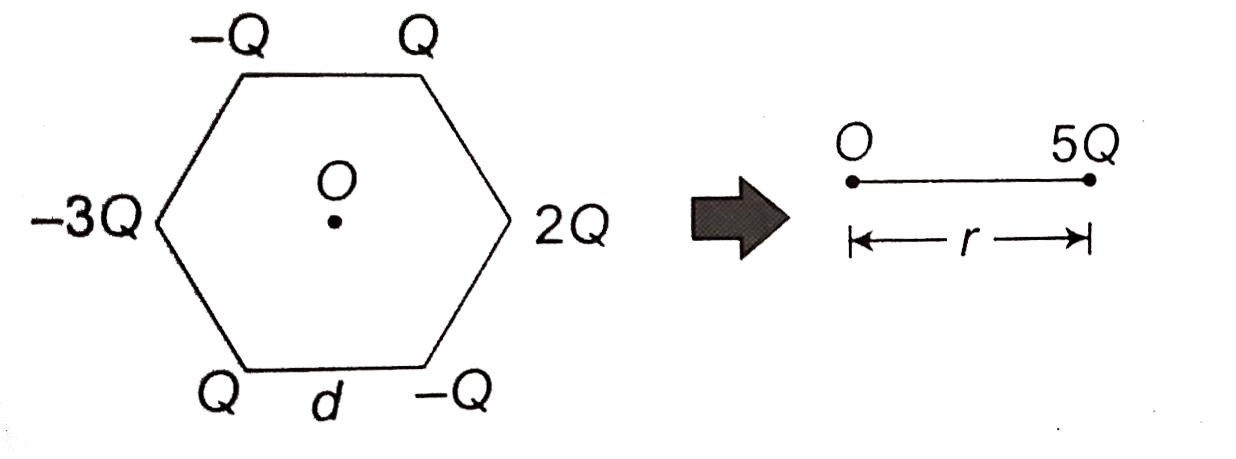
|
|
| 14. |
State Gauss' law in magnetism. |
| Answer» Solution :According to Gauss.s law for MAGNETISM ,the NET magnetic flux throughany CLOSED surface isalways zero. | |
| 15. |
The number of degrees of freedom for a mole of diatomic gas at N.T.P. is: |
|
Answer» `30.1xx10^(23)` 1 mole of the gas contains `N=6.023xx10^(23)` molecules. `therefore` Total NUMBER of degress of freedom =Nf. `=6 CDOT 023xx10^(23)xx5=30cdot115xx10^(23)` Thus, correct choice is (a). |
|
| 16. |
Two point charges of values -20 esu and +20 esu are placed on the x-axis at x = -10cm and x = +10cm respectively. Calculate (iii) Find the work done in carrying a positive charge of value +6 esu from P to Q along a straight the joining them. |
|
Answer» Solution :TWO CHARGES + 20 esu and -20 esu are placed at A and B respectively. (iii) WORK done to bring a positivecharge of value 6 esu from P to Q, `W = 6(V_(Q) - V_(P)) = 6 XX 4/3 = 8 erg`. |
|
| 17. |
Two point charges of values -20 esu and +20 esu are placed on the x-axis at x = -10cm and x = +10cm respectively. Calculate (iv) Is there any path along which the work done is less than the above value ? Why? |
|
Answer» Solution :Two CHARGES + 20 esu and -20 esu are PLACED at A and B respectively. (iv) As electrostaticfield is conservative, so it does not DEPEND on the path and work DONE remains the same. |
|
| 18. |
Cracks in bones can be detected using ……… |
| Answer» Answer :A | |
| 19. |
Three resistors of resistance 2 Omega,5 Omega and 3 Omegarespectively are connected in parallel across a battery of 10 volts and negligible resistance. The potential difference across 5 Omegaresistor is |
|
Answer» 5V |
|
| 20. |
Which of the following waves can be polarized (i) Heat waves, (ii) Sound waves. Give reason to support your answer. |
| Answer» SOLUTION :HEAT WAVES, as they are transverse/ electromagnetic in nature. | |
| 21. |
The moment of inertia of two spheres of equal masses about their diameters are equal. If one of them is solid and other is hollow, the ratio of their radii is : |
|
Answer» `sqrt(3):sqrt(5)` `therefore (2)/(5)MR_(1)^(2)=(2)/(3)MR_(2)^(2)or(R_(1)^(2))/(R_(2)^(2))=(5)/(3)` |
|
| 22. |
A convex lens of focal length f_(1)is kept in contact with another lens of focal length/2. Find an expression for the focal length of the combination. |
Answer» Solution :Consider TWO THIN lenses A and B of focal LENGTHS `f_(1)` and `f_(2)`placed in contact. Let a point object be placed at O, beyond the focus of first lens A. Lens A forms a REAL image at `I_(1)`. This image serves as a virtual object for second lens B and the final real image is formed at I.  For image `I_(1)` formed by first lens, we have `1/v_(1) -1/u =1/f_(1)` and for the image I formed by the second lens, we have `1/v - 1/v_(1) = 1/f_(2)`...(ii) Adding (i) and (ii), we have `1/v - 1/u =1/f_(1) + 1/f_(2)`...(iii) If the two lens system is considered as equivalent to a single lens of focal length f, then `1/v -1/u = 1/f` COMPARING (iii) and (iv), we find that : `1/f = 1/f_(1) + 1/f_(2)` |
|
| 23. |
As shown in the figure a square having length a has electric charge distribution of surface charge density sigma =sigma_(0)xy. The total electric charge on the square will be......(The cartesian coordinate system is shown in figure.) |
|
Answer» Solution :Consider an element of area dxdy at a POINT [x, y) as shown in the figure. The charge on the area element is: `DQ = sigma_(0).xy dx.dy` `therefore` Therefore, TOTAL ELECTRIC charge on the surface. `Q = sigma_(0)int_(0)^(a)x.dx.int_(0)^(a)ydy` `=sigma_(0)[x^(2)/2]_(0)^(a).[y^(2)/2]_(0)^(a)` `therefore =(sigma_(0)a^(4))/4` |
|
| 24. |
A horizontal thin copper ring has a diameter exactly 1.00000 inch at temperature 0^(@)C and is ficed to a non conducting stand. An aluminium sphere of diameter exactly 1.00200 inch at 100^(@)C is placed on the top of the ring. When the two attain temperature equilibrium, the sphere just passes through the ring. Assuming that the whole heat energy remains within the ring sphere system find (alpha_(Cu)=1.67xx10^(-5).^(@)C^(-1), alpha_(Al)=2.4xx10^(-4).^(@)C^(-1)) (i) the final equilibrium temperature (ii) the ratio of the mass of the ring to that of the sphere. |
|
Answer» |
|
| 25. |
Two circular coils are made from a uniform wire the ratio of radii of circular coils are 2.3 & no. of turns is 3:4. If they are connected in parallel across a battery. A.: Find ratio of magnetic induction at their centres. B: Find the ratio magnetic momentsof 2 coils |
|
Answer» <P> Solution :when connected in parallela) `Bprop1/(r^(2)),(B_(1))/(B_(2))=((r_(2))/(r_(1)))^(2)=(3/2)^(2)=9/4` `b)M=niA_("coil")` but `i=V/R=V/(PL)A_("wire")` `rArrM=(VA_("wire"))/(p(2pir_("coil")))(pir_("coil")^(2)),M=(VA_("wire"))/(pxx2)r_("coil")` `(M_(1))/(M_(2))=(r_(1))/(r_(2))=2/3` |
|
| 26. |
Two bodies with kinetic energies in the ratio of 4:1 are moving with equal linear momentum. The ratio of their masses is |
|
Answer» SOLUTION :`P=SQRT(2mk)` Here`P_1=P_2` `sqrt(2m_1k_1)`=`sqrt(2m_2k_2) THEREFORE (m_1)/(m_2)=(k_2)/(k_1)=1/4` |
|
| 27. |
For the arrangement of Fig 25-22 suppose, that the battery remains connected while the dielectric slab is being introduced. Calculate (a) the capacitance (b) the charge on the capacitors plates (c ) the electric field inthe gap and (d) the electric field in the slab after the slab is in place. |
| Answer» SOLUTION :`a) 13.4 pF B) 1.15 NC C) 1.13 times 10^4 N//C d) 4.33 times 10^3 N//C` | |
| 28. |
Anexperimenter arranges to trigger two flashbulbs simultaneously, producing a big flash located at the origin of his reference frame and a small flash at x = 30.0 km. An observer moving at a speed of 0.450c in the positive direction of x also views the flashes. (a) What is the time interval between them according to her? (b) Which flash does she says occurs first? |
|
Answer» |
|
| 29. |
Consider a hypothetical annihilation of a stationary electron with a stationary positron. What is the wavelength of resulting radiation |
|
Answer» `H/(2m_0c)` |
|
| 30. |
Mention applications of Gauss's law. |
|
Answer» SOLUTION :The applications of Gauss.s LAW are as below : (1) To obtain field due to an INFINITELY long straight UNIFORMLY charged wire. (2) To obtain field due uniformly charged infinite plane sheet. (3) To obtain field due to uniformly charged THIN spherical shell. (4) To obtain field due Lo uniformly charged sphere. |
|
| 31. |
Two parallel plate capacitors C and 2C are connected in parallel and charged to a P.D 'V'. The battery is then disconnected and the region between the plates of the capacitor 'C' is completely filled with a material of dielectric constant 'K'. The P.D across the capacitors now becomes |
| Answer» Answer :C | |
| 32. |
A 2 uF capacitor, 100 Omegaresistor and 8 Hinductor are connected in series with an a.c. source. Find the frequency of the a.c. source for which the current drawn in the circuit is maximum. If the peak value of emf of the source is 200 V, calculate the (i) maximum current, and (ii) inductive and capacitive reactance of the circuit at resonance. |
|
Answer» |
|
| 33. |
The dimensions of h/2_pi will be equivalent to that of? |
|
Answer» momentum |
|
| 34. |
A charged particle is projected into a transverse uniform magnetic field. The area enclosed by its path i) Directly proportinal to its K.E ii) Inversely proportional to square of charge iii) Directly porportional to velocity iv) inversely porportional to time. |
| Answer» Answer :B | |
| 35. |
Why is photodiode used in reverse bias ? |
| Answer» Solution :When operated under reverse bias, the PHOTODIODE can DETECT changes in current with changes in light INTENSITY more EASILY. | |
| 36. |
Magnetic field inside the toroid is |
|
Answer» RADIAL |
|
| 37. |
Solve the foregoing problem for the case of the pan having a mass M. Find the oscillation amplitude in this case. |
|
Answer» Solution :Unlike the previous `(4.40)` problem the kinetic energy of body `m` decreases due to the perfelcty inelastic collision with the pan. Obviously the body `m` comes to strike the pan with velocity `v_(0)=sqrt(2gh)`. If `v` be the common velocity of the `''` body `m+` pena `"` system due to the collision thrn from the conservation of linear momentum `m v_(0)=(M+m)v` or `v=(m v_(0))/((M+m))=(msqrt(2gh))/((M+m))...(1)` At the moment the body `m` STRIKES the pan, the spring is compressed due to weight of the pan by the amount `Mg//k`. If `l`be the further compression FO the spring due to the velocity acquired by the`"` pan `-` body `m"` system, then from the conservatiion of mechanical energy of the said system in the field generated by the joint action of boty the gravity and spring forces `(1)/(2)(M+m)v^(2)+(M+m)gl=(1)/(2)k((Mg)/(k)+l)^(2)-(1)/(2)k((Mg)/(k))^(2)` or, `(1)/(2)(M+m)(m^(2)2gh)/((M+m))+(M+m)gl=(1)/(2)k((Mg)/(k))^(2)+(1)/(2)kl^(2)-Mgl-(1)/(2)k ((Mg)/(k))^(2)` (Using 1) or, `(1)/(2)kl^(2)-mgl-(m^(2)gh)/((m+M))=0` Thus` l=(mg+-sqrt(m^(2)g^(2)+(2kghm^(2))/(M+m)))/(k)` As minus sign is not acceptable `l=(mg)/(k)+(1)/(k)sqrt(m^(2)g^(2)+(2km^(2)gh)/((M+m)))` If the oscillating " pan `+` body `m"` system were at REST it correspong to their equilibrium position i.e. the spring were compressed by `((M+m)g)/(k)` therefore the amplitude of oscillation `a=l-(mg)/(k)=(mg)/(k)sqrt(1+(2hk)/(mg))` The mechanical energy of oscillation which is only conserved with the RESTORING forces becomes `E=U_("extreme")=(1)/(2)ka^(2)`( Because spring force is the only restoring force not the weight of the body ) Alternately `E=T_("mean")=(1)/(2)(M+m)a^(2)omega^(2)` thus `E=(1)/(2)(M+m)a^(2)((k)/(M+m))=(1)/(2)ka^(2)` |
|
| 38. |
In Fresnel experiment, a quantity Z_F is given by |
|
Answer» `Z_(F) APPROX lambda"/"a^(2)` |
|
| 39. |
An object of specific gravity rhois hung from a thin steel wire. The fundamental frequency fortransverse standing waves in the wire is 300Hz. The object is immersed in water, so that one half of its volume is submerged. The new fundamental frequency (in Hz) is |
|
Answer» `300 ((2RHO - 1)/(2rho))^(1//2)` |
|
| 40. |
How did the boy make himself walk? |
|
Answer» He MADE himself walk through determination |
|
| 41. |
Calculate the percentage of any radioactive substance left undecayed after half of half life. |
|
Answer» SOLUTION :From RELATION `N/(N_0) =(1/2)^(t//T) "When" t=T//2` `N/(N_0)=(-)^(1//2)` or `N/(N_0)=1/sqrt2=(100)/sqrt2=70.9%` |
|
| 42. |
An optical system is located in air. Let OO' be its optical axis, F' and F' are the front and rear focal points, H and H' are the front and rear principle planes, P and P' are the conjugate points. By means of plotting find: (a) the position F' and H' (Fig.), (b) the position of the point S' conjugate to the point S (Fig.), (c) the positions F, F', and H' (Fig. where the path of the ray of light is shown before and after pasing through the system). |
|
Answer» <P> Solution :(a) Draw `P'X` parallel to the axis `OO'` and let `PE` intensity it at `X`. That determines the principle point `H`. As the MEDIUM on both sides of the SYTEM is the same, the principle point conicides with the NODAL point. Draw a ray parallel to `PH` through `P'`. that determines `H'`. Draw a ray `PX'` parallel to the axis and join `P'X'`. That givens `F'`. (b) We let `H` stand fro the principle point (on the axis). Determine `H`' by drawing a ray `P'H` passing through `P'` and parallel to `PH`. One ray (conjugate to `SH`) can be obtained from this. To GET the other ray once needs to know `F` or `F'`. This is easy because `P` and `P'` are knows. Finally we get `S'`.  (c) From the incident ray we determine `Q`. A line parallel to `OO'` through `Q` determines `Q` and hence `H' H` and `H'` are then also the normal points. A ray parallel to the incident ray thorugh `H` will emerge parallel to itself through `H'`. That determines `F'`. Similarly a ray parallel to the emergent ray through `H` determines `F`. 
|
|
| 43. |
If G, r_Aand r_Vdenote the internal resistances of a galvanometer, an ammeter and a voltmeter among the following the correct relationship is |
|
Answer» `G LT r_A lt r_V ` |
|
| 44. |
In a characteristic x-ray spectra (as shown in the following figure), L shell of some element is superimposed on continuous x-ray spectra. Ere |
|
Answer» <P>P can represent `L_(alpha)` line |
|
| 45. |
A wire has a resistance of 2.5 Omegaat 100^@ C. Temperature coefficient of resistance of the material alpha = 3.6 xx 10^(-3) K^(-1)at 25^@ C. Find its resistance at 25^@ C. |
|
Answer» Solution :`R = 2.5 Omega , t_2 = 100^@ C` `ALPHA = 3.6 xx 10^(-3) K^(-1) , R_1 = ?` `t_2 = 100+ 273 = 373 K . T_1 = 25^@ C = 273 + 25 = 298 K` `alpha =(R_2 -t_1)/(R_1 (t_2 -t_1))` `3.6xx10^(-3) = (2.5 - R_1)/(R_1 (373-298)) = (2.5 - R_1)/(R_1 xx 75)` `3.6xx10^(-3) xx 75 xx R_1 = 2.5 - R_1` `0.270 xx R_1 = 2.5 - R_1` `0.270 xx R_1 + R_1 = 2.5` `1.27 R_1 = 2.5 impliesR_1 = 1.96 Omega` Resistance at `25^@ C , R_1 = 1.97 Omega` |
|
| 46. |
The squareroot of the product of inductance and capacitance has the dimensions of : |
|
Answer» length |
|
| 47. |
Figure 8.6 shows a capacitor made of two circular plates each of radius 12 cm, and separated by 5.0 cm. The capacitor is being charged by an external source (not shown in the figure). The charging current is constant and equal to 0.15A. (a) Calculate the capacitance and the rate of change of potential difference between the plates. (b) Obtain the displacement current across the plates. (c) Is Kirchhoff’s first rule (junction rule) valid at each plate of the capacitor? Explain. |
|
Answer» Solution :(a) `C=epsi_(0)A//d =80.1 PF` `(dQ)/(DT) =C ""(dV)/(dt)` `(dV)/(dt) =(0.15)/(80.1xx10^(-12))=1.87xx10^(9) V s^(-1)` (b) `i_(d) =epsi_(0) ""(d)/(dt) PHI _(E)`. Now across the capacitor `Phi_(E)=EA`, ignoring and corrections. Therefore, `i_(d)=epsi_(0)A""(d Phi_(E))/(dt)` Now, `E=(Q)/(epsi_(0)A)`. Therefore, `(dE)/(dt)=(i)/(epsi_(0) A)`, which implies `i_(d)=i=0.15 A.` (c) Yes, provided by ‘current’ we mean the sum of conduction and displacement currents. |
|
| 48. |
In young's double slit experiment, the 10th maximum of wavelength lambda_(1), is at a distance of y_(1) from the central maximum. When the wavelength of the source is changed to lamda_(2), 5^(th) maximum is at a distance of y_(2) from its central maximum. The ratio ( y_(1)/y_(2) ) is |
|
Answer» `(2lambda_(1))/(lambda_(2))` |
|
| 49. |
Consider two point charges q_(1) and q_(2) at rest as shown in the figure. They are separated by a distance of 1 m. Calculate the force experienced by the two charges for the following cases: (a) q_(1)=+2 mu C and q_(2)=+3mu C (b) q_(1)=+2muC and q_(2)=-3mu C (c) q_(1)=+2muCand q_(2)-3mu C kept in water (epsilon_(r)=80) |
Answer» Solution :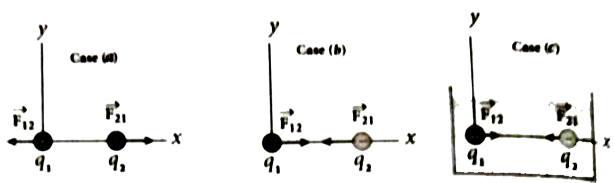 (a) `q_(1)=+2 mu` C and `q_(2)=+3muC` and r=1 m. Both are positive charges . So the force will be repulsive Force EXPERIENCED by the charge `q_(2)` due to `q_(1)` is given by `vecF=(1)/(4piepsilon_(0))(q_(1)q_(2))/(r^(2))r_(12)` Here `r_(12)` is the unit vector from `q_(1)` to `q_(2)` . Since `q_(2)` is located on the right of `q_(1)` we have `hatr_(12)=HATI` , so that `vecF_(n)=(9xx10^(9)xx2xx10^(-6)xx3xx10^(-6))/(1^(2))hati[(1)/(4piepsilon_(0))=9xx10^(9)]` `= 54xx10^(-3)N hati` According to Newton .s third law the force experienced by the charge `q_(1)` due to `q_(2)` is `vecF_(12)=-vecF_(21)` So that `vecF_(12)=-54xx10^(-3)Nhati` The directions of `vecF_(21)` and `vecF_(12)` are shown in the above figure in CASE (a) (b) `q_(1)=+2muC, q_(2)=-3muC` and r=1 m. They are unlike charges . So the force will be attractive force experienced by the charge `q_(2)` due to `q_(1)` is given by `vecF_(21)=(9xx10^(9)XX(2xx10^(-6))xx(-3xx10^(-6))/(1^(2))hatr_(12)=-54xx10^(-3)N hati("Using " hatr_(12)=hati)` The charge `q_(2)` will experience an attractive force towards `q_(1)` which is in the negative x direction . According to Newton.s third law the force experienced by the charge `q_(1)` due to `q_(2)` is `vecF_(12)=-vecF_(21)` So that `vecF_(12)=54xx10^(-3)Nhati)` The directions of `vecF_(21)` and `vecF_(12)` are shown in the figure (case (b)). (c ) If these two charges are kept INSIDE the water then the forrce experienced by `q_(2)` due to `q_(1)vecF_(21)^(w)=(1)/(4piepsilon)(q_(1)q_(2))/(r^(2))hatr_(12)""` Since `epsilon=epsilon_(r)epsilon_(0)` , we have `vecF_(21)^(w) =(1)/(4piepsilon_(r)epsilon_(0))(q_(1)q_(2))/(r^(2)) hatr_(12)=(vecF_(21))/(epsilon_(r))` Therefore `hatF_(21)^(w)=(-54xx10^(-3)N)/(80)hati=-0.675xx10^(-3)Nhati` |
|