

Saved Bookmarks
This section includes InterviewSolutions, each offering curated multiple-choice questions to sharpen your knowledge and support exam preparation. Choose a topic below to get started.
| 5701. |
A Long straight conductor carrying a current of 2 A is in parallel to another conductor of length 5 cm. and carrying a current 3A. They are separated by a distance of 10 cm. Calculate (a) B due to first conductor at second conductor (b) the force on the short conductor. |
|
Answer» Solution :Given, `i_(1)=2A,i_(2)=3A` `r=10cm=10xx10^(-2)m,l_(2)=5cm` a) `B=(mu_(0)i_(1))/(2pir)=2xx10^(-7)xx2/(10xx10^(2))=4XX10^(-6)` TESLA b) `F=(mu_(0)i_(1)i_(2))/(2pir)l_(2)=2xx10^(-7)xx(2xx3)/(10xx10^(-2))xx5xx10^(-2)` `=6xx10^(-7)N` |
|
| 5702. |
Which mirror is to be used to obtain a parallel beam of light from a small lamp? |
|
Answer» PLANE mirror |
|
| 5703. |
The electrostatic potential phi_(r), of a spherical symmetrical system kept at origin, is shown in the adjacent figure, and given as phi_(r)=(q)/(4 pi epsilon_(0)r)(r ge R_(0)) phi_(r)=(q)/(4 piepsilon_(0)R_(0))(r le R_(0)) Which of the following option is incorrect ? |
|
Answer» For spherical region `r le R_(0)` total ELECTROSTATIC energy stored is zero |
|
| 5704. |
If a crown glass prims of refracing angle 10^(@) have refractive indices for red and violet rays 1.514 and 1.523 respectively then find the dispersion caused by a crown glass prism. |
|
Answer» `0.07^(@)` `=delta_(V)-delta_(R)=(mu_(v)-mu_(R))A=(1.523-1.514)xx10^(@)` `=0.009xx10^(@)=0.09^(@)` |
|
| 5705. |
A bob of pendulum of mass 50 g is suspended by string with the roof of an elevator. If the lift is flying with a uniform acceleration of5m s^(-2)the tension in the string is (g = 10m s^(-2)) |
|
Answer» 0.5 N |
|
| 5706. |
A wire of resistance 8R is bent in the form of a circle. What is the effective resistacne between the ends of a diameter AB ? |
Answer» SOLUTION :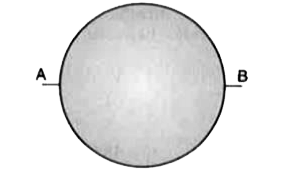
|
|
| 5707. |
The deflection of a galvanometer falls to 1//10^(th)when a resistance of 5Omega is connected in parallel with it. If an additional resistance of 2Omega is connected in parallel to the galvanometer, the deflection is |
|
Answer» `(1)/(6)` th |
|
| 5708. |
The speed of a wave on a string is -150 m/s when the tension is, 120 N.The percentage increase in the tension in order to raise die wave speed by 20% is : |
| Answer» ANSWER :A | |
| 5709. |
A bar magnet of length 0.1 m has a pole strength of 50 Am . Calculate the magnetic field at a distance of 0.2 m from its centre on (i) its axial line and (ii) its equitorial line . |
|
Answer» |
|
| 5710. |
In the above example, the speed of raindrops w.r.t. the moving man, will be- |
|
Answer» `10//sqrt(3)km//h` ` v_(r.g) cos 30^(@) = v_(r.m) " or " v_(r.m) = 20 (sqrt(3))/(2) = 10 sqrt(3)` km/h Hence correct answer is © |
|
| 5711. |
The transfer ratio beta of a transistor is 50. The input resistance of the transistor when used in the common emitter mode is 1kOmega . The peak value of the collector alternating current peak voltage of 0.01 V is : |
|
Answer» `0.25 MUA` Then , `i_c/i_b=beta=50xx10^(-5)A` `:. i_c=500 muA` |
|
| 5712. |
In a photocell bi chromatic light of wave length 2480Å and 6000Å are incident on a cathode whose work function is 4.8eV. If a uniform magnetic field of 3xx10^(-5)T exists parallel to the plate, find the radius of the circular path described by the photoelectron. (mass of electron is 9xx10^(-31)kg) |
|
Answer» Solution :`E_(1)=(12400)/(lamda_(1))=(12400)/(2480)=5eV` `E_(2)=(12400)/(lamda_(2))=(12400)/(6000)=2.06eV` As `E_(2)ltW_(0)` and `E_(1)gtW_(0)`,PHOTO ELECTRIC emission is possible only with `lamda_(1)`. Maximum K.E of emitted photo electrons `K=E_(1)-W_(0)=0.2eV`. Photo electrons experience magnetic force and move along a circular path of radius `r=(mv)/(Bq)=(SQRT(2mK))/(Bq)impliesr=5cm`. |
|
| 5713. |
Show on a graph the variation of resistivity with temperature for a typical semiconductor |
Answer» Solution :VARIATION of RESISTIVITY of a TYPICAL SEMICONDUCTOR with temperature is SHOWN in Fig.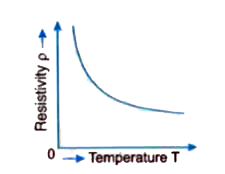
|
|
| 5714. |
Two point coherent sources of power P_(0) nad 4P_(0) emmitting sound of frequency 150 Hz are kept at point A and B respectively. Both sources are in same phase. A detector is kept at point C as showin in figure. The distance of point A and B is r and 4r form detectro respectively. The speed of sound in medium is 300 m/s . Given P_(0)=64pi Watt and r=1m. The intensity observed by detector is |
|
Answer» `25W//m^(2)` |
|
| 5715. |
Mention an expression for the magnetic field produced at the centre on the axis of a current carrying Solenoid and Explain the terms |
|
Answer» Solution :`B= mu_(0)n I` where `mu_(0)`- permeability of FREE space n-number of TURNS per UNIT length of solenoid I- CURRENT through solenoid |
|
| 5716. |
Each of the four particles move along x axis. Their coordinates (in metres) as function of time (in seconds) are given by {:("Particle 1" : x(t)=3.5-2.7t^(3)"Particle 2" : x(t)=3.5+2.7t^(3)),("Particle 3" : x(t)=3.5+2.7t^(2)"Particle 4" : x(t)=3.5-3.4t-2.7t^(2)):} which of these particles is speeding up for t gt 0? |
|
Answer» All four `(dx)/(dt)=0` for particles 1, 2 and 3 and `|(d^(2)X)/(dt^(2))|GT 0` for `t gt 0` and `(dx)/(dt)=-3.4 m//s` for particle 4 and `(d^(2)x)/(dt^(2))` isnegative for `t gt 0` Therefore `t gt 0 , |(dx)/(dt)|` is INCREASING in all. |
|
| 5717. |
Consider a situation (i) that two sound waves, y_(1) = (0.2) sin 504pi (t-x//300) and y_(2) = (0.6) sin 490pi(t-x//300). Consider anothe situation (ii) that two sound waves, y_(1) = (0.2m) sin 504pi (t-x//300) and y_(2) = (0.4 m) sin504pi(t+x//300), are superimposed. Match the Column I with Column II: |
|
Answer» |
|
| 5718. |
The magnitude of point charge due to which the electric field 30 c away has the magnitude2"N C"^(-1) will be |
|
Answer» `2xx10^(-11)C` `Q=(Er^(2))/K=(2xx(0.3)^(2))/(9xx10^(9))` = `(2xx9xx10^(-2)xx10^(-9))/9` `thereforeq=2xx10^(-11)C` |
|
| 5719. |
Questions 124 and 125 are based on paragraph given below: Unpolarised light of intensity 32 W m^(-2) passes through three polarisers such that transmission axis of last polariser is crossed with first, the intensity of emergent light is 3 Wm^(-2). 124. The nagle between transmission axis of first two polarisers is |
|
Answer» `10^(@)` `theta_(2)` = angle between second and third polariser I = initial intensity of unpolarised light and `I_(1), I_(2) and I_(3)` = intensities transmitted through first, second and third polarisers, then `I_(1) = I_(2)`and `I_(2) = I_(1) cos^(2)THETA, I_(3) = i_(2) cos^(2)theta_(2)` Now `theta_(1) + theta_(2) = (pi)/(2)` `theta_(2) = (pi)/(2) - theta_(1)` Then `I_(3)= I_(2)cos^(2)((pi)/(2) - theta_(1)) = I_(2) sin^(2) theta_(1)` `I_(3) = I_(1) cos^(2)theta_(1). sin^(2)theta_(1) = (I)/(2) cos^(2)theta_(1). sin^(2)theta_(1)` ` = I/2((sin 2theta_(1))/(2))^(2) = I/8 sin^(2)2theta_(1)` But ` i = 32 Wm^(-2)` and `I_(3) = 2Wm^(-2)` Then `theta_(1) = 30^(@)`. |
|
| 5720. |
What is angular dispersion ? |
| Answer» Solution :It is DEFINED as the DIFFERENCE between the deviationin the angles of deviation suffered by two colors while passing through a PRISM. | |
| 5721. |
When Z is doubled in an atom, which of the following statements are consistent with Bohr's theory? |
|
Answer» Energy of a state is DOUBLED. Also, radius `alpha 1/Z`, thus when Z is doubled, radius is halved. |
|
| 5722. |
A boat can go across a lake of length I and return in time To at a speed yo. On a rough day there is a uniform current moving with a speed y to help onward journey and impede the return journey. If the time taken to go across and return on the rough day is t/(t_0) then the ratio is : |
|
Answer» `1-(v^(2))/(v_(0)^(2))` or `t=((v_0-v)l+(v_0+v)l)/(v_0^2 -v^2)=(2lv_0)/(v_0^2-v^2)` `=(1)/(1-(V^2/v_0^2))` |
|
| 5723. |
Give use of galvanometer as a voltmeter. |
Answer» Solution :1. Galvanometer can be use to MEASURE voltage ACROSS a given section of the circuit.  2. A voltmeter has to be joined in parallel with the component through which the potential difference is to be measure. 3. It must draw a very small current otherwise the voltage MEASUREMENT will disturb the original setup by an amount which is very large. 4. To ensure this, a large resistance R is connected in series with the galvanometer. 5. This arrangement is schematically depicted in figure. Note that the resistance of the voltmeter is, `R_(G)+R~~R` (R is very large). |
|
| 5724. |
(A ): Induced electric fields are produced by time varying magnetic field.(R): According to faraday’s law ointvecE.vecdl=(dϕ)/(dt) |
|
Answer» Both 'A' and 'R' are TRUE and 'R' is the CORRECT EXPLANATION of 'A'. |
|
| 5725. |
What is an energy band ? How are solids classified in the light of energy bands ? |
|
Answer» Solution :Energy BANDS in Solids. Solids display a large range of electrical resistivity. Whereas some solids are good conductors of electricity, others are insulators (bad condutors) and still others, called semiconductors have properties in between conductors and insulators. The significant feature of atomic structure is that there exist discrete energy levels or shells in an atom called K,L,M......, shells. An electron revolving round the nucleus can occupy one of these shells to have a definite value of energy associated with it. Consider now a single valence electron in an atom like that in lithium or sodium atom. When another identical atom is brought close to it as in a crystal, the electron energy level gets modified because now it is under the electrostatic influence of two atomic cores (consisting of two nuclei plus the inner orbital electrons) instead of only one. Each of the two valence electrons may now occupy a different energy state, one a little higher, `E_(1)` and the other a little lower, `E_(2)` than that of the isolated atom, `E`. The magnitudes `(E_(1)-E)` and `(E-E_(2))` increase as the atoms are brought closer together. Now in a solid there are about `10^(23)` atoms per cubic centimetre and same, therefore, is the number of single valence electrons. Thus there is an enormously large number of energy levels which the electron may occupy with certain upper and lower limits (a certain energy range) depending upon the nature of the element. The enormous number of energy states constitutes an energy band in which there is a continuous distribution of energy within a certain energy range.  Consider lithiun atom. Its electronic configuration is `1s^(2)`, `2s^(1)`. Thus it has two electrons in the `s` state in K shell and they have opposite spins (fig. a). The third (valence) electron is in the state in L shell. In an isolated atom, each of the electrons in the K shell and the electrons in the L shell are associated with a definite amount of energy characteristic of lithium, irrespective of the atom to which these electrons belong. LET us consider a lithium crystal consisting of n atoms, say. These N atoms do no have corresponding electrons in identical energy states. There are evidently N energy states corresponding to each shell and they are so numerous and close to each other that they form energy bands as explained above. Any energy state in an energy band may be occupied by two electrons (and not more than two) with opposite spins. Hence, N energy states are completely filled when they accummodate a maximum number of `2N` electrons. In fig. (a) which shows the energy levels for isolated lithium atom, there are two K shell electrons in the same energy level and one L shell electron in a higher level. Fig (b) which shows the energy bands for a lithium crystals, there are `2N` electrons in K shell filling N energy states in one band and N electrons in L shell in the higher energy band. Since the SECOND band accommodates HALF the maximum number it can do, it is only half filled. In fig. (a), there is also shown an unoccupied level. It refers to the level which the electrons could enter on being excited. Fig (b) shows the corresponding unoccupied energy band. A solid can be classified as conductor , an insulator or a semiconductor on the basis of its energy band structure. Distinction between insulators, semiconductors and conductors Insulators. As show in energy band fig. (c), the valence band in this case is completely filled and conduction band is completely empty and the two bands are separated by a wide energy gap `E_(g)` (known as forbidden band). Since forbidden band is quite wide, an applied electric  field cannot give enough energy to an electron in the valence band to enable it to enter the conduction band. Thus, materials with large energy gap between valence and conduction bands behave as insulators. The example of insulators are wood, GLASS, mica, diamond etc. The resistivity of insulators is greater than `10^(4)` ohm-m . For diamond, the energy gap is `5.4eV`. Semiconductors. In this case, energy gap is smaller than insulator and it is nearly `1eV` (Fig.d). At ordinary temperature say `300K`, some electrons in the valence band may have enough thermal energy to surmount the valence band and enter the conduction band. The gap or valency caused in the valence band due to the shift of an electron to the conduction band is called a hole. Thus in such solids both holes and electrons contributes to the conduction process and such solids are called semiconductors. Their resistivity varies from `10^(-8)` and `10^(-4)Omegam`. Energy gap `E_(g)` for `Si` is `1.12eV` for `Ge`it is `0.75eV`. Conductors have resistivity less than `10^(-8)Omegam`. In such substances the valence bond and conduction band overlap each other so that electrons from the valence band can easily pass into conduction band as shown in fig. (e). Electrons in overlaping region are conduction electrons. |
|
| 5726. |
An electric dipole is placed at an angle of 30^@ to a nonuniform electric field. The dipole will experience |
|
Answer» a translational force only in the DIRECTION of the field |
|
| 5727. |
Two long parallel wires separated by a distance d carry equal current I each . The magnitude of the force per unit length of the wires is |
|
Answer» `(mu_0I^2)/(2pid)` |
|
| 5728. |
Consider a thin lens placed between a source (S) and an observer (O) (see figure) . Let the thicknes of the lens very as w(b) = w_0- (b^2)/(alpha), where b is the verticle distance from the pole. w_0 is constant. Using Fermat.s principle i.e. the time of transit for a ray between the source and observer is an extremum, find the condition that all paraxial rays starting from the source will converage at a point O on the axis. Find the focal length. (ii) A gravitational lens may be assumed to have a varyingwidth of the from w(b) = k_1 "ln" ((k_2)/(b)) b_("min") lt b lt b_("max") = k_1 "ln" ((k_2)/(b_"min")) b lt b_("min") Show that an observe will see an image of a point object as a right about the center of the lens with and angular radius beta=sqrt(((n-1)k_1(u)/(v))/(u+v)) |
|
Answer» Solution :`rArr` (i) Time taken by light ray to travel from S to `P_1` `t_1 = (SP_1)/(C) = ((u^2+b^2)^(1//2))/(c) = ({u^2(1+b^2/u^2)}^(1/2))/(c)` `therefore t_1 = u/c(1+ b^2/u^2)^(1/2)` `rArr` Here `(b^2)/(u^2) lt lt 1` and so expanding according to binomial theorem and then retaining only first two terms, `t_1 ~~ u/c (1+(b^2)/(2u^2))` .......(1) `rArr` Similarly, time taken by light ray to travel from `P_1` to O, `t_2 = (P_1O)/(c) = ((v^2 + b^2)^(1/2))/(c) = ({v^2(1+ b^2/v^2)}^(1/2))/(c)` `therefore t_2 = v/c (1+(b^2)/(v^2))^(1/2)` `rArr` Here `(b^2)/(b^2) lt lt 1` and so expanding according to binomial theorem and then rataining only first two terms , `t_(2) = v/c (1 + (b^2)/(2v^2))`.......(2) `rArr` Now time taken by light ray to travel trough thickness W of a LENS at point `P_1` `t_(2) = v/c (1 + (b^2)/(2v^2))` `rArr` Now time taken by light ray to travel trough thickness W of a lesns at point`P_1` `t_3 = ((n-1)W)/(c)` (As PER statement `W = W_0 - (b^2)/(alpha))`......(3) `rArr` Now, total time taken by light ray to travel from S to `P_1` to O is t then, `t = t_1 + t_2+t_3` `therefore t = u/c (1 + (b^2)/(2b^2))+v/c(1+(b^2)/(2v^2)) +((n-1)W)/(c)` `therefore t = 1/c (u + (b^2)/(2u))+1/c(v+b^2/(2v))+1/c(n-1)W` `therefore t 1/c [ u+v+(b^2)/(2)(1/u +1/v)+(n-1)W]` `rArr` Here, for the sake of simplicity, if we assume `1/u + 1/v = 1/D` then ......(4) `t = 1/c[u +v + (b^2)/(2D) +(n-1)W].....(5)` `therefore t =1 /c[u+v+(b^2)/(2D)+(n-1)(w_0 - (b^2)/(alpha))]....(6)` As per statement `therefore (dt)/(db) = 1/c[0+0+1/2(2b)+(n-1)(0-1/alpha XX 2b)]` `therefore (dt)/(db) = 1/c[b/D - (2b)/(alpha)(n-1)]`........(7) `rArr` Now , according to Farmar.s principle above time t is either maximum or mimum and so its first derivative with respect to variable b should be zero. `(dt)/(db) = 0` `therefore1/c[b/c - (2b)/(alpha)(n-1)] =0` `therefore b/D = (2b)/(alpha) (n-1)` `alpha = 2 (n-1)D`.....(8) `rArr` Above equation gives required condition. Here, value of `alpha` is independent of b. Hence for the case when `b lt lt u`, all paraxial rays, incident on the lens, will be focused at point O. (ii) Now, for given gravitational lens, `W= K_1 "log"((K_2)/(b))` (As per statement ) ....(9) `rArr` From equation (5) and (9). `t = 1/c[u+v = (b)/(2D)+(n-1) K_1 "log"((K_2)/(b))]` `therefore t = 1/c[u+v+(b^2)/(2D) + (n-1)K_1{logK_2-logb}]` `therefore (dt)/(db) = 1/c[0+0 + (1)/(2D) (2b)+(n-1)K_1{0-1/b}]` `therefore (dt)/(db)=1/c[b/d-((n-1)K_1)/(b)]`........10 `rArr` Now, according to Farmat.s principle we have `(dt)/(db) = 0` ` b/D = ((n-1)K_1)/(b)` `therefore b = (n-1)K_1D` `therefore b = sqrt((n-1)K_1D)`.......(11) `rArr`Thus, those light rays which are incident on the lens at above HEIGHT from S, contribute in the formation of image. Such image is having shape of a circular ring . If its angular radius is `beta` then , `Beta = ("arc")/("radius")` `therefore beta = = (b)/(b)` `= sqrt((n-1)K_1D)/(b)` `= sqrt(((n-1)K_1)/(v^2) xx (uv)/(u+v)`) `( therefore" From equation (4) D " = (uv)/(u+v))` `thereforebeta = sqrt(((n-)K_u)/(v(u+v)))"".......(12)` `rArr` Above equation gives required result. |
|
| 5729. |
Explain qualitatively on the basis of domain picture the irreversibility in the magnetisation curve of a ferromagnet. |
| Answer» Solution :If we consider magnetisation CURVE (B-H curve) for a ferromagnetic material then increasing H means alignment and MERGER of domains and consequently rise in value of B. Now even when H is made zero, the domains are not COMPLETELY randomised. Further if H is reversed and slowly increased, certain domains are flipped until the net field B becomes zero. It CLEARLY SHOWS the irreversibility of the magnetisation curve of a ferromagnetic material. | |
| 5730. |
Meaning of the hurdle in the context is : |
|
Answer» A race |
|
| 5731. |
A source of sound is moving along a circular orbit of radius 3m with an angular velocity of 10 red/s. A sound detector located far away from the source is executing linear simple harmonic motion along the line BD with amplitude BC= CD = 6m. The frequencyof oscillation of the deterctor is (5 //pi) rev/sec. The source is at the point A when the detector is at the point B. If the source emits a continuous sound wave of frequency 340 Hz, find the maximum and the minimum frequencies recorded by the detector [velocity of sound =330 m/s]. |
|
Answer» Solution :Time period of circular motion `T =(2pi//omega) =(2pi //10)` is same as that of SHM. i.e., `T =(1//f) =(pi//5`, so both will complete ONE periodic motion in same time. Futher more, source is MOVING on a circle, its speed `v_s =romega =3XX 10 = 30m//s` and as detector is executing `SHM, v_D =omegasqrt(A^2 -y^2) =10sqrt(6^2 -y^2)` i.e., `(v_D)_(MAX)= 60 m//s` when y = 0 i.e.,detector is at C.Now in the case of Doppler effect,`f_(Ap) = f[(v pm v_D)/(v pm v_S)]` So `f_(Ap)` will be maximum when both move towards each other. `f_(max) = f [(v +v_D)/(v -v_S)]` with `v_D =` max i.e., the source is at M and detector at C and moving towards B, so `f_(max) =340 [ (330 +6)/(330 -30)] =442 Hz` Similarly `f_(Ap)` will be minimum when both are moving away from each other, `i.e.,f_(max) =f[(v-v_D)/(v + v_S)]` with `v_D =` max i.e., the source is at N and detector at C but moving towards D,so `f_("min") =340 [(330-60)/(330 + 30)]= 255 Hz` |
|
| 5732. |
A strip of copper and another of germanium are couled from 300 K to 80 K. The resistance of |
|
Answer» COPPER as WELL as GERMANIUM strip increases. |
|
| 5733. |
(M)/(V_(r)) has the dimensions of (M = Magnetic moment , V = Velocity , r = radius) |
|
Answer» POLE strength |
|
| 5734. |
What type impurity is added to obtain n-type semiconductor ? |
| Answer» Solution :To OBTAIN n-type SEMICONDUCTOR, pentavalent ATOMS (such、as arsenic) are added to PURE semiconductor. | |
| 5735. |
(A) : The resistance of voltmeter is very small as compared to the resistance of the galvanometer, from which it is obtained. (R) : The voltmeter is connected in series to the conductor across which potential difference is to be measured. |
|
Answer» Both 'A' and 'R' are true and 'R' is the CORRECT EXPLANATION of 'A'. |
|
| 5736. |
An electron and a proton are freely situation in an electric field. Will the electric force on them be equal. Will there acceleration be equal ? Explain with reason. |
| Answer» Solution :We KNOW that proton and electron are equal in MAGNITUDE. So, the electric forces on them will be equal in magnitude but opposite in DIRECTION. The acceleration of the proton will be [1/1836] times the acceleration of electron because the mass of the proton is 1836 times the mass of electron. | |
| 5737. |
Compare the interference pattern observed in Young’s double slit experiment with single slit diffraction pattern, pointing out three distinguishing features. |
|
Answer» Solution :CASE I: `X_L =R` `Z=SQRT(R^2+X_L^2)=sqrt(R^2+R^(2))=sqrt(2R)` POWER factor,`P_1=cosphicosphi=R/Z=R/sqrt(2R)=1/sqrt(2)` Case II: `Z=sqrt(R^2+(X_L-X_C)^2)=sqrt(R^2)=R` power factor , `P_2=R/Z=R/R=1` `=P_1/P_2=1/sqrt2` |
|
| 5738. |
When a ray of light enter from one medium to another, its velocity is doubled. The critical angle for the ray for two internal reflection will be |
|
Answer» `30^(@)` |
|
| 5739. |
A series LR circuit is connected to a voltage source with V(t) = V_(0) sin omega t. after very large time, current I(t) behaves as (t_(0) gt gt (L)/(R)) |
|
Answer»
HENCE option (B) is CORRECT . |
|
| 5740. |
Why do alpha particles have a high ionising power? |
| Answer» Solution :ALPHA particle have a HIGH ionising powerbecause of their LARGE mass, large VELOCITY and large K.E. | |
| 5741. |
Each quadrant of the circular scale of deflection magnetometer is graduated from ........... . |
|
Answer» |
|
| 5742. |
No. of moles in 32 g methane is …………….. |
|
Answer» 1 |
|
| 5743. |
The intensity of the electric field required to keep a water drop of radius 10^-5 cm justsuspend in air when charged with one electron is approximately. |
|
Answer» (A) 130V/cm mg =Ee `THEREFORE E = (mg)/e = (4/3pi^(2)rhog)/e` `=(4 xx 3.14 xx (10^(-7))^(3) xx 10^(3)xx 9.8)/(3 xx 1.6 xx 10^(-19))` `=25.643 xx 10^(1) = 256` = 260 N/C (UPTO two SIGNIFICANT numbers) |
|
| 5744. |
A telescope consisting of an abjective of the length 100 cm is focussed on a distant in such a way that parallel rays emergs of the eyes. If the object subtends an angle of 2^@ at the objective, the angular width of the image is : |
| Answer» ANSWER :A | |
| 5745. |
When an Ammonia tanker leaks, water is sprayed to reduce its inten-sity. What is the reason for this? |
| Answer» SOLUTION :REFRACTION | |
| 5746. |
Three identical charges of magnitude 2 mu C are placed at the corners of right angled triangle ABC whose base BC and height BA respectively 4 cm and 3 cm. Forces on charge at right angled corner B due to charges at 'A' and 'C' are respectively F1 and F2. The angle between their resultant force and F2 is |
|
Answer» `SIN^(-1) ""((3)/(4))` |
|
| 5747. |
In a parallel -plate capacitor, the plates are kept vertical. The upper half of the space between the plates is filled with a dielectric with dielectric constant K and the lower half with a dielectric with dielectri constant K and the lower half with a dielectric with dielectric constant 2K. The ratio of the charge density on the upper half of the plates to the charge density on the lower half of the plates will be equal to |
|
Answer» 1 |
|
| 5748. |
Charge Q is distributed on two identical capacitors in parallel. Seperation of the plates in each capacitor is d_0 . If the first plate of the capacitor C_1 and the second late of the capacitor C_2 start moving to the left with constant speed v, then match the options of Column I with those in Column II Match the column I and Column II |
|
Answer» <P> |
|
| 5749. |
Photo electrons are emitted with a maximum speed of 7xx10^(5)ms^(-1) from a surface when light of frequency 8xx10^(14)Hz is incident on it, the threshold frequency for this surface is : |
|
Answer» `2.32xx10^(14)Hz` `=8XX10^(14)-(9.1xx10^(-31)xx49xx10^(10))/(2xx6.63xx10^(-34))` `=8xx10^(14)3.63xx10^(14)=4.64xx10^(14)Hz` |
|
| 5750. |
Zener diode when used as a voltage regulator is connected a) in forward bias b) in reverse bias c) in parallel to the load d) in series with the load |
|
Answer» a and B are CORRECT |
|


