

Saved Bookmarks
This section includes InterviewSolutions, each offering curated multiple-choice questions to sharpen your knowledge and support exam preparation. Choose a topic below to get started.
| 6001. |
A convex lens is placed in a medium having refractive index greater than that of the lens. The lens now behaves as: |
|
Answer» A)Converging lens |
|
| 6002. |
Four particles of masses 1 kg, 2 kg, 3 kg and 4 kg are at the vertices of a rectangle of sides a and b with agtb. If a = 1 m, b = 2 m, what is the location of their centre of mass ? |
|
Answer» 0.5 m, 1.4 m `=(1)/(10)(0xx1+2xxa+3xxa+4xx0)=0.5m` `VECY=(Sigmam_(1)x_(1))/(M)` `=(1)/(10)(0xx1+2xx0+3xxb+4xxb)` = 1.4 m 
|
|
| 6003. |
What is domain ? |
| Answer» SOLUTION :In the same direction there is a GROUP of MOLECULES that have a dipole moment called a domain | |
| 6004. |
Pick the wrong answer in the context with rainbow. |
|
Answer» Rainbow is a combined effect of dispersion, REFRACTION and reflection of sunlight. |
|
| 6005. |
Choose the word or phrase that is most closely associated with the given word. You may use a choice more than once or not at all. Eliminate those choices that you think to be incorrect and mark the letter of your choice on the answer sheet (1)Graham's law of diffusion (2)Charles's law (3)Ohm's law (4) Gresham's law F=(MV^2)/R |
|
Answer» |
|
| 6006. |
In the arrangement of capacitors shown in figure, each capacitor is of 9 muF, then the equivalent capacitance between the points a and B is |
|
Answer» `9 MUF` |
|
| 6007. |
The work done for rotating a magnet with magnetic dipole moment m, by 90° from its magnetic meridian is n times the work done to rotate it by 60°, find value of n. |
|
Answer» Solution :Suppose the WORK done for RELATING a magnet with magnetic dipole moment m, by 90° from its magnetic meridian is `W_1`, then `W_1 = mB (1- cos theta_(1) )= mB (1- cos 90^(@) )= mB` and the work done to rotate it by 60° is W `therefore W_(2) = mB ((1)/(2)) = (mB)/(2)` Now according to condition GIVEN `W_(1) = nW_2` `mB= n ((mB)/( 2))` `therefore n=2` |
|
| 6008. |
Answer the following questions : (e ) Some scientists have predicted that a global nuclear war on the earth would be followed by a severe .nuclear winter. with a devastating effect on life on earth. What might be the basis of this prediction ? |
| Answer» Solution :The prediction is based on the ASSUMPTION that the large clouds PRODUCED by global NUCLEAR WAR would perhaps cover substantial part of the sky and solar radiations will not be able to reach the earth. It may cause a severe winter on the earth with a devastating effect on life on earth. | |
| 6009. |
Ina triangle ABC, the sides AB and AC are represented by the vectors 3hati+hatj+hatk and hati+2hatj+hatk respectively. Calculate the angle angleABC. |
|
Answer» `cos^(-1)sqrt((5)/(11))` `vec(AC)=(hati+2hatj+hatk)` `:. Vec(CB) = vec(AB)- vec(AC)`  `= 3hati+hatj+hatj+hatk-hati-2hatj-hatk=2hati-hatj` `because angleABC=theta` is the angle between `vec(AB) ` and `vec(CB)` , `:. bar(AB) . bar(CB) = |bar(AB)|.|bar(CB)|cos theta` `implies ( 3hati+hatj+hatk).(2hati-hatj)` `=(sqrt((3)^(2)+(1)^(2)+(1)^(2)))(sqrt((2)^(2)+(-1)^(2)))costheta` `=6+(-1)+0=sqrt(11) . sqrt(5)cos theta` `:. cos theta= (5)/(sqrt(11).sqrt(5))=(sqrt(5))/(sqrt(11))or theta= cos^(-1)[sqrt((5)/(11))]` |
|
| 6011. |
A springis stretched by applying a load to its free end . The strain produced in the spring is |
|
Answer» VOLUMETRIC |
|
| 6012. |
A current carrying infinitely long wire is kept along the diameter of a circular wire loop, without touching it, the correct statements(s) is(are) |
|
Answer»
`:.` Induced emf in any CASE is zero. 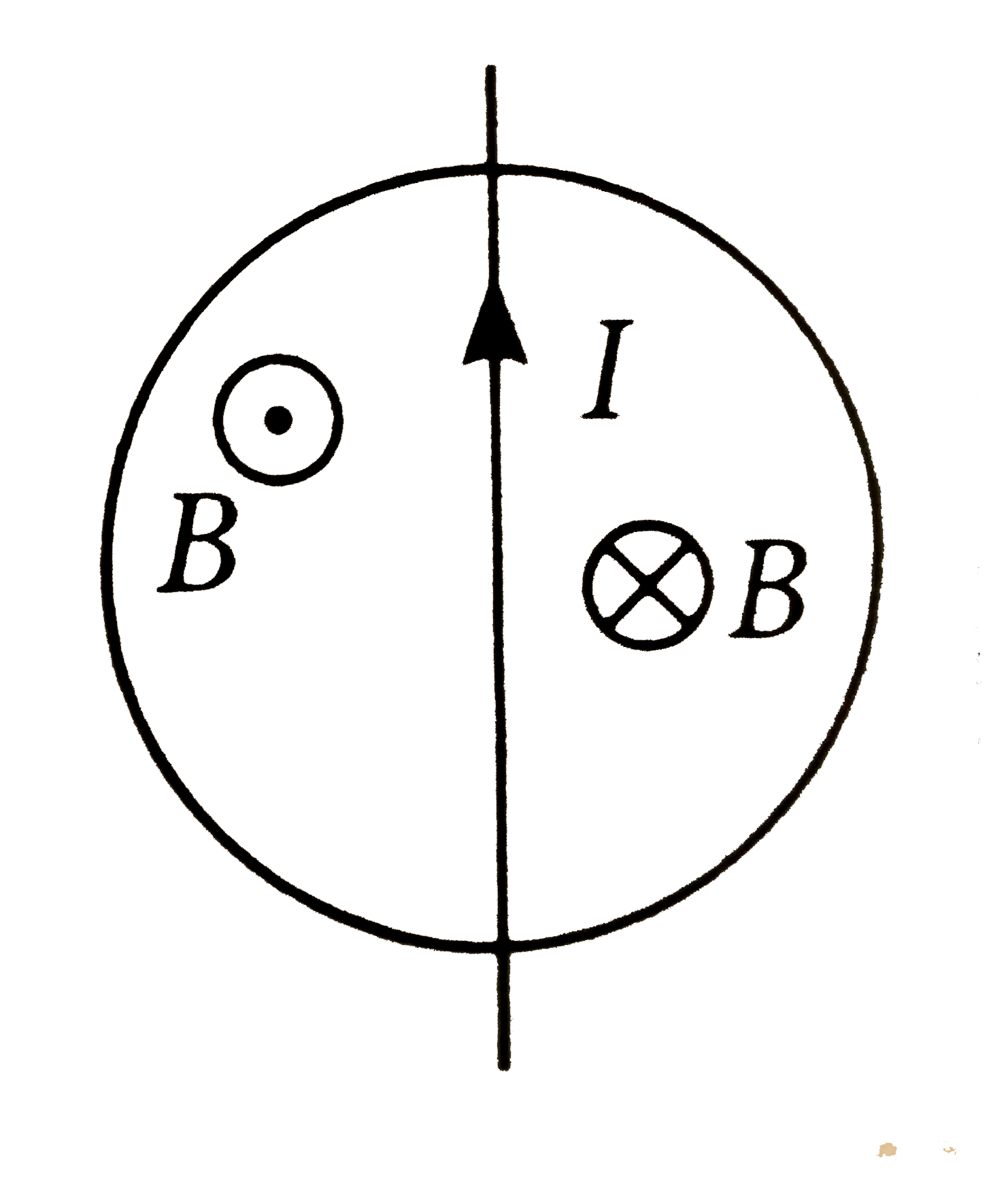
|
|
| 6013. |
The initial velcoity of particle vec(u)=4 hati + 3hatj. It is moving with uniform acceleration vec(a) = 0.4 hati+0.3 hatj . Its velocity after 10 seconds is : |
|
Answer» 3 UNITS `vec(V)=vec(u) +vec(a)t=(4hati+3hatj)+10(0.4hati+0.3hatj)` `=(4hati+3hatj)+(4hati+3hatj)` `vec(V)=(8hati+6hatj)` `|V|=sqrt((8)^(2)+(6)^(@))=10` units |
|
| 6014. |
Fig. Shows two coherent sources S_(1) and S_(2), emitting wavelength lambda.The separation S_(1)S_(2) = 1.51. S_(1) is ahead in phase by (pi)/(2) relative to S_(2).The maxima occurs in a direction given by sin^(-1) of : |
|
Answer» `0` `delta =((2PI)/(lambda) d sin THETA + pi/2)` 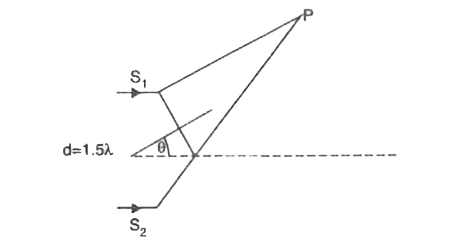 For maximaat P, `delta = n pi, n = 0, pm1, pm2`... `therefore (2pi)/(lambda).d sin theta + pi/2 = n pi` `(2pi)/(lambda)(1.5 lambda sin theta) = (n - 1/2)pi` `therefore 3 sin theta = (n - 1/2)` `thereforesin theta = ((n -1/2))/(3)` For n = 0"`sin theta = -1/6` `n = pm 1"sin theta = 1/6, -1/2` `n = pm2"sin theta = 1/2, -5/6` |
|
| 6015. |
(a) The observed decay products of a free neutron are a proton and an electron. The emitted electrons are found to have a continuous distribution of kinetic energy with a maximum of (m_(n)-m_(p)-m_(e))c^(2). Explain clearly why the presence of a continuous distribution of energy is a pointer to the existence other unobserved products in the decay. (b)If a neutron is unstable with a half life of about 917 seconds, why don't all the neutrons of a nucleus decay eventually into protons? How can a nucleus of Z protons and (A-Z) neutrons ever remains stable, if neutrons themselves are unstable? |
|
Answer» Solution :(a) The decay of a FREE neutron at rest can be represented as `._(0)n^(1)to._(1)H^(1)+._(-1)e^(0)` According to the PRINCIPLE of conservation of linear moementum, the electron and proton will acquire equal and opposite momentum. This means the energy of electron in the above decay is fixed in terms of the mass of the particles involved. Therefore, it is impossible for the electron in the above decay to have a continuous distribution of energy. However, if an additional particle were present, the available energy can be shared by the electron and the additional particle. This simple logic was among the several arguments which led Pauli to postulate the existance of the third particle unobserved till then in the phenomenon of `beta` decay. The correct equation for `beta`-decay is, therefore `._(0)n^(1)to._(1)H^(1)+._(-1)e^(0)+barV_(e)` Where the symbole `barV_(e)` represented the new particle, called the (electron) ANTINEUTRINO. It is neutral particle of NEGLIGIBLE small rest mass and instrinsic spin `=1/2(h//2pi)`. It was extremely difficult to detect a neutrino because of its weak interaction with matter. (b) A free neturon has rest mass greater than that of a proton. Thus `beta`-decay is energetically allowed. But the `beta^(+)` decay of a free proton is not allowed energetically i.e. `._(1)H^(1)to ._(0)n^(1)+._(1)e^(0)+v_(e)` is not allowed in case of a free proton. But in a nucleus, individual neturons and protons are not free. That is why `beta^(+)` decay of proton occurs side by side. The energy needed for this decay comes form the appropriate difference in binding energies of a proton and neutron in the nucleus. In a stable nucleus with Z protons and (A-Z) neutrons, the two reciprocal process (neutron decay and proton decay) are in dynamic equilibrium. |
|
| 6016. |
A current carrying loop in a uniform magnetic field experieces |
|
Answer» FORCE only |
|
| 6017. |
A solid conducting sphere of radius R is placed in a uniform electric field E as showo in figure. Due to electric field non uniform surface charges are induced on the surface of the sphere. Consider a point A on the surface of sphere at a polar angle thetafrom the direction of electric field as shown in figure. Find the surface density of induced charges at point A in terms of electric field and polar angle theta : lt brgt |
|
Answer» |
|
| 6018. |
If vecA=3hati-4hatj and vecB=- hati- 4hatj, calculate the direction of vecA+becB |
|
Answer» `tan^(-1)(4)` with +X- axis in CLOCK wise |
|
| 6019. |
In Young's double-slit experiment, if yellow light is replaced by blue light, the interference fringes become |
|
Answer» Darker |
|
| 6020. |
Find the power and type of the lens by which a person can see clearly the distant objects, if a person cannot see objects beyond 40cm |
|
Answer» `-2.5D` and concave LENS `:.u=oo,v=-40cm` and `1/f=1/v-1/u` `1/f=1/(-40)-1/(-oo)` `1/f=-1/40` POWER `=1/f=-1/40=-2.5D` Negative sign shows that lens used is concave lens. |
|
| 6021. |
Energy of 1photon of gamma rays having wavelength of 2.5xx10^(-13)m will be how many times energy of radiation having wavelength of 5000 Å |
|
Answer» `2XX10^(6)` `therefore (HC)/(lambda_(1))=n(hc)/(lambda_(2))` `therefore n=(lambda_(2))/(lambda_(1))=(5000xx10^(-10))/(2500xx10^(-16))` `therefore n=2xx10^(6)` |
|
| 6022. |
What internal pressure (in the absence of an external presure) can be sustained (a) by a glass tube, (b) by a glass spherical flask, if in both cases the wall thickness is equal to Deltar=1.0mm and the radius of the tube and the flask equals r=25mm? |
|
Answer» Solution :(a) Consider a transverse section of the tube and concentrate on an element which subtends and angle `Deltavarphi` at the centre. The forces acting on a portion of length `Deltal` on the element are (1) tensile forces side ways of magnitude `sigmaDeltarDeltal`. The resultant of these is `2sigmaDeltarDeltalsin(Deltavarphi)/(2)~~sigmaDeltarDeltalDeltavarphi` radially towards the centre. (2) The force due to fluid PRESSURE `=prDeltavarphiDeltal` Since these balance, we get `p_(max)~~sigma_m(Deltar)/(r)` where `sigma_m` is the maximum tensile force. Putting the values we get `p_(max)=19*7` atoms. (b) Consider an element of area `dS=pi(rDeltatheta//2)^2` about z-axis chosen arbitrarily. There are tangential tensile forces all around the ring of the cap. Their resultant is `sigma[2pi(r(DELTATHETA)/(2))Deltar]SI n(Deltatheta)/(2)` Hence in the limit `p_mpi((rDeltatheta)/(2))^2=sigma_mpi((rDeltatheta)/(2))DeltarDeltatheta` or `p_m=(2sigma_mDeltar)/(r)=39*5` atoms.  
|
|
| 6023. |
A spectral line of a certain star is observed to be "red shifted" from a wavelength of 500 nm to a wavelength of 1500 nm. Interpreting this as a Doppler effect, the speed of recessionof this star is |
|
Answer» 0.33c |
|
| 6024. |
(a) Describe a simple experiment (or activity) to show that the polarity of emf induced in a coil is always such that it tends to produce a current which opposes the change of magnetic flux that produces it. (b) The current flowing through an inductor of self-inductance L is continuously increasing. Plot a graph showing the variation of (i) Magnetic flux versus the current (ii) Induced emf versus dI//dt (iii) Magnetic potential energy stored versus the current. |
Answer» Solution :(a) Prepare a coil AB of few turns of enamelled copper wire and join its ends to a sensitive galvanometer G. Take a strong bar magnet NS and quickly bring north pole N of magnet towards the coil AB. We find that galvanometer G gives a momentary deflection towards right and current induced in the coil flows in an anticlockwise direction when seen from the side of magnet. Due to the approaching magnet the magnetic flux of coil AB increases. The induced current opposes this increase in magnetic flux and as a result the end A of the coil acquires N polarity so as to oppose the motion of approaching magnet (FIG. 6.56 (a)].  If now the magnet NS is taken away from the coil AB, we again GET a momentary deflection in galvanometer G but now the induced current is flowing in clockwise direction when seen from the side of magnet NS. Thus, end A of the coil is now behaving as Spole and opposes the away motion of magnet NS. Thus, it is demonstrated that the polarity of emf induced in a coil is always such that it tends to produce a current which opposes the change of magnetic flux that produces it. (b) Here current I flowing through an inductor of self-inductance Lis continuously increasing at a constant rate. Thus, `(dI)dt = a` a constant. (i) As magnetic flux `phi_(B) = LI` and I is continuously increasing, hence `phi_(B)` is also increasing proportionately. Therefore `phi_(B) - I` graph is a straight line inclined to the axes as shown in Fig. 6.57(a). (ii) Induced emf `|epsi|= L (dI)/dt and (dI)/dt` is a constant. Therefore, MAGNITUDE of induced emf is also a constant. So `varepailon - (dI)/dt` graph is a straight line parallel to `(dI)/dt` AXIS as shown in Fig. 6.57(b). (iii) Magnetic potential energy stored in the inductor `U_(B) = 1/2LI^(2)`. Therefore, `U_(B) - I` parabolic curve as shown in Fig. 6.57(c). 
|
|
| 6025. |
In a middle of the rotatation-vibration band of emission specturm of HCI molecule, where the "Zeroth" line is forbidden by the selcetion rules, the interval between neighbouring lines is Delta omega= 0.79.10^(13) s^(-1). Calculate the distance between the nuclei of an HCI molecule. |
|
Answer» Solution :In the ratation vibration band the MAIN TRANSITION is due to change in vibrational quantum number `v rarr v-1`. Together with this roatational quantum number MAY change. The "Zeroeth line" `0 rarr 0` is forbidden in this case so the neighbouring lines arise due to `1 rarr 0 or 0 rarr 1` in the rotaional quantum number. Now `E=E_(v)+(ħ^(2))/(2I)J(J+1)` Thus `ħ OMEGA=ħ omega_(0)+(ħ^(2))/(2I)(+-2)` Hence `Delta omega =(2ħ)/(I)=(2V)/(MUD^(2))` so `d= sqrt((2ħ)/(muDelta omega))` Substitutiongives `d= 0.128nm`. |
|
| 6026. |
A mass m is moving with a constant velocity along a line parallel to the X-axis away from the origin, its angular momentum w.r.t. origin: |
|
Answer» is zero |
|
| 6027. |
The number of neutron in a _92U^235 nucleus is : |
|
Answer» 92 |
|
| 6028. |
Figure shows the path of an electron in a region of uniform magnetic field. The path consists of two straight sections, each between a pair of uniformly charged plates and two half circles. The electric field exists only between the plates |
|
Answer» Plate `I` of pair A is at higher potential than plate-`II` of the same pair |
|
| 6029. |
Which of the following lines represents the wavelength of the spectrum of Balmer series? |
|
Answer» `(1)/(LAMDA)=R((1)/(2^(2))-(1)/(n^(2)))` where n=3,4.... |
|
| 6030. |
Ram is a student of class X in a village school. His uncle gifted him a bicycle with a dynomo fifted in it. He was very excited to get it. While cycling during night, he could light the bulb and see the objects on the road. He, however, did not know how this device works. He asked this questions to his teacher. The teacher considered it an opprtunity to explain the working to the whole class. Answer the following questions : (i) State the principle and working of dynamo. (ii) Write two values each displayed by Ram and his school teacher. |
|
Answer» Solution :`(i)` Principle : It works on the principle of electromagnetic induction. When a coil is rotated in a magnetic field, magnetic flux linked to it CHANGES continuously giving rise to an alternating emf. Working : When the armature coil is rotated in the strong magnetic field, the magnetic flux linked with the coil changes and the current is induced in the coil. CONSIDERING the armature of be in vertical position and as it rotates in anticlock wise DIRECTION, the side ab moves upward and cd downward, so that the direction of induced current is shown in fig. In the circuit, the current flows along `B_(1)`, `R_(1)`, `B_(2)`. The direction of current remains unchanged during the first half turn of armature. During the second half revolution, the wire ab moves downward and cd upward, so the direction of current it reversed and in external circuit it flows along `B_(2)R_(L)B_(1)`. Thus, the direction of induced emf and current changes in the external circuit after each half revoluation. `(ii)` Ram is very CURIOUS to know, quest for knowledge. Teacher is very helping and having good knowledge of science. |
|
| 6031. |
Athin wire of length of 99 cm is fixed at both ends as shown in the figure. The wire is kept under a tansion and is divided into three segments of lenghts l_(1)l_(2) and l_(3) as shown in figure. When the wire is made to vibrate, the segments vibrate respectively in the ratio 1 : 2 : 3, Then, hte lenghts l_(1),l_(2) and l_(3) of the segments respectively are (in cm) |
|
Answer» 27,54,18 `(n_(1):n_(2):n_(3))=1:2:3` 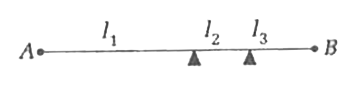 `l_(1):l_(2):l_(3)=(1)/(n_(1)):(1)/(n_(2)):(1)/(3)=6:3:2` `l_(1)=(6xx99)/(11)=54` `l_(2)=(3xx99)/(11)=27` `l_(3) = (2 XX 99)/(11) = 18)` |
|
| 6033. |
Two ships A and B are 10km apart on a line running south to north. Ship A farther north is streaming west at 20 km/h and ship B is streaming north at 20 km/h. Their distance of closest approach and how long do they take to reach it? |
|
Answer» `5sqrt(2)KM 15` MIN |
|
| 6034. |
In a double slit interference pattern, the first maxima for infrared light would be |
|
Answer» at the same PLACE as the first MAXIMA for green light |
|
| 6035. |
If the energy levels of a hypothetical one electron atom are shown in the figure then find the INCORRECT option. n = oo _____________________________ 0 eV n = 5_____________________________ -0.80 eV n = 4_____________________________ -1.45 eV n=3_____________________________ -3.08 eV n=2_____________________________ -5.30 eV n=1_____________________________ -15.6 eV |
|
Answer» The ionization potential of this atom is 15.6 V `THEREFORE` ionization potential `= 15.6 V. lambda_("min")` for series terminating at n = 2 is `(hc)/(5.3)` For excitation to `n = 2, Delta E = 10.3 eV` For transition n = 3 to n = 1. `Delta E = 12.52 eV`. `therefore lambda = (hc)/(12.52)RARR` wave no. `((1)/(lambda))=(12.52)/(hc)` |
|
| 6036. |
A hollow insulated sphere of copper is positively charged. The electric intensity inside the sphere is |
|
Answer» Same as that on its SURFACE |
|
| 6037. |
The unit of magnetic induction in SI system is_____and in CGS system is________. |
| Answer» SOLUTION :`TESLA(T) Weber//m^2` and GAUSS (G) or `"MAXWELL"//cm^2` | |
| 6038. |
(A) : No two electric lines of force can intersect each other (R ): Tangent at any point of electric line of force gives the direction of electric field. |
|
Answer» Both .A. and .R. are true and .R. is the CORRECT EXPLANATION of .A. |
|
| 6039. |
When a thin metal plate is placed in the path of one of the interfering beams of light |
|
Answer» the FRINGES BECOME blurred |
|
| 6040. |
The half life of a radioactive elements is 10 yrs. Calculate the fraction of the sample left after 20 yrs. |
|
Answer» Solution :Data supplied, `T_(1//2) = 10 YRS :. t = 20 yrs = 2 xx 10= 2T_(1//2) :. n = (2T_(1//2))/(T_(1//2))= 2` `N = N_0 E^(-lambda t) = N_0 (e^(-lambda T_(1//2)))^(t//T_(1//2)) = N_0.(1/2)^(t//T_(1//2))` Also `N = N_0//2^n` `:. N_0//2^n = N_0 (1/2)^(1//2)` `:. N/(N_0) = 1/(2^n) = 1/4` `:. N = (N_0)/4` i.e., No. of atoms left after 20 yrs = `(N_0)/(4)`, i.e. `1/4 th`of the original no. of atom. |
|
| 6041. |
A boy is pushing a box on a horizontal floor from a position of rest whilemoving on a straight line. Consider the three phases of motion. Floor is rough with a small friction ceofficient. (i) Initially a constant hard push on the box to get itmoving and attain a maximum velocity. (ii) Mild push to keep the box moving with constant velocity. (iii) To pull back the box to bring it to stop wilth same retardation. Which of the following graphs is CORRECT? |
|
Answer»
(D) Friction is CONSTANT |
|
| 6042. |
Two buses start off with a gap of 2 minutes move with the same acceleration. How long after the departure of 1/9the second is the distance covered by it equal to of the distance covered by the first? |
|
Answer» 4 minutes |
|
| 6043. |
A particle of mass m falls from a height h on a mass m and gets stuck to it. Then, |
|
Answer» <P>acceleration of the pulley - mass system after impact is given by g/5. `P_(i)=m sqrt(2gh)` `P_(i)=m sqrt(2gh)` `P_(i)-l=P_(f)` `m sqrt(2gh)-l=2mv` `l = 3MV` `v=(1)/(5)sqrt(2gh)` `v^(2)=2gh.` `h.=((1)/(5)sqrt(2gh))^(2)//(2G)/(5)=(h)/(5)` `therefore`(A) & (B) |
|
| 6044. |
Which of the following is matter ? |
|
Answer» Love |
|
| 6045. |
A tank, which is open at the top, contains a liquid up to a height H. A small hole is made in the side of the tank at a distance y below the liquid surface. The liquid emerging from the hole lands at a distance x from the tank : |
|
Answer» `2sqrt(h(H-h))` Time TAKEN by any particle of the liquid to travel from the hole to the GROUND, `t=sqrt((2(H-h))/(g))` Therefore, `L=vt=(sqrt(2gh))(sqrt((2(H-h))/(g)))=2sqrt(h(H-h))` |
|
| 6046. |
Two equal charges q are kept fixed at a and +a along the x-axis. A particle of mass m and charge q/2 is brought to the origin and given a small displacement along the x-axis then |
|
Answer» the particle executes oscillartory motion 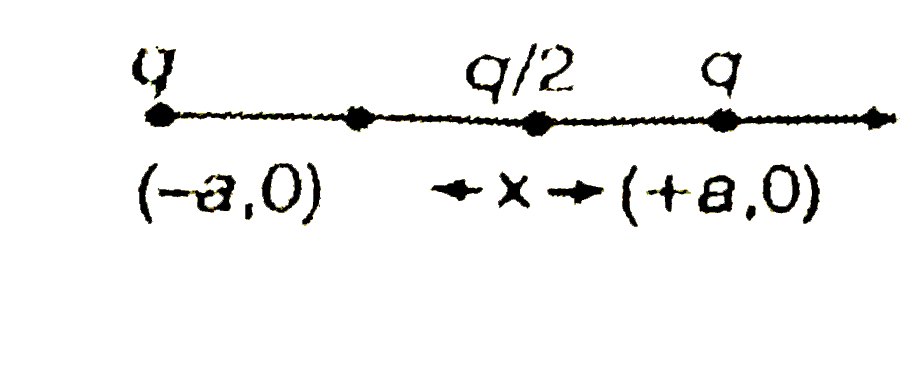 `F=1/(4 epsilon_(0))(q_(1)q_(2))/(r^(2))` `F=1/(4pi epsilon_(0))(qxxq/2)/((a+x)^(2))-1/(4piepsilon_(0)).(qxxq/2)/((a-x)^(2))` `=1/(4piepsilon_(0))(q^(2))/2[1/((a+x)^(2))-1/((a-x)^(2))]` `=1/(4piepsilon_(0).(q^(2))/2 [-(4AX)/((a^(2)-x^(2))^(2))]` When `x lt lt a`, then `F=-(2q^(2))/(4piepsilon_(0)a^(3))ximpliesF PROP -x` Hence SHM isaklong `x`-axis. |
|
| 6047. |
The e.m.f. of 5 volt is produced by a self-inductance. When the current changes at a steady rate from 3A to 2A in one mu second. Value of self-inductance is: |
|
Answer» Zero |
|
| 6048. |
The instrument for accurate measurement of emf of a cell is |
|
Answer» a voltmeter |
|
| 6049. |
A thin nonconducting rod with a uniform distribution of positive charge Q is bent into a complete circle of radius R (Fig.). The central perpendicular axis through the ring is a z aaxis, with the origin at the center of the ring. What is the magnitude of the electric field due to the rod at (a) z = 0 and (b) z = oo ? (c ) In terms of R, at what positive and Q = 5.00 mu C, what is the maximum magnitude ? |
| Answer» SOLUTION :(a) 0, (B) 0, (c ) 0.707 R, (d) `4.33 XX 10^(7)N//C` | |
| 6050. |
When was their common link of friendship snapped? |
|
Answer» when he WENT to college |
|


