

Saved Bookmarks
This section includes InterviewSolutions, each offering curated multiple-choice questions to sharpen your knowledge and support exam preparation. Choose a topic below to get started.
| 38651. |
A flat , rectangular coil, carrying current, is placed beside a long straight conductor carrying current. The two are coplanar. The net force and net torque experienced by the coil are F and tau . |
|
Answer» `F=0,tau=0` |
|
| 38652. |
When a bar magnet is brought closer to a coil, emf generated in the coil does not depend on ______ |
|
Answer» no. of TURNS Resistance is always offered to the flow of current, after it is produced. Thus, emf generated in the coil does not depend on its resistance. |
|
| 38653. |
The coercivity of a small magnet where the ferromagnet gets demagnetized is 3 xx 10^(3) "Am"^(-1) The current required to be passed in a solenoid of length 10 cm and number of turns 100, so that the magnet gets demagnetized when inside the solenoid is: |
|
Answer» Solution :`H=nl` `therefore H= (NI)/(l)""[because n= (N)/( l)]` `therefore I= (HL)/( N)` `=3 xx 10^(3)xx (0.1) /( 100)` `therefore I=3A` |
|
| 38654. |
What is the power dissipation in an a.c. circuit in which voltage and current are given by V = 300 sin(omega t + pi//2) and I = 5 sin omega t ? |
| Answer» Solution :As phase difference between VOLTAGE and current is `pi//2`, POWER DISSIPATION is zero. | |
| 38655. |
What is an electric dipole? Derive expression of electric field intensity at a point on its axial line. |
Answer» Solution :Electric dipole is a set of two equal and opposite charges separation by certain finite distance. Consider an electric dipole consisting of CHARGE -q and +q, separated by a distance 2a and placed in free space. Let P be a POINT on the axial line joining the two charges of the dipole at a distance r from the centre O of the dipole. 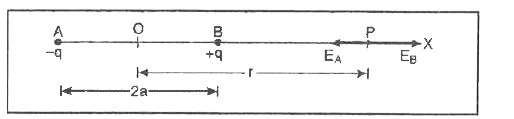 The electric field `vecE` at point P due to dipole will be the resultant of the electric field `vecE_(A)` (due to charge -q at point A) and `vecE_(B)` (due to charge +q at point B) i.E., `vecE=vecE_(A)+vecE_(B)` Now, `|vecE_(A)|=(1)/(4piepsi_(0))*(q)/(AP^(2))=(1)/(4piepsi_(0))*(q)/((r+a)^(2))`(along PA) and `|vecE_(B)|=(1)/(4piepsi_(0))*(q)/(BP^(2))=(1)/(4piepsi_(0))*(q)/((r-a)^(2))`(along PX) Obviously, `|vecE_(B)|` is greater than `|vecE_(A)|`. Since `vecE_(A) and vecE_(B)` act along the same line but in opposite DIRECTION, the magnitude of the electric field at point P is given by `|vecE|=|vecE_(B)|-|vecE_(A)|` or `E=(1)/(4piepsi_(0))*(q)/((r-a)^(2))-(1)/(4piepsi_(0))*(q)/((r+a)^(2))`(along PX) `=(1)/(4piepsi_(0))*q[((r+a)^(2)-(r-a)^(2))/((r^(2)-a^(2))^(2))]` or `E=(1)/(4piepsi_(0))*(q(4ra))/((r^(2)-a^(2))^(2))` Now, q(2a)=p, the magnitude of the electric dipole moment of the dipole. therefore, `E=(1)/(4piepsi_(0))*(2pr)/((r^(2)-a^(2))^(2))`(along PX) It may be noted that direction of electric field at a point on axial line of the dipole is from charge -q to +q i.e. same as that of electric dipole moment of the dipole. when the point P is very far away from the electric dipole, then `a^(2) lt lt r^(2)`. therefore. `E=(1)/(4piepsi_(0))*(2pr)/(r^(4))` or `E=(1)/(2piepsi_(0))*(p)/(r^(3))` |
|
| 38656. |
Sharavathy hydroelectric project is expected to produce about 1000 mW of power. This is equivalent to the conversion of a certain mass of matter into energy completely say in a reactor. This amout is |
|
Answer» 4 kg PER second |
|
| 38657. |
Four vessels A,B,C and D contain respectively 20g atom (T_(1//2)=5h) 2g atom (T_(1//2)= 1h)5g atom(T_(1//2)=2h) and 10g atom (T_(1//2)=3h) of different radio nuclides in the beginning , the maximum activity would be exhibited by the vessel is |
| Answer» SOLUTION :`R = lamdaN=(0.693)/(T_(1//2)) N` HENCE , GREATER `(N/(T_(1//2)))` value , grater will be the rate . So A has MAXIMUM activity. | |
| 38658. |
Check that the ratio ke^(2)//Gm_(e) m_(p) is dimenionless, Look up a tableof Physical Constants and determinethe valueof thisi ratio. What does the ratio signigy ? |
|
Answer» <P> Solution :`(ke^(2))/(G m_(e) m_(p)) = ([N m^(2) C^(-2)] [C^(2)])/([N m^(2) KG^(-2)] [kg] [kg]) = 1 = (M^(@) L^(@)T^(@))``:.` The GIVEN ratio dimenesionless.using`k = 9xx10^(9) N m^(2) C^(-2), e = 1.6xx10^(-19)C, G = 6.67xx10^(-11) N m^(2) kg^(-2)`, `m_(e) = 9.1xx10^(-31) kg, and m_(p) = 1.66xx10^(-27) kg`, we get ,`(ke^(2))/(G m_(e) m_(p)) = 2.29xx10^(39)` This is the ratio of electrostaticforce to gravitationalforce between anelectronand a proton. |
|
| 38659. |
The number of electrons to be put on a spherical conductor of radius 0.1 m to produce on electric field of 0.036 N/C justabove its surface is |
|
Answer» `2.7 XX 10^(5)` |
|
| 38660. |
Two masses m_(1) and m_(2)are suspended w together by a light spring of spring constant k as shown in figure. When the system is in equilibrium, the mass m_(1)is removed without disturbing the system. As a result of this removal, mass m_(2) performs simple harmonic motion. For this situation mark the correct statement(s). |
|
Answer» The amplitude of osciallation is `(m_(1)g)/k` `y_(0) =((m_(1) + m_(2))g)/k`  In equilibrium position, for resulting oscillation after removal of `m_(1)`, elongation in spring is: `y_(1) =(m_(2)g)/k` So, amplitude of oscillations is, `y_(0)-y_(1) =(m_(1)g)/k` TIME period of simple harmonic motion is, `T =2pi sqrt(m_(2)/k) rArr OMEGA = sqrt(k/m_(2))` |
|
| 38661. |
A magnifying glass is used, as the object to be viewed can be brought closer to the eye than the normal near point. This results in |
|
Answer» a larger angle to be subtended by the object at the EYE and HENCE viewed in greater detail.  As shown in the figure, while using convex LENS as a magnifying glass, object is placed very CLOSE to principal focus but inside it. By doing so, angle made by object at the eye is obtained large and so we can have more ANGULAR magnification. Thus, option (A) is correct. According to above ray diagram, we obtain image A.B. which is virtual, errect and magnified. Thus option (B) is also correct. |
|
| 38662. |
When kinetic energy of a body is increased by 800%, then percentage change in its linear momentum is |
|
Answer» 1 |
|
| 38663. |
A current I flows along the length of an infinitely long, straight, thin walled pipe. Then |
|
Answer» the MAGNETIC field at all points inside the PIPE is the same , but not zero |
|
| 38664. |
Drops of water fall from the overflow pipe of a overhead water reservoir 9 m high at a regular intervals of time, the first drop reaching the ground at the same instanta which fourth drop just begins to fall. At what distances are the second and third drops from the ground? |
|
Answer» 6 m, 2 m |
|
| 38665. |
At0k temperature, a P- type semi conductor : |
|
Answer» Does not have any CHARGE carriers |
|
| 38666. |
The length the breath of a rectangular object are 25 cm and 10 cm respectively and were measured to an accuracy of 0.1cm . The percentage error in area is |
|
Answer» `2.8%` |
|
| 38667. |
A marble block of mass 2 kg lying on ice when given a velocity of 6 ms^(-1) is stopped by friction in 10 s. Then the coefficient of friction is (g = 10 ms^(-2)) |
|
Answer» 0.02 |
|
| 38668. |
If the KE of free electron doubles, its deBroglie wavelength changes by a factor |
| Answer» ANSWER :D | |
| 38669. |
When the rectangular metal tank is filled to the top with an unkown liquid, as observer with eyes level with the top of the tank can just see the corner E, a ray that refracts towards the observer at the top surface of the liquid is shown. The refractive index of the liquid will be |
|
Answer» `1.2` |
|
| 38670. |
Two charged particles traverse identical helical paths in a completely opposite sense in a uniform magnetic field vecB=B_(0)hatk. |
|
Answer» They have equal z-components of MOMENTA. `P=(2pimvcostheta)/(Bq)` `thereforeq/m=(2pivcostheta)/(PB)""...(1)` (`theta` is angle of VELOCITY of charge particle with x-axis) If motion is not helical `theta=0`. As path of both the particles is identical and helical but of opposite direction in same magnetic field so by law of conservation of momenta, `(e/m)_(1)+(e/m)_(2)=0` |
|
| 38671. |
The value of barrier potential of P-N juntion in Ge is- |
|
Answer» 0.03 VOLT in the DIRECTION of FORWARD current |
|
| 38672. |
In an energy recycling process, X g of steam at 100^(@)C becomes water at 100^(@)C which converts Y g of ice at 0^(@)C into water at 100^(@)C. The ratio of X/Y will be (specific heat of water ="4200" J kg"^(-1)K, specific latent heat of fusion =3.36xx10^(5)"J kg"^(-2), specific latent heat of vaporization =22.68xx10^(6)" J kg"^(-1)) |
| Answer» Answer :A | |
| 38673. |
Gravitational force between H-atom and a particle of mass .m. is given by Newton.s law as F = (GMm)/r^2 , where r is in km. In this equation value of .M. is |
|
Answer» `M = m_("proton") + M_("electron")` |
|
| 38674. |
When in hydrogen like ion, electron jumps fromn = 3 to n = 1, the emitted photon has frequency 2.7 xx 10^(15) Hz. When electron jumps from n=4 to n=1, the frequency is |
|
Answer» `1.6xx10^15` Hz `UPSILON = RC[1/1^2-1/3^2]` or `2.7xx10^15=Rcxx8/9` ….(i) When the electron jumps from n=4 to n=1 `upsilon.=Rc[1/1^2-1/4^2]=Rcxx15/16` …(ii) From eqn (i) and (ii) `(upsilon.)/(2.7xx10^15)=15/16xx9/8` `upsilon.=15/16xx9/8xx2.7xx10^15=2.8xx10^15` Hz |
|
| 38675. |
What happened when the grandmother died? |
|
Answer» All the sparrows were SCATTERED in her room and verandah |
|
| 38676. |
In reptiles, birds, mammals, gymnosperms and angiosperms the fertilisation is |
|
Answer» External |
|
| 38677. |
The relative permittivity and relative permeability of a medium are 3 and (4)/(3) respectively, the critical angle for this medium is |
|
Answer» `15^(@)` `n = (c )/(v)` `(1)/(sqrt((mu_(r )in_(r )))=n` `sqrt((4)/(3)xx3)=n` 2 = n `2=(1)/(sin C)` `THEREFORE sin C = (1)/(2)` `therefore C = 30^(@)` |
|
| 38678. |
When air is replaced by a dielectric medium of constant K the maximum force of attraction between two charges separated by a distance : |
|
Answer» DECREASES K TIMES |
|
| 38679. |
A 50 Omegaresistance is connected to a battery of 5 V. A galvanometer of resistance 100 Omega is to be used as an ammeter to measure current through the resistance, for this a resistancer r_(s)is connected to the galvanometer. Which of the following connections should be employed if the measured current is within 1% of the current without the ammeter in the circuit? |
|
Answer» `r_(s) = 0.5 Omega` in parallel with the galvanometer `I = V/R = 5/50 = 0.1 A`. When ammeter is added in the circuit then current of the circuit decreases and it is given that current should not CHANGE by more than 1%. Hence current in the circuit when ammeter is included can be written as `I. = 0.099 A` Small variation in current is possible only when effective RESISTANCE of the galvanometer is minimum, So we should CONNECT resistance S in parallel to the galvanometer. Effective resistance of the circuit can be written as follows: `R_("eff") = 50 + (100S)/(100 + S) = V/(I.)` `rArr(100S)/(100 + S) = 5/(0.099) - 50 = 50.50 - 50` `rArr(100S)/(100 + S) = 5/(0.099) - 50 = 50.50 - 50 = 0.5` `rArr 100S - 0.5 (100 + S)` ` rArr100S = 50 + 0.5S` `rArrS = 0.5 Omega` Hence `0.5 Omega` resistance should be connected in parallel to the coil of galvanometer. Hence OPTION (a) is correct. |
|
| 38680. |
Three types of radioactive decay occur in nature. Briefly describe them. |
|
Answer» SOLUTION :`beta-` decay is the process of emission of a helium nucleus by a heavier nucleus. Here the atomic number decreases by 2 and mass number less by 4units. In `beta-`decay a neutron converts in to a proton with the ejection of an electron and ANTINEUTRINO. Here atomic number INCREASES by 1 unit while mass number remains the same. `gamma-` decay is the emission of `gamma`-RAY photons by an excited nucleus. |
|
| 38681. |
The following graphs represent the current versus voltage and voltage versus current for the six conductors A,B,C,D,E and F. Which conductor has least resistance and which has maximum resistance? |
Answer» Solution : According to ohm.s law, `V=IR` RESISTANCE of CONDUCTOR, `R=(V)/(I)` Graph-I: Conductor A, `I=4A and V=2V` `R=(V)/(I)=(2)/(4)=0.5Omega` Conductor B, `I=3A and V=4V` `R=(V)/(I)=(4)/(3)=1.33Omega` Conductor C, `I=2A and V=5V` `R=(V)/(I)=(5)/(2)=2.5Omega` Graph-II: Conductor D, `I=2A and V=4V` `R=(V)/(I)=(4)/(2)=2Omega d` Conductor E, `I=4A and V=3V` `R=(V)/(I)=(3)/(4)=1.75Omega` Conductor F, `I=5A and V=2V` `R=(V)/(I)=(2)/(5)=0.4Omega` Conductor F has least resistance, `R_(F)=0.4Omega`, Conductor C has maximum resistance, `R_(C )=2.5Omega` |
|
| 38682. |
Wavelegnth of visible light extends from ________to_________. |
| Answer» SOLUTION :400NM, 700 NM | |
| 38683. |
The electric field in a region of space varies as E = (3v//m)xhat(i)+(4v//m)yhat(j)+(5v//m)zhat(k) Consider a differential cube whose one vertex is (x, y, z) and the three sides are dx, dy, dz, sides being parallel to the three coordinate axes. |
|
Answer» The flux of electric field through the differential cube is zero |
|
| 38684. |
A petrol engine consumes 20 kg of petrol per hour. The calorific value of the fuel is1 xx 10^(7) cal/kg. The power of the engine is 84 kilowatt. Calculate the efficiency of the engine. |
|
Answer» `36 %` `m_(f) = 20/(60 xx 60) kg//s` Heat released DUE to the combustion of fuel, `Q = m_(f) xx ` calorific value of the fuel ` = 20/(60 xx 60) xx 1 xx 10^(7)` ` = 10^(6)/18 " cal/s" = 10^(6)/18 xx 4.2 " joule /s " = 700/3 ` kW Power produced by the engine , `W = 84 kW` ` :. ` EFFECIENCY of the engine ` = W/Q xx 100 = 84/(700//3) xx 100 = 36% ` |
|
| 38685. |
A person sitting firmly over a rotating stool has his arms stretched. If he folds his arms, his angular momentum about the axis of the rotation : |
|
Answer» Increases i.e. ANGULAR momentum remains CONST. |
|
| 38686. |
The angular momentum of an electron in 4^(th) orbit is 2xx10^(-34) Js, then its angular momentum in 5^(th) orbit is ……. |
|
Answer» `5xx10^(-34)Js` `:.lpropn` `:.(l_(4))/(l_(5))=(4)/(5)` `:.l_(5)=(5)/(4)l_(4)` `=(5)/(4)xx2xx10^(-34)=2.5xx10^(-34)Js` |
|
| 38687. |
If minimum voltage in an AM wave was found to be 2V and maximum voltage 10V. Find the percentage of modulation. |
|
Answer» SOLUTION :Modulaion INDEX `m_a=(E_max-E_min)/(E_max+E_min)=(10-2)/(10+2)=2/3` `66.67%` |
|
| 38688. |
The trajectories, traced by different alpha-particles in Geiger-Marsden experiment were observed as shown in the Fig. 12.07. (a)What names are given to the symbols 'b' and 'q' shown here? (b) What can we say about the values of 'V' for (i) theta ~= 0^(@) (ii) theta = piradian ? |
|
Answer» Solution :(a) The SYMBOL .b. is known as the "impact PARAMETER" and symbol .e. is named as "angle of scattering" (b)(i) If `theta = 0^(@)`then .b. has a large VALUE. (ii) If `theta = PI` RADIAN then .b. has almost a zero value. |
|
| 38690. |
A semiconductor has an electron concen- tration of 0.45xx10^(12)m^(-3) and a hole concentration of 5.0xx10^(20)m^(-3). Calculate its conductivity. Given electron mobility =0.135M^(2)v^(-1)S^(1), hole mobility = 0.048m^(2)v^(-1)S^(-1). |
|
Answer» Solution :The conductivity of a semiconductor is the sum of the conductivities due to electrons and holes and is given by `SIGMA= sigma_(e)+ sigma_(h)=n_(e)emu_(e)+n_(h)emu_(h)=e(n_(e)mu_(e)+n_(h)mu_(h))` As per given DATE, `n_(e)` is negligible as compared to `n_(h),` so that we can write ` sigma=en_(h)mu_(h)` `=(1.6xx10^(-19)C)(5.0xx10^(20)m^(-3))(0.048m^(2)V^(-1)s^(-1))` `=3.84Omega^(-1)m^(-1)=3.84Sm^(-1)` where S (siemen) stands for `Omega^(-1)` |
|
| 38691. |
The (W/Q) of a Carnot - engine is 1//6. Now thw temperature of sink is reduced by 62^(@)C, then this ratio becomes twice, therefore the initial temperature of the sink and source are respectively : |
|
Answer» `33^(@)C,67^(@)C` |
|
| 38692. |
In a compound microscope, the focal lengths of two lenses are 1.5 cm and 6.25 cm an object is placed at 2 cm from objective and the final image is formed at 25 cm from the eye lens. The distance between the two lenses is (in cm) |
|
Answer» 6 |
|
| 38693. |
The intensity at a point where the path difference is (lambda)/(6)(lambda being the wavelength of the light used) is I. If I_(0) denotes the maximum intensity, (I)/(I_(0)) is equal to : |
|
Answer» `(sqrt3)/(2)` `I_(0) =a^(2) + a^(2) + 2a.a cos theta = 4a^(2)` ....(1) When ` x = (lambda)/(6)` `phi = (2pi)/(lambda).x = (2pi)/(lambda)(lambda)/(6) = (pi)/(3) = 60^(@)` Then `I = a^(2) + a^(2) + 2a.acos 60^(@) = 3A^(2)` `THEREFORE (I)/(I_(0)) = (3a^(2))/(4a^(2)) = 3/4` |
|
| 38694. |
In a transistor amplifier, the two a.c. current gains alpha and beta are define as alpha=(DeltaI_C)/(DeltaI_E and beta=(DeltaI_C)/(DeltaI_B.The relation between alpha and beta is : |
|
Answer» `BETA=(1+ALPHA)/alpha` |
|
| 38695. |
Evaluate the proprgation velcocity of acoustic vibrations in aluminum whose Debye temperature id Theta= 396K. |
|
Answer» Solution :We apply the same formula but assume `v_(||) ~~ v_(_|_)`. Then `THETA=( ħ)/(k)v(6pi^(2)n_(0))^(1//3)` or `v=kTheta//[ ħ(6pi^(2)n_(0))^(1//3)]` For Al `n_(0)=(rhoN_(A))/(M)= 6.023xx10^(22) per c.c` Thus `v=3.39km//s.` The TABULATED values are `v_(||)= 6.3km//s` and `v_(_|_)= 3.1km//s` |
|
| 38696. |
If length and breadth of a plate are (40pm0.2) and (30pm0.1) cm, the absolute emror in measurement of area is |
|
Answer» `10 cm^(2)` |
|
| 38697. |
A microscope has objective of aperture 8 mm and focal length 2.5 cm. Estimate its resolving power. Given lamda=5500Å |
Answer» Solution :We assume that the object is placed a little beyond its focal distance, say 2.5 cm. `tan alpha = (4mm)/(2.5cm) = (0.4)/(2.5) = 0.16` Since `SIN alpha` small , `sin alpha ~~ tan alpha = 0.16` Thus ,` Delta x = (1.22 lamda)/(2mu sin alpha) = (1.22 (5500 xx 10^(-10) m))/(2 xx 1 xx 0.16) = 2 xx 10^(-6) cm` |
|
| 38698. |
A person can see clearly objects between 15 and 100 cm from his eye. Find the range of his vision is he wears close fitting spectacles having a power of 0.8 diopter : |
|
Answer» <P>5 to 500 CM =-125 cm For NEAR point, `v_(1) = - 15 cm, u_(1) = ?` `therefore (1)/(f)=(1)/(V)-(1)/(u)rArr(-1)/(125)=(1)/(-15)-(1)/(u_(1))` `therefore u_(1) = - 17 cm` For distant point, `v_(2) = - 100 cm, u_(2) = ?` `(-1)/(125) = (1)/(-100)-(1)/(u_(2)),u_(2) = - 500 cm` Range is 17 to 500 cm |
|
| 38699. |
In the above problem, the energy density associated with the electric field will be |
|
Answer» `(1)/(2)CV^(2)` |
|
| 38700. |
Which law helps two detect the direction of the induced current? |
| Answer» SOLUTION :Lenz.s LAW. | |