

Saved Bookmarks
This section includes InterviewSolutions, each offering curated multiple-choice questions to sharpen your knowledge and support exam preparation. Choose a topic below to get started.
| 41351. |
If the radius of the second orbit in hydrogen atom is R then radius of the third orbit is ........ |
|
Answer» 3R `":.r_(1)propn_(1)^(2)impliesr_(2)propn_(2)^(2)` `:.(r_(2))/(r_(1))=(n_(2)^(2))/(n_(1)^(2))impliesr_(2)=(n_(2)^(2))/(n_(1)^(2)).r_(1)` `:.r_(2)=(9)/(4)xxR""("":n_(1)=2 and n_(2)=3)` `:.r_(2)=2.25R` |
|
| 41352. |
Consider the D–T reaction (deuterium–tritium fusion) ""_(1)^(2)H + ""_(1)^(3)H to ""_(2)^(4)He + n (a) Calculate the energy released in MeV in this reaction from the data: m (""_(1)^(2)H) = 2.014102u m(""_1^(3)H) = 3.016049 u (b) Consider the radius of both deuterium and tritium to be pproximately 2.0 fm. What is the kinetic energy needed to overcome the coulomb repulsion between the two nuclei? To what temperature must the gas be heated to initiate the reaction? (Hint: Kinetic energy required for one fusion event =average thermal kinetic energy available with the interacting particles = 2(3kT/2), k = Boltzman’s constant, T = absolute temperature.) |
|
Answer» Solution :`A=[m(""_(1)^(2)H)+m(""_(1)^(3)H)-m(""_(2)^(4)He)-m(n)]c^(2)=17.59MeV` (B) K.E. required to overcome Coulomb REPULSION = 480.0 keV `480.0 KeV=7.68xx10^(-14)J=3kT` therefore `T=(7.68xx10^(-14))/(3xx1.381xx10^(-23))""("as "k=1.381xx10^(-23)JK^(-1))` `=1.85xx10^(9)K"(required TEMPERATURE)"` |
|
| 41353. |
What value of torque on a current loop in a uniform magnetic field ? |
| Answer» SOLUTION :`tau=niABcostheta` | |
| 41354. |
A two meter wire is moving with a velocity of 1 m/s perpendicular to a magnetic field of 0.5Wb/m^2. The induced e.m.f. in it will be: |
|
Answer» 0.5 volt |
|
| 41355. |
The optical fibres have in an inner core of refractive index, and a cladding of refractive index no such that |
|
Answer» `n_(1) = n_(2)` |
|
| 41356. |
Two identical positive charges are fixed on the y-axis, at equal distance from the origin O. A particle with a negative charges starts on the x-axis at a large distance from O, moves along the +ve x-axis, passes through O and moves for away from O. its acceleration a is taken as positive along its direction of motion The particle.s acceleration a is plotted its x-coordinate. Which of the following best represents the plot? |
|
Answer»
|
|
| 41357. |
Is a bar magnet an equivalent current carrying solenoid ? |
| Answer» Solution :Yes . Each turn of the solenoid BEHAVES as a small MAGNETIC dipole. THEREFORE , a solenoid can be considered as the arrangement of small magnetic dipoles placed in line with each other . Thus , the magnetic field produced by a current CARRYING solenoid is identical to bar magnet. | |
| 41358. |
A progressive wave is represented by y = 0.5 sin (314t +12.56x) in S.I. units. The wavelength is |
|
Answer» 0.5 m |
|
| 41359. |
A vehicle sounding a whistle of frequency 256 Hz is moving on a straight road, towards a hill with a velocity of 10 m/s. The number of beats produced per second is (Velocity of sound = 330 m/s) |
|
Answer» Zero |
|
| 41360. |
The short wave Radio broadcasting band is |
|
Answer» `7 MHz` to `22 MHz` |
|
| 41361. |
Lower half of the concave mirror is painted black. What effect will this have on the image of an object placed in front of the mirror? |
| Answer» Solution :The INTENSITY of the IMAGE will be reduced (in this case HALF) but no change in size of the image. | |
| 41362. |
When photons incident on a metallic surface elec tric current is produced. The work function of a metal is given by [phi_0 = hc / lambda_0 = h(upsilon_0 )] ,where (lambda_0, c , h , upsilon_0)have their usual meaningThe graph given below shows the variation in stop ping potential with frequency upsilon of the incident cadiation of the materials A and B. : Which material is more photo sensitive? |
| Answer» SOLUTION :The material having low WORK FUNCTION is more sen sitive to photo electric EFFECT. In this case B has low work function. Hence B is more sensitive for photo electric effect | |
| 41363. |
A full wave rectifier is operating at 50 Hz, 220v the fundamental frequency of ripple will be - |
| Answer» Solution :The frequency of the ripple in the output of a fullwave RECTIFIER is TWICE the frequency of the a.c. input. Hence, it is 100 Hz. | |
| 41364. |
Obtainthe formulafor the electricfield due to a longthin wireofuniform linear charge density E without using gauss law |
| Answer» Solution :Considerthe conlductor with the holefilled up then the fieldjust oputside is`vecn` and is zero INSIDE view this field asto the rest of the chargedconductor inside the conductor these fieldsar equal and oppositeoutsidethey are equal both in mangitude and direction hence the field due to the RESTOF THECONDUCTORIS `(omega)/(2epsilon_(0))vecn` | |
| 41365. |
The illumination at a point 3 m from a 60 cd bulb is |
| Answer» Answer :A | |
| 41367. |
Calculate the radius of the third Bohr orbit of the hydrogen atom(h=6.625xx10^-34 Js epsilon^0=8.85xx10^-12 Fm^-1,e=1.6xx10^-19C,m=9.1xx10^-31kg) |
| Answer» SOLUTION :`R=n^2h^2epsilon^2/pime^2` here n=3 `therefore r= (3^2(6.625xx10^(-34))^2 xx(8.85xx10^(-32)))/(3.14xx(9.1xx10^(-31))xx(1.6xx10^(-19)))=4.78A^@` | |
| 41368. |
Under the action of a constant force, a 2 kg body moves such that its position along X-axis is given by x=(t^(2))/(3) where x is in metres and in seconds and x is function time. The work done in 2 sec is: |
|
Answer» 1.6 J implies `(d^(2)x)/(dt)=2/3` Since F=ma implies `F=2xx2/3=4/3N` Displacement in TWO seconds is `x=((2)^(2))/(3)=4/3`. `:.` W=FS `=4/3xx4/3=(16)/(9)J`. |
|
| 41369. |
(a) Write the expression for the force vecF acting on a particle of mass m and charge q moving with velocity vecv in a magnetic field vecB. Under what conditions will it move in (i) a circular path and (ii) a helical path? (b) Show that the kinetic enery of the particle moving in magnetic field remains constant. |
|
Answer» Solution :(a) (i) If direction of `VECV` is at RIGHT angles to that of `vecB`, the CHARGED particles will moave in a circular path. (ii) If `vecv` is inclined to `vecB` at an angle `theta`, where `theta != 0^@` or `pi/2` or `pi`, the charged PARTICLE will move in a helical path. |
|
| 41370. |
In three phase AC generator the three coils are fastened rigidly together and are displaced from each other by an angle |
|
Answer» `90^(@)` |
|
| 41371. |
The circuit diagram shows a logic combination with the states of outputs X , Y and Z given for inputs P , Q , R and S all at state 1 . When inputs P and R change to state 0 with inputs Q and S still at 1 ,the states of outputs X , Y and Z changes to |
|
Answer» 1, 0 , 0 |
|
| 41372. |
A vertical force F of strength 20 N acts on an object of mass 3 kg as it moves a horizontal distance of 4 m. the work done by the vertical force is equal to |
|
Answer» 0J |
|
| 41373. |
A square loop of size 2 cm is lying on a horizontal surface. A uniform magnetic field of 0.4 T is directed downward at an angle of 30^@ to the vertical as shown in the Fig. The flux linked is _____Wb. |
|
Answer» `8xx10^(-4)` `=AB cos theta` `=4xx10^(-4)xx0.4xxcos60^@ "" [because A=(2XX10^(-2))^2 = 4xx10^(-4) m^2]` `THEREFORE phi=8xx10^(-5)` WB |
|
| 41374. |
A circular loop of radius 0.3cm lies parallel to a much bigger circular loop of radius 20cm. The centre of the small loop is on the axis of the bigger loop. The distance between their centres is 15cm. (a) What is the flux linking the bigger loop if a current of 2.0 A flows through the smaller loop ? (b) Obtain the mutual inductance of the two loops. |
Answer» Solution :We know from the considerations of symmetry that `M_(12)= M_(21)`. Direct calculation of flux LINKING the bigger loop due to the field by the smaller loop will be difficult to handle. Instead, let us calculate the flux through the smaller loop due to a current in the bigger loop. The smaller loop is so small in area that one can takes the simple formula for field B on the axis of the bigger loop and multiply B by the small area of the loop to calculate flux without MUCH ERROR. Let 1 refer to the bigger loop and 2 the smaller loop. Field `B_(2)` at 2 due to `I_(1)` in 1 is  `B_(2)= (mu_(0)I_(1)r_(1)^(2))/(2(X^(2) + r_(1)^(2))^(3//2))` Here x is distance between the CENTRES `phi_(2)= B_(2)pi r_(2)^(2)= (pi mu_(0)r_(1)^(2) r_(2)^(2))/(2(x^(2) + r_(1)^(2))^(3//2)) I_(1)` But `phi_(2)= M_(21)I_(1)` `therefore M_(21)= (pi mu_(0)r_(1)^(2) r_(2)^(2))/(2(x^(2) + r_(1)^(2))^(3//2)) = M_(12)` `therefore phi_(1)= M_(12)I_(2)= (pi mu_(0) r_(1)^(2) r_(2)^(2))/(2(x^(2) + r_(1)^(2))^(3//2)) I_(2)` Using the given data `M_(12)= M_(21)= 4.55 xx 10^(-11)H` `phi_(1)= 9.1 xx 10^(-11)Wb` |
|
| 41375. |
Making use of the principle of relativity prove that the intensity of the transverse electric field of moving charges exceeds that of their Coulomb field. |
|
Answer» SOLUTION :Consider the following imaginary experiment. Suppose a current flows in a conduelor from the LEFT to the right (fig. 27.3a) so that the electrons move to the left with a certain velocity 2. Let a free electron move in the same direction with the same velocity. In the reference frame xyz of the conductor there are three forces arling on the electron: the force of repulsion from the plectron CLOUD, `F_(m+1)` the force of attraction to the tonic lattice, `F_m,` and the Lorentz force `F_m` acting in the same direction. It is knowo from experiment that the resultant of those three forces acts in the direction of the conductor, Let us consider the reference frame `x_(0)y_(0)z_(0)` of the electrons (Fig.3b)  act on a stationary electron. The forces acting on an electron are the force oſ repulsion from the electron gas, `F_(0)^(0+)` and the force of attraction to the moving ionic lattice. But if in the former reference frame the electron was altracted to the conductor, in accordance with the principle of relativity it will be attracted to it in any other reference frame as well. Therefore `F_(0)^(+) gt F_(+0)` and consequently, `E_(+)^(0) gt E_(-)^(0)`. We see that the lateral FIELD intensity of moving charges is greater than that of stationary charges, i.e. greater than the Coulomb field. |
|
| 41376. |
A ball weighing 150g is moving with an initial velocityoverline(u)=(3overset(wedge)(i)+4overset(wedge)(j))ms^(-1) After being hit by the player its final velocity is overline(u)=(3overset(wedge)(i)+4overset(wedge)(j))ms^(-1)What is the magnitude of change in momentam in kg ms^(-1) |
|
Answer» `1kg ms^(-1)` `= -2 mu` `-2xx(150)/(10000)[3hati+4hatj]` `=(3000)/(1000)[-3hati-4hatj]` `=-[(9)/(1)hati-(6)/(5)hatj]` Magnitude `Ipl =sqrt((81)/(100)+(36)/(25))=(15)/(10)` `1.5 kg m^(-1)S`Hence (C) is the right choice. |
|
| 41377. |
If the fringe with X =0.4 m m, the distance between 6^(th)bright band and the 4^(th)dark band on the same side is ? |
|
Answer» 1 m m `X_(6) = 6 (D lambda)/(d)` Distance of `4^(th)`DARK fringe, `X_(4) = (7)/(2) (Dlambda)/(d)` `(D lambda)/(d) = 0 . 4` m m (GIVEN) ` :. X_(6) - X_(4) = (6 - (7)/(2)) (D lambda)/(d) = ` m m |
|
| 41378. |
In the potential circuit shown, the length of potential wire AB is 400cm long and resistance per unit length is 0.2Omega//cm. If a battery of e.m.f.E and internal resistance r is connected across XY as shown. Then for given circuit if key is closed. |
|
Answer» `E=2V,r=16Omega`balanced point would not exist on potential wire Maximum readable voltage = 1.6 volt. |
|
| 41379. |
Explain why the reactance offered by an inductor increases with increasing frequency of an alternating voltage. |
| Answer» SOLUTION :We know that an inductor opposes flow of current through it by developing an induced emf in back direction in accordance with Lenz.s law. The induced voltage has a polarity so as to maintain the current at its PRESENT value. If the current is decreasing, the induced emf tends to increase the current and vice versa. As the magnitude of induced emf is proportional to the rate of CHANGE of current, it will provide greater reactance to the flow of current of rate of change of current is faster that is the frequency of a.c. is more. THEREFORE, the reactance offered by an inductor increases with increasing frequency of an alternating voltage. In fact it is given by `X_(L) = Lomega = 2pi v`. | |
| 41380. |
Resistance of platinum wire in one platinum resistance thermometer at ice point and at steam point are respectively 10 Omega and 12.5 Omega. When this thermometer is kept in one heat bath, its resistance is found to be 14 Omega. Find temperature of this heat bath. |
| Answer» SOLUTION :`THETA = 160 ""^(@)C` | |
| 41381. |
Four atmospheric layers are given below, namely (i) stratosphere (ii) ionosphere, (iii) mesosphere and (iv) troposphere The lowermost and higher most layers are respectively : |
|
Answer» i) and (IV) |
|
| 41382. |
If a LC circuit is considered analogous to a harmonically oscillating spring block system, which energy of the LC circuit would be analogous to potential energy and which one analogous to kinetic energy ? |
| Answer» SOLUTION :If we CONSIDER a L-C circuit ANALOGOUS to a harmonically oscillation spring blocks SYSTEM. The electrostatic energy `1/2CV^2` is analogous topotential energy and energy associated with moving charges (current) that is MAGNETIC energy `(1/2LI^2)` is analogous to kinetic energy. | |
| 41383. |
The component of a vector vec(r) along x- axis will have a maximum value if |
|
Answer» `VECR` is along `+ve` x - axis `r_(x)` is maximum if `theta=0^(@)` |
|
| 41384. |
The figure shows conduction electrons moving leftward in a wire. Are the following leftward or rightward. (a) the current I, (b) the current density barJ, (c) the electric field vecE in the wire? |
|
Answer» |
|
| 41385. |
The greatest heigh of which a man can throw a stone is h. The greatest distance he can throw it is |
|
Answer» h/2 |
|
| 41386. |
What is the frequency and energy of a photon of wavelength 6000 A^@ (Given h = 6.6 xx 10^(-34) Js, C = 3 xx 10^8 ms^(-1)). |
|
Answer» Solution :FREQUENCY V = `c/ lambda = (3 xx 10^8)/(6000 xx 10^(-10)) = 5 xx 10^14 Hz` and energy = hv=`6.6 xx 10^-34 xx 5 xx 10^14 = 3.3 xx 10^-19 J` |
|
| 41387. |
When light travels from a rarer to a denser medium, the speed decreases. Does this decrease in speed imply a decrease in the energy carried by the light wave ? Justify your answer. |
| Answer» Solution :No, because ENERGY depends on amplitude and frequency only. ( or Energy does not depend on SPEED. ) | |
| 41388. |
A parallel beam of monochromatic light is incident nor- mally on a narrow slit. A diffraction pattern is formed on a screen placed perpendicular to the direction of the incident beam. At the first minimum of the diffraction pattern, the phase difference between the rays coming from the two edges of the slit is: |
| Answer» ANSWER :D | |
| 41389. |
An alpha- particle of 10 MeV is moving forward for a head on collision. What will be the distance of closest approach from the nucleus of atomic number Z = 50 ? |
|
Answer» `1.44xx10^(-14)m` Potential energy of a-PARTICLE at DISTANCE d = kinetic energy of a particle at LARGE distance `(1)/(4piepsi_(0))((Ze)(2e))/(d)=10MeV` `d=((Ze)(2e))/(4piepsi_(0)xx10xx10^(6)xx1.6xx10^(-19))` `=(2xx50xx(1.6xx10^(-19))^(2))/(4xx3.14xx8.85xx10^(-12)xx10^(7)xx1.6xx10^(-19))` `=(100xx1.6xx10^(-19))/(4xx3.14xx8.85xx10^(-5))` `:.d=1.44xx10^(-14)m` |
|
| 41390. |
If the circuit is connected to a 110 V, 12 kHz supply? Hence, explain the statement that a capacitor is a conductor at very high frequencies. Compare this behaviour with that of a capacitor in a dc circuit after the steady state. |
|
Answer» Solution :(a) `I_(0)=3.88A` (b) `phi=0.2` and is NEARLY ZERO at high frequency. THUS, at high frequency, C acts LIKE a conductor. For a dc circuit, after STEADY state, `omega=0` and C amounts to an open circuit. |
|
| 41391. |
Where should a convex lens of focal length 9 cm be placed (in cm) between two point sources S_(1) and S_(2) which are 24 cm apart, so that images of both the sources are formed at the same place. You have to find distance of lens from S_(1) or S_(2) which ever is lesser. |
|
Answer» |
|
| 41392. |
A current of 5A flows downwarcls in a long straight vertical conductor and the earth's horizontal flux density is 2xx10^(-7)T then the neutral point occurs |
|
Answer» due north 10 CM from the wire |
|
| 41393. |
The small ozone layer on top of the stratosphere is crucial for human survival.why ? |
| Answer» SOLUTION :It ABSORBS ultraviolet radiations from the sum and PREVENTS it from reaching the earth.s surface and causing DAMAGE to life. | |
| 41394. |
Zno is an example of _____ |
|
Answer» BULK solid |
|
| 41395. |
Draw aray diagram to show the image formation of a distant object by a refracting telescope. Write the expression for its angular magnification in terms of the focal lengths of the lensesused. State the important considerations required to achieve large resolution and their consequent limitations. |
Answer» SOLUTION :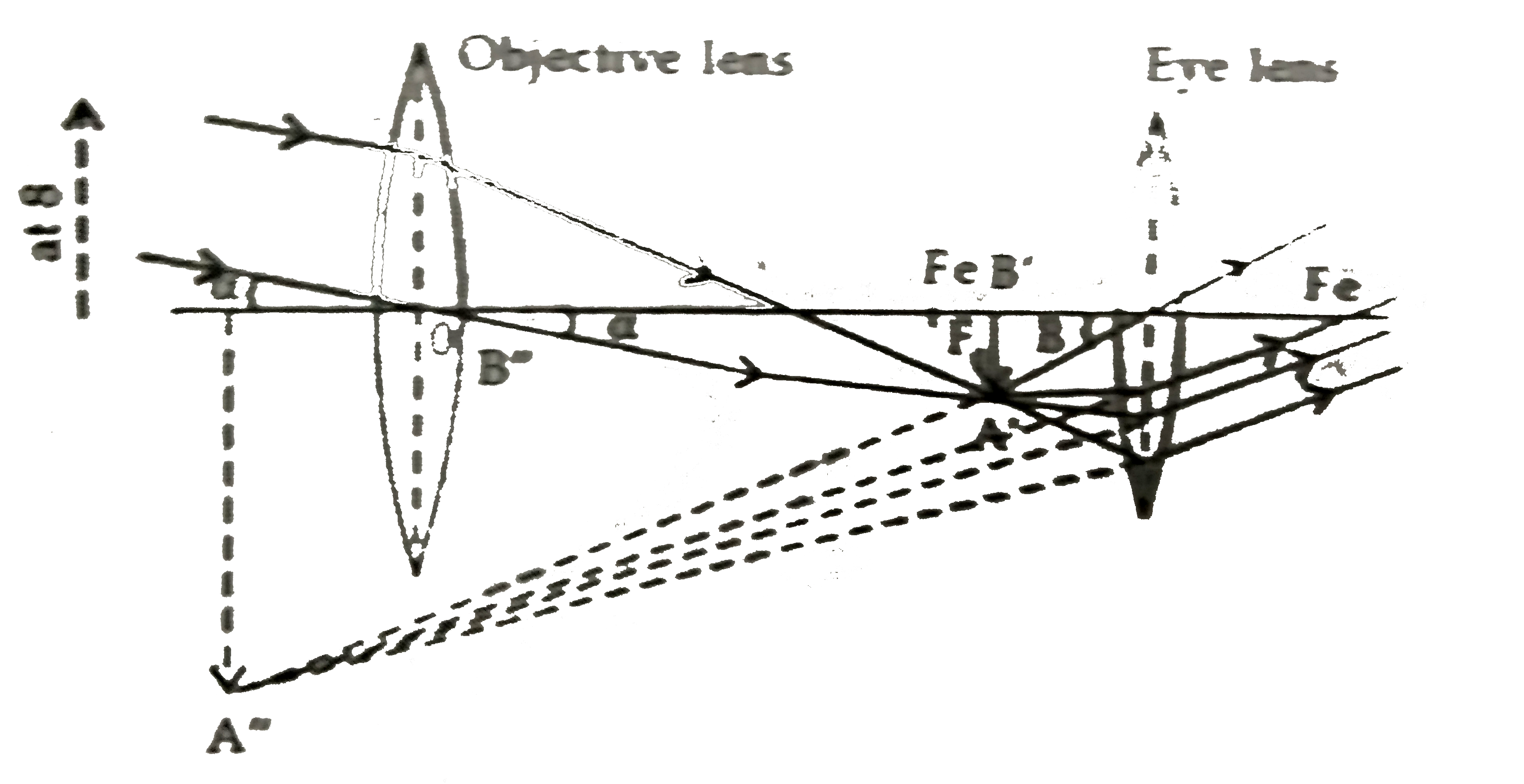 Angular magnification when the final image is at infinity (Normal Adjutment): `M=(f_(0))/(-f_(E))` Angular magnification when the final image is formed at least distance of distinct vision : `M=(-f_(0))/(f_(e))(1+(f_(e))/(D))` Resolving power of telescope is given by : `R.P.=(D)/(1.22 lamda)` Resolving power of telescope can be increased by INCREASING the diameter (D) of objective lens. Refracting type telescope has many limitations LIKE chromatic and spherical abserration. |
|
| 41396. |
Amount of lightentering into the camera depends upon |
|
Answer» diameter only |
|
| 41397. |
If the voltage between the terminals A and B is 17 V and Zener breakdown voltage is 9 V , then the potential across R is |
| Answer» Answer :B | |
| 41398. |
An isotropic point source of radiation power P is located on the axis of an ideal mirror plate. The distance between the source and the plate exceeds the radius of the plate eta-fold. In terms of the corpuscular theory find the force that light exterts on the plate. |
|
Answer» <P> SOLUTION :CONSIDER a ring of radius `x` on the plate. The normal PRESSURE on this ring is, by problem`(2)/(c )(P)/(4PI(x^(2)+eta^(2)R^(2))).cos^(2)theta` `=(P)/(2pic) (eta^(2)R^(2))/((x^(2)+eta^(2)R^(2))^(2))` The total force is then `underset(0)overset(R)int (P)/(2pic)(eta^(2)R^(2))/((x^(2)+eta^(2)R^(2))^(2))2pixdx` `=(Peta^(2)R^(2))/(2c) underset(eta^(2)R^(2))overset(R^(2)(1+eta^(2)))int (dy)/(y^(2))` `= (Peta^(2)R^(2))/(2c) [(1)/(eta^(2)R^(2))-(1)/(R^(2)(1+eta^(2)))] = (P)/(2c(1+eta^(2)))` 
|
|
| 41399. |
The total energy in case of a hydrogen atom is given by E = ? |
| Answer» SOLUTION :`-13.6/n^2eV` | |
| 41400. |
In the magnetic meridian of a certain place, the horizontal component of the earth's magnetic field is 0.26 G and the dip angle is 60^@ . What is the magnetic field of the earth at this location ? |
|
Answer» SOLUTION :It is GIVEN that `H_E=0.26G` `COS60^@=H_E/B_E` `B_E=H_E/(cos60^@)=(0.26)/((1/2))=0.52G` |
|


