

Saved Bookmarks
This section includes 7 InterviewSolutions, each offering curated multiple-choice questions to sharpen your Current Affairs knowledge and support exam preparation. Choose a topic below to get started.
| 1. |
Give equation for each of the following reactions. Phenol is heated with Zinc dust. |
|
Answer» |
|
| 2. |
Give energy level diagram of molecular orbital obtained by overlapping of 2p_(x)^(1) orbital of two atoms . |
Answer» Solution :Two `2p_(x)` orbital are perpendicular & parallel to internuclear axes overlap and form`pi` MO. The energy level diagram is in given fig.  Where, AO = Atomic ORBITALS `(2p_(x)^(1))` MO = Molecular orbitals `(pi 2p_(x) , pi^(**)2p_(x))` BMO = Bonding orbitals `(sigma 2p_(x))` ABMO = Antibonding orbitals `(sigma^(**)2p_(Z))` Energy order : `pi 2p_(x) lt 2p_(x) lt pi^(**) 2p_(x)` Note : (i) One electron of opposite spin in baoth `2p_(x)` or both ATOM. (ii) BMO energy `lt ` ABMO energy, so according in high energy. to Aufbau and both electron in BMO and ABMO is empty. `because ` the figure ofMO, `(pi 2p_(x)) and (pi^(**) 2p_(x))`which are form by LCAO of `2p_(x)` orbitals of two ATOMS are as under fig.  In `pi` TYPE BMO (+) and (-) waves are below and above of internuclear axis and electron density between two nucleus. In `pi^(**)` type ABMO vertical nodal is located. Electron density is not between two nucleus. (+) and (-) waves are below and above the internuclear axis. |
|
| 3. |
Give equation for each of the following reactions. Benzene is treated with Chlorine in presence of Ferric chloride. |
|
Answer» |
|
| 4. |
Give energy level diagram obtained by over lapping of 2p_(z) orbitals. |
Answer» Solution :By LCAO,` 2p_(z)^(1) - 2p_(z)^(1)` are OVERLEAP and form MO.The energy diagram is under. . Where, AO = Atomic orbitals (here, `2p_(z)`) MO = Molecular orbitals (here, `sigma 2p_(z) sigma^(**) 2p_(z)`) BMO Bonding orbitals (here, `sigma 2p_(z)`) ABMO Antibonding orbitals (here `sigma^(**) 2p_(z)` ) Energy : `(2p_(z)^(1) + 2p_(z)^(1) ) = (sigma 2p_(z) + sigma^(**) 2p_(z))` Energy order : `sigma 2p_(z) lt 2p_(z)^(1) lt sigma^(**) 2p_(z)` NOTE : (i) The electron spin oppostie in both `2p_(z)`like `uarr and darr ` (ii) Two electron in BMO but ABMO is empty. ` because ` The electron filled in first less energy than in high energy. The axia figure of MO, `sigma^(**) 2p_(z) and sigma 2p_(z)` are formed by LCAO of two atom ` 2p_(z)^(1)` are as under figure .  Note: () LCAO in Z-axis, so AO form sigma `(sigma)` types. (ii) BMO `sigma_(2p_(z)) = Psi_(2p_(z)) + Psi_(2p_(z))` ABMO `sigma_(2p_(z))^(**) = Psi_(2p_(z)) - Psi_(2p_(z))` (iii) In `sigma_(2p_(z)) ` BMO electron are symmetrical (iv) In `sigma_(2p_(z))^(*)` ABMO orbital electron COULD is asymmetrical but an INTERNUCLEAR axis. |
|
| 5. |
Give electronic configuration of group - II-A. |
| Answer» Answer :B | |
| 6. |
Give electron configuration,magnetic property bond order and energy diagram for oxygen (O_(2))molecule. |
|
Answer» Solution :`O_(2) (Z = 8 ) 1 s^(2) 2s^(2) 2p^(4)` ,So total electron in `O_(2)`= 16 ,& 12 valence electrons are participate in bond. electron configuration in MO for `O_(2)` . KK `(sigma 2s)^(2) (sigma^(**)2s)^(2) (sigma 2p_(x))^(2) = (pi 2p_(y))^(2) (pi^(**) 2p_(x))^(1) (pi^(**) 2p_(y))^(1)` Bond order `= (1)/(2)(N_(b) - N_(a))` = `(1)/(2) (10 - 6)= 2("DOUBLE bond" O_(2))` in it unpair `bar(E) " in " pi_(2p_(x))^(**) and pi_(2p_(y))^(**) `, So paramagnetic Energy diagram for `O_(2)` molecule : 
|
|
| 7. |
giveelectron configurationof Fe^(+3) initsgroundstate . |
|
Answer» `[AR] 3D^(3) 4s^(2)` |
|
| 8. |
Give electron configuration, magnetic property bond order and energy diagram for Nitrogen (N_(2)) molecule. |
|
Answer» Solution : `N_(2) (Z= 7) 1s^(2) 2S^(2) 2p^(3)`,total electron in `N_(2)` = 14 and affected valence electron = 10 Electron configuration in MO for `N_(2)` : KK `(SIGMA 2s)^(2) (sigma^(**) 2s)^(2) (pi 2p_(x))^(2) = (pi 2p_(y))^(2) (sigma 2p_(z))^(2) ` OR `(sigma 1s)^(2) (sigma^(**) 1s)^(2) (sigma 2s)^(2) (sigma^(**) 2s)^(2) (pi 2p_(x))^(2)= (pi 2p_(y))^(2) (sigma 2p_(z))^(2)` Bond order = `(1)/(2) (N_(b) - N_(a)) = (1)/(2) (8 - 2) = 3` OR BO `= (1)/(2) (N_(b) - N_(a)) = (1)/(2) (10 - 4) = 3 ` (Triple bond in `N_(2)`) Magnetic Property : All ELECTRONS are paired energy DIAGRAM for `N_(2)` Molecular 
|
|
| 9. |
Give electron configuration, magnetic property, bond order and energy diagram for fluorine (F_(2))molecule. |
|
Answer» SOLUTION : `F_(2) (Z = 9) 1s^(2) 2s^(2) 2p^(5)` . In valence CELL 7 ELECTRON and bond structure of `F_(2) ` = 14 ELECTRONS. Electron configuration in MO for `F_(2) `: KK `(sigma_(2s))^(2) (sigma 2p_(z))^(2)(pi 2p_(x))^(2) = (pi 2p_(y))^(2) (pi^(**)2p_(x))^(2) = (pi^(**) 2p_(y))^(2)` Bond order = `(1)/(2) (N_(b) - N_(a)) = (1)/(2) ( 10 - 8) = ` So, F - F Single bond Magnetic propoerty : All electrons are paried , So, diamagnetic . Energy diagram for `F_(2)` molecule. : 
|
|
| 10. |
Give electron configuration, Magnetic property, bond order and energy diagram for carbon (C_(2)). |
|
Answer» Solution :`C_(2) (z =6) 1s^(2) 2S^(2) 2p^(2)`, So TOTAL electron in `C_(2)` = 12 Electron configuration in MO for `C_(2)` : `(sigma 1s)^(2) (sigma^(**) 1s)^(2) (sigma 2s )^(2) (sigma^(**) 2s)^(2) (pi 2p_(x))^(2) (pi 2p_(y))^(2)` OR KK `(sigma 2s)^(2) (sigma^(**) 2s)^(2) (pi 2p_(x))^(2) (pi 2p_(y))^(^(2) ` Bond order = `(1)/(2) (N_(b) - N_(a)) = (1)/(2) ( 8 - 4) = 2 ` Magnetic Property : All electrons are paired So, diamagnetic Note: In `C_(2)` Molecule, the bond present in double bond are `pi -`bond. Energy DIAGRAM for `C_(2)` molecule : 
|
|
| 11. |
Give electron configuration, bond order,Magnetic property and energy diagram for Baron (B_(2)) Molecule and write about it existence. |
|
Answer» Solution :`B_(2) (Z = 5) 1s^(2) 2s^(2) 2p^(1) ` So, total electron in `B_(2) = 10 ` Electron configuration in MO for`B_(2)`: KK `(sigma_(2s))^(2) (sigma^(**) 2s)^(2)(pi 2p_(x))^(1) (pi 2p_(y))^(1)("Because " B_(2) pi 2p lt sigma 2p_(z))` BOND order = `(1)/(2) (N_(b) - N_(a)) = (1)/(2) (4 - 2) = 1 ` Two unpaired electron present in `B_(2)` , So it is paramagnetic and Single bond so, it is stable . Bond length B - B ( 159 PM ) and Bond energy `B_(2) ` 290 kj `mol^(-1)` Energy DIAGRAM for `B_(2) ` Molecule is as under (fig). 
|
|
| 12. |
Give electron configuration, bond order magnetic property and energy diagram for Lithium (Li_(2)) molecule. |
|
Answer» SOLUTION :Li (Z = 3), So, Total electron in `Li_(2)` = 16 Electron configuration in MO for `Li_(2)`: `(SIGMA 1s)^(2) (sigma^(**) 1s)^(2) (sigma 2s)^(2) (sigma^(**) 2s)^(0) "ORKK" (sigma 2s)^(2) ` Magnetic Property : All electrons are PAIRED. So, it should be diamagnetic. where , `N_(b) = 4, N_(a) = 2 ` Bond order `= (1)/(2) (N_(b) - N_(a))` = `(1)/(2) (4- 2 ) = 1 ` So, single bond and `Li_(2) ` is STABLE Note : KK means `[He_(2)] = (sigma 1s )^(2) (sigma^(**) 1s )^(2)` Energy diagram for `Li_(2)` molecule is as under. 
|
|
| 13. |
Give electron configuration, bond order, magnetic property and energy diagram for berilium (Be_(2)) molecule and writ about itexistence. |
|
Answer» Solution :Be (Z = 4) So, TOTAL electron in `Be_(2) ` = 8 Electron configuration in MO for `Be_(2)` : KK `(sigma 2s)^(2) (sigma^(**) 2s)^(2) "OR " (sigma 1S)^(2) (sigma^(**) 1s)^(2) (sigma 2s )^(2) (sigma^(**) 2s)^(2)` Magnetic Property : All electrons are paired . So, diamagnetic Bond ORDER BO `= (1)/(2) (N_(b)- N_(a) ) = (1)/(2) (2 - 2) = 0 " OR " ` BO = `(1)/(2) (N_(b) - N_(a))= (1)/(2) ( 4 - 4) = 0 ` Bond order is zero, So, `Be_(2)` is unstable and does not exist. Energy diagram for `Be_(2)` molecule is as under. 
|
|
| 14. |
Give electron configuration, bond order and magnetic property, energy diagram in MO for Helium (He_(2)) molecule. OR (He_(2))molecule is not possible . |
|
Answer» Solution :He (Z = 2), So, Total electron in `He_(2)` = 4 Electron CONFIGURATION in MO`He_(2) : (sigma_(1s))^(2) (sigma_(1s)^(**))^(2)` All electron are PAIRED in `He_(2)`, so it is diamagnetic , Bond order = `(1)/(2) (N_(b) - N_(a)) = (1)/(2) (2 - 2) = 0` Bond order in `He_(2)` is zero. So it is unstable and does not exist. Mo energy diagram of `He_(2)` is as under. 
|
|
| 15. |
Give E_(CI_(2)//CI)^(@)=1.36V , E_(Cr^(3)+//Cr)^(@)=-0.74V (E Cr_(2) O_(7)^(2-)//Cr^(3+))^(@)=1.33 V, E_(MnO_(4)^(-)//Mn^(2+))^(@)=1.51 V Among the following the strongest reducing agent is |
|
Answer» `Cr^(3+)` |
|
| 16. |
Give distinguishing test for the following : (a) ethane and ethyne (Alkane and alkyne RC-=CH) (b) Ethene and Ethyne (Alkene and Alkyne RC-=CH) (c) Dimethyl ethyne and ethyne (d) Ethane and Ethene (Alkane and alkene) |
|
Answer» Solution :Ethane and ethyne : (x) in ethyne `(HC-=CH)`, H is acidic in nature and so it reacts with sodium or sodamide while ethane does not give such reaction. (i) `UNDERSET("Ethyne")(HC-=CH)underset(or NanH_(2))overset(Na(NH_(3)))rarr underset("Disodium ethynide")(NaC-=CNa)` (Eq. (i)) (ii)On reaction of ethyne with ammonium silver nitrite it gives precipitates of silver ethynide. while ethane does not give such reaction. `HC-=CH+ 2Ag(NH_(3))_(2)NHO_(3) rarr underset("Disilver ethynide")(AgC-=C Ag_(s)) + 2NH_(4)NO_(3) + 2NH_(3)` (Eq. (ii)) (iii) `CH_(3)-CH_(3)+2Ag(NH_(3))NO_(3) rarr "No reaction"` OR Alkane `+ 2Ag(NH_(3))NO_(3) rarr "No reaction"` (b) Ethene is alkene in nature and H-atom present in them are not acidic in nature. So ethene, means all alkenes does not react with Na, `NaNH_(2)` and `Ag(NH_(3))_(2)NO_(3)`. But ethyne can react according to reaction (i) and (ii). (c) When dimethyl ethyne `(CH_(3)C-=C CH_(3))` and ethyne `(CH-=CH)` both REACTED with `Na(NH_(3)), NaNH_(2)` and ammonium silvernitrate, then ethyne shows the reaction while dimethyl ethyne does not shows the reaction. `underset("(Dimethyl ethyne)")underset("But-2-yne")(H_(3)C C-=C-CH_(3))underset(underset(or Ag(NH_(3))_(2)NO_(3))(or NaNH_(2)))overset(Na(NH_(3)))rarr"No reaction"` The hydrogen of ethye `(HC-=CH)` acidic in nature and so it react with Na and `NaNH_(2)`, according to answer of (a) and reaction (i) and (ii). (d)Distinguishing reaction of ethane and ethene :Ethane is alkane and ethene is alkene. Ethene is unsaturated in nature and so it gives following two-reaction of unsaturation. (i) Bayer test : Alkene (Ethene) remove color of `KMnO_(4)`. `underset("Ethene")(CH_(2))=CH_(2)+H_(2)O + O underset(KMnO_(4))overset("Cold, Dilute")rarr underset("Glycol")(CH_(2)OH-CH_(2)OH)` (ii) Ethene react with `Br_(2)` in `C Cl_(4)` and decolorize RED color of `Br_(2)`. `underset("Ethene")(CH_(2))=CH_(2)+underset("Red liquid")(Br_(2)) overset(C Cl_(4))rarr CH_(2)Br CH_(2)Br` Ethane is saturated in nature, it does not gives above reaction and so can be distinguished. |
|
| 17. |
Give dipole arrow of the following molecules. (i) HF (ii) CO (iii) |
|
Answer» Solution :(i) H `OVERSET( rarr )(-)` F : is negative and H is positive So, bonding electron pair is nearer to negative ion H : F, Thus `H^(delta +) F^(delta -)` (II) `C overset(rarr)(-) O C^(delta +) O^(delta-)` (iii) Cl - Cl is NON polar , So, electron pair is in centre , Cl : Cl and arrow is not put. |
|
| 18. |
Give different unit of pressure of gas. |
| Answer» Solution :(i) SI UNIT : Pascal (PA) (ii) bar(iii) ATMOSPHERE (ATM) (IV) torr. | |
| 19. |
Give difference: Bonding molecular orbital and antibonding molecular orbitals. |
Answer» SOLUTION :
|
|
| 20. |
Give difference of disscriation and ionization. |
Answer» SOLUTION :
|
|
| 21. |
Give differences between electrophiles and nucleophiles |
|
Answer» SOLUTION : |
|
| 22. |
Givedifferencebetweenw andw^(2) |
Answer» SOLUTION :
|
|
| 23. |
Give difference between Ideal Gas and Real Gas. |
Answer» SOLUTION :
|
|
| 24. |
Give difference between paper chromatography and thin layer chromatography |
Answer» SOLUTION :
|
|
| 25. |
Give difference between first element of group and other elements of group ? |
Answer» SOLUTION :
|
|
| 26. |
Give difference between empirical and molecular formula. |
Answer» SOLUTION :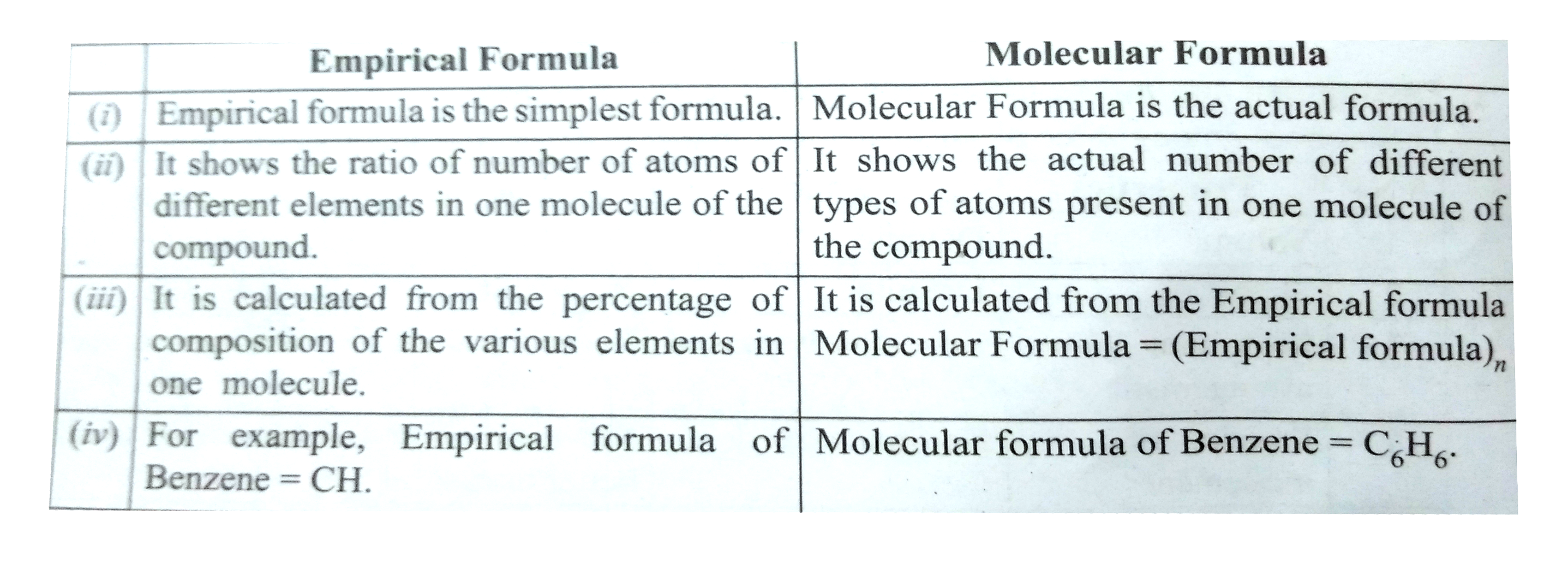
|
|
| 27. |
Give difference. |
|
Answer» SOLUTION :(i) Cyclo alkane and linear alkane. (ii) SATURATED and unsaturated HYDROCARBON. (iii) Cyclo and non-cyclo unsaturated hydrocarbon. (IV) Cyclic structure or multicyclic structure AROMATIC hydrocarbon. |
|
| 28. |
Give detail explanation on Oxo acid salts of alkaline earth metal elements. |
|
Answer» SOLUTION : Salts of Oxoacids : The alkaline earth metals also form salts of oxoacids. Some of these are : (a) Carbonate compounds (b) Sulphate compounds and (c) Nitrate compounds (a) Carbonates : Carbonates of alkaline earthmetals are INSOLUBLE in water and can be precipitated by addition of a sodium or ammonium carbonate solution to a solution of a soluble salt of these metals. The solubility of carbonates in water decreases as the atomic number of the metal ion increases. All the carbonates decompose on heating to GIVE carbon dioxide and the oxide. Beryllium carbonate is unstable and can be kept only in the atmosphere of `CO_(2)`. The thermal stability increases with increasing cationic size. (b) Sulphates : The sulphates of the alkaline earth metals are all white solids and stable to heat. `BeSO_(4), and MgSO_(4)` are readily soluble in water, the solubility decreases from `CaSO_(4)` to `BaSO_(4)`. The greater hydration enthalpies of `Be^(2+)` and `Mg^(2+)` ions overcome the lattice enthalpy factor and therefore their sulphates are soluble in water. (c) Nitrates : The nitrates are made by dissolution of the carbonates in dilute nitric acid. Magnesium nitrate crystallises with six molecules of water, whereas barium nitrate crystallises as the anhydrous salt. This again SHOWS a decreasing tendency to form hydrates with increasing size and decreasing hydration enthalpy. All of them decompose on heating to give the oxide like lithium nitrate. `2M(NO_(3))_(2) to 2MO+4NO_(2)+O_(2) (M=Be,Mg,Ca,Sr,BA)` |
|
| 29. |
Give definition of position isomerism and Example |
|
Answer» Solution :When two or more compounds differ in the POSITION of substituent atom or functional group on the carbon skeleton, they are CALLED position isomers and this phenomenon is termed as position isomerism. Example: The molecular FORMULA `C_(3)H_(8)O` represents two ALCOHOLS because the one function group `-OH` present but position is differ `underset("Propan-1-ol (n-propyl alcohol)")(CH_(3)CH_(2)CH_(2)OH) underset("Propan-2-ol (Isopropyl alcohol)")(CH_(3)- underset(underset(OH)(|))(CH)-CH_(3))` |
|
| 30. |
Give definition, general characteristics and use of functional group |
|
Answer» SOLUTION :DEFINITION: A functional group of defined earlier, is an atom or a group of atoms bonded TOGETHER in a unique manner which is usually the site of chemical reactivity is an organic molecule. Characteristics: Compound having the same functional group undergo similar reactions. For example, `CH_(3)OH, CH_(3)CH_(2)OH, and (CH_(3))_(2)CHOH`- all have `-OH` functional group liberate hydrogen on reaction with sodium metal. Uses: The systematically classification of organic compound in different classes by the presence of functional group in organic compounds. |
|
| 31. |
Give decreasing rate order for the halogenation reaction of alkyl compounds. |
| Answer» SOLUTION :`F_(2) GT Cl_(2) gt Br_(2) gt I_(2)` | |
| 32. |
Give definition, dimensions and SI unit of surface tension. |
|
Answer» Solution : ..The force acting per UNIT length perpendicular to line, DRAWN on the surface of liquid is known as surface TENSION... Its dimension are J. `m^(-2)` Its is DENOTED by Greek Letter `gamma` (Gamma) Unit : Kg `S^(-2)` SI unit : `Nm^(-1)` |
|
| 33. |
Givedefination andexamples of isobars and isotopes. |
|
Answer» Solution :ISOBARS :are the species havingsamemass NUMBER(atomicmass) butdifferentatomicnumber . Isotopes :are specieswithidenticalatomicnumberbutdifferentatomicmass EX: Hydrogen hasthreeisotopes viz protium DEUTERIUM andtritium |
|
| 34. |
Give decreasing order of the stabilities of the following : |
Answer» Solution :`EDG` increases the stability of -I order-`NO_(2) GT -Cl gt -OMe` so the order is 2gt3gt4gt1gt5.(b) Here we have an aromatic compound, so resonance effect and `H.C` will also operate. 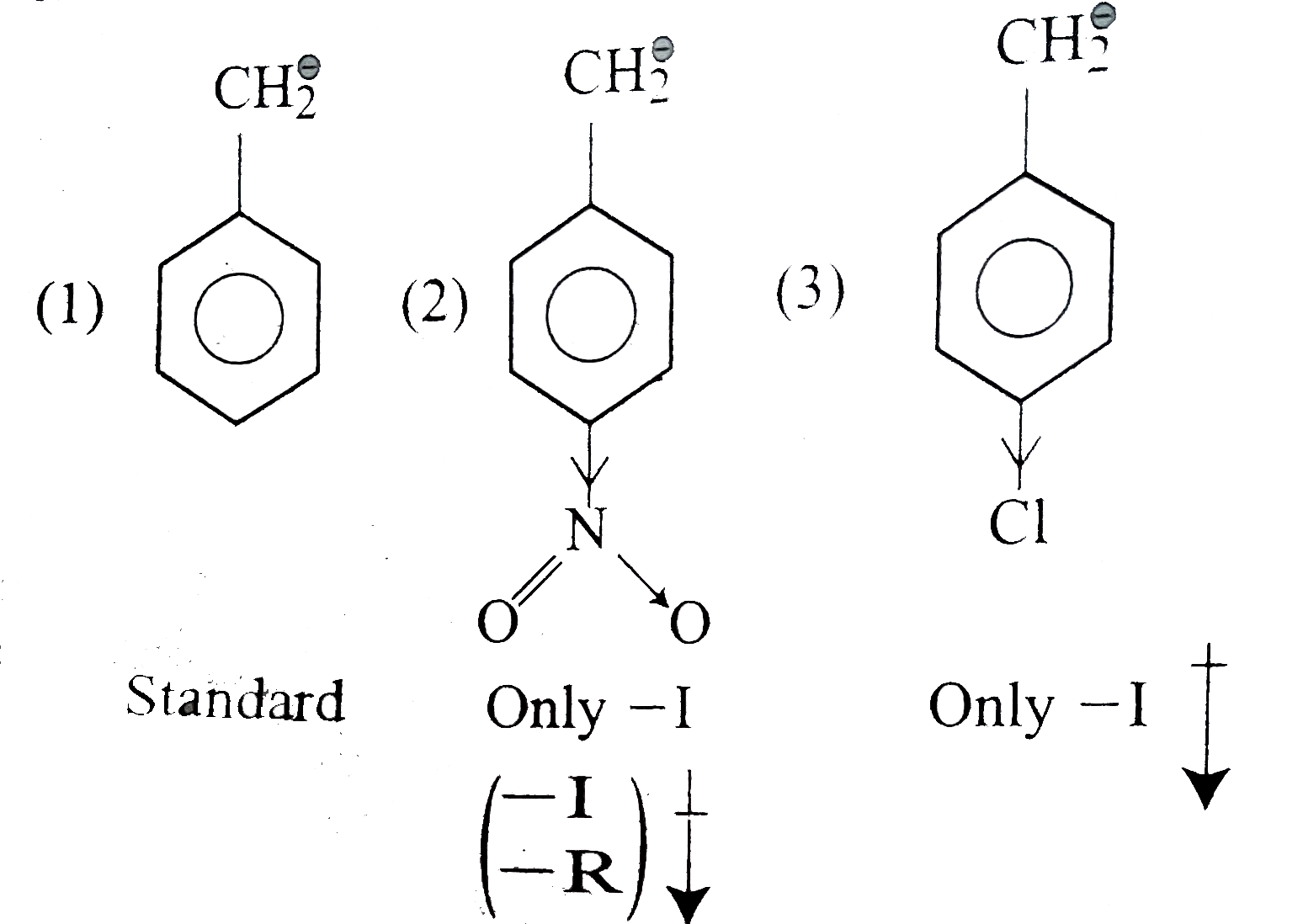 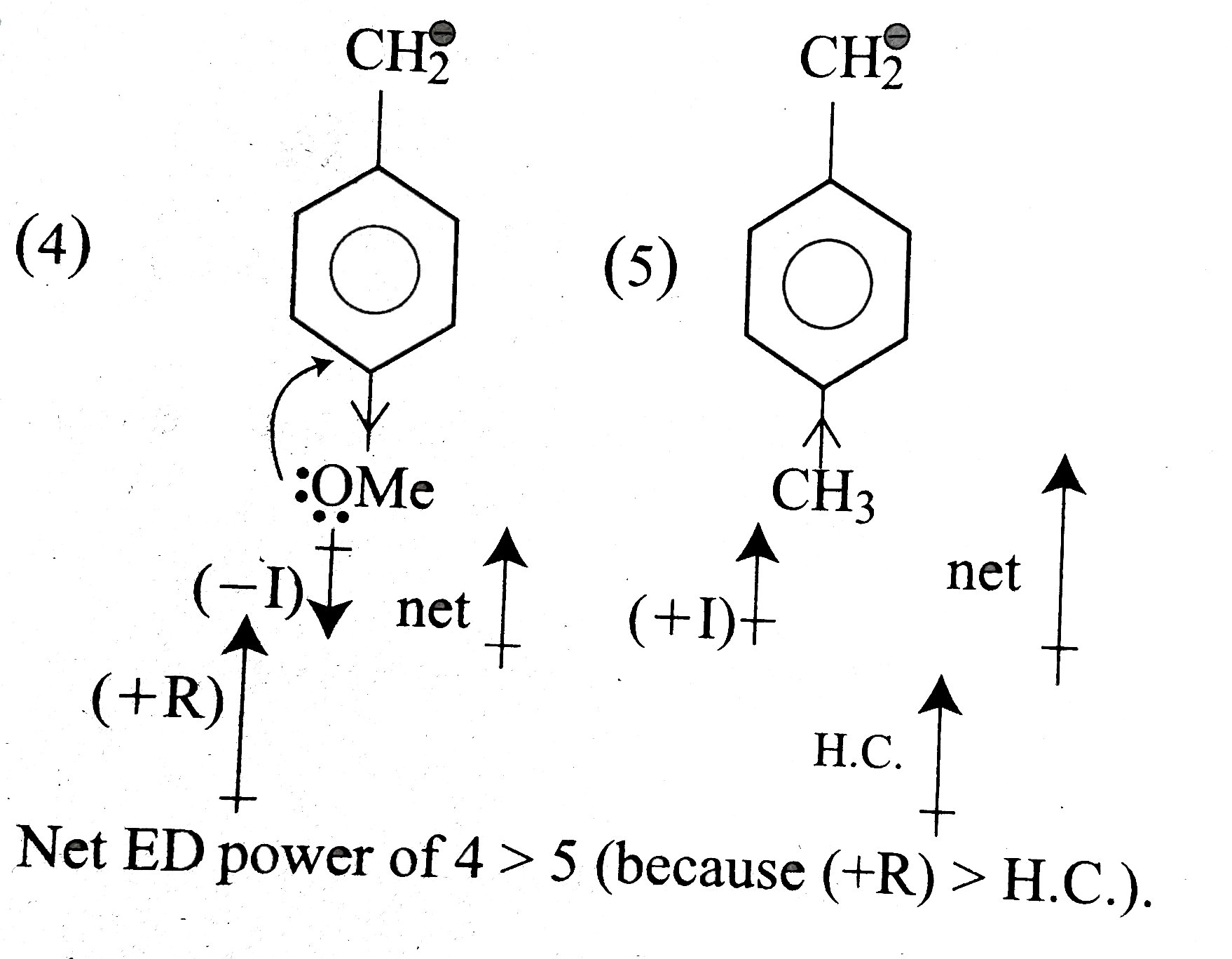 Net `ED` power of `4 gt 5` (because `(+ R) gt H.C)` So the order is : `2 gt 3 gt 1 gt 5 gt 4 `. Structure `(4)` has more `EDG` due to resonance effect is greater than `+1` and `H.C` ( c) Same as in `(b)` except in `(5) (OMe)` group is at `m`, where there is no resonance (only `- I` is considered) So the order is : `2 gt 5 gt (-I at m "is more than" - I at p) gt 3 gt 1 gt 4 (here -I and + R, + Rgt -I)`. Order is : `2 gt 5 gt 3 gt 1 gt 4` (d) Reverse of (a) `(5 gt 1 gt 4 gt 3 gt 2)`. (e) Reverse of (b) `(4 gt 5 gt 1 gt 3 gt 2)`. (f) Reverse of ( c) `(4 gt 1 gt 3 gt 5 gt 2 )`. (g) Stability of benzy1 `C^(oplus)` is determined by ` H.C` Since `H.C` in `(2)` is greater than in `(3)` and `(4)`, the order is `2 gt 3 gt 4 gt 1 gt 6 gt 5`. |
|
| 35. |
Give correct IUPAC name of structure of |
| Answer» SOLUTION :5-(2.- ethylbutyl)-3, 3-dimethyl DECANE | |
| 36. |
Give correct IUPAC name of |
|
Answer» Cyclohex-1-ene-1-3-nitro |
|
| 37. |
Give correct ionization enthalpy order for group 14. |
|
Answer» `C lt SI lt Ge lt SN` |
|
| 38. |
Give conversion reaction of benzene in the following products : (i) Nitrobenzene (ii) Chlorobenzene (iii) Bromobenzene (iv) Benzene sulphonic acid (v) Toluene (vi) Ethyl benzee and (vii) Acetophenone |
Answer» SOLUTION : 
|
|
| 39. |
Give conjugate base - conjugate acid pair of NH_(3(aq)) + H_2O_((aq)) hArr NH_(4(aq))^(+) + OH_((aq))^(-) |
| Answer» SOLUTION :`NH_3 ` and `NH_4^(+) , OH^-` and `H_2O` | |
| 40. |
Give conversion reaction for methane rarr ethane. |
| Answer» SOLUTION :`underset("Methane")(H-underset(H)underset(|)OVERSET(H)overset(|)(C)-H) underset(underset("reaction")(-2HBr "Substraciton"))overset(+Br_(2), HV)RARR underset("Bromoethane")(2H-underset(H)underset(|)overset(H)overset(|)(C)-H)underset(underset(underset("reaction")("WURTZ"))(-2NaBr))overset(+2Na, "Dry ether")rarr underset("Ethane")(H-underset(H)underset(|)overset(H)overset(|)(C)-underset(H)underset(|)overset(H)overset(|)(C)-H)` | |
| 41. |
Give conjugate acid of following: HS^(-) , NH_3, C_6H_5COO^(-), OH^(-) |
| Answer» SOLUTION :`H_2S, NH_4^(+) , C_6H_5COOH, H_2O` | |
| 42. |
Give conjugate Acid and conjugate base of following: (i)NH_3, (ii)H_2O , (iii)HCO_3^-, (iv)HSO_4^(-) (v)CH_3COOH, (vi)C_6H_5OH , (vii)HPO_4^(2-) , (viii)C_6H_5NH_2 , (ix)NH_2NH_2 ,(x)HC_2O_4^(-) |
Answer» SOLUTION :
|
|
| 43. |
Give conditions for covalent bond formation bylewis dot structure. |
|
Answer» Solution :Each COVALENT bond is FORMED as a result by sharing of an electron pair between the atoms. Each combining atom contributes atleast one electron to the shared pair. The combining atomsattain the OUTER SHELL noble gas configurations as a result of the sharing of electrons. |
|
| 44. |
Give condensed and bond line structural formulas and identify the functional groups (s) present, if any, for : (a) 2, 2, 4-Trimethylpentane(b) 2-Hydroxy-1, 2, 3-propanetricarboxylic acid(c) Hexanedial |
Answer» SOLUTION :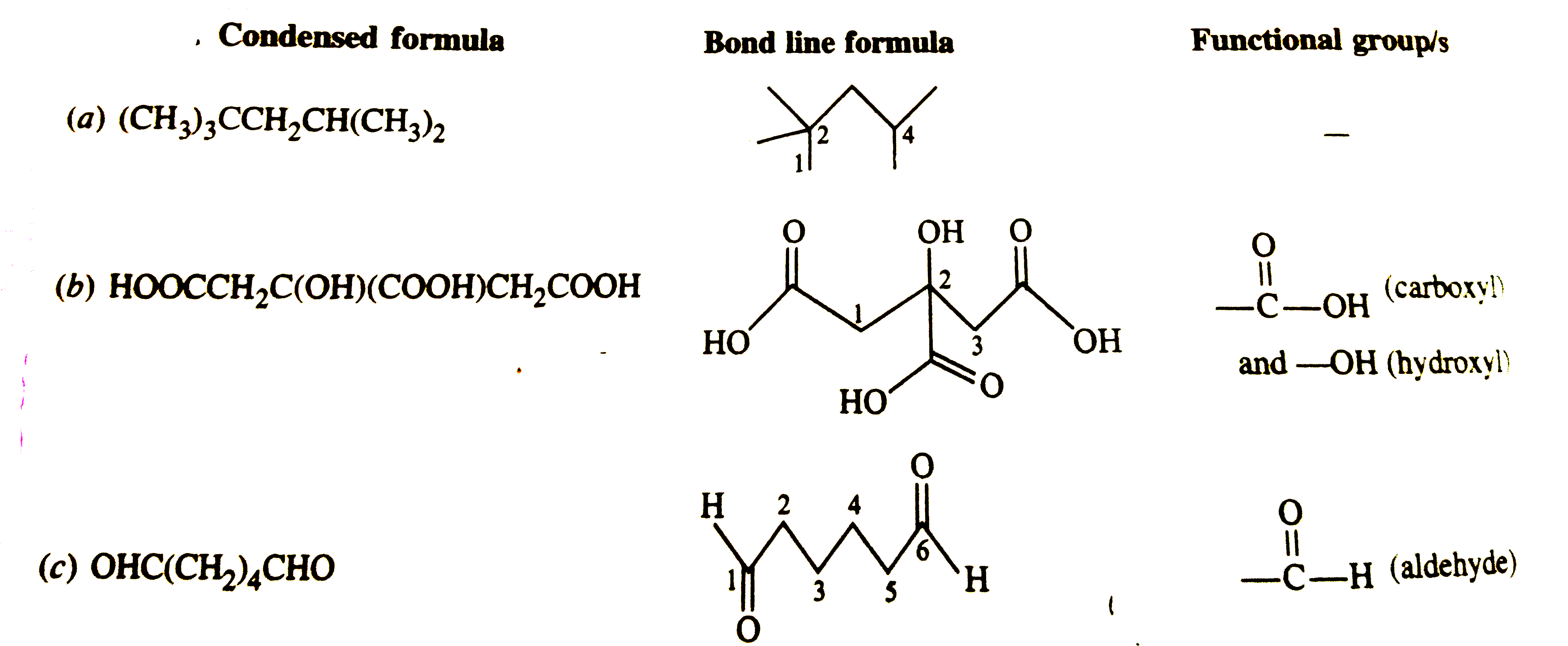
|
|
| 45. |
Give conjugate acid and conjugate base of following: (i)(CH_3)_2NH (ii)HPO_4^(-2) (iii)HS^- |
|
Answer» Solution :(i)`(CH_3)_2N^(+) H_2` and `(CH_3)_2N^(-)` (ii)`H_2PO_4^(-)` and `PO_4^(3-)` (iii)`H_2S` and `S^(2-)` |
|
| 46. |
Give condensed and bond line structural formulas and identify the functional group (s) present, If any, for: (a) 2, 2, 4-Trimethylpentane (b) 2-Hydroxy-1, 2, 3-propanetricarboxylic acid (c ) Hexanedial |
|
Answer» Solution :(a) condensed formula: `(CH_(3))_(3)C CH_(2) CH(CH_(3))_(2)` Bond line formula  (B) 2-hydroxy-1, 2, 3 propanetricarboxylic acid COMPLETE formula: `H - underset(underset(COOH)(|))OVERSET(overset(H)(|))(C ) - underset(underset(COOH)(|))overset(overset(OH)(|))(C )- underset(underset(COOH)(|))overset(overset(H)(|))(C ) - H` Condensed formula: `overset(1)(C )H_(2)(COOH) C(OH) (COOH) overset(3)(C )H_(2) COOH` Bond line formula:  Functional GROUP: ONE hydroxy and three carboxylic acid (c ) Hexanedial : `OHC (CH_(2))_(4)CHO`  Functional group: aldehyde |
|
| 47. |
Give complete structural formulas of the following compounds (i) 3-Amino butanal and (ii) 5-Oxohex-2-enamide |
|
Answer» Solution :There are siz CARBON ATOMS in its longest continuous CHAIN. Amide group is chain terminating. Double bond is at second carbon and keto group at fifth carbon aatom. `H-underset(H)underset(|)OVERSET(H)overset(|)H-overset(H)overset(|)C-underset(H)underset(|)overset(H)overset(|)H-overset(H)overset(|)C=overset(H)overset(|)C-overset(NH_(2))overset(|)C=O(or)CH_(3)-CO-CH_(2)-CH=CH-CONH_(2)` |
|
| 48. |
Give composition of Portland cement. |
|
Answer» Solution :The average composition of Portland cement is : `CaO:50-60%, SiO_(2):20-25%, Al_(2)O_(3):5-10%` `MgO:2-3%,Fe_(2)O_(3):1-2%, SO_(3):1-2%` |
|
| 49. |
Give comparison of properties between lithium and other alkali metals. |
|
Answer» Solution :(i) Lithium is much harder. Its m.p. and b.p. are higher than the other alkali METALS. (ii) Lithium is least reactive but the strongest reducing agent among all the alkali metals. On combustion in air it forms mainly MONOXIDE, `Li_(2)O` and the nitride, `Li_(3)N` unlike other alkali metals. (iii) LiCl is deliquescent and crystallises as a hydrate, `(LiCl * 2H_(2)O)` whereas other alkali metal chlorides do not form hydrates. (iv) Lithium hydrogen carbonate is not obtained in the solid form while all other elements form solid hydrogen carbonates. (v) Lithium unlike other alkali metals forms no ethynide on reaction with ethyne. (VI) Lithium nitrate when heated gives lithium oxide `(Li_(2)O)` whereas other alkali metal nitrates decompose to give the corresponding nitrite. `4LiNO_(3) to 2Li_(2)O+4NO_(2)+O_(2)` `2NaNO_(3) to 2NaNO_(2)+O_(2)` (vii) LiF and `Li_(2)O`are comparatively much LESS soluble in water than the corresponding compounds of other alkali metals. |
|