

Saved Bookmarks
This section includes 7 InterviewSolutions, each offering curated multiple-choice questions to sharpen your Current Affairs knowledge and support exam preparation. Choose a topic below to get started.
| 1. |
A ball is projected form ground with a speed of 20 ms^(-1) |
|
Answer» 5m `RARR 20 sin 45^(@) t = 10` `rArr t = (10)/(20 sin 45^(@)) = (1)/(sqrt(2))s` Now, `y = (20 sin 45^(@)) t - (1)/(2) g t^(2)` `= 20 xx (1)/(sqrt(2)) xx (1)/(sqrt(2)) - (1)/(2) xx 10 xx (1)/(2) = 7.5m` |
|
| 2. |
What is Laplace correction for velocity of sound in a gaseous medium to the Newton's formula.Give the meanings of the symbols used. |
|
Answer» <P> Solution :`v = sqrt((gamma p )/( rho ))` where `sqrt( gamma)`= is Laplace correction factor and` gama = 1+2 //G` where 'f' is degrees of freedom of GASEOUS molecule. |
|
| 3. |
In the figure-2.201 shown the bigger block A has a mass of 40kg and the upper block 5 is of 8kg.The coefficients of friction between all surfaces,of contact are 0.2 (static) and 0.15 (sliding). Find the acceleration of masses when set free. |
|
Answer» |
|
| 4. |
Satellites are objects which revolve around the earth. The direction of revolution of geosynchronous satellite is from ……………. |
|
Answer» EAST to west |
|
| 5. |
A spring is connected with plank and other end of spring is connected with a block of mass m. initially spring is stretched by a distance x_(0) and block is connected with a thread which is connected to other end of the plank as shown. If thread is cut, what will be maximum speed of the plank. |
|
Answer» SOLUTION :TAKE system: spring `+` plank `+` block Observation for the system: No external force acts on the system in horizontal direction. Conclusion: 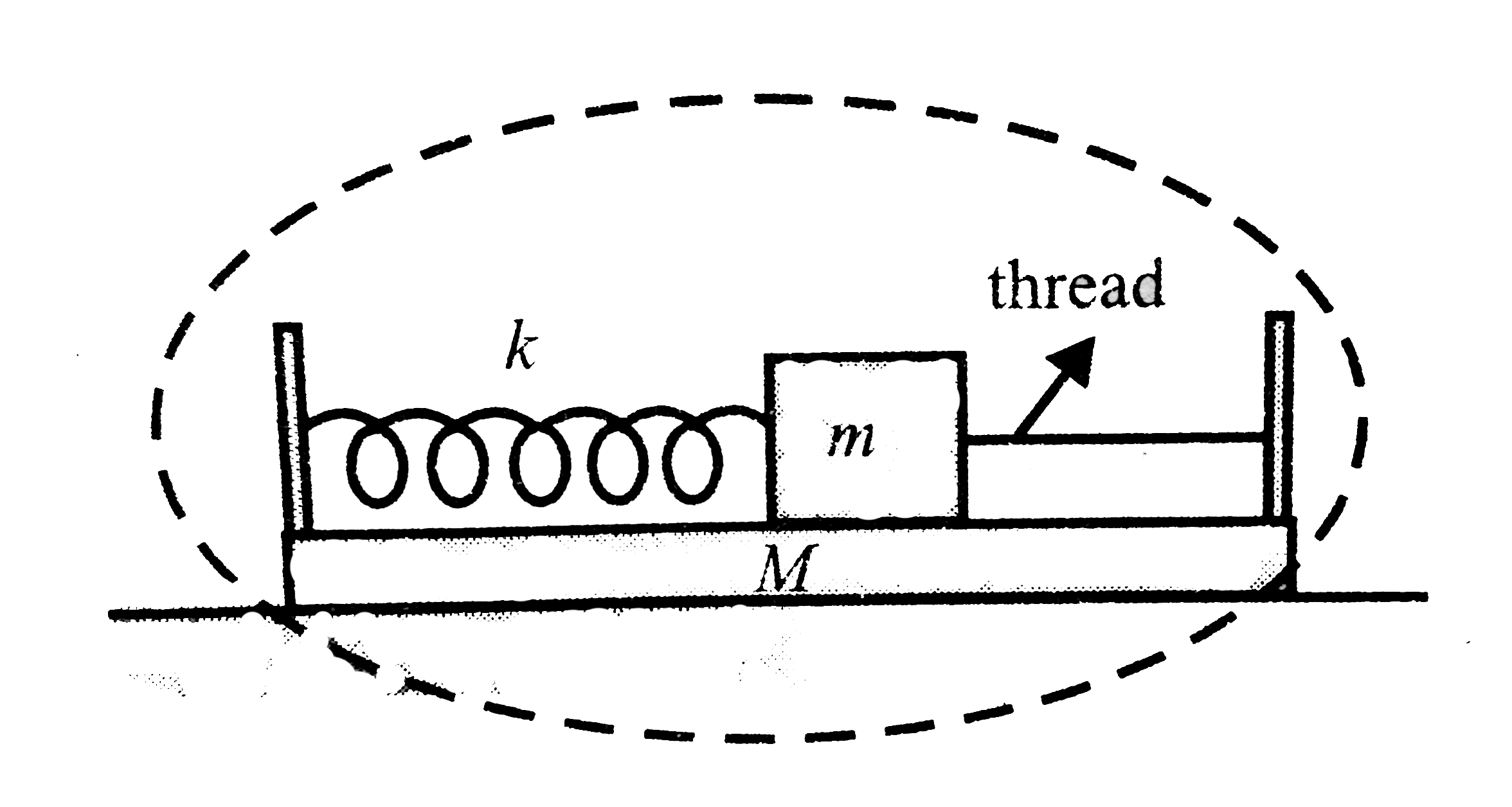 Both linear momentum and mechanical energy will be conserved for the system. Analysis of problem: The speed of the plank will be maximum when all the potential energy of spring converted into kinetic energy of system. The initial linear momentum of system is zero and no external forces are acting on system, the linear momentum of the system be zero always. The motion of the block and plank will be such that they will always MOVE in opposite direction or both will be at REST to justify conservation of linear momentum. Let speed of block and plank (at maximum case) be `v` and `V` respectively. Using conservation of linear momentum at this situation `mv=MV`..............i Now applying conservation of mechanicals energy `/_\K+/_\U=0` `[(1/2MV^(2)+1/2mv^(2))-0][0-1/2kx_(0)^(2)]=0`....................ii from eq `v=(MV)/m` Substituting this VALUE in eqn ii we get `[1/2MV^(2)+1/2m((MV^(2))/m)^(2)]=1/2kx_(0)^(2)` `implies1/2[M+M^(2)/m]v^(2)=1/2kx_(0)^(2)` `V^(2)=(kmx_(0)^(2))/((M^(2)+Mm))impliesV=sqrt((km)/(M(M+m))).x_(0)` |
|
| 6. |
Find the external work done by the system in kcal, when 20 kcal of heat is supplied to the system and the increase in its internal energy is 8400 J. (J = 4200 J/kcal). |
|
Answer» Solution :Heat energy supplied `Q = 20 k cal = 20 xx 10^3 `cal Increase in internal energy , `dU = 8400J =(8400 )/(4200) = 2K cal` From 1st Law of thermodynamics dQ = dU+ DW . `therefore `WORK done dW=dQ- dU (SINCE all are in Kilo calories) Work done in Kilocalories = dQ-dU = 18 kcal. 
|
|
| 7. |
For what value of 'theta' block slides up the Plane with an acceleration 'g' relative to the inclined plane. |
|
Answer» SOLUTION :`ma cos theta - MG sin theta = mg` `a = G (sec theta + TAN theta)` |
|
| 8. |
A pulse travelling on a string is represented by the function y=a^3/((x-vt)^2+a^2) where a=5 mm and v=20 cms^-1. Sketch the shape of the string at t=0, 1 s and 2s. Take x=0 in the middle of the string. |
|
Answer» `y=[((a)^3)/([(x-vt)^2+a^2)])]` `a=5mm` `=0.5cm` `v=20cm/s` At `t=0s, y=a^3/((x^2+a^2))` The graph between y and x can be plotted by talking DIFFERENT VAUES of x. (left as excercse for the studen). ltbr.gt SIMILARLY at t=1 s, `y=a^3/({(x-v)^2+a^2])` and at t=2s, y=a^3/({(x-2v)^2+a^2})` |
|
| 9. |
What is perfect black body ? Give examples. |
|
Answer» Solution :Perfect black BODY : ..The body which absorbs all radiant energy incident on it is called perfect black body... Practically it is impossible to have perfectly black body. For a perfect black body absorptivity `a=1` and emissivity `e=1`.  To obtain perfect black body in practice consider a vessel with a cavity inside it as shown in figure. Inner walls of vessel are irregular and coloured black and a very small hole is provided on its wall. The radiation incident on this hole experiences multiple REFLECTIONS inside and at each reflection it gets partially absorbed by its walls. The possibility of the radiation coming out of the same hole is negligible. Thus, radiation gets absorbed COMPLETELY inside the vessel. The part of the wall facing the hole is such that the radiation entering through the hole does not go out of the hle directly after reflection. In this way, this hole can be regarded as a perfectly black body. When this vessel is heated UNIFORMLY from outside, the radiation emitted through the hole can be CONSIDERED as the radiation emitted from a perfectly black body. It is called the ..cavity radiation... |
|
| 10. |
If a gas is filled in a rest sphere, its molecules moves randomly due to the heat energy. Will the centre of mass of molecules exist? |
|
Answer» Solution :No, there is no any external force EXERTED on a REST sphere and according to the LAW of conservation of MOMENTUM centre of mss of molecules REMAINS rest `therefore vec(v_(cm))=0` |
|
| 11. |
A cylindrical tube of length 100cm. Contains some mercury inside. If the length of remaining air column remains constant at all temperatures, the height of mercury is (neglect the expansion of cross section) ( gamma_(R) of Hg = 18 xx 10^(-5)//""^(@) C , gamma_(g) of tube = 2.7 xx 10^(-5)//""^(@) C) |
|
Answer» 10cm |
|
| 12. |
Two 3 kg masses have velocities barv_(1)=2hati+3hatj m/s and barv_(2)=4hati-6hatj m/s. Find a) velocity of centre of mass, b) the total momentum of the system, c) The velocity of centre of mass 5s after application of a constant force barF=24hatiN,d) position of centre of mass after 5s if it is at the origin at t = 0 |
|
Answer» Solution :`vecv_(c)=(m_(1)vecv_(1)+m_(2)vecv_(2))/(m_(1)+m_(2)),vecv_(c)=(3(2hati+3hatj)+3(4hati-6hatj))/(6)` `:.` Velocity of CENTRE of mass `barV_(c)=3hati-1.5hatjms^(-1)` b) The momentum of the system `=Mv_(c)=6kg(3hati-1.5hatj)ms^(-1)=18hati-9hatjkgms^(-1)` To find the velocity of centre of mass after 5 s of application of the FORCE `vecF=24hatiN` we first find the acceleration of the centre of mass. It is given by `veca_(c)=(vecF)/(M)=(24hati)/(6)=4hatims^(-2)` The velocity of centre of mass before the force is applied is `vecv_(c)`. and from the equation `vecv_(c)=vecv_(c)+veca_(c).t` `vecv_(c)=(3hati-1.5hatj)+(4hati)5=(3hati-1.5hatj+20hati)` `vecV_(c)^(1)=(23hati-1.5hatj)ms^(-1)` From the equation of the position vector `vecr=vecr_(0)+vecv_(0)t+(1)/(2)vecat^(2)` where `vecr_(0)=vec0` (origin at t=0), `vecv_(0)=vecv_(c),VECA=veca_(c)andt=5s` `vecr=(3hati-1.5hatj)5+(1)/(2)(4hati)25,vecr=(15hati-7.5hatj+50hati)` `vecr=(65hati-7.5hatj)m` The coordinates of the centre of mass after 5 s of application of the force `vecF` are (65m, -7.5m) |
|
| 13. |
If the instantaneous velocity of a particle is zero, will its instantaneous acceleration be necessarily zero? |
| Answer» SOLUTION :No. (highest POINT of VERTICAL upward motion under gravity). | |
| 14. |
A pendulum made of a uniform wire of cross sectional area A has time period T. When an additional mass M is added to its bob, the time period changes to T_(M). If the Young's modulus of the material of the wire is Y then 1/Yis equal to: (g = gravitational acceleration) |
|
Answer» `[ ((T _(M))/(R))^(2) -1 ] (A)/(Mg )` `T =2 pi sqrt ((L )/(g)) ""…(i)` If we increase the MASS of bob its length is increased by `DELTA t.` At that time periodic time is `T_(M)` `T _(M) =2pi sqrt ((l + Deltal )/(g )) ""…(ii)` Now Young.s modulus `Y= (F//A)/(Delta l //l ) = (Mg)/(A) xx (1)/( Delta l //l )` `therefore (Deltal )/(l) = (Mg )/(Ay) ""...(iii)` Divide equation (ii) by equation (i) and do square of it `((T _(M))/( T )) ^(2) = (l + Delta l )/(l)= l + (Delta l )/(l)` `therefore ((T _(M))/(T)) ^(2) -1 = (Delta l )/(l) ""...(iv)` PUTTING value of equation (iii) in equation (iv) `((T_(M))/( T)) ^(2) -1 = (Mg )/(AY) = (A)/( Mg ) [ ((T _(M))/( T )) ^(2) -1] (1)/(Y)` |
|
| 15. |
Two metal sphere of same material and each of radius r are in contact with each other. The gravitational force of attraction between the spheres is proportional to |
|
Answer» SOLUTION :`F = (Gm_(1)m_(2))/((2R)^(2)) = (G(""_(3)^(4)pir^(3)d)(""_(3)^(4)pi R^(3)d))/(4r^(2))` `F = Kr^(4) ""F prop r^(4)` 
|
|
| 16. |
When prongs of a tuning fork are rubbed, its frequency decreases. |
| Answer» SOLUTION :FALSE. (ACTUALLY in this CASE frequency INCREASES). | |
| 17. |
A stone of mass m tied with a thread is rotating along a horizontal circular path (force of gravity is neglected). The length of the thread is decreasing gradually in such a manner that the angular momentum of the stone remains constant with respect to the centre of the circle. If the tension in the thread is T= Ar^(n) , where A = constant , r = instantaneous radius of the circle, then find the value of n. |
|
Answer» Solution :If the instantaneous angular velocity of the stone is `omega`, then angular momentum , L`=Iomega= mr^(2)omega`= constant (according to the problem ) or, `omega = (L)/(mr^(2))` Here the tension in the thread provides the necessary centripetal FORCE for rotation. So, `T = Ar^(n) = momega^(2)R= m. (L^(2))/(m^(2)r^(4))r= (L^(2))/(m) r^(-3)` =`Ar^(-3)(A=(L^(2))/(m)="constant")` `:."" n=-3`. |
|
| 18. |
A force of 5 N acts on a body for 2 milliseconds. Calculate the impulse. If the mass of the body is 5 g, calculate the change of velocity. |
| Answer» Answer :A | |
| 19. |
A wheel of radius .r. rolls without without slipping with a speed .v. on a horizontal road. When it is at point .A. on the road, a small lump of mud separtes from the wheel at its highest point B and drops at point .C. on the road. The distance AC will be |
|
Answer» `V sqrt((R )/(G))` |
|
| 20. |
A door of moment of inertia 4 km m^(2) is at rest .When a torque of 2pi Nm acts on it find its angular acceleration Find also its angular velocity after 1S |
|
Answer» SOLUTION :MOMENT of inertia I=4kg `m^(2) omega_(1)=0,tau=2piNm` i)Angular acceleration `ALPHA=?,tau=Ialpha=(tau)/(I)=(2pi)/(4)=(PI)/(2) rad//s^(2)` `omega_(1)=o,omega_(2)=?t=1 sec,omega -omega_(1)=alphat,omega_(2)=(pi)/(2)xx(1),omega_(2)=(3.14)/(2)=1.57 `rad/sec |
|
| 21. |
A hydraulic automobile lift is designed to lift cars with a maximum mass of 3000kg . The area of cross - section of the piston carrying the load is 425cm^(2) . What maximum pressure would the smaller piston have to bear ? |
|
Answer» SOLUTION :Pressure on thepistondue to car , `thereforeP=(3000xx9.8)/(4.25xx10^(-2))` `=6917xx10^(2)` `=6.92xx10^(5)NM^(-2)` This is the maximum pressure that the SMALLER PISTON would have to bear. |
|
| 22. |
Maximum spedd of the car will be (given lin 4/3 = 0.28) |
|
Answer» `0.6 MS^(-1)` |
|
| 23. |
If C and R denote capacitance and resistance respectively, then the dimensional formula of CR is |
|
Answer» `[M^(0) L^(0) T]` |
|
| 24. |
Draw a graph showing the variation of potential energy of an object thrown vertically upward by a boy with respect to its height. |
Answer» Solution :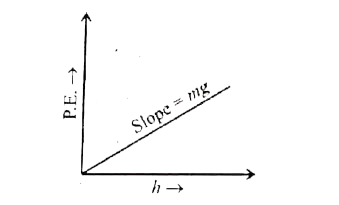 As P.E. = MGH implies `P.E. prop H`. So the GRAPH of P.E. verses HEIGHT is a STRAIGHT line as shown. |
|
| 25. |
Give some examples of motion. |
|
Answer» Solution :Motion is common to everything in the UNIVERSE. We walk, run and RIDE a bicycle. Even when we are SLEEPING, air moves into and out of our lungs and blood flows in arteries and veins. We see leaves falling from trees and water flowing down a dam. Automobiles and planes CARRY people from one place to the other. The earth rotates once every twenty-four hours and revolves round the sun once in a year. The sun itself is in motion in the Milky Way, which is again moving within its local group of galaxies. |
|
| 26. |
(i) A uniform sphere of mass 200 g rotates on a horizontal surface without shipping. If centre of the sphere moves with a velocity 2.00 cm/s then its kinetic energy is? (ii) Derive the expression for kinetic energy in rotating object and also derive the relation between rotational kinetic energy and angular momentum. |
|
Answer» Solution :(i) As the SPHERE rolls without slipping on the plane surface, it.s angular speed about the centre is `OMEGA = (v_(CM) )/(r )` Kinetic ENERGY `k = 1/2 I_(CM) omega^2 + 1/2 M_(CM)^2` `= 1/2 (2/5 Mr^2) omega^2+ 1/2 Mv_(CM)^2` ` = 1/5 M_(CM)^2 + 1/2 Mv_(CM)^2` `= 7/10 Mv_(CM)^2` ` 7/10 (0.200) (0.02)^2` `k = 5.6 xx 10^(-5) J` (ii)  Let us consider a rigid body rotating with angular velocity `omega ` about an axis as shown in figure. Every particle of the body will have the same angular velocity `omega `and different tangential velocities v based on its positions from the axis of rotation. Let us CHOOSE a particle of MASS `m_i`situated at distance `r_i`from the axis of rotation. It has a tangential velocity `v_i` given by the relation, `v_i = r_i omega ` The kinetic energy `KE_i`of the particle is, `KE_i = 1/2 m_i v_i^2` Writing the expression with the angular velocity ` KE = 1/2 m_i (r_i omega)^2= 1/2 (m_i v_i^2) omega^2` For the kinetic energy of the whole body, which is made up of large number of such particles, the equation is written with summation as, `KE = 1/2 (sum m_i r_i^2) omega^2` where , the term `(sum m_i r_i^2) omega^2` is the moment of inertia 1 of the whole body . `sum m_i r_i^2` . Hence, the expression for KE of the rigid body in rotational motion is, `1/2 I omega^2` Relation between rotational kinetic energy and angular momentum Let a rigid body of moment of inertia I rotate withangular velocity `omega` The angular momentum of a rigid body is, `L = I omega ` By multiplying the numerator and denominator of the above equation with I, we get a relation between L and KE as ` KE = 1/2 (I^2 omega^2)/(I) = 1/2 ( (I omega)^2)/(I)` `KE = (L^2)/(2I)` |
|
| 27. |
If random error in the arithmetic mean of 100 observations is x, then the randow error in the arithmetic mean of 500 observations would be |
| Answer» ANSWER :(B) | |
| 28. |
The |u|,|v| graph for a concave mirror is a shown in figure. Here |u|gt|f|. A line passing through origin of slope 1 cut the graph at point P. Then co-ordinate of point P are |
|
Answer» `(|2F|,|2f|)` |
|
| 29. |
A vector sqrt(3)hati + hatjrotates about its tail through an angle 30^(@)in clock wise direction then the new vector is |
|
Answer» Solution :The magnitude of `sqrt(3) HAT(i) + hat(j)` is `sqrt(3+1) = 2` The angle made by the vector with x-axis is `Tan THETA = (A_(y))/(A_(x)) = (1)/(sqrt(3))` `therefore theta = 30^(@)`  When the GIVEN vector rotates `30^(@)` in CLOCK wise is directions changes along x-axis but its magnitude does not change. `therefore` The new vector is `2hat(i)` 
|
|
| 30. |
Radiant Energy emitted by a body depends upon |
|
Answer» Nature of the SURFACE of the body |
|
| 31. |
What should be the average velocity be the average velocity of water in a tube of diameter 2 cm so that the flow is (i) laminar (ii) turbulent?The viscosity of water is 0.001 Pa-s . |
|
Answer» Solution :Here D= 2cm - 0.02 m , `eta= 0.001 Pa-s , rho = 10^3 kg//m^3` Now , `v= (R eta)/(rhod) =(1000 XX 0.001)/(10^3 xx 0.02) = 0.05 ms^(-1)` (ii) For turbulent flow, Reynold number, R= 2000, v= ? `therefore v= (2000 xx 0.001)/(10^3 xx 0.02) = 0.1 ms^(-1)` . |
|
| 32. |
A man jumping out of a moving train falls with his head forward. Why ? |
| Answer» Solution :His feet SUDDENLY come to rest on touching the GROUND while the upper part of the body continues to MOVE forward DUE to INERTIA of motion. That is why he falls with his had forward. | |
| 33. |
A particle executes SHM represented by the equation , y= 0.02sin(3.14t+ (pi)/(2)) meter. Find amplitude |
|
Answer» Solution :comparing equation `y= 0.02sin(3.14t+ (PI)/(2))`with the GENERAL from of the equation , `y= A sin(omegat+phi_(0))` AMPLITUDE: A= 0.02 |
|
| 34. |
Two converging glass lenses A and B have focal lengths in the ratio 2:1 The radius of curvature of first surface of lens A is 1//4th of the second surface where as the radius of curvature of first surfaces of lens B is twice that of second surface. Then the ratio between the radii of the first surfaces of A and B is |
|
Answer» `5:3` |
|
| 35. |
A staircase contains three steps each 10 cm high and 20 cm wide as shown in the figure . What should be the minimum horizontal velocity of a ball rolling off the uppermost plane so as to hit directly the edge of the lowest plane ? ""[g = 10m//s^(2)] (##AKS_DOC_OBJ_PHY_XI_V01_A_C04_SLV_059_Q01.png" width="80%"> |
|
Answer» Solution :h=30cm S = 60c = `vsqrt((2H)/(g))` `=vsqrt((2xx30)/(1000)) = sqrtv((3)/(50))` `:. V = (60)/(100)sqrt((50)/(3))=(3)/(5)xx5sqrt((2)/(3)) = sqrt(3)xxsqrt(2)` `=2.45m//s` |
|
| 36. |
A uniform rod of mass M and length L is hinged at its lower end so as to rotate freely in the vertical plane of the fig. There is a small tight fitting the hinged end. A small mass less pin welded to the rod supports the bead. The system is released from the vertical position shown. It was observed that the bead just begins to slide on the rod when the rod becomes horizontal. (a) Find the normal contact force between the rod and the bead when the rod gets horizontal. What is the direction of this force? (b)Find the coefficient of friction between the bead and rod. |
|
Answer» (B) `MU = 22.5` |
|
| 37. |
A river of salty water is flowing with a velocity 2m/sec. If the density of the water is 1.2 gm/c.c. then the kinetic energy of each of cubic metre of water is |
|
Answer» 2.4J |
|
| 38. |
Is it possible to measure the depth of a well using kinematic equations? |
|
Answer» Solution :Consider a WELL without water, of some DEPTH d. Take a small object (for example lemon) and a stopwatch. When you drop the lemon, start the stop watch. As soon as the lemon touches the bottom of the well, stop the watch. Note the time taken by the lemon to reach the bottom and denote the time as t. Since the initial velocity of lemon u=0 and the acceleration due to gravity g is constant over the well, we can use the equations of motion for constant acceleration. `s=ut+(1)/(2)at^(2)` Since u=0, s=d, a=g (Since choose the yaxis DOWNWARDS), Then `d=(1)/(2)"gt"^(2)` SUBSTITUTING `g=9.8ms^(-2)` we get the depth of the well. To estimate the error in our calculation we can use another method to MEASURE the depth of the well. Take a long rope and hang the rope inside the well till it touches the bottom Measure the length of the rope which is the correct depth of the well `(d_("correct"))`. Then error = `d_("correct")-d` relative error `(d_("correct")-d)/(d_("correct"))` percentage of relative error `(d_("correct")-d)/(d_("correct"))xx100` What would be the reason for an error, if any? Repeat the experiment for different masses and compare the result with `d_("correct")` every time. |
|
| 39. |
The radius of rear wheel of bicycle is two times then the radius of front wheel. If V_(F) and V_(r) are the speed of top most points of front and rear wheels respectively, then which one of the following is true? |
|
Answer» `v_(r)=2v_(F)` `therefore v_(F)=v_(r)` but the angular velocity is DIFFERENT for both the wheel. |
|
| 40. |
Two bodies are thrown at angles theta and (90-theta) from th same point with same velocity 25ms^(-1). If the difference between their maximum heights is 15 m, Find the respective maximum heights (g=10ms^(-2)) |
|
Answer» |
|
| 41. |
An optical engineering question firm needs to ensure the separation between two mirrors is unaffected by temperature changes. The mirrors are attached to the ends of two bars of different materials that are welded together at one end as shown in figure. The surfaces of the bars are lubricated. If the coefficient of linear expansions of the two rods ( of initial length L_(1) and L_(2) ) are alpha_(1) and alpha_(2) respectively and L is the distance between the two mirrors initially, then |
|
Answer» `L_(1) = ( L alpha_1)/( alpha_2 - alpha_1)` |
|
| 42. |
A body of mass m=1.8 kg is placed on an inclined plane, the angle of inclination is alpha = 37^(@), and is attached to the top end of the slope with a thread which is parallel to the slop. Then the slope is moved with a horizontal acceleration of a. Fraction is negligible. The acceleration, if the body pushes the slope with a force of (3)/(4) mg is : |
|
Answer» `(5)/(3) m//s^(2)` |
|
| 43. |
What is the triple point ? |
|
Answer» Solution :The phase in which matter EXISTS depends on FACTORS like pressure and temperature. In some specific situations , matter can coexist in more than one PHASES in equilibrium. The graphs of pressure against temperature indicating the phase of matter at different temperatures and pressures is called phase diagram of that substance.  Fusion Curve : A curve AB on a phase diagram such that for values of pressures and temperatures CORRESPONDING to the point on it, both solid and liqiuid phases coexist in equilibrium is called a fusion curve. Sublimation Curve : curve OA is called a sublimation curve becaue for the values of pressures and temperatures corresponding to all the points on this curve, both solid and gas phases coexist in equilibrium. Vaporization Curve : A curve AC on a phase diagram for all the values of pressure and temperature corresponding to all the points on which liquid and gaseous STATES of matter coexist in equilibrium is known as the vaporization curve. Triple Point : The point at which the vaporization curve, the fusion curve and the sublimation curve meet, i.e. the values of particular pressure and particular temperature at which all the three states of matter coexist in equilibrium is called triple point of that substance. For differnt substances sucha state is obtained at differnt specific values of temperature and pressure. Triple point of water is obtained at the pressure of `4.58` mm Hg and `273.16K` temperature. Triple point of water is used to fix the scale of thermometers. |
|
| 44. |
In the given figure the tension in the string OB is 30N. Find the weight 'W and the tension in the string OA. |
Answer» SOLUTION :Let `T_(1)` and `T_(2)` be the tensions in the strings OA and OB respectively  ACCORDING to lami.s theorem `(T_(1))/(sin 90^(@)) = (T_(2))/(sin 150^(@)) = (W)/(sin 120^(@)) (T_(2) = 30N)` on solving `w = 30sqrt(3)N` and `T_(1) = 60 N` |
|
| 45. |
A solid cylinder of mass 3 kg and radius 10 cm is rotating about its axis with a frequency 20//pi. The rotational kinetic energy of the cylinder |
|
Answer» `10 pi J` ANGULAR frequency `omega=2piv=(2pixx20)/(pi)=40 "rad"//s^(-1)` Moment offerta of the cylinder about its axis `=I=(1)/(2) mR^(2)xx3xx(0.1)^(2)=0.015 KG m^(2)` `K.F=(1)/(2) I omega^(2)=(1)/(2)xx0.015xx(40)^(2)=12 J` |
|
| 46. |
Water falls from a top, down the streamline |
|
Answer» AREA decreases |
|
| 47. |
A particle is projected from the ground with velocity u making an angle thetawith the horizontal. At half of its maximum heights. |
|
Answer» its horizontal VELOCITY is a cos `theta` |
|
| 48. |
What is blackbody ? |
|
Answer» SOLUTION :A black BODY is one which neither reflects nor transmits but absorbs whole of the heat RADIATION INCIDENT on it. The ABSORPTIVE power of a perfect black body is unity. |
|
| 49. |
The centre of mass of three particles of masses 10 kg, 20 kg and 30 kg is on origin (0, 0, 0). Now where should one place a mass of 40 kg, so that centreof mass of system is equal to (3, 3, 3)? |
|
Answer» `(0,0,0)` `(x,y,z)=(m_(3)(x_(3),y_(3),z_(3))+m_(4)(x_(4),y_(4),z_(4)))/(m_(1)+m_(2)+m_(3)+m_(4))` `therefore (x,y,z)=(0+m_(4)(x_(4),y_(y),z_(4)))/(10+20+30+40)` `therefore (3,3,3)=(40(x_(4),y_(4),z_(4)))/(100)` `therefore ((300)/(40),(300)/(40),(300)/(40))=(x_(4),y_(4),z_(4))` `therefore (7.5,7.5,7.5)=(x_(4),y_(4),z_(4))` `therefore (x_(4),y_(4),z_(4))=(7.5,7.5,7.5)` unit |
|