

Saved Bookmarks
This section includes 7 InterviewSolutions, each offering curated multiple-choice questions to sharpen your Current Affairs knowledge and support exam preparation. Choose a topic below to get started.
| 1. |
What is time period of a simple pendulum in a freely falling lift ? |
|
Answer» Solution :The OSCILLATION of simple pendulum in freely FALLING lift BECOMES stop due to the period becomes INFINITE. Because in freely falling lift. The effective acceleration `g-g= 0` and period of oscillation `T= 2pi sqrt((L)/(0))` T = infinite. |
|
| 2. |
(A) : If barometer is accelerated upwards, the level of mercury in the tube of barometer will decrease. (R ) : The effective value of 'g' increases while the barometer is accelerated up. |
|
Answer» Both (A) and (R ) are TRUE and (R ) is the correct EXPLANATION of (A) |
|
| 3. |
Assertion :The amplitude of an oscillating pendulum decreases gradually with time. Reason : The frequency of the pendulum decreases with time. |
|
Answer» Both are ture and the REASON is the CORRECT EXPLANATION of the ASSERTION. |
|
| 5. |
A vehicle moving in a straight road has its speed changed from 5m//s to 8m//s in 2 sec. What is the average acceleration? |
|
Answer» `1m//s^(2)` |
|
| 6. |
In Ohm's law potential difference between two end of a resistor are 15V, 14V, 10V, 12V and 13V. Find average absolute error, fractional (relative) error and pecentage error. |
|
Answer» SOLUTION :ABSOLUTE ERROR =1.44 LEAST error `=0.1125` PERCENTAGE error =`11.25%` |
|
| 7. |
What is the minimum force that needs to be applied on a body of mass 100 g, kept on a horizontal surface, to set the body in motion? Given, coefficient of friction between the surface and the body is 0.4 and the force acts parallel to the surface. |
|
Answer» |
|
| 8. |
A wire of length '1' meters, made of a material of specific gravity 8 is floating horizontally on the surface of water. If it is not wet by water, the maximum diameter of the wire (in milli-meters) upto which it can continue to float is (surface tension of water is T=70xx10^(-3)Nm^(-1)) |
|
Answer» `1.5` |
|
| 9. |
V_(x) and V_(y) are the horizontal and vertical compounds of velocity with x and y as the corresponding displacements along horizontal and vertical at any time t in a projectile motion in XY co-ordinate system, where g is the acceleration due to gravity. |
|
Answer» y-t GRAPH is PARABOLIC. |
|
| 10. |
Weight of a body mass 'm' decreases by 1% when it is raised to a height 'h' above the earth's surface. If the body is taken to a depth 'h' in a mine, the change in its weight is |
|
Answer» DECREASES by `2%` |
|
| 11. |
Ten particles are moving at the speed of of 2,3,4,5,5,5,6,6,7 and 9 and ms^(-1). Calculate rms speed , average speed and most probable speed . |
|
Answer» Solution :The average speed `BAR nu=(2+3+4+5+5+5+6+6+7+9)/10=5.2"MS"^(-1)` To find the rms speed, first calculate the mean square speed `BARV^(2)` `bar(nu^(2))=(2^(2)+3^(2)+4^(2)+5^(2)+5^(2)+5^(2)+6^(2)+6^(2)+7^(2)+9^(2))/10=30.6 m^(2)s^(-2)` The rms speed `nu_(rms)=sqrt(nu^bar(2))=sqrt(30.6)=5.53ms^(-1)` The most probable speed is `5ms^(-1)` because THREE of the pearticles have that speed. |
|
| 12. |
Figure shows a concave mirror with its pole at (0,0) and principal axis along x axis. There is a point object at (-40 cm, 1cm) Then the position of image (-40,1) |
|
Answer» SOLUTION :According to SIGN convention, `u=-40cm implies h_1=1cm implies f=-5cm` `implies 1/v+1/u=1/f implies 1/v+1/(-40)=1/(-5) implies V=(-40)/7 cm`, `h_2/h_1=(-v)/u, h_2=(-v)/u times H= (-(-40/7) times 1)/(-40)=-1/7 cm` `therefore` The POSITION of IMAGE is `((-40)/7 cm,-1/7 cm)` |
|
| 13. |
The mass and diameter of a planet are two times those of earth. If a seconds pendulum is taken to it, the time period of the pendulum in seconds is |
|
Answer» `(1)/(SQRT(2))` |
|
| 14. |
On what does the reaction time depend ? |
| Answer» SOLUTION :REACTION TIME depends on the SITUATION and the person. | |
| 15. |
Velocity-time graph for the motion of a certain body is shown in Fig. Explain the nature of this motion. Find the initial velocity and acceleration and write the equation for the variation of displacement with time. What happens to the moving body at point B? How does the body moves after this moment? |
Answer» Solution : The VELOCITY - time graph is a straight LINE with-ve slope. The motion is uniformly retarding up to point B and there after uniformly accelerated up to C. At point B the body stops and then its direction of velocity REVERSED. The initial velocity at point A is `v_(0)=7ms^(-1)`. `therefore a=(v_(f)-v_(o))/(Deltat)=(0-7ms^(-1))/(11s)=(-7)/(11)ms^(-2)` `=0.64ms^(2)` The equation of motion for this body which gives variation of displacement with time is `S=7t-(1)/(2)0.64t^(2)=7t-0.32t^(2)`. |
|
| 16. |
A massless rod S having length 2l has point masses attached to its two each as shown in Fig. The rod is rotating about an axis passing through its centre and making angle alpha with the axis. The magnitude of rate of change of momentum of rod i.e. |(dL)/(dt)| equals |
|
Answer» `2 ML^(3) omega^(2) sin ALPHA. COS alpha` 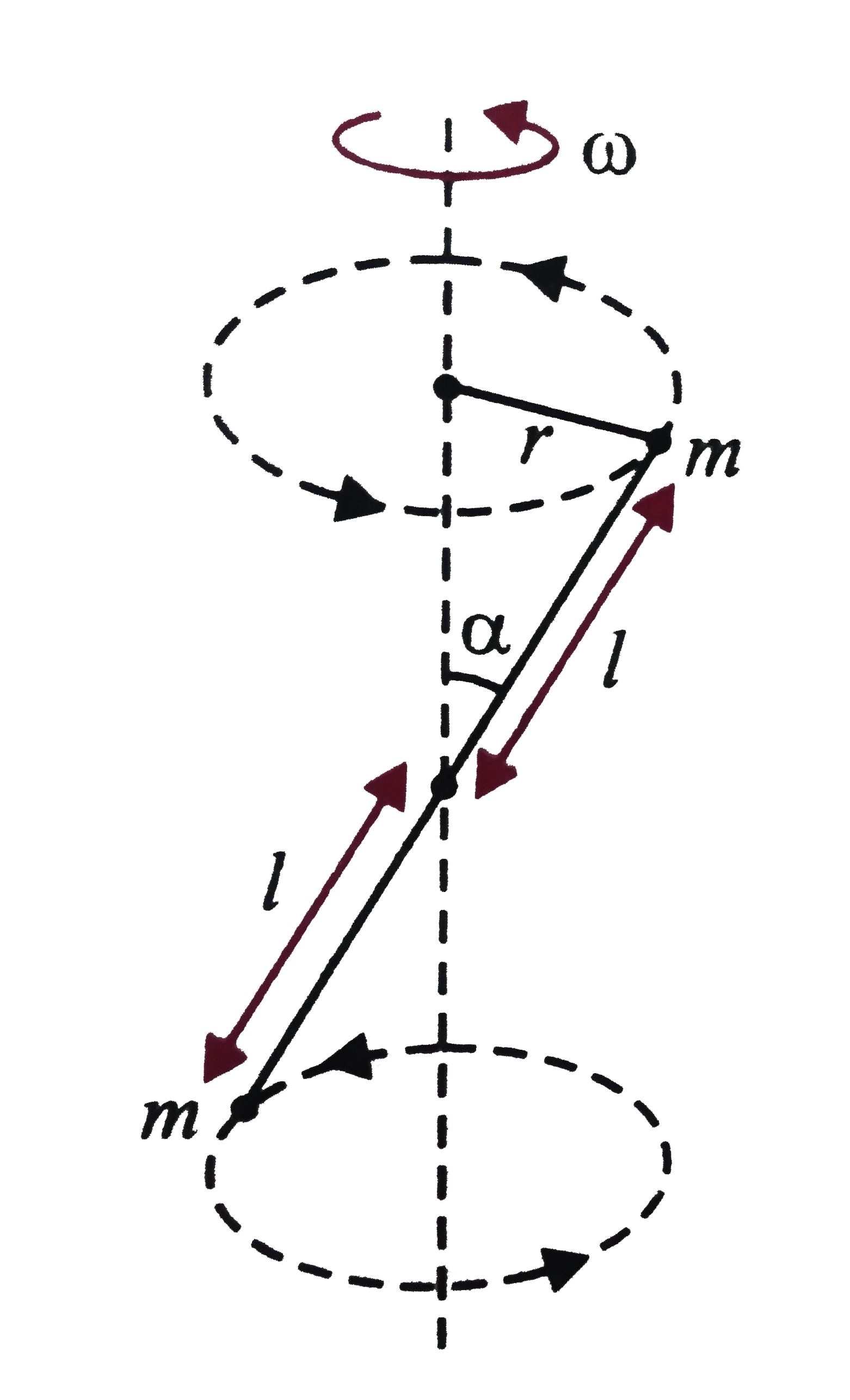 The radius `r` of the circle traced by the masses is `r = l sin alpha` Angular momentum `overset rarr(L) = overset rarr(r ) xx m overset rarr(v)` `|overset rarr(L)| = r xx m omega r = m omega r^(2)` `= momega (l sin alpha)^(2) = m omegal^(2) sin^(2)alpha` `(dL)/(dt) = m omegal^(2) sin alpha cos alpha(d alpha)/(dt)` `= m omegal^(2) (sin 2 alpha) omega = m omega^(2)l^(2) sin 2 alpha` |
|
| 17. |
A car is moving in a circular horizontal track of radius 10 m with a constant speed of 10 ms^(-1). A plumb bob is suspended from the roof of the car by a string of length 1m. The angle made by the string with vertical is (g=10 ms^(-2)) |
|
Answer» `0^(@)` |
|
| 18. |
If the escape velocity on the earth is 11.2km-s^-1, its value for a planet having double the radius and 8 times the mass of earth is |
|
Answer» `10.2 KMS^(-1)` |
|
| 19. |
Calculate the value of g in the following two cases: (a) If a mango of mass 1/2 kg falls from a tree from a height of 15 metres, what is the acceleration due to gravity when it beigns to fall? (b) Consider a satellite orbiting the Earth in a circular orbit of radius 1600 km above the surface of the Earth. What is the acceleration experienced by the satellite due to Earth's gravitational force? |
|
Answer» SOLUTION :`g^(.)=g(1-(2h)/(Re))` `=g(1-(2 XX 1600 xx 10^(3))/(6400 xx 10^(3)))=g(1-(2)/(4))` `g^(.)=g(1-(1)/(2))=(g)/(2)` `g^(.)=(8)/(2)` (or) `g^(.)=(9.8)/(2)=4.9 ms^(-2)` |
|
| 20. |
A particle is acted upon by constant magnitude force perpendicular to ot which is always perpendicular to velocity of particle. The motion is taking place in a plane it follows that : |
|
Answer» Velocity is constant |
|
| 21. |
the displacement in metres of a body varies with time t in second as y = t2 – t – 2. The displacement is zero for a positive of t equal to |
|
Answer» 1s |
|
| 22. |
Two bodies start moving in the same straight line at the same instant of time from the same origin. The first body moves with a constant velocity of 40 m/s, and the second starts from rest with a constant acceleration of 4m/s""^2. Find the time that elapses before the second catehes the firs body. Find also the greatest distance between der prior to ir and the time at which this occurs. |
|
Answer» SOLUTION :When the second body catches the first, the DITANCE TRAVELLED by each is the same. `40t=1/2(4)t^(2) or t=20S` Now, the distance s between the two bodies at any time t is `s=ut-1/2at^(2)` For s to be maximum. `(DS)/(dt)=0 or u-at=0` `or t=u/a=(40)/(4)=10s` Maximum Distance `=40 xx 10-1/2 xx 4 xx (10)^(2)=400-200=200m` |
|
| 23. |
Define projectile motion . |
|
Answer» SOLUTION : A projectile moves under the combined effect of two velocities. (i) A UNIFORM velocity in the horizontal direction, which will not change provided there isno air resistance. (ii) A uniformly changing velocity (i.e., increasing or decreasing) in the vertical direction. There are two types of projectile motion: (i) Projectile given an INITIAL velocity in the horizontal direction (horizontal projection) (ii) Projectile given an initial velocity at an angle to the horizontal (ANGULAR projection) To STUDY the motion of a projectile, let us Projectile given an initial velocity at an angle to the horizontal (angular projection) To study the motion of a projectile, let us Projectile given an initial velocity at an angle to the horizontal (angular projection) To study the motion of a projectile, let us assume that, (i)Air resistance is neglected. (ii) The effect due to rotation of Earth and curvature of Earth is negligible. (iii) The acceleration due to gravity is constant in magnitude and direction at all points of the motion of the neglected. |
|
| 24. |
From a circular disc of radius R and mass 9 M , a small disc of mass M and radius (R)/(3) is removed concentrically . The moment of inertia of the remaining disc about an axis perpendicular to the plane of the disc and passing through its centre is |
|
Answer» `(40)/(9) MR^(2)` Mass of removed portion of disc = M The moment of inertia of the complete disc about an axis passing through its centre O and PERPENDICULAR to its plane is `I_(1) = (9)/(2) MR^(2)` Now, the moment of inertia of the disc with removed portion `I_(2) = (1)/(2) M ((R)/(3))^(2) = (1)/(18) MR^(2)` Therefore , moment of inertia of theremaining portion of disc about O is `I = I_(1) - I_(2) = (9 MR^(2))/(2) = (MR^(2))/(18) = (40 MR^(2))/(9)` |
|
| 25. |
Which of the following quantities is expressed as force per unit area? |
|
Answer» Pressure |
|
| 26. |
Select the correct reason for the uplift of a jet plane A jet plane moves up in air because |
|
Answer» the gravity does not ACT on bodies moving with HIGH speeds |
|
| 27. |
Obtain the differential equation of forced oscillation. |
|
Answer» Solution :The force act on OSCILLATOR to sustain the oscillations external periodic force `F(t)= F_(0) cos omega_(d) t` Here, F(t) is the amplitude `F_(0)` of external periodic force dependently on time. Three forces act on oscillator (1) Restoring force `""F(x) = -KX(t)` (2) Resistive force `""F_(S) = -bv(t)` External periodic force `F_(d) = F_(0) cos omega_(d)t` Where `F_(0) cos omega_(d) t` is external periodic force and `omega_(d)= (2pi)/(T) implies T= (2pi)/(omega_d)` Period of external periodic force depends on the ANGULAR frequency of drivingforce. From Newton.s second law of motion, if the net force is `F(t)= ma(t)` then `F(t) = F(x) +F_(S)+F_(d)"""......."(1)` `ma(t) = -kx(t) -bv(t) +F_(0)cos omega_(d)t` but `a(t) = (d^(2)x(t))/(DT^2), v(t) = (dx(t))/(dt)` From equation (1) `m(d^(2)x(t))/(dt^2)= -b(dx(t))/(dt) -kx(t) -bv(t) +F_(0)cos omega_(d)t` `therefore m(d^(2)x(t))/(dt^2)+ b(dx(t))/(dt) +kx(t) = F_(0)cos omega_(d)t` `therefore (d^(2)x(t))/(dt^2)+(b)/(m)*(dx(t))/(dt) +(k)/(m) x(t)= (F_0)/(m) cos omega_(d)t` is the DIFFERENTIAL equation of forced oscillation. m is the mass of oscillator. This oscillator initially oscillates with its natural frequency `omega`. When we apply the external periodic force, the oscillations with the natural frequency die out, and then the body oscillates with the angular frequency of the external force. Its displacement, after the natural oscillations die out, is given by `x(t) = A cos (omega_(d)t + phi)` where t is the time measured from the moment when the periodic force is applied. The amplitude of forced oscillation, `A= (F_0)/([m^(2)(omega^(2)-omega_(d)^(2))^(2)+(omega_(d)^(2)b^(2))^(1/2)])` and phase `phi = tan^(-1) ((v_0)/(omega_(d)x_(0)))` Where `v_(0)` is the velocity of the particle at time `t=0" and "x_(0)` is the displacement of the particle at time t=0. |
|
| 28. |
A small planet revolving around a large starting a circulation orbit of radius R with a period of revolution T. The gravitaional force of attraction between the star and the planet is proportional to R^(3/2) then T is proportional to |
|
Answer» `R^(3)` |
|
| 29. |
A body of 200g begines to fall from a height where is potential energy is 80 j. Its velocity at a point where kinetic and potential energies are equal is |
| Answer» Answer :D | |
| 30. |
An ideal gas undergoes a thermodynamic process as shown in Fig. The process consists of two isobaric and two isothermal steps. Show that the network done during the whole process is W _((Net)) = P _(1) (V _(2) - V _(1)) log _(e)""(P_(2))/( P _(1)) |
|
Answer» <P> Solution :`W _(nct) =P_(2)(V _(B) -V _(A)) + P _(1) P_(2)LOG _(e) ( V _(2) // V _(B)) + P _(1) (V _(1) - V _(2)) + P _(1) V _(1) log (V _(A) //V_(1)) , P _(2) V _(B) = P _(1) V _(2), P _(2) V _(A) = P _(1) V _(1) W _(net) = P _(2) V _(B) - P _(2) V _(A) + P _(1) V _(2) log _(e) (P _(2) // P _(1)) + P _(1) V _(1) - P _(1) V _(2) - P _(1) V _(1) log ( P _(1) // P _(1)) = P _(1) (V _(2) - V _(1)) log _(e) ( P _(2) // P _(1))` |
|
| 31. |
A rod of length 1 and radius .r. is joined to a rod of length 1/2 and radius r/2 material. The free end of small rod is fixed to a rigid base and the free and of larger rod is given a twist of theta. The twist angle at the joint will be |
|
Answer» Solution :`theta_(1)+theta_(2)= theta to (1)` we know that `theta PROP (L)/(r^(4))` `:.(theta_(1))/(theta_(2))=(l_(1))/(l_(2))xx(r_(2)^(4))/(r_(1^(4)))=(1//2)/(l)xx(r^(4))/((r//2)^(4))=8, (theta_(1))/(theta_(2))=8 to (2)` After solving equation (1) and (2), we get `theta_(1)=(8)/(9) theta` |
|
| 32. |
The velocity at the maximum height of a projectile is half of its initial velocity of projection. The angle of projection is |
|
Answer» `30^(0)` |
|
| 33. |
The average resisting force that must act on a 5kg mass to reduce its speed from 65 cms^(-2) to 15 cms^(-1) in 0.2s is |
|
Answer» 12.5N |
|
| 34. |
A copper cube 0.30m on a side is subjected to a shearing force of F = 6.0xx10^6N . Assuming that the shear modulus for copper is 4.2xx10^10 N//m^2 . The angle through which the cube shear is (approximately) |
|
Answer» `0.09^@` |
|
| 35. |
Derive an expression for the acceleartion of the bodysliding down a frictionless surface |
Answer» Solution :Whenan objectof massmslideson africtionalsurfaceinclinedat anangle `theta` as shownin the figurethe forcesactingonitdecides theaccelerationof THEOBJECT(b)speedof theobject when it reachesthe bottom .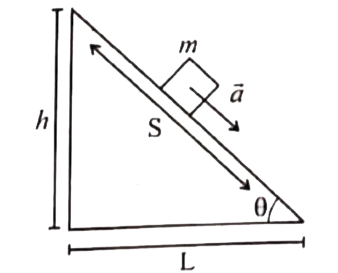 The forceactingon theobject is (i)Downwardgravitational force (mg) (II) Normalforceperpendicularto inclinedsurface (N) theblockis assumedto be apointmass[Inorder to drawthe freebodydiagram in figure(a)].Sincethe motionis on theinclinedsurfacethecoordinatesystemparallelto tehinclinedsurfaceis chosenas shown in thefigure (b)It isnotedthat theanglemadebythe gravitationalforcewith theperpendicularto the surfacesi EQUALTO theangleof inclination `theta` as shown inin figure `-mg cos theta hat(j)+ N hat(j) = 0`(No acceleration ) Bycomparingthecomponentson bothsidesN- mg cos `theta = 0` `N= mg cos theta` Themagnitude of normalforce(N)exertedby tghesurfaceis EQUIVALENTTO mgcos `theta` . Theobjectslidesalongthe x direction . Bycomparingthe componentson bothsideswe canequate `mg sin theta= ma ` Theaccelerationof theslindingobjectis 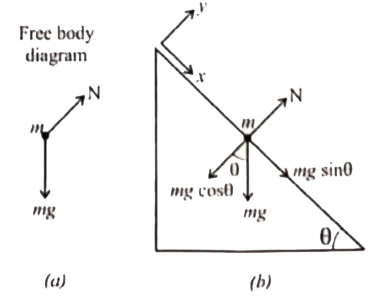 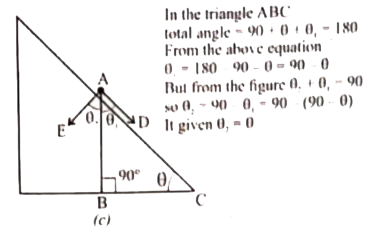 Notethat theacceleratindependson theangleinclination `theta` |
|
| 36. |
Match the column I with columnII |
|
Answer» (A)-(s),(B)-(R ),(C )-(q),(D)-(p) 
|
|
| 37. |
The sum of the given two numbers with regard to significant figures is (5.0 xx 10^(-8) ) + (4.5 xx 10^(-6) )= |
|
Answer» `4.55 XX 10^(-6)` |
|
| 38. |
A string of neglisible mass going over a clamped pulley of mass m supports a block of mass M as shown in figure. Find the force on the pulley by the clamp. |
|
Answer» |
|
| 39. |
Let y=1/(1+x^(2)) at t=0 s be the amplitude of the wave propogating in the positive x-direction. At t=2 s, the amplitude of the wave propogating becomes y=1/(1+(x-2)^(2)). Assume that the shape of the wave does not change during propogation. The velocity of the wave is |
|
Answer» `0.5 ms^(-1)` The general EXPRESSION y in terms of x `y = (1)/(1 + (x - vt)^(2))` The shape of the wave does not change: ALSO wave move in 2 SEC, 2m in positive .x. direction. So, wave moves 2m in 2 sec. `therefore`The velocity of the wave =`("displacement")/("time") = (2)/(2) : v = 1 ms^(-1)` |
|
| 40. |
Earth orbiting satellite will escape if |
|
Answer» its speed is increased by 41 % Further speed is to INCREASE `sqrt(2)` TIMES and KINETIC enegry is to increase two times. |
|
| 41. |
Does speed of planet remain constant in an orbit? |
| Answer» Solution :`IMPLIES` According to equation `v_0=sqrt((GM_e)/r)`, for definiteorbit, r is constant and ORBITAL SPEED `v_0` is constant. | |
| 42. |
The phase difference between two pointsw separated by 1 in a wave of frequency 120 Hz is 90^(@).The wave velocity will be : |
|
Answer» `480 m//s` As `Delta varphi =(2PI)/(LAMBDA)xx Delta x` (or) `(pi)/(2)=(2pi)/(lambda)xx1` (or) `lambda=4m` `v= gamma lambda120xx4= 480 m//s` |
|
| 43. |
A particle of mass 4 gm is moving simple harmonically with a period 8 sec and amplitude 8 cm. What is its velocity when the displacement is 8 cm |
|
Answer» 8 cm/sec |
|
| 44. |
Give the ideal gas equation and explain the terms . |
|
Answer» <P>`PV=(k_BN)/T` |
|
| 45. |
When the planet Jupiter is at a distance of 824.7 million kilometers from the Earth, its angular diameter is measured to be 35.72" of arc. Calculate the diameter of Jupiter. |
| Answer» SOLUTION :`1.429xx10^(5)` KM | |
| 46. |
What is the length of a simple pendulum, which ticks seconds ? |
|
Answer» SOLUTION :From Eq. (14.29), the time period of a SIMPLE pendulum is given by, `T=2pisqrt(L/g)` From this relation one gets, `L=(gT^(2))/(4pi^(2))` The time period of a simple pendulum, which ticks seconds, is 2 s. THEREFORE, for g = 9.8 m `s^(-2)` and T = 2 s, L is `=(9.8(MS^(-2))xx4(s^(2)))/(4pi^(2))` `=1M` |
|
| 47. |
Two identical water bottles one empty and the other filled with water are allowed to roll down an inclined plane. Which one of them reaches the bottom first ? Explain your answer. |
| Answer» SOLUTION :MASS of the EMPTY water bottle mostly CONCENTRATED on its SURFACE. So moment of inertia of empty water bottle is more than the bottle filled with water. As we know, moment of inertia is inversely proportional to angular velocity. Therefore, the bottle filled with water whirls with greater speed and reaches the ground first | |
| 48. |
When a liquid in a vessel is heated its levela)will increase b) may increase or decreases c) will decrease d) may remains same |
|
Answer» only (a) is CORRECT |
|
| 49. |
A Carnot engine takes 3000 kcal of heat from a reservoir at 627^(@)C. The sink is at 27^(@)C. What is the amount of work done by the engine? |
|
Answer» SOLUTION :Temperature of the reservoir, `T_(1) = (627 + 273)K = 900K` Temperature of the sink, `T_(2) = (27_273)K = 300K` `:. "EFFICIENCY", eta = 1 -(T_2)/(T_1) = 1 - (300)/(900) = 2/3` Again, `eta = W/(Q_1)` or, `W = etaQ_(1) = 2/3 xx 3000` `=2000 kcal = 2000 xx 4.2 xx 10^(3)J` `=8.4 xx 10^(6) J`. |
|
| 50. |
For a uniform body, if the shape is kept the same but its size is changed uniformly, will the position of the centre of gravity change ? |
|
Answer» |
|