

Saved Bookmarks
This section includes 7 InterviewSolutions, each offering curated multiple-choice questions to sharpen your Current Affairs knowledge and support exam preparation. Choose a topic below to get started.
| 1. |
The radius vector of a particle varies with time t as vecr=vecbt(1-alpha t)where vecbis a constant vector and a is a positive factor . Find the time interval Delta ttaken by the particle to return to the initial point |
|
Answer» SOLUTION :`vecr=vecbt(1-alpha t)` For INITIAL POINT , `vecr=0,vecb=t(1-alphat)=0` `t=0"and" t=1/alpha` HENCE,` Deltat=1/alpha ` |
|
| 2. |
C_(P) is always greater than C_(V) for a gas. Which of the following statements provide, partly or wholly,the reason for this? a) No work is done by a gas at constant volume b) When a gas absorbs heat at constant pressure, its volume must change c) For the same change in temperature, the internal energy of a gas changes by a smallar amount at constant volume than at constant pressure d) The internal energy of an ideal gas is a function only of its temperature |
|
Answer» only a,B are correct |
|
| 3. |
A car moving on a straight path with a speed of 54 km/h, passes by a stationary listener, playing hrn with a frequency 500 Hz. If velocity of sound in air is 340 m/s, find out the differenfce in frequencies of sound of horn, heard by stationary listener when car approaches him and recedes from him. |
| Answer» SOLUTION :`F _(1) - f _(L) =44.2 HZ` | |
| 4. |
Two bodies begin to fall freely from the same height. The second body begins to fall 'tau' s after the first. After what time from the beginning of first body dose the distance between the bodies equals to l? |
|
Answer» Solution :LET the time of fall of the 1st BODY be t seconds Time of fall of second body `=t-tau` Distances of free fall of the bodies in the above time INTERVALS respectively are `H_(1)=(gt^(2))/(2), H_(2)=(g(t-tau)^(2))/(2)` `H_(1)=(gt^(2))/(2), H_(2)=(g(t-tai)^(2))/(2)` Therefore `l=H_(i)-H_(2)=gt tau-1/2 gt^(2)""therefore t=l/(g tau)+tau /2` |
|
| 5. |
A man weighs 75kg on the surface of the earth. His weight on a geostationary satellite is |
| Answer» ANSWER :C | |
| 6. |
A solid cylinder rolls up an inclined plane of angle of inclination 30^(@) . At the bottom of the inclined plane the centre of mass of the cylinder has a speed of 5 m s^(-1) . How far will cylinder go up the plane ? (Take g = 10 m s^(-2)) |
|
Answer» `(15)/(4) `m |
|
| 7. |
A train was moving at the rate of 54kmh^(-1)when brakes were applied. It came to rest within a distance of 225 m. Calculate the retardation produced in the train. |
|
Answer» Solution :The final VELOCITY of the particle v = 0 The initial velocity of the particle `u=54xx(5)/(18)ms^(-1)=15ms^(-1)` `S=225m` Retardation is always against the velocity of the particle. `v^(2)=u^(2)-2AS` `0=(15)^(2)-2a(225)` `450a=225` `a=(225)/(450)ms^(-1)=0.5ms^(-2)` Hence, retardation `=0.5ms^(-2)` |
|
| 8. |
The period of a simple pendulum on the surface of earth is T. At an altitude of half of the radius of earth from the surface, its period will be |
|
Answer» `sqrt((3)/(2))T` |
|
| 9. |
Power of a man who can chew 0.3 kg ice in one minute is (in Cal/s) |
|
Answer» 400 |
|
| 10. |
The measured mass and volume of a body are 53.63g and 5.8 cm^(3) respectively, with possible errors of 0.01 g and 0.1 cm^(3). The maximum percentage error in density is about |
|
Answer» 0.002 |
|
| 11. |
One end of a long string of linear mass density10^(-2) kg m^(-1) is connected to an electrically driven tuning fork of frequency 150 Hz. The other end passes over a pulley and is tied to a pan containig a massof 90 kg. the pulley end absorbs all the incoming energy so that reflected waves from this end have neglidible amplitude , At t =0, the left end (fork end ) of the string is at x=0 has a transverse displacement of 2.5 cm and is moving along positive y-direction. the amplitude of the wave is 5 cm. write down the transverse displacement y (in cetimetres) as function of x(in metres) and t (in seconds ) that describes the wave on the string. |
|
Answer» Solution :`theta=pi//6` `V=sqrt(T//mu)=sqrt(900)/(0.01)=300 m//s` FREQUENCY `=150 Hz` `:.lambda=(v)/(f)=(300)/(150)=2m` Then equation will be `y=A sin{2pi((t)/(T)-(x)/(lambda))+theta}` `=5 sin{2pi(150t-(x)/(2))+(pi)/(6)}` `=5 sin{pi(300t-x)+(pi)/(6)}` |
|
| 13. |
A ladder .AB. of weight 300 N and length 5 m is lying on a horizontal surface. Its centre of gravity is at a distane of .2m. from end A.A weight of 80N is attached at end B. The work done in raising the ladder to the vertical position with end .A. in contact with the ground is, |
|
Answer» 500J |
|
| 14. |
A large steel wheel is to be fitted on to a shaft of the same material. At 27 ^(@) C, the outer diameter of the shaft is 8.70 cm and the diameter of the central hole in the wheel is 8.69 cm. The shaft is cooled using dry Icel. At what temperature of the shaft does the wheel slip on the shaft? Assume coefficient of linear expansion of the steel to be constant over the required temperature range: alpha_("steel ") = 1.20 xx 10^(-5) K^(-1). |
| Answer» SOLUTION :When the shaft is COOLED to TEMPERATURE ` - 69 ^(@) C`the WHEEL can SLIP on the shaft . | |
| 15. |
A,B,C and D are four points on a vertical line such that AB = BC CD. A body is allowed to fall freely from A. Prove that the respective times required by the body to cross the distances AB, BC, CD should be in the ratio 1 : (sqrt(2)-1) : (sqrt(3)-sqrt(2)). |
|
Answer» Solution :Let AB = BC = CD = x and time taken by the body to cover these distances be`t_(1), t_(2)`and `t_(3)` respectively. Now, `x = (1)/(2)"gt"_(1)^(2) """or", t_(1) = sqrt((2x)/(G)) ""cdots(1)` `2x = (1)/(2) g(t_(1)-t_(2))^(2) """or", t_(1)+t_(2)= sqrt((4X)/(g)) ""cdots(2)` `3x = (1)/(2) g(t_(1)+t_(2)+t_(3))^(2)"""or" t_(1)+t_(2)+t_(3)= sqrt((6x)/(g)) "" cdots(3)` From (1) and (2) we GET, `t_(2) = sqrt((4x)/(g))-sqrt((2x)/g)=sqrt((2x)/(g))(sqrt(2)-1)` From (2) and (3) we get , `t_(3)=sqrt((6x)/(g))-sqrt((4x)/g)=sqrt((2x)/(g))(sqrt(3)-sqrt(2))` `:. "" t_(1):t_(2):t_(3)=1:(sqrt2-1):(sqrt3-sqrt(2))""`(Proved). |
|
| 16. |
A difference of temperature of 25°C is equivalent to a difference of |
|
Answer» `25^(@)F` |
|
| 17. |
Obtain instantaneous velocity of a particle executing SHM. |
|
Answer» SOLUTION :Intantaneous velocity of SHM particle is the rate of change of displacement for a time interval. Suppose the displacement of SHM particle at time t with amplitude A and angular speed `omega` is `x(t)= A cos (omega t+ phi)"""……"(1)` where `phi` is the initial phase DIFFERENTIATING EQUATION (1) respect to t gives the instantaneous velocity `therefore v(t)= (d[x(t)])/(dt) = (d)/(dt)[A cos (omega t+ phi)]` `therefore v(t)= -A omega sin (omega t+ phi)` but `sin(omega t +phi)= pm sqrt(1-cos^(2) (omega t+ phi))` `v(t)= (-A omega) (pm sqrt(1-cos^(2) (omega t+ phi)))` `= pm omega sqrt(A^(2)-A^(2) cos^(2)(omega t+ phi))` `= pm omega sqrt(A^(2)-x^(2)(t))` Generally `v= pm omega sqrt(A^(2) - x^(2))` Special Cases : (1) At mean position, x=0 Velocity `v= pm omega A` In +x-direction, v is positive and in -x-direction, v is negative. Hence, maximum velocity of SHM particle `v_("max")= A omega` (2) At extreme point, for velocity `x= |A|`, `v= pm omega sqrt(A^(2)-A^(2))""[therefore |A|^(2)= A^(2)]` `therefore v= 0` The velocity of SHM particle at extreme points is ZERO. |
|
| 18. |
A rigid bar of mass M is supported symmetrically by three wires each of length l. Those at each end are of copper and the middle one is of iron. The ratio of their diameters, if each is to have the same tension, is equal to |
|
Answer» `("Ycopper")/("Yiron")` `impliesD=sqrt((4Fl)/(piDeltalY))or D prop sqrt((1)/(Y))` Hence `(D copper)/(D iron) = sqrt((Y iron)/(Ycopper))` |
|
| 19. |
A particle is executing simple harmonic motion with an amplitude of 2m . The difference in the magnitudes of its maximum acceleration and maximum velocity is 4. The time period of its oscilation and its velocity when it is 1m away from the mean position are respectively. |
|
Answer» `2S, 2sqrt(3)ms^(-1)` |
|
| 20. |
A stationary light, smooth pulley can rotate without friction about a fixed horizontal axis. A light rope passes over the pulley. One end of the rope supports a ladder with man and the other end supports a counterweight of mass M. Mass of the man is m. initially, the centre of mass of the counterweight is at a height h from that of man as shown in Fig. If the man starts to climb up the ladder slowly, calculate work done by him to reach his centre of mass in level with that of the counterweight. |
|
Answer» Now cenre of mass (man`+`ladder) system will be raised by `y` , then 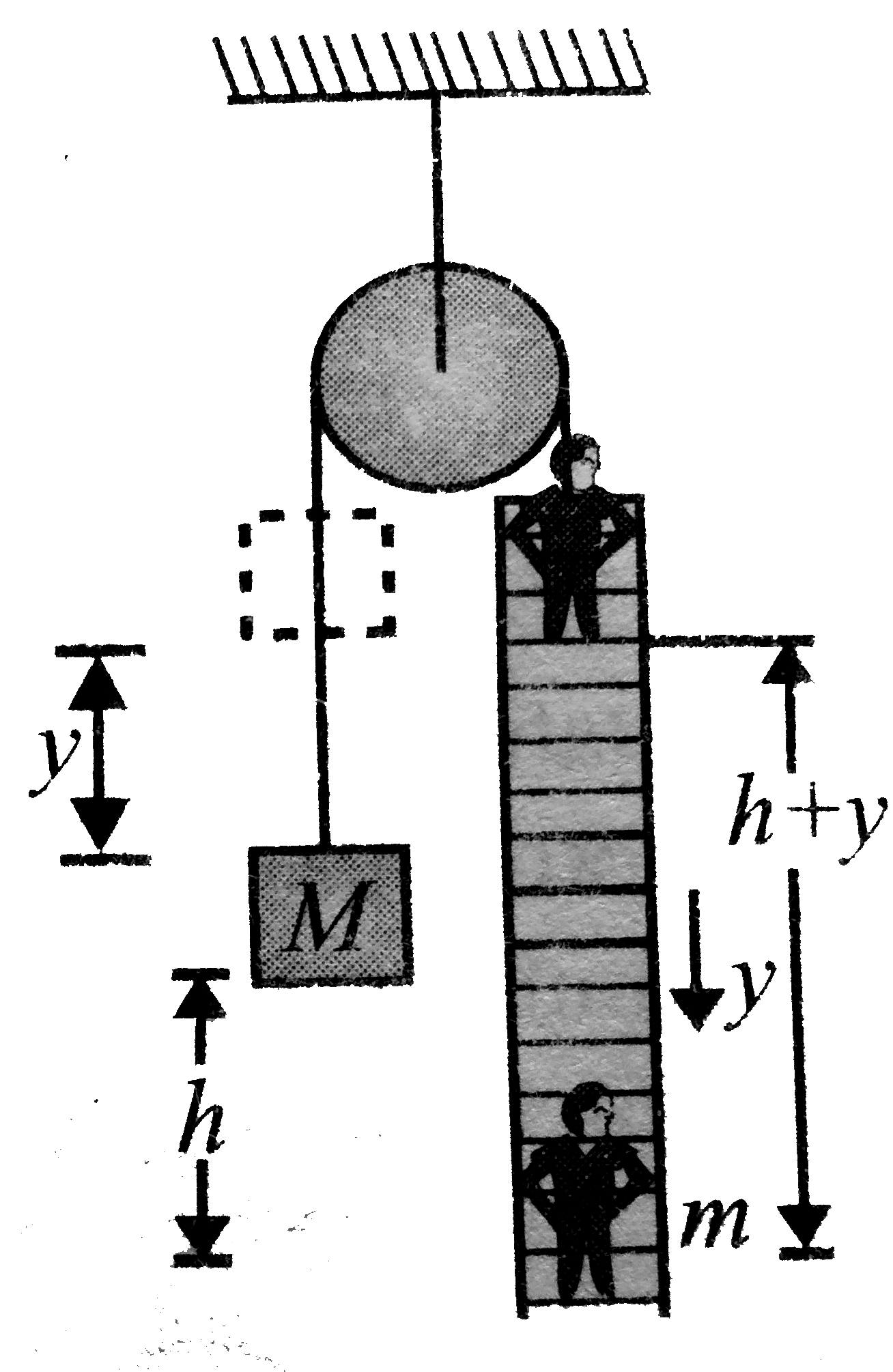 `y=(m(h+y)+(M-m)(-y))/(2(M-m))` Now work done by man `W=`total change in potential energy of system `implies W=Mgy+mg(h+y)-(M-m)GY` Put the values of `y` and solve to get `W=(Mmgh)/(M-m)` |
|
| 21. |
For the arrangment shown in the figure, tension in the string is |
| Answer» Answer :D | |
| 22. |
A vessel contains two non reactive gases : neon (monatomic) and oxygen (diatomic). The ratio of their partial pressures is 3:2. Estimate the ratio of (i) number of molecules and (ii) mass density of neon and oxygen in the vessel. Atomic mass of Ne=20.2 u, molecular mass of O_(2) = 32.0 u. |
|
Answer» Solution :Partial pressure of a gas in a mixture is the pressure it would have for the same volume and temperature if it alone occupied the vessel. (The total pressure of a mixture of non-reactive gases is the sum of partial pressures due to its constituent gases.) Each gas (assumed IDEAL) obeys the gas law. Since V and T are common to the two gases, we have `P_(1) V = mu_(1), RT` and `P_(2)V= mu_(2)RT`, i.e. `(P_(1)//P_(2)) = (mu_(1) // mu_(2))`. Here 1 and 2 referto neon and oxygen respectively. Since`(P_(1)//P_(2)) = (3//2)`(GIVEN),`(mu_(1) // mu_(2))= 3//2`. (i) By definition `mu_(1) = (N_(1)//N_(A))` and `u_(2) = (N_(2)//N_(A))`where `N_(1)` and `N_(2)` are the number of molecules of 1 and 2, and `N_(A)` is the Avogadro.s number. Therefore, `(N_(1)//N_(2)) = (mu_(1) // mu_(2)) = 3//2`. (ii) We can also write `mu_(1) = (m_(1)//M_(1))` and `mu_(2) = (m_(2)//M_(2))` where `m_(1)` and `m_(2)` are the masses of 1 and 2, and `M_(1)` and `M_(2)` are their molecular masses. (Both `m_(1)` and `M_(1)`, as well as `m_(2)` and `M_(2)` should be expressed in the same units). If `rho_(1)` and `rho_(2)` are the mass DENSITIES of 1 and 2 respectively, we have `(rho_(1))/(rho_(2))= (m_(1)//V)/(m_(2)//V)= (m_(1))/(m_(2))= (mu_(1) )/ (mu_(2)) xx (M_(1)/(M_(2)))` `= (3)/(2) xx (20.2)/(32.0)= 0.947` |
|
| 23. |
The correctness of equation can be checked using the principle of homogeneity in dimensions. The velocity V of a particle depends on time V as V=At^2+BtFind the dimensions and units of A and B. |
| Answer» SOLUTION :`[A]=[[V]]/[[t^2]]=[[M^0LT^-1]]/[[M^0L^0T^2]]=[M^0LT^-3]` UNIT of`A=ms^-3[B]=[[V]]/[[t]]=[[M^0LT^-1]]/[[M^0L^0T]]=[M^0LT^-2]` Unit `B=ms^-2` | |
| 24. |
A capillary tube of diameter 0.4mm is dipped in a beaker containing mercury. If density of mercury is 13.6 xx 10^3 kg//m^3, surface tension 0.49Nm^(-1), angle of contact 135^@, the depression of the meniscus in the capillary tube will be |
|
Answer» `0.13 m` |
|
| 25. |
Find the weight of water supported by surface tension in a capillary tube with a radius of 0.2mm. Surface tension of water is 0.072Nm^(-1) and angle of contact of water is 0^(@) |
|
Answer» Solution :Assume the weight of WATER to be .F. weight of water in capillary tube = upward force due to surface tension i.e., `F=2pir(Scostheta)` Surface tension of water `S=0.072Nm^(-1)` ANGLE of contact`theta=0^(@)` RADIUS of capillary tube `(r)=(0.2)/(1000)m=0.2xx10^(-3)m` `F=2pir(Scostheta)=2xx(22)/(7)xx0.2xx10^(-3)xx0.072xx1` `=90.51xx10^(-6)NimpliesF=90.51xx10^(-6)N` |
|
| 26. |
Derive an expression for the potential energy of a body near the surface of the Earth. (OR) Calculate the potential energy of the object of mass m at a height h. |
Answer» Solution :(i) The gravitational potential energy (U) at some HEIGHT h is equal to the amount of work required to take the object from ground to that height h with constant velocity.  (ii)Consider a body of mass m being moved from ground to the height h against the gravitational force as shown in Figure. (III)The gravitational force `vec(F)_(g)` acting on the body is, `vec(F)_(g)=-mg hat(j)` (as teh force is in y direction, unit vector is used). Here,negative sign implies that the force is acting vertically downwards. In order to move the body without acceleration (or with constant velocity), an external applied force `vec(F)_(a)` equal in magnitude but opposite to that of gravitational force `vec(F)_(g)` has to be applied on the body i.e., `vec(F)_(a)-vec(F)_(g)`. This implies that `vec(F)_(a)=-mg hat(j)` (iv)The positive sign implies that the applied force is in vertically upward direction. Hence, when the body is lifted up its velocity remains UNCHANGED and thus its KINETIC energy also remains constant. (v) The gravitational potential energy (U) at some height h is equal to the amount of work required to take the object from the ground to that height h. `U = int vec(F)_(a).d vec(r )=int_(0)^(h)|vec(F)_(a)||d vec(r )|cos theta` (vi)Since the displacement and the applied force are in the same upward direction, the angle between then, `theta = 0^(@)`. Hence, `cos theta^(@)=1` and `|vec(F)_(a)|=mg` and `= |d vec(r )|dr`. `U = ms int_(0)^(h)dr` `U=mg [r]_(0)^(h)=mgh`. |
|
| 27. |
A body moving ina curved path possessesa velicty 3m//stowards north at any instant of its motion . A fter 10s, the velocity of the body was found to be 4 m//s towards west. Calculate the average acceleration during this interval . |
|
Answer» Solution :To SOLVE this problem the vector nature of velocity must be TAKEN into account. In the figure, the initial velocity`v_(0)`and the final velocity v arfe DRAWN from a common origin . The vecto difference of them is found by the parallelogram method. The magnitude of difference is `|v-v_(0)|=OC=sqrt(OA^(2)+AC^(2))` `=sqrt(4^(2)+3^(2))=5m//s` The direction is given by `tan theta =3/4=0.75, theta =37^(0)` Average acceleration `=|vecv-vecv_(0)|/t=5/(10)=0.5m//s^(2)`at`37^(@)`south of WEST 
|
|
| 28. |
Same heat is given to Helium and Oxygen gasof equal masses under constant volume. Then the temperature of the gas which increases more is |
|
Answer» OXYGEN |
|
| 29. |
In the case of a body freely falling from small height |
|
Answer» the CHANGES of position are equal in equal intervals of time |
|
| 30. |
If a room has dimensions 3m x 4m x 5m, what is the mass of air in the room if density of air at NTP is 1.3kg/m^(3) |
|
Answer» Solution :`m=rhoxxv=(1.3kg//m^(3))(3xx4xx5m^(3))=78 kg` i.e. ,mass of AIR in the ROOM is 78 kg which is unbelievable (as air is assumed to be WEIGHTLESS) but is TRUE. |
|
| 31. |
A small hole in the wall of an enclosure behaves as |
|
Answer» GOOD absorber & POOR EMITTER |
|
| 32. |
The frequency of the whlstle of a train Is 512 Hz . Thetrain crosses a station at a speed of 72 km . h^(-1) Calculate the frequency of the sound heard by a Iistener, standing on the platform , before and after the train crosses the station. Neglect the effect of wind . Velocity of sound is 336 , m s^(-1) . |
|
Answer» Solution :Velocity of the TRAIN ` = 72 km . `h^(-1)` ` = (72 xx1000)/(60xx60) m. s^(-1)` `= 20 m. s^(-1)` When the train approaches the station , the DISTANCE covered hy 512 sound waves = 336 - 20 = 316` m ` therefore ` Apparent wavelength , ` lambda . = (316)/(512) m ` ` therefore ` Apparent frequencydue to Doppler effect ` = (" velocity of sound (V))/(lambda .)` `(336)/((316)/(512)) = (336xx512)/(316) = 544.4 Hz ` ` Again , when the train recedes from the station , the distance covered y 512 sound waves= 366 + 20 = 356 m ` therefore ` Apparent wavelength , ` lambda . = (356)/(512) m` ` therefore ` Apparent freaquency= `(V) /(lambda .) = (336)/((356)/(512)) = (336xx 512)/(356) = 483.2 Hz .` |
|
| 33. |
A body constrained to move along the z-axis of a coordinate system is subject to a constant force F give by F = hat(i)+2hat(j)+3hat(k). What is the work done by this force in moving the body a distance of 4 m along the z- axis ? |
| Answer» Answer :A | |
| 34. |
Water is taken in one beaker and glycerine in another. Both are stirred well and kept on the table. Which will come to rest first? |
| Answer» SOLUTION :The LIQUID with LARGER VISCOSITY i.e. GLYCERINE | |
| 35. |
Define angle of friction |
| Answer» Solution :The anglebetweenthe normalforce (N) ANDTHE resultantforce (R )of normalforce andmaximum FRICTIONFORCE `(f_(X)^(max))` | |
| 36. |
State and prove theorem of parallel axis. |
Answer» Solution :The moment of INERTIA of a body about any axis is equal to the sum of the moment of inertia of the body about a parallel axis passing through its centre of MASS and the product of its mass and the square of the distance between the two parallel axes.  As shown in figure Z and Z. are two parallel axes separated by a distance a. `therefore OO.=a` The Z-axis passes through the centre of mass O of the rigid body. From theorem of parallel axes `I_(Z)=I_(Z)+Ma^(2)orI_(Z)=I_(C)+M(OO.)^(2)` where `I_(Z)andI_(Z)` are the moments of inertia of the body about the Z and Z. axes respectively. M = total mass of the body a = PERPENDICULAR distance between the two parallel axes. If moment of inertia of object of any SHAPE about the axis passing through its centre is given, then moment of inertia about the axis parallel to the axis passing through its centre can be determined. |
|
| 37. |
A particle is executing SIIM with an amplitude of 0.2 m. At what distance from the mean position the potential energy of the particle will be equal to its kinetic energy ? |
|
Answer» SOLUTION :P.E. at the displacement x `P.E.= (1)/(2)m^(2)omega^(2)x^(2)`…….(1) K.E. at the displacement x is given by `K.E.= (1)/(2)m^(2)omega^(2)(A^(2)-x^(2))` …………(2) But PE=KE i.e., `(1)/(2)m^(2)omega^(2)x^(2)= (1)/(2)momega^(2)(A^(2)-x^(2))` `IMPLIES x^(2)= A^(2)-x^(2)` or `implies 2X^(2)=A^(2) x^(2)= (A^(2))/(2)` `:. x= (A)/(sqrt(2)).` But A=0.2m `:. x= (0.2)/(sqrt(2))= 0.1 xx sqrt(2)= 0.1414m` |
|
| 38. |
(A) : The velocity of a body at the bottom of an inclined plane of given height , is more when it slides down the plane, compared to when it rolling down the same plane. (R) : In rolling down, a body acquires both, kinetic energy of translation and rotation |
|
Answer» Both 'A' and 'R' are TRUE 'R' is the correct explanation of 'A' |
|
| 39. |
Describe the construction and working of venturimeter and obtain an equation for the volume of liquid flowing per second through a wider entry of the tube. |
Answer» Solution :  Venturimeter : This device is used to measure the rate of flow ( or say flow speed) of the incompressible fluid flowing through a pipe. It works on the principle of Bernoulli.s theorem. It consists of two wider tubes A and A. (with cross sectional area A) connected by a narrow tube B ( with cross sectional area a). A MANOMETER in the fonn of U-tube is ALSO attached between the wide and narrow tubes. The manometer contains a liquid of DENSITY `. rho_m .` Let `P_1`be the pressure of the fluid at the wider region of the tube A. Let us assume that the fluid of density .`rho` . flows .from the pipe with speed `v_1`and into the narrow region, its .speed increases to `v_2` . ACCORDING to the Bernoulli.s equation, this increase in speed is accompanied by a decrease in the fluid pressure `P_2`at the narrow region of the tube B. Therefore, the pressure DIFFERENCE between the tubes A and B is noted by measuring the height difference`(Delta P = P_1 + P_2)`between the surfaces of the manometer liquid. From the equation of continuity, we can say that `Av_1 = av_2`which means that ` v_2= A/a v_1` Using bernoulli.s equation, ` P_1 + rho (v_1^2)/(2) = P_2 + rho (v_2^2)/(2) = P_2 + rho 1/2 (A/a v_1)^&2` from the above equation , the pressure difference ` Delta P = P_1 - P_2= rho (v_1^2)/(2) (A^2 - a^2)/(a^2)` Thus , the speed of flow of liquid at the wide end of the tube A ` v_1^^2 = (2 (Delta P)a^2)/(rho(A^2 - a^2) ) rArr v_1= sqrt((2(Delta P)a^2)/(rho (A^2 - a^2) )` The volume of the liquid flowing out per second is `V = A v_1 = A sqrt( (2 (Delta P )a^2)/(p (A^2 -a^2) ) )= a A sqrt( (2(Delta P))/(p(A^2 - a^2) ))` |
|
| 40. |
A block of 0.5kg is placed on a horizontal platform. The system is making vertical oscillations about a fixed point with a frequency of 0.5Hz. Find the maximum amplitude of oscillation if the block does not lose contact with the horizontal platform? |
|
Answer» |
|
| 41. |
The volume of a sphere is 1.76 cm^3 . The total volume of 24 such spheres with due regard to the significant places is |
|
Answer» `0.42 XX 10^2 cm^3` |
|
| 42. |
There are three sinusoidal waves A, B and C represented by equations- A rarr Y=A sin kx, B rarr y= A/2 sin 2 kx, C rarr y=A/2 sin 3 kx (a) To get a waveform of nearly the shape given in fig (a) which of the two waves B or C shall be superimposed with wave A? (b) To get a waveform close to that in fig (b) which of the two waves B or C shall be superimposed with A? |
|
Answer» (b) C `(##IJA_PHY_V01_C13_E01_084_A01##)` `(##IJA_PHY_V01_C13_E01_084_A02##)` |
|
| 43. |
A source S and a detector D are placed at a distance d apart. A big cardboard is placed at a distance sqrt2d from the source and the detector as shown in figure. The source emits a wave of wavelength = d/2 which is received by the detector after reflection from the cardboard. It is found to be in phase with the direct wave received from the source. By what minimum distance should the cardboard be shifted away so that the reflected wave becomes out of phase with the direct wave ? |
|
Answer» Initial path DIFFERENCE is given by `2sqrt((d/2)^2+2d^2)=(2xx(3d)/2)-d` If it is now SHIFTED a distance x then PATHDIFFERENCE will be `=2sqrt((d/2)^2)+(sqrt2d+x)^2-d` `=2d+d/4` `rarr (d/2)^2+(sqrt2dx)^2=169/64d^2` `rarr (sqrt2d+x)^2=d^2(9169-16))/64` `rarr sqrt2d+x=1.54d` `rarr x=1.54d-1.414d` `=0.3d` |
|
| 44. |
When a man is standing, rain drops appears to himfalling at 60^(@) from the horizontal from his front side. When he is travelling at 5 kmph on a horizontal road they appear to him falling at 30^(@) from the horizontal from his front side. The actual speed of the rain is (in kmph) |
|
Answer» 3 |
|
| 45. |
Match the physical quantities given in column I with dimensions given in column II. (Dimension of charge is Q) |
|
Answer» 1 - (IV), 2 - (iv), 3 - (v), 4 - (ii) |
|
| 46. |
A wave travels in a medium according to the equation of displacement given by y (x , t) = 0.03 sin {pi (2t - 0.01 x)} where y and x are in metres and t in seconds . The wavelength of the wave is ………. . |
|
Answer» 200 m |
|
| 47. |
If momentum (p), area (A) and time (T) are taken to be fundamental quantities, then energy has the dimensional formula. |
|
Answer» `(pA^(-1)T^(1)]` We can write energy E as `E PROP p^(A)A^(b)T^(c)` `E= kp^(a)A^(A)T^(c)` `:. [E]=[p]^(a)[A]^(A)[T]^(c)` where K is DIMENSIONLESS constant of proportionality Dimensions of `E=[E]=[M^(1)L^(2)T^(-2)] and p]=[M^(1)L^(1)T^(-1)]` `[A]=[L^(2)]` `[T]=[T^(1)]` Putting all the dimensions, we get `M^(1)L^(2)T^(-2)=[M^(1)L^(1)T^(-1)]^(a)[L^(2)][T]^(c)` `:. M^(1)L^(2)T^(-2)=M^(a)L^(2b+b)T^(-a+c)` By comparison of power `a=1, 2b+a=2` `:.2b+1=2` `b=(1)/(2)` `-a+c=-2` `c=-2+a=-2+1=-1` Thus`|E|=[pA^((1)/(2))T^(-1)]` |
|
| 48. |
A cord of negligible mass is wound round the rim of a fly wheel of mass 20 kg and radius 20 cm. A steady pull of 25 N is applied on the cord as shown in Fig. 7.35. The flywheel is mounted on a horizontal axle with frictionless bearings. (a) Compute the angular acceleration of the wheel. (b) Find the work done by the pull, when 2m of the cord is unwound. (c) Find also the kinetic energy of the wheel at this point. Assume that the wheel starts from rest. (d) Compare answers to parts (b) and (c). |
Answer» Solution : (a) Torque `TAU=RFsintheta` `=0.2xx25xxsin90^(@)` `tau=5.0Nm[because sin90^(@)=1]` Moment of inertia `I=(MR^(2))/(2)` `=(20XX(0.2)^(2))/(2)` `therefore I=0.4kgm^(2)` Now `Ialpha=tau` `therefore alpha=(tau)/(I)=(5)/(0.4)` `therefore alpha=12.5"rad/s"^(2)""....(1)` (b) Work DONE by the pull unwinding 2m of the cord `W=Fl` `=25xx2` `therefore W=50J` (c ) Let `omega` be the final ANGULAR velocity The kinetic energy gained `=(1)/(2)Iomega^(2)...(2)` If wheel gains angular velocity `omega` after starting from rest, then Now `omega^(2)=omega_(0)^(2)+2alphatheta` `therefore omega^(2)=2alphatheta""[because omega_(0)=0]...(3)` Angular displacement `theta=("length of unwound string")/("radius of wheel")` `=(2)/(0.2)` `therefore theta=10` rad `""....(4)` From eqn. (1), (3) and (4) `omega^(2)=2alphtheta` `=2xx12.5xx10` `therefore omega^(2)=250 ("rad s"^(-1))^(2)` `therefore` kinetic energy gained `K.=(1)/(2)Iomega^(2)` `=(1)/(2)xx0.4xx250` `therefore K=50J""...(5)` (d) Equation (2) and (5) are equal, means kinetic energy gained by the wheel = work done by the force. Here, there is no loss of energy due to friction. |
|
| 49. |
If R is the radius of the Earth and g is the acceleration due to gravity on the Earth's surface. Find the mean density of the Earth. |
| Answer» ANSWER :D | |
| 50. |
A body is uniformly rotating about an axis fixed in an interial frame of reference. Let barA be a unit vector along the axis of rotation and barB be the unit vector along the resultant force on a particle P of the body away from the axis. The value of barA.barB is |
|
Answer» 1 |
|