

Saved Bookmarks
This section includes 7 InterviewSolutions, each offering curated multiple-choice questions to sharpen your Current Affairs knowledge and support exam preparation. Choose a topic below to get started.
| 1. |
Two protons are relased when they are initially 2 fermi apart. Find their seepds when they are 4 fermi apart. Give the mass of a proton. =1.67 xx 10^(-27)kg and charge =1.6 xx 10^(-19)C. |
|
Answer» Solution :Data supplied, From the law of conservation of energy, Gain in KE =Loss in P.E. Since the protons are intially at REST, gain in KE `=1/2 mv^(2)=1/2 (2m_(p))V^(2)=m_(p)v^(2)` `m_(p)=1.67 xx 10^(-27)kg` Loss in PE `=(1)/((4pi epsi_(0)) q_(1)q_(2)) ((r_(2)-r_(1)))/(r_(1)r_(2)), r_(1)="2 FERMI" =2 xx 10^(-15)m` `r_(2)="4 fermi" =4 xx 10^(-15)m, q_(1)=q_(2)=e=1.6 xx 10^(-19)C` `m_(p)v^(2)=(1)/(4pi epsi_(0)) e^(2) (r_(2)-r_(1))/(r_(1)r_(2))` `v^(2) =(1)/(4pi epsi_(0)) e^(2)/m_(p) ((r_(2)-r_(1)))/(r_(1)r_(2))=9 xx 10^(9) xx ((1.6 xx 10^(-19))^(2))/(1.67 xx 10^(-27)) xx ((4-2) xx 10^(-15))/(2 xx 10^(-15) xx 4 xx 10^(-15))=34.49 xx 10^(12)` Speed `v=5.87 xx 10^(6) m//s` |
|
| 2. |
For most of metals threshold frequency lies in which region of electro-magnetic radiation? |
|
Answer» Infrared |
|
| 3. |
Two circles with unequal radii,centred at A and B respectively,touch each other externally at T.If BD is tangent to the first circle at D and TC is transverse common tangent meeting BD at C.Also,AT has the length 3 and BT has length 2. Then the length of CD is equal to |
|
Answer» 2  BT=2 , AT=3=AD `therefore` AB=5 , AD=3 `therefore` BD=4 From triangle BTC: `COSTHETA="BT"/"BC"=2/"BC"`….(1) From triangle BAD : `cos theta="BD"/"BA"` `costheta=4/5` ….(2) From (1) and (2) `2/"BC"=4/5 rArr BC=5/2` `therefore` CD=BD-BC `=4-5/2` `=3/2` |
|
| 4. |
Gauss's law for magnetism is ...... |
|
Answer» `OINT overset(to)(B).doverset(to)(l) = 0` |
|
| 5. |
There are two separate long cylindrical wires having uniform current density. The radius of one of the wires is twice that of the other. The fig. shows the plot of magni- tude of magnetic field intensity versus radial distance (r) from their axis. The curved parts of the two graphs are overlapping. Find the ratio B_(1) : B_(2). |
|
Answer» |
|
| 6. |
Resistivityrho is given by ________ and its dimension is |
| Answer» SOLUTION :`[m/(nl^2tau), M^(-1)L^(3)T^(-3)A^(-2)]` | |
| 7. |
In the figure masses m_(1), m_(2) and M are 20 kg, 5 kg and 50 kg, respectively. The co-efficient of friction between M and ground is zero. The co-efficient of friction between m_(1) and M and that between m_(2) and ground is 0.3. The pulleys and the string are massless. The string is perfectly horizontal between P_(1) and m_(1)and also between P_(2) and m_(2). The string is perfectly vertical between P_(1)and P_(2). An external horizontal force F is applied to the mass M. Take g=10m//s^(2). (a) Draw a free body diagram for mass M, clearly showing all the forces. (b) Let the magnitude of the force of friction between m_(1) and M be f_(1) and that between m_(2) and ground be f_(2). For a particular F, it is found that f_(1)=2f_(2). Find f_(1) and f_(2). Write down equations of motion of all the masses. Find F, tension in the string and accelerations of the masses. |
Answer» Solution :(a)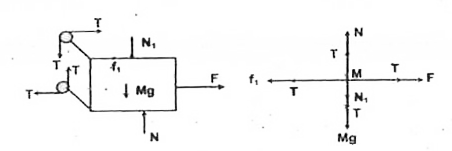 (b) We CONSIDER the following cases: (i) All the three blocks are moving and `m_(1)` moves relative to M. In this CASE, `(f_(1))_("max")= mu_(1)N_(1)=mu_(1)m_(1)g=0.3 xx 20xx10=60N` `(f_(2))_("max")=mu_(2)m_(2)g=0.3xx5xx10=15N` Given that `f_(1)=2f_(2)"or" f_(2)=f_(1)//2` The maximum value of `f_(2)` is 15N so `f_(1)` cannotbe more than 30N. This case is not possible. So, `m_(1)`remain at rest w.r.t. M. (ii) All three blocks are at rest. Now, `F-f_(1)=0, T=f_(1) and T=f_(2)` So, `f_(1)=f_(2)"" ` (not possible) (iii) All the three blocks are moving with same acceleration .a.. In this case, Equation for `M:F-f_(1)=Ma` Equation for `m_(1):f_(1)-T=m_(1)a` Equation for `m_(2):T-f_(2)=m_(2)a` `f_(1)=2f_(2)=15xx2` Solving, we get `a=0.6m//s^(2), F=60N, T=18N, f_(2)=15N, f_(1)=30N`. |
|
| 8. |
What is emw's called gammarays ? |
| Answer» SOLUTION :The `gamma`rays are HIGH energy.e.m. waves hacing very hligh FREQUENCY ranging NEARLY from `3xx 10^18`HZ to `5xx10^20`Hz. | |
| 9. |
Torqure acting on an electric dipole in an electric field is maximum when the angle between the electric field and the dipole moment is ......... |
|
Answer» |
|
| 10. |
The V-I characteristics of silicon diode is shown in Fig. Calculate the diode resistance inforward bias at V=+0.9Vreverse bias V=-3.0V. |
|
Answer» SOLUTION :In forward characteristic for VOLTAGE `V=+0.9V` `DeltaV=DE=1.0-0.80=0.2V, DeltaI=CE=10-6=4mA` `:.` Forward resistance, `R_(f)=(DeltaV)/(DeltaI)=(0.2V)/(4mA)=50OMEGA` in reverse characteristics for voltage `V=-3V ,DeltaV=-2-(-4)=2V, DeltaI=3-2=1muA` `:.` Reverse resistance, `R_(r)=(DeltaV)/(DeltaI)=(2V)/(1muA)=2xx10^(6)Omega` |
|
| 11. |
A circular disc is rolling down an inclined plane without slipping. If the angle of inclination is 30^(@), the acceleration of the disc down the inclined plane is : |
|
Answer» g For disc, `I=(1)/(2)mr^(2)impliesa=(gsin30^(@))/(1+(1)/(2)(mr^(2))/(mr^(2)))` `a=(2)/(3)gxx(1)/(2)=(1)/(3)g` |
|
| 12. |
Given below are four logic gate symbols . Those for OR, NOR and NAND are respectively |
|
Answer» 1,4,3 |
|
| 13. |
For organ pipe opens at both ends |
|
Answer» odd harmonics are PRESENT |
|
| 14. |
The torque vectau on a body about a given point is found to be equal to vecA and vecL where vecA is a constant vector, and vecL is the angular momentum of the body about that point. From this it follows that |
|
Answer» `(dvecL)/(dt)` is perpendicular to `vecL` at all instants of time `vectau=(dvecL)/(dt)therefore(dvecL)/(dt)=vecAxxvecL` By the rule of cross-product of VECTORS, `(dvecL)/(dt)` is always perpendicular to the plane containing `VECA` and `vecL`. Hence option (a) is correct (b) For vector `vecL`, the magnitude of L is constant but `vecL` is not constant. It changes. `therefore` Let `vecL = (a cos theta)hati + (a sin theta)hatj` where a is a constant. Differentiate it to obtain `vectau`. `therforevectau=-(asintheta)hati+(acostheta)hatj` `vecL.vectau=-a^(2)sinthetacostheta+a^(2)sinthetacostheta` or `vecL.vectau=0` or `vecL` is perpendicular to `vectau` `vecA` is a constant vector and is always `bot` to `vectau` Let `vecA=Ahatk` `vecL.vecA=[(acostheta)hati+(asintheta)hatj].[Ahatk]` or `vecL.vecA=0` `therforevecL` is perpendiclar to `vecA`. `therefore` Component of `vecL` along `vecA` is ZERO. ( `because Lcos90° = 0`) `therefore` Component of `vecL` along `vecA` does not change with time. Hence option (b) is correct. By the rule of dot product of vectors, `vecL.vecL = L^(2)` Differentiate it w.r.t. time. `thereforevecL.(dvecL)/(dt)+(dvecL)/(dt).vecL=2L.(dL)/(dt)` where `L=absvecL` or `2vecL.(dvecL)/(dt)=2L(dvecL)/(dt)` Since `vecL` is perpendicular to `(dvecL)/(dt)` their dot product is zero. `therefore0=2L(dL)/(dt)` or `2L(dL)/(dt)=0` This is possible if L is a constant. `therefore` Magnitude of `vecL` = constant or Magnitude of `vecL` does not change with time. Hence option ( c) is correct. ( d) `vecL` changes with time on account of change in its direction. Magnitude of does not change with time, as shown at option (c). Hence options (a), (b) and (c) are correct. Option (d) is not correct. |
|
| 15. |
The de-Broglie wavelength of electgron in 3^(rd) orbit of He^(+1) ion is approximately |
|
Answer» `2A^(@)` `lamda=(2pir)/(N)=(2pixx(0.529A^(@))(n^(2))/(z))/(n)` `lamda=(0.529A^(@))(n^(2))/(z)=2pixx(0.529A^(@))(3)/(2)` `lamda=3pixx0.529A^(@)~~5A^(@)` |
|
| 16. |
What is the difference between terminal voltage and emf of a cell ? |
| Answer» Solution :The emf of a cell is the potential DIFFERENCE between its TERMINALS in an open circuit i.e., when no current is being DRAWN from the cell. The TERMINAL voltage is the potential difference between THETERMINALS of cell in a closed circuit i.e., when some current is being drawn from the cell. | |
| 17. |
In Young's experiment band with is 2.4 mm. The interference pattern is of length 9.6 mm. The number of fringes in this length will be : |
|
Answer» 3 |
|
| 18. |
The total energy of an electron in the first excited state of the hydrogen atom is about -3.4 eV. What is the kinetic energy of the electron in this state ? |
|
Answer» Solution :In Bohr.s model , `mvr = (nh)/(2pi) and (mv^2)/r = (Ze^2)/(4 pi epsilon_0 r^2)` Which give `T = 1/2 mv^2 = (Ze^2)/(8 pi epsilon_0 r) , r = (4 pi e_0 h^2)/(Z e^2 m) n^2` These relations have nothing to do with the CHOICE of the zero of potential energy. Now, choosing the zero of potential energy at infinity we have `V = – (Z e^2/4 pi epsilon_0 r)` which gives `V = –2T and E = T + V = – T` (a) The quoted value of E = – 3.4 eV is based on the customary choice of zero of potential energy at infinity. Using E = – T, the kinetic energy of the electron in this state is + 3.4 eV . (b) Using V = – 2T, potential energy of the electron is = – -6.8 eV (c) If the zero of potential energy is chosen DIFFERENTLY, kinetic energy does not change. Its value is + 3.4 eV independent of the choice of the zero of potential energy. The potential energy, and the total energy of the state, however, WOULD alter if a different zero of the potential nergy is chosen. |
|
| 19. |
A plane longitudinal wave of angular frequency omega=1000 rad Is is travelling along positive x direction in a homogeneous gaseous medium of density d = 1kgm^(-3). Intensity of wave is I = 10^(-10) W.m^(-2) and maximum pressure change is (Delta P)_m = 2 xx10^(-4) Nm^(-2) .Assuming at x = 0, initial phase of medium particles to be zeroVelocity of the wave is |
| Answer» Answer :D | |
| 20. |
Using relevant Bohr's postulates establish an expression for the speed of the electron in nth orbit of hydrogen atom. |
|
Answer» SOLUTION :For revolution of an electron in nith Bohr orbit in a hydrogen atom the centripetal force is provided by coulombian attractive force. Hence `(m v_(n)^(2))/(r_(n)) = (1)/(4 pi in_(0)) .(e^(2))/(r_(n)^(2)) rArr m v_(n)^(2) r_(n) = (e^(2))/(4 pi in_(0))""........(i)` Again from Bohr quantum CONDITION, we have `m v_(n) r_(n) = (n h)/(2 pi)""...........(IV)` Dividing (i) by (ii), we get ` v_(n)= (e^(2))/(2 in_(0) n h)` |
|
| 21. |
An enlarged virtual image can be obtained only in |
|
Answer» CONCAVE SPHERICAL mirror |
|
| 22. |
A plane longitudinal wave of angular frequency omega=1000 rad Is is travelling along positive x direction in a homogeneous gaseous medium of density d = 1kgm^(-3). Intensity of wave is I = 10^(-10) W.m^(-2) and maximum pressure change is (Delta P)_m = 2 xx10^(-4) Nm^(-2) .Assuming at x = 0, initial phase of medium particles to be zeroThe equation of the travelling wave is given by |
|
Answer» `y = 10^(-9) sin (1000t - 5x) m` |
|
| 23. |
A plane longitudinal wave of angular frequency omega=1000 rad Is is travelling along positive x direction in a homogeneous gaseous medium of density d = 1kgm^(-3). Intensity of wave is I = 10^(-10) W.m^(-2) and maximum pressure change is (Delta P)_m = 2 xx10^(-4) Nm^(-2) .Assuming at x = 0, initial phase of medium particles to be zeroAmplitude of the travelling wave is |
|
Answer» `10^(-6) m` |
|
| 24. |
What did the villagers bring with them? |
|
Answer» Towels |
|
| 25. |
(A) : The smallest value of magnetic moment of orbiting electron orbiting about the central nucleus is equal to Bohr magneton. (R) : Orbital magnetic is given by M=e/(2m)L. |
|
Answer» Both 'A' and 'R' are true and 'R' is the CORRECT EXPLANATION of 'A'. |
|
| 26. |
Given below are some famous numbers associated with electromagnetic radiations in different contexts in physics. State the part of the electromagnetic spectrum to which each belongs.a.21 cm (wavelength emitted by atomic hydrogen in interstellar space).b.1057 MHz (frequency of radiation arising from two close energy levels in hydrogen , known as Lamb shift).c.2.7 K [temperature associated with the isotropic radiation filling all space - thought to be a relic of the 'big-bang' origin of the universe].d.5890 Å-5896 Å [double lines of sodium]e.14.4 keV [energy of particular transition in ""^(57)Fe nucleus associated with a famous high resolution spectroscopic method (Moss bauer spectroscopy)]. |
|
Answer» Solution :a.Radio WAVES (short WAVELENGTH end) b.Radio waves (short wavelength end) c.Microwave d.Visible (YELLOW) e.X-RAYS (or soft `gamma` - rays) region. |
|
| 27. |
In the figure below , the capacitance of each capacitor is 3muF. The effective capacitance betweenA and B is |
|
Answer» `(3)/(4)MUF` 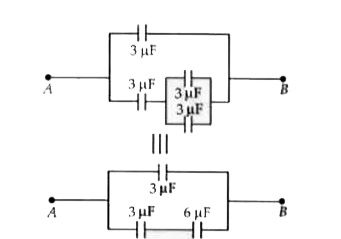 The effective capacitance BETWEENA and B is `C=3muF+(3muFxx6muF)/(3muF+6muF)=3muF+2muF=5muF` |
|
| 28. |
Which one of the following has not been expressed in proper units ? |
|
Answer» Stefan's constant - `Wm^(-2)K^(-4)` Its UNITS are `J` `mol^(-1)K^(-1)` |
|
| 29. |
What are coherent sources? |
| Answer» Solution :Two light source are said to be coherent if they produced WAVES which have same PHASE or contant phase DIFFERENCE, same FREQUENCY or WAVELENGHT (monochromatic). Same waveform and preferalby same amplitude. | |
| 30. |
The radius of curvature of the curved surface of a plano-convex lens is 20 cm. If the refractive index of the material of the lens be 1.5, it will |
|
Answer» ACT as a convex lens only for the objects that lie on its curved side. `f=(R)/(mu-1)=(20)/(1.5-1)=(20)/(0.5)=40` cm As here `f GT 0 implies` It acts like a convex lens. |
|
| 31. |
56 tunning forks are arranged in a series that each fork given 4 beats/s with previous one. The frequency of last fork is 3 times that fo first. Then frequency of first fork is : |
|
Answer» Solution :Let the frequency of 56 forks be v, v + 4 , v + 2 `xx`4 .......... V + 55 `xx ` 4. Now v + 55 `xx` 4 = 3v. `rArr ` 2V = 220 `rArr "" ` v = 110 Hz. |
|
| 32. |
Electromagnetic waves used as a diagnostic tool in medicine are |
|
Answer» X-RAYS. |
|
| 33. |
A parallel plate capacitor has a parallel sheet of copper inserted between and parallel to the two plates, without touching the plates. For what position of copper plate the capacity of the capacitor after the introduction of the copper sheet is minimum, maximum and invariant |
|
Answer» |
|
| 34. |
A point source (S) of light having power 500 W is kept at the focus of a lens of aperture diameter d. The focal length of the lens is2d/3. Assume that 40% of the incident light energy is transmitted through the lens and the complete transmitted light is incident normally on a perfectly reflecting surface placed behind the lens. Calculate the force on the reflecting surface. |
|
Answer» |
|
| 35. |
The period of revolution of planet A around the sun is 8 times that of B. The distance of A from the sun is how many times greater than that of B from the sun ? |
|
Answer» Solution :Period of revolution of planet `A(T_(A))=8T_(B)`. According to Kepler.s 111 law of planetary motion `T^(2) PROP r^(3)`. Therefore `((r_(A))/(r_(B)))^(3)=((T_(A))/(T_(B))^(2))=((8T_(B))/(T_(B))^(2))=64` or `(r_(A))/(r_(B))=4" or " r_(A)=4r_(B)` |
|
| 36. |
A wire loop carrying current 'T' is placed in the x-y plane. Magnetic induction at P is |
|
Answer» ` (mu_0I)/( 2A )((SQRT(3))/(pi )-1/3)ox` |
|
| 37. |
Derive the expression for the fringewidth ofinterferencepatternin Young'sdouble-slitexperiment . |
|
Answer» <P> Solution :Let A and B be twoslitsseparatedby a distance.d.. Let .`lambda`. be the wavelengthof light .Let .D.be the distance betweenthe screenand the double slit.Let .C. be a pointon BP such that `AP~~CP`.Path differencebetweenthe two wavesreaching.P. is GIVEN by BP-AP=BC=d From the D BFP , `BP^2 =BF^2 +FP^2`and from the `D AEP , AP^2 = AE^2 +EP^2` `BP^2 - AP^2=(D^2 + FP^2) -(D^2 - EP^2) ` i.e., `BP^2 -AP^2 =FP^2 -EP^2 ` `=(x+d/2)^2 - (x-d/2)^2 ` (BP-AP)(BP+AP)=`2(2x.d/2)` For a point .P. close to .O., BP > > AP=D (BP-AP)(2D)=2x.d But (BP-AP)=BC=d i.e.,`d=(xd)/D` or `x=(DELTAD)/d` For a constructiveinterference`d=nlambda` Distanceof `n^(th)`brightfringefrom the centralbrightfringe`x_n=n(lambdaD)/d` Distanceof `(n+1)^(th)`brightfringe from thecentralbrightfringe`x_(n+1)=(n+1)(lambdaD)/d` By definition,Fringewidthis the distancebetweentwo consecutivebrightor dark fringes . `x_(n+1)-x_(n)=b=lambda/d(n+1-n)` i.e,`beta=(lambdaD)/d` Fringewidth `beta prop D, beta prop lambda` and `beta prop 1/d`. We can show that the fringewidthbetweenany twodarkfringes is ALSO`beta=(lambdaD)/d` . |
|
| 39. |
Assertion :- If s steel core is used ina transformer in place of soft iron core then hyesterisis losses are increased Reason :- Steel core is easily magnetised but it is easily not demagnetised by the alternating magnetic field. |
|
Answer» If the ASSERTION & Reason are True& the Reason is a correct explanation of the Assertion . |
|
| 40. |
Ina situation the contact force by a rough horizontal surfaceon a body placed on it has constant magnitude . If the anglebetweenthisforce and the verticalis decreased , thefrictionalforce betweenthe surface and thebody will |
|
Answer» increase |
|
| 41. |
Show that linear magnification of an image formed by a curved mirror may be expressed as : m=f/(f-u) = (f-v)/f where the letters have their usual meanings. |
|
Answer» Solution :We know that linear magnification of an image FORMED by a spherical MIRROR is GIVEN by : `m=h^(.)/h = -v/u` ………..(i) However, from mirror formula `1/v = 1/f - 1/u = (u-f)/(UF)` or `v=(uf)/(u-f)` `m=-v/u = -1/u (uf)/(u-f) =f/(f-u)` Again as PER mirror formula `1/u =1/f- 1/v = (v-f)/(fv)` `therefore = -v/u =-v(v-f)/(fv) = (f-v)/f`.....(iii) |
|
| 42. |
The potential energy of the orbital electron i the ground state of hydrogen atom is -E. What is its kinetic energy? |
|
Answer» `(E)/(4)` `(MV^(2))/(r)=(KE^(2))/(r^(2)) RARR (1)/(2) mv^(2)=(ke^(2))/(2r)...(1)` Potential energy `=-(ke^(2))/(r)....(2)` Say E is potential energy then `E=-(ke^(2))/(r)` `:.` Kinetic energy `=-(ke^(2))/(r)=(1)/(2)(-(ke^(2))/(r))` `:.`Kinetic energy `=(E)/(2)` |
|
| 43. |
The electric current in a wire in the direction from B to A is decreasing. What is the direction of induced current in the metallic loop kept above the wire as shown in the Fig. 6.16? |
|
Answer» |
|
| 44. |
The electric current 'i' in the given circuit is |
|
Answer» A |
|
| 45. |
Obtain an expression for potential energy due to a collectrion of three point charges which are separated by finite distances. |
|
Answer» Solution :Electrostatic potential energy for collection of point charges : The electric potential at a point at a distance r from charge `q_(1)` is given by `V=(1)/(4piepsilon_(0)) (q_(1))/(r )` This potential V is the work done to bring a unit POSITIVE charge from infinity at a distance r from `q_(1)` the work done is the product of `q_(2)` and the electric potential at that point. THUS we have `W = q_(2) V ` This work done is STORED as the electrostatic potential energy U of a system of charge `q_(1)` and `q_(2)` separated by a distance r. Thus we have `U=q_(2)V=(1)/(4piepsilon_(0))(q_(1))/(q_(2))/(r)` The electrostatic potential energy depends only on the distance between the two point charges . In fact the expression (3) is derived by assuming that `q_(1)` is fixed and `q_(2)` is brought from infinity. The equation (3) holds true when `q_(2)` is fixed and `q_(1)` is brought from infinity or both `q_(1)` and `q_(2)` are simultaneously brought from infinity to a distance r between them . Three charges are arranged in the following configuration as shown in Figure . To calculate the total electrostatic potential energy we use the following procedure . We bring all the charges one by one and arrange them according to the configuration . 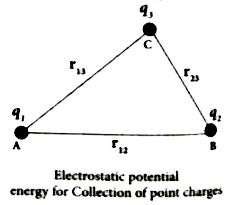 (i) Bringing a charge `q_(1)` from infinity to the point A requires no work because there are no other charges already present in the vicinity of charge `q_(1)` . (ii) To bring the second charge `q_(2)` to the point B work MUST be done against the electric field created by the charge `q_(1)` . So the work done on the charge `q_(2)` is W=` q_(2) V_(1B).` Here `V_(1B)` is the electrostatic potential due to the charge `q_(1)` at point B. `U=(1)/(4piepsilon_(0))(q_(2)q_(2))/(r_(12))` NOTE that the expression is same when `q_(2)` is brought first and then `q_(1)` later. (iii) Similarly to bring the charge `q_(3)` to the point C work has to be done against the total electric field due to both charges `q_(1)` and `q_(2)` . So the work done to bring the charge `q_(3)` is =` q_(3)(V_(1C)+V_(2C)).` Here `V_(1C)` is the electrostatic potential due to charge `q_(1)` at point C and `V_(2c)` is the electrostatic potential due to charge `q_(2)` at point C . The electrostatic potential is `U= (1)/(4piepsilon_(0))((q_(1)q_(3))/(r_(13))+(q_(2)q_(3))/(r_(23)))` (iv) Ading equations (4) and (5) the total electrostaic potential for the system of three charges `q_(1), q_(2)` and `q_(3)` is `U=(1)/(4piepsilon_(0))((q_(1)q_(2))/(r_(12))+(q_(1)q_(3))/(r_(13))+(q_(2)q_(3))/(r_(23)))` Note that this stored potential energy U is equal to the total external work done to asemble the three charges at the given locations . The epression (6) is same if the charges are brought to their poitions in any other order. Since the Coulomb force is a conservative force the electrostatic potential energy is independent of the manner in which the configuration of charges is arrived at . |
|
| 46. |
Which of following phenomenon is not to explained by Huygen's construction of wavefront? |
|
Answer» REFRACTION |
|
| 47. |
Refraction through eye of Anableps anabelps fish Figure 34-28 shows a vertical cross section through an eye of the Anableps anableps fish that swims with each eye half in and half out of the water, with a pigment band separating the two halves at the water surface. The front of the eye (the cornea) is a spherically convex refracting surface of radius r=1.95mm and index of refraction n_(2)=1.335. The refraction at the cornea is the first step in the eye's focusing of a real image into the back of the eye (the retina), where visual processing begins. If the cornea faces an insect (lunch) at object distance p=0.20m, what is the image distance i of that refraction for the cornea in air (n_(1)=1.000) and in water (n_(1)=1.333) ? |
|
Answer» Solution :(1) Because the object and its image are on opposite SIDES of the refracting surface with its convex side facing the object, the situation is like either Fig. 34-24a (for a real image) or Fig.34-24c (for a virtual image). (2) Image distance and object distance are related by `(n_(1))/(p)+(n_(1))/(i)=(n_(2)-n_(1))/(r )` Calculation : SOLVING this equation for i gives us `i=(n_(2))/((n_(2)-n_(1))/(r )-(n_(1))/(p))` Substituting the given values and using the index of refraction `n_(1)=1.000` for air, we find `i=(1.335)/((1.335-1.000)/(0.00195)-(1.000)/(0.20))` `=8.00mm` Repeating the calculation but using the index of refraction `n_(1)=1.333` for water, we find `i=(1.335)/((1.335-1.333)/(0.00195)-(1.333)/(0.20))` `=-0.237m` Learn : After LIGHT is refracted by the cornera, it is further refracted by a lens to give a final real image on the retina. (The function of a lens is discussed in the next section). Our first answer is positive (indicating a real image, as needed) and about twice the diameter of the eye. Thus, the role of the lens in focusing the light onto the retina is moderate because so much refraction occursat the cornea. Our second answer is quite DIFFERENT : It is negative (indicating a virtual image ) and much larger. So far more focusing is required by the lens to put a real image onto the retina. to provide moderate focusing of light from the water, the eye lens in Anableps anableps is egg shaped, with much greater curvature in the bottom half than in the top. 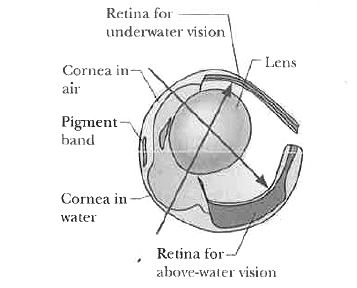
|
|
| 48. |
Resultant of two vectors vec F 1 and vec F 2 is of magnitude vec p . If vec F_2 is reversed then resultant is of magnitude Q. what is the value of P^2 +Q^2 |
|
Answer» `F_1^2+F_2^2` |
|
| 49. |
Two bodies of masses m_1 and m_2 are acted upon by a constant force F for a time t . They start from rest and acquire kinetic energies E_(1) and E_(2) respectively . Then (E_(1))/(E_(2)) is |
|
Answer» `(m_1)/(m_2)` `:.V_1=u+a_1t=0+(F)/(m_1).t` `:.E_1=1/2mv_1^2=1/2m_1.(F^2)/(m_1^2).t=(F^2t)/(2m_1)` SIMILARLY`a_2=(F)/(m_2)` `v_2=u+a_2t=0+(F)/(m_2).t` `:.E_2=1/2m_2v_2^2=1/2m_2.(F^2)/(m_2^2)t^2=(F)/(m_1)=(F^2t)/(m_2)` `:.``(E_1)/(E_2)=(m_2)/(m_1)` |
|