

Saved Bookmarks
This section includes 7 InterviewSolutions, each offering curated multiple-choice questions to sharpen your Current Affairs knowledge and support exam preparation. Choose a topic below to get started.
| 1. |
Suppose a pure Si crystal has 5 xx 10^(22) atoms m^(-3) . It is doped by 1 ppm concentration of pentavalent . As . Calculate the number of electrons and holes . Given that n_(i) = 1.5 xx 10^(16) m^-3 . |
|
Answer» Solution : The thermally GENERATED electrons (`n_(i) ~ 10^(16) m^(-3)`) are negligibly small as compared to those produced by doping . Therefore , `n_(e) ~~ N_(D) ` . Since `n_(e) n_(h) = n_(i)^(2)` , the NUMBER of holes`n_(h)= (2.25 xx 10^(32))// (5 xx 10^(22))` ` ~ 4.5 xx 10^(9) m^(-3)` |
|
| 2. |
In space communication, the information can be passed from one place to another at a distance of 100km in |
| Answer» Answer :D | |
| 3. |
Using Wien's formula, demonstrate that (a) the most probable radiation frequency omega_(pr) prop t, (b) the maximum spectral density of thermal radiation (u_(omega))_(max) prop T^(3), (c ) the radiosity M_(e) prop T^(4). |
|
Answer» SOLUTION :(a)The most probable radiation frequency `omega_(P)` is the frequency for which `(d)/(d omega) u_(omega) = 3 omega^(2)F(omega//T)+(omega)/(T)^(3)F(omega//T) = 0` The maximum frequency is the ROOT other than `omega = 0` of this EQUATION. It is `omega=- (3TF(omega//T))/(F'(omega//T))` or `omega_(Pr) = x_(0)T` where `x_(0)` is the solution of the TRANSCENDENTAL equation `3F(x_(0)) +x_(0)F' (x_(0)) =0` (b) The maximum spectral DENSITY is the density corresponding to most probable frequency. It is `(u_(omega))_(max) = x_(0)^(3)F(x_(0))T^(3) alphaT^(3)` where `x_(0)` is defined above. (c ) The radiosity is `M_(e) = (c)/(4) underset(0)overset(oo)int omega^(3)F((omega)/(T)) d omega = T^(4) [(4)/(c) underset(0)overset(oo)int x^(3)F(x)dx]alpha T^(4)` |
|
| 4. |
A galvanometer og resistance (G) 10Omega and series resistance (R) 240Omegais used to convert it into voltmeter of 2 V reading .The current passing throuhg the circuit is |
|
Answer» 0.008mA |
|
| 5. |
Define S.I unit of charge . |
| Answer» Solution : the S.I UNIT of charge is coulomb (C ) it is defined as the charge FLOWING through a WIRE in one second when the current is one ampere. | |
| 6. |
A rectangular loop with a slide wire of length l is kept in a uniform magnetic field as shown in the figure. The resistance of slider is R. Neglecting self inductance of the loop find the current in the connector during its motion with a velocity v. |
Answer» SOLUTION : The Equivalent CIRCUIT is The equivalent RESISTANCE of the circuit is`R = (R+ (R_1 R_2)/(R_1 + R_2) )` Hence the current in the connector is i ` = e/R` ` THEREFORE i = (Blv (R_1 + R_2))/((R R_1 + RR_2 + R_1 + R_2))` |
|
| 7. |
Consider three charges q_1,q_2,q_3 each equal to q at the vertices of an equilateral triangle of side l. what is the force on a charges Q ( with the same sign as q)placed at the centroid of the triangle,as shown in figure? |
| Answer» Solution : The forces `F_1 ,F_2 and F_3` are equal ( in magnitude) and act ALONG the MEDIANS with inclination `120^(@) ` each. They form a CLOSED VECTOR triangles and hence the resultant is zero. | |
| 8. |
A source emitting a sound of frequency n is placed at a large distance from an observer. The source starts moving towards the observer with a uniform acceleration a. Find the frequency heard by the observer corresponding to the wave emitted just after the source starts. The speed of sound in the medium is v. |
| Answer» SOLUTION :`(2vn^2)/(2vn -a)` | |
| 9. |
It is desired to measure the magnitude of field between the poles of a powerful loud speaker magnet. A small flat search coil of area 2 cm^2 with 25 closely wound turns, is positioned normal to the field direction, and then quickly snatched out of the field region. Equivalently, one can give it a quick 90^@ turn to bring its plane parallel to the field direction). The total charge flown in the coil (measured by a ballistic galvanometer connected to coil) is 7.5 mC. The combined resistance of the coil and the galvanometer is 0.50 Omega. Estimate the field strength of magnet. |
|
Answer» Solution :`Q = int_(t_i)^(t_f) I dt` `=1/R int_(t_i)^(t_f) epsi dt` `= - N/R int_(Phi_i)^(Phi_f) d Phi` `= N/R (Phi_i - Phi_f)` for N= 25 , R=0.50 `Omega, Q = 7.5 xx 10^(-3)` C `Phi_f = 0 , A = 2.0 xx 10^(-4) m^2, Phi_i = 1.5xx10^(-4) Wb` `B= Phi_f//A = 0.75 T` |
|
| 10. |
Two circular rings A and B each of radius a = 30 cm are placed coaxially with their axis horizontal in a uniform electric field E = 10^(5) NC^(-1)directed vertically upward as shown in figure. Distance between centers of the rings A and B (C_A and C_B)is 40 cm. Ring A has positive charge q_A = 10muCand B has a negative charge q_B = -20muC. A particle of mass m and charge q = 10muC is released from rest at the center of ring A. If particle moves along C_AC_B, then Work done by electric field, when particle moves from C_A to C_B is |
|
Answer» `-1.2 J` `=3.6J` Since only conservative forces act on the system, potential energy CHANGES to kinetic energy. `3.6=(1)/(2)mv^(2)` or `V^(2)=72` or `v=6sqrt(2)ms^(-1)` |
|
| 12. |
Elaborate the standard construction details of AC generator. |
|
Answer» SOLUTION :CONSIDER a rectangular coil of, N turns kept Figure(a). The coil rotates in anti-clockwise direction with an angular velocity `OMEGA` about an axis, perpendicular to the field. ii. At time = 0, the plane of the coil is perpendicular to the field and the flux linked with the coil has its maximum value `Phi_(m)=BA` (where Ais the area of the coil). iii. In a time t seconds, the coil is rotated through an angle `theta(=omegat)` in anti-clockwise direction. In this position, the flux linked is `Phi_(m)COSOMEGAT,` a component of `Phi_(m)` normal to the plane of the coil (Figure(b)). The component parallel to the plane `(Phimsinomegat)` has no role in electromagnetic induction. Therefore, the flux linkage at `NPhi_(B)=NPhi_(m)cos omegat`  iv. According to Faraday's law, the emf induced at that instant is `epsi=(d)/(dt)(NPhi_(B))=-(d)/(dt)(NPhi_(m)cosomegat)` =-NPhi(-sinomegat)omega` =NPhi_(m)omegasinomegat` v. When the coil is rotated through 90o from intial position, `sinomegat=1.` Then the maximum value of induced emf is `epsi_(m)=NPhi_(m)omega` `epsi_(m)=NBAomega""" SINCE "Phi_(m)=BA` vi. Therefore, the value of induced emf at that instant is then given by `epsi=epsi_(m)siomegat.` vii. It is seen that the induced emf varies as sine function of the time angle `omegat.` The graph between induced emf and time angle for one rotaion of coil will be a sine curve (Figure) and the emf varying in this manner is called sinusoidal emf or alternating emf. |
|
| 13. |
A black body, at temperature T K emits radiation at the rate of 81 W/m2. It the temperature falls to 173 K. then the new rate of thermal radiation will be |
| Answer» Answer :D | |
| 14. |
A beam of light consisting of two wavelengths 6500Å and 5200Å is used to obtain interference fringes in YDSE. The distance between slits is 2mm and the distance of the screen form slits is 120 cm. What is the least distance from central maximum where the bright due to both wavelengths coincide? |
|
Answer» 0.156cm or `n_1/n_2 = lambda_1/lambda_2 = 5200/6500= 4/5 ` ` :.` 4th maxima of `lambda_1` coincides with 5th maxima of `lambda_2`. ` y_min = (4lambda_1 D)/d ` ` = (4 XX 6500 xx 10^-10 xx 1.2)/(2 xx (10^(-3)))` ` = 1.56 xx 10^(-3)m = 0.156 CM ` . |
|
| 15. |
During the process of modulation, if phase of the carrier wave is varied in accordance with information/message signals then it would result in |
|
Answer» AMPLITUDE modulation |
|
| 16. |
Assertion : A charge, whether stationary or in motion produces a magnetic field around it. Reason : Moving charge produce only electric field in the surrounding space. |
|
Answer» If both ASSERTION and reason are true and reason is the correct EXPLANATION of assertion |
|
| 17. |
The intensity produced by a long cylindrical light source at a small distance r from the source is proportional to |
|
Answer» `1/r^2` |
|
| 18. |
A cube of side b has a charge g at each of its vertices. Determine the potential and electric field due to this charge array at the centre of the cube. |
|
Answer» SOLUTION :Consider a cube ABCDEFGH of side b each and let a charge q beplaced at all the 8 vertices of the cube. We KNOW that distance of centre point o of the cube from any vertex `r = (b sqrt3)/2`. `:.` Total potential at point O `V = 8 XX 1/(4pi epsi_0). q/r = 8/(4pi epsi_0) .q/((bsqrt3)/2) = (4Q)/(sqrt3pi epsi_0b)` The resultant electric field at point O is zero because electric field is a vector and the fields due to diagonally opposite charges of cube, being equal but opposite, nullify each other. |
|
| 19. |
Determine the age of an ancient wooden piece, if it is known that specific activity of C^(14) nuclide in it amounts to 3/5 of that in freshly fallen trees. The half life of C^(14) nuclide is 5570 yrs |
|
Answer» `2.2 xx 10^(2) yrs` `3/5 N_(0)=N_(0) e^(-lambda t) or t=(ln ""5/3)/(lambda)` `RARR t=(ln ""5/3)/((ln 2)/(T))=5570 (ln""5/3)/(ln 2)=4.1 xx 10^(3) yrs` |
|
| 20. |
A ray of light passes through four transparent media with refractive indices mu_(1),mu_(2),mu_(3), and mu_(4) as shown in figure. The surfaces of all media are paralle. If the emerent ray CD is parallel to the incident ray AB, we must have |
|
Answer» `mu_(1)=mu_(2)` `.^(1)mu_(2)=(sini)/(sinr_(1))=(mu_(2))/(mu_(1))`(i) Applying Snlle's law at Q, `.^(2)mu_(3)=(sinr_(1))/(sinr_(2))=(mu_(3))/(mu_(2))`(ii) Again, applying Snell's law at R, `.^(3)mu_(4)=(sinr_(1))/(sinr_(2))=(mu_(4))/(mu_(3))` (iii) Multiplying (i), (ii) and (iii) , we get `mu_(4)=mu_(1)` Correct option is (d). 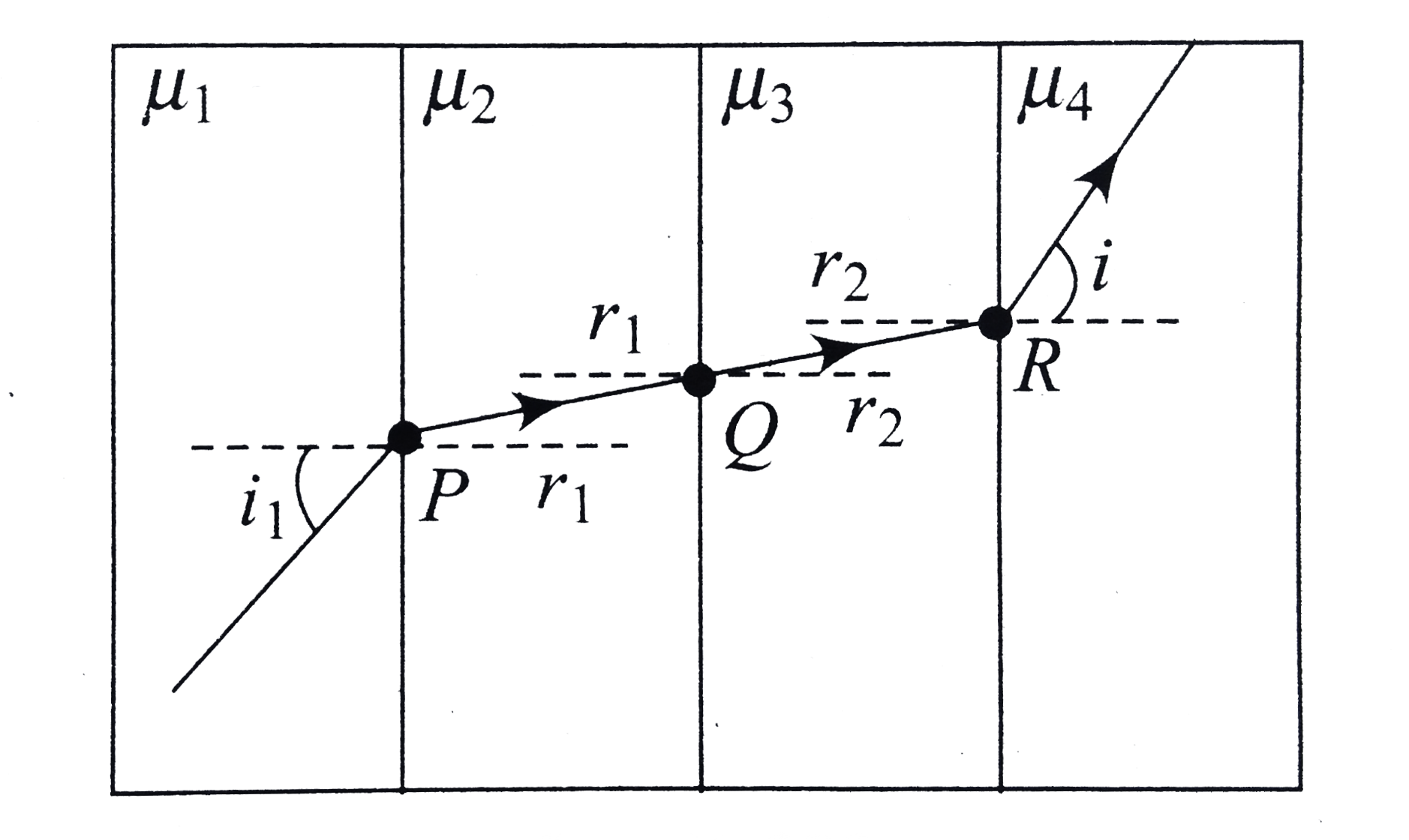
|
|
| 21. |
A hollow sphere of glass of R.I .n has small mark M on its interior surface which is observed by an observer O from a point outside the sphere, .C is centre of the sphere. The inner cavity (air) is concentric with the external surface and thickness of the glass is every where equal to the radius of the inner surface. Find the distance by which the mark will appear nearer than it really is in terms of n and R assuming paraxial rays. |
Answer» _E01_156_S01.png) Now `u_(2) = R-V_(1) = R + (2nR)/((2n-1)) = ((4n-1))/((2n-1))R` `(1)/(v_(2)) + (h)/(((4n-1)/(2n-1))R) = (1-n)/(-2R) implies v_(2) = -((4n-1)/(3n-1))xx 2R` Total shift = `3R - |v_(2)|` =`3R - (4n-1)/(3n-1) xx 2R = ((n-1))/((3n-1))R` |
|
| 22. |
Assertion (A) : Self-inductance of a coil is also called its 'electrical inertia'. Reason (R) : Self-inductance is the phenomenon due to which an induced emf is set up in a coil as a result of change in current in the coil. |
|
Answer» If both assertion and reason are true and the reason is the CORRECT explanation of the assertion. |
|
| 24. |
Explain the formulas of energy of electron in atom revolving around the nucleus in different orbits. |
|
Answer» Solution :According to the Rutherford nuclear model of the atom which is a electrical neutral sphere of a very small, massive and positively charged nucleus at the centre surrounding by the revolving electron in their respective STABLE orbits. The electrostatic force of attraction, `F_(e)` between the revolving electrons and the nucleus provides the requisite centripetal force to keep them in their orbits. For a stable orbit in a hydrogen atom, `F_(e)=F_(e)` where `F_(e)=` Electric force `F_(e)=` Centripetal force `:.(1)/(4pi epsi_(0))*(e^(2))/(r^(2))=(MV^(2))/(r)` `:.r=(e^(2))/(4pi epsi_(0)) mv^(2)....(1)` which is the relation between the velocity of electron to the orbital radius. The kinetic energy of electron in hydrogen atom. `(1)/(2)mv^(2)=(e^(2))/(2xx4pi epsi_(theta)r) [ :.`From equqtion (1)] And potential energy `tj=-(1)/(4pi epsi_(0))*(Zexxe)/(r)""..(3)` [ `:.` For hydrogen Z=1] In this formula, the negative sign in U signifies that the electrostatic force is in the -r. Hence, the total energy of electron in a hydrogen atom is, `E=K+U` `=(e^(2))/( 8pi epsi_(0)r)-(e^(2))/(4pi epsi_(0)r)` [ `:.` From EQUATION (1) and (2)] `:.E=(e^(2)-2e^(2))/(8 pi epsi_(0)r)=-(e^(2))/(8 pi epsi_(0)r)` `:. E=-(e^(2))/(8 pi epsi_(0)r)` The total energy of the electron is negative. The implies the fact that the electron is bound to tl nucleus. If total energy were positive, an electron will N follow a closed orbit around the nucleus. |
|
| 25. |
Show that nuclear density is almost constant for nuclei with Zgt10. |
|
Answer» Solution :Nuclear density, `rho` = (mass of the nuclei)/(VOLUME of the nuclei) = `(A.m)/((4)/(3) pi R_(0)^(3)A) = (m)/(4/3 pi R_(0)^(3))` `rho = (1.67 xx 10^(-27))/(4/3 pi xx (1.2 xx 10^(-15))^(3)) = 2.3 xx 10^(17) kg m^(-3)` The EXPRESSION shows that the nuclear density is independent of the mass number A.In other words, all the nuclei `(Z gt 10)` have the same density and it is IMPORTANT characteristics ofthe nuclei. |
|
| 26. |
For the combination of one prism and 2 lenses shown in figure, the size of the final image (in mm) = 0.5n. When the object (of length 1 cm) is located as shown in the figure. Refractive index of material from which prism is made is p = 1.5. Find the value of n |
|
Answer» |
|
| 27. |
What is the area of the plates of 0.1muFparallel plate capacitor ,given that separation between the plates is 0.1mm? |
| Answer» SOLUTION :`A=(CD)/(epsilon_0)=(0.1xx10^(-6)xx0.1xx10^(-3))/(8.85xx10^(-12))=1.13m^2` | |
| 28. |
Drift speed of electrons is of the order of 10^(-3) m/s , but current is established in the circuit with the speed of light . Explain . |
| Answer» SOLUTION :Electric fieldis BUILT up the conductorwith SPEED of LIGHT. | |
| 29. |
Calculate the focal leght of a reading glass of a person if his distance vision is 75 cm. |
|
Answer» 37.5 cm |
|
| 30. |
In the above question what is the displacement of the cyclist from his starting point ? |
| Answer» Answer :C | |
| 31. |
A small telescope has an objective lens of focal length 60 cm and an eyepiece of focal length 4 cm. The magnifying power of the telescope is ________ and the separation between the objective and eyepiece is ________. |
| Answer» Solution :HINT : `|m|=(f_(0))/(f_(e))=(60)/(4)="15 and L "=f_(0)+f_(e)=60+4=64 cm` | |
| 32. |
A massless spool of inner radius r, outer radius R is placed against vertical wall and tilted split floor as shown. A light inextensible thread is tightly wound around the spool through which a mass m is hanging. There exists no friction at point A, while the coefficient of friction between spool and point B is μ . The angle between two surface is theta. |
|
Answer» The magnitude of force on the spool at B in order to MAINTAIN equilibrium is mgr= jR ... (i) `N_(1) sintheta + f= mg` ….(ii) `N_(1)COSTHETA =N_(2)` …(iii) From (i), `f=(mgr)/R` `N_(2)=(mg-f)/(tantheta)=(mg)/(tantheta)[1-r/R]` Net force at B: `F_(g)=sqrt(f^(2)+N_(2)^(2))=mgsqrt((r/R)^(2)+(1-r/R)1/(tan^(2)theta))` For minimum value of `mu:flemuN_(2)` `rArr(mgr)/Rle(MUG)/(tantheta)[1-r/R]rArrmugge(tantheta)/((R//r)-1)` 
|
|
| 33. |
Average magnetic energy density mu_B is given by _____. |
| Answer» SOLUTION :`mu_B = (1)/2 (B^2)/mu_0` | |
| 34. |
The half-life of radium is 1600 y. How much of 1 mu g of radium will remain undistintegrated after 8000 y? |
|
Answer» `(1)/(28) mu g` |
|
| 35. |
In a Wheatstone's network , four resistors with resistances P,Q,R and S are connected in a cyclic order. Write the balancing conditionof the network . |
|
Answer» SOLUTION :Ratios of upper resistancesis EQUAL to ratiosof LOWER RESISTANCES . `P/Q=S/R` |
|
| 36. |
An optical instrument used for angular magnification has a 25 D objective and a 20 D eyepiece. The tube length is 25 cm when the eye is least strained. a. Whether it is a microsciAn optical instrument used for angular magnification has a 25 D objective and a 20 D eyepiece. The tube length is 25 cm when the eye is least strained.e or a telescope? b. What is the angulasr magnificant produced? |
|
Answer» `f_(upsilon) = (1)/(25D) = 0.04m = 4 cm,` `f_e = (1)/(25D) = 0.05m = 5 cm.` Tube, length = 25 cm, `upsilon_e = 25 cm.` `:. (1)/(upsilon_0) - (1)/(u_e) = (1)/(f_e)` `-(1)/(25) - (1)/(u_e) = (1)/(5)` `RARR- (1)/(u_e) = (1)/(5) + (1)/(25) = (5+1)/(25) = (6)/(25)` `rArr u_e = - (25)/(6)cm` `:. upsilon_0 = 25 - (25)/(6)` `=25xx (5)/(6) = 20.84cm.` `Again, `(1)/(upsilon_0) - (1)/(u_0) = (1)/(f_0)` `(1)/(20.83) - (1)/(u_0)= (1)/(4)` `rArr - (1)/(40) = (1)/(4) = (1)/(20.84)` `=(5.21 -1)/(20.84) = (4.21)/(20.84)` `rArr - (upsilon_0)/(f_0) = 4.21` So, required MAGNIFICATION (m) `= (upsilon_0)/(u_0) ((D)/(f_e)) = 4.21 xx (25)/(5) = 21.` |
|
| 37. |
Assertion (A) : An ammeter is connected in series of the current carrying circuit but a voltmeter is connected in parallel across those two points, potential difference between which is to be measured. Reason (R) : Resistance of an ideal ammeter is zero but the resistance of an ideal voltmeter is infinite. |
|
Answer» If both assertion and reason are true and the reason is the correct explanation of the assertion. A voltmeter , being of extremely high resistance , is connected in parallel across those TWO points potential difference between which is to be MEASURED . In this way, voltmeter does not affect the circuit current and can measure and EXACT VALUE of potential difference. |
|
| 38. |
A person can read clearly beyond a distance of 40 cm. What is the power of the lens required to correct the defect to enable him to read at 25 cm ? |
|
Answer» SOLUTION :Here `U = -25CM,v=-40therefore 1/f=1/v-1/u=-1/40-1/-25=1/25-1/40=3/200` POWER of LENS`=100/f=100/300/3=300/200=1.5D` |
|
| 39. |
An electron and a proton are possessing same amount of KE. Which of the two has greater de Broglie wavelength Explain. |
| Answer» Solution :The DE Brogile wavelength, `lambda=h/sqrt(2ME)` where E is KE of particle mass m. Here KE is same for PROTON and ELCETRON. So `lambda_alpha 1/sqrtm`.HENCE `lambda` will be greater for smaller mass. Thus de Broglie wavelength is greater for an electron than a proton (`lambda_e>lambda_p`) | |
| 40. |
Assertion : In a simple battery circuit the point of lowest potential is positive terminal of the battery.Reason : The current flows towardi, the point of the higher potential as It nows In such a circuit from the negative to the positive terminal. |
|
Answer» Both ASSERTION and REASON are TRUE and the Reason is correct explanation of the Assertion. In the circuit the point of lowest potential is negative terminal of the battery, so Assertion is false . In the circuit flow towards the point from higherpotential to lower potential, so Reason is also false. |
|
| 41. |
Elaborate on the basic elements of communication system with the necessary block diagram. |
|
Answer» Solution :Elements of an electronic communication system • Information (Baseband or input signal) Information can be in the form of a sound signal like speech, music, pictures, or computer data which is given as input to the input transducer. Transmission  Reception • Input transducer A transducer is a device that converts variations in a physical quantity (prese temperature, sound) into an equivalent electrical signal or vice versa. In communistem, the transducer converts the information which is in the form of sound pictures or computer data into corresponding electrical signals. The electrical equival of the original information is called the baseband signal. The best example for transducer is the microphone that converts sound energy into electrical energy. • Transmitter It feeds the electrical signal from the transducer to the communication channel. It consists of circuits such as amplifier, oscillator, modulator, and power amplifier. The transmitter is located at the broadcasting station. Amplifier: The transducer output is very weak and is amplified by the amplifier. Oscillator: It generates high-frequency carrier wave (a sinusoidal wave) for long distance transmission into space. As the energy of a wave is proportional to its frequency, the carrier wave has very high energy Modulator: It superimposes the baseband signal onto the carrier signal and generates the modulated signal , Power amplifier: It increases the power level of the electrical signal in order to COVER a large distance. • Transmitting antenna It radiates the radio signal into space in all directions. It travels in the form of electromagnetic waves with the velocity of light `(3xx10^(8)MS^(-1))`. • Communication channel Communication channel is used to carry the electrical signal from transmitter to receiver with less noise or distortion. The communication medium is basically of two types wireline communication and wireless communication. NoiseIt is the undesirable electrical signal that interfaces with the transmitted signal. Noise attenuates or reduces the quality of the transmitted signal. It MAY be man-made automobiles, welding machines, electric motors etc.) or natural (LIGHTENING, radiation from sun and stars and environmental effects). Noise cannot be completely eliminates. However, it can be reduced using various techniques. Receiver The signals that are transmitted through the communication the help of a receiving antenna and are fed into the receive vacation medium are received with the receiver. The receiver consists of electronic circuits like demodulator. amplifier DET er, delector etc. The demodulator extraces the baseband signal from the carrier signal. Then hen the baseband signal is detected and amplified using amplifiers. Finally, it is fed te amplifiers. Finally, it is fed to the output transducer. • Repeaters Repeaters are used to increase the range or distance through which the signals are sent. It is a combination of transmitter and receiver. The signals are received, amplified, and retransmitted with a carrier signal of different frequency to the destination. The best example is the communication satellite in space. • Output transducer It converts the electrical signal back to its original form such as sound, music, pictures or data. Examples of output transducers are loudspeakers, picture tubes, computer monitor, etc. • Attenuation The loss of strength of a signal while propagating through a medium is known as attenuation. • Range It is the maximum distance between the source and the destination up to which the signal is received with sufficient strength. |
|
| 42. |
Light travels with a speed of 2xx10^8 m/s in crown glass of refractive index 1.5. What is the speed of light in dense glass of refractive index 1.8 ? |
|
Answer» `1.33xx10^8 m//s` |
|
| 43. |
A wire is stretched such that its volume remains constant. The Poisson's ratio of the material of the wire is |
|
Answer» `0.25` volumeremainconstant`V= Alimplies+-(Delta V )/(V )= +-(Delta A)/( A )+-(Delta l )/(I)implies 0= ( 2Deltar)/( r )+(Delta l )/(I)` `((Deltar)/(r ))/(( Deltal)/(I)) = -1/2=- 0.5` |
|
| 44. |
A and B are two trains moving parallel to each other. If a ball is thrown vertically up from the train A, the path of the ball is |
|
Answer» PARABOLA for an OBSERVER standing on the ground |
|
| 45. |
A compound microscope has an objective lens of focal length 1 cm and aneyepiece of focal length 2.5 cm . (ii) Under the above condition the between the two lenses will be |
| Answer» Answer :D | |
| 46. |
A horizontal straight wire 10 m long extending from east to west is falling with a speed of 5.0 ms^(-1) at right angles to the horizontal component of the Earth's magnetic field 0.30 xx10^(-4) Wb" " m^(-2). (b) What is the direction of the emf ? |
| Answer» SOLUTION :The DIRECTION of EMF is from WEST to EAST | |
| 47. |
A particle executing a simple harmonic motion has a period of 6 sec. The time taken by the particle to move from the mean position to half the amplitude, starting from the mean position is : |
|
Answer» `(3)/(2)`sec `y=r SIN omega t` `:.""( r )/(2)=r sin((2pi)/(T).t)` `(1)/(2)=sin((2pi)/(T).t)` `IMPLIES""(2pi)/(T).t=(pi)/(6)` `implies""t=(T)/(12)` `t=(6)/(12)=(1)/(2)s` So correct choice is b. |
|
| 48. |
Calculate the electronic gas pressure in metallic sodium, at T=0 in which the concentration of free electrons is n=2.5.10^(22)cm^(-3). Use the equation for the pressure of ideal gas. |
|
Answer» <P> Solution :From the kinetic theory of gasses we know`P(2)/(3)(U)/(V)` Here `U` is the total interval enrgy of the GAS. This result is applicable to Fermi gas also Now at `T = 0` `U=U_(0)=Nlt E gt = nVlt E gt` so `p=(2)/(3)n lt E gt` `=(2)/(3)nxx(3)/(5)E_(F)=(2)/(5)nE_(F)` `=( ħ^(2))/(5m)(3PI^(2))^(2//3)n^(5//3)` Substituting the value we get `p= 4.92xx10^(4)` atoms |
|
| 49. |
(A): Ampere is a standard unit of electric current. (R): It is independent of physical conditions like temperature, pressure etc. |
|
Answer» Both (A) and (R) are true and (R) is the CORRECT EXPLANATION of (A) |
|