Saved Bookmarks
This section includes 7 InterviewSolutions, each offering curated multiple-choice questions to sharpen your Current Affairs knowledge and support exam preparation. Choose a topic below to get started.
| 1. |
An example of a double salt is |
|
Answer» Bleaching powder |
|
| 4. |
An exammple of autocatalytic reaction is:- |
|
Answer» The decomposition of nitroglycerine |
|
| 5. |
An exammple of autocatalysis is |
|
Answer» Oxidation of NO to `NO_(2)` the pink COLOUR of `KMnO_(4)` DISAPPEARS slowly on treating it with oxalic acid, but the rate of disappearance of colour FASTENS after sometime due to the formation fo `Mn^(2+)` ions which acts as autocatalyst for the reaction. |
|
| 6. |
An evacuated glass vessel weights 50.0 g whenempty, 148.0 g when filled with a liquid of density 0.98 g mol^(-1) and 50.5 g when filled with an ideal gas at 760 mm Hg at 300 K. Determine the molecular weight of the gas. |
|
Answer» Solution :Volume of the LIQIUD`=((148-50)g)/(0.98 g mol^(-1))`=100 ml=0.1 litre. This is the volume of the vessel and HENCE the volume of the gas. For ideal gas, PV=nRT`=(w)/(M)RT" or "M=(WRT)/(PV)=(0.5 gxx0.82 L atm K^(-1)mol^(-1)xx300 K)/(1 atm xx0.1 L)=123 mol^(-1)` |
|
| 7. |
An evactuated vessel weights 50 g when empty, 144 g when filled with a liquid of density 0.47 g mL^(-1) and 50.0 g when filled with an ideal gas at 760 mm Hg at 300 K. The molar mass ideal gas is (given R = 0.0821 L K^(-1) mol^(-1)) |
|
Answer» 61.575 Mass of LIQUID filling the vessel `= 144 - 50 = 94 g` Volume of liquid = Volume of Vessel. `= (94 g)/(0.47 GM L^(-1)) = 200 mL` Volume of gas = 200 mL = 0.2 mL PRESSURE of gas = 300 K Mass of gas `= 50.5 - 50 = 0.5 g` `PV = nRT = (W)/(M) RT :. M = (WRT)/(PV)` `= (0.5 xx 0.0821 xx 300)/(1 xx 0.2) = 61.575` |
|
| 8. |
An ester is boiling with KOH. The product is cooled and acidified with conc. HCl. A white crystalline acid separates. The ester is |
|
Answer» Methyl acetate `ArCOOK + HCL rarr ArCOOH + KCl` Aromatic ACIDS are INSOLUBLE in cold water. |
|
| 9. |
An ester (A) with molecular formula C_(9)H_(10) O_(2) was treated with excess of CH_(3)MgBr and the compound so formed was treated with conc. H_(2)SO_(4) to form olefin (B). Ozonolysis of B gave ketone with formula C_(8)H_(8)O which shows positive iodoform test. The structure of A is |
|
Answer» `C_(6)H_(5)COOC_(2)H_(5)` |
|
| 10. |
An ester (A) (C_4H_8O_2) , on treatment with excess methyl magnesium chloride followed by acidification, gives an alcohol (B) as the sole organic product. Alcohol (B), on oxidation with NaOCI followed by acidification gives acetic acid. Deduce the structures of (A) and (B). show the reactions involved. |
|
Answer» Solution :Let the ester be `R-overset(O)overset(||)C-OR`', i.e., `C_4H_8O_2`. The reactions of an ester with methtyl magnesium chloride are as follows : `R-overset(O)overset(||)underset((A))C-OR'overset(CH_3MgCI)toR-overset(OMgCI)overset(|)underset(CH_3)underset(|)C-OR'overset(H^+)to R'OH+R-overset(O)overset(||)C-CH_3overset(CH_3MgCI)toR-overset(OMgCI)overset(|)underset(CH_3)underset(|)C-CH_3overset(H^+)toR-overset(OH)overset(|)underset((B))underset(CH_3)underset(|)C-CH_(3)overset([O])underset(NaOCI)toCH_3COOH` THUS, R, should be H, because only secondary alcohol can be oxidised by `NaOCI` and not tertiary. Hence, the ester is `H-overset(O)overset(|)C-OC_3H_7(C_4H_8O_2)` and R'OH on oxidation GIVES `CH_3COOH`. Thus, R'OH must be secondary alcohol of three carbon ATOMS, `(CH_3)_2CH-OH`, i.e., R' is isoproyl `(CH_3)_2CH-`. Therefore, the ester (A) is `H-overset(O)overset(||)C-O-overset(H)overset(|)underset(CH_3)underset(|)C-CH_3` (isopropyl formate) and alcohol (B) is a secondary alcohol , `CH_3-underset(OH)underset(|)CH-CH_3` (isopropyl alcohol ). |
|
| 11. |
An equimolar mixture of Na_(2)C_(2)O_(4) and H_(2)C_(2)O_(4) required V_(1)L of 0.1 M KMnO_(4) in acidic medium for complete oxidation. The same amount of the mixture required V_(2)L of 0.1 M NaOH for neutralization. The ratio of V_(1) to V_(2) is |
|
Answer» `1:2` Eqts of `(Na_(2)C_(2)O_(4))` + Eqts of `H_(2)C_(2)O_(4)` = Eqts of `KMnO_(4)` `(axx2)+(axx2)=0.1xx5xxV_(1)` `4a=0.1xx5V_(1)""…..(1)` Eqts of `(Na_(2)C_(2)O_(4)) +` Eqts of `H_(2)C_(2)O_(4)` = Eqts of NaOH `axx2=0.1xx1xxv_(2)"".....(2)` On solving (1), (2) implies `(V_(1))/(V_(2))=2:5` |
|
| 12. |
An equimolar mixture of ferrous oxalate & stannous chloride is treated with decinormal acidic KMnO_4giving ferric, stannic & chlorate ions along with CO_2gas. If the titre value is 225 ml. Numbers of millimoles of chlorate ions produced are |
|
Answer» 1.5 m moles n-factor of `FeC_(2)O_(4)=3` n-factor of `SnCI_(2)=14` `:. 3x + 14 x = 0.1 xx 225` `implies 17x = 22.5 implies x = (22.5)/17` m.moles of `ClO_(3)^(-) ` FORMED `=(22.5)/17xx2=2.64` |
|
| 13. |
An equilibrium mixture of the reaction 2H_(2)S(g)("number of moles of" O_(2))/("volume" ("in litre")) = (96)/(32)xx(1)/(2) = 1.5 mol//L2H_(2)(g) + S_(2)(g) had 0.5 mole H_(2)S, 0.10 mole H_(2) and 0.4 mole S_(2) in one litre vessel. The value of equilibrium constant (K) in mole "litre"^(-1) is |
|
Answer» `0.004` |
|
| 14. |
An equilibrium mixture of NO_(2)(g) and N_(2)O_(4)(g) is present in a closed container at 300 K with pressures 0.4 atm and 0.2 atm respectively. On doubling the volume of container, the pressure oif NO_(2)(g) at new equilibrium at 300 K will be : |
|
Answer» `0.19` ATM |
|
| 15. |
An equilibrium mixture in a vessel of capacity 100 litre contains 1 mol N_2 , 2mol O_2 and 3 mol NO. Number of moles of O_2 to be added so that at new equilibrium the concentration of NO is found to be 0.04 mol/lit : |
|
Answer» `(101/18)` |
|
| 16. |
An equilibrium mixture in a vessel of capacity 100 litre contain 1 "mol" N_(2).2"mol"O_(2) "and" 3 "mol" NO. Number of moles of O_(2) to be added so that at new equilibrium the conc. Of NO is found to be 0.04 mol//lt. |
|
Answer» `(101//18)` |
|
| 17. |
An equilibriummixture in a vessel of capacity 100 litre contain 1 mol N_(2) , 2 mol O_(2) and 3 mol NO. NO. of mole of O_(2) to be added so that new equilibrium the conc. Of |
|
Answer» `(101//18)` `K_(c) = (0.03^(2))/(0.01xx0.02) = 4.5` Let a moles of `O_(2)` be ADDED `{:(N_(2),+,O_(2),hArr,2NO),(0.01-x,,0.02+a-x,,0.03+2x):}` `0.03+2x = 0.04` `implies``x=0.005` i.e.,`4.5 = ((0.04)^(2))/((0.015+a)(0.005))` Moles of `O_(2)` added `=axx100 = (101)/(18)` |
|
| 18. |
An equilibrium mixture for the reaction, 2H_(2)S(g) hArr 2H_(2) (g) + S_(2) (g) has 1 mole of H_(2)S, 0.2 mole of H_(2) and 0.8 mole of S_(2) in 2 L flask . The value of K_(C) in mol L^(-1) is |
|
Answer» `0.004` |
|
| 19. |
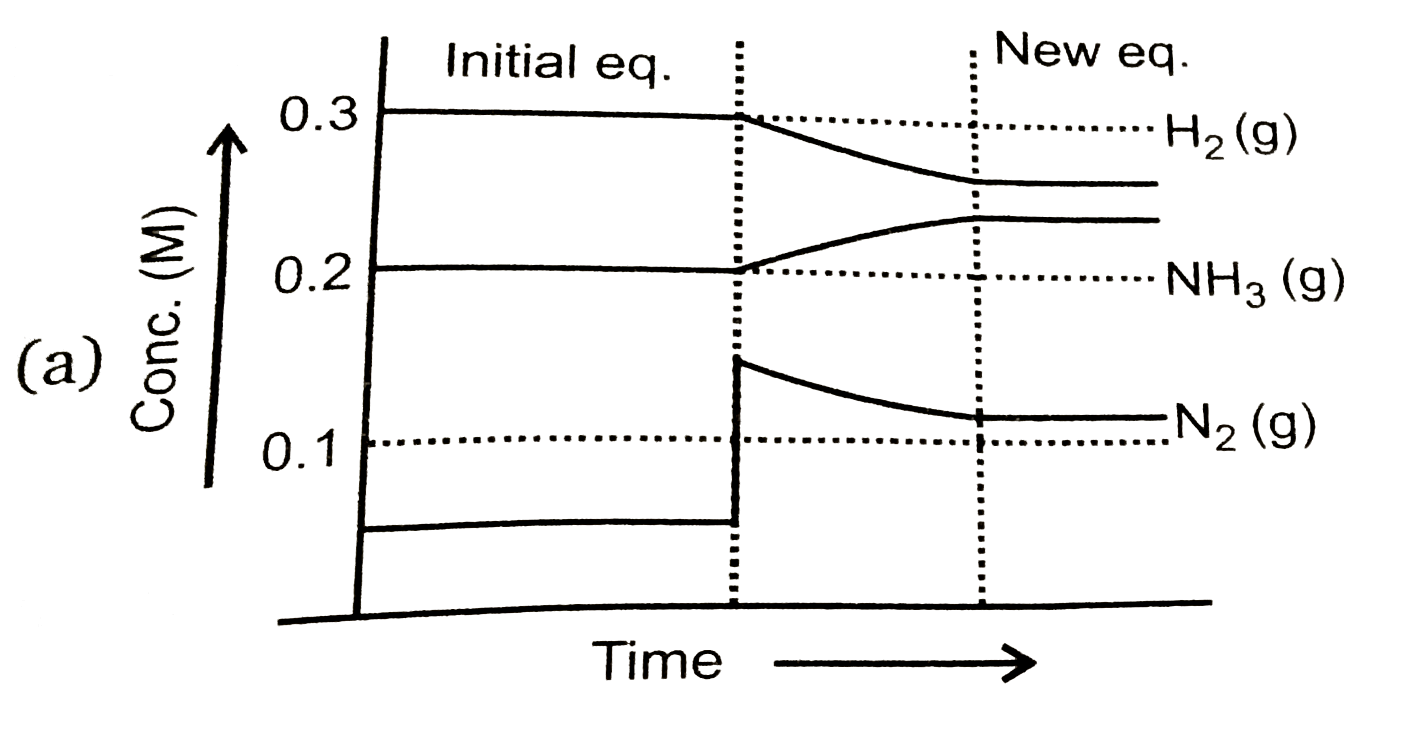
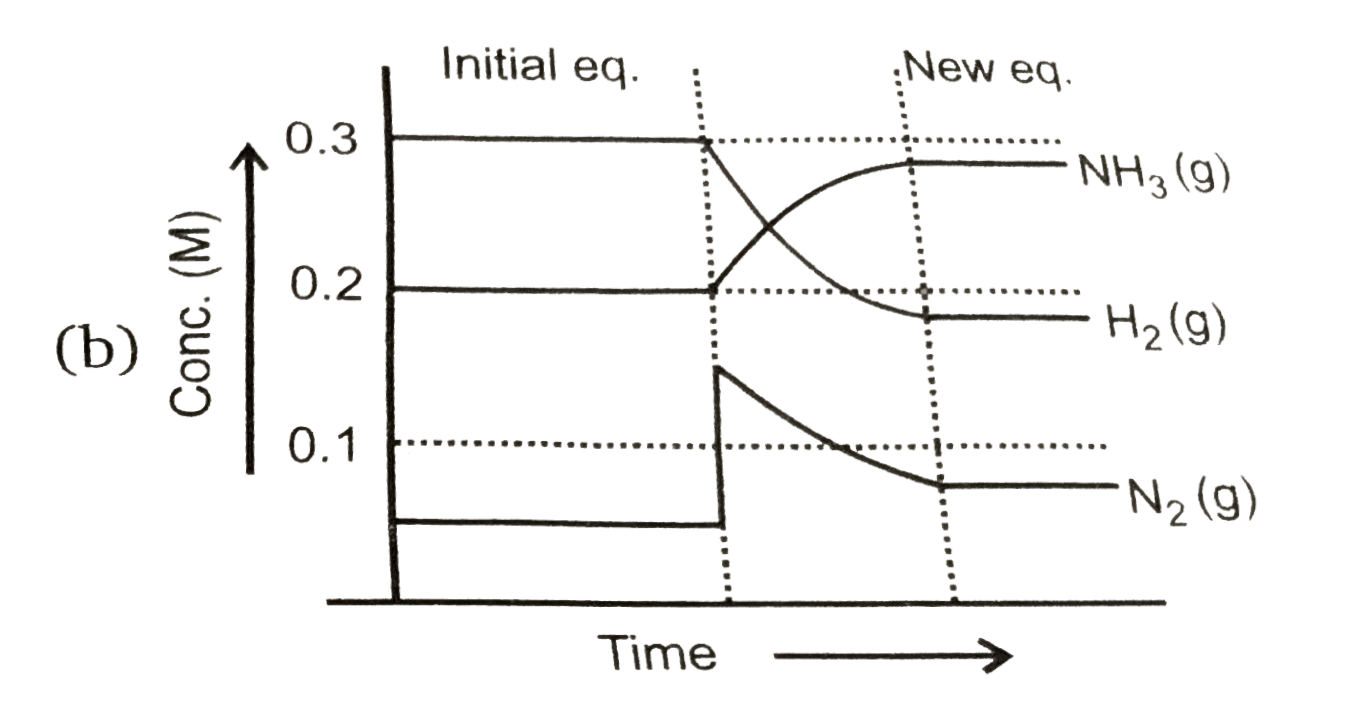
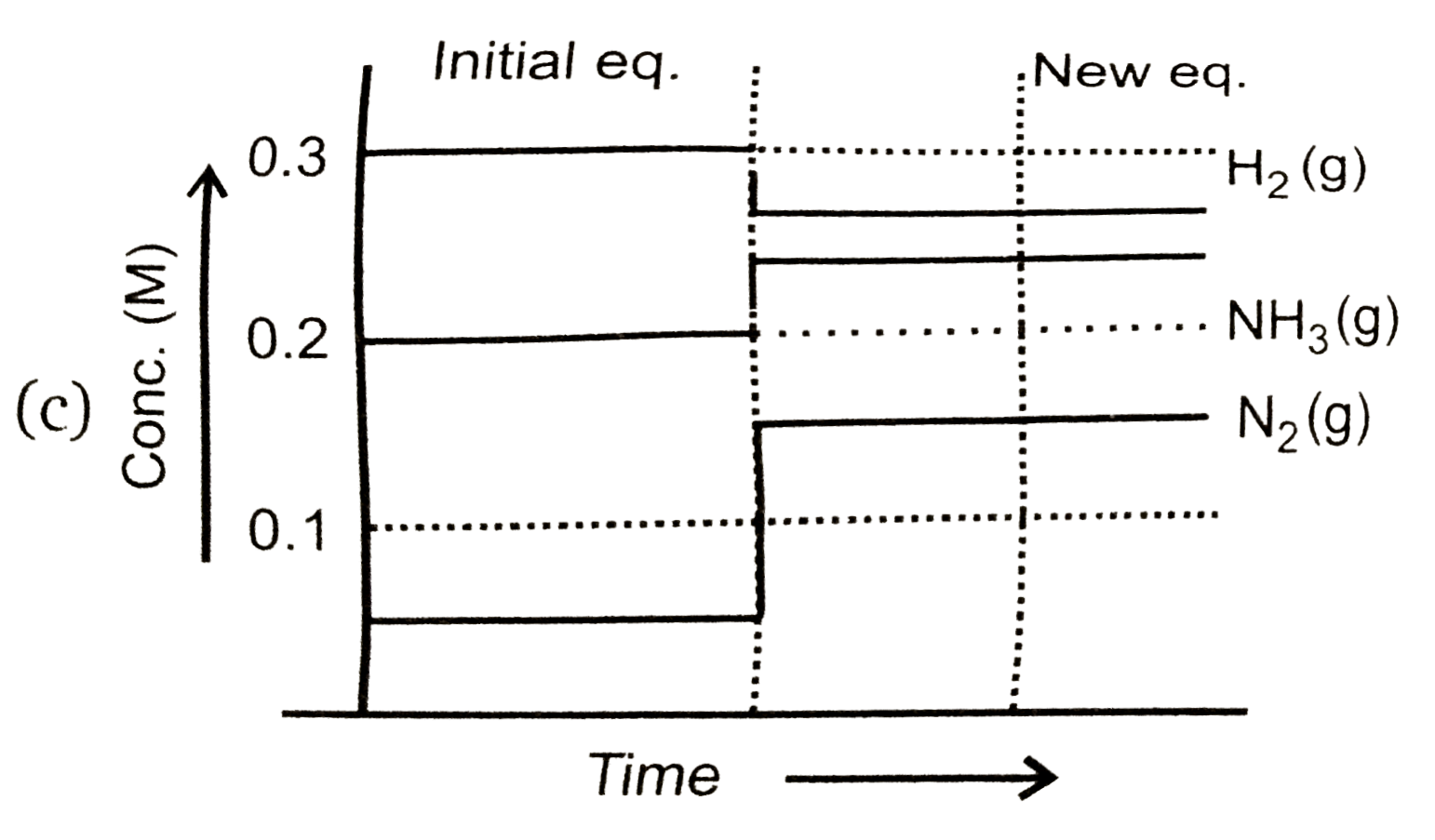
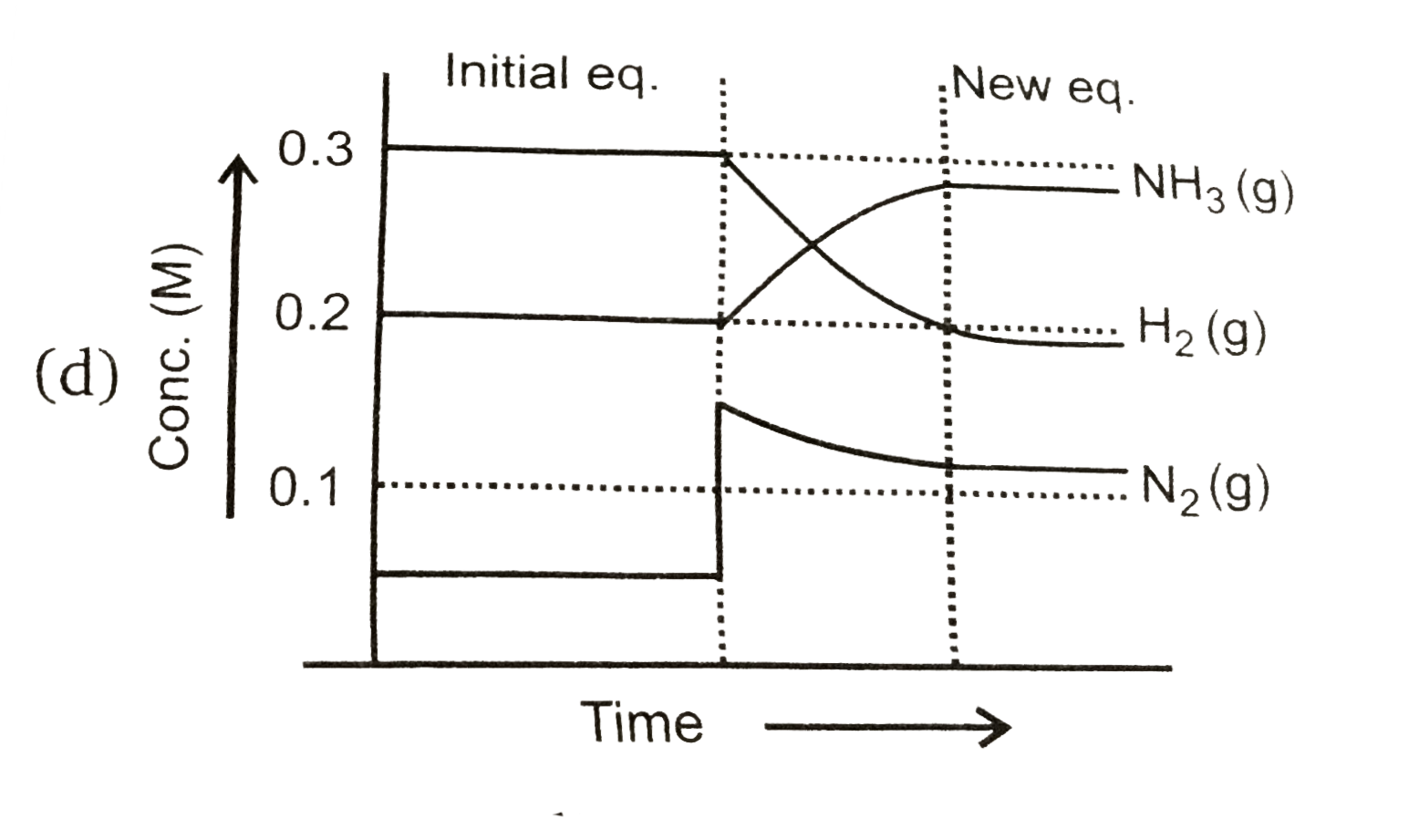
An equilibrium mixture at 700 K of 0.05M N_(2)(g) and 0.2 M NH_(3)(g) is present in a container .Now if this equilibrium is disturbed by adding N_(@) (g) so that its concentration becomes 0.15M just after addition then which of the following graph represents the above situation more appropriately: |
|
Answer»
|
|
| 20. |
An equilibrium constant of 3.2xx10^(-6) for a reaction means, the equilibrium is |
|
Answer» largely towards forward DIRECTION |
|
| 21. |
An equilibrium mixture at 300 K containsN _(2) O_(4) and NO_(2) at 0*28 and 1*1 atmrespectively. If the volume of the container is doubled, calculate the new equilibrium pressures of two gases. |
|
Answer» Solution :Step 1 . Calculate of `K_(p)` ` {:(,N_(2)O_(4),hArr,2 NO_(2)),("Equilibrium",0*28 "ATM",,1*1"atm"):}` `K_(p) = (p_(NO_(2))^(2))/(p_(N_(2)O_(4)))= (1*1 "atm")^(2)/(0*28 "atm")=4*32 "atm"` Step 2 . Calsulation of new equilibrium pressures . On doubling the volume , PRESSURE will decreaseto half . Hence, equilibrium will shift to the sideaccompanied by increasein the number of moles , i.e.,forward direction . This MEANS that pressure of `N_(2)O_(4) `will decreasewhile that of `NO_(2)`will increase . Suppose decreasein pressureof `N_(2)O_(4) = p` . Then ` {: (,N_(2)O_(4),hArr,2NO_(2)), ("Intial pressures ",0*28//2 "atm",,1*1//2 "atm"), ("New eqm. pressures ",(0*28/2-p)"atm",,(1*1/2 +2 p)"atm" ),(,=(0*14 -p)"atm",,=(0*55 +2p) "atm"):} ` . ` 0* 3025 + 4p^(2) + 2*2 p = 0* 6048 - 4* 32 p ` ` 4p^(2) + 6*52 p - 0*3023= 0 ` ` p = (-6* 52 pm sqrt(42 *51 + 4*84 ))/8 = 0*045 "atm" ` (minus value is neglected ) For quadratic equation ` ax^(2) + bx + c = 0 : x = (-b pm sqrt(b^(2) - 4ac))/ (2a)` ` :." New equilibrium pressures ")` ` p_(N_2O_(4)) = 0 *14 - 0* 045 = 0* 095 "atm" ` ` p_(NO_(2)) = 0* 55 + 2 xx 0* 045 = 0* 64 " atm"` ` |
|
| 22. |
An equilibrium constant of 3.2 xx 10^(-6) for a reaction means, the equilibrium is ………………… . |
|
Answer» largely towards forward DIRECTION `3.2 xx 10^(-6) = (["Products"])/(["Reactants"])` `K_C lt 10^(-3)," INDICATES that [REACTANT ]" > >"[Product]"` |
|
| 23. |
An equilibrium constant of 3.2 xx 10^(-6) for a reaction means, the equilibrium is …………... |
|
Answer» largely towards FORWARD direction `3.2xx10^(-6) = (["Products"])/(["Reactants"])` `K_(c) lt 10^(-3)` indicates that [Reactant] `gtgt`[Product] |
|
| 24. |
An equilibrium reaction X + Y hArr W +Z, Delta H= +ve is spontaneous in the forward direction. Then corresponding sign of Delta G and Delta S should be respectively |
|
Answer» `+ve, -ve ` |
|
| 25. |
An enzyme contains 2% of sulphur. The molecular weight of the Enzyme is 6400. How many sulphur atoms are present in that enzyme molecule? |
|
Answer» 6400 g enzyme - `(6400xx2)/(100)=128G` sulphur No. of sulphur ATOMS = `(128)/(32)=4` |
|
| 26. |
An engine operating between 127"^(@)C and 47"^(@)C takes some specified amount of heat from high temperature reservoir. Calculate the percentage efficiency of an engine. |
|
Answer» Solution :Given :`T_(1)=127"^(@)C=127+273=400 K` `T_2=47"^(@)C=47+273=320 K` %efficiency `eta`=? `eta=[(T_(1)-T_(2))/(T_1)]xx100=[(400-320)/(400)]xx100` `eta=[(80)/(400)]xx100` `eta=20%` |
|
| 27. |
An engine operating between 127^@C and 47^@C takes some specified amount of heat from a high temperature reservoir. Assuming that there are no frictional losses, calculate the percentage efficiency of an engine. |
|
Answer» SOLUTION :Given : `T_1=127^@C`=127+273=400 K `T_2=47^@C` =47+273=320 K % EFFICIENCY `ETA`= ? `eta=[(T_1-T_2)/T_1]XX100` `eta=[(400-320)/400]xx100` `eta=[80/400]xx100` `eta=20%` |
|
| 28. |
An endothermic reactionis allowed to take place rapidly in air. The temperature of the surrounding air will |
|
Answer» increase |
|
| 29. |
An endothermic reaction has a postive value for DeltaS^circ. Which of the following is true about the equilibrium constant for this reaction? |
|
Answer» It MAY be greater than 1 only at LOW TEMPERATURES. |
|
| 30. |
An enantiomerically pure acid is treated with racemic mixture of an alcohol having chiral carbon, The ester formed will be |
|
Answer» mixture of diastereomers `{:("[R",,"R]"),(,"+",),("[R",,"S]"):}}` Misture of Diastereomers Enantiomerically pure acid (R (or) S) is treated with racemic mixture `[50%R + 50%S]` of an alconol it gives mixture of diastereomers |
|
| 31. |
An emulsion is a colloidal solution of one of the following dispersed in another liquid. |
|
Answer» SOLID |
|
| 32. |
an emulsion becomes stable if soap is added to it. soap contains hydrophobic and hydrophilic parts . |
|
Answer» STATEMENT -1 is TRUE, statement-2 is true , statement -2 is a correct |
|
| 33. |
An emulsifier is a substance which |
|
Answer» Stabilises the emulsion |
|
| 34. |
An elementswithmass number81contains31.7%moreneutronsiscomparedto protonsAssignthe atomicsymbol. |
|
Answer» Solution :Atomicnumber of atom= NOOF PROTON = x No ofneutron (n ) = (No of `//`Proton )+ (No of31.7%proton ) ATOMICMASS (A )= (No ofprotnp ) + (No ofneutron n ) Atomicnumber =35so Br atom andatomicmass =81 Symbol81 . 35 Br |
|
| 35. |
An elements has electronic configuration 1s^2 2s^2 2p^6 3s^1 in its + 2 oxidation state. The formula of its sulphide is |
|
Answer» `M_3S_2` |
|
| 36. |
An element X withatomicnumber112has recently beendiscovered. Predict itselectronic configuration andsuggest the group in whichthiselement wouldbe placed. |
| Answer» Solution :`[RN] 5F^(14) 6d^(10) 7s^(2)` 12th group | |
| 37. |
An elementX isusedin theextractionofmetalfromtheiroxideswherecabonisineffective.TheelementX is _________. |
|
Answer» MAGNESIUM |
|
| 38. |
An element 'X' is strongly electropositive and an element 'Y' is strongly electronegative and both are univalent. The compound formed would be |
|
Answer» `X^(+) Y^(-)` |
|
| 39. |
An element X has the following isotopic composition 200X=90%,199X=85%and202X=2%The weighted average atomic mass of the element X is closest to ______ |
|
Answer» 201u |
|
| 40. |
AnelementX hassamenumberof electronsin the firstand the fourthshell as wellas in thesecondandthe thirdshell. (a) Writedownthe electronic configurationof the element. ( b) Writedown thegroupnumberand theperiodto whichit belongs ( c)What is thevalencyof theelement ? (d )Willit formionicor covalentcompoundwith theelement Y (2,8,6) ? ( e)What isthe natureof the oxides ofX and Y ? |
|
Answer» SOLUTION :(a) Weknow that the MAXIMUMNUMBER OFELECTRONS in theIstand 2ndshell are 2and 8respectively.Since3rdshellhas thesamenumberof electrons as the2ndshelltherefore3rdshellalsohas 8electrons. Further since4thshellhas thesamenumberof electrons as the1stshelltherefore4thshellhas TWOELECTRONS. Thereforethe electronicconfigurationof the element X is 2,8,8,2Actually theelementXis Ca. (b) Sincein theelementX thevalenceelectrons are presentin the fourthshell ,thereforethe periodofelementX is 4.Furthersinceis has twoelectrons in thevalenceshellthereforeitsgroupnumberis 2. ( c) Valenceyof theelementX ( 2,8,8,2)i.e., Ca hastwoelectrons moreandtheelementY (2,8,6 ) i.e., Shas twoelectronslessthan thestableelectronicconfigurationof thenearestgasargon(2,8,8)thereforeXtransfers twoelectrons to Yto formioniccompound. 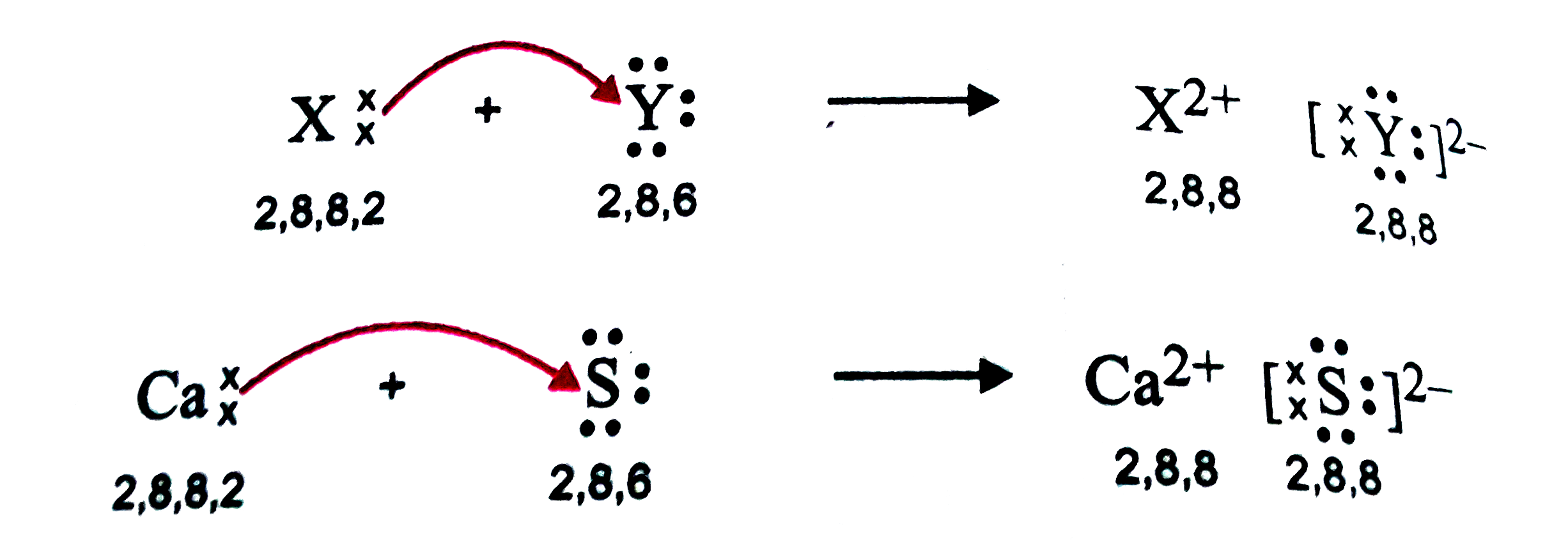 (e )SinceX isa metaltherefore its oxideis basici.e.,CaO. SinceY is anon- metalthereforeitsoxide isacidic i.e.,`SO_(2)" or" SO_(3)` |
|
| 41. |
An element X has the following isotopic composition ""^(200)X = 90 %, ""^(199)X=8 % and ""^(202) X=2 %, The weighted average atomic mass of the element X is closest to |
|
Answer» 201u |
|
| 42. |
An element X' has atomic number 34. Give its position in the periodic table. |
|
Answer» |
|
| 43. |
An element X forms two oxides. Formula of the first oxide is XO_(2). The first contains 50% of oxygen. If the second oxide contains 60% oxygen, the formula of the second oxide is |
|
Answer» `XO_(3)` |
|
| 44. |
An element X burns in nitrogen to give a compound Y which on reaction with water gives a compound Z and a gas with a pungent smell. Z can be used during construction and white washing. When excess of CO_(2) is bubbled through Z, a compound P is formed which on heeating decomposes to give a compourless, odourless gas. identify X, Y, Z and P. |
|
Answer» <P>`X-Ca,Y-Ca_(3)N_(2),Z-Ca(OH)_(2),P-Ca(HCO_(3))_(2)` `Ca_(3)N_(2)+6H_(2)O to underset((Z))(3Ca(OH)_(2))+underset(("gas with a pungent SMELL"))(2NH_(3))` `underset((Z))(Ca(OH)_(2))+underset("excess")(CO_(2)) to underset((P))(Ca(HCO_(3))_(2)` `underset((P))(Ca(HCO_(3))_(2))overset("HEAT")to CaCO_(3)+H_(2)O+CO_(2)` |
|
| 45. |
An element X belongsto fourthperiod and fifteengroupof theperiodic table .Which of thefollowingstatements is true? |
|
Answer» It has acompletelyfilled s- orbital and apartially filledd- orbital Inotherwordsthe elementhas half- filledp- orbitalsand completelyfilled s- andd- orbitals i.e.,option( d) iscorrect. |
|
| 46. |
An element 'X' (At mass = 40 "g mol"^(-1)) having fcc structure, has unit cell length of 400 pm. Calculate the density of 'X' and the number of unit cells in 4 g in 'X' (N_A=6.022xx10^23 "mol"^(-1)) |
|
Answer» `RHO=(ZxxM)/(a^3xxN_A)=(4xx40)/(6.022xx10^23xx(400xx10^(-10))^3)=4.15 g CM^(-3)` MASS of one unit cell =`40/(6.022xx10^23)xx4g` No. of unit cells in 4g of the element =`"Mass of the element "/"Mass of one unit cell"=4/((40xx4)//(6.022xx10^23))=1.505xx10^22` |
|
| 47. |
An element with molar mass2.7 xx 10^(-2) "mol"^(-1)forms a cubic unit cell with edge length 405 pm. If its density is 2.7xx10^3 kg m^(-3),what is the nature of the cubic unit cell ? |
|
Answer» Solution :Density , `rho=(ZxxM)/(a^3xxN_0) "or" Z=(rhoxxa^3xxN_A)/M` Here, M (MOLAR mass of the element )=`2.7xx10^(-2)"kg MOL"^(-1)` a (edge length) =405 pm =`405xx10^(-12) m =4.05xx10^(-10) m` `rho` (density) =`2.7xx10^3 "kg m"^(-3)` `N_A` (AVOGADRO's number )=`6.022xx10^23 "mol"^(-1)` Substituting these values in expression (i), we GET `Z=((2.7xx10^3 "kg m"(-3))(4.05xx10^(-10) m)^3 (6.022xx10^23 "mol"^(-1)))/(2.7xx10^(-2) "kg mol"^(-1))` =3.99=4 Thus, there are 3 atoms of the element present per unit cell. Hence, the cubic unit cell must be face-centred or cubic close packed (ccp) |
|
| 48. |
An element with molar mass 2.7 xx 10^(-2) " kg mol"^(-1) forms a cubic unit cell with edge length 405 pm.If its density is2.7xx10^(3) " kg m"^(-3) , what is the nature of the cubic unit cell ? |
|
Answer» <P> Solution : Density = ` p = (Z xx M)/(a^(3) xx N_(A)) or Z = ( p xx a^(3) xx N_(A))/M`here, M (molar mass of the element )= ` 2.7 xx 10^(-2) " kg mol" ^(-1)` a( edge lenth) = 405 pm = ` 405 xx 10^(-12) m = 4.05 xx 10^(-10) m` p (density ) = ` 2.7 xx 10^(3) " kg m"^(-3)` ` N_(A)` (Avogardro's number ) = ` 6.022 xx 10^(23) mol^(-1)` Substituting these values in expression (i), we get ` Z = ( ( 2.7 xx 10^(3) " kg m"^(-)) ( 4.05xx10^(-10) m)^(3) ( 6.022 xx 10^(23) mol^(-1)))/( 2.7xx 10^(-2) " kg mol"^(-1)) = 3.99 = 4 ` Thus, there are 4 ATOMS of the element present per unit cell. Hence, the CUBIC unit cell must be face centred or cubic close packed (ccp). |
|
| 49. |
An element with molar mass 27 g mol^(-1) forms a cubic unit cell with edge length 4.05 xx 10^(-8) cm. If its density is 2.7 g cm^(-3), what is nature of cubic unit cell ? |
|
Answer» Hence, it has face-centred cubic UNIT cell. |
|
| 50. |
An element with molar mass 27 gmol^(-1)forms a cubic unit cell with edge length4.05 xx 10^(-8)cm.If its density is2.7 " g cm^(-3), what is the nature of the cubic unit cell ? |
|
Answer» <P> HENCE , it has face -CENTRED cubic unit cell. |
|