

Saved Bookmarks
This section includes 7 InterviewSolutions, each offering curated multiple-choice questions to sharpen your Current Affairs knowledge and support exam preparation. Choose a topic below to get started.
| 1. |
Assuming ideal behaviour, calculate Boyle's law constant for each of the following gase at 25^(@)C a. 10g of O_(2) in 2 L container b. 8g of CH_(4) in 5 L container |
|
Answer» Solution :Boyle's law constant is GIVEN by PRODUCT of PV at a given temperature. Now. PV=nRT a. 10g of `O_(2)=10//32` mol THUS, PV`=(10xx0.0831xx298.15)/(32)=7.74`L bar (B). 18g of `CH_(4)=8//16=0.5` mol thus `PV=0.5xx0.0831xx298.15=12.38` L bar |
|
| 2. |
Assuming fully decomposed, the volume of CO_(2) released at N.T.P on heating 9.85 g of BaCO_(3) (Atomic mass of Ba = 137) will be : |
|
Answer» 0.84 L |
|
| 3. |
Assuming Delta H^(0) and Delta S^(0) do not change with temperature the boiling point of liquid ''A'' (the thermodynamics data given below) is |
|
Answer» 300K `100- (-130) = 30kJ` `T = (30 xx 1000)/(100) = 300 ( :. T = (Delta H)/(Delta S))` |
|
| 4. |
Assuming complete ionization same moles of the following compundswill require theleast amount ofacidicfied MNnO_(4) for complete oxidatoin ? |
|
Answer» `FeSO_(3)` `MnO_(4)^(-)+8H^(+)+5e^(-)rarrMn^(2+)+4H_(2)O` no of electrons involved in the reqction =5 (a) oxidation of `FeSO_(3)`to `Fe_(2)(SO_(4))_(3)` `Fe^(2+)rarrFe^(3+)+e^(-)` `SO_(3)^(2-)+H_(2)OrarrSO_(4)^(2-)+2H^(+)+2E^(-)` (B) oxidation of `FeC_(2)O_(4)` `Fe^(2+)rarrFe^(3+)+e^(-)` `C_(2)O_(4)^(2-)rarr2CO_(2)+2e^(-)` (c ) oxidation of `Fe(NO_(2))_(2)` `Fe^(2+)rarrFe^(3+)` `2NO_(2)^(-)+2H_(2)Orarr2NO_(3)+4H^(+)+4e^(-)` (d) oxidation of `FeSO_(4)` `Fe^(2+)rarrFe^(3+)+e^(-)` no of ELECTRONIC involved =1since `FeSO_(4)` gives least number of electons therefore it will required least amount of L `MnO_(4)` for its oxidation |
|
| 5. |
Assuming complete dissociation, calculate the pH of the following solutions : (a)0.003 M HCl , (b)0.005 M NaOH , (c)0.002 M HBr , (d)0.002 M KOH |
|
Answer» SOLUTION :(a)pH of 0.003 M HCl : Complete ionization of HCl, then solution , [HCl]=`[H^+]`= 0.003 M = `3.0xx10^(-3)` M pH =-log `[H^+]` `=-log (3.0xx10^(-3))={log 3.0+log 10^(-3)}` =-(0.4771-3.0)=-(-2.5229) =+2.5229 `approx` 2.52 (B)pH of 0.005 M NaOH : NaOH is a strong BASE , its complete ionization occurs `[OH^-]`=[NaOH ] =0.005 M = `5.0xx10^(-3)` M So, pOH = -log `[OH^-]` `=-log (5.0xx10^(-3))=-(log 5+ log 10^(-3))` =-0.6990-3.0)=-(-2.3010) =+2.3010 Now, pH = 14.0-pOH =14.0- 2.3010 =11.6990 `approx` 11.70 (c)pH of 0.002 M HBR : HBr is strong acid and 100% ionization occur, `[HBr]=[H^+]=0.002 M = 2.0xx10^(-3)` M `therefore` pH=-log `[H^+]` `=-log (2.0xx10^(-3))=-{log 2.0 + log 10^(-3)}` =-(0.3010-3.00)=-(-2.6990) =+2.699 `approx` 2.70 (d) pH of 0.002 M KOH : KOH is strong base and complete ionization in solution, `[OH^-]=[KOH]=0.002 M =2.0xx10^(-3)` M pOH = -log `[OH^-]` `=-log (2.0xx10^(-3))` `=[log 2.0 + log 10^(-3)]` =-{0.3010 -3.0} = -(-2.6990) =+2.6990 pH = 14.0-pOH = 14.0-2.699 =11.3010 `approx` 11.30 |
|
| 6. |
Assuming complete dissociation, calculate the pH of the following solutions : (a) 0.003 M HCl(b) 0.005 M NaOH(c) 0.002 M HBr(d) 0.002 M KOH |
|
Answer» Solution :(a) `HCl + aq rarr H^(+) + Cl^(-) , :. [H^(+)]=[HCl]=3xx10^(-3)M, pH = - log (3xx10^(-3))=2.52` (b) `NaOH + aq rarr NA^(+) + OH^(-)= 5xx10^(-3) M, [H^(+)]=10^(-14)//(5xx10^(-3))=2xx10^(-12)M` `pH = - log (2xx10^(-12))=11.70` (c) `HBr + aq rarr H^(+) + Br^(-), :. [H^(+)]=2xx10^(-3)M, pH = - log (2xx 10^(-3))=2.70` (d) `KOH + aq rarr K^(+) + OH^(-) , :. [OH^(-)]=2xx10^(-3)M,[H^(+)]=10^(-14)//(2xx10^(-3))=5xx10^(-12)` `pH = - log (5xx10^(-12))=11.30` |
|
| 7. |
Assuming 2s - 2p mixing is not operative , the paramagnetic species among the following is |
|
Answer» `Be_(2)` orbitals may be ARRANGED in ORDER of energy as follows : `sigma (1s), sigma^(**) (1s), sigma(2s), sigma^(**) (2s), sigma(2p_(z)), PI(2p_(x))` `= (2p_(y)), pi^(**) (2p_(x)) = pi^(**) (2p_(y)), sigma^(**) (2p_(z))` Applying this configuration , `Be_(2), B_(2) and N_(2)`will be diamgnetic but `C_(2)` will be paramagnetic . |
|
| 8. |
Assume that the decomposition of HNO_(3) can be represented by the following equation 4HNO_(3(g)) hArr 4NO_(2(g)) + 2H_(2) O_((g)) + O_(2(g))and the reaction approaches equilibrium at 400K temperature and the copper turnning 0 atm pressure. At cquilibrium partial pressure of HNO_(3) is 2 atm. Calculate Kc in ("mole" //L)^(3) at 400 K. |
|
Answer» 4 `P_("Total")=P_(HNO_(3))+P_(NO_(2))+P_(H_(2)O)+P_(O_(2))` `:. P_(NO_(2))=4_(PO_(2))` and `P_(H_(2)O)=2P_(O_(2))` `:. P_("Total")=P_(HNO_(3))+7P_(O_(2))` `IMPLIES 30-2=P_(O_(2)) xx 7, P_(O_(2))=4` `Kp=(P_(NO_(2))^(4) xx P_(H_(2)O) xx P_(O_(2)))/(P_(HNO_(3))^(4))` `=((4 xx 4) xx (2 xx 4)^(2) xx 4)/(2^(4))=2^(20)` `Kp=Kc(RT)^(Delta n_((g)))=Kc(0.0821 xx 400)^(3)` `implies Kc(0.08 xx 400)^(3) implies Kc=32` |
|
| 9. |
Assume that 4g of I_(2) are allowed to react with 4g of Mg metal according to the following equation Mg+I_(2) rarr MgI_(2) Which is the limiting reagent in the reaction ? |
|
Answer» `underset(24g)(Mg)+underset(underset(=254g)(2xx127))(I_(2))rarrMgl_(2)` 24 G of Mg metal require `I_(2) = 254 g` 4 g of Mg metal require `I_(2)=((254g))/((24g))XX(4g)=42.3g` But `I_(2)` actually available = 4g `:. I_(2)` is the limiting reactant. |
|
| 10. |
Assume that 2 xx 10^(-17) J of light energy is needed by the interior of the human eye to see an object. The number of photons of yellow light with lambda = 595.2nm are needed to generate this minimum energy is 12x. Then the value of x is _________ . |
|
Answer» `implies(2xx 10^(-17))/(1.6 XX 10^(-19)) eV = n xx (1240)/(595.2) xx (eV. Nm)/(nm)` `impliesn = 60 implies 12 x = 60 implies x = 5` |
|
| 11. |
Assume ideal gas behavior for all the gasesconsidered and vibratonal degree of freedom to be active. Separated equimolarsample of Ne,O_(2), So_(2) and CH_(4)were subjedted to a two step process as mentioned . Initiallytall areat samestate of temperture and pressure.Step -I:All undergo reversibleabiabatic expansion to attainsame finalvolume therebycausingthedecreasae in theirtemperature.Step -II:Afterstep I, allare given appropriate amount of heat isochoricallyto restorethe originaltemperature . Mark the correct optoin(s). |
|
Answer» Due to step Ionly , the decrease in temperature will be maximumfor Ne. |
|
| 12. |
Assume ideal gas behaviour for all the gases considered and neglect vibrational degrees of freedom. Separate equimolar sample. Separate equimolar samples of Ne, O_(2) , CO_(2) and SO_(2)were subjected to a two process as mentioned. Initially all are at same state of temperature and pressue.Step I rarr All undergo reversible adiabatic expansion to attain same final volume, which is double the original volume thereby causing the decreases in their temperature. Step rarr After step I all are given appropriate amount of heat isochorically to restore the original temperature. Mark the correct option(s) : |
|
Answer» Due to step I only, the decrease in temperature will be maximum for Ne Second step is isochoric (w = 0) 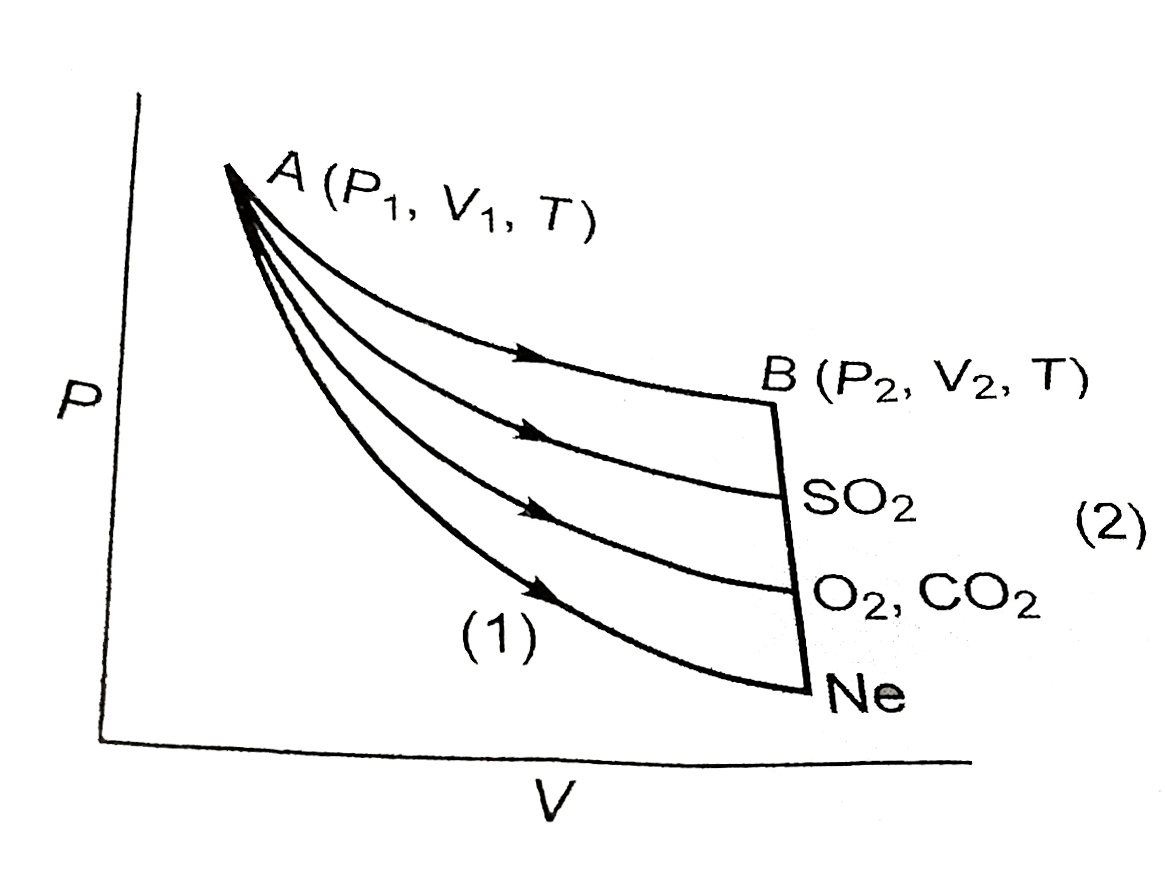 So, `""DeltaU_(2)=q_(2)` `because` initial and final temp. are same `therefore""DeltaU_("toal")=DeltaU_(1)+DeltaU_(2)=0` ` "or"w_(1)+q_(2)=0` Max. work done by the gas, `SO_(2)` is (area) under the curve so, `SO_(2)` absorbed `because ""gamma_(SO_(2))lt gamma_(CO_(2))=gamma_(O_(2))=ltgamma_(Ne)` so, max. decrease in temp. of Ne due to step 1. |
|
| 13. |
Assume each reaction is carried out in an open container. For which reaction will Delta H = Delta E? |
|
Answer» `2CO _((G)) + O _(2 (g)) to 2 CO _(2 (g))` <BR>`H _(2 (g)) + Br _(2 (g)) to 2 HBr _((g))` |
|
| 14. |
Associated colloid among the following is |
|
Answer» enzymes |
|
| 15. |
Assining R,S configuration to the given compound : |
|
Answer» 2R, 3S |
|
| 16. |
Assing the position of the elements with outer electronic configuration ns^2np_4 (n = 3) |
| Answer» SOLUTION :`3^rd` PERIOD, GROUP 16 | |
| 17. |
Assing the position of the elements with outer electronic configuration (n-2)f7 (n-1)d^1 ns^2 (n=6) |
| Answer» SOLUTION :`6^th` PERIOD, GROUP 3 (all f block ELEMENTS are in group 3). | |
| 18. |
Assing the position of the elements with outer electronic configuration (n-1) d^2 ns^2(n = 4) |
| Answer» SOLUTION :`4^th period,4^th` GROUP (group NUMBER = number of d ELECTRONS + number of s electrons) | |
| 19. |
Assign the priority order number of the following atoms or groups. (a) -CHO,-CH_(2)OH,-CH_(3),-OH (b) -Ph,-CH(Me)_(2),-H,-NH_(2) (c) -COOH,-Ph,-CHO,-C-=CH,-Ph (d) -CH(Me)_(2),-CH=CH_(2),-CH_(2),-C-=CH,-Ph (e) -CH_(3),-CH_(2)Br,-CH_(2)OH,-CH_(3)Cl (f) -H,-N,(Me)_(2),-Me,-OMe (g) -CH=CH_(2),-Me,-Ph,-Et (h) -CH_(2)-CH_(2)-Br,-Cl,-CH_(2)-CH_(2)-CH_(2)-Br,(Me)_(2)CH- (i) -Cl,-Br,-I,-NH_(2) (j) NH_(2),NO_(2),CH_(2)NH_(2),C-=N |
|
Answer» |
|
| 20. |
Assign the position of the element having outer electronic configuration (i) ns^(2)np^(4) " for " n = 3 (ii) (n -1) d^(2)ns^(2) " for " n = 4and (iii) (n -2) f^(7) (n -1) d^(1) ns^(2) " for " n = 6,in the periodic table. |
|
Answer» <P> Solution :For n = 3, the element belongs to third period. The electronic configuration is `3d^(2) 3d^(4)`.Since the last electron enters p ORBITAL, therefore, the element belongs to p-blcok, Group no, of the element, ` = 10 + ` No. of electron in valence shell ` = 10 + 6 = 16` ` :. ` Period = 3 , group = 16 (ii) For n = 4, the element belongs to fourthperiod. The electronic configuration is`3d^(2) 4s^(2)`. Since the d-sub-shell is incomplete, the element belongs to d-block. Group no, of the element, = No. of electron in `(n -2)` subshell ` + ` No. of electron in ns subshell ` = 2 + 2 = 4` ` :. ` Period = 4, group = 4 (III)For n = 6, the element belongs to SIXTH period. The electronic configuration is`4f^(7) 5d^(1) 6s^(2)`. Since the electron goes to f -orbital, therefore, its belongs to f-block. All f-block elements belongs to group-3. `:. `Period = 6, group = 3 |
|
| 21. |
Assign the position of theelement havingouterelectronicconfiguration , (i) n s^(2) np^(4) for n = 3(ii)(n-1) d^(2)n s^(2) forn=4and (ii) (n-2) f^(7)(n-1)d^(1)n s^(2) for n= 6 in theperiodictable. |
|
Answer» Solution :(i) n=3 suggeststhat theelementbelongs to thirdperiod . Sincethe lastelectronentersthe p- orbital thereforethe givenelement is p- blockelement .Furthersince thevalenceshellcontains6 (2+electrons thereforegroupnumberof theelement= 10 +no. of electrons in the valenceshell = 10 + 6 = Thecompleteelectronicconfigurationof the elementis `1 s^(2)2 s^(2)2 p^(6)3 s^(2)3p ^(4)` and theelement is( sulphur ) (II) n=4 suggetsthat theelementlies in the4thperiod. sincethe d- orbitals are incompletethereforeit isd-blockelement . the groupnumberof the element no. OFD- electrons + no. of s- electrons = 2 + 2 =4 . Thusthe elementslie ingroup 4 and4thperiod . Theconfigurationof the elementis `[Xe] 4 f^(7)5 d^(1) 6 s^(2). ` Theatomicnumber of theelement= 54 + 7 + 1 + 2= 64and thethe element is Gd(gadolinium ). |
|
| 23. |
Assign reasons for each of the following : (i) + 1 gallium undergoes disproportionation reactions. (ii) Unlike In^(+), Ti^(+) is more stable with respect to disproportionation. (ii) InCl undergoes disproportionationbut TlCl does not. (iv) In (III)is more stablethan In (I) aqueous solution. |
Answer» Solution :(i) Due to inert pair effect, galliumshowsboth +1 and +3 oxidationstates butits +3 oxidationstate is more stable than `+1` oxidationstate.In other words +1 oxidation state. Inother words `+1` gallium is less stable than +3 gallium and hence undergoes disproportionation (self oxidation -reduction) to form gallium metal and the more stable+3 gallium IONS in aqueoussolutionas shownbelow : (ii) Althroughboth In and TI can show oxidationstates of +1 and +3 , but inert pair effect is more prominent in Tl than in In. Therefore,+1 oxidationstate of Tl is more stablethan its +3 oxidation state while +3 oxiationstate ofln is more stablethan its + 1 oxidationstate.Consequently in aqueous solution, less stable`ln^(+)`undergoesdisproportionation to form more state `In^(3+)` but `+1`thalliumbeing more stabledoes not undergo disproportionationto form +3 THALLIUM. `3In^(+) (aq) overset("Disproportionation")rarr 2In(s) + In^(3+) (aq)`  (iii) As statedabove, `+3` oxidationstate of In is more stable than its +1 oxidationstate, therefore, `InCl` undergoesdisproportionation in aqueoussolution. `3In Cl(aq) rarr 2In (s) + In^(3+) (aq) + 3Cl^(-) (aq)` Since +1 oxidationstate of Tl is morestablethan its +3 oxidationstate,therefore,`TlCl` does notundergo disproportional in aqeuoussolution.  (iv) Same as explained in ANSWER (ii) above. |
|
| 24. |
Assign oxidation number to the underlined elements in each of the following species : Naul(B)H_(4) |
|
Answer» Solution :In `NaBH_(4)`, H is present as `H^(-)` ion because it is a hydride. THEREFORE, oxidation NUMBER of H in it is -1. `OVERSET(+1)(NA)overset(x)(B)overset(-1)(H_(4))` `(+1)+(x)+[(-1)xx4]=0` or `x=+4-1=+3` `:.` The oxidation number of B in `NaBH_(4)` is +3. |
|
| 25. |
Assign oxidation number to the underlined elements in each of the following species : NaHul(S)O_(4) |
|
Answer» Solution :`overset(+1)(NA)overset(+1)(H)overset(X)(S)overset(-2)(O_(4))` `(+1)+(+1)+(x)+[(-2)xx4]=` or `x=+8-2=+6` Therefore, the OXIDATION number of S in `NaHSO_(4)` is + 6. |
|
| 26. |
Assign oxidation number to the underlined elements in each of the following species : NaH_(2)ul(P)O_(4) |
|
Answer» Solution :LET the oxidation number of P be x. Writing the oxidation NUMBERS of all elements present, we have `overset(+1+1)(NaH_(2))overset(x-2)(PO_(4))` The sum of oxidation numbers of all atoms in a NEUTRAL molecule is zero. Hence, `(+1)+[(+1)xx2]+(x)+[(-2)xx4]=0` or `x=+8-3=+5` Thus, the oxidation number of P in `NaH_(2)PO_(4)` is +5. |
|
| 27. |
Assign oxidation number to the underlined elements in each of the following species : KAl(ul(S)O_(4))_(2).12H_(2)O |
|
Answer» Solution :`overset(+1)(A)overset(+3)(Al)overset(X-2)((SO_(4))_(2)).12overset(+1-2)(H_(2)O)` `(+1)+(+3)+[(x)+(-2)xx4]xx2+[(+1)xx2+(-2)]xx12=0` or `+4+2x-16+24-24=0` or `2x=+16-4+12` or x=+6 `:.` The oxidation NUMBER of S in `KAI(SO_(4))_(2).12H_(2)O` is +6. |
|
| 28. |
Assign oxidation number to the underlined elements in each of the following species : H_(4)ul(P)_(2)O_(7) |
|
Answer» Solution :`overset(+1)(H_(4))overset(X-2)(P_(2)O_(7))` `(+1)xx4+(x)xx2+[(-2)xx7]=0` or `2x=+14-4=+10` or x=+5 `:.` The oxidation state of P in `H_(4)P_(2)O_(7)` is +5. |
|
| 29. |
Assign oxidation number to the underlined elements in each of the following species : K_(2)ul(Mn)O_(4) |
|
Answer» SOLUTION :`overset(+1)(K_(2))overset(x)(Mn)overset(-2)(O_(4))` `(+1)xx2+(x)+[(-2)xx4]=0` ror `x=+8-2=+6` `:.` The OXIDATION state of P in `K_(2)MnO_(4)` is +6. |
|
| 30. |
Assign oxidation number to the underlined elements in each of the following species : H_(2)ul(S_(2))O_(7) |
|
Answer» Solution :`overset(+1)(H_(2))overset(x)(S_(2))overset(-2)(O_(7))` `[(+1)xx2]+[(x)xx2]+[(-2)xx7]=0` or `2x=+14-2=+12` or x=+6 `:.` The oxidation NUMBER of S in `H_(2)S_(2)O_(7)` is +6. |
|
| 31. |
Assign oxidation number to the underlined elements in each of the following species : Caul(O)_(2) |
|
Answer» Solution :`OVERSET(+2)(Ca)overset(x)(O)` `(+2)+(x)=0` or x=-2 `:.` The oxidation STATE of O in CAO is -2. |
|
| 32. |
Assign oxidation number to the underlined elements in each of the following species : (a) NaH_(2)underlinePO_(4) (b) NaHunderlineSO_(4) ( c) H_(4)underlineP_(2)O_(7) (d) K_(2)underline(Mn)O_(4) (e) CaunderlineO_(2) (f) NaunderlineBH_(4) (g) H_(2)underlineS_(2)O_(7) (h) KAl(underlineSO_(4))_(2)*12H_(2)O |
|
Answer» Solution :(a) `NaH_(2)underlinePO_(4)to1(Na)+2(H)+(P)+4(O)=0` `therefore1(+1)+2(+1)+(P)+4(-2)=0` `therefore1+2+P-8=0` `thereforeP=+5` (b) `NaHunderlineSO_(4)to(+1)+(+1)+(S)+4(-2)=0` `therefore+2+S-8=0` `thereforeS=+6` ( C) `H_(4)underlineP_(2)O_(7)to4(+1)+2(P)+7(-2)=0` `therefore4+2P-14=0` `therefore2P-10=0` `thereforeP=+5` (d) `K_(2)UNDERLINE(Mn)O_(4)to2(+1)+Mn+4(-2)=0` `therefore+2+Mn-8=0` `thereforeMn=+6` (e) `CaunderlineO_(2)toCa+2(-1)=0` `thereforeCa-2=0` `thereforeCa=+2` (F) `NaunderlineBH_(4)to1(+1)+B+4(-1)=0` `thereforeB=+3` (g) `H_(2)underlineS_(2)O_(7)to2(+1)+2(S)+7(-2)=0` `thereforex=+6` (h) `KAl(underlineSO_(4))_(2)*12H_(2)Oto1+3+2(S)+8(-2)+12(2xx1-2)=0` `therefore2(S)+4-16` `thereforeS=+6` OR As `H_(2)O` is NEUTRAL therefore total charge remain zero. `therefore1+3+2(S)+8(-2)=0` `thereforeS=+6` |
|
| 33. |
Assign oxidation number to the underlined element in each of the following species NaH_(2)PO_(4) (b) NaHSO_(4) (c )H_(4)P_(2)O_(7) (d)K_(2)MnO_(4) (e )CO_(2) (f) NaBH_(4) (g)H_(2)S_(2)O_(7) (h)KAI(SO_(4))_(2)12H_(2)O |
|
Answer» Solution :(a) Let the oxidation number of p be x writing the oxidation number of each atom above its symbol we sum of oxidation numbr of various atoms in `NaH_(2)PO_(4)=1(+1)+2 (+1)+1(x)+4(-2)=x-5` but the sum of oxdation numberof various atoms in `NaH_(2)PO_(4)` (neutral) is ZERO Thus the oxidation nuber of p in `NaH_(2)PO_(4)=5` (b) `overset(+1)NA overset (x)H overset(x)S overset(-2) O_(4) therefore +1(+1)+x+4(+1)-2=0 or x=_6` Thus the oxidation number of S in `NaHSO_(4)=+5` (C ) `overset(+1)H_(4)overset(+1)P_(2)overset(x)S overset(-2)O_(4)therefore4(+1)+2(x)+7(-2)=0 or x=+5` (d)`K_(2)Mn O_(4)^(-2) therefore 2(+1)+1(x)+7(-2)=0 or x =+6` thus the oxidation numbr of Mn in `K_(2)MnIO_(4)=+7` (e ) let hte oxidation number of O be x since ca is an alkaline earth METAL therefore its oxidation number is +2 thus `CaO_(2)therefore +2+2(x)=0 or x=-1` (f) In `NaBH_(4)` H is present as hydride ion therefore its oxidation number ois -1 thus `Na BH_(4) therefore2(+1)+x+(-1)=0 or x=+3` thus the oxidation number of B in `NaBH_(4)=+3` (g) `H_(2)S_(2)O_(7)^(2-) therefore 2(+1)+2(x)+7(-2)=0 or x_6` thus the oxidation number of s in `H_(2)S_(2)O_(7)=+6` (h)`K AI(SO_(4))12(H_(2)O or +1+3+2x+8(-2)+12(2xx1-2)or x=+6` alternatively since `H_(2)O` is a neutral molecule therefore sum of oxidation numberof S `therefore+1+3+2+x-16=0or x=+6` thus the oxidation number of S in KaI `(SO_(4))12H_(2)O=+6` |
|
| 34. |
Assign oxidation number to the underlined elements in each of the following species |
| Answer» SOLUTION :`+3`(H is PRESENT as -1) | |
| 36. |
Assetion: An acidifiedd queous solution of KCIO_(3) when boiled with iodine produces KIO_(3) Reason : KCIO_(3) is an oxidising agent while KIO_(3) is not |
|
Answer» If both assetion and RESON are corect and REASON is CORRECT explanation for ASSERTION |
|
| 37. |
Assetion : An electrochemical cell can be set up only if redox reaction is sponttaneous. Reason: A reaction is spontaneous if free energy change (triangleG) is negative |
|
Answer» If both ASSETION and RESON are CORECT and reason is correct EXPLANATION for ASSERTION |
|
| 38. |
Assertion:The packing efficiency is maximum for the fcc structure. Reason: The coordination number is 12 in fcc structures. |
|
Answer» ASSERTION and reason both are correct statements and reason is correct explanation for assertion. |
|
| 39. |
Assertion.The bond enthalpy of C-H bondin CH_(4) is nearly 416 k J mol^(-1) Reason . First , second, third and fourth C-H bonds in CH_(4) have same bond enthalpy. |
|
Answer» If both A and R are TRUE,andR is the trueexplanation of A. |
|
| 40. |
Assertion:Temporary hardness can be removed by the addition of lime Ca(HCO_(3))_(2) in hard water is converted to insoluble CaCO_(3) on moderate heating. |
|
Answer» Solution :(B) Correct explanation. Lime REACTS with `CA(HCO_(3))_(2)` to from insouble `CaCO_(3)`. `Ca(OH_(3)_(2)+CaO to 2CaCO_(3)+H_(2)O` |
|
| 41. |
Assertion:Oxidation state of oxygen in OF_(2) and Na_(2)O is +2 and -2 respectively. |
|
Answer» If both ASSERTION and REASON is the CORRECT EXPLANATION of assertion. |
|
| 42. |
Assertion:Number of raidal and angular nodes for 3p orbital are1,1 respecticvely. Reason:Number of radial and angular nodes depends only on principle quantum number. |
|
Answer» both assertion and REASON are true and reason is the CORRECT explanation of assertion. No.of radial node=n-l-1 No.of ANGULAR node=lfor3p orbital No.of angular node=l=1 No. of radial node=n-l-1=3-1-1=1 |
|
| 43. |
Assertionj: The following structures (I) and (II) canot e the major contributors to the real structure of CH_(3)COOCH_(3) CH_(3)-underset(I)underset(+)overset( : overset(..)(C)^(-): )overset(|)(C)-underset(..)overset(..)(O)harrunderset(II)(CH_(3)-overset( : overset(..)(O)^(-): )overset(|)(C)=underset(..)overset(+)(O)-CH_(3)) Reason: Both the structures involve charge separation and structure (I) contains a carbon atom with an incomplete octet. |
|
Answer» If both ASSERTION and REASON are TRUE and reason is the CORRECT EXPLANATION of assertion |
|
| 44. |
Assertion.If the length of the unit cell of LiCl having NaCl structure is 5.14 Å, the ionic radius of Cl^- ion 1.82 Å Reason. Anion-anion contact is retained in LiCl structure because anions constitute the lattice. |
|
Answer» If both assertion and reason are true, and reason is the true explanation of the assertion. 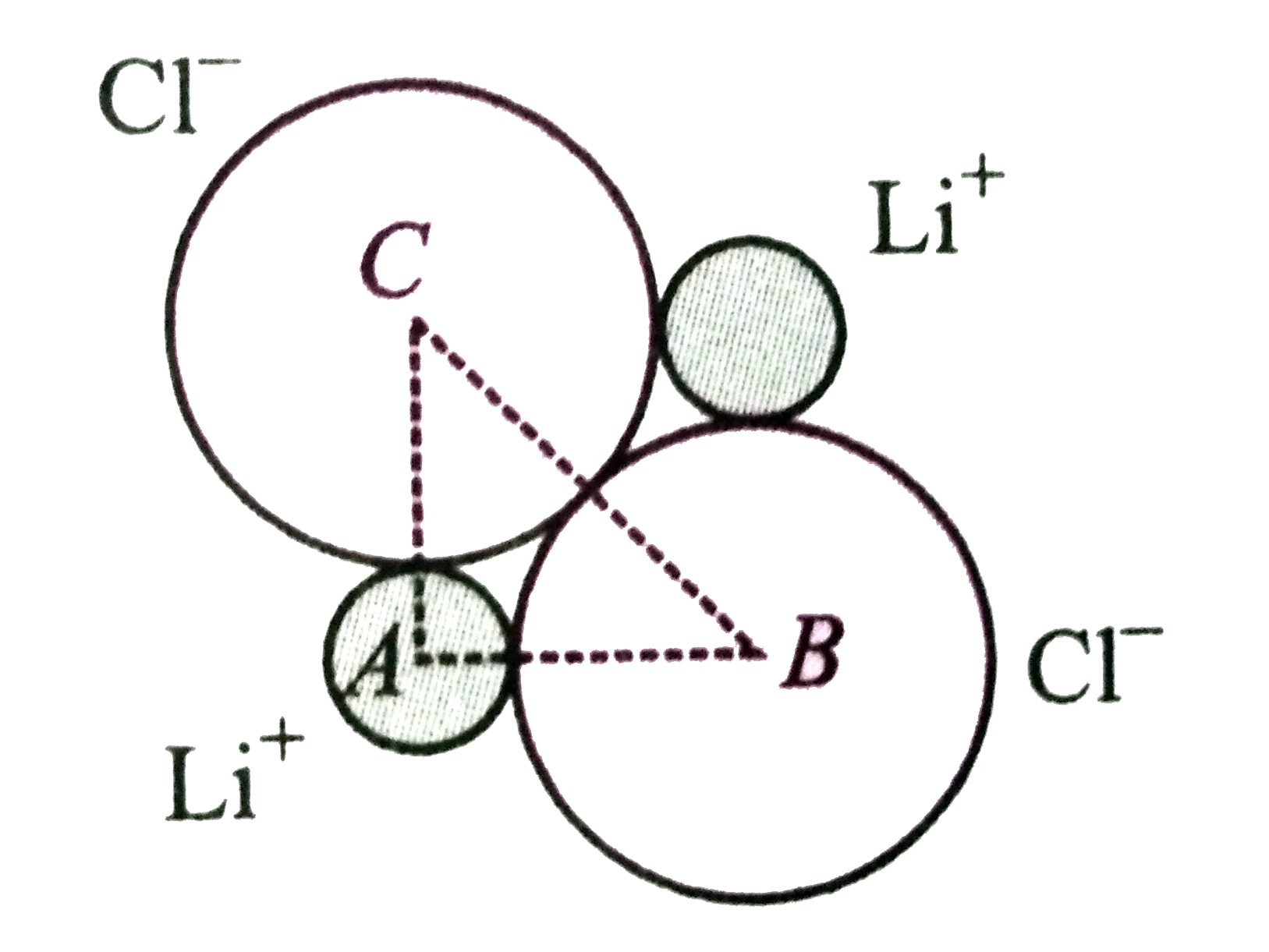 Interionic distance of LiCl =`a/2` `="5.14 Å"/2`=2.57 Å `BC=sqrt(AB^2+AC^2)=sqrt((2.57)^2+(2.57)^2)` =3.63 Å Radius of `CL^-` ion =`1/2BC =1/2xx3.63`=1.81 Å Hence , R is the CORRECT explanation of A. |
|
| 45. |
Assertion::In the electrolysis of water containing 15 to 20 percent H_(2)SO_(4) SO_(4)^(2-) ions are not discharged at anode. Reason: The discharge potentail of SO_(4)^(2-) ions is higher than that OH^(-) ions. |
| Answer» SOLUTION :(a) REASON is the CORRECT EXPLANATION for ASSERTION. | |
| 46. |
Assertion.Hexagonal close packing is more closely packed than cubic close packing. Reason.Hexagonal close packing has a coordination number of 12 whereas cubic close packing hasa coordination number of 8 |
|
Answer» If both assertion and REASON are true, and reason is the true explanation of the assertion. Correct R. Both have a coordination number of 12. |
|
| 47. |
Assertion.CsCl has body-centred cubic arrangement Reason.CsCl has one Cs^+ ion and 8 Cl^- ions in its unit cell. |
|
Answer» If both assertion and reason are true, and reason is the true explanation of the assertion. |
|
| 48. |
Assertion:Addition of bromine to trans-2-butene yields meso-2, 3 -dibromobutane. Reason:Addition of bromine to an alkene is an electrophilic addition. |
|
Answer» Both Assertion and REASON are true and Reason is the CORRECT explanation of Assertion. |
|
| 49. |
Assertion(A): When is subjected to dehydrohalogenation using NaOEt/EtOH, the product contains no deuterium . Reason(R): E_(2) follows anti elimination. |
|
Answer» If both A and R are true and R is the correct explanation of A. |
|
| 50. |
Assertion(A) : Neutral molecule SnCI_(4) can act as an electrophile. Reason (R) : It has vaccant 'd' orbitals which can accommadate the electrons from others. |
|
Answer» Both(A) and (R) are CORRECT and (R) is the correct EXPLANATION of (A). |
|