

Saved Bookmarks
This section includes 7 InterviewSolutions, each offering curated multiple-choice questions to sharpen your Current Affairs knowledge and support exam preparation. Choose a topic below to get started.
| 1. |
Find the radius of the soap bubble if 44xx10^(-6)J of work is done in blowing the soap bubble. Surface tension of soap solution = 7xx10^(-2)Nm^(-1) |
|
Answer» Solution :Work done, `W=44xx10^(-6)J` If .r. is the radius of the SOAP bubble Surface area of the soap bubble = `8pir^(2)` Work done in BLOWING soap bubble (W) = surface area of the bubble x surace tension `W=8pir^(2)`. S `therefore r^(2)=(W)/(8piS)` `r=sqrt((W)/(8piS))=sqrt((44xx10^-6)/(8xx(22)/(7)xx7xx10^-2))` `=sqrt((1)/(4)xx10^(-4)),"r = 0.005m (or) 5MM"` |
|
| 2. |
The mass of a car is 1500 kg. How much work is required to be done on itto make with a speed of 72 km/h ? |
|
Answer» `30xx10^(5)J ` ` :. DELTAK = W = 1/2 mv^(2) = 1/2 xx1500 (20^(2)` ` :. W = 1500 xx(400)/2 = 1500 xx200 = 3xx10^(5) J ` |
|
| 3. |
In soldering, addition of flux makes soldering easily why? |
| Answer» Solution :The addition of FLUX REDUCES the surface TENION of molten TIN, hence it spreads. | |
| 4. |
Rain is falling vertically with a speed of 35 ms^(-1) . Windsstarts blowing aftersometime with a speed of 12 ms in east to west direction . In which direction should a boywaiting at a bus stop holdhis umbrella ? |
|
Answer» Solution :The velocity of the RAIN and the windare represented by the vectors `v_(r ) and v_(w)` in Fig. 4.7and arein the direction specified by the PROBLEM . Usingthe ruleof vector addition, we see that the resultant of `v_(r )andv_(w)` is R as shown in the figure . The magnitude of R is `R=sqrt(v_(r)^(2)+v_(w)^(2))=sqrt(35^(2)+12^(2)) "m s"^(-1)=37 " m s "^(-1)` The direction `THETA` that R MAKES with the vertical is given by `tantheta=(v_(w))/(v_(r))=(12)/(35)=0.343` Or , `theta=tan^(-1)(0.343)=19^(@)` Therefore , theboy should hold his umbrella in thevertical plame at an angle of about`19^(@)` with the vertical towards the east. |
|
| 5. |
A trolley of mass 3.0 kg is connected to two identical springs each of force constant600 Nm^(-1)as shown in figure 13.32 (amplitude=5cm) Problem (a) period of oscillationProblem (b) the max speed of trolley. If the spring in the problem are replaced by rubber bands, what is the answer to the question (a) and (b) in the problem ifK of rubber band is 600 Nm^(-1) during extensions. |
|
Answer» SOLUTION :Rubber BAND acts like a spring during stretching only . So there is no restoring FORCE during compression. (a) `:. T=2pisqrt(m/k)=2xsqrt(3/(600))=0.44s` `v_(MAX) = aomega=asqrt(k/m)=0.05sqrt(600/3)=0.71 MS^(-1)` |
|
| 6. |
In pure rolling, the velocity at the point of contact: |
| Answer» Answer :D | |
| 7. |
A sphere A moving with a speed 'U' and rotating with an angular velocity 'omega' makes head-on elastic collision with an identical stationary sphere. There is no friction between the surfacces A and B neglect gravity (A) A will stop moving but continue to rotate with angular velocity 'omega' (B) A will come to rest and stop rotating (C ) B will move with speed 'U' without rotating (D) B will move with speed U and rotate with an angular velocity w. |
|
Answer» A &C |
|
| 8. |
A sphere ,a cubeand a thin circular plate,all made of the same meteriel and having the same mass are initially heated to a temperature of 200°C.Which of them will cool fastest and which one slowest when left in air at room temperature? |
| Answer» Solution :The circular plate has larger surface AREA, while the SPHERE has the least area . HENCETHE disc will cool FASTEST and the sphere will cool SLOWEST. | |
| 9. |
Starting from rest at s=0 a boat travels in a straight line with an acceleration on as shown by the a-s graph. Determine the boat's speed at s=40,90"and"200m |
|
Answer» |
|
| 10. |
A body is projected with an initial speed of 100sqrt(3)ms^(-1) at an angle of 60^(@) above the horizontal. If g=10ms^(-2) then velocity of the projectile (a) Is perpendicular to it.s acceleration at the instant t = 15 sec (b) Is perpendicular to inital velocity of projection at t = 20 sec. ( c)Is minimum at the highest point (d) Changes both in magnitude and direction during its flight. Mark the answer as |
|
Answer» if a, B, C and d are CORRECT |
|
| 11. |
A sky lab of mass 2 xx 10^(3) kg is first launched from the surface of earth in a circular orbit of radius 2R (from the centre of earth) and then it is shifted from this circular orbit to another circular orbit of raidus 3R. Calculate the minimum energy required (a) to place the lab in the first orbit (b) to shift the lab from first orbit to the second orbit. GIven , R = 6400 Km and g = 10 m//s^(2). |
|
Answer» Solution :The energy of the sky lab on the surface of earth `E_(s) = KE + PE = 0 + (-(GMm)/(R)) = -(GMm)/(R)` And the energy of the sky lab in an orbit of radius r `E = (1)/(2)mv_(0)^(2) + [-(GMm)/(r)] = (-GMm)/(2r) ["as " v_(0) = SQRT((GM)/(r))]` (a) So the energy required to palce tha lab from the surface of earth to the orbit of radius 2R, `E_(1) - E_(s) = -(GMm)/(2(2R)) -[-(GMm)/(R)] = (3)/(4)(GMm)/(R)` i.e., `Delta E = (3)/(4)(m)/(R) xx g R^(2) = (3)/(4) mgR ""["as g" = (GM)/(R^(2))]` i.e., `Delta E = (3)/(4)(2 x 10^(3) xx 10 xx 6.4 xx 10^(6)) = (3)/(4)(12.8 xx 10^(10)) = 9.6 xx 10^(10)J` (b) As for II orbit r = 3R, `E_(11) = -(GMm)/(2(3R)) = -(GMm)/(6R)` `therefore E_(11) - E_(1) = -(GMm)/(6R) -(-(GMm)/(4R)) = (1)/(12) (GMm)/(R)` But as `g = (GM//R^(2))`, i.e., `GM = gR^(2)` or `Delta E = (1)/(12)mgR = (1)/(12)(12.8 xx 10^(10)) = 1.1 xx 10^(10)J` |
|
| 12. |
Two equal sphere of mass m are in contact o a smooth horizontal table. A third identical sphere impinges symmetrically on them and is reduced to rest. Find e and the loss KE. |
|
Answer» |
|
| 13. |
A thin 1 m long rod has a radius of 5 mm. A force of 50 pikN is applied at one end of determine its Young.s modulus. Assume that the force is exactly known. If the least count in the measurement of all lengths is 0.01 mm, which of the following statements is false? |
|
Answer» The maximum value of `gamma` that can be determined is `10^(14)N//m^(2)`. |
|
| 14. |
The figure show a cross-sectionof a doubleglass unit ofa windowon a vertical wall. A graphwall. A graph of thetemperatureat different pointswithin the unit isshow nextto it. The temperaturedifferenceacrosstheunit is 13 K. Ithas acrossp-sectionalarea of1.3m^(2)and the rate ofheat flow throughit is 65 W. Then the correctstatementis (Glasshas a thermal conductivity of 1 W m^(-1) K^(-1)) |
|
Answer» The unitis in steady state andin thermalequilibrium |
|
| 15. |
When a spring is compressed by a distance 'x', the potential energy stored is U_(1). When it is further compressed by a distance 2x, the increase in potential energy is U_(2), Theratio of U_(1): U_(2) is |
| Answer» ANSWER :B | |
| 16. |
The gas law (PV)/(T )=" constant is true for "……………… . |
|
Answer» ISOTHERMAL CHANGES only |
|
| 17. |
A block of mass m is connected to another block of mass M by a spring (massless) of spring constant k. The blocks are kept on a smooth horizontal plane. Initially the blocks are at rest and the spring is unstreatched. Then a constant force F starts acting on the block of mass M to pull it. Find the force on the block of mass m. |
|
Answer» `(MF)/(M)` |
|
| 18. |
An air chamber of volume v has a neck area of cross section a into whicha ball of mass m just fits and can move up and down without any friction. Show that when the ball is pressed down a little and released for the time priod of oscillation, assuming pressure-volume variations of the air to be isothermal. |
Answer» SOLUTION :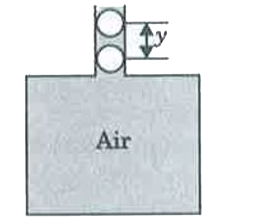 , , volume of chamber = V Area of cross section of neck = a mass of ball = m Intially pressure Let the ball be depressed by y units. Due to depression, there will be reduction in volume and hence, increase of pressure inside chamber. `therefore` Decrease in volume of chamber = `DELTAV = AY` `therefore` Volumetric strain` = (DeltaV)/(V) = (ay)/(V)` `therefore B = Bulk modules= -(P)/((DeltaV)/(V)) = -(PV)/(ay)` `P = -(Bay)/(V)` Restoring force `F = PA` ` = -(Ba^(2)y)/(V)` As `F = -Kx` `therefore` we can write `K = (Ba^(2))/(V)` `T = 2pi sqrt((mV)/(Ba^(2)))` |
|
| 19. |
A man of mass 60 kg sitting on ice pushes a block of mass of 12kg on ice horizontally with a speed of 5 ms^(-1). The coefficient of friction between the man and ice and between block and ice is 0.2. If g=10 ms^(-2), the distances between man and the block, when they come to rest is |
| Answer» Answer :B | |
| 20. |
The masses of two planets are M and 16M respectively. Their radii are a and 2a respectively and their centres are 10 a apart. A body of mass m is fired straight from the surface of the larger planet towards the smaller planet. What should be the minimum projectile speed so that it reaches the surface of the smaller planet ? Obtain the expression in terms of G, M and a. |
|
Answer» |
|
| 21. |
A block of quartz of mass 13.5 g is weighed in aniline at 0^(@)C and at 100^(@)C. The weighings are 8.905 and 9.29 g respectively. Calculate the coefficient of cubical expansion of aniline, assuming coefficient of cubical expansion of quartz to be zero. |
| Answer» SOLUTION :`9.166 XX 10 ^(-4) //^(@)C` | |
| 22. |
At a metro station, a girl walks up a stationary escalator in time t_(1). If she remains stationary on the escalator, then the escalator take her up in time t_(2). The time taken by her to walk up on the moving escalator will be |
|
Answer» `(t_(1)+t_(2))//2` |
|
| 23. |
A liquid of density rho is flowing inside a pipe of cross - sectional area A. The pipe is bent in the shape of a right angle as shown. What force should be exerted on the pipe at the corner to keep it fixed in the two cases shown? |
|
Answer» Solution :(a) CONSIDER a mass `Deltam` of liquid flowing across the corner in time `Deltat`. We will apply Newton.s Iind law of motion to the mass `Deltam`. `"MAGNITUDE of initial momentum "=P_(i)=(Deltam)V` `"Magnitude of final momentum"=P_(F)=(Deltam)V` `"Change in momentum"=Deltabar(P)=barP_(f)-barP_(i)` `DeltabarP` can be calculated by vector subtraction GEOMETRICALLY. 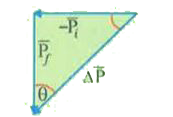 `"As"P_(i)=P_(f) rArr theta =45^(@)` `DeltaP=sqrt((P_(i)^(2)+P_(f)^(2)))=sqrt(2(Deltam)^(2)V^(2))=sqrt2(Deltam)V` The force on liquid has same direction as the direction of change in momentum of liquid. The force by lilquid on the pipe is equal and opposite to this force. Hence the pipe must be pushed at the corners with force `sqrt2AV^(2)rho` an angle of `45^(@)` with horizontal. The force by liquid on the pipe is equal and opposite to this force. (b) Force exerted on the liquid `=(Deltavecp)/(Deltat)=(2DeltamV)/(Deltat)=2Vrho"(volume per sec)"` `=2V rho AV=2AV^(2)rho` |
|
| 24. |
A projectile is projected with a velocityv_(0) at an angletheta with the horizontal as shown in figure. The angular momentum of particle about the origin: |
|
Answer» is zero when particle is at the origin |
|
| 25. |
Ifvec(A) + vec(B) +vec(C)=0, "then" vec(A)xx vec(B)is : |
|
Answer» `vec(B) XX vec(C)` |
|
| 26. |
In the measurement of a physical quantity (L), the formula used is L=k(m x n), where k is a constant and m and n are the quantities to be measured. If the % errors in m and n are respectively 3% and 5%. The % error in the measurement of L is |
|
Answer» 0.02 |
|
| 27. |
Explain limiting friction and kinetic friction. State laws of limiting friction. Give two methods of reducing friction. Show that kinetic friction is less than static friction. |
|
Answer» Solution :(i) Application of lubricating oils, and (ii) USE of ball BEARINGS and roller bearings between the surfaces in CONTACT are two of many methods that can reduce FRICTION. When a force applied to move a body over a surface just exceeds the limiting friction the body starts to move. Now, even if the applied force is not INCREASED any more the body is observed ot accelerate. This means that the resultant force is positive, i.e, the kinetic force. This indicates that the kinetic friction falls below the limiting friction ( the limiting value of static friction ) as soon as the body starts to move. |
|
| 28. |
The property of surface tension tends to persists even if a liquid is solidified. Hence, solids can also be assumed to possess surface tension. Consider a liquid in contact with a solid with air above. Let T_1 , T_2 and T_3 be the surface tension at the liquid-air interface, solid-air interface and the solid-liquid interface. The liquid drop will spreads on the solid surface if |
|
Answer» `|T_2 -T_1 | T_1` |
|
| 29. |
In which of the following cases the planet will have same value of .g. as that of the value on the earth |
| Answer» Answer :B | |
| 30. |
On what the value of surface tension depends ? |
|
Answer» SOLUTION :The VALUE of surface tension depend on the TEMPERATURE. At critical temperature its value is zero. Critical temperature of water is `37.4^(@)C`. Like viscosity surface tension of LIQUID decreases with temperature. Surface tension of some liquids at the temperature indicated with the HEATS of the vaporisation are shown in table below : 
|
|
| 31. |
A particle or mass m is moving with speed u in a direction in a which makes 60^(@) with respect to x axis to x axis . It undergoes elastic collision with the well . What is the change in momentum in x and y direction? |
|
Answer» `Deltap_(X)`=-MU ,`Deltap_(y)`=0 `Deltap_(x)`=FINAL momentum - collision The change in momentum of the molecule in Y direction `Deltap_(y)=0`  |
|
| 32. |
The property of surface tension tends to persists even if a liquid is solidified. Hence, solids can also be assumed to possess surface tension. Consider a liquid in contact with a solid with air above. Let T_1 , T_2 and T_3 be the surface tension at the liquid-air interface, solid-air interface and the solid-liquid interface. The angle of contact will be obtuse if |
|
Answer» `T_2 LT T_3` |
|
| 33. |
A body describes simple harmonic motion with an amplitude of 5 cm and a period of 0.2s. Find the acceleration and velocity of the body when the displacement is 5 cm. |
|
Answer» `(A)/(3)` `(1)/(2)momega^(2)y^(2)=(1)/(2)((1)/(2)momega^(2)A^(2))impliesy=(A)/(sqrt(2))` |
|
| 34. |
Given : vec(A)rarr=2hat(i)-3hat(j) is The magnitudeof (vec(A)+vec(B)) is : |
|
Answer» `SQRT(120)UNITS` `:. |vec(A)+vec(B)|=sqrt(49+81)=sqrt(130)` |
|
| 35. |
Two simple harmonic oscillators with amplitudes in the ratio 1: 2 are having the same total energy. The ratio of their frequencies is |
|
Answer» 1:4 |
|
| 36. |
A liquid of density 0.8 gm/c.c is flowing through a pipe. If the kinetic energy per cubic meter of the liquid is 14.4 KJ//m^(3), the velocity of flow is |
| Answer» Answer :D | |
| 37. |
A small piece of wire 4 cm long is floating on the surface of water. If a force of 560 dynes in excess of its weight is required to pull it up from the surface, find the surface tension of water. |
|
Answer» Solution :LENGTH of wire `l=4cm` Contact length of solid with liquid surface `L=2l=8cm` Surface tension `S=(F)/(L)impliesS=(560)/(8)=70` dyne/CM Surface tension of water = 70 dyne `cm^(-1)=0.07Nm^(-1)`. |
|
| 38. |
Choose the correct alternative(s) |
|
Answer» For a general rorational MOTION angular momentum `VEC(L)` and angular VELOCITY `vec(omega)` need not be parallel |
|
| 39. |
In problem 17 if the mass m is allowed to fall from a height 2R, find the reaction of the track on the sliding mass the lowest point, at the highest point,at the mid-point. Take R : r = 5:2 |
|
Answer» |
|
| 40. |
The resultant of two vectors vec(P) and vec(Q) is vec(R). If the magnitude of vec(Q) is doubled, the new resultant becomes perpendicular to vec(P), then the magnitude of vec(R) is |
|
Answer» <P>`(P^(2) - Q)/(2PQ)` |
|
| 41. |
A microscope is focussed on a coil lying at the bottom of a beaker. The microscope is now raised up by 1cm. To what depth should the water be poured in to the beaker so that coin is again in focus (mu_W=4//3) |
|
Answer» 1CM |
|
| 42. |
Match the following in case of refraction in (i_1= angle of incidence i_2= angle of emergence) prism |
|
Answer» `a to G, B to H, c to f, d to e` |
|
| 43. |
What is an ideal gas? |
| Answer» SOLUTION :A gas which obeys gas laws under all CIRCUMSTANCE of pressure and temperature is called ideal gas will follow the EQUATION PV = nRT at all pressure and TEMPERATURES. | |
| 44. |
Two heavenly bodies S_1 and S_2not far off from each other are seen to revolve in orbit |
|
Answer» around their common centre of mass |
|
| 45. |
An Indian scientist who won Nobel prize for Physics is |
| Answer» Answer :C | |
| 46. |
How would the fundamental frequency emitted from an organ pipe, open at both the ends, change, if (i) an open end is suddenly closed, (ii) the length of the pipe is increased,(iii)the diameter of the pipe is increased ? (iv) what would happen if air is blown heavily through an open end ? |
|
Answer» (II)The frequency of the emitted fundamental tone isinversely PROPORTIONAL to the length of the pipe.So ,the frequency would decrease with the increases in the length of the pipe. (iii)The end error of a pipe increases with the increase in diameter.As a result, the effective length of the pipe increases . The fundamental frequency is inversely proportional to the length of the pipe ; so the frequency would decrease due to this increase ineffective length. (iv)Heavier blow would increase the loudness of the emitted tones. MOREOVER, the higher (i.e., 2nd , 3RD , 4th, ....) harmonics would be formed more easily . |
|
| 47. |
The escape velocities on the surface of two planets of masses m_1 and m_2 and having the radius r_1 and r_2 are v_1 and v_2 respectively, then |
|
Answer» `v_1/v_2=(m_1r_1)/(m_2r_2)` |
|
| 48. |
A gold crown adulterated with silver was found to weigh 0.540 kg in air and 0.498 kg in water. If the densities of gold and silver are 13900"kgm"^(-3) and 10500"kgm"^(-3), then calculate the mass of silver mixed with gold. |
|
Answer» Solution :Mass of pure gold =(V-X) 13 900 Mass of pure silver =10500 x but `(rho)/(rho_(W))=(W_("air"))/(W_("air)-W_("water"))=(0.540)/(0.540-0.498)=12.857` Density of the IMPURE gold crown `=12.857 xx 1000 =12857 kgm^(-3)` Density of the crown substance `=("mass of gold+mass of silver")/("volume")` 12857V=(V-x)13900+10500x 12857V=13900V-3400x `therefore x/V=(1043)/(Vrho)=(0.3068 xx 10500)/(12857)` `therefore M_(Ag)=0.2505M` i.e, Mass of silver `=0.2505 XX 0.540 =0.1353kg` and the REST pure gold `=0.5400-0.1353=0.4047kg` Percentage of mass of Ag `=(0.1353)/(0.540) xx 100=25.5%` Percentage of mass of Au is 75.5%. |
|
| 49. |
When .n.number of particles of masses m, 2m, 3m..... nm are at distances x_(1)=1,x_(2)=2,x_(3)=3,.........,x_(n)=n units respectively from origin on the x-axis, then find the distance of centre of mass of the system from origin. |
|
Answer» Solution :`x_(cm)=(m(1)+2M(2)+3M(3)+......+(NM)n)/(m+2m+3m+.......+nm)` `x_(cm)=(m(1^(2)+2^(2)+3^(2)+.......+n^(2)))/(m(1+2+3+.......+n))` `X_(cm)=(((n(n+1)(2n+1))/(6)))/(((n(n+1))/(2)))=(2n+1)/(3)` |
|
| 50. |
A rubber ball falls from a height h and rebounds to a height h/2. A rubber ball of double the mass falling from the same height h rebounds to a height |
|
Answer» h |
|