

Saved Bookmarks
This section includes 7 InterviewSolutions, each offering curated multiple-choice questions to sharpen your Current Affairs knowledge and support exam preparation. Choose a topic below to get started.
| 1. |
Wavelength of characteristic X-ray depends on which property of target ... |
|
Answer» A |
|
| 2. |
A ray of light refracts from medium 1 into a thin layer of medium 2, crosses the layer and is incident at the critical angle on the interface between the medium 2 and 3 as shown in the figure. If the angle of incidence of ray is theta, the values of theta is |
|
Answer» `sin^(-1)((8)/(9))` `(sin theta)/(sin r) = ""_(1)mu_(2)=(mu_(2))/(mu_(1))`...(A) then again light falls from medium 2 to medium 3 at critical angle `( sin r)/(sin 90^(@))= ""_(2)mu_(3)= (mu_(3))/(mu_(2))` `sin r = (1.3)/(1.8)` Put the value in equation (A) we get, `sin theta = (1.8)/(1.6)xx(1.3)/(1.8)` `rArr theta= sin^(-1) (13/16)` |
|
| 3. |
A cylindrical vessel of depth 4m is fully filled with non homogenious liquid whose refractive index (mu) varies with depth y (in meters) a mu=1+(y)/(4). Find the depth of the bottom of vessel as seen by an observer just above the top of the vessel. |
| Answer» SOLUTION :`4//n 2 m` | |
| 4. |
In the given figure, a diode D is connected to an external resistance R=100Omega and an emf of 3.5V. If the barrier potential developed across the diode is 0.5 V, the current in the circuit will be: then the output across R_(L) will be |
|
Answer»

|
|
| 5. |
The spaceship Enterprise, traveling through the galaxy, sends out a smaller explorer craft that travels to a nearby planet and signals its findings back. The proper time for the trip to the planet is measured by clocks |
|
Answer» On BOARD the Enterprise |
|
| 6. |
The potential difference between points A and B of adjoining figure is: |
|
Answer» 2/3V |
|
| 7. |
Angle of a prism 30^(@) and its refractive index is sqrt2 and one of the prism surface is silvered. At what angle of incidence, a ray should be incident on one surface so that after reflection from the silvered surface, it retraces its path |
|
Answer» `30^(@)` incident on the silvered surface, hence `angler_(2)=0^(@)`. `because angler_(1)+angler_(2)=angleA" hence "r_(1)=A=30^(@)` As `(sini)/(sinr_(1))=n RARR sini = n sin r_(1)=sqrt2xx sin 30^(@)=sqrt2xx(1)/(2)=(1)/(sqrt2)` `rArr""i=sin^(-1)((1)/(sqrt2))=45^(@)` 
|
|
| 8. |
(a) The emf of a cell is E and its intenal resistance is r. Its terminals are connected to a resistance R. The potential difference between the terminal is 12 V if R = 3 Omega and 16 V if R = 8 Omega. Find the values of E and r (b) When an unknown resistance is connected across a series combination of two identical cells, each of 18 V, current through the resistance is 4 A. When it is connected across a parallel combination of the same cells, the current through it is 3 A. Find the unknown resistance and internal resistance of each cell. ( c) p identical cells, each of emf E and internal resistance r, are joined in series to form a closed circuit. One cell (X) is joined with reversed polarity. Find the potential difference across each cell except X and also across X. (d) 12 cells each having the same emf are connected in series and are kept in a closed box. Some of the cells are wrongly connected. This battery is connected in series with an ideal ammeter and two cells of same emf as of 12 cells. The current is 3 A when the cells and the battery aid each other and 2 A when the cells and battery oppose each other. How many cells in the battery are wrongly connected ? |
|
Answer» Solution :(a) `i = E//(r + R)` `p.d`. Across cell `V_A - V_B = V = (E - ir)` or `iR` `V = (ER)/(R + r)` When `R = 3 Omega, V = 12 V` `R = 8 Omega, V = 16 V` `12 = (E xx 3)/(3 + r)` …(i) `16 = (E xx 8)/(8 + r)`….(ii) (ii)//(i) `rArr (16)/(12) = (8)/(8 + r). (3 + r)/(3)` `(1)/(2) = (3 + r)/(8 + r) rArr 8 + r= 6 + 2r rArr r = 2 Omega` `12 = (3E)/(3 + r) = (3E)/(3 + 2) rArr E = 20 V` (b) Case (a) : `i_1 = (18 + 18)/(R + 2r) =(36)/(R + 2r)` `4 = (36)/(R + 2r) rArr R + 2r = 9` ...(i) Case (b) : Two cells of same EMF are equivalent to a cell of same emf `18 V` and resistance `r//2` `i_2 = (18)/(R + (r)/(2))` `3 = (18)/(R + (r)/(2)) rArr R + (r)/(2) = 6` ...(ii) Solving (i) and (ii), `r = 2 Omega, R = 5 Omega` ( C) One cell is wrongly connected Net emf `= (p -2) E` Net resistance `= pr` `i = ((p -2)E)/(pr)` All cells are supplying current except `X` `p.d` across each cell (except `X`) `V = E - ir = E - ((p -2)E)/(pr) r = E -((p -2)E)/(p)` =`(2E)/(p)` Cell `X` is TAKING current `p.d. V' = E + ir = E + ((p -2)E)/(pr) r = (2(p-1)E)/(p)`. (d) Let `n` cells are wrongly connected, let emf of each each cell is `E` and internal resistance is `r` New emf of battery `= (12 - 2n) E` Net resistance `= 12 r` (i) When battery and two cells aid each other Net emf `=(12 - 2n) E + 2 E` Net resistance `= 12 r+ 2r= 14 r` Current `i_1 = ((12 - 2n)E + 2E)/(14 r) = 3` ...(i) (ii) When battery and two cells oppose each other Net emf ` = (12 - 2n) E - 2 E` Current `i_2 = ((12 - 2n)E - 2E)/(14 r) = 2`...(ii) (i)//(ii) `rArr (14 - 2n)/(10 - 2n) = (3)/(2) rArr 28 - 4n = 30 - 6n` `2n = 2 rArr n = 1` only one cell is wrongly connected. (a) 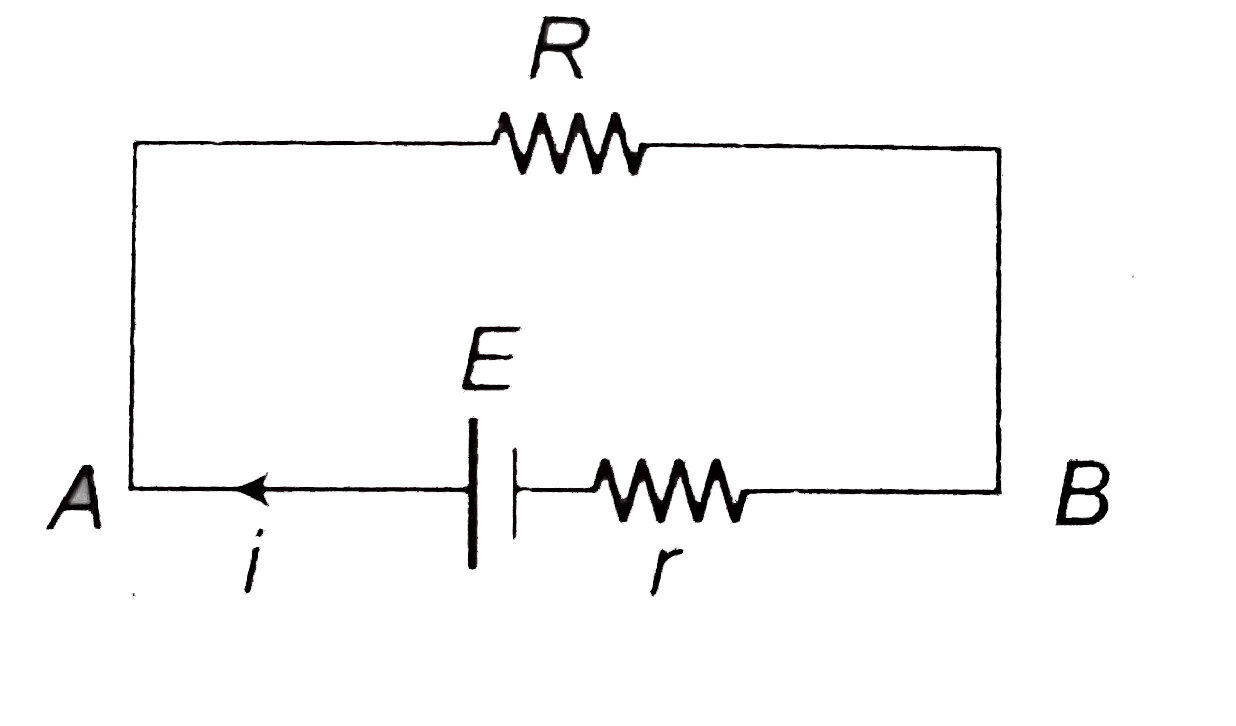 (b) 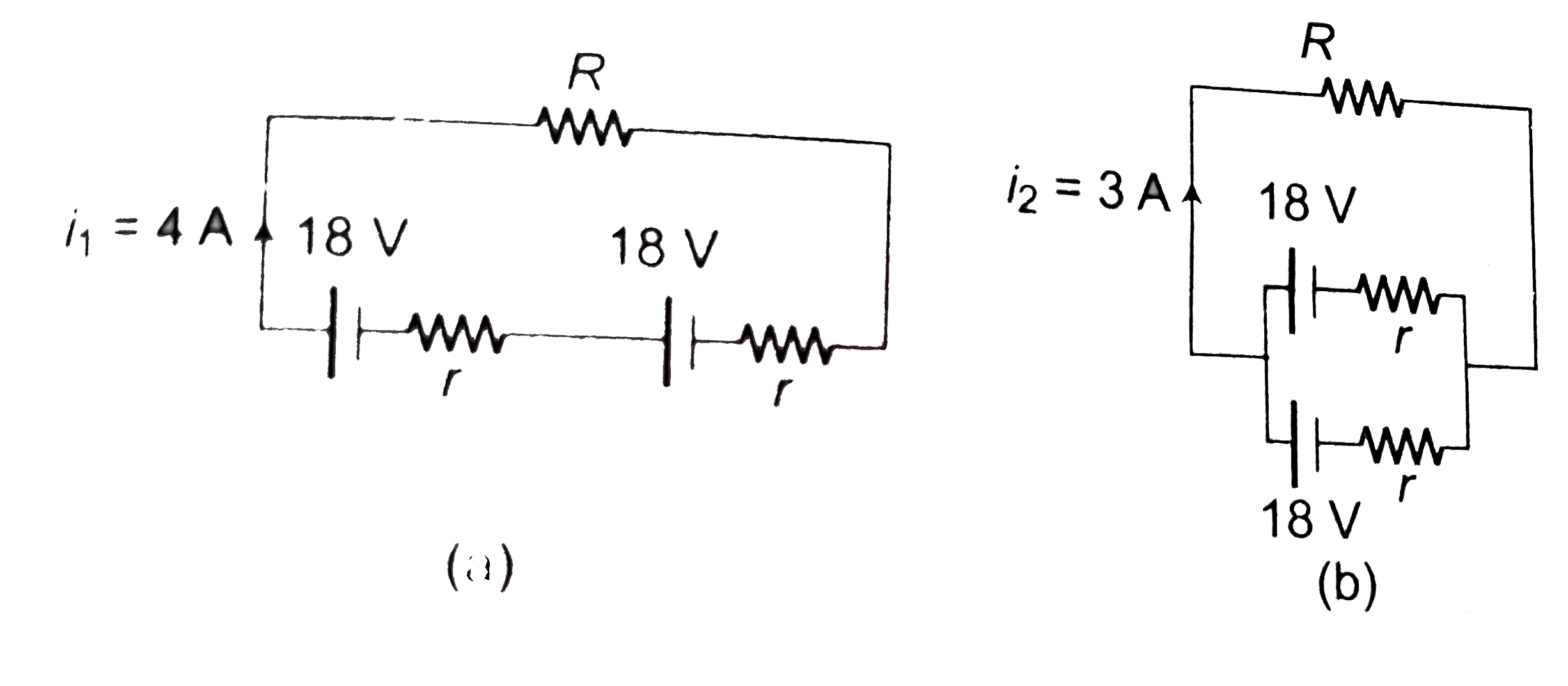 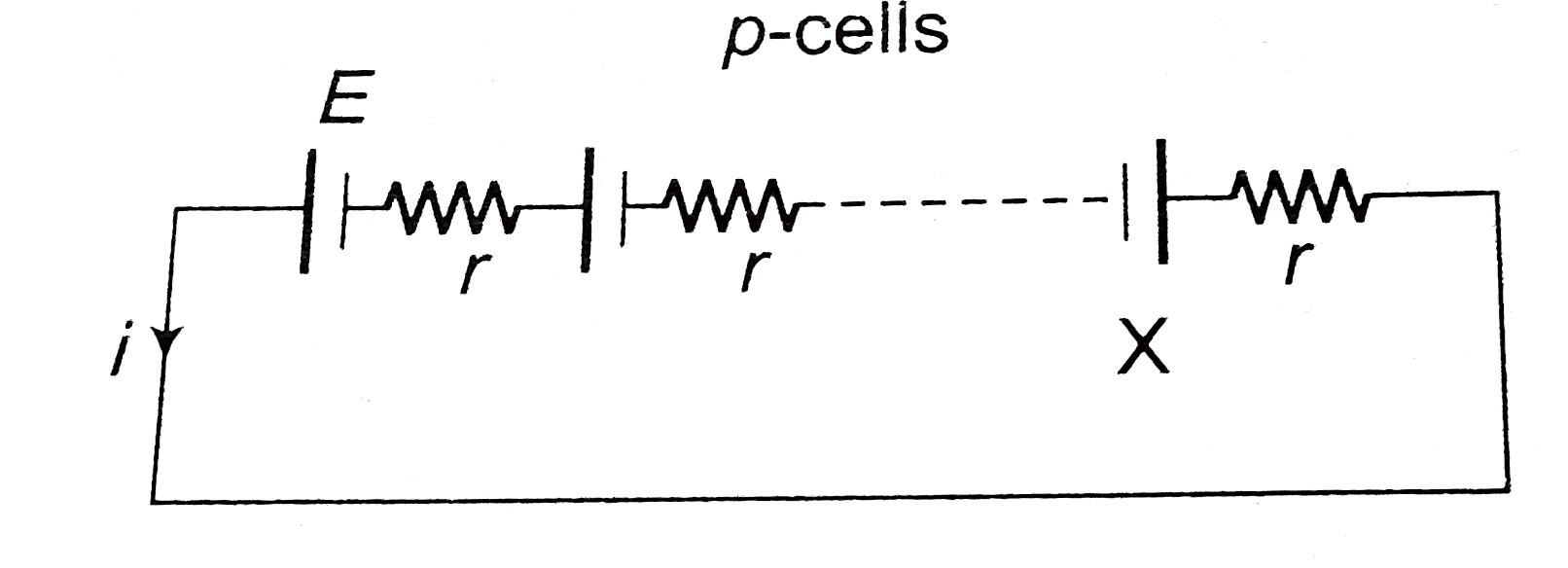
|
|
| 9. |
A square plate of mass 10kg and side 20m is moving along the groove with the help of two ideal rollers (massless), connected at the corners A and B of the square, as shown in the figure. At a certain moment of time, during motion, the corner A is moving with velocity 16m//s downward. Find the speed of corner D. |
|
Answer» `32 m//s` |
|
| 10. |
The sky wave propagation is suitable for radio waves of frequency |
|
Answer» upto 2MHZ |
|
| 11. |
For the reaction 2NO_(2)rarrN_(2)O_(3)+O_(2), rate expression is as follows : -(d[NO_(2)])/(dt)=K[NO_(2)]^(n), where K=3xx10^(-3)mol^(-1)L sec^(-1) If rate of formation of oxygen is 1.5xx10^(-4)mol L^(-1)sec^(-1) then the molar concentration of NO_(2)in mole L^(-1) is : |
|
Answer» `1.5xx10^(-4)` `-(1)/(2)=(d[NO_(2)])/(dt)=(d[O_(2)])/(dt)` `:.""-(d[NO_(2)])/(dt)=2XX(d[O_(2)])/(dt)=2xx1.5xx10^(-4)=3XX10^(-4)` `3xx10^(-4)=K[NO_(2)]^(2)=3xx10^(-3)[NO_(2)]^(2)` `:. ""[NO_(2)]=0.316` |
|
| 12. |
What is Rayleigh's criterion? . |
| Answer» Solution :The IMAGES of two point OBJECTS are just resolved when the central MAXIMUM of the DIFFRACTION pattern of one FALLS over the first minimum of the diffraction pattern of the other. | |
| 13. |
Length of solenoid is having 5000 turns is 40 cm. Magnetic field produced inside it is _____ T if 10 A electric current passes through it. |
|
Answer» 0.0157 `=(4xx3.14xx10^(-7)xx500xx10)/0.4` = 0.0157 T |
|
| 14. |
The radius of a soap bubble is 5 mm. What charge should be imparted to it to make it begin to swell? |
|
Answer» SOLUTION :The electrical forces extending the film must exceed the surface tension forces: `(Q^(2))/(32 pi^(2)epsi_(0)R^(4)) GE (4 SIGMA)/(R)` |
|
| 15. |
The force experienced by a charge of 2mu C in an electric field is 3 xx 10^(-3)N. The intensity of the electric field. |
|
Answer» `1.5 XX 10^(3) N//C` |
|
| 16. |
Calculate the energy equivalent to one atomic mass unit ( 1 a.m.u.) in M eV. |
|
Answer» As we know, 1 GRAM atom of an element contains `6.023xx10^(23)` atom (Avogado.s number). Thus `6.023xx10^(23)` ATOMS of carbon weigh `=12g` 1 atom of carbon weigh `=(12xx10^(-3))/(6.023xx10^(23))`kg Hence `1 amu=1/12 xx (12xx10^(-3))/(6.023xx10^(23))kg` `=1.66xx10^(-27)kg`. Relation between amu and Me V (or Energy equivalence of 1 amu.) From Einstein.s mass energy relation, we have `E=m_(0)c^(2)` where E is the energy EQUIVALENT of rest mass `m_(0)` and c is the velocity of LIGHT. Thus, `E=1.66xx10^(-27)xx(3xx10^(8))^(2)J` `=(1.66xx9xx10^(-11))/(1.6xx10^(-19))` eV `=931.5 xx 10^(6) eV=931.5 ` M eV`( :. 1 eV = 1.6xx10^(-19)J)` `~=931` M eV. |
|
| 17. |
Represent graphically the displacement, velocity and acceleration against time for a particle performing linear SHM starting from the positive extreme position. State the conclusions. |
|
Answer» Solution :For the graphical representations, refer to the answer to Q. 16 of the colved Model Question Paper in Part Conclusions: (1) The displacement, velocity and ACCELERATION of a particleperforming LINEAR SHM are PERIODIC (HARMONIC) functions of time. For a particle STARTING from an extreme position, the x-t and a-t graphs are cosine curves, the u-t graph is a sine curve. (2) There is a phase difference of `(pi/(2))` radians between x and v, and between v and a. (3) There is a phase difference of z radians between x and a. |
|
| 18. |
If proton moves with velocity 10hatims^(-1) in magnetic field having magnitude 5hatj T, magnetic force acting on it is ______ N. |
|
Answer» `5xx10^(-18)` = `1.6xx10^(-19)(10hatixx5hatj)` = `1.6xx10^(-19)(50hatk)` `thereforevecF=8xx10^(-18)HATK` |
|
| 19. |
Define Voltagesensitivity ? |
|
Answer» Solution :It is defined as the DEFLECTION produced per unit voltage applied across it. `V_(s) = (theta)/(V)` `V_(s) = (theta)/(I R_(G)) = (NAB)/(KR_(g)) rArr V_(s) = (l)/(G R_(g)) = (I_(s))/(R_(g))` |
|
| 21. |
A thin string is held at one end and oscillaes vertically so that, y(x=0,0) = 8 sin dem Neglect the gravirational force. The string 's linear was density is 0.2 Kg/m and its tension is in the string passes through but filled with I kg : Due tofrietion to the heat The heat transfer efficiency is 50%. Calentate how much time passes before the temperature of the bath rises by one degree kelvin. |
|
Answer» Solution :`v=sqrt((T)/(mu))=sqrt((1)/(0.2))=2.236m//s` further `rhoS=mu=0.2 kg//m` Te average power over a period is `P=(1)/(2)(rhoS) omega^(2)A^(2)v` Substituting the values, we have`P=2.29xx10^(-2)J//s` Now LET, it takes t SECOND to raise the temperature of 1 kg water by ONE degree kelvin. Then `Pt=ms DELTAT` Here S= specific heat of water `=4.2xx10^(3)J//kg-K` `:.t=(msDeltat)/(P)=((1)(4.2xx10^(3))(1))/(1.145xx10^(-2))~~4.2` DAY |
|
| 22. |
Take the particle in question number 49, an electron projected with velocity v_(x)=4xx10^(6)ms^(-1). If electric field between the plates separated by 1 cm is 8.2xx10^(2)NC^(-1), then the electron will strike the upper plate if the length of plate is (Take m_(e)=9.1xx10^(-31)kg) |
|
Answer» 2.14cm `E=8.2xx10^(2)NC^(-1),q=e=1.6xx10^(-19)C,m_(e)=9.1xx10^(-31)KG` The electron will strike the UPPER plate at its other end of x = L as soon as its deflection. And `y=d/2=10^(-2)/2m=5xx10^(-3)m` From eqn. (iii), `L=sqrt((2m_(e)v_(x)^(2)y)/(qE))=sqrt((2xx9.1xx10^(-31)xx(4xx10^(6))^(2)xx5xx10^(-3))/(1.6xx10^(-19)xx8.2xx10^(2)))` `L=3.3xx10^(-2)m` = 3.3 cm |
|
| 23. |
A source of a.c. voltage V = V_(m) sin omega tis connected to a series combination of a capacitor C and a resistor R. Draw the phasor diagram and use it to obtain the expression for (i) impedance of the circuit, and (ii) phase angle. |
Answer» Solution :Consider an alternating voltage given by `V=V_(m) sin omega t`applied to a capacitor C and resistor R joined in SERIES as SHOWN in Fig. 7.28. As C and R are in series, same current I flows in the entire circuit. Let `vecV_(C), vecV_(R)` and `vecV`be the magnitudes of instantaneous values of voltage across the capacitance, resistance and the source. Then, as shown in phasor diagram:  `vecV_(C) = VECI.X_(C)` lagging behind in phaseby `pi/2` as compared to `vecl`, and `vecV_(R) = vecI R` in same phase as that of `vecl` These are being represented by phasors OB and OA, RESPECTIVELY. Then, total instantaneous voltage V is given by phasor OC such that: `V = sqrt(OA^(2) + OB^(2)) = sqrt(V_(R)^(2) + V_(C)^(2)) = Isqrt(R^(2) + X_(C)^(2))` `therefore` Impedance offered by the circuit, `Z = V/I = sqrt(R^(2) + X_(L)^(2)) = sqrt(R^(2) + (1/(Comega)^(2))` Moreover, the phasor diagram indicates that source voltage `vecV`lags behind the current I (or the circuit current leads the a.c. supply voltage) by a phase angle `phi`where, `tan phi = (OB)/(OA) = (IX_(C))/(IR) = X_(C)/R = (1//Comega)/R = 1/(R. Comega)` 
|
|
| 24. |
Block A is released from rest from wedge B. find out velocity of the wedge 'C' when the bloack A slide down completely after climbing up on it. All surfces are smooth. Block A, wedge B and wedge C are at rest initially. |
|
Answer» `sqrt(2gH)` `0=mv_(A)-2mv_(B)` `(1)/(2)2mv_(B)^(2)+(1)/(2)mv_(A)^(2)=MGH` When block A climbs up and then climbs down from C. By CONSERVATION of momentum and energy velocity of with `C=(2m)/(m+2m)V_(A)` |
|
| 25. |
A charged oil drop is held stationary in an electric field. The space containing the drop is exposed to a radioactive source and drop moves with different terminal velocities v, 2v, 30, 40 ....... etc. It suggests : |
|
Answer» the charge is quantised Now `v_(0)+v=V, 2V, 3V....etc` `:. Q=((6 pi eta r)/(E))V. [(6pi eta r)/(E)]2V, [(6pi eta r)/(E)]3V....` `=q.,2q,3q....` Thus, charge is quantized. |
|
| 26. |
In a p-n junction diode, the thickness of deplection layer is2 xx 10^(-6) m and barrier potential is 0.3 V. The intensity of the electric field at the junction is |
|
Answer» `0.6 XX 10^(-6) VM^(-1)` from N to p side |
|
| 27. |
If R_(1) gt R_(2) gt R_(y) rank the three resistance according to (a) the current through them and (b) the potential across them, greatest first. |
|
Answer» |
|
| 28. |
If a light of wavelength 4950 Å is viewed as a continuous flow of photons, what is the energy of each photon in eV ? (Given h = 6.6 xx 10^(-34) "Js, c =" 3 xx 10^(8) ms^(-1)) |
|
Answer» SOLUTION :Here `lambda = 4950 Å = 4950 XX 10^(-10) m` ENERGY of each photon, `E =(hc)/(lambda) = (6.6 xx 10^(-34) xx 3 xx 10^(8))/(4950 xx 10^(-10)) = 4 xx 10^(-19)J` `= (4 xx 10^(-19))/(1.6 xx 10^(-19)) eV` E = 2.5 eV |
|
| 29. |
Infrared rays wavelengths ranging from 10^(-1)m" to "10^(-3)m. |
| Answer» Solution :Infrared WAVES have wavelengths RANGING from 1MM `(or 10^(-3)m)" to "700 nm (or 7xx10^(-7)m)`. | |
| 30. |
To get three images of a single obiect, one should have two plane mirror at an angle of |
|
Answer» `60^(@)` |
|
| 31. |
An experiment is performed to calculate the value of an unknown resistance R of range K Omega by using a battery of variable potential difference, a voltmeter of resistance 10^6 Omega and an ammeter of resistance 10^(-3)Omega. Choose the circuit diagram which indicates correctly the position of ammeter and voltmeter so that percentage error in calculation of R is minimum |
|
Answer»
|
|
| 32. |
Consider the network as shown in Fig. Current is supplied to the network by two batteries as shown. Find the values of currents I_(1), I_(2), I_(3). The direction of the currents are as indicated by the arrows. |
Answer» SOLUTION : Applying Kirchhoff.s 1st law to junction C, we GET `I_(1)+I_(2)-I_(3)=0"….(1)"` Applying Kirchhoff.s Iind law to the closed meshes ACDA and BCDB, we get `-5I_(1)-2I_(3)+12=0 rArr 5I_(1)+2I_(3)=12"...(2)"` `-3I_(1)-2I_(3)+6=0 rArr 3I_(1)+2I_(3)=6"....(3)"` On solving , `I_(1)=1.548A`. `I_(2)=0.58A and I_(3)=I_(1)+I_(2)=2.3128A`. |
|
| 33. |
If friction between pulley and string is sufficient to allow pure rolling then acceleration of pulley ‘A’ will be – |
|
Answer» `(2g)/(7)` |
|
| 34. |
A tong solenoid with 15 turns per em has a small loop of area 2.0 cm^(2) placed inside the solenoid normal to its axis, If the current carried by the solenoid changes steadily from 2.0 A to 4.0 A in 0.1 s, what is the inducced emf in the loop while the current is changing? |
| Answer» Solution :The magnetic field along the axis of solenoid is `B=mu_(0) n i` where n is no. of turns per unit length. flux through the smaller loop PLACED in solenoid is `phi=B xx A` SINCE current in solenoid is changing, emf induced in loop is `E=(d phi)/(dt)=(d)/(dt)[mu_(0)n i A]` `e=mu_(0)nA((di)/(dt))=4 pi xx 10^(-7) xx 15 xx 10^(2) xx 2 xx 10^(-4) xx ((4-2)/(1-0))=0.75 xx 10^(-6)V` | |
| 35. |
A charge of 8.85C is placed at the centre of a spherical Guassian surface of radius 5cm. The electric flux through the surface is |
|
Answer» `10^(12)V//m` |
|
| 36. |
Due to the occurrence of transition of electrons in hydrogen atom ...... radiation cannot emitted. |
|
Answer» ULTRAVIOLET |
|
| 37. |
A potential barrier of 0.5V exists across a pn junction diode. If the width of depletion layer is 10^(-6) m, then the strength of the electric field at the junction is |
|
Answer» `2 xx 10^5 VM^(-1)`from n to p side |
|
| 38. |
The anode voltage of a photocell is kept fixed. The wavelength lambda of the light falling on the cathode is gradually changed. The plate current I of the photocell varies as follows : |
|
Answer»
|
|
| 39. |
v_(e )and v_(p) denote the escape velocities from the earth and another planet having twice the radius and the same mean density as that of the earth. Then |
|
Answer» `v_(e )v_(p)//2` `=sqrt((2G)/(R )xx((4)/(3)piR^(3))rho)=sqrt((8piGrho)/(3))R`. `:. (v_(e ))/(v_(p))=(R )/(2R )=(1)/(2)`. |
|
| 40. |
A projectile has the maximum range of 500 m. If the projectile is now thrown up on an inclined plane of 30° with the same speed, what is the distance covered by it along the inclined plane ? |
|
Answer» Solution :`R_("max") =u^(2)/g` `therefore 500 =u^(2)/g` or `u=sqrt(500 g)` `V^(2)-u^(2) =2gs` `RARR 0-500g =2 XX (g sin 30^(@))xx x` `x=500 m` |
|
| 41. |
What happens to the drift velocity of electron and to the resistance if length of conductor is doubled keeping potential differnece unchanged ? |
| Answer» Solution :`v_(d)=(EE)/(m) TAU=(eV)/(ml)* tau [ E=(V)/(l)]`keeping V constant, if l is DOUBLED, `v_(d)` is halved. Again keeping area constant. If length is doubled, if R will be doubled `[R alpha,1` if a is constant]. | |
| 42. |
Frequency of various radiations are given as f_(v) to Visible light, f_(r )to Radio wavesf_(UV)to Ultra Violet wavesThen which of following is true ? |
|
Answer» `f_(UV)LT f_(v)lt f_(r )` |
|
| 43. |
State the conditions for dispersion without deviation. |
| Answer» Solution :If the ANGLES of two prisms are so adjusted that the deviation produced for the mean RAY by the first prism is equal and opposite to that produced by the SECOND prism, then the emergent mean ray will be parallel to the incident ray. In this case the combination of such prisms produces dispersion without deviation. The net deviation of the mean ray from the two prisms is ZERO. The refracting EDGES of two prisms will be placed opposite to each other. The two prisms are made up of differentmaterialsand have different reflacting angles. | |
| 44. |
The space waves which are affected seriously by stmospheric conditions are |
|
Answer» MF |
|
| 45. |
The self-inductance of a coil having 200 turns is 10 milli henry. Calculate the magnetic flux through the cross-section of the coil corresponding to current of 4 milliampere. Also determine the total flux linked with each turn. |
|
Answer» SOLUTION :Total magnetic flux linked with the coil, `N phi=LI=10^(-2) xx 4 xx 10^(-3)=4 xx 10^(-5)` Wb `:.` Flux per TURN, `phi=(4 xx 10^(-5))/(200)=2 xx 10^(-7)`Wb |
|
| 46. |
Why do means have a large number of free electrons ? |
|
Answer» SOLUTION :(i) In metals,the electrons in the outer most SHELLS are lossely bound to the NUCLEUS. (ii) EVEN at room temperature, there are a large number of FREE electrons which are moving inside the metal in a random manner. (iii) Though they move freely inside the metal, they cannot leave the surface of the metal. |
|
| 47. |
The maximum distance between the transmitting and receiving TV towers is 72 km. If the ratio of the heights of the TV transmitting tower to receiving tower is 16:25, the heights of the transmitting and receiving towers are |
|
Answer» 51.2 m , 80 m |
|
| 48. |
एक वायुयान 400m उत्तर की ओर, 300 m दक्षिण की ओर तथा 1200 m ऊपर की ओर गति करता है तो कुल विस्थापन होगा |
|
Answer» 1200m |
|
| 49. |
A dielectric slab of thicknesss d is inserted in a parallel - plate capacitor whose negative plate is at x = 0 and positive plate is x = 3d. The slab is equidistant from the plates. The capacitor isgiven some charge. As x goes from 0 to 3d, |
|
Answer» the magnitude of the electric field remains the same  In regions I and III there will be electric field `vecE_(0)` directed from positive to negative in region II due to orientation of dipoles there is an electric field `vecE_(0)` present in the opposite direction of `vecE_(0)` but SINCE `vecE_(0)` is also present the net electric field is `E_(0)-E_(k)` in the direction of `vecE_(0)` as shown in fig. `(becauseE_(0)gtE_(k))` Also, please note that when one MOVES opposite to the direction of electric field the potential ALWAYS increases, the stronger the electric field the more is the increase in potential sice in region II the electric field is less as comparred to regions I and III the increase in potential will be less but there has to be less but there has to be an increase in potential in all the regions from `x=0` to `x=3d`. |
|
| 50. |
At two points P and Q on a screen in Young's double slit experiment, waves from slits S_(1) and S_(2) have a path difference of 0 and (lambda)/(4) respectively. The ratio of intensities at P and Q will be |
|
Answer» `2 : 1` `Delta PHI = 0^(@)` `I_(1)= I_(0) + I_(0) + 2I_(0)cos 0^(@) = 4I_(0)` `Deltax_(2) = (LAMBDA)/(4)` `Deltatheta = (2pi)/(lambda) (lambda)/(4) = ((pi)/(2))` `I_(2) = I_(0) + I_(0) + 2I_(0) cos (pi)/(2) = 2 I_(0)` `(I_(1))/(I_(2)) = (4I_(0))/(2I_(0)) = 2/1`. |
|


