

Saved Bookmarks
This section includes 7 InterviewSolutions, each offering curated multiple-choice questions to sharpen your Current Affairs knowledge and support exam preparation. Choose a topic below to get started.
| 1. |
At 700 K, equilibrium constant for the reaction H_(2(g)) + I_(2(g)) hArr 2HI_((g))is 54.8. If 0.5 mol L^(-1) of НІ_((g)) is present at equilibrium at 700 K, what are the concentration of H_(2(g)) and I_(2(g)) assuming that we initially started with HI(g) and allowed it to reach equilibrium at 700 K ? |
|
Answer» Solution :`{:("EQUILIBRIUM reaction :", H_(2(G)) + I_(2(g)) hArr , 2HI_((g)) , K_c=54.8),("Reaction start with HI :",2HI_((g)) hArr, H_(2(g)) + , I_(2(g)) of K._c),("Concentration at equilibrium [M]:", 0.5,X,x "and" K._c=1/K_c=1/54.8):}` Expression of equilibrium constant of reaction which start with HI, `K._c=([H_2][I_2])/([HI]^2` `therefore 1/54.8=((x)(x))/(0.5)^2=(x/0.5)^2` `therefore (1/54.8)^(1/2)=x/0.5=1/7.403` `therefore` 7.403 x= 0.5 and `x=0.5/7.403` = 0.0675 M So, `[H_2]=[I_2]`= x = 0.0675 M |
|
| 2. |
At 700 K, equilibrium constant for the reaction H_(2) (g) + I_(2) (g) hArr hArr 2 HI (g)" is "54*8 If 0*5 " mol " L ^(-1) of HI (g) is present at equilibrium at 700 K, what are the concentrations of H_(2) (g) and I_(2) (g)assuming that we initially started withHI(g) and allowed it to reach equilibrium at 700 K. |
|
Answer» SOLUTION :` 2 HI(g) hArr H_(2) (g) + I_(2) (g), K= 1/54*8 ` At equilibrium , ` [HI] = 0*5 "mol" L^(-1) , [H_(2)] = [I_(2)] = x "mol" L^(-1):. K= (x xx x)/(0*5)^(2)=1/(54*8).` This gives ` x = 0*068 , i.e., [H_(2)] = [I_(2) = 0*068 "mol"L^(-1) .` |
|
| 3. |
At 673 K temperature for reaction SO_(2(g)) + NO_(2(g)) hArrNO_((g)) + SO_(3(g)) , K_c = 85 and Q_c = 1 14.8, then to get equilibrium the reaction occurs in which direction ? |
| Answer» SOLUTION :`Q_c (114.8) GT K_c(85)` , So, value of `Q_c` is more then reaction PROCEED in reverse DIRECTION. | |
| 4. |
At 673 K of N_(2(g))+ 3H_(2(g)) hArr 2NH_(3(g))reaction is K_c 0.50. If pressure is in atmosphere, then calculate K_p. (R=0.082 L atm K^(-1) "mol"^(-1) ) |
| Answer» SOLUTION :`1.64xx10^(-4)` | |
| 5. |
At 627^(@) and one atmosphere pressure, SO_(3) is partially dissociated into SO_(2) and O_(2) as SO_(3) (g) hArr SO_(2) (g) + 1/2 O_(2) (g) The density of the equilibrium mixture is found to be 0*925 g L^(-1) . Calculate the degree of dissociation of SO_(3)under the given conditions. |
|
Answer» Solution :Observed molar mas can be aclculated from the given density as follows : `PV = nRT = w/M RT` or `M _(obs) = (wRT)/(VP) = (d RT)/P= (0*925 gL^(-1) xx 0*0821" L atm "K^(-1) mol^(-1) xx (627 + 273) K )/(1 " atm")` ` 68*35 " gmol"^(-1)` Theoretical molar mass of `SO_(3) (g) HARR ( M_("theoretical"))=32 + 48 = 80" gmol"^(-1)` If `alpha` is the degree of dissociation, `{:(,SO_(3)(g),hArr,SO_(2)(g),+,1/2O_(2)(g)),(" Initial moles",1,,0,,0),("At equilibrium ",1-alpha,,alpha,,1/2alpha):}"Total"=1+alpha/2` Theoretical `V.D. (D) alpha 1/V(V=" Molar volume ")` ` "Volume of " (1+alpha/2) " moles i.e.", " volume after dissociation "=(1+alpha/2) V` `:. "Observed V.D. (d) " alpha1/((1+alpha/2)V)` `:. D/d = 1 + alpha/2 or alpha = 2 ((D-d)/d)` or `alpha = 2 ((M_("theoretical" )-M_("observed"))/(M_("observed")))= 2((80-68*35)/(68*35))= 0*3409` |
|
| 6. |
At 60^(@)Cdinitrogen tetroxide is fifty percent dissociated. Calculate the standard free energy change a this tempeature and one atmosphere. |
|
Answer» Solution :`{:(,N_(2)O_(4)(g),hArr,2NO_(2)(g)),("Initial AMOUNT",1"mole",,0),("At eqm.",1-0.5=0.5 "mol",,0.5 xx 2 =1 "molTotal"= 1.5 "mol" ):}` `p_(N_(2)O_(4))= (0.5)/(1.5) xx1atm=(1)/(2) atm,p _(NO_(2))= (1)/(1.5) xx1 atm(2)/(3) atm` `K_(p)= (p_(NO_(2)))/( p_(N_(2)O_(4)))= ((2//3)^(2))/((1//3))= 1.33atm` `Delta_(R)G^(@) = - 2.303 RT log K_(p) = - 2.303 ( 8.314JK^(-1) mol^(-1)) ( 333K) log 1.33 = -790 J mol^(-1)` |
|
| 7. |
At 60°C, dinitrogen tetroxide is fifty percent dissociated. Calculate the standard free energy change at this temperature and at one atmosphere. |
|
Answer» Solution :`N_(2) O_(4(g)) hArr 2NO_(2(g))` If `N_(2) O_(4)` is 50% dissociated, the mole FRACTION of both the substances is given by `X_(N_(2) O_(4))= (1-0.5)/( 1+0.5) , ""X_("NO"_(2) ) = (2 xx 0.5)/( 1+ 0.5)` `P_(N_(2) O_(4) ) = (0.5)/( 1.5 ) xx 1"atm"` `P_(NO_2) = (1)/( 1.5) xx 1"atm"` The equilibrium CONSTANT `K_(p)` is given by: `K_(P) = ((P_(NO_2))^(2) )/(P_(N_(2) O_(4) )) = (1.5)/( (1.5)^(2) xx (0.5) ) = 1.33 "atm"` Since, `Delta_(r) G^( Theta )= - "RT In" K_(p)` `Delta_(r) G^( Theta ) = (-8.314 "JK"^(-1) "mol"^(-1) ) xx (333 K) (2.303) xx (0.1239)` `= -763.8 "kJ mol"^(-1)` |
|
| 8. |
At 60^@C dinitrogen tetroxide is fifty percent dissociated. Calculate the standard free energy change at this temperature and at one atmosphere. |
|
Answer» |
|
| 9. |
At 600 K Ammonium carbomate decompose in closed vessel : NH_4COONH_(2(s)) hArr 2NH_(3(g)) + CO_(2(g)) ,at equilibrium total pressure is 3 bar, So calculate K_p. |
| Answer» SOLUTION :`K_p=4/27 P^3=4/27 (3)^3=4` | |
| 10. |
At 600^@ NH_4COONH_(2(s)) hArr 2NH_(3(g)) + CO_(2(g))is K_p=3.2xx10^2 "bar"^3 of equilibrium constant , So, calculate K_c. (R=0.0831 L bar K^(-1) "mol"^(-1)) |
| Answer» SOLUTION :`2.5812xx10^(-3) ("MOL"^(-1) L)^3` | |
| 11. |
At 60^@ temperature H_2O_((l)) hArr H_2O_((g)). What is the value of equilibrium constant K_p of reaction ? At 60^@ temperature vapour pressure of water is 0.185 bar. |
| Answer» SOLUTION :`K_p=p_(H_2O)`=0.185 | |
| 12. |
At 60^@ H_2O_((l)) undersetlarrto H_2O_((g))in this equilibrium the value of K_p ? At 60^@C upper pressure of water is 0.185 bar. |
|
Answer» SOLUTION :`H_2O_((L)) UNDERSETLARRTO H_2O_((G))` `K_p=(pH_2O)` = 0.185 BAR |
|
| 13. |
At 540 K, 0*10mol of PCl_(5) are heated in a 8*0L flask. The pressureof the equilibrium mixture is found to be 1*0 atm. Calculate K_(p) and K_(c) for the reaction . |
|
Answer» Solution :` {: (,PCl_(5),hArr,PCl_(3) ,+,Cl_(2),), (" INTIAL" ,0*1 "MOL",,,,,),("At eqm.",0*1-x,,x,,x,"Total no. of moles at eqm . "= 0*1+x):}` ` PV = nRT , i.e., n=(PV)/(RT)= (1xx8)/(0*0821 xx540 )= 0*18` ` :. 0*1 + x 0*18 or x = 0*08:.K_(c) = ((0*08 //8) (0*08//8))/(0*02 //8) = 0*04` ` K_(p) = K_(c) (RT)^(Delta n )= 0*04 (0*821 xx540 )^(1) = 1*77 ` |
|
| 14. |
At 500K, K_(P)=2.4 xx 10^(-2) atm for the reaction, 2NOCl(g) Leftrightarrow 2NO(g)+Cl_(2) (g). Calculate K_(C) at the same temperature. |
|
Answer» <P> SOLUTION :EQUILIBRIUM constant are related as `K_(c)=K_(p)//(RT)^(trianglen) trianglen=2+1-(2)=1 and R=0.0821" L-atm K"^(-1) mol^(-1)`Equilibrium constant interms of concentration `K_(c)=2.4 XX 10^(-2) //(0.082 xx 500)=5.845 xx 10^(-4) mol L^(-1)`. |
|
| 15. |
At 500 K, equilibrium constant, K_c for the following reaction is 5. 1/2H_(2(g)) + 1/2I_(2(g)) hArr HI_((g)) What would be the equilibrium constant K_c for the reaction :2HI_((g)) hArr H_(2(g)) + I_(2(g)) |
|
Answer» 0.04 `K_c="[HI]"/([H_2]^(1/2)[I_2]^(1/2))=5`. THUS, for the reaction, `2HI_((g)) hArr H_(2(g)) + I_(2(g))` `K_(c_1) = ([H_2][I_2])/[HI]^2=(1/K_c)^2 =(1/2)^2=1/25`=0.04 |
|
| 16. |
At 500 K temperature in 2L vessel 0.32 g O_(2) gas is wllected over water. If the vapour pressure of water is 32 bar at 500 K, find the partial pressure of dry O_(2) gas. (R=8.314xx10^(-2)" L bar mol"^(-1)K^(-1)) |
|
Answer» <P> |
|
| 17. |
At 473K, equilibrium constant K_c for decomposition of phosphorus pentachloride, PCl_5 is 8.3 xx10^(-3). If decomposition is depicted as, PCl_(5(g))hArr PCl_(3(g)) + Cl_(2(g)) ,Delta_r H^ө=124.0 kJ mol^(-1) (a) Write an expression for K_c for the reaction. (b) What is the value of K_c for the reverse reaction at the same temperature ? (c) What would be the effect on K_c if (i) more PCl_5 is added (ii) pressure is increased (iii) the temperature is increased ? |
|
Answer» Solution :(a)`K_c` for REACTION : `K_c=([PCl_3][Cl_2])/([PCl_5])` (b)`K._c` for reverse reaction =`1/(K_c " FORWARD reaction")` `therefore K._c= 1/(8.3xx10^(-3))`=120.48 (C) Effecton `K_c` :(i) No effect, because `K_c` is constant at a given temperature. (ii) No effect (iii) Increases. Since reaction is endothermic, on increasing temperature, `K_f` will increase, so that`K_c= K_f/K_b`will ALSO increases. |
|
| 18. |
At 500 K , equilibrium constant K_(C) for the following reaction is 5 , (1)/(2) H_(2) (g) + (1)/(2) t_(2) (g) hArr HI (g) what would be the equilibrium constant K_(C) for the reaction 2 HI (g) hArr H_(2) (g) + I_(2) (g) |
|
Answer» Solution :`2 HI (g) hArr H_(2) (g) + I_(2) (g)` `K_(C) = ([H_(2)][I_(2)])/([HI]^(2)) = ?` `(1)/(2) H_(g) (g) + (1)/(2) I_(2) (g) hArr HI (g)` `K_(C)^(1) = ([HI])/([H_(2)]^((1)/(2)) [I_(2)]^((1)/(2))) = 5 IMPLIES ((1)/(K_(C)))^(2) = ([H_(2)] [I_(2)])/([HI]^(2)) = ((1)/(5))^(2) = K_(C)` `K_(C) = (1)/(25)= 0.04` |
|
| 19. |
At 500 K, equilibrium constant, K_(c), for the following reaction is 5. (1)/(2) H_(2) (g) + (1)/(2) I_(2) (g) hArr HI(g) What would be the equilibrium constant K_(c) for the reaction, 2 HI (g) hArr H_(2) (g) +I_(2) (g) ? |
|
Answer» 0.04 `:. ` For `H_(2) + I_(2) hArr 2 HI, K = 5^(2) = 25` For reverse REACTION, `2HI hArr H_(2)+I_(2). K = (1)/(25) = 0.04`. |
|
| 20. |
At 473 K , equilibrium constant , K_(c), for the decomposition of phosphorous pentachloride, PCl_(5) " is " 8*3 xx 10^(-3). If decomposition is depicted as: PCl_(5) (g) hArr PCl_(3) (g) + Cl_(2) (g) , Delta_(r) H^(@) = 124*0 " kj mol"^(-1) (a) Which an expression forK_(c) for the reaction ? (b) What is the value of K_(c) for the reverse reaction at the same temperature ? (c) What would be the effect on K_(c)"if (i0 mor " PCl_(5) is added (ii) pressure is increases (iii) temperature is increased ? |
|
Answer» Solution :(a) ` K_(c) = ([PCl_(3)(g) ] [Cl_(2)(g)] )/([PCl_(5)(g)])` (b)`K'1/K_(c) = 1/(8*3 xx 10^(-3))=120*48` ©(i) No effect as `K_(c) ` is constant temperature . (ii) No effect (iii) As given REACTION is endothermic , on INCREASING the temperature , ` k_(f)` will increase . As ` K_(c) = (k_(f))/(k_(b)) ,` `K_(c)`will increasewith increase of temperature . |
|
| 21. |
At 473 K, the equilibrium constant K_c for the decomposition of phosphorus pentachloride(PCl_5) is 8.3 10^(-3) .If decomposition proceeds as : PCl_5(g) hArr PCl_(3) + PCl_(3)(g) + Cl_(2)(g), Delta H =+ 124.0 Kj mol ^(-1) (a) Write an expression for K_C for the reaction. (b) What is the value of K for the reverse reaction at the same temperature. (c) What would be the effect on K_C if(i) More of PCl_3 is added (ii) Temperature is increased |
|
Answer» Solution :The expression for `K_(C)=(PCl_3(g)[Cl_2(g)])/([PCl_5(g)])` b. For reverse reaction `(K._c) = (PCl_5(g))/([PCl_5(g)][Cl_2(g)]) = (1)/(8.3 xx 10^(-3)) =0 120.48 ` (i) By adding more of PCI,, VALUE of Ko will remain constant because there is no change in TEMPERATURE. (ii) By increasing the temperature the orward reaction will be FAVOURED since it is endothermic in nature. Therefore, the value of equilibrium constant will INCREASE |
|
| 22. |
At 448^(@)the equilibrium constant(K_(c))for the reaction , H_(2) (g) + I_(2) (g) hArr 2 HI(g) , "is "50*5. Predict the direction in which the reaction will proceed to reach equilibrium at 448^(@)C, " if we start with " 2*0xx 10^(-2) " mol of " HI,1*0 xx 10^(-2) " mol of "H_(2) and 3*0 xx 10^(-2) "mol of " I_(2) " in a " 2*0 " L container" |
|
Answer» |
|
| 23. |
At 450 K, K_p = 2.0 xx 10^10/bar for the given reaction at equilibrium: 2SO_2(g) + O_2(g) hArr 2SO_3(g) What is the K_c at this temperature ? |
|
Answer» SOLUTION :`K_p=K_c(RT)^(Deltan_g)` or `K_c=K_p/(RT)^(Deltan_g)` `Deltan_g` =2-(2+1)=-1, T=450 K, R=0.083 L bar `K^(-1) "MOL"^(-1)` `THEREFORE K_c=(2.0xx10^10)/(0.083xx450)^(-1) =2.0xx10^10xx(0.083xx450)` `=7.47xx10^11 M^(-1)` |
|
| 24. |
At 450 K, K_p = 2.0xx10^10/ bar for the given reaction of equilibrium . 2SO_(2(g)) + O_(2(g)) hArr 2SO_(3(g)) What is K_c at this temperature ? |
|
Answer» Solution :`{:("Reaction at equilibrium:", 2SO_(2(G))+ , O_(2(g)) hArr , 2SO_(3(g))),("Stoichiometry of reaction:","2 mol","1 mol","2 mol"):}` `Deltan_((g))`= Total moles of product - Total mole of reactant =2 mol `(SO_3)` - (2 mol `SO_2` + 1 mol `O_2` ) =2-(2+1)=-1MOL `K_p=K_c(RT)^(Deltan)` and `K_c=K_p/(RT)^(Deltan)` `therefore K_c=(2.0xx10^10 "bar"^(-1))/([(0.0831 "bar L mol"^(-1) K^(-1))(450 K^(-1))])` `=(2.0xx10^10 "bar"^(-1))(0.0831 "bar L mol"^(-1) K^(-1))(450 K)` `=7.479xx10^11 "mol"^(-1) L = 7.479xx10^11 M^(-1)` |
|
| 25. |
At 427^@C, for a given change the values of DeltaG and DeltaH are -11,500 J mol^(-1) and -11,300 J mol^(-1) respectively. Calculate the value of DeltaS. |
| Answer» SOLUTION :`145 KJ MOL ^(-1)` | |
| 26. |
At 413 K temperature and 100 atm pressure 1 mol N_2 and 3 mol H_2 heated in closed vessel. At equilibrium 0.5 mol NH_3 is present, find K_p. |
| Answer» SOLUTION :`3.594xx10^(-5) "ATM"^(-2)` | |
| 27. |
At 400 K temperature volume and pressure of gas is 200 mL and 1.5 bar respectively then calculate volume weight and number of molecules at STP. [R=8.31xx10^(-2)"L bar mol"^(-1)K^(-1)] |
|
Answer» |
|
| 28. |
At400 K, the root mean square (rms) speed of a gas X (molecular weight =40) is equal to the most probable speed of gas Y at 60 K. The molecular weight of Y is |
|
Answer» `u_(X)=sqrt((3RT)/(M_(X)))"and "alpha_(Y)=sqrt((2RT_(Y))/(M_(Y)))` As `u_(X)=alpha_(Y),:. (3RT_(X))/(M_(X))=(2RT_(Y))/(M_(Y))` or `M_(Y)=(2)/(3)(T_(Y))/(T_(X))xx M_(X)=(2)/(3)xx(60)/(400)xx40=4` |
|
| 29. |
At 400 K temperature in a closed vessel the % by volume of He, Ne and Ar are 40%, 40% and 20% respectively. If the total pressure is 25 bar, then find the pasrtial pressure of each gas.(Total pressure is 25 bar) |
|
Answer» <P> |
|
| 30. |
At 400 K temperature, 200 mL N_(2) has pressure 1.5 bar. Find the volume of N_(2) gas at STP. |
|
Answer» |
|
| 31. |
At 400 K in a closed vessel H_(2(g)) + I_(2(g)) hArr 2HI_((g))reaction take place. At equilibrium concentration of H_2 : 0.6 mol L^(-1) concentration of I_2 : 0.8 mol L^(-1) and concentration of HI : 0.14 mol L^(-1) than calculate the equilibrium constant. |
| Answer» SOLUTION :`4.1xx10^(-2)` | |
| 32. |
At 400 K for reaction 2NO_(2(g)) hArr N_2O_(4(g)) is NO_2 0.710 M and N_2O_4 0.145 Mz concentration. Find of equilibrium constant. |
| Answer» SOLUTION :`K_c=0.2876 M^(-1)` | |
| 33. |
At 400K, 5 moles of an ideal gas expands isothermally and reversibly from 10dm^3 to 20 dm^3. Calculate the work done by the gas. |
| Answer» SOLUTION :`11.528 KJ` | |
| 34. |
At 380 K NH_4H_5 decompose than total pressure is 1.12 bar. Find K_p. NH_4HS_((s)) hArr NH_(3(g)) + H_2S_((g)) |
| Answer» SOLUTION :0.3136 `"BAR"^2` | |
| 35. |
At 33^(@)C, g of gas occupies 250 cm^(2) under normal pressure. What would be its volume if the temperature is increased to 54^(@)C at the same pressure. |
|
Answer» Solution :`v_(1)=250 cm^(3), T_(1)=33^(@)C=273=306K, V_(2)=? T_(2)=54^(@)C=273=327K` `(V_(1))/(T_(1))=(V_(2))/(T_(2)) or V_(2)=(V_(1)T_(2))/(T_(1))=(250xx327)/(306)` `:. V_(2)=267*156 cm^(3)` |
|
| 36. |
At 33K , N_(2)O_(4) is fifty percent dissociated Calculate the standard free energy change at this temperature and at one atmosphere. |
|
Answer» Solution :T=33 K `N_2O_4 hArr 2NO_2` Initial concentration 100% Concentration dissociated 50% Concentration REMAINING at EQUILIBRIUM 50% - 100% `K_(eq)=100/50=2` `DeltaG^0`=-2.303 RT log `K_(eq)` `DeltaG^0`=-2.303 X 8.314 x 33 x log 2 `DeltaG^0=-190.18 "J mol"^(-1)` |
|
| 37. |
At 300K, heat of dissociation of lime stone is +180 kJ mol^(-1). Entropies of CaCO_(3), CaO and Co_(2) are respectively 93, 39 and 213 J mol^(-1) K^(-1). Calculate Delta S_("total") |
| Answer» SOLUTION :`-441 KJ ^(-1)` | |
| 38. |
At 300 K, the reactions satisfying the following graph is: |
|
Answer» <P>`A(s)hArr2B(g)` `K_(P)=K_(C)(RT)^(DELTAN)` `THEREFORE "LOG"(K_(P))/(K_(C))=(Deltan)"log"(RT)` 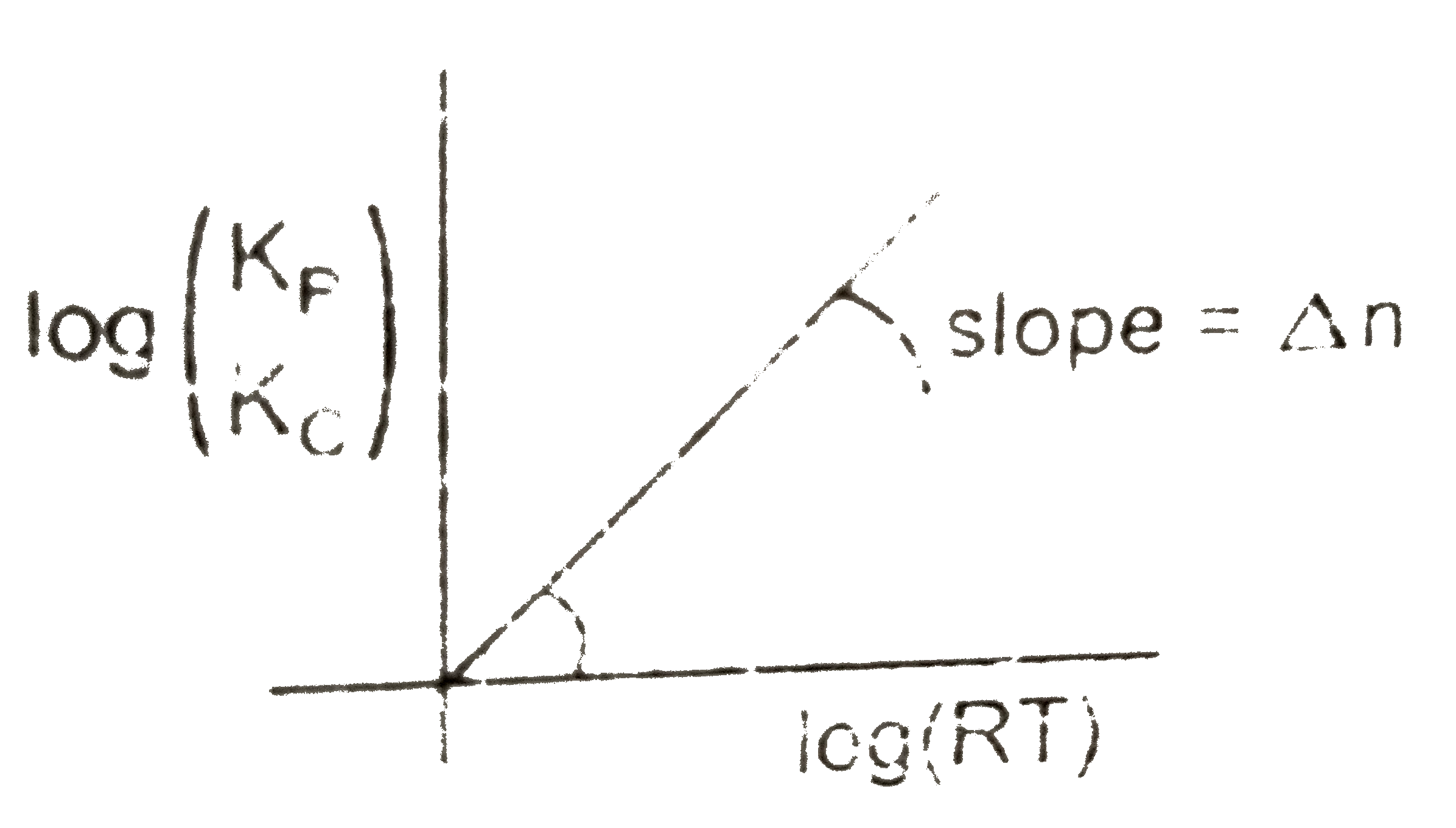
|
|
| 39. |
At 300 K temperature, presure and volume of gas is 1 bar and 10 L respectively. If pressure becomes 2 bar then calculate volume of gas at same temperature. |
|
Answer» |
|
| 40. |
At 300 K temperature, liquid of small test tube is pour in large beaker then what change obsered in vapour pressure ? |
| Answer» SOLUTION :There MAY no change VAPOUR pressure remain constant as TEMPERATURE is constant and INTERMOLECULAR forces remains constant. | |
| 41. |
At 300 K temperature pressure of 2.5 gm N_(2) gas is 4 bar and volume 2.5 L. It pressure becomes 10 bar then calculate its volume at same temperature. |
|
Answer» |
|
| 42. |
At 300 K temperature 20 g H_(2), 220 g CO_(2) and 140 g N_(2) are filled in a vessel having volume 2L. Find the total pressure in bar unit and which gas is removed from the vessel so that pressure can be reduced by 50%.(R=8.314xx10^(-2)) |
|
Answer» |
|
| 43. |
At 300 K one mole ideal gas is expand freely to 100 liter from 10 liter. If Delta U = 0, then Delta H = …..... |
| Answer» Answer :D | |
| 44. |
At 300 K constant temperature gas having 20 cm^(3), 1 bar pressure it is convert into 50 cm^(3) then calculated pressure ? |
|
Answer» |
|
| 45. |
At 300 K and 1 atm, 15 mL of a gaseous hydrocarbon requires 375 ml air containing 20% O_2 by volume for complete combustion. After combustion the gases occupy 330 ml. Assuming that the water formed is in liquid form and the volumes were measured at the same temperature and pressure, the formulaof the hydrocarbon is : |
|
Answer» `C_4H_10` Vol. of `O_2` used =`20/100xx375` =75 mL From the REACTION of combustion , 1 mL `C_x H_y` requires =`(4x+y)/4` mL `O_2` `because` 15 mL `=15((4x+y))/4`=75 mL So, 4x+y=20 So, x=3 , y=8hence formula of hydrocarbon is `C_3H_8`. |
|
| 46. |
At 298K , K_(p) for the reaction N_(2)O_(4)(g) hArr 2NO_(2)(g)is 0.98 . Predict whether the reaction is spontaneousor not. |
| Answer» SOLUTION :`Delta_(r) G^(@) = - RTln K_(p)`. Here , `K_(p)= 0.98`, therefore, `Delta_(r)G^(@) ` is`-ve`. HENCE, the REACTION is SPONTANEOUS. | |
| 47. |
At 298K heats of formation of H_(2)O_((l)), CO_(2(g)), HCl_((g))and C Cl_(4(l)) are respectively -241.8, -393.7, -92.5 and -106.7 kJ mol^(-1). Calculate DeltaH for the following reaction C Cl_(4(l)) + 2H_2O_((g)) to CO_(2(g)) + 4HCl_((g)) |
|
Answer» |
|
| 48. |
At 298K 10 litres of N, at 0.96 alm is added to 32 litres of an evacuvated polythene bag, Subsequently enough O_2 is pumped into the bag at 298K. Now if the total pressure is 0.990 atm, partial pressure of O_2 |
|
Answer» 0.69 ATM `implies P_2 = (10 XX 0.96)/(32) = 0.3` Final PRESSURE = `0.99 ` atm. `implies P_(O_2) = 0.99 - 0.3 = 0.69 atm`. |
|
| 49. |
At 298 K , the K_(sp)value of Fe(OH)_3 in aqueous solution is3.8 xx 10^(-38). The solubility of Fe^(3+)ions will increase when |
|
Answer» <P>`P^(H)` is increased |
|
| 50. |
At 298 K, the molar equilibrium concentrations of Ag^(+) , NH_(3) and [Ag (NH_(3))_(2)]^(+) for the equilibrium Ag_((aq))^(+) + 2 NH_(3 (aq)) hArr [Ag (NH_(3))_(3)]_(aq)^(+) were foundto be 10^(-1) , 10^(-3), and 10^(-1) respectively . The value of K_(C) is |
| Answer» Answer :A | |