Saved Bookmarks
This section includes 7 InterviewSolutions, each offering curated multiple-choice questions to sharpen your Current Affairs knowledge and support exam preparation. Choose a topic below to get started.
| 1. |
An organic compound was found to contain the following consitituents : C = 33 % , H = 4.7 % , N = 13.2 %, Cl = 33.4 %. Determine the empirical formula of the compound Hint : Calculate the percentage of oxygen since the sum of the percentages of elements is not 100. The percentage of oxygen = 15.7. |
|
Answer» Step II. Empirical formula of the organic compound `{:("Element","Percentage","Atomic mass","Gram atoms (Moles)","Atomic ratio (Molar ratio)","Simplest whole no. ratio"),("C",33.0,12,(33.0)/(12)=2.75,(2.75)/(0.94)=2.93,3),("H",4.7,1,(4.7)/(1)=4.70,(4.70)/(0.94)=5.0,5),("N",13.2,14,(13.2)/(14)=0.94,(0.94)/(0.94)=1.0,1),("CL",33.4,35.5,(33.4)/(33.5)=0.94,(0.94)/(0.94)=1.0,1),("O",15.7,16,(15.7)/(16)=0.98,(0.98)/(0.94)=1.04,1):}` Empirical formula of the compound `= C_(3)H_(5)NCLO` |
|
| 2. |
An organic compound 'P' with molecular formula C_(9)H_(8)O_(2) on oxidation gives benzoic acid as one of the products. The possible structure/s 'P' is/are |
|
Answer» I and III |
|
| 3. |
An organic compound present in vinegar has 40% carbon , 6.6% hydrogen and 53.4%oxygen. Find the empirical formula of the compound. |
Answer» SOLUTION :
|
|
| 4. |
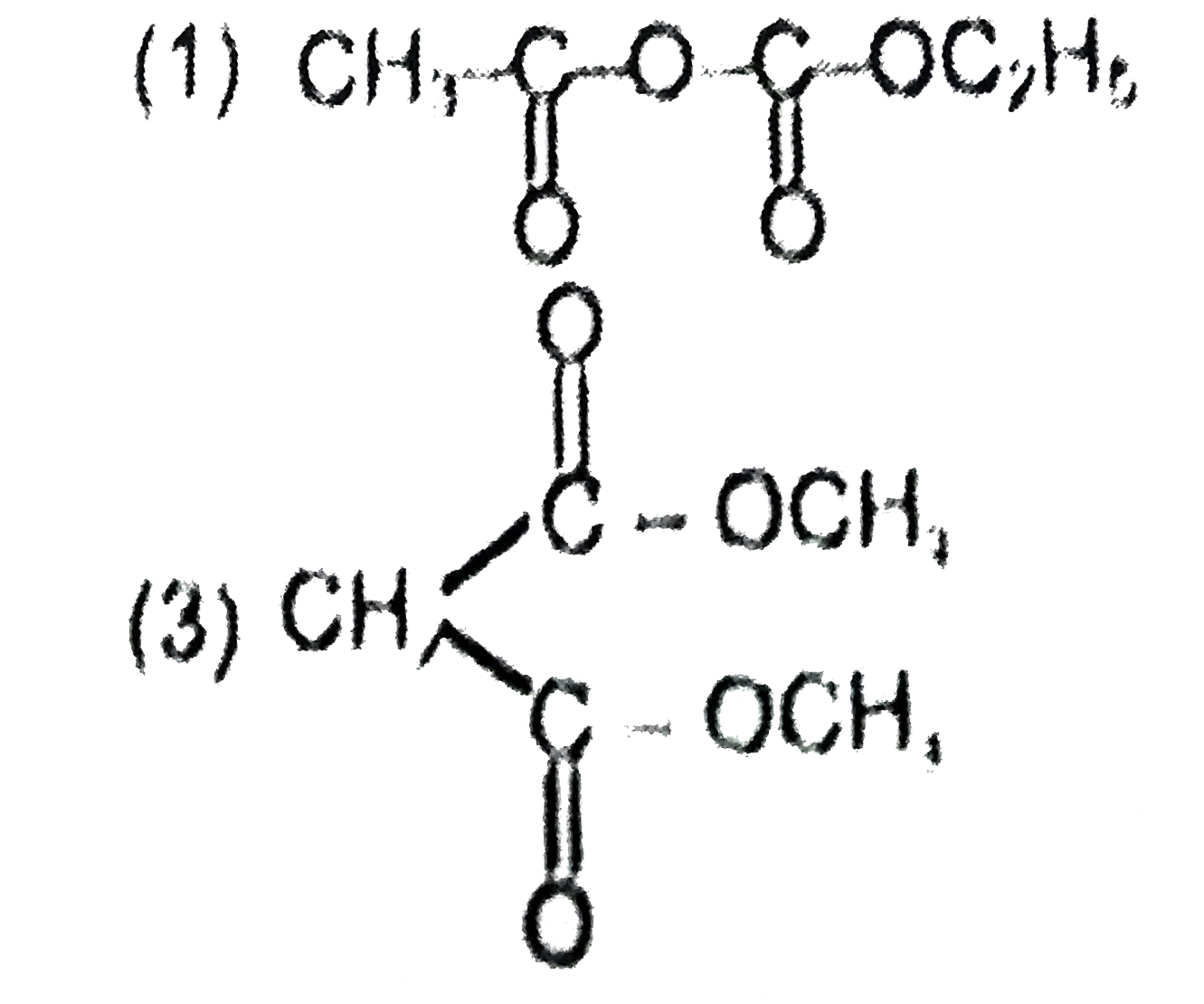
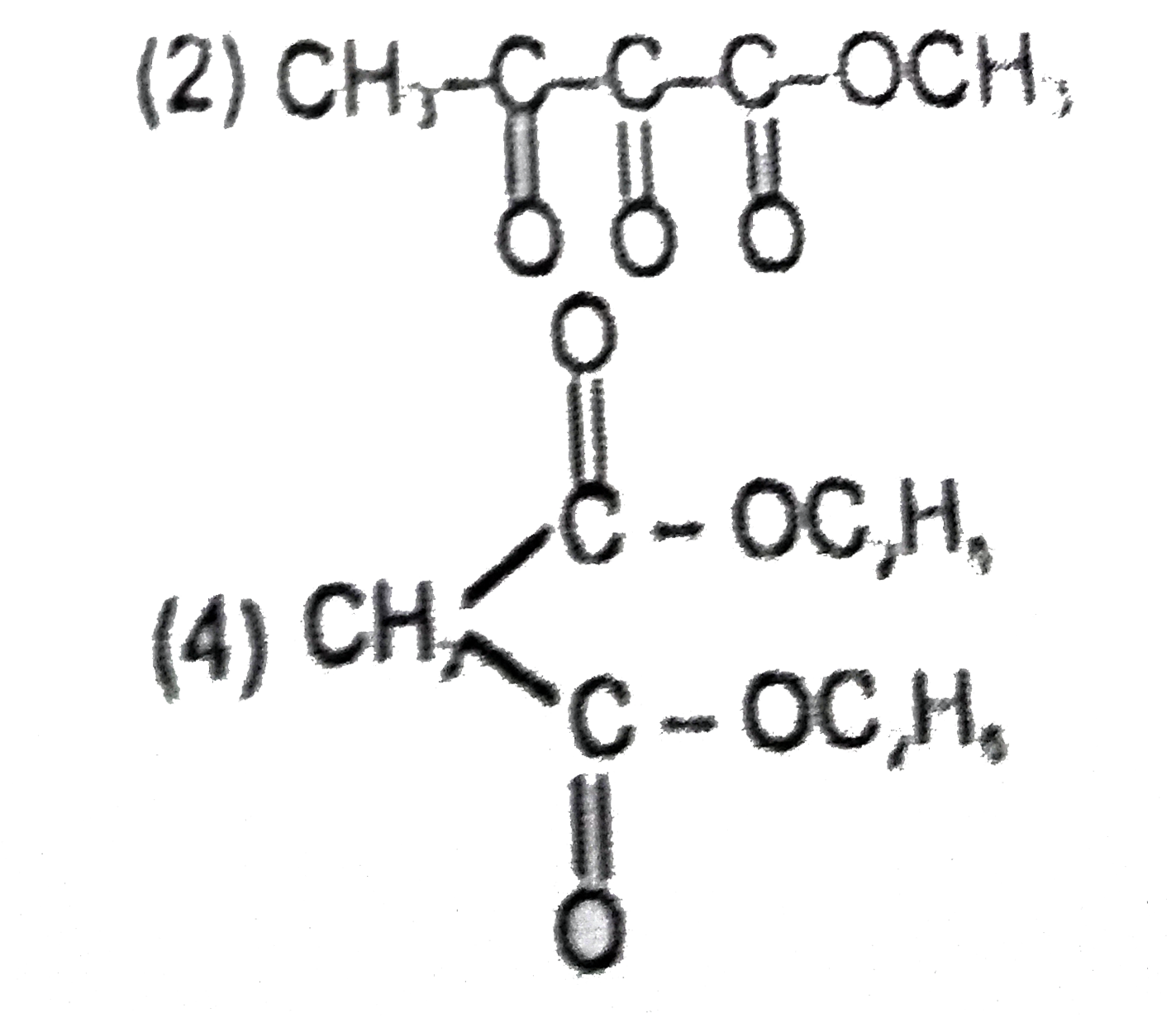
An organic compound (P) with molecular formula C_(6)H_(8)O_(4) is stable to heat but hydrolyse to (Q) and MeOH by NaOH follwed by acidification. (Q) on strong heating gives (R) which with Red P/HI gives ethane. Compound (P) is: |
|
Answer» `CH_(3)-underset(O)underset(||)(C)-O-underset(O)underset(||)(C)-OC_(2)H_(5)` |
|
| 5. |
An organic compound on reaction with O_3 followed by Zn and H_2Ogives CH_3 - overset(O)overset(||)C-CH_2 - CH_2 - overset(O)overset(||)C-CH_3. The structures are : |
|
Answer»
 
|
|
| 6. |
An organic compound on heating with CuO produces CO_(2) but no water. It may be: |
| Answer» Answer :D | |
| 7. |
An organic compound on analysis was found to contain 16.27% carbon. 0.67% Hydrogen, 72.2% chlorine. The V.D. of the compound is equal to 73.75. Calculate the empirical formula and molecular formula of the compound. |
Answer» Solution : EMPIRICAL FORMULA of the compound `=C_(2)HCl_(3)O` `(2xx 12)+(1 XX 1)+(3 xx 35.5) +(1 xx 16)=147.5` Molecular weight `=2x V.D. =2 xx 73.75=147.50` `n=("Molecular weight")/("Empirical formula weight")=(147.50)/(147.50)=1` Molecular formula `=C_(2)HCl_(3)O` |
|
| 8. |
An organic compound on analysis gave C=54.2%, H=9.2% by mass. Its empirical formula is |
|
Answer» `CHO_2` 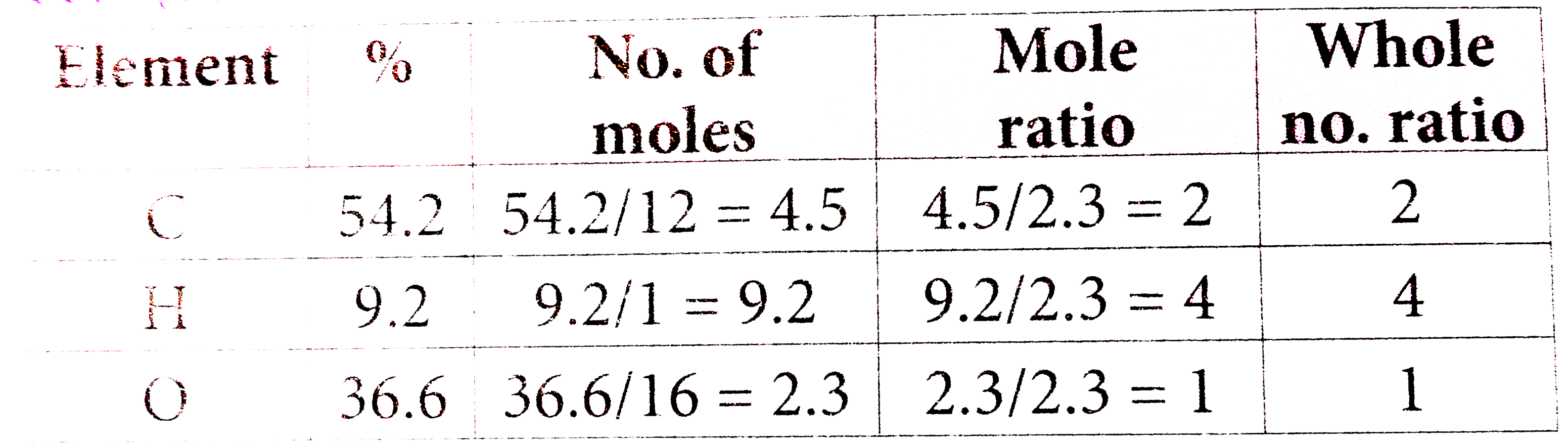 EMPIRICAL FORMULA `=C_2H_4O` |
|
| 9. |
An organic compound on analysis gave the following percentage composition : C = 57.8 %, H= 3.6 % and the rest is oxygen. The vapour density of the compound was found to be 83. Find the molecular formula of the compound. |
|
Answer» Step II. Empirical formula of organic compound `{:("Element","Percentage","Atomic mass","GRAM atoms (Moles)","Atomic ratio (Molar ratio)","Simplest WHOLE no. ratio"),("C",57.8,12,(57.8)/(1)=4.82,(4.82)/(2.41)=2.0,4),("H",3.6,1,(3.6)/(1)=3.6,(3.60)/(2.41)=1.5,3),("O",38.6,16,(38.6)/(16)=2.41,(2.41)/(2.41)=1.0,2):}` Empirical formula of the compound `= C_(4)H_(3)O_(2)` Step II. Molecular formula of the compound Empirical formula mass `= 4 xx 12 + 3xx 1+ 2 xx 16 = 83 u` Molecular mass `= 2 xx V.D = 2 xx 83 = 166u` `n=("Molecular mass")/("Empirical formula mass")=((166u))/((83u))=2` `:.` Molecular formula of compound `= 2 xx C_(4)H_(3)O_(2) = C_(8)H_(6)O_(4)`. |
|
| 10. |
An organic compound of structure CH_(3)-CH_(2)-CH_(2)-CO-CH_(3) shows functional isomerism with another organic compound of structural formula______________ |
|
Answer» `CH_(3)-CH_(2)-CO-CH_(2)-CH_(3)` |
|
| 11. |
An organic compound is found to contain C = 54.5%, 0=36.4% and H = 9.1% by mass. Its empirical formula is |
| Answer» Answer :C | |
| 12. |
An organic compound is boiled with alcoholic potash. The product is cooled and acidified with HCl. A white solid separates out. The starting compound may be |
|
Answer» ethyl benzoate `C_(6)H_(5) COONa (AQ) + HCL rarr NaCl + C_(6)H_(5) COOH` (Insoluble in cold water) |
|
| 13. |
An organic compound having the molecular formula C_(7)H_(8)O is insoluble in NaHCO_(3) solution but dissolves in aqueous NaOH. When treated with bromine water the compound rapidly forms a precipitate having the molecular C_(7)H_(5)Obr_(3). The organic compound is |
|
Answer» o-cresol |
|
| 14. |
An organic compound haavig C, H and O has 13.13% H, 52.14% C and 34.73% O. its molar mass is 46.068 g. What are its empirical and molecular formulae? |
|
Answer» `C_(2)H_(6)O, C_(4)H_(12)O_(2)` |
|
| 15. |
An organic compound having a carbon attached to four different group is optically actve, But is it that opposite is also true? That is, do all optically active organic compounds have chiral carbons? Not necessarily. Presence or absence of chiral centre is not the sufficiet criterion for optical activity. The ultimate criterion is presence or abosence of either plane or centre of symmtry. Two compounds which are non super im[osabble mirror images of each other are called enantiomers. If a compound contains more than one chiral carbon, new words are required to describe the relationship between various stereo isomers of the compounds. Those words are diastereomers and mesomers. |
|
Answer» POSITIONAL ISOMERS |
|
| 16. |
An organic compound having a carbon attached to four different groups is optically active. But is it that opposite is also true? That is, do all optically active organic compounds have chiral carbons? Not necessarily. Presence or absence of chiral centre is not the sufficient criteria for optical activity. The ultimate criteria is presence or absence of either plane or centre of symmetry. Two compounds which are non superimposable mirror images of each other are called enantiomers. If a compound contains more than one chiral carbon, new words are required to describe the relationship between various stereisomers ofthe compound. Those words are diastereomers and mesomers.Optically active compounds among the following is |
|
Answer» `CH_3 CH_2 undersetoverset(|)(CL)(C )HCH_2CH_3` |
|
| 17. |
An organic compound having a carbon attached to four different group is optically actve, But is it that opposite is also true? That is, do all optically active organic compounds have chiral carbons? Not necessarily. Presence or absence of chiral centre is not the sufficiet criterion for optical activity. The ultimate criterion is presence or abosence of either plane or centre of symmtry. Two compounds which are non super im[osabble mirror images of each other are called enantiomers. If a compound contains more than one chiral carbon, new words are required to describe the relationship between various stereo isomers of the compounds. Those words are diastereomers and mesomers. In the above compound no. of stereogenic centers and no. of optical active isomers possible are. |
|
Answer» 3,8 |
|
| 18. |
An organic compound having a carbon attached to four different group is optically actve, But is it that opposite is also true? That is, do all optically active organic compounds have chiral carbons? Not necessarily. Presence or absence of chiral centre is not the sufficiet criterion for optical activity. The ultimate criterion is presence or abosence of either plane or centre of symmtry. Two compounds which are non super im[osabble mirror images of each other are called enantiomers. If a compound contains more than one chiral carbon, new words are required to describe the relationship between various stereo isomers of the compounds. Those words are diastereomers and mesomers. Optically active compounds among the following is/are |
|
Answer» A,B and E |
|
| 19. |
An organic compound having a carbon attached to four different group is optically actve, But is it that opposite is also true? That is, do all optically active organic compounds have chiral carbons? Not necessarily. Presence or absence of chiral centre is not the sufficiet criterion for optical activity. The ultimate criterion is presence or abosence of either plane or centre of symmtry. Two compounds which are non super im[osabble mirror images of each other are called enantiomers. If a compound contains more than one chiral carbon, new words are required to describe the relationship between various stereo isomers of the compounds. Those words are diastereomers and mesomers. A sample of organic compound (S) is found to have optical rotation of +20^(@). Which of the following statement(s) is/are correct of the sample. |
|
Answer» The SAMPLE MIGHT be a MIXTURE of d-isomers |
|
| 20. |
An organic compound having a carbon attached to four different group is optically actve, But is it that opposite is also true? That is, do all optically active organic compounds have chiral carbons? Not necessarily. Presence or absence of chiral centre is not the sufficiet criterion for optical activity. The ultimate criterion is presence or abosence of either plane or centre of symmtry. Two compounds which are non super im[osabble mirror images of each other are called enantiomers. If a compound contains more than one chiral carbon, new words are required to describe the relationship between various stereo isomers of the compounds. Those words are diastereomers and mesomers. The optical rotation of a solution o fpure natural camphor is found to be +5.76^(@) under the following conditions, concentration=0.13g/ml, lenghth of polarmeter=1dm, wavelength=sodium D line, T=25^(@)C The specific rotation of camphor is |
|
Answer» `+44.3^(@)` |
|
| 21. |
An organic compound having a carbon attached to four different group is optically actve, But is it that opposite is also true? That is, do all optically active organic compounds have chiral carbons? Not necessarily. Presence or absence of chiral centre is not the sufficiet criterion for optical activity. The ultimate criterion is presence or abosence of either plane or centre of symmtry. Two compounds which are non super im[osabble mirror images of each other are called enantiomers. If a compound contains more than one chiral carbon, new words are required to describe the relationship between various stereo isomers of the compounds. Those words are diastereomers and mesomers. Which of the following form diastereomeric pair? |
|
Answer» A,B |
|
| 22. |
An organic compound has C and H percentage in the ratio 6 : 1 by mass and C and O percentage in the ratio 3 : 4 by mass the compound is |
|
Answer» HCHO |
|
| 23. |
An organic compound having C, H and S elements contains 4% sulphur. The minimum molecular weight of the compound is |
|
Answer» Solution :8 parts of sulphur=100 parts of compound 32 parts of sulphur=? The minimum molecular weight of the compound `=(32)/(8) XX 100=400` Molecular weight may be a MULTIPLE of 400, like 800, 1200, 1600, 2000 etc. |
|
| 24. |
An organic compound has 68.327% C, 6.406% H, 25.267% CI. Calculate the molecular formula of the compound if its vapour density is 70.25. |
|
Answer» |
|
| 25. |
An organic compound gave the following results on analysis, 0.2496 g of the compound gave 0.3168 g of CO_(2) and 0.0864 g of H_(2)O. Calculate the percentage of carbo and hydrogen in the compound. |
|
Answer» `%` of `H=2/18xx("Mass of "H_(2)O)/("Mass of compound")xx100=2/18xx0.0864/0.2496xx100= 3.84 %` |
|
| 26. |
An organic compound gave 0.4655 g of CO_(2) on complete combustion. If the mass of the compound taken was 0.2115g, what is the percentage of C in it? |
|
Answer» 0.133 Mass of organic COMPOUND taken=0.2115g % of `C=(12)/(44)xx("maff of "CO_(2))/("Mass of compound")XX100` `=(12)/(44)xx(0.4655)/(0.2115)xx100=60.03%` |
|
| 27. |
An organic compound does not react appreciably with Lucas reagent but give white precipitate with Tollen's reagent. Which is the possible structure of compound ? |
|
Answer» `CH_(3)-UNDERSET(OH)underset(|)(CH)-C-=CH` |
|
| 28. |
An organic compound contains C, H and O. 0.2475 g of the organic compound yielded on combustion 0.4950 g of CO_(2) and 0.2025 g of H_(2)O. Find the percentage composition of the organic compound. |
| Answer» SOLUTION :`C=54%, H=9.08%, O=36.37%` | |
| 29. |
A compound contains 40% carbon, 6.6% hydroaen and 53.33% oxy1en._Its vapour density is 30. Calculate its empirical and molecular formulae. |
|
Answer» Solution :Calculation of empirical formula : The SUM of percentages of C and H in the given compound is not 100. Therefore, it must contain oxygen also. Percentage of O = `100 - (40 + 6.67) = 53.33`. The empirical formula of this compound can be obtained as follows :  `therefore` The empirical formula of the given compound is `CH_(2)O` Calculation of molecular formula : Empirical formula mass = `12.01 + (2 xx 1.008) + 16.0 = 30.0` amu Molecular mass (given) = 30.0 amu Molecular mass `therefore n=("Molecular mass")/("Empirical formula mass")=30.0/30.0 =1` `therefore` Molecular formula `=1 xx` Empirical formula =`CH_(2)O` HENCE, the molecular formula of the given compound is the same as its empirical formula and is `CH_(2)O` |
|
| 30. |
An organic compound contains C = 40%, H = 6.66%. If the V.D. of the compound is 15, find its molecular formula. |
Answer»  `therefore` The empirical formula = `CH_(2)O` Calculation of molecular formula :Molecular mass = `2 xx V.D. = 2 xx 15 = 30` Empirical formula mass = `12.01 + (2 xx 1.008) + 16.0 = 30.0` `therefore n=("Molecular mass")/("Empirical formula mass")= 30/30= 1` `therefore` Molecular formula of the given COMPOUND `=CH_(2)O` |
|
| 31. |
Anorganiccompoundcontains C = 16.27%, H = 0.677%, CI = 72.2% and O=10.8%. Its molecular mass is 147.5 amu. Find its molecular formula. |
|
Answer» Solution :Determination of EMPIRICAL formula : Percentage of oxygen `= 100 - (16.27 + 0.677 + 72.2) = 10.8` `therefore` The empirical formula of the given compound as CALCULATED in the table given ahead is `C_2HCl_3O`. CALCULATION of molecular formula Empirical formula mass `=(12.01 xx 2) + 1.008 + (35.45 xx 3) + 16.0 = 147.4` Molecular mass (given) = 147.5  `therefore n=("Molecular mass")/("Empirical formula mass") = 147.5/147.4 =1` `therefore` Molecular formula `=1 xx` Empirical formula `= 1 xx C_(2)HCl_(3)O` `=C_(2)HCl_(3)O` Hence, the molecular formula of the given compound is `C_(2)HCl_(3)O`. |
|
| 32. |
An organic compound contains about 25% carbon. It could be: |
|
Answer» ethanol |
|
| 33. |
An organic compound contains 69% carbon and 4.8% hydrogen, the remainder being oxygen. Calculate the masses of carbon dioxide and water produced when 0.20 g of this compound is subjected to complete combustion. |
|
Answer» SOLUTION :Step 1. Calculation of mass of `CO_(2)` produced Mass of compound = 0.20 g Percentage of carbon = 69 g `"Percentage of carbon"=(12)/(44)=("Mass of carbon dioxide formed")/("Mass of compound") xx 100` `69= (12)/(44)=("Mass of carbon dioxide formed")/((0.20g)) xx 100` `:. "Mass of" CO_(2) "formed" = (69 xx 44 xx (0.20g))/(12 xx 100)=0.506g` Step II. Calculation of mass of `H_(2)O` produced Mass of compound=0.20g Percentage of hydrogen = 4.8% `4.8 = (2)/(18) xx ("Massof water formed")/("Mass of compound") xx 100` `:. "Mass of" H_(2)O "formed"=(4.8 xx 18 xx (0.20 g))/(2 xx 100)=0.0864 g` |
|
| 34. |
An organic compound contains 69% carbon and 4.8% hydrogen, the remainder being oxygen. What will be the masses off carbon dioxide and water produced when 0.20 g of this substance is subjected to complete combustion. |
|
Answer» 0.69g and 0.048g `69=(12)/(44)xx("Mass of "CO_(2)" formed")/("mass of substance taken")xx100` `4.8=(2)/(18)xx(x)/(0.2)xx100` `x=(4.8xx18xx0.1)/(100)=0.086g` |
|
| 35. |
An organic compound contains 69% carbon and 4.8% hydrogen, the remainder being oxygen. Calculate the masses of carbon dioxide and water produced when 0.20 g of this substance is subjected to complete combustion. |
|
Answer» Solution :We know that, `%C = (12)/(44) xx ("Mass of " CO_(2) " formed")/("Mass of SUBSTANCE taken") xx 100` Substituting the values of % of C and mass of the substance taken, we have, `69 = (12)/(44) xx ("mass of " CO_(2) " formed")/(0.2g) xx 100` or Mass of `CO_(2)` formed `= (69 xx 44 xx 0.2)/(12 xx 100) = 0.506 g` Similarly, `%H = (2)/(18) xx ("Mass of" H_(2)O " formed")/("Mass of substance taken") xx 100` Substitutingthe values of % of H and mass of the substance taken, we have, `4.8 = (12)/(18) xx ("Mass of " H_(2)O " formed")/(0.2) xx 100` or Mass of `H_(2)O` formed `= (4.8 xx 18 xx 0.2)/(2 xx 100) = 0.0864 g`. |
|
| 36. |
An organic compound contains 69% carbon and 4.8% hydrogen, the remainder being oxygen. Calculate the masses of carbon dioxide and water produced when 0.20g of this substance is subjected to complete combustion |
|
Answer» SOLUTION :Calculation of mass of water % `H= (2)/(18) XX (m_(1) xx 100)/(m)` where % H= 4.8, mass of compound m= 0.2 gm, mass of `H_(2)O= m_(1)gm` `therefore m_(1)= (% H xx 18 xx m)/(100 xx 2) = (4.8 xx 18 xx 0.2)/(100 xx 2)` `=0.0864 gm H_(2)O` Calculation of mass of `CO_(2)` % `C = (12)/(44) xx (m_(2) xx 100)/(m)` where `m_(2)`= mass of `CO_(2)` %C= 69 `:. 69 = (12)/(44) xx (m_(2) xx 100)/(0.2)` m= mass of compound = 0.2gm `therefore m_(2)= (69 xx 0.2 xx 44)/(100 xx 12)= 0.506gm` |
|
| 37. |
An organic compound contains 69% carbon and 4.8 % hydrogen, the remainder being oxygen. Calculate the masses of carbon dioxide and water produced when 0.20 g of this compound is subjected to complete combustion. |
|
Answer» Solution :Step I : Calculation of mass of `CO_(2)` produced Mass of compound `=0.20 G` Percentage of carbon `= 69%` Percentage of carbon `=12/44 xx ("Mass of carbon DIOXIDE formed")/("Mass of compound")XX100` `69=12/44xx("Mass of carbon dioxide formed")/((0.20 g))xx100` `:.` Mass of `CO_(2)` formed `=(69xx44xx(0.20 g))/(12xx100)=0.506 g` Step II. Calculation of mass of `H_(2)O` produced Mass of compound `=0.20 g` Percentage of hydrogen `= 4.8 %` Percentage of hydrogen `=2/18xx("Mass of water formed")/("Mass of compound")xx100` `4.8=2/10xx("Mass of water formed")/((0.20 g))xx100` `:.` Mass of `H_(2)O` formed `=(4.8xx18xx(0.20 g))/(2xx100)=0.0864 g`. |
|
| 38. |
An organic compound contains 69% carbon and 4.8% hydrogen and the remaining is oxygen. Calculate the mass of CO_2 and H_2O formed when 0.20 g of the compound is subjected to combustion? |
|
Answer» `4.8=(2)/18xx(y)/0.2xx100=; y`(mass of `H_2O`) = 0.086 g |
|
| 39. |
An organic compound contains 52.2%C, 13%H and remaining oxygen.What is its empirical formula? |
|
Answer» |
|
| 40. |
An organic compound contains 4.05% hydrogen, 24.26% carbon and 71.67% chlorine. Its milecular mass is 98.96. Find its empirical and molecular formula (Atomic mass of H=1, C=12, Cl=35.45) |
|
Answer» Solution :Element `""` % Age `""` Atomic mass `""` % ageAto. Mass `""` DIVIDE by least no `""` Simdle PATIO C `""` 24.26 `""` 12 `""` `24.26/12=2.02` `""` `2.02/2.02=1` `""`1 H`""` 4.05 `""`1.008`""4.05/4.008=4.05""4.05/2.02=2""2` Cl`"" 71.67""35.45""71.67/35.45=2.02""2.02/2.02=1""1` Emperical formula `=CH_(2)Cl` `n=("Mol.Mass")/("Emp. formulamass")=98.96/49.42=2` Mol Formula `=NXX"Emp. formula"=2(CH_(2)Cl)=C_(2)H_(4)Cl_(2)` |
|
| 41. |
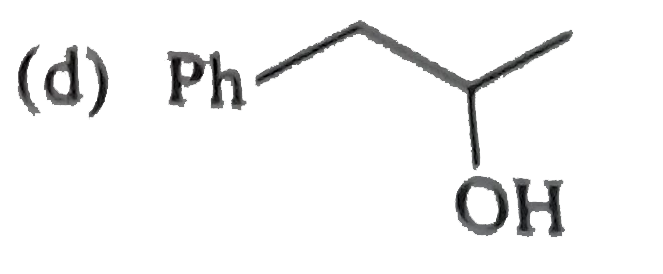
An organic compound containing one oxygen gives red colour with cerric ammonium nitrate solution , decolourise alkaline KMnO_(4) , respond iodoform test and show geometrical isomerism . It should be : |
|
Answer» `Ph-CH=CH-CH_(2)OH` |
|
| 42. |
An organic compound contains 20 atoms of carbon per molecule, the pecentage of carbon by weight being 70. The gram molecualr mass of the organic compound is approximately: |
|
Answer» 465 |
|
| 43. |
An organic compound containing carbon, hydrogen and nitrogen have the percentage, 40,13.33 and 46.67 respectively. Its empirical formula will be |
|
Answer» `C_(2)H_(7)N` |
|
| 44. |
An organic compound contains C = 40%, H = 13.33% and N = 46.67%. Its emperical formula is |
|
Answer» `C_2H_7N` |
|
| 45. |
An organic compound containing C, H, N and O gave the following results on analysis : (i) 0.25 g of the compound gave 0.368 g of CO_2 and 0.205 g of H_2 O (ii) The same weight of the compound gave 31.2 mL of N_2at S. T. P. Calculate the percentage composition of the compound. |
|
Answer» `= (12)/( 44) xx ( " Wt. of" CO_2 ) /( "Wt. of COMPOUND") xx 100` `= (12)/( 44)xx ( 0.368)/( 0.25) xx 100` `= 40.14 %` (ii) Percentage of `H = (2)/( 18) xx ("Wt. of water")/( " Wt. of compound" xx 100` `= (2)/( 18) xx (0.205)/( 0.25) xx 100 = 9.11 %` |
|
| 46. |
An organic compound containing Cand H has 92.3% of carbon. Its empirical formula is |
| Answer» ANSWER :D | |
| 47. |
An organic compound C_8H_18 on monochlorination gives a single monochloride. Write the structure of the hydrocarbon. |
| Answer» SOLUTION :Since, the HYDROCARBON`(C_8H_18)`on monochlorination GIVES a single monochloride , therefore , all the 18 H-atoms are EQUIVALENT. The only such hydrocarbon is 2,2,3,3-tetramethylbutane , i.e., `CH_3-undersetunderset(CH_3)|oversetoverset(CH_3)|C-undersetunderset(CH_3)|oversetoverset(CH_3)|C-CH_3` | |
| 48. |
An organic compound C_(6)H_(12)(X) on reduction gives C_(6)H_(14)(Y). X on ozonolysis gives two aldehydes C_(2)H_(4)O(I) and C_(4)H_(8)O(II). Identify the compounds X, Y and aldehydes (I) and (II). |
|
Answer» `X=CH_(3)CH=CHCH_(2)CH_(2)CH_(3),Y=CH_(3)(CH_(2))_(4)CH_(3),(I)=CH_(3)CHO,(II)=CH_(3)(CH_(2))_(2)CHO` 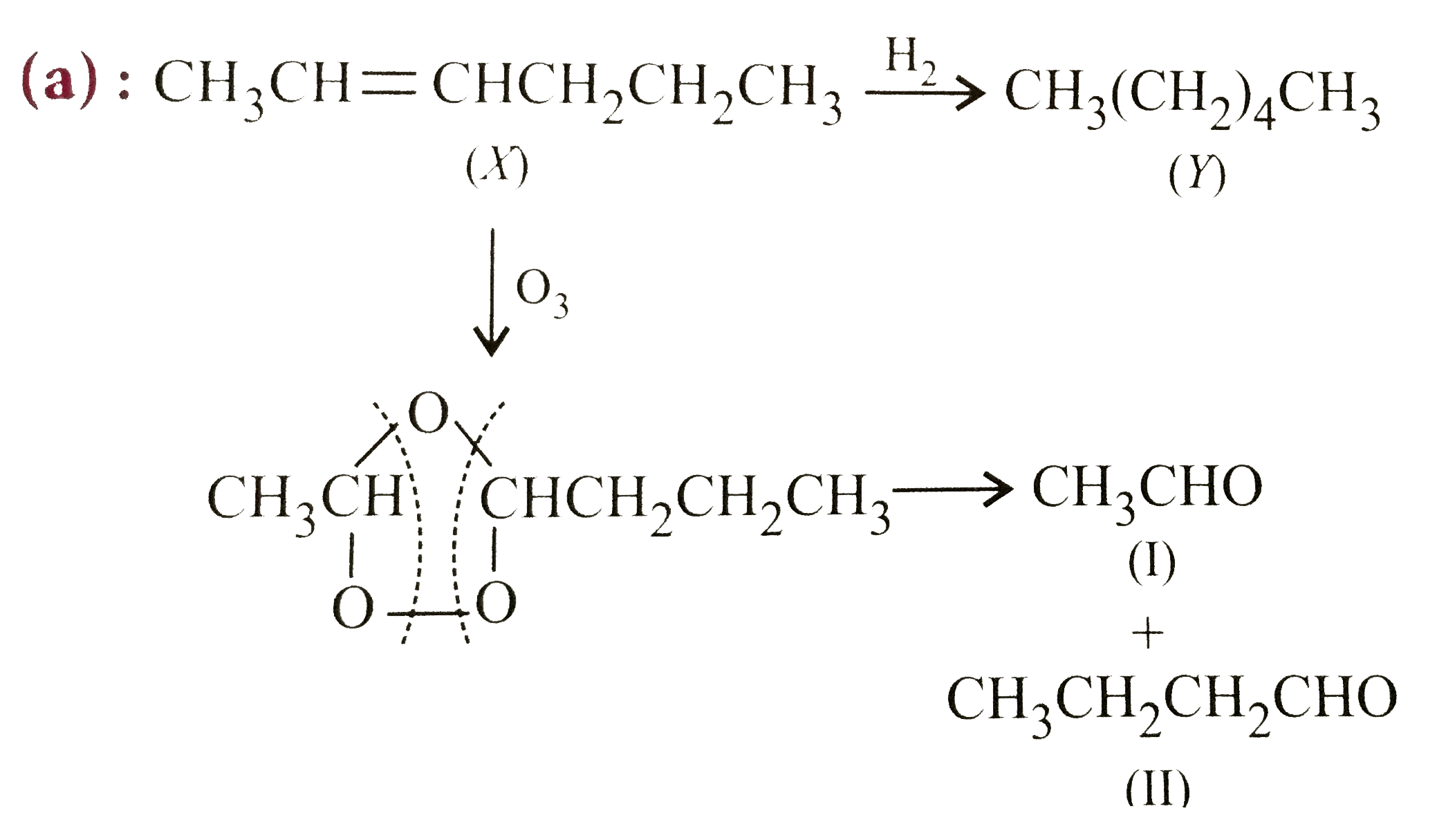
|
|
| 49. |
An organic compound C_(6))H_(12)(X) on reduction gives C_(6)H_(14)(Y). X on ozonolysis gives two aldehydes C_(2)H_(4)O(I) and C_(4)H_(8)O(II). Identify the compounds X, Y and aldehydes (I) and (II). |
|
Answer» `X=CH_(3)CH=CHCH_(2)CH_(2)CH_(3),Y=CH_(3)(CH_(2))_(4)CH_(3),(I)=CH_(3)CHO,(II)=CH_(3)(CH_(2))_(2)CHO`
|
|
| 50. |
How does an aminothioether respond to sodium fusion extract test? |
|
Answer» Solution :If the organic compound contains both nitrogen and sulphur, sodium thiocyanate is formed. This gives blood red COLOURED ferric thiocyanate with ferric ions. `Na+C+S+NrarrNaSCN, Fe^(3)+SCN^(-)RARR[Fe(SCN)]^(2)` If sodium fusion is CARRIED out with excessof sodium, the thiocyante decomposes to yield cyanide and sulphide. These ions give their USUAL thests. `NaSCN + 2NA rarr Na_(2)S + NaCN` |
|