

Saved Bookmarks
This section includes 7 InterviewSolutions, each offering curated multiple-choice questions to sharpen your Current Affairs knowledge and support exam preparation. Choose a topic below to get started.
| 1. |
Calculate the average velocity of CO_2 molecule at S.T.P. |
| Answer» SOLUTION :`2.42 XX 10^2 CM^(-1)` | |
| 2. |
Calculate the average, the RMS and the most probable velocities of nitrogen molecules at S.T.P. |
| Answer» SOLUTION :`bar(u)= 4.54 xx 10^4 " CM " s-^(1) , u = 4.93 xx 10^4 " cm " s^(-1) , ALPHA = 4.03 xx 10^4 " cm " s^(-l)` | |
| 3. |
Calculate the average kinetic energy of a hydrogen molecule at 27^@C. |
|
Answer» SOLUTION :The average KINETIC ENERGY of a SINGLE molecule is given by `E_x = 3/2 KT` `:.`Average kinetic energy of a hydrogen molecule at at `27^@(300 K)` `=3/2xx1.3807 x 10^(-23) xx 300` ( `:. k = 1.3807 xx 10^(-23) JK^(-1))` = `6.231 xx 10^(-21) J` |
|
| 4. |
Calculate the average kinetic energy in joules of the molecules in 8.0 g of methane at 27^@C. |
|
Answer» `K.E. = n(3/2 RT)` Number of moles in 8.0 g of methane = `(8.0)/16 = 0.500` (The molecular MASS of `CH_4 = 12 +4 = 16)` `R = 8.314 J K^(-1) mol^(-1)` Hence, the average kinetic energy of 0.5 moles of `CH_4 at 27^@C`. = `0.500 XX 3/2 xx 8.314 xx (27 + 273) = 1.87 x 10^3 J` |
|
| 5. |
Calculate the average atomic mass of naturally occurring magnesium using the following data |
|
Answer» Solution :ISOTOPES of Mg ATOMIC MASS=`Mg^(24)=23.99xx78.99/100=18.95` Atomic mass=`Mg^(25)=24.99xx10/100=2.499` `Atomic mass=Mg^(26)=25.98xx11.01/100=2.860` Average Atomic mass - 24.300 Average atomic mass of Mg 24.300 |
|
| 6. |
Calculate the average and total kinetic energy of 0.5 mole of an ideal gas at 0^@C |
| Answer» SOLUTION :`5.65 xx 10^(-21) J`MOLECULE`""^(-1)` , 1.7KJ | |
| 7. |
Calculate the approximate number of unit cells present in 1g of gold. Given that gold crystallizes in the face- centred cubic lattice. (Atomic mass of gold = 197 u). |
|
Answer» |
|
| 8. |
Calculate the approximate pH of a 0.100 M aqueous H_(2)S solution. K_(1) and K_(2) for H_(2)S are 1.00xx10^(-7) and 1.30xx10^(-13) respectively at 25^(@)C. |
|
Answer» Solution :`K_(2) lt lt K_(1)`. Hence `H^(+)` ions are mainly from 1ST dissociation, i.e., `H_(2)S HARR H^(+)+HS^(-)` `K_(1)=([H^(+)][HS^(-)])/([H_(2)S])=([H^(+)]^(2))/([H_(2)S]) or [H^(+)]=sqrt(K_(1)[H_(2)S]):. [H^(+)]=sqrt(10^(-7)xx10^(-1))=10^(-4)`. Hence, pH = 4 |
|
| 9. |
Calculate the approximate number of unit cells present in 1 g of gold. Given that gold crystallize in the face -centred cubic lattice. ( Atomic mass of gold = 197 u) |
|
Answer» |
|
| 10. |
Calculate the approximate charge in coulombs and approximate mass in kilograms of the nucleus of lithium-7 isotope |
|
Answer» Solution :Nucleus of Li atom has 3 protons and 4 neutrons. CHARGE on one proton `= 1.60 XX 10^(-19)` coulombs `:.` Charge on 3 protons (i.e., charge on nucleus) `= 3 xx 1.60 xx 10^(-19) C = 4.80 xx 10^(-19) C` Mass of proton `~~` mass of NEUTRON `~~ 1.67 xx 10^(-27) kg` `:.` Mass of nucleus `= 7 xx 1.67 xx 10^(-27) kg = 11.69 xx 10^(-27) kg` |
|
| 11. |
Calculate the approximate number of unit cells present in 1 g of ideal NaCl crystals. |
|
Answer» Solution :1 mole of NaCl=58.5 g =`6.02xx10^23` FORMULA units. `therefore` No. of formula units in 1 g of NaCl=`(6.02xx10^23)/58.5` As ONE unit cell of NaCl contains 4 NaCl formula units, therefore, NUMBER of unit CELLS PRESENT in 1 g of NaCl =`(6.02xx10^23)/(58.5xx4)=2.57xx10^21` |
|
| 12. |
Calculate the approxiimate number of unit cells present in 1g of gold. It is well known that gold crystallises in the face cubic lattice (atomic mass of gold is 197u). |
|
Answer» `7.64xx10^(20)` Number ofatomsavailable in 1g of gold =`(6.02xx10^(23))/(197)` As FCC unit CELL contains 4 atoms. Number of unit cells present=`(6.02xx10^(23))/(197xx4)=7.64xx10^(20)` |
|
| 13. |
Calculate the angular frequency of an electron occupying the second Bohr's orbit of He^(+) ion. |
|
Answer» Solution :Velocity of electron in the NTH orbit of H-like particle `(v) = (2pi ZE^(2))/(nh)` Radius of electron in the nth orbit of H-like particle `(r_(n)) = (n^(2) h^(2))/(4pi^(2) me^(2) Z)` Angular frequency `(omega) = (v)/(r_(n)) = (2pi Ze^(2))/(nh) xx (4pi^(2) me^(2) Z)/(n^(2) h^(2)) = (8pi^(3) Z^(2) me^(4))/(n^(3) h^(3))` For `He^(+), Z = 2, n = 2` (GIVEN) Also `m = 9.108 xx 10^(-28)J, h = 6.625 xx 10^(-27)` erg sec, `e = 4.803 xx 10^(-10)` esu SUBSTITUTING these values, we get `omega = (8 xx (22//7)^(3) xx (2)^(2) xx (9.108 xx 10^(-28)) xx (4.803 xx 10^(-10))^(4))/((2)^(3) xx (6.625 xx 10^(-27))^(3)) = 2.067 xx 10^(16) s^(-1)` |
|
| 14. |
Calculate the amount per litre of 10 mL of a solution of hydrogen peroxide labelled 20 volumes. |
| Answer» SOLUTION :60.7 g/litre | |
| 15. |
Calculate the amount of carbon dioxide that could be produced when (i) 1 mole of carbon is burnt in air. (ii) 1 mole of carbon is burnt in 16 g of dioxygen. (iii) 2 moles of carbon are burnt in 16 g of dioxygen. |
|
Answer» Solution :Carbon burns in dioxygen/AIR as follows : `UNDERSET("1 mole" 12 g)(C(s)) + underset("1 mole" 32 g)(O_(2)(g)) to underset("1 mole 44 g")(CO_(2)(g))` (i) In air, there is plenty of dioxygen. THEREFORE, combustion would be complete. HENCE, `CO_2` produced by the combustion of 1 mole of carbon = 44 g (ii) In this case, dioxygen is the limiting reagent. Only 0.5 mole of carbon will be burnt.v 32 g of `O_2` produces `CO_2 = 44 g` `therefore 16 g` of `O_(2)` will produce `CO_(2) = 44/32 xx 16 = 22 g` (iii) In this case also, dioxygen is the limiting reagent. 16 g of `O_(2)` will COMBINE only with 0.5 mole of carbon. `therefore CO_2` produced = 22 g |
|
| 16. |
Calculate the amount of water produced by the combustion of 32 g of methane. |
|
Answer» Solution :`CH_(4(G))+2O_(2(g))rarrCO_(2(g))+2H_(2)O_((g)) ` As per the stoichiometric EQUATION, Combustion of 1 MOLE (16 g) `CH_(4)` produces 2 moles (2 `xx `18 = 36 g) of water. 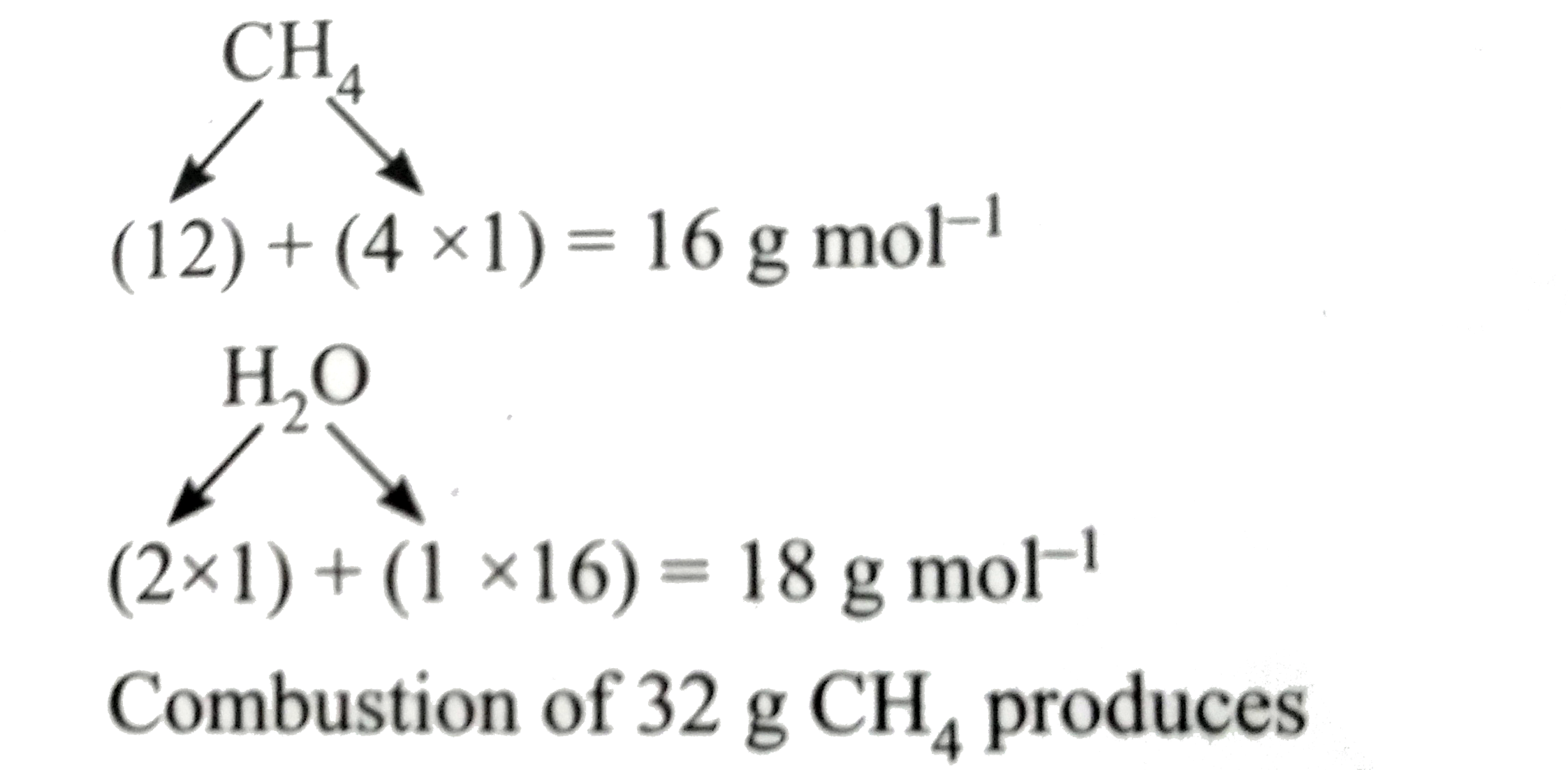 Combustion of 32 g `CH_(4)` produces `(36 g H_(2)O)/(16g CH_(4)) xx 32xxCH_(4)` 2= 72 gof water |
|
| 17. |
Calculate the amount of work done in each of the following cases :- (i) One mole of an ideal gas contained in a bulbof 10 litre capacity at 1 bar is allowed to enter into an evacuated bulb of 100 litre capacity. (ii) One mole of a gas is allowed to expand from a volumeof 1 litre to a volume of 5 litres against the constant external pressure of 1 bar ( 1 litre bar = 100 J) Calculate the internal energy change (Delta U )in each case if the process were carrid out adiabatically. |
|
Answer» SOLUTION :(i) `x= -P_(ext)xxDeltaV` As expansion takes place into the evacuated bulb, i.e., agains vacuum, `P_(ext) = 0`. Hence, w`=` 0 For adiabatic PROCESS `, q=0:. Delta U = q+w= 0+0=0` (ii) `Delta V = V_(2)-v_(1) =5-1 = 4 `litres `P= 1`bar` :. w= - P Delta V = -1 xx 4` LITRE bar `= - 4 xx 100J = -400J ( 1 L ` bar `= 100 J )` The negative sign implies that the work is done by the system. For adiabatic process, `q=0` . Hence `Delta U = q+w= 0 - 405.2 J = - 405 . 2 J`. |
|
| 18. |
Calculate the amount of water (g) produced by the combustion of 16 g of methane. |
|
Answer» `CH_(4(g))+2O_(2(g)) rarr CO_(2(g)) + 2H_(2)O_((g))` (i) 16 g `CH_(4)` corraspondsto one mole. (ii) From the above equation , 1 mol of `CH_(4(g))`gives 2 mole of `H_(2)O_((g))`. 2 mol of water `H_(2)O_((g)) = 2 xx (2+16) ` `= 2 xx 18 = 36 g` 1 mol `H_(2)O_((g)) = 18 g H_(2)O = (18g H_(2)O)/(1 "mol" H_(2)O)=1` Hence 2 mol `H_(2)O_((g)) = (18 g H_(2)O)/(1 "mol" H_(2)O)= 2 xx 18 g H_(2)O` `= 36g H_(2)O` |
|
| 19. |
Calculate the amount of (NH_(4))_(2)SO_(4) in g which must be added to 500 mL of 0.2 M NH_(3) to yield a solution of pH = 9.35, K_(b) for NH_(3) = 1.78xx10^(-5). |
|
Answer» Solution :As it is a BASIC buffer, `pOH=pK_(b) + LOG. (["Salt"])/(["Base"])=-log K_(b) + log. ([NH_(4)^(+)])/([NH_(4)OH])` As `pH = 9.35, :. pOH = 14 - 9.35 = 4.65` Millimoles of `NH_(4)OH` in solution `= 0.2xx500 = 100` Suppose millimoles of `NH_(4)^(+)` to be added = X `:. 4.65 = - log (1.78xx10^(-5))+ log. (x//500)/(100//500)= (5 - 0.2504) +log .(x)/(100)` or `log. (x)/(100) = - 0.0996 = bar(1).0004 ~= 0.1 or log x = 2.1 or x = 125.9` `:.` Millimoles of `(NH_(4))_(2)SO_(4)` to be added `=(125.9)/(2) = 62.95` (`:. 1 "millimole of " (NH_(4))_(2)SO_(4)-=2 "millimoles of " NH_(4)^(+)`) `:.` Mass of `(NH_(4))_(2)SO_(4)` to be added `=(62.95xx10^(-3) "MOLES" ) (132 G "mol"^(-1))=8.3094 g`. |
|
| 20. |
Calculate the amount of NH_(3) and NH_(4)Cl required to prepare a buffer solution of pH 9.0 when total concentration of buffering reagents is 0.6 mol L^(-1). pK_(b) for NH_(3)=4.7, log 2 = 0.30. |
|
Answer» Solution :`pH = 9.0 `. Hence, `pOH = 14-9 = 5 ` `pOH = pK_(b) + log. (["SALT"])/(["BASE"])` `5=4.7+ log. (["Salt"])/(["Base"]) orlog. (["Salt"])/(["Base"]) = 0.3 or(["Salt"])/(["Base"]) = Antilog 0.3 = 2, i.e.,["Salt"]=2xx["Base"]` Also. We are given : [Salt]+ [Base] = 0.6 mol `L^(-1)` This on solving gives [Base] = 0.2 mol `L^(-1)` and [Salt]=0.4 mol `L^(-1)` |
|
| 21. |
Calculate the amount of NaOH present in 200 mL of 0.5 N solution. |
|
Answer» `("0.5 equiv L"^(-1))=(W)/(("40 g equiv"^(-1))xx("0.2 L"))` `W=("0.5 equiv L"^(-1))xx("40 g equiv"^(-1))xx("0.2 L")=4g`. |
|
| 22. |
Calculate the amount of lime and soda required for the softening of 10^(6) L of a sample of boiler feed water with the following data: CaCO_3=1.4^@ Clark, MgCO_3=0.56^@ Clark, CaSO_4=0.42^@ Clark, MgSO_4=0.14^@ Clark, MgCl_2=0.035^@ Clark, and NaCl=0.035^@ Clark. |
|
Answer» Solution :`1ppm =0.07^@` Clark So, ppm of all constituents are `CaCO_3=20ppm, MgCO_3=8ppm, CaSO_4=6ppm`, `MgSO_4=22ppm, MgCl_2=0.5ppm, and NaCl=0.5ppm` `NaCl=0.5ppm` has no constibution for hardness so it has no contribution towards `CACO_3` equivalents, `CaCO_3=20` ppm as `CaCO_3`. `MgCO_3=8ppm=(8xx100)/(84)=9.523 ppm CaCO_3Eq` `CaSO_4=6ppm=(6xx100)/(136)=4.417ppmCaCO_3Eq` `MgSO_4=2ppm=(2xx100)/(120)=1.666ppmCaCO_3Eq` `MgCl_2=0.5ppm=(0.5xx100)/(95)=0.5263ppmCaCO_3Eq` `NaCl=0.5ppm=` no contribution to hardness. LIME REQUIREMENT: `=(74)/(100)` [Temporary Ca hardness `+2xx` Temporary Mg hardness ` +` permanent Mg hardness] `=(74)/(100)[20+2xx9.523+1.666+0.5263]` `=(74xx41.2383)/(100)=30.5163ppm` `=30.5163mgL^(-1)=30.4163xx10^(6)(mg)/(10^(6))L` Soda requirment `(106)/(100)` [Permanent Ca hardness `+` permanent Mg hardness `+` free acids `-HCO_3^(ɵ)`] `=(106)/(100)[4.417+1.666+0.5263]=7.0ppm=7.0mgL^(-1)` `=7.0xx10^(6)mg10^(6)L^(-1)=7.0kg` |
|
| 23. |
Calculate the amount of heat necessary to raise 180 g of water from 25^@C to 100^@C . Molar heat capacity of water is 75.3 "J mol"^(-1) K^(-1) |
|
Answer» Solution :Given : Number of moles of water `n=(180 G)/(18 g "mol"^(-1))=10` mol molar heat capacity of water `C_P=75.3 J K^(-1) "mol"^(-1)` `T_2=100^@C`=373 K `T_1=25^@C` =298 K `DeltaH`=? `DeltaH=nC_P (T_2-T_1)` `DeltaH="10 mol" xx "75.3 J mol"^(-1) K ^(-1) xx(373-298)K` `DeltaH`=56475 J `DeltaH` =56.475 kJ |
|
| 24. |
Calculate the amount of heat evolved when (i) 500 cm^(3) of 0.1 Mhydrochloric acid is mixed with 200 cm^(3) of 0.2 M sodium hydroxide solution (ii) 200 cm^(3) of0.2 M sulphuric acid is mixed with 400 cm^(3) of 0.5 M potassium hydroxide solution. Assuming that the specific heat of water is 4.18 J K^(-1) g^(-1) and ignoring the heat absorbed by the container, thermometer, stirrer etc, what would be the rise in temperature in each of the above cases ? |
|
Answer» Solution :(i) `500 cm^(3)` of 0.1M HCl`= (0.1)/(1000) XX 500`MOLE of `HCl = 0.05` mole of HCl `= 0.05` mole of `H^(+)` ions ` 200 cm^(3)` of0.2 M NaOH `= (0.2)/( 1000) xx 200 `mole of NaOH `=0.04` mole of NaOH `=0.04` mole of `OH^(-)`ions Thus, `0.04` mole of `H^(+)`ions will combinewith `0.04` mole of `OH^(-1) ` ions to FORM moleof `H_(2)O` and 0.01 mole of `H^(+)` ions will remain unreacted. Heart evolved when 1 mole of `H^(+)`ions combine with 1 mole of `OH^(_)` ions `= 57.1 kJ`. `:. ` Heat evolved when 0.04 mole of `H^(+)`ions combine with0.04 mole of `OH^(-)` ions `= 57.1xx 0.04 = 2.284 kJ` (ii) `200 cm^(3)` of 0.2M `H_(2)SO_(4) = (0.2)/(1000) xx 200` mole of `H_(2)SO_(4) = 0.04` mole of `H_(2)SO_(4) = 0.08` mole of `H^(+)` ions ` 400 cm^(3)` of 0.5 M KOH `= (0.5)/(1000) xx 400` mole o KOH `= 0.2` mole of `OH^(-)` ions Thus, 0.08 mole of `H^(+)` ions will neutralize`0.08` mole of `OH^(-)` iosn. (out of 0.2 mole of `OH^(-)` ions) to form `0.08` mole of `H_(2) O` Hence, heat evolved `= 57.1 xx 0.08 = 4.568kJ` In case (i) , heat produced `= 2.284 kJ = 2284J` Total mass of the solution `= 500 + 200 = 700 g` Specific heat `= 4.18 J K^(-1) g^(-1)` `Q = m xx C xx Delta t ``:.Delta t = (Q)/(m xx C) = ( 2284)/( 700 xx 4.18 ) = 0.78 ^(@)` In case (ii), heat produced `= 4.568 kJ = 4568 J ` Total mass of the solution ` = 200 + 400 = 600 g ``:. Delta t = (Q) /( m xx C ) = ( 4568) /( 600 xx 4.18) = 1.82 ^(@)` |
|
| 25. |
Calculate the amount of H_(2)O_(2) present in 10 mL of 25 volume H_(2)O_(2) solution. |
|
Answer» Solution :10 mL of 25 volume `H_(2)O_(2)` LIBERATE `O_(2)=10xx25=250` mL at NTP Now,`""underset(68g)(2H_(2)O_(2))to 2H_(2)O+underset(22400 mL at NTP)(O_(2))` `THEREFORE` Amount of `H_(2)O_(2)` that will liberate 250 mL of `O_(2)` at NTP `=(68xx250)/(22400)=0.759 g` |
|
| 26. |
Calculate the amount of CO_2 produced when 2 moles of carbon are burned in l6 g of O_2 |
| Answer» SOLUTION :Here ALSO 16 g of `O_2` can REACT with only 1/2 mol of carbon Mass of`CO_2` PRODUCED = 22G | |
| 27. |
Calculate the amount of CO_2 produced when 1 mole of carbon is burned in air |
| Answer» Solution :MASS of `CO_2` produced by 1 mole of carbon = 44G | |
| 28. |
Calculate the amount of CO_2 produced when 1 mole of carbon is burned in 16 g of O_2 |
| Answer» Solution :16G of `O_2`can REACT with only 1/2 mol of CARBON. Mass of `CO_2`PRODUCED - 22g | |
| 29. |
Calculate the amount of carbondioxide produced by the combustion of 24g of methane. |
|
Answer» SOLUTION :`underset(16g)(CH_(4)(g))+underset(32gxx2=64g)(2O_(2)(g))tounderset(44g)(CO_(2)(g))+underset(2xx18g=36g)(2H_(2)O(l))` 1 mole `=16g` of `CH_(4)` gives 44 g of `CO_(2)` `:.24G` of `CH_(4)` gives `=(24xx44)/16=66g` of `CO_(2)` |
|
| 30. |
Calculate the amount of carbon dioxide that could be produced when, (i) 1 mole of carbon is burnt in air. (ii) 1 mole of carbon is burnt in 16g of dioxygen. (iii) 2 moles of carbon are burnt in 16 g of dioxygen. |
|
Answer» (i) ACCORDING Reaction, the complete combustion of1 mol carbon with air and creat `44 g CO_(2)`. (ii) For complete combustion of 1 mole carbon 32 g dioxygen gas is CONSUMED but here, only 16 g dioxygen is present. So, dioxygen is a limiting REAGENT. So, `22 g CO_(2)` gas is formed by 16 g dioxygen. (iii) According to above example dioxygen gas is limiting reagent. So, 0.5 mol `CO_(2)` gas formed 16 g dioxygen. |
|
| 31. |
Calculate the amount of benzoic acid (C_(6) H_(5) COOH) required for preparing 250 mL of 0.15 Msolution in methanol. |
|
Answer» Solution :`0.15` M solution means that `0.15 ` moles of `C_(6) H_(5) COOH` is present in 1L `=1000 ML ` of the solution Molar mass of `C_(6) H_(5) COOH = 72 + 5 + 12 + 32 + 1 = 122 G mol ^(-1)` `therefore 0.15` mole of benzoic acid `=0.15 xx 122 g =18.3 g` Thus, 1000 mL of solution contains benzoic acid `=18.3g` `therefore 250mL` of solution will contain benzoic acid `= (18.3)/(1000) xx 250=4.575g` |
|
| 32. |
Calculate the amont of SeO_(4)^(2-) in solution on thebasic of the following data. 20mL of M//60 solution of KBrO_(3) was added to a define volume of SeO_(3)^(2-) solution. The bromic evolved was removed by boiling and excess of KBrO_(3) was back titrated with 5.1mL of M//25 solution fo NaAsO_(2). The reaction are given below: (a) SeO_(3)^(2-) + BrO_(3)^(-) + H^(+) rarr SeO_(4)^(2-) + Br_(2) + H_(2)O (b) BrO_(3)^(-) + AsO_(2)^(-) + H_(2) O rarr Br^(-) + AsO_(4)^(3-) + H^(+) |
|
Answer» |
|
| 33. |
Calculate the amount of 90% H_(2)SO_(4) required for the preparation of 420 kg HCl. 2NaCl+H_(2)SO_(4)toNa_(2)SO_(4)+2HCl |
|
Answer» |
|
| 34. |
Calculate the amount of 80% pure sodium hydroxide required to react completely with 21.3 grams of chlorine in hot conditions. |
|
Answer» |
|
| 35. |
Calculate the actual mass of a single molecule of benzene. |
|
Answer» Solution :The molecular MASS of benzene `(C_(6)H_(6)) = (6 xx 12.01) + (6 xx 1.008) = 78.11 G` `therefore` Mass of ONE molecule of benzene `=(78.11)/(6.022 xx 10^(23)) = 1.297 xx 10^(-22) g` |
|
| 36. |
Calculate the accelerating potential that must be applied on a proton beam to give it an effective wavelength of 0.005 nm ? |
|
Answer» SOLUTION :Step 1. CALCULATION of velocity of proton Mass of proton `~=` Mass of hydrogen atom `= (1.008)/(6.022 xx 10^(23)) g = 1.67 xx 10^(-24) g = 1.67 xx 10^(-27) kg` Wavelength `(LAMDA) = 0.005nm = 0.005 xx 10^(-9) m = 5 xx 10^(-12)m` Applying de Broglie EQUAITON, `lamda = (h)/(mv) or v = (h)/(m xx lamda)= ((6.626 xx 10^(-34) kg m^(2) s^(-1)))/((1.67 xx 10^(-27) kg) (5 xx 10^(12) m)) = 7.94 xx 10^(4) m s^(-1)` Step II. Calculate of accelerating potential If accelerating potential is V volts, then energy acquired by the proton = eV where e is the charge on the proton (which is equal to the charge on the electron). This BECOMES the kinetic energy of the proton. Hence, `e xx V = (1)/(2) mv^(2) or V = (mv^(2))/(2 xx e) = ((1.67 xx 10^(-27) kg)(7.94 xx 10^(4) ms^(-1)))/(2 xx (1.602 xx 10^(-19) C)) = 32.8 (kg m^(2) s^(-1)) (C^(-1))` `= 32.8 J C^(-1) = 32.8 (CV) C^(-1) = 32.8 V` |
|
| 38. |
Calculate standard entropy change in the reaction Fe_(2)O_(3(s)) + 3H_(2(g)) rarr 2Fe_((s)) + 3H_(2)O_((l)) Given: S_(m)^(0) (Fe_(2)O_(3), s) = 87.4 S_(m)^(0) (Fe, s) = 27.3, S_(m)^(0) (H_(2)g) = 130.7, S_(m)^(0) (H_(2)O, 1) = 69.9 JK^(-1) mol^(-1) |
|
Answer» `-212.5 JK^(-1)` `= 2 xx S_(Fe)^(0) + 3S_(H_(2)O)^(0) - S_(Fe_(2)O_(3))^(0) - 3S_(H_(2))^(0)` `= 2 xx 27.3 + 3 xx 69.9 - 87.4 - 3 xx 130.7` `= -215.2 J//K` |
|
| 39. |
Calculate root mean square speed of methane molecules at 27^(@)C. |
| Answer» Solution :`6.84 XX 10^(4) CMS^(-1)` | |
| 40. |
Calculate RMS velocity of ozone at 20^@C and 82cm. of Hg pressure. |
| Answer» SOLUTION :`390 .2 MS^(-1)` | |
| 41. |
Calculate RMS velocity of 1.5L of ethane at 750mm of Hg. |
|
Answer» |
|
| 43. |
Calculate resonance enthalpy of CO_(2)(g) from following data: DeltaH_("combustion")^(@)[C_("graphite")]=-390Kj//mol DeltaH_("Sublimation")^(@)[C_("graphite")]=-715Kj//mol DeltaH_(B.E.)[O=O]=500KJ//mol DeltaH_(B.E.)[C=O]=875KJ//mol |
|
Answer» `-40KJ//mol` |
|
| 44. |
Calculate radiation from n = 3 t o n = 2 i n a hydrogen atom. |
|
Answer» Solution :In hydrogen spectrum , the spectral lines are expressed in term of wave NUM ber obey the following formula. Wave numer, `BARV=R_(H)(1)/(n_(1)^(2))-(1)/(n_(2)^(2))` `bar=109677 cm^(-1)((1)/(2^(2))-(1)/(3^(2)))` `barv=109677 xx5/36=1523.9 cm^(-1)` `barv=(1)/(lambda)` |
|
| 45. |
Calculate Q,W,DeltaE and DeltaH for the isothermal reversible expansion of one mole of an ideal gas from an initial pressure of1.0 bar to a final pressure of0.1 bar at a constant temperature of273 K. |
|
Answer» Solution :For isothermal reversible expansion of an ideal gas, `W= - 2.303 nRT LOG. ( P_(1))/( P_(2)) = -2.303 XX1 xx8.314 xx273 log. (1)/( 0.1) = - 5227 J` `DeltaE=Q+W`. But`DeltaE =0` for isothermal expansion of ideal gas. Hence, `Q= -W = 5527J` `H= E +PV` or `DeltaH = DeltaE +P DeltaV = DeltaE +P DeltanRDelta T = 0+0=0``( :' T =`constant so that`DELTAT =0)` |
|
| 46. |
Calculate pH of the following: (a)0.002 M HNO_3 and (b) 0.06 M H_2SO_4 |
| Answer» SOLUTION :(a)2.699 , (B) 0.9208 | |
| 47. |
Calculate pH of following solutions : (a)0.1 M HCl (b)0.1 M H_2SO_4 (c)0.1 M HNO_3 (d)0.1 M NaOH (e) 0.1 M KOH (f)0.1 M Ba(OH)_2 |
| Answer» Solution :(a)1 , (B)0.6990 , (C) 1,(d)13 , (E) 13 , (F)13.301 | |
| 48. |
Calculate pH of a 1.0 xx 10^(-8) M solution of HCl. |
|
Answer» Solution :The complete ionization occurs of strong acid HCI. Thus, [HCl]=`[H^+]=1.0xx10^(-8)`M Because of self ionization of water, the `[H_3O^+]` also present in solution, So, Hydrogen ion concentration of HCl is less than `[H_3O^+]` of water therefore `[H_3O^+]`of water is taken in calculation. Self ionization of water : `2H_2O_((l)) HARR H_3O_((AQ))^(+) + OH_((aq))^(-)` `K_w=[H_3O^+][OH^-]=1.0xx10^(-14)` ....(Equation ) Suppose from water `[H_3O^+]=[OH^-]=1xx10^(-7)`M TOTAL `[H_3O^+]` in solution =(`[H_3O^+]` of water ) + (`[H_3O^+]` of HCl) `=(1xx10^(-7)+1xx10^(-8))` M `=1.1xx10^(-7)` M `pH=-log [H^+]=-log (1.1xx10^(-7))` =-(0.0414-7.0)=(-6.9586)=+6.96 |
|
| 49. |
Calculate pH of 3xx10^(-9) M NaOH. |
| Answer» Solution :`pOH=-log_(10)[OH^(-)]=-log_(10)[3XX10^(-9)]=9-log3=9-04771=8.5229` | |
| 50. |
Calculate pH of 0.02 mL ClCH_2COOH. Its K_a = 1.36 xx 10^(-3) calculate its pK_b. |
| Answer» SOLUTION :2.283, 11.137 | |