

Saved Bookmarks
This section includes 7 InterviewSolutions, each offering curated multiple-choice questions to sharpen your Current Affairs knowledge and support exam preparation. Choose a topic below to get started.
| 1. |
The pitch of a screw gauge is 0.5 mm. It's head scale contains 50 divisions. The least count of the screw gauge is |
|
Answer» 0.01 MM |
|
| 2. |
In the case of conservative force |
|
Answer» Work done is independent of the path |
|
| 3. |
An air bubble of radius 0.4 is rising upwards through a liquid with a uniform velocity of 0.5 cm. s^-1. Density of the liquid is 2000 kg. m^-3. Determine the coefficient of viscosity of the liquid. Neglect the density of air. |
| Answer» SOLUTION :`21.78N.s.m^-2` | |
| 4. |
A man is walking at 2m*s^(-1) towards south . To him, the wind appears to blow from east. When he moves with double the velocity , the direction of the wind appears to beexactly from the sount-east. Find the velocity of the wind and the direction of blowing . |
|
Answer» |
|
| 5. |
A particle of mass m is projected axially (along x-axis) from the centre of a uniform disc of mass M and radius R with a velocity v_0 . If the maximum distance covered by the particle relative to the centre of the disc is equal to R, find v_0 |
| Answer» SOLUTION :`v_0 = 2sqrt((2-sqrt2) G(M+m)//R)` | |
| 6. |
A packet of weight 'W' dropped from a parachute strikes the ground and comes to rest with retardation equal to twice the acceleration due to gravity. The force exerted on the grounds is |
|
Answer» W |
|
| 7. |
A simple harmonic oscillator has a time period of 2s. What will be the change in the phase after 0.25s after leaving the mean position? |
|
Answer» Solution :Time period T= 2 sec, time = 0.25 sec, PHASE DIFFERENCE after sec `=f xx t/T xx 2PI=(0.25)/(2) xx 2pi = pi/4 , pi/4 = 90^@` For a phase `pi/4` starting from MEAN position the body will be EXTREME position. (Phase difference between mean position and extreme position is `pi/4` Rad or `90^@`) |
|
| 8. |
Select the correct answer: Kilowatt-hour is the unit of_____. |
|
Answer» energy |
|
| 9. |
There is an air bubble of radius 1.0mm in a liquid of surface tension 0.072 N/m and density 1000kg//m^3. The bubble is at a depth of 10 cm below the free surface. By what amount (as multiple of 2.26 xx 10^2 Pa) is the pressure inside the bubble greater than the atmospheric pressure ? Take g = 9.8 m//s^2 |
|
Answer» |
|
| 10. |
If the radius of a spherical liquid (of surface tension S) drop increases from r to r + Delta r, the corresponding increase in the surface energy is |
|
Answer» `8 pi r Delta r S` `=[4pi (r + Delta r)^(2) - 4pi r^(2)] S = [4pi (Delta r)^(2) + 8pi r Delta r]S` If we take `Delta r` to be small, `(Delta r)^(2)` is still SMALLER and can be neglected. Thus INCREASE in surface energy `=8 pi r Delta RS` |
|
| 11. |
The number of particles crossing unit area perpendicular to x-axis in unit time is given by n = (-D(n_2-n_1))/(x_2 - x_1) Where n_1 and n_2are number of particles per unit volume for the value of x meant to x_1 and x_2 . The dimensions of D are |
|
Answer» `M^0LT^3` |
|
| 12. |
can two isothermal curves intersect each other ? |
| Answer» Solution :no if they intersectedthe volume and the pressure of a GAS at TWO DIFFERENT temperature will be the same which is not POSSIBLE . | |
| 13. |
A body of mass.m. is dropped and another body of mass M is projected vertically up with speed V simultaneously from the top of a tower of height H. If the body reaches the heightst point before the dropped body reaches the ground, then maximum height raised by the centre of mass of the system from ground is |
|
Answer» `H + U^(2)/(2G)` |
|
| 14. |
Explain how overtones are produced in a, (a) Closed organ pipe (b)Open organ pipe |
Answer» Solution :Closed organ pipes : If one end of a pipe is closed, the wave reflected at this closed end is `180^(@)` out of phase with the incoming wave. So,there is no displacement of the particles at the closed end. Hence nodes are formed at the closed end anti-closed are formed at open end.  Consider the simplest mode of vibration of the air column callede the fudamental mode. Anit-node is formed at the open end and node at closed end. From the above figure, let L be the length of the tube and the wavelength of the wave produced. For the fundamental mode of vibration, we have, `L=(lambda_(1))/(4)(or)` Wave length `lambda_(1)=4L` The frequency of the note emitted is `f_(1)=(v)/(lambda_(1))=(v)/(4L)` which is called the fundamentla note. The frequencies higherthan fundamental frequency can be produced by blowing air strongly at open end. Such frequencies are called overtones. The second mode of vibration having two nodes and two antinodes is showing in the figure.  `4L=3 lambda_(2)` `L=(3lambda_(2))/(4) (or) lambda_(2)=(4L)/(3)` The frequency for this `f_(2)=(v)/(lambda_(2))=(3y)/(4L)=3f_(1)` is called first over tone, since here , the frequency is three times the fundamental frequency it is called thir harmonic. The figure SHOWS third mode of vibration having three nodes and three anti-nodes.  We have, `4L=5 lambda_(3)` `L=(5lambda_(3))/(4)=5f_(1)` is called second over tone, and since n=5 here, this is called fifth harmonic. Hence the closed organ pipe has only odd harmonics and frequency of the `n^(th)` harmonic is `f_(n)=(2n+1)f_(1)`. Hence the frequency of harmonics are in the RATIO, `f_(1):f_(2):f_(3):f_(4):.....=1:3:5:7:...` Flute is an example of open organ pipe. It is a pipe with both the ends are OPENED. At both open ends, anit-nodes are formed. Consider the simplest mode of vibration of the air column called fundamental mode. Since anit-nodes are formed at the open end, a node is formed at the mid-point of the pipe.  From above Figure. if L be length of the tube, the wavelenght of the ave produced is given by `L=(lambda_(1))/(2) (or) (lambda_(1)=2L` The frequency of the note emitted is `f_(1)=(v)/(lambda_(1))=(v)/(2L)` That is called the fundamental note. The frequencies higher than fundamental frequency can be produced by blowing air strongly at one of the open ends. Such frequencies are called overtones.  The second mode of vibration in open pipes is shown in figure. It has two nodes and three anti-nodes, `:.L lambda_(2)(or) lambda_(2)=L` The freuency, `f_(2)=(v)/(lambda_(2))=(v)/(L)=2xx(v)/(2L)=2f_(1)` is called first over tone. Since n=2 here, it is called the second harmonic.  The figure above shows the third mode of vibration having three nodes four anti-nodes `L:(3)/(2) lambda_(3) (or) lambda_(3)=(2L)/(3)` The frequency,. `f_(3)=(v)/(lambda_(3))=(3v)/(2L)=3f_(1)` is called second over tone. since n=3, here, it is called the third harmonic. Hence, the open organpipe has all the harmonics and frequency of `n^(th)` harmonic is `f_(n)=nf_(1)`. Hence the frequency of harmonics are in the ratio `f_(1):f_(2):f_(3):f_(4):... =1:2:3:4:...` |
|
| 15. |
A thermometer has wrong calibrations marked on it. The lower and upper fixed points on it are 4^@ and 96^@ . The temperature of a body measured by this thermometer is 60^@. Calculate the correct temperature of the body on Celsius scale. |
| Answer» SOLUTION :`60.8^@C` | |
| 16. |
Figure shows plot of (PV)/(T) and P for 2gm of oxygen gas at two different temperatures (i) The significance of dotted line (ii) The relation between T_(1) and T_(2) (iii) The value of (PV)/(T) where the curves meet on the x-axis. |
|
Answer» Solution :(i) For the dotted line, `(PV)/(T)`= constant It represents the behaviour of an ideal gas. (II) The gas equation PV=RT is true only at high temperature in fig, curves for `T_(1)` is CLOSER to the dotted line than curve for `T_(2)` Hence the relation between `T_(1) and T_(2)` is `T_(1) gt T_(2)` (III) `(PV)/(T)=mu, R`. So, the value of `(PV)/(T)` where the curves meet on the Y-axis gives the value of `mu R`. In this case `mu=(m)/M=(2)/(32)=(1)/(16)` `(PV)/(T)=mu R=(1)/(16) XX 8.31 =0.519J//K` |
|
| 17. |
The gravitational force between two identical objects at a separation of 1m is 0.06667 mg-wt. Find the mass of each object (G = 6.67 xx 19^(-11) Nm^(2)//kg^(2) and g = 10m//s^(2)) |
|
Answer» Solution :Give that R = 1m, `F = 0.0667 xx 10^(-6) xx 10 N` and Let `m_(1) = m_(2) = m`. The gravitational force `F = (Gm_(1)m_(2))/(r^(2))` `0.0667 xx 10^(-6) xx 10 = 6.67 xx 10^(-11) xx (m^(2))/(1^(2))` `rArr m = 100 KG` |
|
| 18. |
A violin note and a sitar note may have the same frequency and yet we can distinguish between the two notes, Explain? |
| Answer» SOLUTION :This is due to the fact that OVERTONES produced by the two SOURCES MAY be different. in other words the quality of sound produced by the two instruments same fundamental friquancy is different. | |
| 19. |
Draw a graph showing the variation of 'g' with distance from the centre of the Earth. |
Answer» SOLUTION :
|
|
| 20. |
A bomb falling freely bursts after 10 sec. (g=10ms^2) into two fragments of masses in the ratio of 2:1. The velocity of heavier fragment immediately after the explosion is 200 ms^(-1) vertically downwards. The velocity of the lighter fragment immediately after the explosion is |
|
Answer» `50 MS^(-1)` upward |
|
| 21. |
The magnitude of static frictional force f_slies between |
|
Answer» `0 LT= f lt= mu_s N` |
|
| 22. |
The angular frequency of the damped oscillator is given by, omega = sqrt(((k)/(m)-(b^(2))/(4m^(2)))where k is the spring constant, m is the mass of the oscillatory and b is the damping constant. If the ratio (b^(2))/(mk) is 8%, the change in time period compared to the undamped oscillator is approximately as follows: |
|
Answer» INCREASES by 1% |
|
| 23. |
A body of mass 3 kg is under a force causes a displacement in it, given by S=t^(2)/3 (in metres). The work done by the force in 2 s is |
|
Answer» 2J `int_(t = 0)^(t = 2) 3(2/3)((2t)/(3)) dt = 4/3 int_(0)^(2) t dt = 2.6 J` |
|
| 24. |
How much steam at 100^(@)C is to be passed into water of mass 100 g at 20^(@)C to raise its temperature by 5^(@)C? (Latent heat of steam is 540 cal/g and specific heat of water is 1cal//g""^(@)C) |
|
Answer» Solution :Heat lost by steam = heat gained by water `m_(s)L_(s)+m_(s)S(100-t)=m_(W)s(t-20)`, where `m_(s)` is the mass of steam, `L_(s)` is the LATENT heat of steam, s is the SPECIFIC heat of water and `w_(s)` is the mass of water. Here, `L_(s)=540cal//g,s=1cal//g""^(@)C,m_(w)=100g`, `t=20+5=25^(@)C` `m_(s)xx540+m_(s)XX1(100-25)=100xx1(25-20)` `m_(s)xx615=500" "thereforem_(s)=500/615=0.813g`. |
|
| 25. |
If L = 20.04 mpm 0.01 m B = 2.52 m pm 0.02m What are the values of (L//B)? |
|
Answer» Solution :Given errors are absolute errors, while the RULE SAYS that percentage errors are to be added. Hence, the first step will be to convert the given absolute errors intopercentage errors. `L= 20.04 m pm (0.01)/( 20.04) XX 100% = 20.04 pm 0.05 %` `B = 2.52 m pm (0.02)/( 2.52)xx 100% = 2.52 m pm 0.79%` `L xx B = (20.04 xx 2.52) m^(2) pm (0.05 + 0.79 )%` `= 50.50 m^(2) pm 0.84 %` This is the result. However, since the data given in the question was in TERMS of absolute errors, so we should GIVE our result also in absolute errors. `L xx B = 50.50m^(2) pm (0.84)/( 100) xx 50.50 m^(2)` `= 50.50 m^(2) pm 0.42 m^(2)` |
|
| 26. |
A solid sphere of mass M and radius R has a moment of inertia about an axis tangent to its surface is given by formula ………….. |
|
Answer» `(2)/(5)MR^(2)` From parallel axis theorem, moment of inertia about axis TANGENTIAL to surface, `I=I_(c)+Md^(2)` `=(2)/(5)MR^(2)+MR^(2) [because d=R]` `therefore I=(7)/(5)MR^(2)` |
|
| 27. |
Equal masses of two liquids at different temperature are mixed if the resultant temperature is equal to the mean of their temperatures, what is your inference about their specific heats? |
|
Answer» |
|
| 28. |
What is a collision ? Mention the types of collisions |
| Answer» Solution :A COLLISION is a STRONG physical interaction between two or more bodies which causes a SUDDEN change in their momenta. It is an isolated event. Collisions are of two TYPES, namely, elastic collisions and inelastic collisions. | |
| 29. |
Match Column-I with Column-II : {:("Column-I","Column-II"),("(1) Resultant of two mutually perpendicular vector.","(a) At angle bisector of angle between two vector."),("(2) Direction of "vecAxxvecB,"(b) Plane"),(,"(c) Perpendicular to plane formed by "vecA and vecB.):} |
|
Answer» |
|
| 30. |
Name the physical quantities that have dimensional formuls [ML^(-1)T^(-2)] |
| Answer» SOLUTION :STRESS. PRESSURE and MODULUS of ELASTICITY. | |
| 31. |
If a capillary tube is immersed at first in cold water and then in hot water, the height of capillary rise will be smaller in the second case. How can thisbe explained? |
|
Answer» SOLUTION :We know that H = `(2Scostheta)/(rrhog)` Surface tension of hot water is less than the surface tension of COLD water. MOREOVER, due to thermal expansion the radius of the capillary tube will increase in hot water. Due to both reasons, the HEIGHT of capillary rise will be less in hot water as compared to cold water. |
|
| 32. |
A standing wave is represented by Y = A sin (100t) cos (0.01x) where Y and A are in millimetre, t is in seconds and x is in metre. The velocity of wave is……. |
|
Answer» |
|
| 33. |
IF refractive index of glass and water are respectively 3//2 and 4//3 refractive index of glass w.r.t water is |
|
Answer» 2 |
|
| 34. |
A liquid of density 0.8gm/c.c is flowing through a pipe. If the kinetic energy per cubic meter of the liquid is 14.4 KJ//m^(3), the velocity of flow is |
|
Answer» `4ms^(-1)` |
|
| 35. |
Path different between waves y_(1) = A_(1) sin (omega t - (2pix)/(lamda)) and y _(2) = A_(2) cos (omega t - (2pi x)/(lamda) + phi) at the point of superpositon is : |
|
Answer» `(lamda)/(2pi) PHI` `y _(2) = A _(2) cos (omega t - (2pi x )/( lamda ) + pi ) ` `y _(2) = A _(2) sin ((pi)/(2) + omega t - (2pi x )/( lamda ) + phi) ""...(2)` `{ because cos theta = sin ((pi)/(2) + theta ) }` Now, phase difference, `Delta theta = (2pi)/(lamda ) XX Delta x` `THEREFORE ` Path difference `Delta x = (lamda )/(2pi ) xx (Delta theta )` `therefore Delta x = (lamda )/(2pi ) (theta _(2) - theta _(1))` `= (lamda )/( 2pi ) { ((pi )/(2) + omega t - (2pi x )/( lamda )+ phi )- (omega t - (2pi x )/( lamda )) }` `therefore Delta x = (lamda )/( 2pi ) ((pi )/(2) + phi ) ` (From equation (1) and (2) |
|
| 36. |
Why coffee runs up into a sugar lump (a small cube of sugar) when one corner of the sugar lump is held in the liquid? |
|
Answer» Solution :(i) If sugar cube is dropped into liquid the outermost layer has to dissolve FIRST, then next layer, then until the whole sugar is dissolved. (II) The coffee runs up into PORES of sugar lump DUE to capillary action of the liquid. |
|
| 37. |
A ball of mass 1 kg is thrown upwards with a velocity 10 ms^(-1) If air exerts an average resisting force 1 N, the velocity with which the ball returns to the thrower is |
|
Answer» `10 SQRT((10)/(11))` |
|
| 38. |
STATEMENT-1 Spherical aberration is a defeat of a spherical mirror,in which not all rays focus at single point. STATEMENT 2 The laws of reflecion are not valid for all rays |
|
Answer» STATEMENT -`1`is true statement `2` is true,Statement -`2`is a correct EXPLANATION for statement -`1` |
|
| 39. |
Two particle A and B, move with constant velocities vec(v_1) and vec(v_2). At the initial moment their position vectors are vec(r_1) and vec(r_2) respectively . The condition for particles A and B for their collision is |
|
Answer» `vec(r_1) XX vec(v_1) = vec(r_2) xx vec(v_2)` `vec(r_1) + vec(v_1) t = vec(r_2) + vec(v_2)t` `vec(r_1) - vec(r_2) = vec(v_2) t = (vec(v_2) - vec(v_1)) t` Also, `|vec(r_1) - vec(r_2)| = |vec(v_2) - vec(v_1)|t " or " t = (|vec(r_1) - vec(r_2)|)/(|vec(v_2) - vec(v_1)|)` Substituting this value of t in eqn. (i), we get `vec(r_1) - vec(r_2) = (vec(v_2) - vec(v_1)) (|vec(r_1) - vec(r_2)|)/(|vec(v_2) - vec(v_1)|) " or " (vec(r_1) - vec(r_2))/(|vec(r_1)-vec(r_2)|) = ((vec(v_2) - vec(v_1)))/(|vec(v_2) -vec(v_1)|)` . |
|
| 40. |
A gasoline tank made of steel is filled completely with 60 litres of gasoline, both at a temperature of 12^@C . How much gasoline will overflow when the temperature is increased to 25^@C ? alpha_("steel") = 1.1 xx 10^(-5) ""^@C^(-1) gamma_("gasoline") = 9.5 xx 10^(-4) ""^@C^(-1) |
|
Answer» Solution :Volume of gasoline = Volume of steel tank, V = 60l `Delta T = 15 - 12 = 13^@C` ` gamma_("gasoline") = 9.5 xx 10^(-4) ""^@C^(-1)` Change in volume of gasoline is `DeltaV_(g) = gamma_("gasoline") V Delta T` ` = 9.6 xx 10^(-4) xx 60 xx 3` Change in volume of steel tank, ` Delta V_s= gamma_("steel") V Delta T` ` = 3 alpha_("steel") V Delta T` ` = 3 xx 1.1 xx 10^(-5) xx 60 xx 13` Volume of gasoline that overflows is ` Delta V_g- Delta V_s = 9.5 xx 10^(-4) xx 60 xx 13 -3 xx 1.1 xx 10^(-5) xx 60 xx 13` ` = (9.5 xx 10^(-4) - 3 xx 1.1 xx 10^(-5) ) xx 60 xx 13` ` = (9.5- 0.33) xx 10^(-4) xx 60 xx 13` `= 9.17 xx 60 xx 13 xx 10^(-4) ` = 0.715 litres |
|
| 41. |
What are the rate of change of momenta of the pendulum bobs 1 and 2 as observed from the reference frames A and B respectively Find the net forces acting on the bobs relative to A and B in each case find the tension in the strings as viewed by both observers. |
|
Answer» Solution :For the observed A, the FBD of the bodies 1 and 2 are given since no FORCE acts horizontally the rate of change of their MOMENTA is ZERO The vertical forces T and mg are BALANCED For the observer B, the FBD of the bodies 1 and 2 are given. The pseudo forces ma acts on each bodies to left Hence, the net force acting on each body will be equal to `-ma` which is numerically equal to the rate of change in momentum of the bodies as observed by B. 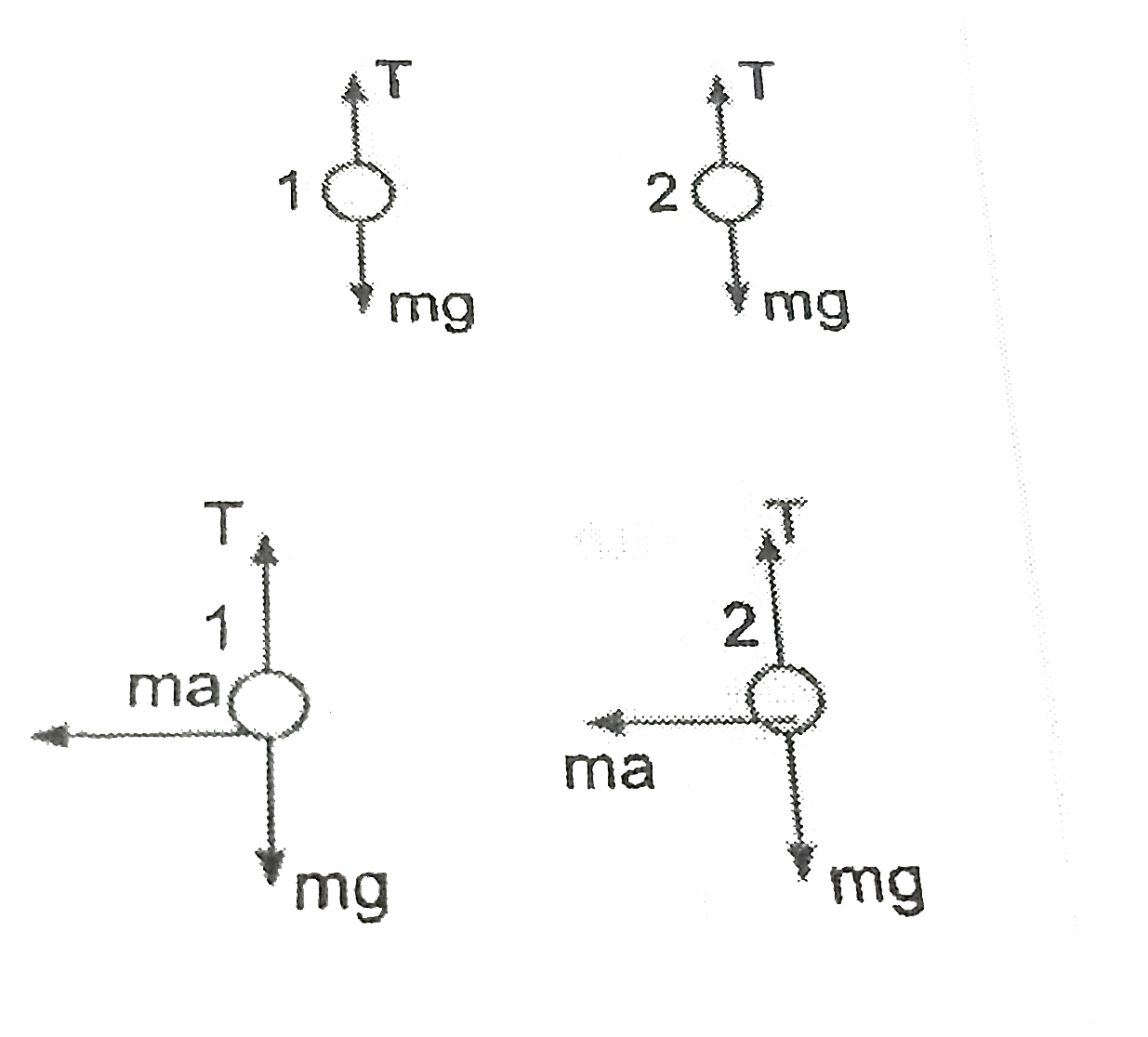
|
|
| 42. |
Two samples of Hydrogen and Oxlygen of same mass possess same pressure and volume. The ratio of their temperatures is |
|
Answer» `1:8` |
|
| 43. |
(A) : If momentum of a body increases by 50%, its kinetic energy will increase by 125%.(R ) : Kinetic energy is proportional to square of velocity. |
|
Answer» Both (A) and (R ) are TRUE and (R ) is the CORRECT explanation of (A) |
|
| 44. |
A mass of 0.1kg is rotated in a vertical circle using a string of length 20cm. When the string makes an angle 30^(@) with the vertical, the speed of the mass is 1.5 ms^(-1). The tangential acceleration of the mass at that instant is |
|
Answer» `4.9 MS^(-2)` |
|
| 45. |
Albert Einstein got Nobel prize in Physics for his work on |
|
Answer» SPECIAL THEORY of relativity |
|
| 46. |
A body of mass 10 kg is raised from certain depth. By the time it is raised by 10m, if its velocity is 2ms^(-1), work done during this time is, |
| Answer» Answer :D | |
| 47. |
(A) : Detergents should have small angles of contact. (R ) : If angle of contact is small therefore detergents rinse the clothes easily. |
|
Answer» Both (A) and (R ) are true and (R ) is the CORRECT explanation of (A) |
|
| 48. |
Length of a sheet is (17.3_-^+0.3) cm and breadth is (3.12_-^+0.08) cm. Calculate the percentage error in the area. |
| Answer» SOLUTION :`A=lxxb(DELTAA)/lxx100=(DELTAL)/lxx100+(DELTAB)/bxx100=0.3/17.3xx100+0.08/3.12xx100=4.3% | |
| 49. |
A heat engine has an efficiency eta. Temperature of source and sink are each decreased by 100 K. Then, the efficiency of the engine |
|
Answer» INCREASES where `T_(1)` and `T_(2)` are the temperatures of the source and SINK respectively. When `T_(1)` and `T_(2)` both are decreased by 100 K each, `(T_(1) - T_(2))` STAYS constant and `T_(1)` Decreases. `:. eta` increases. |
|