

Saved Bookmarks
This section includes 7 InterviewSolutions, each offering curated multiple-choice questions to sharpen your Current Affairs knowledge and support exam preparation. Choose a topic below to get started.
| 1. |
How much PCl_(5) must be added to a one litre vessel at 250^(@)C in order to obtain a concentration of 0.1 mole of chlorine ? Equilibrium constant for the dissociation of PCl_(5) " at " 250^(@)C " is " 0.0414. |
|
Answer» `K_(C) = ([PCl_(3)][CL_(2)])/([PCl_(5)]) , 1.e., 0*0414 = (0*1 xx 0*1)/(a-0*1)` This gives a = `0*3415` mole |
|
| 2. |
How much PCl_(5) must be added to a one litre vessel at 250^(@)C in order to obtain a 35 concentration of 0.1 mol of Cl_(2)? K_(c) for PCl_(5) hArr PCl_(3)+Cl_(2) is 0.0414 mol L^(-1) |
|
Answer» `:. K_(c)=(0.1/1xx0.1/1)/((a-0.1)/1) ( :' "volume is" 1 L)` `0.0414=0.01/((a-0.1))` or `a=0.3415 "mol"` |
|
| 3. |
How much oxygen is required for complete combustion of 560 g of ethene? |
|
Answer» 6.4 kg 28 G of `C_2H_4` REQUIRES 96g of `O_2` 560 g of `C_2H_4` requires `96/28xx560` =1920g or 1.92kg of `O_2` |
|
| 4. |
How much of lime, CaO can be obtained by the calcination of 400 gm of lime stone? |
|
Answer» |
|
| 5. |
How much of 0.3 M ammoniumhydroxide should be mixed with 30 mL of 0.2 M solution of ammonium chloride to give a buffer solution of pH 10. Given pK_(b) for NH_(4)OH is 4.75. |
|
Answer» `pOH = pK_(b) + log .(["Salt"])/(["Base"]), 4= 4.75 + log.(["Salt"])/(["Base"]) or log.(["Salt"])/(["Base"]) = - 0.75 = 1.25 or (["Salt"])/(["Base"]) = 0.1778` i.e.,`("Moles of salt")/("Moles of base")=0.1778 or ((0.2)/(1000)xx30)/((0.3)/(1000)xxV)=0.1778` or `V = 112.5 ML` |
|
| 6. |
How much of 0.3 M ammonium hydroxide should be mixed with 30 mL of 0.2 M solution of ammonium chloride to give buffer solutions of pH 8.65 and 10 (pK_b = 4.75) ? |
|
Answer» SOLUTION :For BASIC buffer solution, `PH=14-pK_b+"LOG""[Base]"/"[Salt]"` pH=14-4.75 +log `"[Base]"/"[Salt]"` or log `"[Base]"/"[Salt]"` = pH-9.25 (i)For suffer of pH=8.65 log `"[Base]"/"[Salt]"`=8.65-9.25 or `"[Base]"/"[Salt]"` =Antilog (-0.60)=0.25 or `([NH_4OH])/([NH_4Cl])=((0.3xxV)/1000)/((0.2xx30)/1000)`=0.25 `V=(0.25xx0.2xx30xx1000)/(0.3xx1000)` =5.02 ML Similarly for solution of pH =10 log `"[Base]"/"[Salt]"` =10-9.25 `"[Base]"/"[Salt]"` =antilog 0.75=5.62 `therefore ((0.3xxV)/1000)/((0.2xx30)/1000)=5.62` `therefore V=(5.62xx0.2xx30xx1000)/(0.3xx1000)` =12.94 mL |
|
| 7. |
How much of 0.3 MNH_(4) should be mixed with 30 mL of NH_(4)Cl to give a buffer solution of pH10.pk_(b)" for " NH_(4)OH "is " 4.75. |
|
Answer» |
|
| 8. |
How much (NaN)_(3) must be weighed out to make 50 ml of an aqueous solution containing 70 mg of Na^(+) per mL? |
|
Answer» `12.394` G |
|
| 9. |
How much nitrogen is evolved when one gm of NH_(4)Cl is heated with borax strongly ? |
|
Answer» |
|
| 10. |
How much mass of sodium acetate is required to make 250 mL of 0.575 molaraqueous solution? |
|
Answer» 11.79 g =82.0245 g/mol Mass of `CH_3COONa` required to make 250 mL of 0.575M solution `=(0.575xx82.0245xx250)/(1000)=11.79g` |
|
| 11. |
How much iron can be theoretically obtained by the reduction of 1 kg ofFe_2O_3 Atomic mass of Fe = 55.8. |
| Answer» SOLUTION :0.699 KG | |
| 12. |
How much hydrogen will be obtained from a mixture containing 8 grams of LiH and 21 grams of CaH_2 |
|
Answer» `CaH_2 + 2H_2O to Ca(OH)_2 + 2H_2` `42 gm to 4 gm` `21 g m to 2 gm` |
|
| 13. |
How much heat is reuired to convert 5.0 g of ice at -10.0^(@) C to liquid water at 15.0^(@) C ? (Assume heart capacities are indendent o ftemperature.) |
|
Answer» `4.2xx10^(2)J` |
|
| 14. |
How much heat energy must be supplied to change36 g of ice at 0^(@)C to Water at room temperature 25^(@)C? Data for Water DeltaH_("fusion")^(@)=9Kj//mol, c_(p("liquid"))=4JK^(-1)g^(-1) |
|
Answer» 18KJ |
|
| 15. |
How much gm of bleaching powder required for chlorination of 1000 lit water ? |
| Answer» Solution :5 gm | |
| 16. |
How much gm water required to prepare 10% w/w solution of HCl by dissolving 36.5 gm HCl. |
|
Answer» |
|
| 17. |
How much energy is required to ionise a hydrogen atom if the electron occupies n=5 orbit ? Compare your answer with the ionisation energy of hydrogen atom (energy required to remove the electron from n=1 orbit). |
|
Answer» Solution :`E_(n)=-(21.8xx10^(-19))/n^(2)" J ATOM"^(-1)` For ionization from 5TH ORBIT, `n_(1)=5, n_(2)=OO` `:. Delta E=E_(2)-E_(1)=-21.8xx10^(-19) (1/n_(2)^(2)-1/n_(1)^(2))=21.8xx10^(-19) (1/n_(1)^(2)-1/n_(2)^(2))=21.8xx10^(-19) (1/5^(2) -1/oo)` `=8.72xx10^(-20) J` For ionization from 1st orbit, `n_(1)=1, n_(2)=oo` `Delta E'=21.8xx10^(-19) (1/1^(2)-1/oo)=21.8xx10^(-19) J` `(Delta E')/(Delta E)=(21.8xx10^(-19))/(8.72xx10^(-20))=25` Thus, the energy required to remove electron from 1st orbit is 25 times than that required to remove electron from 5th orbit. |
|
| 18. |
How much energy will be released when a sodium ion and a chloride ion, originally at infinite distance are brought together to a distance of2. 76 Å ( the shortest distance fo approach in a sodium chloride crystal ? Assume that the ions act as point charges , each with a mangitude of1. 60 xx 10^(-19) C ( the electronic charge ) Also if lattice enrgy of Nacl is185kcal , how the lower value obtained per mole by above calculation can be explained ? |
| Answer» SOLUTION :119.595 KCAL , | |
| 19. |
How much energy is required for the removal of the only electron present in the hydrogen atom ? |
| Answer» SOLUTION :`Delta E = E_(oo) - E_(1) = 0 - (-21.8 xx 10^(-19)J) = 2.18 xx 10^(-19) J` | |
| 20. |
Calculate the ionisation energy of hydrogen atom as well as energy needed to promote its electron from first energy level to third energy level |
|
Answer» SOLUTION :Ionizationenthalpy n=5 forionization n`=prop=n_(F )` in initialelectron is inn=5so `n_(i)=5 ` hydrogen z=1 `Delta E = 2.18 xx 10^(18)((1)/(n_(1)^(2) ) - (1)/(n_(f )^(2)))= IE_(5)` `=2.18 xx 10^(18)((1)/(5^(2)) - (1)/(prop^(2)))` `=(2.18 xx 10^(18))/( 25) J` tibalanceionisationenthalpy of `IE_(5) ` and `IE_(1)` : `(1E_(5))/( 1E_(1)) = (8.72 xx 10^(20)J )/( 2.18 xx 10^(18) J) = 4.-036 xx 10^(2)= 0.04` ionizationenthalpyof n=1compareto n=5is0.04 for`n_(5)`LESSAND `n_(1)` moreionizationenthalpy `IE(5): IE (1)` `=0.04 :1` `4:100` `1: 25` So IE (1) isapprox25 timemorethan1E(5 )` |
|
| 21. |
How much energy is released when 6 mole of octane is burnt in air? GivenDelta H_(f)^(0) " for " CO_(2(g)), H_(2)O_((g)) and C_(8)H_(18(l)) respectively are -390, -240 and +160 KJ/mol |
|
Answer» `-32.6 MJ` `Delta H_("comb") = 8 Delta H_(f_(CO_(2))) + 9Delta H_(f_(H_(2)O)) - Delta H_(f_(C_(8)H_(18)))` `= 8 xx(-390) + 9 xx (-240) - (+160)` `= --5400` kJ/mol For 6 moles `= -32640kJ = - 32.6` MJ |
|
| 22. |
How much copper sulphate will be required to saturate 100g of a dilute aqueous solution of CuSO_(4) at 25^(@)C if 10g of the dilute solution leave on evaporation and drying 1.2g of anhydrous CuSO_(4) ? The solubility of CuSO_(4) in water at 25^(@)C is 25. |
|
Answer» Solution :100g of dilute solution of `CuSO_(4)` CONTAIN `=1.2 xx 10 = 12.0 g CuSO_(4)` MASS of water present in dilute solution `=(100-12)=88g` To saturate 100g of water, `CuSO_(4)` required = 25g So, to saturate 88g of water, `CuSO_(4)` required `= (25)/(100)xx88` `=22g` Thus, the mass of `CuSO_(4)` to be ADDED to 100g of dilute solution to saturate it `= (22-12)=10g`. |
|
| 23. |
How much copper can be obtained from 100 g of CuSO_4 |
| Answer» Solution :Molecular MASS of `CuSO_4=63.5+32+64=159.5` Mass of CU PRESENT in `1.59.5 G CuSO_4=63.5/159.5xx100=39.8 g` Mass of Cu present in`100gCuSO_4=63.5/159.5xx100=39.8g` | |
| 24. |
How much copper can be obtained from 100 g of copper sulphate (CuSO_(4))? |
|
Answer» Solution :MOLAR mass of `CuSO_(4) = 63.5 + 32 + (4 xx 16) = 159.5 G mol^(-1)` 1 mole (159.5 g) of `CuSO_4` contains 1 g atom (63.5 g) of copper. Amount of copper that can be obtained from 100 g of copper sulphate. `=(63.5)/159.5 xx 100 = 39.81 g` |
|
| 25. |
How much copper can be obtained from 100 g of copper sulphate (CuSO_(4)) ? |
|
Answer» `= 159.6g` mol In `159.6 g CuSO_(4) rarr 63.54g` CU obtained `:. 100 g CuSO_(4) = "" (?)` `= (63.54xx100)/(159.6)= 39.81 g Cu` |
|
| 26. |
How much copper can be obtained from 100 g of anhydrous copper sulphate? |
|
Answer» SOLUTION :Anhydrous COPPER sulphate = `CuSO_(4)` MOLECULAR mass of `CuSO_(4)` = 63.5+ 32+ (16 `xx` 4) = 63.5 + 32 + 64 = 159.5 g 159.5 g of `CuSO_(4)`contains 63.5 g of copper. `:. `100 g of `CuSO_(4)` contains `63.5/159.5 xx 100 = 0.39811xx100` = 39.81 g of copper |
|
| 27. |
How much Ca(NO_(3))_(2) in mg must be present in 50 ml of a solution with 2.35 ppm of Ca? |
|
Answer» `0.1175` `10^(6)g` (`10^(6)` ml) water CONTAINS 2.35g CA 50ml (50G) water contains `(50xx2.35)/(10^(6))GCA` `=(50xx2.35)/(10^(6))xx10^(3)mgCa=0.1175gCa` `40gCa-164gCa(NO_(3))_(2)` `0.1175Ca-0.48g Ca(NO_(3))_(2)` |
|
| 28. |
How methane reacts with Cl_(2) in the presence of light ? |
| Answer» Solution :`underset("Methane")(CH_(4) + ) Cl_(2) OVERSET("light") underset(HCl)(to) underset("CHLORIDE") underset("methyl")(CH_(3)Cl) overset(Cl_(2)) underset(-HCl)(to) underset("chloride") underset("Methylidene")(CH_(2)Cl_(2))overset(Cl_(2))underset(HCl)(to) underset("CHLOROFORM") (CHCl_(3)) overset(Cl_(4)) underset(-HCl)(to) underset("Carbon tetra- chloride")(C Cl_(4))` | |
| 29. |
How may the conductivity of an intrinsic semiconductor by increased ? |
| Answer» Solution :The conductivity can be increased by DOPING either by ADDING electron rich impurities like that that of P, As etc. giving n -typesemicomductor or by adding electron deficit impurities like thatof B, Al etc. giving p -type semiconductor. | |
| 30. |
How may of the following reagents can be used to distinguish between hex-1-yne and hex-2-yne? (a). CuCl//NH_(3) (b). AgNO_(3)//NH_(3) (c). Na metal (d). Neutral FeCl_(3) (e). Fehling's reagent |
|
Answer» |
|
| 32. |
How may octahedral voids are there in 1 mole of a compound having cubic close packed structure ? |
| Answer» SOLUTION :No. of OCTAHEDRAL VOIDS = No, if ATOMS in the pocking = 1 mole = ` 6.02 xx 10^(23)` | |
| 33. |
How may moles of oxygen are present in 400 cm^(3) sample of the gas at a pressure of 760 mm of Hg at a temperature of 310K. (The value of R 1 s 8.31 kP a dm^(-3) K^(-1) "mol"^(-1)) |
|
Answer» Solution :Here value of R is given in SI unit : pressure and VOLUME is expressed in Kpa and `DM^(3)` . Thus `P=760 mm 101*3 kPa, v=400 cm^(3) =400xx10^(-3) dm^(3)` According to ideal GAS equation. `pv=nRT` `n=(pv)/(RT)=(101*3xx0*40)/(8*31xx310)=0*01572` `:. n=1 1*57xx10^(-2) "mol"` |
|
| 34. |
How may atoms can be assigned to its unit cell if an element forms (i)body-centred cubic cell (ii) a face -cenrtred cubic cell. |
|
Answer» Solution :Atoms per unit cell in a body-centred CUBIC cell = `8 xx 1/8` ( from corners) + 1 ( from body CENTRE )= 2 Atoms per unit in a FACE- centred cubic cell =` 8xx 1/8 ` ( from corners) + ` 6 xx 1/2` ( from CENTRES ) = 4 |
|
| 35. |
How may lonepairs and bond pairs are present in SO_(4)^(2-) and H_(3)O^(+)? |
| Answer» Solution :`SO_(4)^(2-)` contains 6 bond pairs and 10 LONEPAIRS `H_(3)O^(+)` contains 3 bond pairs and 1 lone PAIR | |
| 36. |
How many years would it take to spend Avogadro Number of rupees at the rate of 10 lakh rupees per second ? |
|
Answer» Solution :Avogadro.s Number = `6.022 XX 10^23` If 10 lakh (`10^6`) rupees are spent every second, the number of SECONDS taken in spending `6.022 xx 10^(23)` rupees `=(6.022 xx 10^(23))/10^(6) = 6.022 xx 10^(17)` `therefore` 1 second = `3.169 xx 10^(-8) xx 6.022 xx 10^(17)` `=1.908 xx 10^(10)` YEARS Hence, it will take `1.908 xx 10^10` years to spend Avogadro number of rupees at the rate of 10 lakh rupees PER second. |
|
| 37. |
How many water molecules present in Epsom salt. |
|
Answer» |
|
| 38. |
How many volume of Hydrogen chlorid form by combine with one volume of hydrogen and one volume of chloride |
|
Answer»
|
|
| 39. |
How many volume of ammonia produece by combine of one volume Nitrogen and three volume of Hydrogen ? |
|
Answer»
|
|
| 40. |
How many valence electrons are present around phosphorous is PCl_(5)? |
Answer» SOLUTION :`P-15=1s^(2) 2s^(2) 2p^(6)//3S^(2)3p^(3)`. TEN electrons 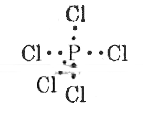
|
|
| 41. |
How manyunpairedelectronsare presentin p -orbitalof oxygen? |
|
Answer» 0 |
|
| 42. |
How many unpaired electrons are present in oxygen molecule ? |
|
Answer» 0 |
|
| 44. |
How many unpaired electrons are present in a ground state? |
|
Answer» 6 |
|
| 45. |
How many unpaired electrons are in a Fe^(2+) ion in the ground state? |
|
Answer» 0 |
|
| 46. |
How many unpaired electorns are present in the ground state of fe^(3+)(z=26),Mn^(2+)(Z=25) and argon(Z=18)? |
|
Answer» Solution :`F to Fe^(3+)+3e^(-)` Fe(Z=26)`Fe^(3+)`=number of electrons=23 `1s^(2)2s^(2)2p^(6)3P^(6)3D^(6)4s^(2)`for Fe atom. `1s^(2)2s^(2)2p^(6)3s^(6)3d^(5) for Fe^(3+)ion.` So,it CONTAIN 5 unpaired electrons. `Mn toMn^(2+)+2e^(-)` Number of unpaired electrons in `Mn^(2+)=5` AR(Z=18)Electronic configuration is `1s^(2)2s^(2)2p^(6)3s^(2)3p^(6)` All ORBITALS are completely filled.So,no unpaired electrons in it. |
|
| 47. |
How many unpaired electorns are present in the ground state of(i)Cr^(2+)(Z=24)(ii)Ne(Z=10) |
|
Answer» Solution :(i)`Cr(Z=24)``1S^(2)2s^(2)2p^()3s^(2)3p^(6)3d^(5)4s^(1)` `Cr^(3+)-1s^(2)2s^(2)2p^()3s^(2)3p^(6)3d^(4)` It CONTAINS 4 UNPAIRED electrons. (ii)Ne(Z=10)`1s^(2)2s^(2)2p^(6)`.No unpaired electrons in it. |
|
| 48. |
How many unit cells are present in a cube-shaped ideal crystal of NaCl of mass 1.00 g ? [Atomic mass:Na=23,Cl=35.5] |
|
Answer» `2.57times10^(21)`unit CELLS `=(4(23+35.5))/(6.02times10^(23))g=((58.5times4)/(6.02times10^(23)))g` No. of unit cells in 1 g `=(6.02times10^(23))/(58.5times4)=602/(58.5times4)=10^(21)=2.57times10^(21)` |
|
| 49. |
How many unit cells are present in a cube shaped ideal crystal of NaCl of mass 1g ? (atomic masses : Na = 23, CI=35.5) |
|
Answer» `1.7 XX 10^21)` UNIT cells |
|
| 50. |
How many unit cells are present in a cube shaped ideal crystal of NaCl of mass 1.00 g ? Atomic masses : Na=23, Cl=3.55) |
|
Answer» `1.28times10^(21)` =`a^(3)timesd=a^(3)times(MZ)/(N_(0)a^(3))=(MZ)/(N_(0))` `therefore m=(58.5times4)/(6.02times10^(23))G` Number of unit CELLS in `1 g=1/m` `=(6.02times10^(23))/(58.4times4)=2.57times10^(21)` |
|