

Saved Bookmarks
This section includes InterviewSolutions, each offering curated multiple-choice questions to sharpen your knowledge and support exam preparation. Choose a topic below to get started.
| 6601. |
A body P is thrown vertically up with velocity 30 ms^(-1) and another body Q is thrown up along the same vertically line with the same velocity but 1 second later from the ground.When they meet (g=10ms^(-2)) |
|
Answer» <P>P TRAVELS for 2.5 s |
|
| 6602. |
A bodyof weight10 Nis placedon a roughplanemakingan angleSin^(-1)(3//5)withhorizontal . If mu_(S) and mu_(k) = 3/5then (g = 10 m^(-2)) The bodymoves up The body just begins to side down During motion its acceleration is 1.2 ms^(-1) The limitingfriction is 6N |
|
Answer» a and B are CORRECT |
|
| 6603. |
Two parallel plate capacitors X and Y have the same area of plates and same separation between them , X has air between the plates while Y contains a dielectric medium of epsi_(r) = 4. Calculate capacitance of each capacitor if equivalent capacitance of the combination is 4 mu F . |
|
Answer» Solution :Here `A_(X) = A_(Y) , d_(X) = d_(Y) , (epsi_(R))_(X) = 1` and `(epsi_(r))_(Y) = 4` `therefore (C_(X))/(C_(Y)) = ((epsi_(r))_(X))/((epsi_(r))_(Y)) = (1)/(4) IMPLIES C_(Y) = 4 C_(X)` As capacitors X and Y have been joined in SERIES and their equivalent capacitance is `4 mu F` , hence `(1)/(4 mu F) = (1)/(C_(X)) + (1)/(C_Y) = (1)/(C_X) + (1)/(4 C_(X)) = (5)/(4 C_X) implies C_X = (4 xx 5)/(4) mu F ` and `C_(Y) = 4 C_(X) = 20 mu F ` |
|
| 6604. |
Give the order of magnitude of nuclear mass density and average atomic mass density. Compare these densities with the typical mass density of solids, liquids and gases (at oridnary temperature and pressure). |
| Answer» Solution :Nuclear mass DENSITY is of the order of `10^(17)KG m^-3`. This is `10^(13)` to `10^(14)` times the average atomic mass density, which is of the order of `10^3` to `10^4kgm^-3`. Typical mass densities of solids and LIQUIDS are of the same order as the atomic mass densities. This is because the atoms are tightly packed in these phases. The typical densities of GASES at S.T.P. are of the order of `10^-1kgm^-3` to `1kgm^-3`. | |
| 6605. |
The maximum velocity of a particle performing S.H.M. is 6.28 cm/s. If the length of its path is 8 cm, What is its period ? |
|
Answer» SOLUTION :`v_max=a OMEGA` ` 6.28=a omega` `6.28=axx(2xx3.14)/T` `6.28=axx(2PI)/T` `T=a=4sec.` |
|
| 6606. |
Hert's observation-Explain in short. |
|
Answer» Solution :Photoelectric effect was FIRST observed by scientist Hertz in 1887. Hertz made experimental investigation of production of electromagnetic waves by means of spark discharge. Hertz observed that high voltage spark across detector loop were enhanced when the emitter plate was ILLUMINATED by ULTRAVIOLET light from an arc lamp when light is INCIDENT on meral surface.Some electrons NEAR metal surface,some electrons near metal surface,some electrons near the surface absorb enough energy,from incident radiation to overcome attraction of positive ions is the metal surface. After gaining sufficient energy from incident light,the electrons escape from the surface of the metal into surrounding space. |
|
| 6607. |
A ring is rotating without slipping. The ratio of its translational kinetic energy to the total K.E. is : |
|
Answer» `1:2` = `(1)/(2)mv^(2)+(1)/(2)mv^(2)=mv^(2)` `THEREFORE (E_("trans"))/(E_("total"))=((1)/(2)mv^(2))/(mv^(2))=(1)/(2)` |
|
| 6608. |
..................... Termed the classification of positive and negative charges. |
|
Answer» |
|
| 6609. |
What is an equipotential surface? |
| Answer» SOLUTION :An EQUIPOTENTIAL SURFACE is a surface on which all the POINTS are at the same POTENTIAL . | |
| 6610. |
The ratio of time taken by ice on the surface of ponds or lakes to become triple the thickness is |
| Answer» ANSWER :D | |
| 6611. |
In a cyclotron, a magnetic filed of 3.5 Wb//m^(2) is used to accelerate protons. What should be the time interval in which the electric field between the dees should be reversed? [Mass of the proton =1.67 xx 10^(-27) kg, charge on the proton =1.6 xx 10^(-19)C] |
|
Answer» Solution :Data: `B=3.5 Wb//m^(2), m=1.67 xx 10^(-27) kg, q=1.6 xx 10^(-19)` C, `T= (2pim)/(qB)` `therefore t=T/2 = (PIM)/(qB) = (3.142 xx 1.67 xx 10^(-27))/(3.5 xx 1.6 xx 10^(-19)) = 9.37 xx 10^(-9) s` This is the required time interval. |
|
| 6612. |
(A): In reactors, light nuclei called moderators are provided along with the fissionable nucli for slowing down fast neutrons. (R): In an elastic collision with hydrogen the neutron almost comes to rest and proton carries away the energy. |
|
Answer» Both .A. and .R. are true and .R. is the CORRECT EXPLANATION of .A. |
|
| 6613. |
Two identical cells either in series or in parallel combination , gives the same current of 0.5 Athrough external resistance of 4Omega. Find emf and internal resistance of each cell. |
|
Answer» Solution :Let each cell be of emf E and internal resistance r, `R=4Omega`, I=0.5 A When the two cells are connected in series : Total emf =E+E=2E , Total resistance = 4+r+r =4+2r `therefore` Circuit current `I=E/(R+r)` `therefore I_1=(2E)/(4+2r) to ` (1) When the two cells are connected in PARALLEL : Total emf =E , Total resistance =`4+r/2` Circuit current `I_2=E/(4+r/2) =(2E)/(8+r) to` (2) As `I_1=I_2` 8+r=4+2r 4=r `r=4Omega` eqn. (1) `RARR` 0.5 =`(2E)/(4+2(4)) rArr 2+4=2E rArr 6/2 =E rArr E=3V` |
|
| 6614. |
A circuit cosisting of a constant e.m.f. 'E' a self induction 'L' and a resistance 'R' is closed at t=0 The relation between the current I in the circuit and time t is as shown by curve 'a' in the fig. When one or more of paraments E,R & L are changed, the curve 'b' is obtained The steady state current is same in both the cases Thenit is possible that: |
|
Answer» E & R are KEPT CONSTANT & L is increased |
|
| 6615. |
Four rods with different raddi r and length l are used to connect two heat reservoirs at different temperatures . Which one will conduct most heat ? |
|
Answer» `r=1cm,l=1m` `((A)/(L))_(1)=(PI(1)^(2))/((1)/(2))=2pi" units"((A)/(L))_(2)=(pi(1)^(2))/((1)/(2))=2pi" units"` `((A)/(L))_(3)=(pi(2)^(2))/((1)/(2))=4pi" units"((A)/(L))_(4)=(pi(2)^(2))/((1)/(2))=8pi" units"` So rod (4) will CONDUCT most heat PER SECOND. |
|
| 6616. |
Figure shows as thin tube open at one end rotating with constant angular speed omega. The other end of the tube has a small opening. Tube contains a fluid of density rho which effuses with speed u relative to the tube. Let rho_(A) be the pressure at the point in the tube just behind the opening. Assume the atmospheric pressure to be p_(0) and pick correct option(s) for the instant when h=l/2 |
|
Answer» <P>`p_(A)=p_(0)+(rho omega^(2)l^(2))/4` `(p_(A)-p_(0))s=rhoshomega^(2)(l-h/2)` `impliesp_(A)=p_(0)+rho omega^(2)h(l- h/2)` By Bernoulli's equation `u=omegasqrt(2h(l-h/2))` 
|
|
| 6617. |
A solenoid having an inductance of 9.70 μH is connected in series with a 1.20 kOmega resistor. (a) If a 14.0 V battery is connected across the pair, how long will it take for the current through the resistor to reach 40.0% of its final value? (b) What is the current through the resistor at time t = 0.50tau_(L)? |
| Answer» SOLUTION :(a) 4.13 NS, (B) 4.59 mA | |
| 6618. |
Which law is violated in the following nuclear reaction? ._0n^1 to ._1H^1+._(-1)e^0? |
| Answer» Solution :The law of conservation of SPIN (angular momentum) is violeted. Each particle on right SIDE has a spin `1/2(h//2pi)` so that the RESULTANT spin on the right side is 0 or `1(h//2pi)`. And on the LEFT side, is `1/2(h//2pi)`. | |
| 6619. |
In the Young's double-slit experiment, some variations which can be made are listed in column A. The possible efffects of such changes are listed in column B. |
|
Answer» |
|
| 6620. |
Which of the following is fluid. |
|
Answer» Water |
|
| 6621. |
A very long non-conducting cylindrical shell of length l=10m is free of rotate about its fixed axis. A light inextensible thread is wrapped over non-conducting cylindrical surface and one end P is pulled with constant acceleration of F/(2m). F is the force applied at P and m is the mass of cylinder. Then charge on the cylinder will be 5xx10K coulomb. [Given m=25kg, l=10m]. Find the value of K? |
|
Answer» `F=Ralpha[m+(mu_(0)q^(2))/(4pil)]` `F/(2M)=Ralpha=F/(m+(mu_(0)q^(2))/(4lpi))` `q=sqrt((ml4pi)/(mu_(0)))=5xx10^(4)` |
|
| 6622. |
A parallel plate capacitor (Fig 8.02] made of circular plates each of radius R = 6.0 cm has a capacitance C = 100 pF. The capacitor is connected to a 230 V a.c. supply with a (angular) frequency of "300 rad s"^(-1). (a) What is the rms value of the conduction current? (b) Is the conduction current equal to the displacement current? (c) Determine the amplitude of vecB at a point 3.0 cm from the axis between the plates. |
|
Answer» Solution :(a) Given that radius of each circular plate `R=6.0cm = 0,06m, C =100pH=10^(-10)F, V_("rms")=230V` and angular frequency `omega="300 rad s"^(-1)`. `therefore"rms value of conduction current "I_("rms")=(V_("rms"))/(X_(c))=V_("rms")xxComega` `=230xx10^(-10)xx300=6.9xx10^(-6)A=6.9muA` (B) Yes, the condution current is equal to the displacement current even for the a.c. circuit. (c) As per modified form of Ampere.s circuital law `B=(mu_(0))/(2pi)(I+I_(d)).(r)/(R^(2))`. For a point situated at a distance `r=3.0cm=0.03m` from the AXIS between the plates `I=0`. Hence, `B=(mu_(0))/(2pi)i_(d).(r)/(R^(2))` and the AMPLITUDE of `vecB=B_(0)=(mu_(0)r)/(2piR^(2)).I_("max")=(mu_(0)r)/(2piR^(2)).sqrt2I_("rms")` `therefore""B_(0)=(4pixx10^(-7)xx0.03xxsqrt2xx6.9xx10^(-6))/(2pixx(0.06)^(2))=1.63xx10^(-11)T.` |
|
| 6623. |
An electron is moving round the nucleus of a hydrogen atom in a circular orbit of radius r. The coulomb force vec(F)between the two is |
|
Answer» `-K (e^2)/(R^3) HATI ` |
|
| 6624. |
The resultant of two forces whose magnitudes are in the ratio 3:5 is 28 N. If the angle of their inclination is 600, then find the magnitude of each force. |
|
Answer» Solution :LET `F_(1) and F_(2)` be the TWO FORCES. Then `F_(1)=3X:F_(2)=5x: R=28 N and theta=60^(@)` `R= sqrt(F_(1)^(2)+F_(2)^(2)+2F_(1)F_(2) cos theta)` `rArr 28= sqrt((3x)^(2)=(5x)^(2)+2(3x)(5x) cos 60^(@))` `rArr 28=(9x^(2)+25x^(2)+15x^(2))=7x rArr x=(28)/(7) =4` `:.F_(1)=3=12 N, F_(2)=5xx4=20 N.` |
|
| 6625. |
Two charges are at a distance d apart. If a copper plate of thickness d/2 is placed between them, if effective force will be, |
|
Answer» 2F 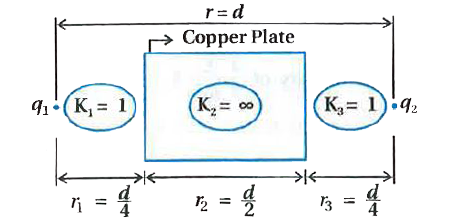 Colombian FORCE exerted between charges `q_1 and q_2` in the absence of copper plate, `F=1/(4pi e_0 K) (q_1q_2)/r^2` `therefore F=1/(4pi e_0) (q_1q_2)/d^2 (because k=1)` Now ,as SHOWN in the FIGURE, after placing given copper plate, new colombian force between `q_1 and q_2` will be `F.=1/(4pi e_0) (q_1q_2)/((sqrtK_1 r_1+sqrtK_2 r_2+sqrtK_3r_3)^2)` Placing the values `F.=1/(4pi e_0) (q_1q_2)/((d/4+infty+d/4)^2)=1/(4 pi e_0)(q_1q_2)/infty^2=0` Note: HEIGHT of copper plate should be give every large otherwise electric field line emanating from `q_1` may reach `q_2` by passing above or below the copper plate. |
|
| 6626. |
At what temperature will the r.m.s. velocity of gas be double its value at N.T.P. |
|
Answer» `4200^@ K` |
|
| 6627. |
In case of a body rolling down an inclined plane acceleration a is given by ...... |
| Answer» SOLUTION :[`I+(K^2)/R^2`] | |
| 6628. |
A radioactive nucleus A with a half life T, decays into a nucleus B. At t = 0, there is no nucleus B. At sometime t, the ratio of the number of B to that of A is 0.3. Then, t is given by : |
|
Answer» t = T log (1.3) `N_a/N_A=3 RARR N_B = 3N_A` also let initially there are total `N_0` number of nuclei `N_A+N_B=N_0` `N_A=N_0/1.3` Also as we KNOW `N_A=N_0 e^(-lambdat) , N_0/1.3=N_0e^(-lambdat)` `1/1.3=e^(-lambdat) rArr ln(1.3) =lambdat` or `t=(ln(1.3))/LAMDA` `t=(ln(1.3))/((ln(2))/T) =(ln(1.3))/(ln(2))T` |
|
| 6629. |
The height y and the distance x along the horizontal plane of a projectile on a certain planet (with no surrounding atmosphere) are given by y = 8t - 5t^(2) meter and x = 6t meter, where t is in seconds. The velocity with which the projectile is projected is : |
|
Answer» `6ms^(-1)` At t=0, `v_(y)=8m//s` Similarly `x=6t:v_(x)=(DX)/(dt)=6m//s` Now `v=sqrt(8^(2)+6^(2))=10m//s` |
|
| 6630. |
Answer the following questions : (a) In any a.c. circuit, is the applied instantaneous voltage equal to the algebraic sum of the instantaneous voltages across the series elements of the circuit ? Is the same true for rins voltage ? (b) A capacitor is used in the primary circuit of an induction coil. (c) An applied voltage signal consists of a superposition of a d.c. voltage and an a.c. voltage of high frequency. The circuit consists of an inductor and a capacitor in series. Show that the d.c. signal will appear across C and the a.c. signal across L. (d) A choke coil in series with a lamp is connected to a d.c. line. The lamp is seen to shine brightly. Insertion of an iron core in the choke causes no change in the lamp's brightness.Predict the corresponding observations if the connection is to an a.c. line. (e) Why is choke coil needed in the use of fluorescent tubes with a.c. mains ? Why can we not use an ordinary resistor instead of the choke coil ? |
|
Answer» Solution :(a) Yes, the applied instantaneous voltage is equal to the algebraic sum of the instantaneous voltages across the series elements of the given a.c. circuit. The same is not true for rms voltage, because voltages across different elements may not be in phase. (b) Out of syllabus. (c) For d.c., impedance of L is negligible and of C very HIGH (infinite), so the d.c., signal appears across C. For high frequency a.c., impedance of L is high and that of C is low. So, the a.c., signal appears across L. (d) For a steady state d.c., inductance of the choke coil has no effect, even if it is increased by inserting an iron-core. For a.c., the lamp will shine dimly because of additional impedance of the choke. It will dim further when the iron core is inserted which increases the choke.s impedance. br>(e) A fluorescent tube needs less current for discharge (GLOW) to take place. A choke coil joined with fluorescent tube REDUCES the current flowing because in an a.c. circuit the choke OFFERS an inductive reactance X1. However, power consumed by choke is negligible because currentand voltage in choke coil differ in phase by `pi/2` . Thus, we save in power. If we use an ordinary RESISTOR instead of a choke coil with the fluorescent tube, no doubt current in the circuit will fall to the desired level. However, it involves loss of power `pi/2` Thus, the fluorescent tube will consume more power. |
|
| 6631. |
Where does Jack and Jill live? |
|
Answer» NEW Hampstead |
|
| 6632. |
A fighter plane flying horizontally passes over an antiaircraft gun with a uniform velocity 200 ms^(-1) . The gun can fire the shell with a velocity 200sqrt(2)ms^(-1) . At what angle should the gun fire the shell so as to hit the plane ? |
|
Answer» `45^@` and `theta` be the angle at which SHALL is fired to HIT the plane, then `Ucostheta=Vimpliescostheta=V/U=200/(200sqrt(2))` `costheta=1/sqrt(2)impliestheta=45^@` |
|
| 6633. |
A chain lies on a rough horizontal table. It starts skidding when one fourth of it’s length hangs over the edge of the table. The coefficient of static friction between the chain and the surface of the table is |
|
Answer» `1/2` |
|
| 6634. |
The two batteries of emf E_(1) and E_(2) having internal resistances r_(1) and r_(2) respectively are connected in series to an external resistor R. Both the batteries are gatting discharged. The above described combination of these two batteries has to produce a weaker current then when any one of the battery is connected to same resistor. For this requirement to be fulfilled. |
|
Answer» `(E_(2))/(E_(1))` must not lie between `(r_(2))/(r_(1)+R) and (r_(2)+R)/(r_(1))` |
|
| 6635. |
Cross-sectional area of proton beam having electric current 1 muA is 0.5mm^(2) and move with velocity 3 xx 10^(4) m/s so current density = ......... |
|
Answer» `6.6 xx 10^(-4) C // m^(3)` Electric charge density `rho= (" electric charge ")/(" Volume ") = (Q)/(AD)` ` therefore rho =(It)/(Ad) = (I)/(A xx v) "" [ because (d)/(t) = v ] ` `therefore rho =(10^(-6))/(0.5 xx 10^(-6) xx 3 xx 10^(4))` `therefore rho = 0.66 xx 10^(-4) C// m^(3)` `therefore rho = 6.6 xx 10^(-5) C//m^(3)` |
|
| 6636. |
A wire of length I is kept just taut horizontally between two walls. A mass m hanging from its raid-point depressesit by 5.Calculate the time in which a pulse set up at one end will reach the other end. The mass of the wire per unit length of it is mu . |
|
Answer» |
|
| 6637. |
A wave pulse starts propagating in the x direction along a non uniform wire of length 10m with mass per unit length is given bymu = mu_(0) + ax and under a tension of 100N. The time taken by a pulse to travel from the lighter end to heavier end (mu_(0) = 10^(-2) kg//m " and " a = 9 xx 10^(-3) kg//m^(2)) is |
|
Answer» 22.27 SEC |
|
| 6638. |
In the circuit of CE amplifier, a sililcon transistor is used. The value of V_("CC")=+20V, R_(L)=3kOmega, collector voltage =5V, beta=100. Then the base resistance R_(B) should be (Take input voltage drop across Si transistor = 0.7 V) |
|
Answer» `3.86xx10^(6)OMEGA` |
|
| 6639. |
A coil area of cross section 0.5 m^2 with 10 turns is in a plane which is perpendicular to an uniformmagnetic field of 0.2 Wb//m^2. The flux through the coil is ……………… . |
|
Answer» 100 WB |
|
| 6640. |
A train of 100 m long travelling at 40m/s starts overtaking another train 200 m long travelling at 30 m/s. The time taken by the first train to pass the second train completely is |
|
Answer» 30 s |
|
| 6641. |
One evening a man fixes a two metre high insulating slab carrying on its top a large aluminimum sheet of area 1 m^2 outside his house. Will he get an electric shock if he touches the metal sheet next morning? |
| Answer» Solution :Yes, earth, the aluminium sheet with the dielectric slab in between will form a capacitor. The potential of the aluminium sheet will RISE due to the down POUR of atmospheric CHARGE during the night. When a person touches the sheet, the accumulated charge will flow through his BODY to earth. This will constitute a electric current and the person will EXPERIENCE an electric shock. | |
| 6642. |
Two parallel rails with negligible resistance are 10.0cm apart. They are connected by a 5.0Omegaresistor. The circuit also contains two metal rods having resistances of 10.0Omegaand 15.0Omegaalong the rails. The rods are pulled away from the resistor at constant speeds 4.00 m/s and 2.00 m/s respectively. A uniform magnetic field of magnitude 0.01 T is applied perpendicular to the plane of the rails. Determine the current in the 5.0Omegaresistor. |
|
Answer» Solution :In the figure ` R = 5.0 Omega , r_1 = 10 Omega, r_2 = 15Omega` ` e_1 = Blv_1 = 0.01 xx 0.1 xx 4 = 4 xx 10^(-3) V` ` e_2 = Blv_2 = 0.01 xx 0.1 xx 2 = 2 xx 10^(-3) V` APPLYING kirchoff.s law to the left loop: `10i + 5(i_1 - i_2) = 4.10^(-3)` `rArr 15 i_1 + (5(i_1- i_2) = 4.10^(-3)` ` rArr 15i_1 - 5i_2 = 4 xx 10^(-3) to (1) ` Right loop `: 15i_2 - 5(i_1 - i_2) = 2.10^(-3)` `rArr 20i_2 - 5i_1 = 2 xx 10^(-3) to (2)` SOLVING (1) and (2) gives `i_1 =18/55 xx 10^(-3) A` and `i_2 = 10/55 xx 10^(-3)A` `rArr` current through `5Omega = i_1 - i_2` ` = 8/55 xx 10^(-3) A = 8/55 mA` |
|
| 6643. |
Water at 50^(@)C is filled in a cubical container of side 1m. The thickness of the walls of the container is 1 mm. the container is surrounded by large amount of ice at 0.^(@)C the temperature of the water becomes 20.^(@)C in 10ln2 seconds. Choose the correct options. find the thermal conductivity of the material of the container and the ice melted in that time. [Given, specific heat of water =1cal/gm degree, latent heat of fusion of ice =80cal//gm, density of water =1gm//cm^(3) heat capacity of the container cong=0] |
|
Answer» THERMAL conducitivity of the material is `70J//m.^(@)C` `i=(kA)/(x).(T-0)`.(1) Where `A=6a^(2)=6m^(2)`= thickness `=1mm=10^(-3)m` Rate of heat lost from water `(dQ)/(dt)=+ms(dT)/(dt)`..(2) So, we get from (1) & (2) `-ms(dT)/(dt)=(kAT)/(x)implies-int_(50^(@))^(25^(@))(dT)/(T)=(kA)/(mSx)int_(0)^(10ln2)dt` `impliesln(2)=(kA)/(mSx).10(ln2)` So, `(kA(10))/(mSx)=1` putting values `impliesk=(mSx)/(10A)=((10^(3)kg)(4.2xx10^(3)J//kg.^(@)C)10^(-3)m)/(10x(6m^(3)))=k=70J//m.^(@)C` `implies` total heat transferred with be = total heat `Q=intdQ=int(kA)/(x)Tdt` lost by water `Q=mStriangleT=10^(3)xx4200xx25J=(10^(6)gm)(1" CAL")(25)=m_(ice)L` Givin `m_(ice)=((10^(6)xx25)/(80))gm=(25000)/(80)kg=312.5kg` Mass of ice melted `=312.5kg` |
|
| 6644. |
what are non -localised fringes? |
| Answer» Solution :Interference FRINGES can be found on a screen placed anywhere in FRONT of the coherent sources. Thus interference PATTERN is not loclised in a REGION and hence these are called non - localised fringes. | |
| 6645. |
Three uncharged capacitors of capacities C_1 ,C_2and C_3 are connected as shown in the figure to one another and the point. A, B and C are at potentials V_1,V_2, and V_3, respectively. Then the potential at will be |
|
Answer» `(V_1 C_1+V_2C_2+V_3 C_3)/( C_1 +C_2+C_3)` |
|
| 6646. |
A light of 6000 Å is used to produce interference pattern.The observed fringe widht is 0.12 mm. The angle between twointerfering wave trains is : |
|
Answer» `2 xx 10^(-3)` radian ANGLE `theta` between two waves train is `theta = (d)/(D) = (lambda)/(beta)` 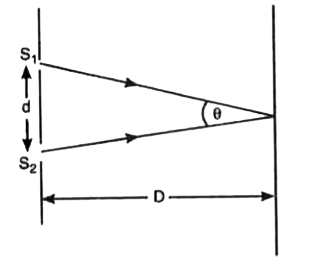 or `theta = (6000 xx 10^(-10))/(0.12 xx 10^(-3))` ` = 5 xx 10^(-3)` radian. |
|
| 6647. |
In a common emitter amplifier circuit using a n-p-n transistor, the phase difference between the input and the output voltages will be …….. |
|
Answer» `135^(@)` |
|
| 6648. |
The middle of a uniform rod of mass m and length l is rigidly fixed to a vertical axis OO^' so that the angle between the rod and the axis is equal to theta (figure). The ends of the axis OO^' are provided with bearings. The system rotates without friction with an angular velocity omega. Find: (a) the magnitude and direction of the rod's angular momentum M relative to the point C, as well as its angular momentum relative to the rotation axis, (b) how much the modulus of the vector M relative to the point C increases during a half-turn, (c) the moment of external forces N acting on the axle OO^' in the process of rotation. |
|
Answer» Solution :(a) The ANGULAR velocity `omega` about `OO^'` can be resolved into a component parallel to the rod and a component `omega sin theta` PERPENDICULAR to the rod through C. The component parallel to the rod does not contribute so the angular momentum `M=lomegasintheta=(1)/(12)ml^2omegasintheta` ALSO, `M_z=Msintheta=(1)/(12)ml^2omegasin^2theta` This can be OBTAINED directly also, (b) The modulus of `vecM` does not change but the modulus of the change of `vecM` is `|DeltavecM|`. `|DeltavecM|=2Msin(90-theta)=(1)/(12)ml^2omegasin2theta` (c) Here `M_(_|_)=Mcostheta=Iomegasinthetacostheta` Now `|(dvecM)/(dt)|=Iomegasinthetacostheta(omegadt)/(dt)=(1)/(24)ml^2omega^2sin^2theta` as `vecM` precesses with angular velocity `omega`. 
|
|
| 6649. |
In the following question a statement of assertion (A) is followed by a statement of reason (R ) A : One may have zero potential but non-zero electric field at a point in space. R : Potential is a scalar quantity . |
|
Answer» If both Assertion & Reason are true and the reason is the CORRECT explanation of the assertion , then mark (1). |
|
| 6650. |
The velocity of projection of an oblique projectile is (6hati + 8hatj)ms^(-1) horizontal range of the projectile is: |
|
Answer» 4.9 m and `v_(y)=8ms^(-1).`The RESULTANT velocity `=sqrt((6)^(2)+(8)^(2))=10ms^(-1)` Now `sintheta=v_(y)/V=8/10=4/5` and `costheta=v_(x)/v=6/10=3/5` But `R=(2v^(2)sinthetacostheta)/g` `=(2xx10^(2))/10xx8/10xx6/10=9.6`m |
|