

Saved Bookmarks
This section includes 7 InterviewSolutions, each offering curated multiple-choice questions to sharpen your Current Affairs knowledge and support exam preparation. Choose a topic below to get started.
| 1. |
Calculate the mass of HCl present per litre of the solution whose pH value is 1.301. |
|
Answer» Solution :`pH = - log [H_(3)O^(+)] :. log [H_(3)O^(+)]=-pH = - 1.301` `[H_(3)O^(+)]=`antilog (-1.301) = antilog `(bar(2). 699) = 5.0xx10^(-2)` G IONS/litre But `[H_(3)O^(+)]` ions are obtained from HCl by its complete ionization as `HCl + H_(2)O rarrH_(3)O^(+)+Cl^(-):. HCl = [H_(3)O^(+)]=5.0xx106(-2)M` MOLAR mass of HCl = 36.5 g `"mol"^(-1)` `:. 5.0xx10^(-2)M HCl = (5.0xx10^(-2))xx36.5g ` of HCl/litre = 1.825 g/litre |
|
| 2. |
Calculate the mass of H_2SO_4 present in 250 cm of a seminormal solution. |
|
Answer» Solution :According to the normality relation, `W=(Nev)/1000` In the PRESENT case, `N=1/2` (solution is seminormal) `E = ("Molecular mass")/("BASICITY")` `=98/2 = 49` `V = 250 cm^(3)` `therefore w =(1/2 xx 49 xx 250)/1000 = 6.125 G` Hence, the given solution contains 6.125 g of `H_(2)SO_(4)` |
|
| 3. |
Calculate the mass of CO_2 that would be obtained by completely dissolving 10 kg of pure CaCO_3in HCl. CaCO_3 + 2HCl to CaCl_2 + H_2O + CO_2 |
|
Answer» SOLUTION :`100 KG xx 10^(-3) 44 kg xx 10^(-3)` 100 kg of `CaCO_3` produces ` 44 xx 10^(-3)` kg of `CO_2` ` 44 xx 10^(-3)` 10kg of `CaCO_3` produces `= ()/(100 xx 10^(-3)) xx 10` `= 4.4 kg ` of `CO_2` |
|
| 4. |
Calculate the mass of CaO required to remove the hardness of 1000,000 litres of water containing 1.62 g of calcium bicarbonate per litre. |
|
Answer» |
|
| 5. |
Calculatethe mass of a photonwithwavelength(lambda) =3.6A |
|
Answer» Solution :Where `lambda =3.6A= 3.6xx 10^(10)m` `h=6.626 xx 10^(34) js` `m= (h)/( lambda v )` `=(6.626 xx 10^(34) J s)/((3.6 xx 10^(10) m 3.0 xx 10^(8) MS^(-1))` =`6.135 xx 10^(33) kg` Note : InNCERTbook6.135 `xx 10^(29) kg `.It is FALSE |
|
| 6. |
Calculate the mass of a photon with wavelength 3.6 Å |
|
Answer» Solution :Here, `lamda = 3.6 Å = 3.6 xx 10^(-10)m` As photon travels with the VELOCITY of light, `v = 3.0 xx 10^(8) MS^(-1)` By de Broglie equation, `lamda = (h)/(MV) or m = (h)/(lamda v) = (6.626 xx 10^(-34)JS)/((3.6 xx 10^(-10)m) (3.0 xx 10^(8) ms^(-1))) = 6.135 xx 10^(-29) kg` |
|
| 7. |
Calculate the mass of a fructose molecule. |
|
Answer» SOLUTION :Molecules formula of fructose is `C_(6)H_(12)O_(6)` Molecular mass of `C_(6)H_(12)O_(6)` = `(6xx12u)+(12xx1u)+(6xx16u) =18U`. |
|
| 9. |
Calculate the mass of 10^(22) formula units of blue vitriol. |
|
Answer» |
|
| 10. |
Calculatethe massof 1 moleof neutron in kg(n_(m) =1.675 xx 10^(27) kg) |
| Answer» SOLUTION :`1.0088 XX 10^(-3)KG )` | |
| 11. |
Calculate the mass of 1 amu in grams. |
|
Answer» Solution :1 amu is defined as the 1/12 th of the actual mass of one atom of `C^(12)`. SINCE, the gram atomic mass of `C^(12)` is 12.00 and this mass contains `6.022 xx 10^(23)` atoms. `therefore` Mass of one atom of `C^(12)` `=(12.00)/(6.022 xx 10^(23)) = 1.993 xx 10^(-23) G` HENCE, 1 amu `=1/2 xx 1.993 xx 10^(-23) = 1.660 xx 10^(-24) g` |
|
| 12. |
Calculate the mass defect and binding energy per nucleon of ._(8)^(16)O which has a mass 15.99491 amu. Mass of neutron=1.008655 amu Mass of proton =1.007277 amu Mass of electron=0.005486 amu 1amu=931.5 MeV |
|
Answer» |
|
| 13. |
Calculate the mass of one mole of electrons |
| Answer» Solution :Mass of one ELECTRON `9.1xx10^(-31)THEREFORE` Mass of one MOLE of ELECTRONS `6.022xx10^23xx9.1xx10^(-31)=5.48xx10^(-7)kg`Charge of one electron `=1.6xx10^(19)Ctherefore`Charge of one mole of electron `6.022xx10^23xx1.6xx10^(-19)=9.64xx10^4C` | |
| 14. |
Calculate the mas of Magnesium required to completely react with 250cm^(3) of 0.1 MHCl. |
|
Answer» SOLUTION :`250xx0.1M=25` millimoles of HCl From the EQUATION it is clear that 2HCl is reacting with ONE Mg. `:.` 25 millimoles of HCl react with 12.5 millimoles of Mg `:.` Mass of magnesium required `=` volume of Mg `xx` ATOMIC weight `=12.5xx10^(3)xx24=0.3g` of Mg OR `V_(HCl)=100cm^(3), V_(NaOH)=25cm^(3) , M_(HCl)=?, M_(NaOH)=0.1M` and `V_(HCl)xxM_(HCl)=V_(NaOH)xxM_(NaOH)xxa_(NaOH)` Where `a_(HCl)=` basicity of HCl `=1, aNaOH=` acidity of `NaOH=1` `M_(HCl)=(25xx0.1)/100=0.025`m Mass of HCl PRESENT in `100cm3=(M_(HCl)xx"Molecular wieight of " HCl)/10` `=(0.025xx36.5)/10=0.0912g` |
|
| 15. |
Calculate the free energy change in kJ when 1 mole of NaCl is dissolved in water at 298 K, Given a) U of NaCl (U = lattice energy) = 778 kJ "mole"^(-1) b) Hydration energy of NaCl = -774.3 kJ "mole"^(-1) (c) Entropy change at 298K = 43 "mole"^(-1) |
|
Answer» `Delta G= Delta H - T Delta S= - 9` |
|
| 16. |
Calculate the magnetic moment of dioxygen molecule. |
|
Answer» SOLUTION :According to molecular ORBITAL theory, `O_(2)` molecule has 2 unpaird ELECTRONS. Magnetic MOMENT `mu=sqrt(n(n+2))=sqrt(2(2+2))=2sqrt(2)` Magnetic moment of `O_(2)=2.828BM` |
|
| 17. |
Calculate the lattice enthalpy of calcium oxide from the following data. Data found in the IB chemistry data booklet and the Born Haber cycle drawn in part (a) enthalpy of atomisation of Ca_((s)) = + 178kJ mol^(-1) second ionization energy of Ca_((g))= +1150 kJ mol^(-1) enthalpy of formation of calcium oxide = -635 kJ mol^(-1 ) |
| Answer» SOLUTION :+2708 kJ/mol | |
| 18. |
Calculate the lattice energy of NaCl using Born-Haber cycle. |
Answer» Solution :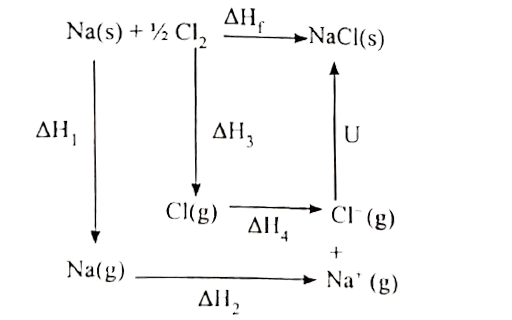 `DeltaH_f` =heat of formation of SODIUM chloride =`-411.3"kJ mol"^(-1)` `DeltaH_1`=heat of sublimation of Na(g) =`108.7 "kJ mol"^(-1)` `DeltaH_2` = ionisation energy of Na(g)=`495.0 "kJ mol"^(-1)` `DeltaH_3` =dissociation energy of `Cl_(2(s))=244 "kJ mol"^(-1)` `DeltaH_4`=Electron affinity of Cl(s) =`-349.0 "kJ mol"^(-1)` U=lattice energy of NaCl `DeltaH_f = DeltaH_1+DeltaH_2 +1//2DeltaH_3 +DeltaH_4 +U` `therefore U=(DeltaH_f)-(DeltaH_1+DeltaH_2+1//2DeltaH_3 +DeltaH_4)` `RARR` U=(-411.3 )-(108.7+495+122-349) U=(-411.3)-(376.7) `therefore U=-788 "kJ mol"^(-1)` This NEGATIVE sign in lattice energy indicates that the energy is released when sodium is formed from its constituent gases ions `Na^+` and `Cl^-` |
|
| 19. |
Calculate the lattice energy of MgBr_(2) from the given date |
|
Answer» Solution :`Mg_((S))+Br_(2_((l)))rarrMgBr_(2_((S)))` `DeltaH_(F)^(@)=524kJmol^(-1)` Sublimation : `Mg_((s))rarrMg_((g))DeltaH_(1)^(@)=+148 "kJmol"^(-1)` Ionisation : `Mg_((s))rarrMg_((g))^(2+)+2e^(-)DeltaH_(2)^(@)=+2187 "kJmol"^(-1)` vapourisation : `Br_(2(l))rarrBr_(2(g))DeltaH_(3)^(@)=+31 "kJmol"^(-1)` Dissociation : `Br_(2(g)))rarr2Br_(2(g))DeltaH_(4)^(@)=+193 "kJmol"^(-1)` Electron AFFINITY affinity : `2Br_((g))+2e^(-)rarr2Br_((g))^(-)DeltaH_(5)^(@)=-662 "kJmol"^(-1)` Lattice enthalpy : `Mg_((g))^(2+)+2Br_((g))^(-)rarrMgBr_(2_((S)))DeltaH_(6)^(@)=?` `DeltaH_(f)^(@)=DeltaH_(1)^(@)+DeltaH_(2)^(@)+DeltaH_(3)^(@)+DeltaH_(4)^(@)+DeltaH_(5)^(@)+DeltaH_(6)^(@)` `-524=148+2187+31+193-662+DeltaH_(6)^(@)` `DeltaH_(6)^(@)=-2421kJ mol^(-1)` `Mg_((g))^(2+)+2Br_((g))^(-)rarrMgBr_(2_((s)))=DeltaH_(6)^(@)=-2421kJ mol^(-1)` By definition `MgBr_(2_((s)))rarrMg_((g))^(2+)+2Br_((g))^(-)DeltaH_(6)^(@)=-2421 kJ mol^(-1)` |
|
| 20. |
Calculate the lattice energy of formation of NaClfrom the following data :Na_((s)) +1//2Cl_(2(g)) to NaCl_((s)) Delta H_(f) -411.3 KJ.mol^(-1)Heat of sublimation of Na_((s))= 108 . 7 kJ mol ^(-1)Ionisation energy of Na_((g)) = 49.5.0 kJ mol^(-1)Dissociation energy of Cl_(2(g)) = 244 kJ mol^(-1)Electron affinity of Cl_((g)) = - 349 . 0 kJ mol^(-1) |
|
Answer» Solution :`Delta^(@) H_(1)` = HEAT of sublimation of `Na_((s))` `= 108 kJ mol^(-1)` `Delta^(@) H_(2)`JONISATION energy of `Na_((g))` ` = 495 . 0 kJmol^(-1)` `Delta^(@)H_(3)`dissociation energy of `Cl_(2(g))` ` 244kJ mol^(-1)` `Delta^(@)H_(4)= `Electron affinity of ` Cl_((g))` `= - 349 . 0 kJ mol^(-1)` U = Lattice energy of NaCl `Delta^(@) H_(f) = Delta^(@) H_(1) + Delta^(@)H_(2) + 1//2 Delta^(@)H_(3) + Delta^(@) H_(4) + Delta^(@) H_(5)` `:. Delta^(@)H_(5)= (Delta^(@)H_(f))-(Delta^(@)H_(1)+ Delta^(@)H_(2)+1//2Delta^(@)H_(3)+Delta^(@)H_(4))` `rArr Delta^(@) H_(5) = (-411.3) - (108 .7 + 495.0 + 122-349)` `Delta^(@) H_(5) = (-411.3)-(376.7)` `:. Delta^(@)H_(5) = - 788 kJ mol^(-1)`. |
|
| 21. |
Calculate the lattice energy of CaCl_2 from the given data. Ca_((s)) + Cl_(2(g)) to CaCl_(2(s)) DeltaH_f^0 =-795 "kJ mol"^(-1) Sublimation : Ca_((s)) to Ca_((g)) "" DeltaH_1^0=+121 "kJ mol"^(-1) Ionisation : Ca_((g)) to Ca_((g))^(2+) +2e^(-) "" DeltaH_2^0=+2422 "kJ mol"^(-1) Dissociation : Cl_(2(g)) to 2Cl_((g)) "" DeltaH_3^0=+242.8 "kJ mol"^(-1) Electron affinity : Cl_((g)) + e^(-) to Cl_((g))^(-) "" DeltaH_4^0=-355 "kJ mol"^(-1) |
Answer» SOLUTION :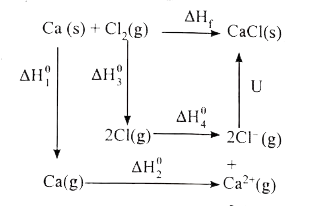 `DeltaH_f=DeltaH_1+DeltaH_2+DeltaH_3+2DeltaH_4 + u` -795=121+2422+242.8+(2 X -355) + u -795 =2785.8-710 +u -795=2075.8 + u u=-795-2075.8 `u=-2870.8 "kJ mol"^(-1)` |
|
| 22. |
Calculate the kinetic energy per mole of carbondioxide at 27^@C |
| Answer» SOLUTION :`894cal , 3740 J , 3.74 XX 10^(10)`ERG | |
| 23. |
Calculate the kinetic energy of the electron ejected when yellow light of frequency 5.2 xx 10^(14) sec^(-1) falls on the surface of potassium metal. Threshold frequency of potassium is 5 xx 10^(14) sec^(-1) |
|
Answer» Solution :K.E. of the ejected ELECTRON is given by `(1)/(2) mv^(2) = hv - hv_(0) = h (V - v_(0))` `= 6.625 xx 10^(-34) Js (5.2 xx 10^(14) - 5.0 xx 10^(14)) s^(-1) = 6.625 xx 10^(-34) xx 0.2 xx 10^(14)` JOULES `= 1.325 xx 10^(-20)` Joules |
|
| 24. |
Calculate the kinetic energy of emitted electron when a radiation with frequency of 2 xx 10^(15) sec^(-1) hits the metal surface. |
| Answer» SOLUTION :`9.93xx10^(-19)J` | |
| 25. |
Calculate the kinetic energy of a chlorine molecule at room temperature. |
|
Answer» |
|
| 26. |
Calculate the kinetic energy of 5 moles of O_2 " at " 0^@C. (R = 8.31 xx 10^7 " ergs " K^(-1) mol^(-1)) |
|
Answer» SOLUTION :The kinetic energy of one mole of a gas is given by `E_k = 3/2 RT` Therefore, for 5 moles of `O_2 " at " 0^@C (273 K)` `E_K = 5 xx 3/2 RT` `= 5XX 3/2xx 8.31 xx 10^7 xx 273` `= 1.70 xx 10^(11)` ergs HENCE, the kinetic energy of five moles of `O_2 " at " 0^@C " is " 1.70 xx 10^(11)` ergs. |
|
| 27. |
Calculate the kinetic energy of 5 moles of O_2 at 37^@ C. |
|
Answer» `19330 J` |
|
| 28. |
Calculate the K_b of hydrazine, if pH of 4 xx 10^(-3) M hydrazine is 9.7. |
|
Answer» Solution :`POH -PH =14-9.7 =4.3` `pOH =(pk_b- log C)/(2) ` ` 4.3=(pK_b - log (4 XX 10^(-3)))/(2 ) implies pk_a = 6.2` ` k_b =10^(-6.2) = 6.30xx 10^(-7)` |
|
| 29. |
Calculatethe ionizationenergyof H_(i)He^(+) and Li^(2+)in kJmol^(-1) Noten=1,Z=1,2,3respectively E_(n) = (2.18 xx 10^(-18) Z^(2))/(n^(2)) |
| Answer» SOLUTION :Respectively1311.85247.2 and11806 .2 | |
| 30. |
Calculate the ionization constant of 0.05M weak acid if it's degree of disociation is 0.018 |
|
Answer» |
|
| 31. |
Calculate the ioninc radius of a Cs^(+) ion, assuming that the cell edge length for CsCl is 0.4123 nm and the ionic radius of a Cl^(-) ion is 0.181nm. |
|
Answer» 0.176nm `r_(Cl^(+))=0.357-0.181=0.176nm` |
|
| 32. |
Calculate the ionic strength of a solution containing 0.2M NaCL and 0.1 M Na_(2)SO_(4). |
|
Answer» |
|
| 33. |
Calculate the internal energy change in each of the following cases :- (i) A system absorbs 15 kJ of head and does 5 kJ of work. (ii) 5 kJ of works is done of the system and 15 kJ of heat is given out by the system. |
|
Answer» SOLUTION :(i) Here, `Q= + 15 kJ , W= - 5 kJ` `:.` Accordingto first LAW of thermodynamics., `Delta U = q+w= 15 + (-5) = 10 kJ` Thus, internal energy of the system increasesby `10 kJ` (ii) Here,` x= + 5 kJ, q = - 15 kJ` `:. `ACCORDING to first law of thermodynamics, `Delta U = q+ w= -15 + (+5) = - 10kJ` |
|
| 34. |
Calculate the increase in vapour pressure of water per atmosphere rise in external pressure at 10^(@)C. The vapour pressure of water at 10^(@)C and 1 atm is equal to 9.2 mm. |
|
Answer» <P> `V_(l)=` molar volume of liquid] |
|
| 35. |
Calculate the hydrolysis constant of the salt containing NO_(2)^(-) ions. (Given K_(a) for HNO_(2) = 4.5 xx 10^(-10)). |
|
Answer» |
|
| 36. |
Calculate the hydrolysis constant, degree of hydrolysis and pH of 0.10 M KCN solution at 15^(@)C . For HCN, K_(a)=6.2xx10^(-10). |
|
Answer» Solution :As KCN is a SALT of strong base and weak ACID, HYDROLYSIS constant, `K_(h) = (K_(w))/(K_(a))=(10^(-14))/(6.2xx10^(-10))=1.6xx10^(-5)` Degree of hydrolysis, `h=sqrt((K_(h))/(c))=sqrt((1.6xx10^(-5))/(0.1))=1.26xx10^(-2)` The hydrolysis reaction will be : `{:(,CN^(-),+,H_(2)O,hArr,HCN,+,OH^(-)"...(i)"),("Initial conc.",cM,,,,0,,0),("At eqm.",c-x,,,,x,,x "(x-No. of moles of" CN^(-) "reacted)"),(,,,,,,,):}` `K(h)=([HCN][OH^(-)])/([CN^(-)])=(x xx x)/(c-x)=(x^(2))/(c)orx=sqrt(K_(h)xxc)=sqrt((1.6xx10^(-5))(0.1))=1.26xx10^(-3)` i.e., `[OH^(-)]=1.26xx10^(-3)` `:. [H^(+)]=(K_(w))/([OH^(-)])=(10^(-14))/(1.26xx10^(-3))=7.94xx10^(-12)` `pH = - log [H^(+)]=-log (7.94xx10^(-12))=12-0.90=11.1` Alternatively, reaction (i) is the hydrolysisof the base `(CN^(-))`. We need `K_(b)` for this reaction. We are given `K_(a)` of the conjugate acid (HCN) . Hence, `K_(b)=(K_(w))/(K_(a))=(10^(-14))/(6.2xx10^(-10))=1.61xx10^(-5)` For equilibrium(i), `K_(b)=(x xx x)/(c-x) ~= (x^(2))/(c)` `:. 1.61xx10^(-5)=(x^(2))/(0.1) or x^(2)xx1.61xx10^(-6) or x = 1.26xx10^(-3)` i.e., `[OH^(-)]=1.26xx10^(-3)` `pOH = log (1.26xx10^(-3))=2.9` `:. pH = 14-2.9 = 11.1` Alternatively, pH can be calculated directly by applying the formula, `pH = 7 +(1)/(2) [pK_(Z)+log c]` |
|
| 37. |
Calculate the hydrogen ion concentration in the following biological fluids whose pH are given below: (a) Human muscle-fluid, 6.83 (b) Human stomach fluid, 1.2 (c) Human blood, 7.38 (d) Human saliva, 6.4. |
|
Answer» Solution :(a)Hydrogen in CONCENTRATION in Human muscle fluid (pH=6.83) pH=-log `[H^+]`= 6.83 `therefore` log `[H^+]=-6.83 =bar7.17` `therefore [H^+]` = Antilog `(bar7.17)` `=1.4791xx10^(-7) APPROX 1.48xx10^(-7)` (b)`[H^+]` in Human STOMACH [pH=12] pH = -log `[H^+]`=1.2 and log `[H^+]` =-1.2 `therefore [H^+]` = + Antilog (1.2) = + Antilog `(bar2.8)` `=+(6.3095xx10^(-2))` `=6.31xx10^(-2)` M (c) `[H^+]` in Human blood [pH=7.38] pH=-log `[H^+]`= 7.38 `therefore` log `[H^+]=-7.38 = bar8.62` `therefore [H^+]`= Antilog `(bar8.62)` `=4.1687xx10^(-8) M approx 4.17xx10^(-8)` M (d)`[H^+]` in Human SALIVA [pH=6.4] pH=-log `[H^+]`= 6.4 `therefore` log `[H^+]=-6.4 = bar7.6` `therefore [H^+]`=Antilog `(bar7.6)` `=3.981xx10^(-7)` M |
|
| 38. |
Calculate the hydrogen ion concentration in the following biological fluids whose pH are given : (a) Human muscle-fluid, 6.83(b) Human stomach fluid, 1.2 (c) Human blood, 7.38(d) Human saliva, 6.4 |
|
Answer» (b) ` log [H^(+)]=-pH =-1.2=bar(2).8 :. [H^(+)]= "Antilog" bar(2).8 = 6.31xx10^(-2)M` (c) `log[H^(+)] =- log = - 7.38 =bar(8).62 :. [H^(+)] = "Antilog" bar(8).62= 4.169xx106(-8)M` (d) `log [H^(+)]=-pH = - pH = - 6.4 = bar(7).60 :. [H^(+)]= "Antilog" bar(7).60=3.981xx10^(-7)M` |
|
| 39. |
Calculate the heat of reaction of the following reaction : CO_(2)(g) + H_(2)(g) rarr CO(g) + H_(2)O(g) Given that the Delta_(f)H^(@) of CO(g) = -110.5 kJ, Delta_(f)H^(@) of CO_(2)(g) = -393.8 kJ, Delta_(f)H^(@) of H_(2)O(g) = -241.8 kJ respectively |
|
Answer» Solution :The required equation is `CO_(2)(g) + H_(2)(g) RARR CO(g) + H_(2)O(g)` `DELTA H = Sigma Delta H_(f"(products)") - Sigma Delta H_("(REACTANTS)")` `= Delta H_(f)^(@)CO_((g)) + Delta H_(f)^(@)H_(2)O_((g)) - Delta H_(f)^(@)CO_(2(g)) - Delta H_(f)^(@)H_(2(g))` `= -110.5 kJ - 241.8 kJ - (-398.3 kJ) - 0 = 352.3 kJ + 393.8 kJ = 41.5 kJ`. |
|
| 40. |
Calculate the hest of reaction of the following reaction : C_(6)H_(12)O_(6(s)) + rarr 6CO_(2(g)) + 6H_(2)O_((g)) : Delta H = ? |
|
Answer» Solution :`"C(graphite)" + O_(2)(g) rarr CO_(2)(g) , Delta H = -395.0 kJ` …(1) `H_(2)(g) + (1)/(2)O_(2)(g) rarr H_(2)O(l) , Delta H = -269.5 kJ` ...(2) `6"C(graphite)" + 6H_(2)(g) + 3O_(2)(g) rarr C_(6)H_(12)O_(6) , Delta H = -1169.8 kJ` ... (3) Multiplying equation (1) and (2) each by 6 and reversible (3), we get, `6"C(graphite)" + 6O_(2)(g) rarr 6CO_(2(g)) , ""Delta H = -2370 kJ` …(4) `6H_(2(g)) + 3O_(2(g)) rarr 6H_(2)O_((l)) , ""Delta H = -1617.0 kJ`…(5) `C_(6)H_(12)O_(6(s)) rarr 6C_("(graphite)") + 6H_(2(g)) + 3O_(2(g)) , Delta H = +1169.8 kJ` ...(6) ADDING (4), (5) and (6), `C_(6)H_(12)O_(6(s)) + 6O_(2(g)) rarr 6CO_(2(g)) + 6H_(2)O_((g))`, `Delta H(C_(6)H_(12)O_(6)) = -2370.0 - 1617.0 + 1169.8 = -2817.2 kJ`. |
|
| 41. |
Calculate the height of a column of water equivalent to 1 atmosphere. ("density of Hg "=13.6 g cm"^(-3)) |
|
Answer» Solution :`"1 atm = 76 cm of HG"` `p=h_(1)d_(1)g" (mercury) "=h_(2)d_(2)g" (WATER)or"` `76xx13.6=h_(1)XX(1)/(2)` `h_(2)=1033.6cm"or= 10.336 m"` |
|
| 42. |
Calculate the heat produced during neutrilisation reaction of 36.5 gm HCl and 40 gm NaOH. |
| Answer» Answer :A | |
| 43. |
Calculate the heat of reaction of the following reaction C_(6)H_(12)O_(6(s))+6O_(2(g))to6CO_(2(g))+6H_(2)O_(g)), DeltaH=? |
|
Answer» SOLUTION :Multiplying EQUATION 1 and 2 each by 6 REVERSING 3 we get `6C_(("graphite"))+6O_(2(g))to6CO_(2(g)),DeltaH=2370kJ` ……………4 `6H_(2(g))+3O_(2(g))to6H_(2)O_((1)),DetlaH=-1616.4kJ`………… 5 `C_(6)H_(12)O_(6(s))to6C_(("graphite"))+6H_(2(g))+3O_(2(g)),DeltaH=+1169.8kJ`.......6 Adding 4, 5 and 6 `C_(6)H_(12)O_(6(s))+6O_(2(g))to6CO_(2(g))+6H_(2)O_((g))`, `DeltaH_(g)(C_(6)H_(12)O_(6))=-2370.0-1616.4+1169.8=-2816.6kJ` |
|
| 44. |
Calculate the heat of glucose and its calorific value from following data : (i)C_"(graphite)"+O_(2(g)) to CO_(2(g)) ,DeltaH=-395 KJ (ii)H_(2(g)) +1//2O_2 to H_2O_((l)) , DeltaH=-269.4 KJ (iii)6C+6H_(2(g)) +3O_(2(g)) to C_6H_12O_(6(s)) , DeltaH=-1169.8 KJ |
|
Answer» Solution :The required equation is `C_(6)H_(12)O_(6_((s)))+6O_(2_((g)))rarr6CO_(2_((g)))+6H_(2)O_((L))` (i) `C_("graphite")+O_(2_((g)))rarrCO_(2_((g))):DeltaH=-395.0KJ` (II) `H_(2_((g)))+1/2O_(2)rarrH_(2)O_((l)):DeltaH=-269.4KJ.` (III) `6C_("graphite")+6H_(2_((g)))+3_(2_((g)))rarrC_(6)H_(12)O_(6_((s))) : DeltaH=-1169.8KJ.` MULTIPLY equation (i) and (ii) by 6 and add them up `C_(6)H_(12)O_(6_((s)))+6O_(2_((g)))rarr6CO_(2_((g)))+6H_(2)O_((l)) DeltaH=-2816.6KJ.` `:.` Enthalpy of combustion of glucose `=-2816.6KJ.` |
|
| 45. |
Calculate the heat of formation of KCl from the following data : (i)KOH (aq) +HCl(aq) rarr KCl(aq) + H_(2) O(l) , Delta H = - 57.3 kJ mol^(-1) (ii)H_(2)(g) +(1)/(2) O_(2)(g) rarr H_(2)O(l), Delta H = - 286.2kJ mol^(-1) (iii)(1)/(2) H_(2)(g) +(1)/(2)Cl_(2)(g) +aq rarr HCl(aq), Delta H = - 164.4 kJ mol^(-1) (iv)K(s) + (1)/(2) O_(2) (g) +(1)/(2) H_(2)(g) +aq rarr KOH (aq), Delta H = - 487 . 4 kJ mol^(-1) (v) KCl(s) + aq rarrKCl (aq), Delta H= + 18.4 kJ mol ^(-1) |
|
Answer» Solution :We aim at `: K_(s) + (1)/(2) Cl_(2) (G) rarr KCL (s) , Delta _(f) H = ?` In order to get this thermochemical EQUATION, we follow the following two steps `:` `K(s) + (1)/(2) Cl_(s) (g) + H_(2)(g) + (1)/(2) O_(2)(g) rarr KCl(s) + HCl(aq) + KOH (aq) - KCl(aq) ` `DELTAH = - 487.4 + ( - 164.4) - (18.4) = -670 .2 kJ mol^(-1)`....(vii) Step 2. To CANCEL out the terms of this equation which do not appear in the required equation (vi)and subtract eqn. (ii) from theirsum. This gives `K(s) + (1)/(2)Cl_(2)(g) rarrKCl(s) , Delta _(f)H = - 670.2 + 57.3 - (- 286.2) = - 441.3 kJ` |
|
| 46. |
Calculate the heat of formation of KOH from the following data K_((s)) + H_(2)O + aq rarr KOH_((aq)) + (1)/(2) H_(2(g)) , Delta H = -48.4 K.Cal H_(2(g)) + (1)/(2) O_(2(g)) rarr H_(2)O_((l)) , Delta H = -68.44 K.Cal KOH_((s)) + aq rarr KOH_(aq) , DeltaH = -14.01 K.Cal |
|
Answer» `+102.83` |
|
| 47. |
Calculate the hardness of water sample which contains 0.001 mole of MgSO_4 dissolved per litre of water. |
|
Answer» SOLUTION :`"1 mole "MgSO_4= "1 mole "CaCO_3` `10^(-3)" Mole "MgSO_4=10^(-3)" MOL "CaCO_3` `therefore "0.120g "MgSO_4 =0.1"g CaCO"_3" in 1000 mL "` `therefore "HARDNESS ==100ppm "` |
|
| 48. |
Calculate the hardness of a water sample which contains 0.001 mole of MgSO_(4) dissolved perr litre of the solution. |
|
Answer» Solution :0.001 mole of `MgSO_(4)-=0.001 ` mole `CaCO_(3)=0.001xx1000 ` mg =100 mg 1L of `H_(2)O-=10^(3) g = 10^(6) ` mg`therefore ` DEGREE of hardness =100 PPM |
|
| 49. |
Calculate the H_(3)O^(+) ion concentration of a solution having pH 6.58. |
|
Answer» Solution :`PH = - log [H_(3)O^(+)] :. Log [H_(3)O^(+)]=-pH = - 6.58 `{pH = 6.58, given } `:. [H_(3)O^(+)]` = antilog (-6.58) = antilog `bar(7) .42=2.63xx10^(-7) ` G ions/litre |
|