

Saved Bookmarks
This section includes 7 InterviewSolutions, each offering curated multiple-choice questions to sharpen your Current Affairs knowledge and support exam preparation. Choose a topic below to get started.
| 1. |
Calculate the H_(3)O^(+) and OH^(-) ion concen- trations at 25^(@)C in(i) 0.02 N HCl solution (ii) 0.005 N NaOH solution |
|
Answer» Solution :(i) HCl completely ionizes as:`HCl + H_(2)O RARR H_(3)O^(+) + CL^(-)` `[H_(3)O^(+)]=[HCl]=0.02 N ` (Given) `0.02 M ` (`:'` HCl is monobasic) `=2xx10^(-2)M` Now, as `[H_(3)O^(+)][OH^(-)]=K_(w) = 10^(-14) :. [OH^(-)]=(K_(w))/([H_(3)O^(+)])=(10^(-14))/(2xx10^(-2))=5xx10^(-13) M` (ii) NaOH completely ionizes as `NaOH rarr Na^(+) + OH^(-)` `:. [OH^(-)]=[NaOH] = 0.005 N ` (Given) `=5xx10^(-3) M `(`:'` NaOH ismonoacidic) Now, as `[H_(3)O^(+)] [OH^(-)]=K_(w)=10^(-14) :. [H_(3)O^(+)]=(K_(w))/([OH^(-)])=(10^(-14))/(5xx10^(-3))=2xx10^(-12)M` |
|
| 2. |
Calculate the H^(+) ion concentration in 0.10 M acetic acid solution. Given that the dissociation constant of acetic acid in water is 1.8xx10^(-5). |
|
Answer» Solution :`{:(,CH_(3)CO OH+AQ,HARR,CH_(3)CO O^(-) (aq),+,H^(+)(aq)),("Initial conc.",0.10 M ,,0M,,0M),("Concs. at eqm.",(0.10-x)M,,x M,,x M):}` `K_(a)=([CH_(3)CO O^(-)(aq)][H^(+)(aq)])/([CH_(3)CO OH])` `1.8xx10^(-5)=(x xx x)/(0.10-x) ~~(x^(2))/(0.10) or x^(2)=(1.8xx10^(-5))xx0.10=1.8xx10^(-6)` or `x=sqrt(1.8xx10^(-6))=1.34xx10^(-3) M, i.e., [H^(+)]=1.34xx106(-3)M` |
|
| 3. |
Calculate the Gibb's energy change for the formation of propane, C_(3)H_(8(g)) at 298 K. Given that Delta_(f)H for propane = -103.85 kJ mol^(-1) Delta S for the reaction is - 269.74 JK^(-1). |
|
Answer» Solution :The formation of `C_(3)H_(8(g))` is REPRESENTED by `3C_("(graphite)") + 4H_(2(g)) rarr C_(3)H_(8(g))` `Delta S = -269.74 JK^(-1)` `Delta_(f)G = Delta_(f)H - T Delta S` `= -103.85 XX 10^(3)J - 298 K xx (-269.74 JK^(-1))` `= -23467.48 J` (or) `-23.467 KJ` |
|
| 4. |
Calculate the frequency (v) and wave number (bar(v)) of the yellow light with a wavelength of 580 nm emitted from sodium lamp. |
| Answer» SOLUTION :`v=5.17xx10^(14)m^(-1), barv=1.72xx10^(6)m^(-1)` | |
| 5. |
Calculate the frequency of yellow radiation having wavelength 5800Å. [1Å=10^(-10)m,C=3xx108ms^(-1)] |
|
Answer» |
|
| 6. |
Calculate the frequency of infrared radiations having wavelength, 3 xx 10^(6)nm. |
|
Answer» |
|
| 7. |
Calculate the frequency and the wavelength of the radiation in nanometers emitted when an electron in the hydrogen atom jumps from third orbit to the ground state. In which region of the electromagnetic spectrum will this line lie? (Rydberg constant = 109,677 cm^(-1)) |
|
Answer» |
|
| 8. |
Calculate the frequency and energy of a photon of radiation having wavelength 6000 Å |
|
Answer» Solution :Frequency `v = (c)/(LAMDA)` SUBSTITUTING `c = 3 XX 10^(8) m s^(-1), lamda = 6000 Å= 6000 xx 10^(-10) m`, we get `v = (3 xx 10^(8) ms^(-1))/(6000 xx 10^(-10)m) = 5 xx 10^(4) s^(-1)` (ii) ENERGY of the photon E = hv Substituting `h = 6.625 xx 10^(-34) J s, v = 5 xx 10^(14) s^(-1)`, we get `E = 6.625 xx 10^(-34) J s xx 5 xx 10^(14) s^(-1) = 3.3125 xx 10^(-19) J` |
|
| 9. |
Calculate the freezing point of an aqueous solution of a non-electrolyte having an osmotic pressure 2.0 atm at "300 K. Kf = 1.86 k.kg.mol"^(-1.)" R = 0.0821 lit.atm.k"^(-1)" mol"^(-1) |
|
Answer» |
|
| 10. |
Calculate the free energy change in dissolving one mole of sodium chloride at 25^(@)C . Lattic energy= + 777.8 kJ mol^(-1). Hydration energy of NaCl = - 774.1 kJ mol^(-1) and Delta Sat 25^(@)C = 0.0 43kJ K^(-1) mol^(-1) |
|
Answer» `DeltaG = DeltaH - T DeltaS= 3.7 kJ mol^(-1) -298 K ( 0.043kJ K^(-1) mol^(-1)) = ( 3.7 - 12.8) kJ mol^(-1) = - 9.1 kJ mol^(-1)` |
|
| 11. |
Calculate the free energy change when 1 mole of NaCl is dissolved in water at 298 K. (Given : Lattice energy of NaCl = -777.8 kJ mol^(-1)), Hydration energy -774.1 kJ mol^(-1) and Delta S = 0.043 kJ mol^(-1) mol^(-1) at 298 K). |
|
Answer» Solution :`Delta H` - HYDRATION ENERGY - Lattice energy `Delta H = -774.1 KJ mol^(-1) (-777.8 kJ mol^(-1))= 3.7 kJ mol^(-1)` `Delta G = Delta H - T Delta S = +3.7 kJ - 298 xx 0.043 kJ = +3.7 kJ - 12.81 kJ` `Delta G = -9.11 kJ mol^(-1)`. |
|
| 12. |
Calculate the fractional charge on each atom of HBr. The dipole moment of HBr is 0.78D and its bond length is 1.41Å. [electronic charge, e=4.8xx10^(-10) esu, 1D=10^(-10)esu*cm]. |
|
Answer» SOLUTION :Dipole moment, `mu=qxxd` or, `Q=(mu)/(d)=(0.78xx10^(18)esu*cm)/(1.41xx10^(-8)cm)=0.55xx10^(-10)esu` Fraction of charge `(delta)=("Charge present (q)")/("Electronic charge (e)")` `=(0.55xx10^(-10)esu)/(4.8xx10^(-10)esu)=0.11` `therefore`The fractional charge on HYDROGEN, `delta_(H^(+))=0.11 ` and the fractional charge on BROMINE, `delta_(Br)=-0.11` |
|
| 13. |
Calculate the fractional charge on each atom in HBr molecule. Given that Dipole moment of BHr = 0 . 78 D,Bond distance of HBr =1.41Å. Electronic charge , e =4. 8 xx 10^(-10) esu |
|
Answer» Diplo moment` (MU) = q xx d orq = (mu)/(d) =(0.78xx10^(-18) "esu cm")/(4.8xx10^(-8)cm) = 0.55xx10^(-10) esu` Fractional charge`(delta) = (q)/(E) = (0.55xx10^(_10)esu)/(4.8xx10^(-10)esu) = 0 .11thereforedelta_(H^+)= 0.11,delta_(Br^-) = - 0.11`. |
|
| 14. |
Calculate the formula weight of compounds NaOH |
|
Answer» SOLUTION :a. ` 1 xx AW` or C = 12.0 AMU `1 xx AW ` of H = 1.0 amu ` 3 xx AW` of Cl `=3 xx 35.45`= `ul(106.4 " amu")` Formula weight of `CHCl_3`= `ul(119.4 " amu ")` The ansser rounded to three significant figure is 119 amu. b. IRON (III) Sulfate ` 2 xx `Atomic weight of Fe `=2 xx 55.8`=111.6 am ` 3 xx ` Atomic weight of O `= 12 xx 16 = ul(192.0" amu ")` The answer rounded to three significant figure is ` 4.00 xx 10^(2) ` amu. |
|
| 15. |
Calculate the formula weight of each of the following to three significant figures, using a table of atomic weight (AW): (a) chloroform CHCl_3 (b)Iron (III) sulfate , Fe_2(SO_4)_3. |
|
Answer» Solution :a. ` 1 xx AW` or C = 12.0 amu `1 xx AW ` of H = 1.0 amu ` 3 xx AW` of Cl `=3 xx 35.45`= `UL(106.4 " amu")` Formula WEIGHT of `CHCl_3`= `ul(119.4 " amu ")` The ansser rounded to three significant figure is 119 amu. b. IRON (III) SULFATE ` 2 xx `Atomic weight of Fe `=2 xx 55.8`=111.6 am ` 3 xx ` Atomic weight of O `= 12 xx 16 = ul(192.0" amu ")` The answer rounded to three significant figure is ` 4.00 xx 10^(2) ` amu. |
|
| 16. |
Calculate the formation heat for propen from given equations. (i) C_((s)) + O_(2(g)) to CO_(2(g)) , DeltaH_(1) = - 94.05 k.cal/mole (ii) H_(2(g)) + (1)/(2) O_(2(g)) to H_(2) O_((l)), DeltaH_(2) = -68.32 k.cal/mole (iii) C_(3) H_(8(g)) + 5O_(2(g)) to 3CO_(2(g)) + 4H_(2) O_((l)), DeltaH_(3) = - 530.61 k.cal/mole |
| Answer» SOLUTION :`-24.82` k.cal/mole | |
| 17. |
Calculate the formula charge on each atom in a underset(* *)overset(* *)(":"O)-overset(* *)(S)=underset(* *)(O":") |
|
Answer» Solution :Formula charge on S atom `=6-2-1//2xx6=+1` Formula charge on double BONDED O atom `=6-4-1//2xx4=0` Formal charge on single bonded O atom `=6-6-1//2xx2=-1` The molecule in terms of formal charge MAY be represented as : `overset(-1)overset(* *)UNDERSET(* *)(":"O)-overset(+1)overset(* *)(S)=overset(0)underset(* *)(O":")` |
|
| 18. |
The formal charge on the triply bonded oxygen atom in the structure :O-=C-underset(* *)overset(* *)O: is …………….. |
|
Answer» SOLUTION :In `:O-=C-underset(* *) overset(* *)O:` Formal charge on CARBON `=N_(V)-[N_(l)+(N_(b))/(2)]= 4 -[0+(8)/(2)]= 4 - 4 = 0` Formal charge on singly bonded oxygen `= N_(v)-[N_(l)+(N_(b))/(2)]=6-[6+(2)/(2)]=6-7=-1` Formal charge on TRIPLY bonded oxygen `= N_(v)-[N_(l)+(N_(b))/(2)]=6-[2+(6)/(2)]=6 - 5 = +1` |
|
| 19. |
Calculate the formal charge on (i) S in HSO_(4)^(-)ion (ii) Cl in HClO_(4) |
Answer» Solution : (i) Lewis STRUCTURE of ` HSO_(4)^(-)` ion is  Applying the formula for calculation of formal charge formal charge on S ATOM = ` 6- 0 - (1)/(2) (8) = 6 - 4 = + 2 ` (ii) Lewis structure of ` HClO_(4)` is  Formal charge on ` CL = 7 - 0 - (1)/(2) (8)= + 3 ` |
|
| 20. |
Calculate the formal charge on each oxygen atom in ozone. |
Answer» Solution :The LEWIS structure of ozone `(O_(3))`  Formula charge on `O_(a)=V-L-(1)/(2)(s)` `=6-2-(1)/(2)(6)=+1` Formula charge on `O^(b)=6-4-(1)/(2)(4)=0` Formal charge on `O^(c)=6-6-(1)/(2)=-1` HENCE lewis structure for `O_(3)` with the formal charge in written as 
|
|
| 21. |
Calculate the formal charge on each atom of carbonyl chloride (COCl_(2)) |
|
Answer» Solution :Formal CHARGE `= N_(v)-[N_(1)+(N_(B))/(2)]` Carbonyl chloride `COC1_(2)`:  Formal charge on carbon atom `= 4 - [0+(8)/(2)]=4-4=0` Formal charge on chlorine atom `= 7 - [6 + (2)/(2)]= 7-7 = 0` Formal charge on oxygen atom `= 6 - [4+ (4)/(2)]=6-6=0` |
|
| 22. |
Calculate the formal charge on each atom of carbonyl chloride (COCl_(2)). |
|
Answer» SOLUTION :FORMAL charge `= N_(V) - [N_(l) + N_(b)/2]` Carbonyl chloride  Formal charge on carbon atom ` = 4 - [0 + 8/2] = 4 - 4 = 0 ` Formal charge on chlorine atom ` = 7 - [6 + 2/2] = 7 - 7 = 0 ` Formal charge on oxygen atom ` = 6 - [4 + 4/2] = 6 - 6 = 0 ` |
|
| 23. |
Calculate the formal charge on each atom of carbonyl chloride (COCI_2)? |
|
Answer» Solution :Formal charge =`N_(v)-[N_(l)+(N_(b))/(2)]` Carbonyl chloride `COCl_(2)` 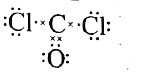 Formalcharge on carbon atom = `4-[0+(8)/(2)]=4-4=0` Formal charge on CHLORINE atom `=7-[6+(2)/(2)]=7-7=0` Formal CHARGEON oxygen atom= `6-[4+(4)/(2)]=6-6=0` |
|
| 24. |
Calculate the following upto proper significant figures : (i) 45.95 xx 0.061, (ii) 312.6 xx 14.68 (iii) 3.2 + 4.004, (iv) 515.69-312.812 (v) (6.7 xx 0.00421)/(11.8), (vi) (5.4 xx 10^(-3) xx 0.0649)/(3.11 xx 10^(-2)) |
|
Answer» Solution :(i) In this calculation, the first quantity is more precise and consists of four significant figures while the second quantity is less precise and consists of only two significant figures. Therefore, the result should be reported upto two significant figures only. Therefore, `45.95 XX 0.061 = 2.80295 - 2.8` ANS. (ii) In this calculation, both the quantities contain four significant figures. Hence, the result should be reported upto four significant figures. Therefore, `312.614.68 = 21.294277 = 21.29`Ans. (iii) In this addition, the first number has one DECIMAL place while the second number has three decimal places. Hence, the result should be reported only upto one decimal place. Therefore, `3.2 + 4.004 = 7.204 = 7.2` Ans. (iv) In this subtraction, the first number has two decimal places while the second one has three decimal places. Therefore, the result should be reported only upto two decimal places. Hence, `515.69 - 312.812 = 202.878 = 202.88` Ans. (v) In this calculation, the least precise number, i.e., 6.7 consists of only two significant figures. Therefore, the result should be EXPRESSED only upto two significant figures. Hence, `(6.7 xx 0.00421)/(11.8) = 2.39042 xx 10^(-3) = 2.4 xx 10^(-3)` (after rounding off) Ans. (VI) In this calculation, the least precise number, i.e.,`5.4xx10^(-3)`consistsof onlytwosignificant figures. Hence, the result should be reported upto two significant figures only. Therefore, `(5.4 xx 10^(-3) xx 0.0649)/(3.11 xx 10^(-2)) = 1.12688 xx 10^(-2) = 1.1 xx 10^(-2)` |
|
| 25. |
Calculate the following in three moles of ethane (C_2H_6) Number of moles of hydrogen atoms |
| Answer» Solution :Number of moles of hydrogen ATOMS in 1 MOLE `C_2H_6=6` Number of moles of hydrogen atoms in 3 moles `C_2H_6=18` | |
| 26. |
Calculate the following In three moles of ethane (C_2H_6) Number of moles of carbon atoms |
| Answer» Solution :NUMBER of MOLES of C in 1 MOLE `C_2H_6=2` Number of moles of C in 3 moles `C_2H_6=6` | |
| 27. |
Calculate the following in three moles of ethane (C_2H_6) Number of molecules of ethane |
| Answer» SOLUTION :Number of MOLECULES in 1 mole `C_2H_6=6.02xx10^23` Number of molecules in 3 moles `C_2H_6=18.06xx10^23` | |
| 28. |
Calculate the extent of hydrolysis of 0.005M K_(2)CrO_(4) K_(2)=3.1xx10^(7) for H_(2)CrO_(4). (H_(2)CrO_(4) is strong for first ionisation and K_(1) = 1.6). |
|
Answer» |
|
| 29. |
Calculate the expression for K_(C) "and" K_(P) if initially a moles of N_(2) "and" B "moles of" H_(2) is taken for the following reaction. N_(2)(g)+3H_(2)(g)hArr2NH_(3)(g) (Deltanlt0) (P,T,V given) |
|
Answer» `{:(At t=0,a,b,0),(t=t_(eq),(a-x)(b-3x),2x,):}` `[N_(2)]=(a-x)/(V), [H_(2)] =(b-3x)/(V), [NH_(3)]=(2x)/(V)` `K_(C)=(((2x)/(V))^(2))/(((1-x)/(V))((b-3x)/(V))^(3))=(4x^(2)V^(2))/((a-x)(b-3x)^(3))` Total no. of moles at EQUILIBRIUM`=a+b-2x` `[P_(N_(2)]]=(a-x)/(a+b-2x). P, [P_(H_(2)]]=((b-3x))/(a+b-2x).P, [P_(NH_(3)]]=((2x).P)/(a+b-2x)` `K_(P)=[P_(NH_(3)]]^(2)/([P_(N_(2)]][P_(H_(2)]]^(3))=(((2x)/(a+b-2x).P)^(2))/([((a-x)/(a+b-2x)).P][((b-3x)P)/(a+b-2x)]^(3))` `((4x^(2).P^(2))/((a+b-2x)^(2)))/(P^(4)((a-x)(b-3x)^(3))/((a+b-2x)^(4)))=((a+b-2x)^(2).4x^(2))/P^(2(a-x)(b-3x)^(3))` |
|
| 30. |
Calculate the equivalent weights of zinc and zinc sulphate (At.wt. of Zn = 65.4). |
|
Answer» |
|
| 31. |
Calculate the equivalent weights of : carbonium ion and metabonate ion. |
|
Answer» |
|
| 32. |
Calculate the equivalent weight of the following: (i) KMnO_4 in acidic medium (ii) KMnO_4 in alkaline medium (iii) FeSO_4 (NH_4)_2 SO_4. 6H_(2) O (converting to Fe^(3+) ) (iv) K_2 Cr_2 O_7 in acidic medium (v) H_2 C_2 O_4 (converting to CO_2 ) (vi) Na_(2) S_(2) O_(3). 5H_(2) O ( reacting with I_2 ) |
|
Answer» SOLUTION :(i) `underset(+7)overset("1 mole")(KMnO_4)to underset(+2)(Mn^(2+))"(acidic medium)"` EQUIVALENT weight of `KMnO_4= ("mol. weight of" KMnO_4)/("change in ON per mole")` `= (158)/( 5) = 31.6` (ii) `underset(+7) overset("1 mole") (KMnO_(4)) to underset(+6)( MnO_(4)^(2-)"(alkaline medium)"` Equivalent weight of `KMnO_4 = ( 158)/(1) = 158`. (iii) `Fe^(2+) to Fe^(3+)` Equivalent weight of `FeSO_(4) (NH_(4) )_(2) SO_(4) . 6H_(2) O = ( 392)/( 1) = 392`. (iv) `underset(+12) overset("1 mole")(K_(2) Cr_(2) O_(7)) to underset(+6) (2Cr^(3+)) ` Equivalent weight of `K_2 Cr_2 O_7 = (294.2)/( 6) = 49.03`. (v) `underset(+6) overset("1 mole") (H_(2) C_(2) O_(4)) to underset(+8) (2CO_(2))` Equivalent weight of `H_(2) C_(2) O_(4) = (90)/(2) = 45`. (vi) `Na_(2) S_(2) O_(3). 5H_(2) O + I_(2)to Na_(2) S_(4) O_(6) + 2I^(-)` or `underset(+4)(S_(2) O_(3)^(2-)) tounderset(+5)((1)/(2) S_(4) O_(6)^(2-))` Equivalent weight of `Na_(2) S_(2) O_(3) . 5H_(2) O = ( 248)/( 1) = 248.` |
|
| 33. |
Calculate the equivalent weight of KMnO_(4) |
|
Answer» Solution :`KMnO_(4)` acts as oxidant in acidic, basic and also in neutral medium. In acidic medium: `KMnO_(4)+8H^(+) +5e^(-) to K^(+) +MN^(2+)+4H_(2)O` One molecular of `KMnO_(4)` gains five electrons. Hence the equivalent WEIGHT of `KMnO_(4):` EQ. `wt=("Mol.wt. of "KMnO_(4))/(5)=(158.04)/(5)=31.608` In neutral as well as weakly basic medium: `KMnO_(4)+2H_(2)O+3e^(-) to K^(+)+4OH^(-)+MnO_(2)` One molecule of `KMnO_(4)` gains three electrons. Eq. wt `=("Mol.wt. of "KMnO_(4))/(3)=(158.04)/(3)=52.68` In strongly alkaline medium `: MnO_(4)+E^(-) to MnO_(4)^(2-)` One molecule of `KMnO_(4)` gains one electron. Eq. wt `=("MOLE. wt. of "KMmO_(4))/(1)=158.04` |
|
| 34. |
Calculate the equivalent weight of hypo based on its reaction with iodine. |
|
Answer» Solution :Hypo reduces IODINE to iodide and the chemical equation is given as `2Na_(2)S_(2)O_(3)+I_(2)to2NaI +Na_(2)S_(4)O_(6)` Sum of the oxidation number of .S. in reactions =2 (-2+6) =+8 Sum of the oxidation numberof .S. in products `=4"x"+2.5=+10` Change in oxidation number of S is 2 Change in oxidation number per mole of sodium thiosulphate =1 Chemical formula of hypo is `Na_(2)S_(2)O_(3) . 5H_(2)O` Formula weight of hypo = 158+90 =248 Equivalent weight`=("Formula weight")/(1)=248` |
|
| 35. |
Calculate the equivalent weight of H_3PO_4 and Ca(OH)_2on the basis of given reaction . H_(3)PO_4 + NaOH to NaH_2PO_4+H_2O Ca(OH)_2+HCI to Ca(OH)CI+H_2O |
|
Answer» SOLUTION :Equivalent WEIGHT of `H_2PO_4` `=("Molecular mass")/("No. of replaceable" H^+)=(98)/(2)=49` Equivalent weight of `Ca(OH)_2` `=("Molecular mass")/("No. of replacement"OH^-)=(74)/(2)=37`. |
|
| 36. |
Calculate the equivalent weight of each oxidant and reducant in: (a) FeSO_(4) + KCl_(3) rarr KCl + Fe_(2) (SO_(4))_(3) (b) Na_(2) SO_(3) + Na_(2)CrO_(4) rarr Na_(2) CrO_(4) rarr Na_(2) SO_(4) + Cr(OH)_(3) (c) Fe_(3)O_(4) + KMnO_(4) rarr Fe_(2) O_(3)+ MnO_(2) (d) KI + K_(2) Cr_(2) O_(7) rarr Cr^(3+) + 3I_(2) (e) Mn^(4+) rarr Mn^(2+) (f) NO_(3)^(-) rarr N_(2) (g) N_(2) rarr NH_(3) (h) Na_(2) S_(2) O_(3) + I_(2) rarr Na_(2) S_(4) O_(6) + 2NaI (i) FeC_(2)O_(4) rarr Fe^(3+) + CO_(2) |
|
Answer» |
|
| 37. |
Calculate the equivalent weight of ferrous sulphate (a) as salt and (b) as reductant. |
|
Answer» SOLUTION :Formula WEIGHT of FERRUS SULPHATE. `FeSO_(4)=56+32+64=152` (a) As salt, number of electrons transferred in the formation of salt is 2. Equivalent weight `=(152)/(2)=76` (b) As reductant, number of electrons transferred `Fe^(2+) to Fe^(3+) ` is 1 Equivalent weight =152 |
|
| 38. |
Calculate the equivalent weight of ferrous oxalate when it acts as reductant in acidic solutions. |
|
Answer» |
|
| 39. |
Calculate the equivalent mass of underlines species : 1. Na_(2)SO_(3)+ul(Na_(2)CrO_(4))to Na_(2)SO_(4)+Cr(OH)_(3) (ii) Fe_(3)O_(4)+ul(KMnO_(4)) to Fe_(2)O_(3)+MnO_(2) (iii) ul(2Na_(2)S_(2)O_(3))+I_(2)to Na_(2)S_(4)O_(6)+2NaI (iv) ul(As_(2)S_(3))+10NO_(3)^(-)+4H^(+) to 10NO_(2)+2AsO_(4)^(3-)+3S+2H_(2)O (v) ul(H_(3)PO_(3)) to H_(3)PO_(4)+PH_(3) (vi) ul(5SO_(2))+2KMnO_(4)+2H_(2)O to K_(2)SO_(4)+2MnSO_(4)+2H_(2)_(2)SO_(4) |
|
Answer» |
|
| 40. |
Calculate the equivalent mass of sulphuric acid(ii) The reaction between aluminium and ferric oxide can generate temperatures up to 3273 K and is used in welding metals. (Atomic mass of AI= 27 u Atomic mass of O = 16 u) 2Al + Fe_(2)O_(3)toAI_(2)O_(3) + 2Fe, If, in this process, 324 g of aluminium is allowed to react with 1.12 kg of ferric oxide. (a) Calculate the mass of AI_(2) O_(3) formed (b) How much of the excess reagent is left at the end of the reaction? |
|
Answer» Solution :Equivalent mass of sulphuric acid:Sulphuric acid = `H_(2)SO_(4)` MOLAR mass of Sulphuric acid = `2 + 32 + 64 = 96` Basicity of Sulphuric acid = 2 Equivalent mass of acid = `("Molar mass of an acid")/("Basicity")=(96)/(2)=49geq^(-1)` (a) `underset(54g)(2A1)+underset(160g)(Fe_(2)O_(3))tounderset(102g)(A1_(2)O_(3))+underset(112g)(2Fe)` As per balanced equation 54 g Al is required for 112 g of iron and 102 g of `A1_(2)O_(3)54g` of Al gives 102 g of `Al_(2)O_(3)` `:.` 324 g of Al will give `(102)/(54)xx 324 = 612` g of `Al_(2)O_(3)` (b) 54 g of Al requires 160 g of `Fe_(2)O_(3)` for welding reaction therefore 324 g of Al will require `(160)/(54)xx 324` = 960 g of `Fe_(2)O_(3)` therefore Excess`Fe_(2)O_(3)`- Unreacted `Fe_(2))O_(3),= 1120 - 960 = 160 g` 160 g of excess reagent is left at the end of the reaction. |
|
| 41. |
Calculate the equivalent mass of H_(2) SO_(4) . |
|
Answer» SOLUTION :SULPHURIC acid = `H_(2)SO_(4)` Molar mass of Sulphuric acid = 2 + 32 + 64 = 96 Basicity of Sulphuric acid = 2 Equivalent mass of acid =` ("Molar mass of an acid")/(" Basicity")` `96/2 = 49 g eq^(-1)` |
|
| 42. |
Calculate the equivalent masses of the following substances: (i) CaCO_(3) (ii) HNO_(3) (iii) Ca(OH)_(2) (iv) Br |
|
Answer» |
|
| 43. |
Calculate the equivalent mass of potassium dichromate in acid medium [K_2Cr_2O_7+4H_2SO_4to K_2SO_4+Cr_2(SO_4)_3 +4H_2O+3(O)3xx16 =48 294 g] |
|
Answer» Solution :48 parts by MASS of oxygen are MADE available from 294 parts by mass of `K_2Cr_2O_7`. `therefore` 8 parts by mass of oxygen will be FURNISHED by `=(294xx8)/(48)=49` Equivalent mass of `K_2Cr_2O_7=49 "g equiv"^(-1)` |
|
| 44. |
Calculate the equivalent mass of (i) Sulphate ion (ii) Phosphate ion. |
|
Answer» Solution :(i) Sulphate ion (`SO_(4)^(2-)` ). Equivalent mass of Sulphate ion = `("Molar mass of Sulphate ion")/("CHARGE")` `(32+64)/2 = 96/2` = 48 G `eq^(-1)` (ii) PHOSPHATE ion (`PO_(4|)^(3-)` ). Molar mass of Phosphate ion = `("Equivalent mass of Phosphate ion")/("Charge")` `(31+64)/3 = 95/3 =`31.6 = `31.6 g eq^(-1)` |
|
| 45. |
Calculate the equivalent mass of hydrated sodium carbonate. |
|
Answer» Solution :Hydrated sodium carbonate = `Na_(2)CO_(3)*10H_(2)O` Molecular mass of `Na_(2)CO_(3)*10H_(2)O=(23xx2) + (12xx1) + (16 XX 13) + (1xx20)` = 46+ 12 + 208 + 20 = 286 Equivalent mass of `Na_(2)CO_(3)*10H_(2)O = ("Molecular mass")/("ACIDITY")` = `286/2 = `143 |
|
| 46. |
Calculate the equivalent mass of hydrated ferrous sulphate. |
|
Answer» Solution : Hydrated ferrous SULPHATE = `FeSO_(4).7H_(2)O` Ferrous sulphate - Reducing agent Ferrous sulphate reacts with an oxidising agent in acid MEDIUM according to the equation. `underset(2xx152g)(2FeSO_(4) +) H_(2)SO_(4) +underset(16g)([O]) to Fe_(2) (SO_(4))_(3) +H_(2)O` 16 g 16 parts by mass of oxygen oxidised 304 g of `FeSO_(4)` 8 parts by mass of oxygen will oxidise `(304)/(16)XX 8` parts by mass of `FeSO_(4) = 152` Equivalent mass of Ferrous sulphate (Anhydrous) = 152 Equivalent mass of CRYSTALLINE Ferrous sulphate `FeSO_(4).7H_(2)O = 152 + 126 = 278` |
|
| 47. |
Calculate the equivalent mass of H_(2)SO_(4) |
|
Answer» Solution :SULPHURIC acid `=H_(2)SO_(4)` Molar MASS of Sulphur acid `=2 + 32 + 64=98` BASICITY of Sulphuric acid =2 Equivalent mass of acid `=("Molar mass of an acid ")/("Basicity")` `= 98/2=49 g "eq"^(-1)` |
|
| 48. |
Calculate the equivalent mass of Copper. (Atomic mass of copper = 63.5) |
|
Answer» Solution :Equivalent MASS = `("ATOMIC mass")/("Valency")` Equivalent mass of Copper = `63.5/2 = 31.75 g eq^(-1)` |
|
| 49. |
Calculate the equivalent mass of bicarbonate ion. |
|
Answer» Solution :Bicarbonate ion = `HCO_(3)^(-)` EQUIVALENT mass of an ion =`("formula mass of the ion")/("NEGATIVE CHARGE of the ion")` Formula mass of `HCO_(3)^(-) = `1+12+48=61 Equivalent mass of` HCO_(3)^(-) = 61/1` = 61 |
|