

Saved Bookmarks
This section includes 7 InterviewSolutions, each offering curated multiple-choice questions to sharpen your Current Affairs knowledge and support exam preparation. Choose a topic below to get started.
| 1. |
Calculate the OH^(-) ion concentration of 0.005 M solution of a weak base BOH if the degree of dissociation is 0.02. |
|
Answer» Solution :For a weak base, `[OH^(-)]=Calpha=0.005xx0.02=1xx10^(-4)"MOL "dm^(-3)` IONISATION constant of `NH_(4)OH` is `1.75xx10^(-5)` at 298 K. |
|
| 2. |
Calculate the H^(+) ion concentration in 0.05M formic acid at 298K. (K_(a)=1.8xx10^(-4) for HCOOH). |
|
Answer» Solution :For a weak MONOBASIC acid, `[H_(3)O^(+)]=sqrt(CALPHA)` `[H_(3)O^(+)]=sqrt(0.04xx1.8xx10^(-4))=2.683xx10^(-3)"MOL "dm^(-3)` `[H_(3)O^(+)][OH^(-)]=10^(-14)` `therefore[OH^(-)]=(10^(-14))/(2.683xx10^(-3))=3.727xx10^(-12)"mol "dm^(-3)` |
|
| 3. |
Calculate the % of following elements (a) Sulphur in CN_(4)H_(4)S (b) Carbon in C_(2)H_(4)O_(2) (c ) Nitrogen in CN_(2)H_(4)O (d) Hydrogen C_(6)H_(6) |
| Answer» SOLUTION :(a) 42.1% (B) 40.0% (C ) 46.67% (d) 7.69% | |
| 4. |
Calculate the oxidation number ofN in NO_3^- . |
Answer» SOLUTION : O.N of N = x+ (-1) + (-2) + (-2) = 0`therefore` x = +5 NORMAL calculation ALSO gives O.N of N as +5 |
|
| 5. |
Calculate the oxidation number ofCr in CrO_5 . |
Answer» Solution : There are two peroxy LINKS with oxygen bearing -1 By the NORMAL calculation, O.N of CR will be +10 which is never possible because ma0XImum O.N of Cr cannot be more than `6(3d^64s^1). This anomally (fallacy) is solved by solved by using the STRUCTURE for calculation. |
|
| 6. |
Calculate the oxidation number of 's' in H_2SO_4 ? |
Answer» Solution : O.N of oxygen in pero0XIde link is -1 each while the otheroxygen atom have o0XIdation NUMBER of -2 `THEREFORE` O.N of S = (+1) + (-2) + X + (2x - 1) + (2x -2) + 1 = 0 and x = +6 (By NORMAL calculation ON of sulphur is +8 which is not possible fallacy) |
|
| 7. |
Calculate the number(n) of atoms contained within (i) a primitive cubic unit cell (ii) a body –centred cubic unit cell and (iii) a face-centred cubic (f.c.c) unit cell |
|
Answer» Solution :: (i) The primitive unit cell consists of one atom at each of the 8 corners, each atom is thusshared by 8 unit CELLS. HENCE n = `8 xx (1//8) = 1` (ii) The b.c.c unit cell consists of 8 atoms at the 8 corners and one atom at the CENTRE. At each CORNER only`1//8^(th)` of theatom is within the unit cell. Thus the contribution of the 8 corners is `8 xx (1//8) = 1` while that of the body-centred atom is 1. Hence, n = 1+1 =2 (iii) The 8 atoms at the corners contribute 8 x (1/8) = 1 atom. There is one atom each of the 6 faces, which is shared by 2 unit cells each. Therefore, the contribution face-centred atoms = 6x (1/2) = 3 Hence, n = 1+3 = 4. |
|
| 8. |
Calculate the number of particles per unit cell in fcc. |
|
Answer» Solution :: (i) The primitive unit cell consists of one atom at each of the 8 corners, each atom is thusshared by 8 unit cells. Hence N = `8 xx (1//8) = 1` (II) The b.c.c unit cell consists of 8 atoms at the 8 corners and one atom at the centre. At each corner only`1//8^(th)` of theatom is within the unit cell. Thus the contribution of the 8 corners is `8 xx (1//8) = 1` while that of the body-centred atom is 1. Hence, n = 1+1 =2 (iii) The 8 atoms at the corners contribute 8 x (1/8) = 1 atom. There is one atom each of the 6 FACES, which is shared by 2 unit cells each. Therefore, the contribution face-centred atoms = 6x (1/2) = 3 Hence, n = 1+3 = 4. |
|
| 9. |
Calculate the number of waves made by Bohr electron in one complete revolution in its third orbit. |
|
Answer» |
|
| 10. |
Calculate the number of waves made by a Bohr.s electrons in one complete revolution in its 3^(rd) orbit of H-atom. |
|
Answer» |
|
| 11. |
Calculate the number of unit cells is 8.1 g of aluminium if it crystallizes in a face-centered cubic (f.c.c) structure . (Atomic mass of Al =27 "g mol"^(-1)) |
|
Answer» Solution :1 mole of AL=27 g `=6.02xx10^23` atoms `therefore` No. of Al atoms present in 8.1 g of Al`=(6.02xx10^23)/27xx8.1=1.806xx10^23` As face-centered CUBIC cell contains 4 atoms , therefore, number of unit CELLS present =`(1.806xx10^23)/4=4.515xx10^22` |
|
| 12. |
Calculate the number of sigma above in the above structures (i-iv) |
Answer» SOLUTION :(i)EXPANDED FORMULA is 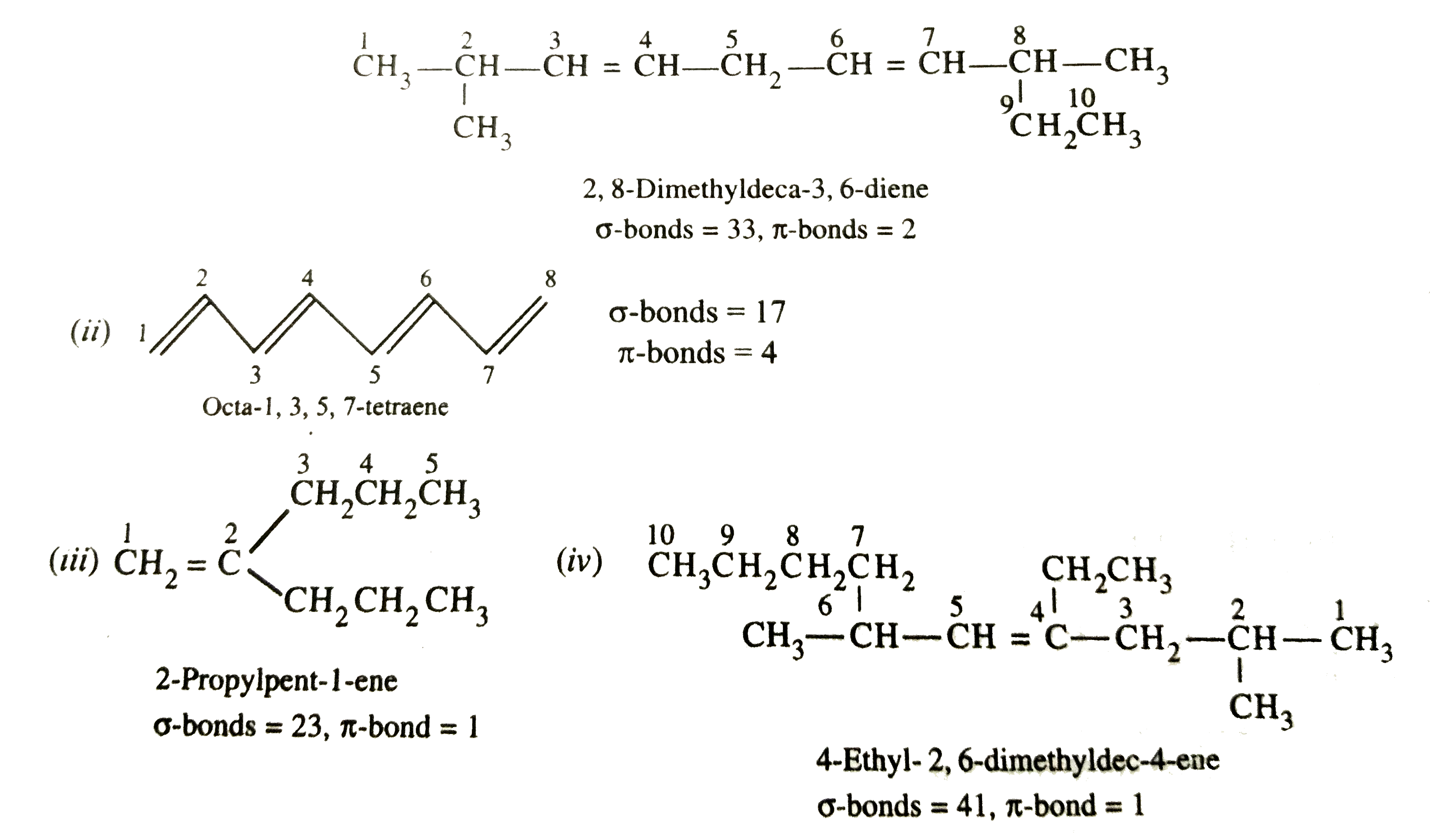
|
|
| 13. |
Calculate the number of sulphate ions in 100 mL of 0.001 M H_(2)SO_(4)solution. |
|
Answer» SOLUTION :No. Of moles = molarity `XX` volume in litres `=0.001 xx 0.1 = 0.0001` Now, 1 molecules of `H_(2)SO_(4)` contains 1 `SO_(4)^(2-)` ion. `therefore` 1 mole of `H_(2)SO_(4)` contains 1 mole of `SO_(4)^(2-)` `therefore 0.0001` mole of `H_(2)SO_(4)` contains 0.0001 mole of `SO_(4)^(2-)` `therefore` NUMBER of sulphate ions = moles of ions `xx` AV. const. `=0.0001 xx 6.022 xx 10^(23) = 6.022 xx 10^(19)` |
|
| 14. |
Calculate the number of rings present in C_(18 ) H_(12) |
|
Answer» SOLUTION :`C_(18 )H_(12)` doublebondequivalentformula `= ( c-(H)/(2)+(N)/(2) +1)` whenC= NOOF carbonatoms, H = noof HYDROGENAND halogenatomsand N = no . Ofnitrogenatoms soin ` C_(18 )H_(12)` doublebondequivalent `= 18 - (12)/(2)+0+1 =18-6+1 =13`  oneringisequalto onedoublebondequivalentare USED so remaining`,13 - 4=9` ninedoublebonsare presentin THERING hence` C_(18) H_(12)`containfouraromaticrings |
|
| 15. |
Calculate the numberof rigns present in C_(18)H_(12) |
|
Answer» Solution :DOUBLE bondequivalentformula `=(C-(H)/(2)+ (N )/(2) +1)` When`C= no`of carbonatoms H= noof HYDROGENAND halogenatomsand N= no .ofnitrogenatoms So in `C_(18) H_(12)` Doublebondequivalent `=18 (12)/(2)+ 0 + 1 -=18 -6+1=13`  Oneringis equalto onedoublebondequivalent. : Hencefourringsare therefourboubleequivalentare usedsoremaining13-4=9ninedoublebonsare presentin thering hence`C_(18) H_(12)` containfouraromaticrings . |
|
| 16. |
Calculate the number of protons, neutrons and electrons in ._(35)^(80)Br. |
|
Answer» Solution :Here, Z = 35, A = 80 `:.` No. of PROTONS = Atomic No. = 35 No. of NEUTRONS `= A - Z = 80 - 35 = 45` As the atom is neutral, No. of electrons = No. of protons = 35 |
|
| 17. |
Calculate the number of protons, neutrons and electrons in underset(35)overset(80)Br |
| Answer» Solution :For `UNDERSET(35)OVERSET(80)Br,Z=35,A=80`, species is neutral. Number of PROTONS = number of electrons =Z=35 Number of NEUTRONS = 80- 35 = 45 | |
| 18. |
Calculate the number of oxalic acid molecules in 100 mL of 0.02 N oxalic acid solution. |
|
Answer» No of molecules in ONE MOLAR solution `=6.02xx10^(23)` No. of molecules in 100 mL of 0.01 M oxalic acid solution `=(0.01xx6.02xx10^(23))/(1000)xx100=6.02xx10^(20)` |
|
| 19. |
Calculate the number of N atoms in 5.6 gm of Nitrogen gas. (N = 14 gm/mol) |
|
Answer» `1.2044xx10^(23)` Mole `= (5.6)/(28)=2` The no. of `N_(2)` ATOMS `= 0.2xx6.022xx10^(23)` `= 1.2044xx10^(23)` No. of N molecule `= 1.2044xx10^(23)xx2` `= 2.4088xx10^(23)` |
|
| 20. |
Calculate the number of moles present in 9g of ethane? |
|
Answer» Solution :Mass of ethane =9G MOLAR mass of ethane `C_2H_6=30 gmol^(-1)` No. of moles =`("Mass")/("Molar mass") =(9)/(30)=0.3 mol`. |
|
| 21. |
Calculate the number of moles present in 9 g of ethane Calculate the number of molecules of oxygen gas that occupies a volume of 224 ml at 273 K and 3 atm pressure. |
|
Answer» Solution :MASS of ethane = 9 G Molar mass of ethane `C_(2)H_(6)`= 30 g `mol^(-1)` . No. of moles = `("Mass")/("Molar mass") = 9/30 =`0.3 mol. Molar volume of oxygen = 22400 ML. 22400 ml of oxygen contains `6.023 xx 10^(23)` MOLECULES. `:.` 224 ml of oxygen contain `(6.023 xx10^(23))/222400 xx 224` at 1 atm.pressure For 3 atm.pressure = `(60.23x10^(23))/100 = 6.023 xx 10^(21)` molecules `xx` 3 = `18.069 xx 10^(21)` molecules (or) `1.8069 xx 10^(22)` molecules |
|
| 22. |
Calculate the number of moles of Sn^(2+)ion oxidise by 1 mole of K_(2)Cr_(2)O_7in acidic medium. |
|
Answer» `:.` 1 MOL of`K_(2)Cr_(2)O_7`will oxidise 3 mole of `Sn^(2+)` |
|
| 23. |
The number of moles of ethane in 60 g is |
|
Answer» Solution :NO. of moles = `("MASS of the substance")/("MOLAR mass of the substance") = W/M` Molar mass of ethane `(C_(2)H_(6))` = 24 + 6 = 30 `:.`Number of moles in 60 g of ethane =`60/30` = 2 moles |
|
| 24. |
Calculate the number of moles ofO_2 required to produce 240 g of Mgo by burning magnesium metal |
|
Answer» ' Solution :`2Mg+underset(1"mole")(O_2)tounderset(2(.24+16)=8002MgO)(2MgO)`Number of moles of `O_2` REQUIRED to produce 80 G MgO = 1 mole `therefore` Number of moles `O_2` required to produce 240g MgO = `1/80xx240=3` moles |
|
| 25. |
Calculate the number of moles of iron in a simple containing 1.0 xx 10^(22) atoms. |
|
Answer» |
|
| 26. |
Calculate the number of moles of hydrogen present in 500 cm^(3) of a gas under a pressure of 101.3kPA at a temperature of 300K. (R=8.314 J K^(-1) mol^(-1)). |
|
Answer» Solution :`n=?, V=500 cm^(3) =500x10^(-3) dm^(3)=0*5 dm^(3)` `T=300K` `PV= NRT or n=(PV)/(RT)=(101*3xx0*5)/(8*314xx300)=0*203 "MOL"` `:. n=0*0203` mol |
|
| 27. |
Calculate the number of moles of hydrogen gas at a pressure of 760 mm Hg and 27^(@)C |
|
Answer» SOLUTION :`PV=nRT,P= 1atm V=-500 cm^(3), N=/, R=82*1 atm cm^(-3) K^(-1) MOL^(-1) ,T=300 K` `n=(1 atm xx500 cm^(3))/((82*1 "atm" cm^(3) K^(-1) "mol.^(-1))xx(300K))=0.02mol` |
|
| 28. |
Calculate the number of moles of carbon atoms in three moles of ethane. |
|
Answer» Solution :Ethane - Molecular formula = `C_(2)H_(6)` 1 MOLE of ethane contains 2 atoms of CARBON `(6.023xx1O^(3)C)` `:.` 3 MOLES of ethane contains 6 atoms of Carbon. `:.` No. of moles of Carbon atoms = `3xx6.023xx10^(23)` Carbon atoms. `= 18.069xx10^(23)` Carbon atoms |
|
| 29. |
Calculate the number of moles and number of molecules in 4.4 g of CO_(2) . Also find its volume at N.T.P |
|
Answer» Solution :The molecular mass of `CO_(2)` `=12.01 + (2 xx 16.0) = 44.01 amu` Hence, the GRAM molecular mass of `CO_(2) = 44.01 g` `therefore` Number of moles = `("Mass in GRAMS")/("Gram molecular mass")` `therefore` Number of moles contained in `4.4 g` of `CO_(2)` `=4.4/(44.01) = 0.10` `therefore` One mole of a substance has `6.022 xx 10^(23)` molecules `therefore` Number of molecules in 0.10 mole of `CO_(2)` `=0.10 xx 6.022 xx 10^(23)` `=6.022 xx 10^(22)` Moreover, since one mole of a gas occupies 22.4 L at S.T.R, the volume occupied by 0.10 mole (4.4 g) of `CO_2 = 0.10 xx 22.4 = 2.24` LITRES. |
|
| 30. |
Calculate the number of molecules present in (a) 1 kg oxygen (b) 1 dm^(3) of hydrogen at N.T.P |
|
Answer» 1000.0 grams of oxygen have molecules `((1000.0g))/((32.0g))xx6.022xx10^(23)=1.88xx10^(25)` (B) `22.4 dm^(3)` of hydrogen at N.T.P have molecules `= 6.022 xx 10^(23)` `1.0 dm^(3)` of hydrogen at N.T.P have molecules `= (6.022)/(22.4)xx10^(23)=2.69xx10^(22)`. |
|
| 31. |
Calculate the number of molecules present in 34.2 g of can sugar [C_(12)H_(22)O_(11)]. |
|
Answer» 342.0 G of OXYGEN contain `= 6.022 xx 10^(23)` molecules 34.2 g of oxygen contain `= (34.2)/(342)xx6.022xx10^(23)=6.022xx10^(22)` molecules |
|
| 32. |
Calculate the number of molecules present in 1.12 xx 10^(-7)c.c. of a gas a STP. |
| Answer» SOLUTION :`3.01 XX 10^(12))` | |
| 33. |
Calculate the number of molecules persent in 1.12xx10^(-7) c.c. of a gas at STP (c.c.- cubic centimeters = cm^(3)). |
|
Answer» |
|
| 34. |
Calculate the number of molecules of oxalic acid (H_2C_2O_4) in 100 mL of 0.2 N oxalic acid |
|
Answer» |
|
| 35. |
Calculate the number of molecules in a drop of water weighing 0.048 g. |
|
Answer» SOLUTION :The GRAM molecular mass of water = 18.016 g. This mass CONTAINS `6.022 xx 10^(23)` molecules. Thenumberofmoleculescontainedin 0.048 g `=(6.022 xx 10^(23))/(18.016)xx 0.048 = 1.604 xx 10^(21)` Hence, one drop of water contains `1.604 xx 10^(21)`molecules. |
|
| 36. |
Calculate the number of molecules in a drop of water weighing 0.05 g. |
|
Answer» 0.05 g of `H_(2)O` contain molecules `= (0.05)/(18.0)xx6.022xx10^(23)=1.672xx10^(21)` molecules. |
|
| 37. |
Calculate the number of molecules in 11.2 litres of SO_(2)gas at NTP. |
|
Answer» Solution :No. Of MOLES of `SO_(2)=("vol. Of NTP (LITRES)")/("std. Molar VOLUME (litres)")` `=(11.2)/(22.4) = 0.5` No. Of molecules of `SO_(2)`= no. Of moles `XX` Av. CONST `=0.5 xx 6.022 xx 10^(23)` `=3.011 xx 10^(23)` |
|
| 38. |
Calculate the number of molecules and number of atoms present in 11.2 litres of oxygen (O_(2)) at N.T.P |
|
Answer» 11.2 litres of `O_(2)` at N.T.P contain `= (11.2)/(22.4)xx6.022 XX 10^(23)` molecules `= 3.01 xx 10^(23)` molecules `= 6.02 xx 10^(23)` ATOMS. |
|
| 39. |
Calculate the number of kJ of heat necessary to raise the temperature of 60.0 g of aluminium from 35°C to 55°C. Molar heat capacity of Al is 24 J "mol"^(-1) "K"^(-1) |
|
Answer» Solution :`q=n xx C xx Delta T` `= (60)/(27) xx 24 xx 20` `= 1066.77 " J" = 1.07" kJ"` |
|
| 40. |
Calculate the numberof kJ necessary to raise the temperature of 60.0 g of aluminium from 35 to 55^(@)C . Molar heat capacity of aluminium is24J mol^(-1)K^(-1). |
| Answer» Solution :`Q = n XX C xx DeltaT = ((60)/( 27) MOL) ( 24 J mol^(-1) K^(-1)) ( 55 - 35K) =1066 .7 J =1.07 kJ ` | |
| 41. |
Calculate the number of kJ of heat necessary to rise the temperature of 60.0 g of aluminum from 35^(@)C to 55^(@)C. Molar heat capacity of aluminum is 24 J mol^(-1)K^(-1). |
|
Answer» |
|
| 42. |
Calculate the number of isomers (structural) possible with molecular formula, C_5H_8 that decolourisesbromine water and gives white precipitate with Ammonical silver nitrate. |
|
Answer» |
|
| 43. |
Calculate the number of hydroxyl ions present in 100mL of pure water. |
| Answer» SOLUTION :`6 XX 10^(15)` | |
| 44. |
The no.of H_(3),O^(+) ions present in 10 ml of water at 25^(@)C is |
|
Answer» SOLUTION : For pure WATER at `25^@ C, [H^(+)] = [H_(3) O^(+)]= 1 xx 10^(-7) mol L^(-1)` 1000 ml of water has `10^(-7)` MOLE of `H_(3) O^(+)` `[H_3 O^(+) ]` in 10 ml of water `= (10^(-7) xx 10)/(1000 )= 10^(-9) ` mole But one mole of `H_3 O^(+)= 6 xx 10^(23)H^(+)` ions Numbers of `H_3 O^(+)` ions present in ten ml water `= 10 xx 6 xx 10^(23)= 6 xx 10^(14)`ions |
|
| 45. |
Calculate the number of gram molecules contained in the following masses. (i) 4.4 g of CO_(2) (ii) 36.0 g of H_(2)O (iii) 0.098 g of H_(2)SO_(4) |
|
Answer» Solution :(i) The MOLECULAR mass of `CO_(2)` `=12.01 + (2 xx 16.0) = 44.0 amu` `THEREFORE` No. of gram molecules in 4.4 g of `CO_(2) = 4.4/(44.0) = 0.1` (II) The molecular mass of `H_(2) O = (2 xx 1.008) + 16.0 = 18.016` amu Therefore, the NUMBER of gram molecules present in 36.0 g of `H_(2)O = (36.0)/(18.016) = 2.0` (iii) The molecular mass of `H_(2)SO_(4)` `=(2 xx 1.008) + 32.0 + (4 xx 16.0) = 98.016` amu Hence, the number of gram molecules present in 0.098 g of `H_(2)SO_(4) = 0.098/(98.016)= 1.0 xx 10^(-3)` |
|
| 46. |
Calculate the number of gram atoms present in the following masses. (i) 12.69 g of hydrogen,(ii) 40.089 g of calcium (Given, atomic mass of H = 1.008 amu and atomic mass of Ca = 40.08 amu) |
|
Answer» Solution :(i) Number of gram ATOMS of HYDROGEN `=("MASS in GRAMS")/("Gram atomic mass")` `=12.69/1.008 = 12.59` (ii) Similarly, Number of gram atoms of calcium `=(40.08)/(40.08) = 1.000` |
|
| 47. |
Calculate the number of moles and number of gram molecules contained in 56 g of N_2. |
|
Answer» |
|
| 48. |
Calculate the number of gold atoms present in 0.450 g of a gold ring made from 22 carat gold. Given that the atomic mass of gold is 197 and pure gold is 24 carats. |
|
Answer» Solution :22 carat gold means 22 parts by weight of pure gold are PRESENT in 24 parts of the sample. Pure gold present in 0.450 g of gold ring. `=22/24 xx 0.450 = 0.412 g` Gram atomic MASS of gold = 197.0 g This mass contains `6.022 xx 10^(23)` ATOMS `therefore` Number of gold present in `0.412` g of pure gold `=(6.022 xx 10^(23))/(197.0)xx 0.412 =1.26 xx 10^(21)` Hence, the given gold ring contains `1.26 xx 10^(21)`atoms of gold. |
|
| 49. |
Calculate the number of electrons which will together weigh one gram? |
| Answer» Solution :Mass of one ELECTRON `=9.1xx10^(-31)kg=9.1xx10^(-28)gtherefore`Number of ELECTRONS having weight `1g=1/(9.1xx10^(-28))=1.099xx10^27` | |