

Saved Bookmarks
This section includes 7 InterviewSolutions, each offering curated multiple-choice questions to sharpen your Current Affairs knowledge and support exam preparation. Choose a topic below to get started.
| 2. |
Calculate the number of electrons, protons and neutrons in (ii) Phosphate ion. |
|
Answer» Solution :PHOSPHATE ION : `(PO_4^(3-))` Number of electron = `15 + 4 xx8 + 3 = 50` Number of protons = `15 + 4 xx 8 = 47` Number of neutrons = `10 + 4 xx 8 = 48`. |
|
| 3. |
Calculate the number of electrons lost in the following change : Fe + H_(2)O rarr Fe_(3)O_(4)+H_2 |
|
Answer» `([(H^(+))_(2)rarr(H^(0))_(2)+2E]xx4)/(3Fe+4H_(2)OrarrFe_(3)O_(4)+4H_2)` `:.` Lost electron = 8 |
|
| 5. |
Calculate the number of coulombs required to deposit 5.4gof Al when the electrode reaction is : Al^(3+) +3e^(-) to Al[Atomic weight of Al = 27 g/mol] |
|
Answer» |
|
| 6. |
Calculate the number of calories of energy released when 1 L of HCI is formed at 1 atm and 25^(@)C. The dissociation energies of gaseous H_(2),Cl_(2) and HCl are respectively 104, 58 and 103 K cal mol^(-1). |
|
Answer» |
|
| 7. |
Calculate the number of Ba^(2+) ions and Cl^(-) ions present in 104.1 g of anhydrous BaCl_2. |
|
Answer» |
|
| 8. |
Calculate the number of bond pairs and lone pairs in Icl_(4)^(-). |
|
Answer» Solution :No. of valence ELECTRONS in `I = 7` Out of 7,4 electrons are bonded to four `Cl^(-)` ATOMS. ` :. ` It has 4- bond pairs No. of LONE pairs = Valence electrons - Bond pairs ` = 7 - 4 = 3` No. of lone pair ` = 3 + 1` (charge on Cl) = 4 electrons or 2 lone pairs |
|
| 9. |
Calculate the number of atoms present in 5.6 litres of a (i) monoatomic, and (ii) diatomic gas at NTP. |
|
Answer» Solution :No. of MOLES of the GAS at NTP = `5.6/(22.4) = 1/4` `therefore` no. Of MOLECULES of the gas `=1/4 xx 6.022 xx 10^(23)` `=1.5 xx 10^(23)` no. of molecules of the gas `=1/4 xx 6.022 xx 10^(23)` `=1.5 xx 10^(23)` Now, if the gas is monoatomic, the no. of atoms of the gas = no. of molecules `=1.5 xx 10^(23)` And if the gas is diatomic, no. of atoms `=2 xx` no. of molecules `=2 xx 1.5xx 10^(23)` `=3.0 xx 10^(23)` |
|
| 10. |
Calculate the number of atoms present in 1 Kg of gold. |
|
Answer» Solution :The atomic MASS of Gold = 197 g `MOL^(-1)` 197 g of gold contains `6.023xx10^(23)` ATOMS of gold. `:.` 1000 g of gold will contain = `(1 000xx6.023xx10^(23))/197` = `3.055xx10^(24)` atoms of Gold |
|
| 11. |
Calculate the number of atoms of hydrogen, oxygen and sulphur in 0.2 mole of sulphuric acid (H_(2)SO_(4)) |
|
Answer» |
|
| 12. |
Calculate the number of atoms in each of the following : (i) 52 moles of He (ii) 52 amu of He (iii) 52 grams of He. |
|
Answer» Solution :(i) HELIUM is monoatomic in nature. One mole of any substance has `6.022 XX 10^(23)`molecules. .Number of molecules in 52 moles of He `=52 xx 6.022 xx 10^(23) = 3.131 xx 10^(25)` SINCE, helium is monoatomic, i.e., its one molecule is composed of one ATOM, the number of atoms present in 52 moles of He = `3.131 xx 10^(25)` . Hence, 52 moles of He contain `3.131 xx 10^(25)`atoms. (ii) The atomic mass of He is 4.003 amu. This means that the mass of one atom of He is 4.003 amu. `therefore` Number of atoms contained in 52 amu of He `=52/(4.003) = 12.99 = 13` Hence, 52 amu of He contain 13 atoms. (iii) The gram atomic mass of He = 4.003 g.This means that 4.003 g of He contain `6.022 xx 10^23` atoms. `therefore` Number of atoms present in 52 g of He `=(6.022 xx 10^(23))/(4.003)xx 52 = 7.823 xx 10^(24)` Hence, 52 g of He possesx `7.832 xx 10^(24)` atoms. |
|
| 13. |
Calculate the number of atoms in each of the following (i) 52 moles of Ar (ii) 52 u of He (iii) 52 g of He. |
|
Answer» Solution :(i) 1 mole of Ar = `6.022 xx 10^(23)` atoms `therefore 52` moles of Ar `=52 xx 6.022 xx 10^(23) = 3.131 xx 10^(25)` atoms of Ar. (ii) 4U of He = 1 atom of He. `therefore 52 u` of He `=52/4 = 13` atoms of He (III) 1 mole of He, i.e., 4 g of He contain `6.022 xx 10^(23)` atoms `therefore` No. of He atoms in 52 g of `He = (6.022 xx 10^(23))/4xx 52 = 7.8286 xx 10^(24)` |
|
| 14. |
Calculate the number of atoms in each of the following : (i) 52 moles of Ar(ii) 52 u of He (iii) 52 g of He |
|
Answer» 52 mole Ar `=52 xx 6.022 xx 10^(23)` atoms `=3.131xx10^(25)` atoms (ii) 4 u He `=` 1 He atom 52 u He `= (52)/(4) = 13` He atoms `=3.131 xx 10^(25)` atoms (ii) 4 u He `=` 1 He atom 52 u He `=(52)/(4) = 13` He atoms (iii) 1 mole He molecule `=4 g = 6.022 xx 10^(23)` atoms 52 gm He `=(52xx6.022xx10^(23))/(4)` atoms `=7.8286xx10^(24)` atoms |
|
| 15. |
Calculate the number of atoms in a cubic based unit cell having one atom on each corner and two atoms on each body diagonal. |
|
Answer» hence, total atoms/unit cell =8+1=9 |
|
| 16. |
Calculate the number of angular nodes and radial nodes present in 3d and 4f orbitals. |
|
Answer» SOLUTION :Number of angular nodes in 3d ORBITALS=? Number of RADIAL nodes in 3d orbitals=? Number of angular nodes=l Number of radial nodes=n-l-1 for 3d ORBITAL: Number of angular nodes=2beacausel=2 Number of radial nodes=3-2-1=0 `:.`TOTAL number of nodes in 3d orbital=2 For 4f orbital: Number of angular nodes=3 because l=3 Number of radial nodes=n-l-1-=4-3-1=0 `:.`Total number of nodes in 4f orbital=3 |
|
| 17. |
Calculate the nuber of KJ of heat necessary to raise the temperatures of 60g of Al from 35^@C to55^@C. Molar heat capacity of Al is 24 J mol^-1K^-1 |
| Answer» SOLUTION :`q=nCDeltaT=60/27xx24(55-35)J=1066.7 J=1.0667KJ=1.07kJ` | |
| 18. |
Calculate the number atoms of oxygen present in 88 g of CO_(2) ? What would be the weight of CO having the same number of oxygen atoms ? |
|
Answer» Solution :44.0 GRAMS of `CO_(2)` CONTAIN OXYGEN ATOMS `= 2 xx 6.022 xx 10^(23)` atoms 88.0 grams of `CO_(2)` contain oxygen atoms `= 2 xx 2 xx 6.022 xx 10^(23) = 2.41 xx 10^(24)` atoms `6.022 xx 10^(23)` atoms of oxygen are PRESENT in `CO = 28.0g` `2.41 xx 10^(24)` atoms of oxygen are present in `CO=(28.0xx2.41xx10^(24))/(6.022xx10^(23))=112.0g`. |
|
| 19. |
Calculate the normality of solution containing 3.15 g of hydrated oxalic acid (H_2C_2O_4. 2H_2O) in 250 ml of solution ( Mol. Mass = 126). |
|
Answer» SOLUTION :Mass of oxalic acid = 3.15 g Equivalent mass of oxalic acid `=( " Mol. mass ")/(" Basicity")` `=(126)/(2)= 63` g `"EQUIV"^(-1)` Equivalent of oxalic acid `=(" Mass of solute ")/( "Eq. Mass ")` `(3.15 g)/( 63 g " equiv"^(-1))= 0.05 " equiv"^(-1)` VOLUME of solution = 250 ml `= (250 )/(1000)L = 0.25 L` Normality =`("Equivalent of solute")/("Volume of solutionin L ")` `=(0.05 "equiv")/(0.25L)= 0.2 N` |
|
| 20. |
Calculate the normality and molarity of H_2SO_4 solution containing 4.9 g of H_2SO_4 per litre of the solution. |
|
Answer» |
|
| 22. |
Calculate the normality of 20 volume hydrogen peroxide solution. |
|
Answer» Solution :Step 1. To calculate the STRENGTH in g/l of 20 VOLUME `H_(2)O_(2)` solution. By definition, 1 litre of 20 volume `H_(2)O_(2)` solution on decomposition gives 20 litres of oxygen at N.T.P. Consider the chemical equation, `underset(2xx34=68 g)(2H_(2)O_(2)) to 2H_(2)O + underset(22.4 " Litres at N.T.P.")(O_(2))` Now 22.4 litres of `O_(2)` at N.T.P. will be obtained from `H_(2)O_(2)` =68 g `therefore `20 litres of `O_(2)` at N.T.P. will be obtained from `H_(2)O_(2)=(68xx20)/(22.4)=60.7 g` Thus, the strength of 20 volume of ` H_(2)O_(2)` solution =60.7 g/l Step 2. To calculate the equivalent weight of `H_(2)O_(2)`. Consider the chemical equation `underset(68 "parts of weight")(2H_(2)O_(2))to 2H_(2)O + underset("32 parts by weight")(O_(2))` From the above equation, 32 parts by wt. of oxygen are obtained from 68 parts by wt. of `H_(2)O_(2)`. `therefore ` 8 parts by wt. of oxygen will be obtained from `(68)/(32)xx8=17` parts by wt. of `H_(2)O_(2) therefore ` EQ. wt. of `H_(2)O_(2)=17` Step 3. To calculate the normality of 20 volume `H_(2)O_(2)` solution. Now we know that , Normality =`("Strength")/(Eq. wt.)=(60.7)/(17)=3.57` Hence , the normality of 20 volume `H_(2)O_(2)` solution =3.57 N |
|
| 23. |
Calculate the no. of moles of Ethane required to produce 44 g of CO_(2(g)) after combustion . |
|
Answer» Solution :Balanced equation for the combustion of ETHANE ` C_(2) H_(6) +(7)/(2) O_(2) to 2 CO_(2) + 3H_(2)O` `rArr 2C_(2)H_(6) + 7O_(2) to 4CO_(2) + 6H_(2) O` To produce 4 moles of `CO_(2)`, 2moles of ethane is required `:.`To produce 1 MOLE (44g) of `CO_(2)`required NUMBER of moles of ethane ` = (2 "mol ethane")/(4cancel(molCO_(2)))xx 1 cancel(molCO_(2))` ` = (1)/(2)` mole of ethane` 0 . 5 `mole of ethane. |
|
| 24. |
Calculate the most probable velocity of nitrogen molecules at 15^@C. |
|
Answer» Solution :The most PROBABLE velocity `(alpha)` is given by `alpha = sqrt((2RT)/M)` In the PRESENT CASE , `T=15+273=288 K, M=28` `R=8.31xx10^7 " ergs " K^(_1) mol^(-1)` `:. "" alpha = sqrt((2xx8.31xx10^7xx288)/28) = 4.135xx10^4 "cm " s^(-1)` Hence, the most probable velocity of nitrogen molecules at `15^@C " is " 4.135xx10^4 " cm " s^(-1)`. |
|
| 25. |
Calculate the momentum of the electron if it is moving with 1/3rd of the velocity of light. |
|
Answer» Solution :Mass of the moving electron `(m') = (m_("rest"))/(SQRT(1 - ((v)/(c))^(2))` Putting `v = (c)/(3)` `m' = (m)/(sqrt(1 ((c)/(3c))^(2))) = (m)/(sqrt(1 - ((1)/(3))^(2))) = (3m)/(sqrt8)` Momentum `= m'v = (3m)/(sqrt8) xx (c)/(3) =(mc)/(sqrt8) = ((9.11 xx 10^(-31)kg) (3 xx 10^(10) ms^(-1)))/(2.828) = 9.66 xx 10^(-21) kg m s^(-1)` |
|
| 26. |
Calculate the momentum of a particle which has a de Brglie wavelength of 1 Å or 0.1 nm. (h = 6.6 xx 10^(-34) kg m^(2) s^(-1)) |
|
Answer» |
|
| 27. |
Calculate the moles of BaSO_(4) obtained in each case if excess of BaCl_(2) is reacted with : (a) H_(2)SO_(4) solution produced from collecting only SO_(3) present in 100 gm of 104.5 % oleum and reacted with excess of water (b) only H_(2)SO_(4) taken from 100 g 104.5 % oleum (c) H_(2)SO_(4) solution obtained when 4.5 gm water is added to 100 gm oleum labelled as 104.5 % Write the nearest integral value of (a)+(b)+(c). |
|
Answer» |
|
| 28. |
Calculate the moles of an ideal gas at pressure 2 atm and volume 1 L at a temperature of 97.5 K |
|
Answer» `1` |
|
| 29. |
Calculate the molecular masses of the given substances. (i) HCl, (ii) HNO_(3), (iii) H_(3)PO_(4) |
|
Answer» |
|
| 30. |
Calculate the molar mass of the following: (i) H_(2)O (ii) CO_(2)(iii) CH_(4) |
|
Answer» Solution :(i) MOLECULAR MASS of `H_(2)O = (2 XX 1.008) + (16.00) = 18.016 amu` (ii) Molecular mass of `CO_(2) = 12.01 + (2 xx 16.00) = 44.01 amu` Molecular mass of `CH_(4) = 12.01 + (4 xx 1.008)=16.042` amu |
|
| 31. |
Calculate the molecular mass of the following : (i) H_(2)O (ii) CO_(2) (iii) CH_(4) |
|
Answer» Solution :STEP I. Calculation of SIMPLEST whole number ratios of the elements `{:("Element","Percentage","ATOMIC mass","Gram atoms (Moles)","Atomic ratio (Molar ratio)","Simplest whole no. ratio"),("Fe",69.9,56,(69.9)/(56)=1.25,(1.25)/(1.25)=1,.2),("O",30.1,16,(30.1)/(16)=1.88,(1.88)/(1.25)=1.5or 3//2,3):}` The simplest whole number ratios of the different elementsd are `:Fe :O : : 2 : 3` Step II. Writing the empirical formula of the compound The empirical formula of the compound `= Fe_(2)O_(3)` |
|
| 32. |
Relativemolarcularmass of sulphuricacidis_______. |
Answer» SOLUTION :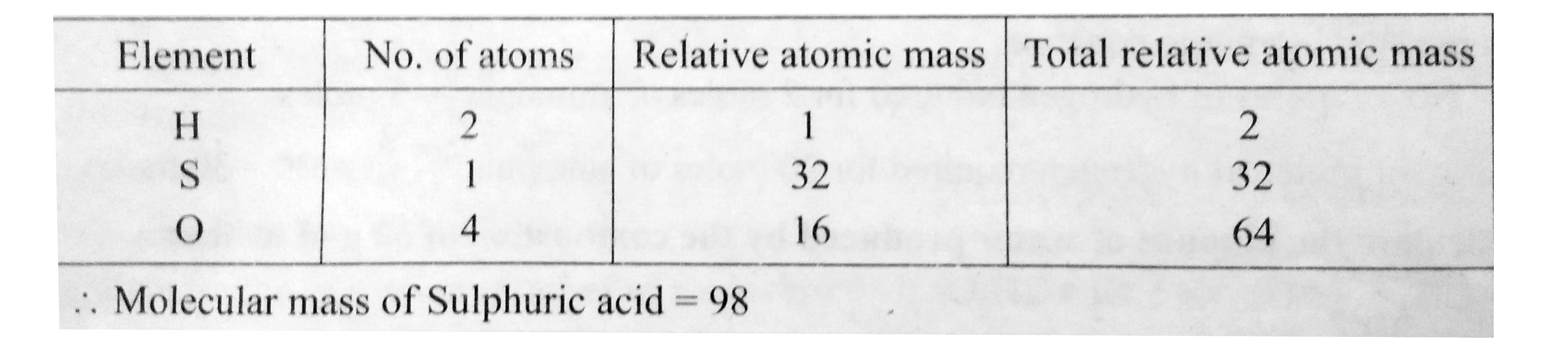
|
|
| 34. |
Calculate the mole ratio in which salt and acid are to be mixed in order to get a buffer solution of 5? [pK_(a) of acid = 4]. |
|
Answer» SOLUTION :Henderson's EQUATION `pH=pK_(a)+"log"(["SALT"])/(["ACID"])` `5=4+"log"(["Salt"])/(["Acid"])` `1="log"(["Salt"])/(["Acid"])` `1="log"10/1` |
|
| 35. |
Calculate the mole coefficient of H^(+) in the balanced equation. IO_(3)^(-)+IH^(+)overset(OH^(-))rarrI_(2)+H_(2)O. |
|
Answer» SOLUTION :The balanced equation is `IO_(3)^(-)+5I^(-)+6H^(+) overset(OH^(-))to 3I_(2)+3H_(2)O` MOLE COEFFICIENT of `H^(+)=6` |
|
| 36. |
Calculate the mole fraction of water in a mixture of 12 g of water, 108 g of acetic acid and 92 g of ethyl alcohol. |
|
Answer» |
|
| 37. |
Calculate the mole fraction of lower alcohol in a mixture of 92g C_(2)H_(5)OH and 32g of CH_(3)OH? |
|
Answer» |
|
| 38. |
Calculate the mole fraction of glucose in 10% aqueou solution. |
|
Answer» SOLUTION :100g pf soution =10g glucose + 90g water Number of moles of GULCOSE `=(10)/(180)=(1)/(18)` Number of moles of water `=(90)/(18)=5` Mole fraction of glucose `=X_("SOLUTE")=((1//18))/((1//18)+(90//18))=(1)/(91)=0.01099` |
|
| 39. |
Calculate the mole fraction of ethyl alcohol and water in a solution in which 46 g of ethyl alcohol and 180 g of water are mixed together. |
|
Answer» |
|
| 40. |
Calculate the mole fraction of Ethanol (C_(2)H_(5)OH) in the solution containing 20 g of Ethanol and 100 g of water. |
|
Answer» Solution :Weight of ETHANOL `=20g` Weight of water `=100G` Molecular MASS of `C_(2)H_(5)-OH=-46` No of moles of ethanol `=20/46=0.4348` moles `n_(8)=` NO. of moles of water `=100/18=5.555` moles `X_(A)=` Mole fraction of ethanol `=(n_(A))/(n_(A)+n_(a))=0.4348/(0.4348+5.555)=0.4348/5.9898` `X_(A)=0.07259` |
|
| 41. |
Calculate the mole fraction of benzene is solution containing 30% by mass in carbon tetrachloride. |
|
Answer» Solution :`30%` of beneze in carbon tetrachloride by mass means that Mass of benzene in the solution = 30 g Mass of solution = 100 g `therefore` Mass of carbon tetrachloride `= 100g - 30G = 70g` Molar mass of benzene `(C_(6) H _(6)) = 78 mol^(-1)` Molar mass of `C Cl_(4) = 12 +(4 xx 35.5) = 154 g mol^(-1)` `therefore` No. of moles of benzene `= ("Mass")/("Molar mass") = (30g)/(78 mol ^(-1)) = 0.385` No. of moles of `C Cl _(4) = ("Mass")/("Molar mass") = (70g)/(154 g mol ^(-1)) =0.455` Mole fraction of benzene `= ("Moles of benzene")/("Total moles in the solution")` `= (0.385)/(0.385 + 0.455) = (0.385)/(0.84) = 0.458` Mole fraction of `C Cl_(4) =1- 0.458 =0.542` |
|
| 42. |
Calculate the mole fraction of benzene and naphthalene in the vapour phase when an ideal liquid solutionis formed by mixing 128 g of naphthalene with 39 g of benzene. It is given that the vapour pressure of pure benzene is 50.71 mm Hg and the vapour pressure of pure naphthalene is 32.06 mm Hg at 300 K. |
|
Answer» Solution :`P_("PURE BENZENE") ^(@) = 50.71 mm Hg` ` P _("nephtalene") ^(@)=32.06 mm Hg` Number of moles of benzene `=(39)/(78) =0.5 mol` Number of moles of naphthalene `= (128)/(128) =1 `mol MOLE fraction of benene `= (0.5)/(1.5) =0.33` Mole fraction of naphthalene `=1 -0.33 = 0.67` Partial vapour pressure of benzene `= P _(benzene")^(@) XX` Mole fraction of benzene `=50.71 xx 0.33 =16.73 `mm Hg Partial vapour pressure of naphthalene `= 32. 06 xx 0.67 = 21. 48 mm Hg` mole fraction of benzene in vapour PHASE `= (16.73)/(16.73 + 21. 48) = (16.73)/(38.21) = 0.44` Mole fraction of naphthalene in vapour phase `=1 -0.44 =0.56` |
|
| 43. |
Calculate the molarity strength of H_(2)O_(2) solution marked '30 volume'. |
| Answer» SOLUTION :MOLARITY =VOLUME strength/11.2`=(30)/(11.2)=2.68 M`. | |
| 44. |
Calculate the molarity of sulphuric acid solution in which mole fraction water is 0.85. |
|
Answer» Let `n_(B)` moles of `H_(2)SO_(4)` be dissolved in 1000 g of water to represent the molality of the solution `:.` No. of moles of water `(n_(A))=((1000G))/(("18 g mol"^(-1)))=55.55` mol No. of moles of `H_(2)SO_(4)=n_(B)` `(n_(B))/(n_(A)+n_(B))=0.15or(n_(B))/(n_(B)+55.55)=0.15` `n_(B)=0.15 n_(B)+55.5xx0.15or` `n_(B)=(55.5xx0.15)/(0.85)=9.8`. |
|
| 45. |
Calculate the molarity of pure water at room temperature if its density is 0.998 g cm^(-3) |
|
Answer» Solution :MASS of `1000 cm^(3)`of pure WATER = Density `xx` Volume `=0.998 xx 1000 = 998 g` MOLECULAR Mass of water `=2+16 = 18` `therefore` NUMBER of moles of water present in `1000 cm^(3)` `=998/18 = 55.44` Hence, the molarity of pure water at room temperature is 55.44 M. |
|
| 46. |
Calculate the molarity of each of the following solutions: |
|
Answer» Solution :(a) 30 g of `Co (NO_(3)) _(2). 6H_(2) O ` in `4.3L` of solution (b) 30 mL of `0.5 M H _(2) SO _(4)` diluted to 500 mL. (a) Molar mass of `Co(NO _(3))_(2). 6H_(2)O = 58.7 + (14 + 48) + (6 xx 18) g mol ^(-1)` `= 58.7 + 124 + 108 mol ^(-1) = 290.7 g mol ^(-1)` No. of moles of `Co(NO_(3)) _(2). 6H_(2)O = ("Mass")/("Molar mass") = (30g)/(290. 7 g mol ^(-1)) = 0.103` Volume of solution `= 4.3 L` `therefore` Molarity of solution `= ("No.of moles of solute")/("Volume of solution in L")` `= (0.103 "mole")/(4.31)= 0.024 M` (b) 1000 mL of `0.5 M H_(2) SO_(4)` Contain `H_(2) SO_(4) =0.5` moles `therefore 30 mL` of `0.5 M H _(2) SO _(4)` contain `H_(2) SO _(4)= (0.5)/(1000)_ xx 30` mole `00.015 ` mole Volume of solution `= 500 mL = 0.500 L` `therefore` Molarity of solution `= ("No. of moles of solute")/("Volume of solution in L") = (0.015)/(0.5) =0.03 M` |
|
| 47. |
Calculate the molarity of a solution of ethanol in water, in which the mole fraction of ethanol is 0.040 (assume the density of water to be one). |
|
Answer» SOLUTION :Number of moles in 1 L of WATER = `1000/18 = 55.55` Assuming the given solution to be dilute, we have in 1 L of solution, Mole fraction of ETHANOL `=("No. of moles of ethanol")/("No. of moles of ethanol + No. of moles of water.)` or `0.040 = ("No. of moles of ethanol")/("No. of moles of ethanol" + 55.55")` `=(55.55 xx 0.040)/(1-0.040)= 2.314` Thus, 2.314 moles of ethanol are present in 1 L solution. Hence, MOLARITY of the given solution = 2.314 M. |
|
| 48. |
Calculate the molarity of a solution of ethanol in water in which the mole fraction of ethanol is 0.040. ( assume the density of water to be one). |
|
Answer» MOLE of `H_(2)O` in 1 litre `=(1000g)/(18) = 55.55` mole For BINARY solution, `X_(1)+X_(2)=1` `X_(H_(2)O) = 1 - X_(C_(2)H_(5)OH)` `X_(H_(2)O)=1-0.040=0.96` `X_(H_(2)O)=(n_(H_(2)O))/(n_(H_(2)O)+n_(C_(2)H_(5)OH))` `0.96=(55.55)/(55.55+n_(C_(2)H_(5)OH))` `53.328 + 0.96 n_(C_(2)H_(5)OH)=55.55` `n_(C_(2)H_(5)OH)=(2.222)/(0.96) = 2.3145` mole In 1 L solution 2.3145 mole `=2.3145` |
|
| 49. |
Calculate the molarity of a solution obtained by mixing 100 mL of 0.3 M H_2 SO_4 and 200 mL of 1.5M H_2 SO_4 |
|
Answer» |
|
| 50. |
Calculate the molarity of a solution containing 2.3 moles of solute dissolved in 4.6 litres. |
|
Answer» 0.5 |
|