

Saved Bookmarks
This section includes 7 InterviewSolutions, each offering curated multiple-choice questions to sharpen your Current Affairs knowledge and support exam preparation. Choose a topic below to get started.
| 1. |
Calculate the molarity, molality and mole fraction of ethyl alcohol in a solution of total volume 95 mL prepared by adding 50 mL of ethyl alcohol (density = 0.789 mL^(-1)) to 50 mL water (density = 1.00 g mL^(-1)). |
|
Answer» SOLUTION :No. of moles of ethyl ALCOHOL `= ("Vol." xx"density")/("Mol. MASS")` `= (50xx0.789)/(46)=0.8576` No. of moles of water `= ("Vol."xx"density")/("Mol. mass")=(50xx1)/(18)=2.7777` Molarity `= ("No. of moles")/("Vol. of sol. in mL")xx1000` `=(0.8576)/(95)xx1000=9.027M` Molarity `= ("No. of moles of solute")/("Mass of SOLVENT in grams")xx1000` `=(0.8576)/(50)xx1000=17.152m` Mole fraction `= (0.8576)/(0.8576+2.7777)=(0.8576)/(3.6353)=0.236`. |
|
| 2. |
Calculate the molar volume of the following : (d ) 3.0115xx10^23 molecules of SO_2 gas . |
|
Answer» Solution :`6.023xx10^(23)` MOLECULES =1 mole `3.0115 xx10^(23)` molecules `=(1)/(6.023xx CANCEL (10^(23)))xx3.0115xx 10^(cancel 23)=0.5` moles. Molar VOLUME of 1 mole of `SO_2 =2.24 xx10^(-2)m^3` Molar volume of 0.5 moles of `SO_2=2.24xx10^(-2)xx0.5` `=1.12xx10^(-2)m^3`. |
|
| 3. |
Calculate the molar volume of a gas at STP. |
|
Answer» |
|
| 4. |
Calculate the molar volume of 146 g of HC1 gas and the number of molecules present in it. |
|
Answer» Solution :MOLAR mass of HCl = 36.5 g The molar volume of 36.5 g (1 mole) of HCl = `2.24xx10^(-2)m^(3)` `:.` The volume of 146 g (4 moles) of HCl = `(2.24xx10^(-2))/36.5 xx 146` = `8.96xxl0^(-2)m^(3)` No. of molecules in 146 g of HCl = 4 N = 4 `xx` Avogadro Number = `4 xx 6.023 xx 10^(23)` = `24.092 xx 10^(23)` = `2.4092 xx 10^(24)` molecules. |
|
| 5. |
Calculate the molar solubility of Ni(OH)_2 in 0.10 M NaOH. The ionic product of Ni(OH)_2 is 2.0xx10^(-15) . |
|
Answer» Solution :0.1 M NaOH is STRONG base , so COMPLETE ionised Thus NaOH `to Na_((aq))^(+) + OH_((aq))^(-)` `therefore [NaOH]=[OH^-]=0.1`M , NaOH Suppose solubility of `Ni(OH)_2 ="S mol L"^(-1)` So, At equilibrium in this salt `[Ni^(2+)] = "S mol L"^(-1)` `[OH^-] = "2 S mol L"^(-1)` produce `{:(Ni(OH)_(2(s)) hArr, Ni_((aq))^(2+) + , 2OH_((aq))^(-)),("At equilibrium ", SM , 2SM):}` CONCENTRATION So, total `[OH^-]`=(0.1+2S)M (ADDITION of `HO^-`of NaOH and `Ni(OH)_2` ) but the VALUE of S is much less , So ineligible in compare to 0.1 in solution. `[OH^-]=(0.1 +2S) approx "0.1 mol L"^(-1)` `K_(sp) =[Ni^(2+)] [OH^-]^2 = 2xx10^(-15)` `therefore (S)(0.1)^2 =2xx10^(-15)` `therefore S=2.0 xx 10^(-13) "mol L"^(-1) = [Ni^(2+)]` |
|
| 6. |
Calculate the molar solubility of Ni(OH)_(2)" in " 0.10mNaOH . The ionic product of Ni(OH)_(2)" is " 2.0 xx 10^(-15). |
|
Answer» |
|
| 7. |
Calculate the molar solubility of Ni (OH)_(2) in 0.10 M NaOH. The ionic product of Ni(OH)_(2) and 2.0xx10^(-15). |
|
Answer» `Ni(OH)_(2)` in the solution dissociates as :`Ni(OH)_(2) hArr Ni^(2+)+2OH^(-)`. Thus, s mol `L^(-1)` of `Ni(OH)_(2)` in the solution gives s mol `L^(-1) ` of `Ni^(2+)` ion and 2 s mol `L^(-1)` of `OH^(-)` IONS. But `OH^(-)` ions are also PRODUCED from NaOH . As NaOH dissociates completely , `OH^(-)` from NaOH = 0.1 M . HENCE, `[Ni^(2+)]=s "mol" L^(-1) and [OH^(-)]=2 s + 0.1 "mol " L^(-1) ~~ 0.1 "mol" L^(-1)` (`:'` 2sisvery small compared to 0.1 ) `K_(sp) ` of `Ni(OH)_(2) = [Ni^(2+)][OH^(-)]^(2)` `:. s (0.1)^(2) = 2.0 XX 10^(-15 ) or s = 2.0 xx 10^(-13) "mol" L^(-1)` |
|
| 8. |
Calculate the molar mass of the following compounds. (i)Urea |CO(NH_(2) )_(2)| (ii) Acetone |CH_(3)COCH_(3)| (iii) Boric acid |H_(3)BO_(3)| (iv) Sulphuric acid |H_(2) SO_(4)| |
|
Answer» Solution :(i) Urea`[CO(NH_(2)]` Atomic MASS of C=12 Atomic mass of O=16 Atomic mass of 2(N)=28 Atomic mass o f4(H)=4 `:.` Molar mass of Urea=60 (ii) Acetone`[CH_(3)COCH_(3)]` Atomic mass of 3( C)=36 Atomic mass of 1(O)=16 Atomic mass of 6(H)=6 `:.` Molar mass of Acetone=58 (iii) BOric acisd `[H_(3)BO_(3)]` Atomic mass of B=10 Atomic mass of 3(H)=3 Atomic mass of 3(O)=48 `:.` Molar mass of Boric acid=61 (iv) Sulphuric acid `[H_(2)SO_(4)]` Atmic mass of 2(H)=2 Atomic mass of 1(S)=32 Atomic mass of 4(O)=64 `:.` Molar mass of SUlphuric acid =98 |
|
| 9. |
Calculate the molar mass of the following : (i) H_(2)O (ii) CO_(2) (iii) CH_(4) |
|
Answer» Molar mass of `H=1.0079 u` Molar mass of `O=16.00u` Molar mass of `C=12.01 u` (i) Molar mass of `H_(2)O = 2 xx "atomic mass of H" + 1 xx "atomic mass of O"` `=2xx1.0079 u + 1 xx 10.00u` `=18.0158u` (ii) Molar mass of `CO_(2) = 1 xx "atomic mass of C" + 2 xx "atomic mass of O"` `= 1 xx 12.01 u + 2 xx 16.00 u` `= 44.01u` Molar mass of `CH_(4) = 1 xx "atomic mass of C" + 4 xx "atomic mass of H" ` `= 1 xx 12.01u + 4 xx 1.0079u` `=16.0416u` |
|
| 10. |
Calculate the molar mass of glucose. |
|
Answer» |
|
| 11. |
Calculate the molar mass of 20 L of gas weighing 23.2 g at STP. |
|
Answer» Solution :Molar MASS = `(" Weight of the substance X Molar VOLUME")/("Volume of the substance at STP")` Molar volume at STP = `2.24 xx 10^(2)m^(3)` = 22.4 L (or) 22400 cc. Molar mass of the GAS at STP = `(23.2xx22.4)/20 ` = 25.984 g . |
|
| 12. |
Calculate the molality of an aqueous solution containing 3.0g of urea (mol.mass=60) in 250g of water. |
|
Answer» SOLUTION :Mass of solute= 3.0 g Moles of solute `=( " Mass of solute ")/(" Molar mass ")` ` = (3.0g )/( 60 g " mol "^(-1))`= 0.05 mol Mass of Solvent = 250 g `= (250)/(1000) = 0.25 kg ` Molality of solution `= (" Moles of solute ")/(" Mass of Solvent in kg . ")` `= (0.05 Mol )/( 0.25 kg ) =0.2 `m |
|
| 13. |
Calculatedthe molality of a solution containing 7.5 g of glycine(NH_2 -CH_2 -COOH)dissolved in 500g of water |
|
Answer» SOLUTION :Molality `= ("No. of moles of solute")/("MASS of solvent (in KG)")` No. of moles of GLYCINE `=("mass of glycine")/("Molar mass of glycine") = (7.5)/(75) =0.1` Molality `= ( 0.1)/(0.5 kg) =0.2 m` |
|
| 14. |
Calculate the molality of a solution containing 20.7 g of potassium carbonate in 500 mL of solution (assume density of solution = "1g mL"^(-1)) |
|
Answer» Mass of SOLVENT (water) `= 500 - 20.7 = 479.3 g = 0.4693 kg` Molality of solution `(m)=((20.7g))/(("138 g MOL"^(-1))xx("0.4793 kg"))=0.313 "mol kg"^(-1)=0.313` m. |
|
| 15. |
Calculate the molality of a solution by dissolving 0.850g of ammonia (NH_3) in 100g of water. |
|
Answer» |
|
| 16. |
Calculate the molality of 1M solution of sodium nitrate. The density of solution is 1.25 "g cm"^(-3) |
|
Answer» DENSITY of solution `= 1.25 g mL^(-1)`. Therefore, mass solution `=1000 xx 1.25 = 1250 g` Mass of SOLVENT (water) `=1250 - 85 = 1165 g = 1.165 kg` Molality of solution `(m)=(("1 MOL"))/(("1.165 kg"))="0.86 mol kg"^(-1)=0.86m`. |
|
| 17. |
Calculate the molality of 1 litre solution of 93% H_2SO_4 (weight/volume). The density of the solution is 1.84 g ml^(-1). |
|
Answer» |
|
| 18. |
Calculate the molality of 90% H_2SO_4 (weight/volume). The density of solution is 1.80 g mL^(-1). |
|
Answer» |
|
| 19. |
Calculate the molality, if density of 8.653% (w/v) Na_(2)CO_(3) solution is 1.018g cc^(-1). |
|
Answer» |
|
| 20. |
Calculate the minimum uncertainty in velocity of a particle of mass 1.1 xx 10^(-27)kg if uncertainly in its position is 3xx 10^(-10) cm (h = 6.6 xx 10^(-34) kg m^(2) s^(-1)) |
|
Answer» |
|
| 21. |
Calculate the Miller indices of crystal planes which cut through the crystal axes at (i) (2a, 3b, c) (ii) (a, b, c) (iii) (6a, 3b, 3c) and (iv) (2a, -3b, -3c). |
Answer» SOLUTION : following the procedure GIVEN above, we prepare the tables as FOLLOWS: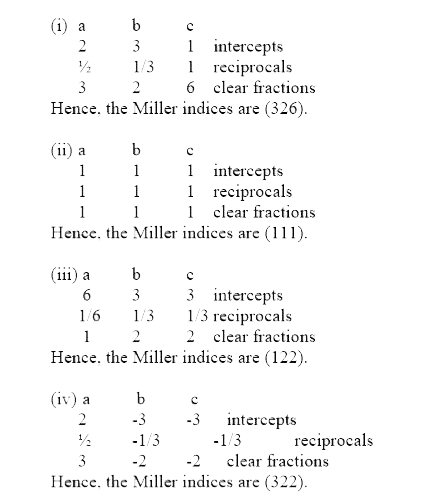
|
|
| 22. |
Calculate the maximum work done (in multiple of 10^(3)) in expanding 16g of oxygen at 300K and occupying a volume of 5 dm^(3) isothermally, until the voume becomes 25 dm^(3) (Give you anwer as nearest integer) |
|
Answer» `= -2.303 xx (16)/(32) (300) (2) "log" (25)/(5) = -2 xx 10^(-3)J` |
|
| 23. |
Calculate the maximum % efficiency of thermal engine operating between 110^(@) and 25^(@) . |
|
Answer» SOLUTION :% Efficiency =`[(T_1-T_2)/T_1]XX100` `T_1=110^@C + 273`=383 K `T_2=25^@C` + 273 +298 K `therefore` % Efficiency =`[(383-298)/383]xx100` `=(85xx100)/383=8500/383` % Efficiency =22.2 % |
|
| 24. |
Calculate the masses of (i) 2.00 gram atoms of chlorine (ii) 2.00 gram molecules of chlorine (iii) 10.50 gram molecules of ammonia. |
|
Answer» Solution : (i) `therefore`The ATOMIC MASS of chlorine (CI) = 35.45 amu `therefore`The gram atomic mass of chlorine = 35.45 g Since, mass in grams = Number of gram atoms x gram atomic mass We have, mass of chlorine = `2.00 xx 35.45 = 70.9` g (ii) `therefore` The molecular mass of chlorine `(Cl_(2))` `therefore` The gram molecular mass of `Cl_(2) = 70.9 g` Since, mass in grams = Number of gram molecules `xx` gram molecular mass We have, mass of chlorine = `2.00 xx 70.9 = 1.42 xx 10^(2)`g (iii) The molecular mass of ammonia `(NH_(3))` `=14.01 + (3 xx 1.008) = 17.034 amu` = 14.01 + (3 x 1.008) = 17.034 amu The gram molecular mass of `NH_3= 17.034` g Hence, we have mass of `NH_(3) = 10.50 xx 17.034 = 178.8` g |
|
| 25. |
Calculate the mass percentage of the element oxygen in hydrogen peroxide. |
|
Answer» |
|
| 26. |
Calculate the mass percent of benzene (C_(6)H_(6)) and carbon tetrachloride (C Cl_(4)) if 22 g benzene is dissolved in 122 g of carbon tetrachloride. |
|
Answer» Mass of benzene = 22 g , Mass of carbon TETRACHLORIDE = 122 g. Mass percent of benzene `= (("22 g"))/(("22g+122g"))xx100=15.28%` Mass percent of carbon tetrachloride `= 100 - 15.28 = 84.72 %` |
|
| 27. |
Calculate the mass percent of calcium, phosphorus and oxygen in calcium phosphate Ca_(3)(PO_(4))_(2). |
|
Answer» Solution :Masspercent of calcium `=(3 XX "(atomic mass of calcium)")/("molecular mass of " Ca_(3)(PO_(4))_(2))xx100` `= (120 u)/(310 u) xx 100 = 38.71%` Mass percent of PHOSPHORUS `=(2xx"(atomic mass of phosphorus)")/("molecular mass of " Ca_(3)(PO_(4))_(2))xx100` `=(2xx31 u )/(310 u) xx 100 = 20%` Mass percent of oxygen`=(8 xx "(atomic mass of oxygen)")/("molecular mass of " Ca_(3)(PO_(4))_(2))xx100` `=(8xx16u)/(310 u) xx 100 = 41.29%` |
|
| 28. |
Calculate the mass per cent of different elements present in sodium sulphate (Na_2SO_4) |
|
Answer» Solution :Gram molecular mass of `Na_2SO_4` `=(2 xx 22.99) + 32.06 + (4 xx 16.00) = 142.04 G MOL^(-1)` Mass per CENT of an element `=("Mass of the element in one MOLE of the compound")/("Gram molecular mass of the compound") xx 100` `therefore` Mass % of sodium `=(22.99 xx 2)/(142.04)xx 100 = 32.37 %` Mass % of sulphur `=32.06/(142.04) xx 100 = 22.57 %` Mass % of OXYGEN `=(16.00 xx 4)/(142.04) xx 100 = 45.06 %` |
|
| 29. |
Calculate the massper cent of different elements present in sodium sulphate (Na_(2)SO_(4)). |
|
Answer» Molecular mass of `Na_(2)SO_(4)=(2xx22.9g)+32.06+(4xx16.00)=142.04g` % of NA `=(45.98xx100)/(142.04g)=32.37%` % of S `=(32.06xx100)/(142.04)=22.57%` % of O `= (64xx100)/(142.04)=45.06%` |
|
| 30. |
Calculate the mass of urea (NH_(2)CONH_(2)) required to prepare 2.5 kg of 0.25 molal aqueous solution. |
|
Answer» Molality of solution `=0.25 m=("0.25 mol kg"^(-1))` Molar mass of urea `(NH_(2)CONH_(2))=2xx14+1xx12+1xx16+4xx1=60 "g mol"^(-1)` Mass of solvent (water) = 2.5 kg `("0.25 mol kg"^(-1))=("Mass of urea")/(("60 g mol"^(-1))XX("2.5 kg"))` Mass of urea `=("0.25 mol kg^(-1))xx("60 g mol"^(-1))xx(2.5 kg)` `= 38.5 g`. |
|
| 31. |
Calculate the mass of urea (NH_(2) CONH_(2)) required in making 2.5 kgof 0.25 molar aqueous solution. |
|
Answer» SOLUTION :`0.25` molar aqueous solution MEANS that Moles of urea `= 0.25 ` mole MASS of solvent (WATER) `=1 kg = 1000 kg` Molar mass of urea `= 14 + 2 + 12 + 16 + 14 + 2 =60 g mol ^(-1)` `therefore 0.25` mole of urea `= 60xx0.25 ` mole = 15 g Total mass of the solution `= 1000 + 15 g = 1015 g = 1. 015g` Thus, `1.015` kg of solution CONTAIN urea = 15 h `therefore 2.5 kg ` of solution will require urea `= (15)/(1.015) xx 2.5 kg =37g` |
|
| 32. |
Calculate the mass of the solute in the following solutions : (i) 100 cm^(3) of N/10 KOH (ii) 150 cm^(3) of M/2 HCl |
|
Answer» |
|
| 34. |
Calculate the mass of the following : (i) 1 atom of sodium (ii) 10 molecules of argon (iii) 1 molecule of CO_2 (iv) 1 molecule of H_2SO_4. |
|
Answer» Solution :(i) The gram atomic mass of sodium = 22.99 This mass contains `6.022 xx 10^(23)` sodium ATOMS. `therefore` Mass of one atom of sodium `=(22.99)/(6.022 xx 10^(23)) = 3.817 xx 10^(-23) g` (ii) Argon is monoatomic. Therefore, its one molecule contains only one atom. HENCE, gram molecular mass of argon = its gram atomic mass 39.95 g. This mass contains `6.022 xx 10^(23)` molecules Hence, mass of 10 molecules of argon `=(10 xx 39.95)/(6.022 xx 10^(23)) = 6.634 xx 10^(-22)g` (iii) Gram molecular mass of `CO_(2)` `=12.01 xx (2 xx 16.0) = 44.01 g` This mass contains `6.022 xx 10^(23)` molecules. Therefore, mass of one molecule of `CO_(2) = (44.01)/(6.022 xx 10^(23)) = 7.308 xx 10^(-23) g` (iv) Gram molecular mass of `H_(2)SO_(4)` `=(2 xx 1.008) + 2.06 + (4 xx 16.0) = 98.076` g This mass contains `6.022 xx 10^(23)` molecules. Therefore, mass of one molecule of `H_(2)SO_(4) = (98.076)/(6.022 xx 10^(23)) = 1.629 xx 10^(-22) g` |
|
| 35. |
Calculate the mass of the following : (i) 1 atom of carbon (ii) 1 atom of silver (iii) 1 molecule 1 benzene (C_(6)H_(6)) (iv) 1 molecule of water (H_(2)O) |
|
Answer» 1.0 atom of carbon has mass `= (12.0)/(6.022xx10^(23))=1.99xx10^(-23)g` (ii) `6.022 xx 10^(23)` atoms of silver have mass = 107.8 g 1.0 atom of silver has mass `= (107.8g)/(6.022xx10^(23))=1.79xx10^(-22)g` (III) `6.022 xx 10^(23)` molecules of benzene `(C_(6)H_(6))` have mass = 78.0 g 1.0 molecule of benzene `(C_(6)H_(6))` has mass `= (78.0g)/(6.022xx10^(23)) = 1.295 xx 10^(-22)g` (IV) `6.022xx10^(23)` molecules of `H_(2)O` have mass = 18.0 g 1.0 molecule of `H_(2)O` has mass `= (18.0 g)/(6.022 xx 10^(23))=2.99 xx 10^(-23) g`. |
|
| 36. |
Calculate the mass of the following atoms in amu(a) Helium (mass of He = 6.641xx10^(-24)g)(b) Silver (mass of Ag = 1.790xx10^(-22) g) |
|
Answer» Solution :1 amu = `1.66056xx10^(-24)` (a) The MASS of Helium atom in amu =`(6.641xx10^(-24))/(1.66056xx10^(-24))`= 3.9992 amu. (b)The mass of SILVER atom in amu = `(1.790xx10^(-22))/(1.66056xx10^(-24))` = 107.79 amu |
|
| 37. |
Calculate the mass of oxygenatom in amu. |
|
Answer» SOLUTION :OXYGEN MASS of Oxygen ATOM `=2.656xx10^(-23)` 1a.m.u ( or 1 u is equal to `1.66075` multiple The mass of oxygen atom in amu `=(2.656xx10^(-23))/(1.66075xx10^(-24))=15.992` a.m.u. |
|
| 38. |
Calculate the mass of sodium which contains the same number of atoms as are present in 10 g of magnesium. |
|
Answer» |
|
| 39. |
Calculate the mass of sodium (in kg) present in 95 kg of a crude sample of sodium nitrate whose percentage purity is 70%. |
|
Answer» Solution :Sodium Nitrate = `NaNO_(3)` Molecular MASS of Sodium Nitrate = NaNO3 = 23 + 14 + 48 = 85 100% pure 85 g of `NaNO_(3)` CONTAINS 23 g of Sodium. 100% pure `95xx10^(3)` g of `NaNO_(3)` will contains` 23/85 xx95 xx 10^(3)` = `25.70xx10^(3)` g of Sodium. 100% pure NaNO3 contains `25.70xx10^(3)` g of Sodium. `:. `100% pure `NaNO_(3)` contains `25.70xx10^(3)`g of sodium `:. `70% pure `NaNO_(3)` will contains `(25.70xx10^(3))/100 xx 70` 17999 (g) or 17.99 kg of Na |
|
| 40. |
Calculate the mass of sodium chloride that is to be treated with 19.6g of sulphuric acid in order to produce 7.3g of hydrogen chloride and 24g of sodium bisulphate. Hint: NaCl +H_(2)SO_(4) to NaHSO_(4)+HCl |
|
Answer» |
|
| 41. |
Calculate the mass of sodium acetate (CH3COONa) required to make 500 mL of 0.375 molar aqueous solution. Molar mass of sodium acetate is 82.0245 g mol^(–1). |
|
Answer» Solution :Molarity of an aqueous solution is given by `W=(MM.V)/1000` In the present case, `M=0.375, M. 82.0245, V=500 mL, w`=? SUBSTITUTING the VALUES, we get `w=(0.375 XX 82.0245 xx 500)/1000 = 15.38 g` Here, mass of sodium ACETATE required = 15.38 g. |
|
| 42. |
Calculate the mass of sodium acetate (CH_3COONa)required to make 500 mL of 0.375 M aqueous solution, (Molar mass of CH_3COONa = 82,0245g mol^(-1) |
| Answer» SOLUTION :Number of moles of `CH_3COONa` in 1000 mL=0.375 Number of moles of`CH_3COONa` in 500 Ml=0.375/2 MASS of `CH_3COONa` REQUIRED = `0.375/2xx82.0245 = 15.38g` | |
| 43. |
Calculate the mass of sodium acetate (CH_(3)COONa) required to make 500 mL of 0.375 molar aqueous solution. Molar mass of sodium acetate is 82.0245 g "mol"^(-1). |
|
Answer» Where, w `=` weight of solute ( in gm) m `=` MOLECULAR MASS of solute `w=(0.375xx82.0245xx500)/(1000)` `= 15.379~=15.38g` |
|
| 44. |
Calculate the mass of oxalic (H_(2)C_(2)O_(4).2H_(2)O) which can be oxidised to CO_(2) by 100 mL of MnO_(4)^(-)(acidic) solution, 10 mL of whichare capable of oxidising 50.0 mL of 1.0 m I^(-) to I_(2). Also calculate the weight of FeC_(2)O_(4) oxidised by same amount of MnO_(4)^(-). |
|
Answer» |
|
| 45. |
Calculate the mass of oxygen obtained by complete decomposition of 10kg of pure potassium chlorate (Atomic mass K=39, O=16 and Cl = 35.5) 2KClO_3 to 2KCl+ 3O_2 |
|
Answer» SOLUTION :MOLECULAR mass of `KClO_3 = 39 + 35.5 + 48 = 122. 5` Molecular mass of `O_2 = 16 + 16 = 32` According to the Stoichiometric equation written above ` ( 2 xx 122.5) xx 10^(-3)`KG of `KClO_3` on heating gives `(3 xx 32) xx 10^(-3)` kg of oxygen . 10 kg of `KClO_3` gives =`(3 xx 32 xx 10^(-3))/( 2 xx 122.5 xx 10^(-3)) xx 10` `=3 .92 kg ` of O_2` |
|
| 46. |
The mass of a non-volatile solute (molar mass 80 g mol^(-1) ) which should be dissolved in 92g of toluene to reduce its vapour pressure to 90% |
|
Answer» Solution :`(Delta P)/(P^(@))=X_(2)` `(100-90)/(100)=(n_(2))/(n_(1)+n_(2))` `(1)/(10)=(n_(2))/(n_(1)+n_(2))` `(n_(2))/(n_(1)+n_(2))=10` `(n_(1))/(n_(2))+1 =10 "" [n_(1)=(92)/(92)=1]` `(1)/(n_(2))=9` `n_(2)=(1)/(9)` `(W_(2))/(M_(2))=(1)/(9)` `W_(2)=(M_(2))/(9)=(80)/(9)=8.89 g` |
|
| 47. |
Calculate the mass of one mole of electrons? |
|
Answer» Solution :Mass of one electron `=9.1095 XX 10^(-31)kg` Mass of one MOLE electrons `=9.1095 xx 10^(-31) xx 6.022xx 10^(23)=5.5 xx 10^(-7)Kg` =0.55mg |
|
| 48. |
Calculate the mass of lime that can be prepared by heating 200 kg of limestone that is 90% pure CaCO_3 CaCO_3 to CaO + CO_2 100 kg xx 10^(-3)"" 56 kg xx 10^(-3) |
|
Answer» Solution :`200kg ` of `90%` PURE `CaCO_3 = 200 xx (90)/(100)` `=180 KG ` pure ` CaCO_3` ` 100 xx 10^(-3)` kg of pure `CaCO_3 ` on heating gives ` 56 xx 10^(-3)` kg of CaO 180 kg of `CaCO_3` gives on heating `=(56 xx 10^(-3) xx 180)/( 100 xx 10^(-3))` `= 100.8 kg ` CaO |
|
| 49. |
Calculate the actual mass of : the atom of silver. Given mass (Ag = 108, N = 14, H = 1) |
|
Answer» |
|
| 50. |
Calculate the mass of : (i) 1.2 gram atom of oxygen (ii) 5.2 gram atom of iodine (iii) 5.6 gram atom of chlorine. |
|
Answer» 1.2 gram atoms of oxygen `= 16.0 XX 1.2 = 19.2 g` (ii) 1.0 gram atom of iodine = 127.0 g 5.2 gram atom of iodine `= 5.2 xx 127.0 = 660.4 g` (III) 1.0 gram atom of CHLORINE `= 35.5 g` 5.6 gram atom of chlorine `= 5.6 xx 35.5 = 198.8 g` |
|