

Saved Bookmarks
This section includes 7 InterviewSolutions, each offering curated multiple-choice questions to sharpen your Current Affairs knowledge and support exam preparation. Choose a topic below to get started.
| 1. |
Calculate the total pressure ina 10 L cylinder which contains 0.4 g helium ,1.6 of oxygen and 1.4 g nitrogen at 27^(@)C. Also calculate the partial of helium gas in the cylinder. Assume ideal hehaviour for gases. |
|
Answer» <P> SOLUTION :Total number of moles `=(0*4)/(4)+(1*6)/(32)+(1*4)/(28)=0.1+05+0*05=0*2` moles.`pV=nRT` `pxx10L=0*2xx0*82xx300rArr p=(24*6xx0*2)/(10)` `p=0*492 atm` `P_(He)(0.1)/(0.2)xx0*492=0*246` atm |
|
| 2. |
Calculate the total number of open chain isomeric carbonyl compounds of molecular formula C_(5)H_(8)O which can't show geometrical isomerism. |
|
Answer» Those ISOMER which can't SHOW G.I `"" ` Those isomer which can show G.I. `C=C-C-C-overset(O)overset(||)(C)-H"" C=C-C-overset(O)overset(||)(C)-C` `C=C-underset(C)underset(|)(C)-overset(O)overset(||)(C)-H` `C-underset(C)underset(|)(C)=C-overset(O)overset(||)(C)-H` `C=underset(C)underset(|)(C)-C-overset(O)overset(||)(C)-H` `C=C-overset(O)overset(||)(C)-C-C` |
|
| 3. |
Calculate the total number of oxygen atoms present in 0.5 moles of H_(2)SO_(4) |
|
Answer» Solution :Number of MOLECULES present in 0.5 moles of `H_(2)SO_(4) = 0.5 xx 6.022 xx 10^(23) = 3.0 xx 10^(23)` One molecule of `H_2SO_4` contains 4 atoms of oxygen. Total number of atoms present in `3.0 xx 10^(23)` molecules = `3.0 xx 10^23 xx 4 = 1.2 xx 10^24` HENCE, 0.5 moles of `H_2SO_4` CONTAIN `1.2 xx 10^24` atoms of oxygen. |
|
| 4. |
Calculate the total number of electrons present in 17g of ammonia. |
|
Answer» Solution :No. of ELECTRONS present in one AMMONIA `(NH_(3))` molecule (7+3)=10 No. of moles of `NH_(3)=` `(Mass )/("Molar mass")=(17g)/(17gmol^(-1))=1mol` No .of molecules present in 1 mol of `NH_(3)=6.023xx10^(23)` No. of electrons present in 1 mol of `NH_(3) ` `""=10xx6.023xx10^(23)` `""=6.023xx10^(24)` |
|
| 5. |
Calculate the total number of electrons present in one mole of methane |
| Answer» Solution :NUMBER of electrons in 1 MOLECULE of `CH_4=6+4=10therefore` Number of electrons in 1 MOL of `CH_4=6.022xx10^23xx10=6.022xx10^24` | |
| 6. |
What is the total number of electrons present in 1.6 g of methane? |
|
Answer» The gram molecular MASS of methane `=12.01 + (4 XX 1.008) = 16.042 G` This mass will contain `6.022 xx 10^23` molecules. Hence, the total number of electrons present in 1.6 g of methane = `6.0 xx 10^(22) xx 10 = 6.0 = 10^(22)` |
|
| 7. |
calculte the total number of electrons present 1.4 g of dinitrogen gas. |
|
Answer» Solution :Moles of `N_2 = (1.4)/28 = 0.05` No. of MOLECULES present `= 0.05 xx 6.022 xx 10^(23)` `:."No. of electrons present " = 0.05 xx 6.022 xx 10^(23) xx 14` `( :. 1 "MOLECULE of " N_2` CONTAINS 14 electrons) = `4.2154 xx 10^(23)` electrons |
|
| 8. |
Calculate the total number of cyclic isomeric carbonyl compounds of molecular formula C_(5)H_(8)O which can't show geometrical isomerism. |
|
Answer» Those ISOMERS which can't SHOW G.I. 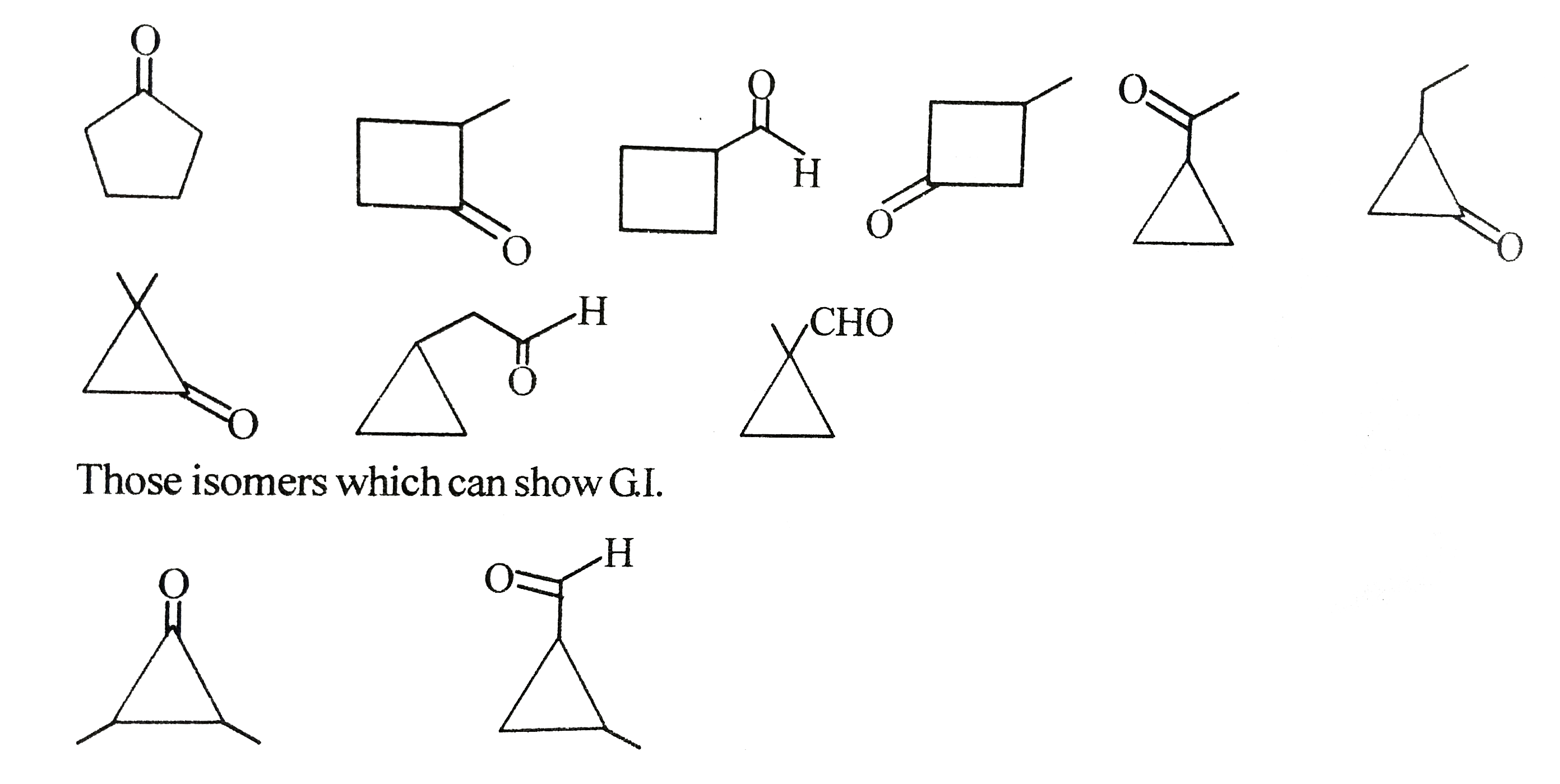
|
|
| 9. |
Calculate the total number of electrons present in 1.4 dinitrogen gas. (N of Z = 7). |
|
Answer» Solution :Moleculasr formula of DINITROGEN gas `= N_(2)` Molecular mass is 28 g `mol^(-1)` Moles of `N_(2)=("Weight")/("Molecular mass of "N_(2))` `= (1.4 g)/(28 g mol^(-1))=0.05` mole `N_(2)` gas ATOMIC NUMBER of Nitrogen (Z) = 7 1 mole of Dinitrogen `7xx2=14` electron `THEREFORE` 1 mole `= 6.023xx10^(23)` molecules of `N_(2)` Number of ELECTRONS in 1 mole Dinitrogen `= 14xx6.022xx10^(23)` But number of electrons present in 0.05 moles Dinitrogen `bar(e )=14xx("0.05 mole")xx(6.022xx10^(23)bar(e )mol^(-1))` `= 14xx0.3011xx10^(23)` electrons `=4.2154xx10^(23)` electrons. |
|
| 10. |
Calculate the total number of chiral carbon atoms in. |
Answer» 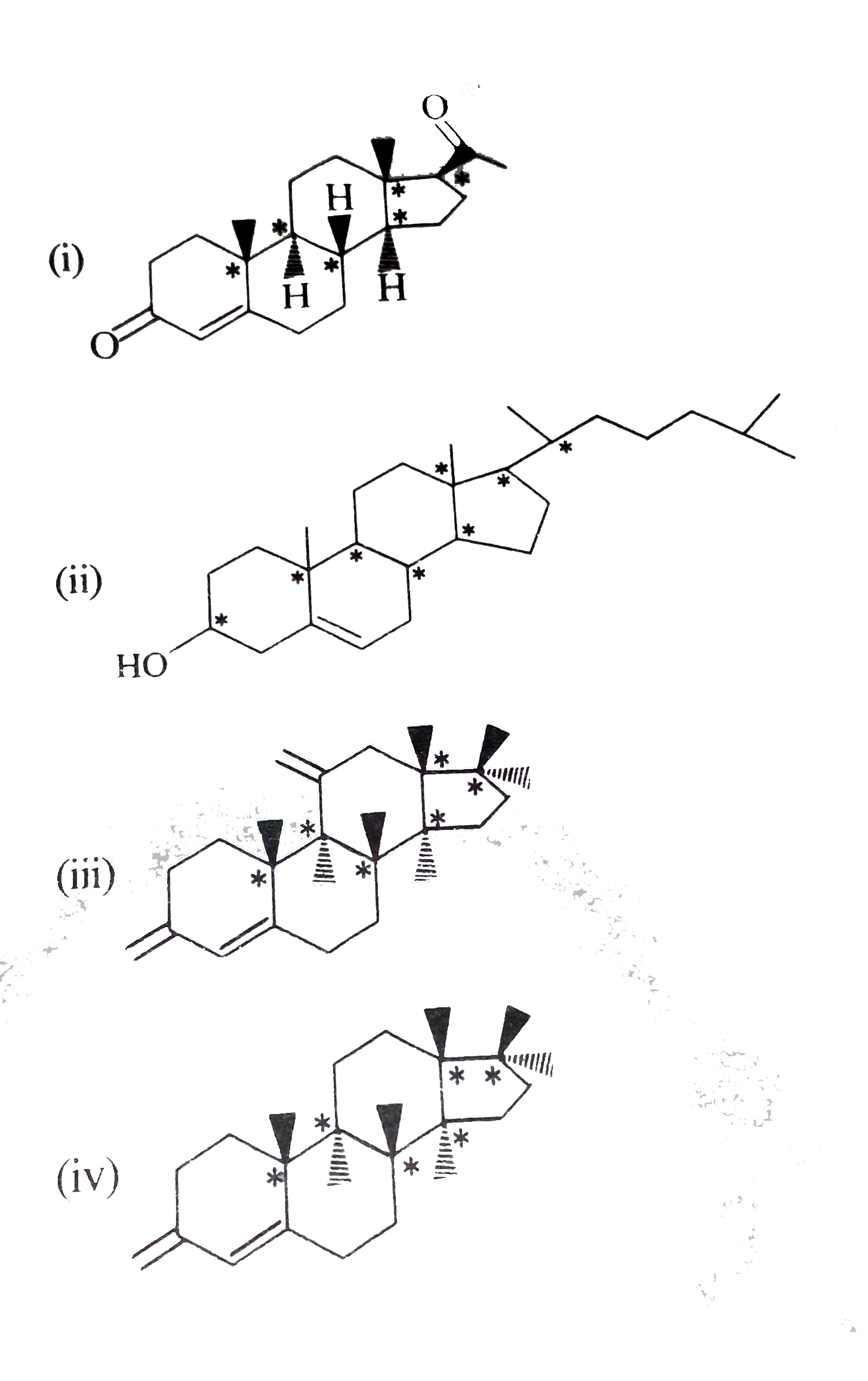
|
|
| 11. |
Calculate the total number of angular nodes and radial nodes present in 4p and4d orbitals. |
|
Answer» SOLUTION :For 4p orbital:Number of angular nodes=lFor 4p orbotal l=1 `:.`Number of angular nodes=1 Number of RADIAL nodes=n-l-1 =4-1-1 =2 `:.`Total number of nodes=n-1=4-1=3 1 angular NODE and 2 radial nodes. For 4d orbital:Number of angular nodes=l For 4d orbitalsl=2 `:.` NUmber of angular nodes=2 Number of radial nodes-n-l-1 =4-2-1 =1 `:.` Total number of nodes=n-1=4-1=3 1 radial nodes and 2 angular node. |
|
| 12. |
Calculate the total number of angular nodes and radial nodes present in 3p orbital |
|
Answer» SOLUTION :For 3p orbital, `n =3, l =1` Number of ANGULAR nodes `= l =1` Number of radial nodes `= n -l -1 =3 -1 =1` |
|
| 13. |
Calculate the total number of angular nodes and radial nodes present in 4p and 4d orbitals. |
|
Answer» Solution :For 4p orbital : NUMBER of ANGULAR nodes = l For 4p orbital l=1 `therefore` Number of angular nodes =1 Number of RADIAL nodes = n-l-1 `=4-1-1` =2 `therefore` TOTAL number of nodes = n-1=4-1=3 1 angular node and 2 radial nodes. For 4d orbital : Number of angular nodes = l For 4 d orbitall=2 `therefore ` Number of angular nodes = 2 Number of radial nodes = n-l-1 `=4-2-1 ` =1 `therefore` Total number of nodes = n-1=4-1=3 1 radial nodes adn 2 angular node. |
|
| 15. |
Calculate the temperature of 4.0 moles of a gas occupying 5 dm^(3) at 3.32 bar (R=0.083 bar dm^(3)K^(-1)mol^(-1)) |
| Answer» Solution :PV=nRTor`T=(PV)/(NR)=(3.32" ABR"xx5dm^(3))/(4.0 molxx0.083" BAR" dm^(3)K^(-1)mol^(-1))=50 K` | |
| 16. |
Calculate the temperature of 4.0 mol of a gas occupying 5 dm^(3) at 3.32 bar. (R = 0.083 bar dm^(3)K^(-1)mol^(-1)). |
|
Answer» Solution :ACCORDING to combined gas equation, pV = nRT `therefore T=(pV)/(nR)` Where Pressure of gas (p) = 3.32 BAR Volume of gas `(V) = 5 dm^(3)` Moles of gas (N) = 4.0 mol gas constant (R ) = 0.083 bar `dm^(3)K^(-1)mol^(-1)` `therefore T=(("3.32 bar")(5 dm^(3)))/((4.0 mol)(0.083" bar dm"^(3)K^(-1)mol^(-1)))` `= 50 K = (50-273)=-223^(@)C`. |
|
| 17. |
Calculate the temperature of 4.0 mol of a gas occupying 5 dm^3 at 3.32 bar (R = 0.083 " bar " dm^3 K^(-1)mol^(-1)). |
|
Answer» SOLUTION :ACCORDING to the gas EQUATION, `PV = nRT` or `T= (PV)/(nR)= (3.32 xx 5)/(4.0xx0.083)=50 K` |
|
| 18. |
Calculate the temperature of 14 mol of a gas occupying 10 dn^(3) at 3.32 bar pressure (R=0*083 bar dm^(3)"mol"^(-1)K^(-1)) |
|
Answer» Solution :Here `n=14= "mol" v= dm ^(3), p=3*32 ` bar `pv= nRT or T=(PV)/(nR)` `t=(3*32 "bar"xx 10 dm^(3))/(14 "mol" xx 0*083dm^(3))"bar" K^(-1)"mol"^(-1) =28*57K or -244*57^(@)C` `:. T-244*27^(@)C` |
|
| 19. |
Calculate the temperature in centrigrade when vaporisation of water in equilibrium at one atmospheric pressure ( Enthalpy of vaporisation = 40 . 63 xx 10^(3) J mol^(-1) , Delta_(vap ) S= 108.8 J K^(-1) mol^(-1)) |
|
Answer» |
|
| 20. |
Calculate the temperature at which the rms velocity of sulphur dioxide molecules is the same as that of oxygen at 300K. |
| Answer» ANSWER :NA | |
| 21. |
Calculate the temperature at which the average speed of oxygen equals that of hydrogen at 20 K. |
|
Answer» |
|
| 22. |
Calculate the temperature at which CO_(2) has the same rms speed to that of O_(2) at STP. |
|
Answer» Solution :rrms of `O_(2)=sqrt3RT"/"M" at STP, URMS of "O_(2)=sqrt3Rxx273"/"32` For `CO_(2) " urms "sqrt3RT"/"44` GIVEN both are same, `3Rxx273"/"32=2RT"/"44` `:. T= 375.38 K = 102.38^(@)C` |
|
| 23. |
The Temperature at which 28 g of N_(2) will occupy a volume of 10.0 L at 2.46 atm is |
| Answer» SOLUTION :`299.6 K` | |
| 24. |
Calculate the temperature at which 28 g of N_2 will occupy a volume of 10.0 litres at 2.46 atmospheres. |
|
Answer» Solution :At S.T.P. (1 atm and 273 K), 28 G of `N_2` (one mole) occupy 22.4 L.According to the gas equation, `(P_1 V_1)/T_1 =(P_2 V_2)/T_2` In the PRESENT case, `P_1 = 1" atm,""" V_1 = 22.4L, ""T_1 = 273 K " and "P_2 = 2.46 " atm, "V_2 = 10.0 L, "" T_2`= ? On SU(bstituting the VALUES, we have `(1xx 22.4)/273 = (2.46xx10.0)/(T_2)` `T_2 = 299.8 = 300 K` Hence, the required temperature is 300 K or `27^@C` . |
|
| 25. |
Calculate the temperature at which28 g of N_(2) will occupy a volume of 10.0 litres 2.46 atmosphere. |
|
Answer» Solution :28 g `N_(2)`=1 MOLE of `N_(2)`. ApplyingPV=nRT,`2.46xx10=1xx0.0821xxT`. This gives T=299.6 K |
|
| 26. |
Calculate the strength of H_2O_2 solution in 10 volume. |
|
Answer» 36.30 GM `{:(2H_2O_2 to , O_2+H_2O),("(2 x 34) gm","22.4 Ltr."):}` So, in 22.4 Ltr `O_2` gas there must be 68 gm `H_2O_2` `therefore` In 10 Ltr `O_2` gas there must be `=(10xx68)/22.4` =30.36 gm |
|
| 27. |
Calculate the strength of H_2O_2solution in 10 volume. |
|
Answer» 36.30 gm `{:(2H_2O_2 to , O_2+H_2O),("(2 x 34) gm","22.4 LTR."):}` So, in 22.4 Ltr `O_2` gas there MUST be 68 gm `H_2O_2` `THEREFORE` In 10 Ltr `O_2` gas there must be `=(10xx68)/22.4` =30.36 gm |
|
| 28. |
Calculate the strength of 5 volumes H_2O_2 solution. |
|
Answer» SOLUTION :According to DEFINITION, 5 volumes `H_2O` solution means that 1 L of 5 volume `H_2O_2` solution on decomposition produces 5 L of `O_2` at STP Reaction : `2H_2O_2 to 2H_2O+ O_2` `2xx34`GM `to` 22.7 L volume of STP Now, 22.7 L `O_2` at STP will be obtained `H_2O_2`= 68 g `therefore` 5L of `O_2` at STP will be obtained from `H_2O_2` = ? `therefore (5xx68)/22.7` gm = 14.98 gm `approx` 15 gm |
|
| 29. |
Calculate the strength of 5 volume H_(2)O_(2) solution. |
|
Answer» SOLUTION :By definiation , 5 volume `H_(2)O_(2)` SOLUTIONS means that 1 L of 5 volume `H_(2)O_(2)` solution on decomposition produces 5 L of `O_(2)` at NTP. Consider the decompositon reaction, `2H_(2)O_(2) to 2H_(2)O + O_(2)` `2xx34g to 22.7 ` L at NTP Now 22.7 L `O_(2)` at NTP will be obtained from `H_(2)O_(2)` =68 g `therefore 5 `L of `O_(2)` at NTP will be obtained from `H_(2)O_(2)=(68xx5)/(22.7) g` `""=14.98g =15g ` But 5 L of `O_(2)` at NTP is produced from 1 L of 5 volume `H_(2)O_(2)` `therefore` Strength of `H_(2)O_(2)` solution =` 15 g L^(-1)` or percentage strength of `H_(2)O_(2)` solution `=(15)/(1000)xx100=1.5%` |
|
| 31. |
Calculate the strength of 10 volume solution of hydrogen peroxide. |
|
Answer» Solution :10 volume solution of `H_2O_2` means that 1 L of this `H_2O_2` solution will give 10 L of oxygen at STP `{:(2H_2O_(2(l)) to O_(2(G)) + ,H_2O_((l))),("2 x 34g","22.7 L at STP"),("68g",):}` On the basis of above equation 22.7 L of `O_2` is produced from 68 g `H_2O_2` at STP 10 L of `O_2` at STP is produced from `(68xx10)/22.4`g = 29.9 g `approx` 30 g `H_2O_2` Therefore , strength of `H_2O_2` in 10 volume `H_2O_2` solution =30g/L =3% `H_2O_2` solution. |
|
| 32. |
Calculate the strength of 10 volume hydrogen peroxide solution. |
|
Answer» Solution :HYDROGEN peroixde decomposes on HEATING ACCORDING to the equation : `{:(2H_(2)O_(2) to 2H_(2)O +""O_(2)),( 2xx34g ""22.4 "litres at N.T.P"),(=68 g"""or 22400 mL at N.T.P."):}` By definition, 10 volume solution of `H_(2)O_(2)` means that 1 L of this `H_(2)O_(2)` will give 10 L of `O_(2)` at N.T.P. From the equation, 22.4 litres of `O_(2)` at N.T.P. are obtained from `2xx34w` or 68 g of `H_(2)O_(2)` . `therefore 10` L of `O_(2)` at N.T.P. will be obtained from `H_(2)O_(2)=(68)/(22.4)xx10=30.36 g` Therefore, strength of `H_(2)O_(2)` in 10 volume `H_(2)O_(2)=30.36 g L^(-1)` |
|
| 33. |
Calculate the standard molar entropy chnage for the following reactions at 298 K : (a)4Fe(s) + 3O_(2)(g) to 2Fe_(2)O_(3)(s) [S^(@) (Fe_(2)O_(3)) = 87.4, S^(@)(Fe) = 27.3, S^(@)(O_(2)) = 205.1(all "in"JK^(-1)mol^(-1)) (b) Ca(s) + 2H_(2)O(l) to Ca(OH)_(2)(aq) + H_(2)(g) [S^(@)Ca(OH)_(2) = -74.5, S^(@)(Ca) = 41.42, S^(@)(H_(2)) = 130.7, S^(@)(H_(2)O) = 69.91(all in JK^(-1) mol^(-1)) (c) Na_(2)CO_(3)(s) + 2HCI (aq) to 2NaCI(aq) + H_(2)O(l) + CO_(2)(g) = 115.13, S^(@)(H_(2)O) = 69.9, S^(@)(CO_(2)) = 213.74 (all in JK^(-1)mol^(-1)). |
|
Answer» (B) `-125.04 J K^(-1)"mol"^(-1)` (c) `264.9 J K^(-1) "mol"^(-1)` |
|
| 34. |
Calculate the standard internal change in multiples of -10^(2)KJ for the reaction OF_(2(g)) + H_(2)O_((g)) rarr O_(2(g)) + 2HF_((g)) at 298K. The standard enthalpies of formation of OF_(2(g)), H_(2)O_((g)), HF_((g)) " are " +20, -250 and -270KJ "mole"^(-1) |
|
Answer» `= 0 + 2 xx (-270) - (20) - (-250) = -310` `Delta E = Delta H - Delta NG RT` `= -310 -1 xx 8.314 xx 0.298 = -312.5` |
|
| 35. |
Calculate the standard heat of formation of propane, if its heat of combustion is-2220.2 kJ "mol"^(-1) , the heats of formation of CO_(2(g)) and H_2O_((l)) are - 393.5 and -285.8 kJ "mol"^(-1) respectively. |
|
Answer» SOLUTION :`C_(3)H_(8)+5O_(2) rarr2CO_(2)+4H_(2) O` `DeltaH_(C)^(@) = -2220.2 "kJ .mol"^(-1)""…(1)` `C+O_(2) rarrCO_(2)` `DeltaH_(f)^(@)=-393.5 "kJ.mol"^(-1)""..(2)` `H_(2)+1/2O_(2)rarrH_(2)O` `DeltaH_(f)^(@) = -285.8 " kJ mol"^(-1)""..(3)` `3C+4H_(2)rarrC_(3)H_(8)` `DeltaH_(f)^(@)=? ` `(2)xx3rArr3C+3O_(2)rarr3CO_(2)` `DeltaH_(f)^(@)=-1180.5kJ ""...(4)` `(3)xx4rArr4H_(2)+2O_(2)rarr4H_(2)O` `DeltaH_(f)^(@)=-1143.2 KJ""....(5)` `(4)+(5)-(1)rArr3C+3O_(2)+4H_(2)+2O_(2)+3CO_(2)+4H_(2)Orarr3CO_(2)+4H_(2)+C_(3)H_(8)+5O_(2)` `DeltaH_(f)^(@)=-11805-1143.2-(-2220.2)kJ` `3C+4H_(2)rarrC_(3)H_(8)` `DeltaH_(f)^(@)=-103.5kJ` STANDARD heat of formation of PROPANE is `DeltaH_(f)^(@)(C_(3)H_(8))=-103.5 kJ`. |
|
| 36. |
For the reaction N_(2)O_(5)(g)rarr 2NO_(2)(g)+(1)/(2)O_(2)(g), the value of rate of disappearance of N_(2)O_(5) is given as 6.5xx10^(-2)"mol L"^(-1)s^(-1). The rate of formation of NO_(2) and O_(2) is given respectively as |
|
Answer» Solution :Standard heat of formation of propane, `3C_((s)) + 4H_(2(g)) to C_3H_(8(g))"" DeltaH_f^0`=? Data given : `C_3H_(8(g)) + 5O_(2(g)) to 3CO_(2)+4H_2O_((l)) "" DELTAH="-2220.2 KJ mol"^(-1)` `C_((s)) + O_(2(g)) to CO_(2(g)) "" DeltaH="-393.5 KJ mol"^(-1)` `H_(2(g)) +1//2O_(2(g)) to H_2O_((l)) "" DeltaH=-"285.8 KJ mol"^(-1)` According to Hess.s law , equation Equation (1) is REVERSED Equation (2) is x 3 Equation (3) is x 4 The add all the equations `3CO_(2(g)) + 4H_2O_((l)) to C_3H_(8_(g)) +5O_(2(g)) "" DeltaH_1="+2220.2 KJ mol"^(-1)` `3C_((s)) + 3O_(2(g)) to 3CO_(2(g)) "" DeltaH_2="-1180.5 KJ mol"^(-1)` `4H_(2(g)) +2O_(2(g)) to 4H_2O_((l)) "" DeltaH_3="-1143.2 KJ mol"^(-1)` `3C_((s)) + 4H_(2(g)) to C_3H_(8(g)) "" DeltaH_f^0="-103.5 KJ mol"^(-1)` Standard enthalpy of formation of propane `DeltaH_f^0=-103.5 "KJ mol"^(-1)` |
|
| 37. |
Calculate the standard Gibbs energy change for the formation of propane at 298 K 3C ( graphite ) + 4H_(2)(g) rarr C_(3)H_(8)(g) Delta_(f)H^(@)for propane, C_(3)H_(8) (g),is - 103.8 kJ mol^(-1) Given S_(m)^(@) C_(3)H_(8)(g) = 270.2JK^(-1) mol^(-1), S_(m)^(@) C( graphite )= 5.70 JK^(-1) mol^(-1) and S_(m)^(@) H_(2)(g) = 130 .7 JK^(-1) mol^(-1) |
|
Answer» `Delta_(r)G^(@) = Delta_(r)H^(@) - T Delta_(r)S^(@) = - 103.8 kJ mol^(-1) - 298 K xx ((-269.7)/( 1000) kJ K^(-1) mol^(-1))` `= - 103.8 + 80.37 kJ mol^(-1) = - 23.43 kJ mol^(-1)` . |
|
| 38. |
Calculate the standard Gibb's energy change for a reaction at 298 K, if its equilibrium constant is 50. |
|
Answer» Solution :`Delta G^(@) = -2.303 T log K` `= -2.303 XX 8.314 xx 298 xx log 50` `= -2.303 xx 8.314 xx 298 xx 1.6990` `= -9694 J = -9.694 KJ mol^(-1)`. |
|
| 39. |
Calculate the standard free energy for a reaction X hArr Y, if the value of equilibrium constant is 1.8 xx 10^(-7) at 298 K. |
|
Answer» Solution :We know that `Delta G^(@) = -2.303 RT LOG K` `= 2.303 XX 8.314 JK^(-1) mol^(-1) xx 298 K xx log.18 xx 10^(-7)` `Delta G^(@) = 38.484 KJ mol^(-1)` |
|
| 40. |
Calculate the standardfree energy change for the reaction, H_(2)(g) + I_(2)(g) rarr 2HI(g), DeltaH^(@) = + 51.9 kJ Given that the standard entropies (S^(@)) of H_(2), I_(2) and HI are 130.6, 116.7 and 206.3 J K^(-1) mol^(-1) respectively.Predict whether the reaction is feasibleat the standard state or not. |
|
Answer» `Delta_(r)G^(@) = Delta_(r)H^(@) - T Delta_(r)S^(@) = 51900 - 298 xx 165.3 = 2640.6 J mol^(-1)` |
|
| 41. |
Calculate the standard free energy change for the reaction : Fe_(2)O_(3)(s) + 4H_(2)(g) rarr2Fe(s) + 3H_(2)O(l) Given that the standard free energies of formation ofFe_(2)O_(3) and H_(2)O are - 741.0 and -237.2kJ mol^(-1) respectively. |
|
Answer» |
|
| 42. |
Calculate the standard free energy change for the reaction, 4NH_(3)(g) + 5O_(2)(g) rarr 2NO(g) + 6H_(2)O(l) Given that the standard free energies of formation (Delta_(r)G^(@)) for NH_(3)(g), NO(g) andH_(2)O(l)are -16.8 , + 86.7 and -237.2 kJ mol^(-1) respectively. Predict the feasibility of the above reaction at the standard state. |
|
Answer» Solution :Here, we are given `Delta_(r) G^(@) (NH_(3))= - 16.8 KJ MOL^(-1)` `Delta_(f)G^(@) (NO) = + 86.7 kJ mol^(-1)` `Delta_(f) G^(@) (H_(2)O) = -237.2 kJ mol^(-1)` `:. Delta_(r) G^(@) = SIGMA Delta_(f) G^(@) ` ( Products) `- Sigma Delta_(f) G^(@) `( Reactants ) `= [ 4 xx Delta_(f) G^(@)(NO) + 6xx Delta_(f) G^(@)(H_(2)O) ]-[4 xx Delta _(f) G^(@) ( NH_(3))+ 5 xx Delta G^(@) (O_(2))]` `= [ 4 xx (86.7) + 6 xx ( -237.2) ]- [ 4 xx ( -16.8) + 5 xx0]= -1009.2 kJ ` Since` Delta_(r) G^(@)` is negative, the process is feasible. |
|
| 43. |
Calculate the standard free energy change (DeltaG^(@)) of the following reaction and say whether it is feasible at 373 K or not 1/2K_(2_((g)))+1/2I_(2_((g)))rarrHI_((g)),DeltaH_(r)^(@) " is " 25.95 kJ mol^(-1)standard entropies of HI_((g)) , H_(2_((g))) and I_(2_((g))) are 206.3 ,140.6 and 118.7 Jk^(-1) mol^(-1) Given S_(I_(2))^(@)=118.7 JK^(-1) mol ^(-1),S_(HI)^(@)=206.3JK^(-1) mol^(-1),S_(H_(2))^(@)=140.6 JK^(-1) mol^(-1) Formula : DeltaS^(@)=S_(HI)^(@)1/2(S_(H_(2))^(@)+S_(I_(2)^(@))) Delta G^(@)=DeltaH^(@) -TDeltaS^(@) |
|
Answer» SOLUTION :`DeltaH_(f)^(@)=+25.95kjmol^(-1)` `DeltaS^(@)=sumS_("PRODUCTS")^(@)-sumS_("Reactants")^(@)` `=206.3-1/2(140+118.7)` `=206.3-129.65` `DeltaS^(@)=76.65kJ^(-1)MOL^(-1)` `DeltaG=DeltaG-TDeltaG` `=25.95-(373xx76xx10^(-3)` `=25.95-28.59` `=-2.640kJ^(-1)mol^(-1)` |
|
| 44. |
Calculate the standard free energy change Delta G^(@) for the reaction, 2HgO(s) rarr 2Hg(l) + O_(2)(g) Delta H^(@) = 91 kJ mol^(-1) at 298 K, S_((HgO))^(@) = 72.0 JK^(-1) mol^(-1). |
|
Answer» Solution :`Delta S = 2S_(HG)^(@) + S_((O_(2)))^(@) - 25_(HgO)^(@)` `= (2 xx 77.4 + 205 - 2 xx 72.0) JK^(-1) MOL^(-1) = 215.8 JK^(-1) mol^(-1)` `Delta G^(@) = Delta_(r )H^(@) - T Delta_(r )S^(@)` `= 91 kJ mol^(-1) - (298 xx 21538)/(1000) xx kJ mol^(-1)` `= (91 - 64.3) kJ mol^(-1) = 26.69 kJ mol^(-1)` |
|
| 45. |
Calculate the standard entropy change for the reactionXhArrYif the value of Delta H^(@) = 28.40kJ andequilibrium constant is 1.8 xx 10^(-7)at 298 K |
|
Answer» `Delta_(r) G^(@) = Delta_(r)H^(@) - T DeltaS ^(@) , i.e., Delta_(r) S^(@) = ( Delta_(r)H^(@) - Delta_(r)G^(@))/(T)= ( 28400-38484)/(298) = -33.8 J K^(-1) mol^(-1)` |
|
| 46. |
Calculate the standard entropy change for the following reaction : H_(2)(g) + Cl_(2)(g) rarr 2HCl(g) at 298 K Given S_(H_(2))^(@) = 131J K^(@) mol^(_1), S_(Cl_(2))^(@) = 223 JK^(-1) mol^(-1) and S_(HCl)^(@) =187 JK^(-1) mol^(-1) |
|
Answer» |
|
| 47. |
Calculate the standardenthalpy of formationof SO_(3) at 298 K using the following reactions and enthalpies S_(8) (s) + 8 O_(2) (g) rarr 8SO_(2)(g) , DeltaH^(@) = - 2775kJ mol^(-1) 2SO_(2) (g) + O_(2)(g) rarr 2SO_(3)(g), DeltaH^(@) = - 198 kJ mol^(-1) |
|
Answer» |
|
| 48. |
C_((s))+O_(2(g)) to CO_(2(g))Calculate the standard entropy change for the above reaction, given the standard entropies of CO_(2(g)), C_((S)), O_(2(g))are 213.6, 5.740 and 205 JK^(-1)respectively. |
|
Answer» Solution :`C(g)+O_2(g) to CO_2(g)` `DeltaS_r^0=sum S_"products"^0-sumS_"REACTANTS"^0` `DeltaS_r^0={S_(CO_2)^0}-{S_C^0-S_(O_2)^0}` `DeltaS_r^0=213.6 - [5.74+205]` `DeltaS_r^0`=213.6-[210.74] `DeltaS_r^0=2.86 JK^(-1)` |
|
| 49. |
Calculate the standard enthaly of formation of Methane. Given that the standard enthalpy of combustion of Methane, carbon and Hydrogen are -893.3kJ, -3.93kJ and -285.8kJ respectively. |
|
Answer» SOLUTION :Required equation: `C(S)+2H_(2)(g)toCH_(4)(g)DeltaH=?` ……1 `C(S)+O_(2)(g)toCO_(2)(g)DeltaH=-393.5kJ`………2 `H_(2)(g)+1//2O_(2)(g)toH_(2)O(L)DeltaH=-285.8kJ`………….3 `CH_(4)(g)+2O_(2)(g)toCO_(2)(g)+2H_(2)O(l)DeltaH=-890.3kJ`………….4 Eqn. 2 `xx1`, EQ. `3xx2` reverse Eqn 4 add `2H_(2)(g)+O_(2)g to 2H_(2)O(l)DeltaH=-571.6kJ` `CO_(2)(g)+2H_(2)O(l)toCH_(4)(g)+2O_(2)(g)DeltaH=+890.3kJ` `C(S)+2H_(2)(g)toCH_(4)(g)DeltaH=-74.8kJ` |
|
| 50. |
Calculate the standard enthalpy of formation of CH_(3)OH(l) from the following data: (i) CH_(3)OH(l) + (3)/(2) O_(2)(g)rarr CO_(2)(g) + 2H_(2)O(l),Delta_(r)H^(@)= - 726 kJ mol^(-1) (ii) C(s) + O_(2)(g) rarrCO_(2)(g), Delta_(c) H^(@) = -393kJ mol^(-1) (iii) H_(2)(g)+ (1)/(2)O_(2)(g) rarr H_(2)O(l) , Delta_(f)H^(@) = - 286kJmol^(-1) |
|
Answer» Solution :Aim`: C(s) + 2H_(2)(g)+(1)/(2)O_(2)(g) RARR CH_(3)OH(l) , Delta_(r)H^(@) = ?` Eqn.(II) `+2 xx` Eqn. (iii) -Eqn. (i)gives the required eqn. with `DeltaH = -393+2(-286)- ( -726 ) kJmol^(-1)= - 239 KJ mol^(-1)` |
|