

Saved Bookmarks
This section includes 7 InterviewSolutions, each offering curated multiple-choice questions to sharpen your Current Affairs knowledge and support exam preparation. Choose a topic below to get started.
| 1. |
Calculate the equilibrium constants of each of the indicated species necessary to reduce an initial 0.2M Zn^(2+) solution to 1.0 xx 10^(-4)Zn^(2+). a. Nh_(3) and Zn(NH_(3))_(4)^(2+) (assume no partial complexation) b. overset(Theta)OH in equilibrium with Zn(OH)_(2)(s). c. overset(Theta)OH and Zn(OH)_(4)^(2-). d. Calculate [overset(Theta)OH] which would be produced by each equilibrium concentration of NH_(3) in part (a). Predict whether Zn(OH)_(2) or Zn(OH)_(4)^(2-) would form in preference to Zn(NH_(3))_(4)^(2+) upon addition of suficient NH_(3) to produce the equilibrium concentration calculated in part(a). e. Explain what would be observeed if concentrated NH_(3) solution were added slowely to 0.2M solution of Zn^(2+). Given. K_(f)Zn(NH_(3))_(4)^(2+) = 5 xx 10^(8). K_(sp)ZN(OH)_(2) = 1.8 xx 10^(-14). K_(f)Zn(OH)_(4)^(2-) = 5 xx 10^(14). K_(b) NH_(4)OH = 1.8 xx 10^(-5). |
|
Answer» Solution :d. `[Zn^(2+)]` final `=1 xx 10^(-4)M` `[Zn(NH_(3))_(4)^(2+)]aq = 0.2 - 10^(-4) ~~ 0.2` `Zn^(2+) + 4NH_(3) HARR Zn(NH_(3))_(4)^(2+)` `K_(f) = ([Zn(NH_(3))_(4)^(2+)])/([Zn^(2+)][NH_(3)]^(4))` `5 xx 10^(8) =(0.2)/((10^(-4))[NH_(3)]^(4))` `(NH_(3))^(4) = 4 xx 10^(-6) = 400 xx 10^(-8)` `(NH_(3)) = 4.5 xx 10^(-2)M` b. `Zn(OH)_(2) rarr Zn^(2+) +2 overset(Theta)OH` `K_(sp) = (1.8 xx 10^(-14))/(10^(-4)) = 1.8 xx 10^(-10)` `[overset(Theta)OH] = 1.3 xx 10^(-5)M` C. `Zn^(2+) + 4overset(Theta)OH rarr Zn(OH)_(4)^(2-)` `K_(f) - ([Zn(OH)_(4)^(2-)])/([Zn^(2+)][overset(Theta)OH]^(4))` `5 xx 10^(4) = (0.2)/((10^(-4))[overset(Theta)OH]^(4))` `rArr [overset(Theta)OH]^(4) = 4 xx 10^(-12), [overset(Theta(O)H] = 1.4 xx 10^(-3)` d. The concentration of `overset(Theta)OH` in equilibrium with the `NH_(3)` concentration of part (a) is given by, `NH_(3) + H_(2)O hArr overset(o+)NH_(4) + overset(Theta)OH`, (LET `x = [overset(o+)NH_(4)] = [overset(Theta)OH]` `K_(b) = ([overset(o+)NH_(4)][overset(Theta)OH])/([NH_(3)])` `1.8 xx 10^(-5) = (x^(2))/(4.5 xx 10^(-2))` `rArr x^(2) = 8.1 xx 10^(-7) rArr x = [overset(Theta)OH] = 9.0 xx 10^(-4)M`. `[overset(Theta)OH] (9.0 xx 10^(-4)M)` from the `4.5 xx 10^(-2)M NH_(3)` is sufficient precipitate `Zn(OH)_(2)` [part (b)] but not sufficient to from `Zn(OH_(4)^(2-))` [part (c)] e. On addition of `Nh_(3)` solution to `Zn^(2+)` solution, a precipitate of `Zn(OH)_(2)` will form, which will later dissolve to yield a clear solution containing `[Zn(NH_(3))_(4)]^(2+)` |
|
| 2. |
Calculate the equilibrium pressure (in Pascal) for the conversion of graphite to diamong at 25^(@)C. The densities of graphite and diamond may be takes to be 2.20 and 3.40 g//cc respectively independent of pressure. (Express your answer in scientific notation x xx10gamma and write the value of y.) [Given : DeltaG_(298)^(@)(C_("graphite") rarr C _("diamond"))=2900J//mol] |
|
Answer» |
|
| 3. |
Calculate the equilibrium constant, K for the following reaction at 400 K ? 2NOCl(g) hArr 2NO(g) + Cl_(2)(g) Given thatDelta_(r) H^(@) = 80.0 kJ mol^(_1) and Delta_(r)S^(@)=120 J K^(-1) mol^(-1) at 400 K. |
|
Answer» SOLUTION :`Delta_(r) G^(@) = Delta_(r)H^(@) - TDelta_(r)S^(@) = 80000J - 400 xx 120 J = 32000 J` Now, `Delta_(r) G^(@) = -2.303 RT log K ` `:. 32000 = - 2.303 xx 8.314 xx 400 xx LOGK `or `log K = - 4.1782 = BAR(5).8218` `:.K = ` Antilog `bar(5).8218 = 6.634 xx 10^(-5)` |
|
| 4. |
Calculate the equilibrium constant (in multiples of 10^(-4)) for the reaction PCl_(5(g)) rarr PCl_(3(g)) + Cl_(2(g)) at 400K, if Delta H^(0) = 77.2KJ "mole"^(-1) and Delta S^(0) = 122JK^(-1) "mole"^(-1) |
|
Answer» `= 77.2 - (400 xx 122)/(1000) = 28.4 KJ` `Delta G^(0) = -RT LN K rArr K = 2 xx 10^(-4)` |
|
| 5. |
Calculate the equilibriumconstant for the following reaction at 298 K and 1 atm pressure : NO(g) + (1)/(2) O_(2)(g) hArr NO_(2)(g) Given : Delta_(f) H^(@) at 298K For NO(g) = 90.4 kJ mol^(-1),ForNO_(2)(g) = 33.8 kJ mol^(-1) Delta S^(@)at 298 K for the reaction= - 70.8 J K^(-1)mol^(-1) Gas constant, R= 8.31 JK^(-1) mol^(-1) |
|
Answer» `= - 56600 J mol^(-1) - 298 K ( - 70.8 JK^(-1) mol^(-1)) = - 35501.6 J mol^(-1)` `:. - 35501.6 =- 2.303 xx 8.31 xx298 log K ` or `log K = 6.2250` or `K = 1.679 xx 10^(6)` |
|
| 6. |
Calculate the entropy change when one kg of water is heated from 27^(@)C to 200^(@)C forming super heated steam under constant pressure. Specific heat of water and systems are respectively 4180 and 1670+0.49J/(kg)-K. |
|
Answer» |
|
| 7. |
Calculate the entropy change when 1 mole of ethanol is evaporated at 351 K. The molar heat of vapourisation of ethanol is 39.84 "kJ mol"^(-1) |
|
Answer» Solution :Given : `T_b`=351 K `DeltaH_"VAP"=39840 "J mol"^(-1)` `DeltaS_V`=? `DeltaS_V=(DeltaH_"vap")/T_b` `DeltaS_V=39840/351` `DeltaS_V=113.5 J K^(-1) "mol"^(-1)` |
|
| 8. |
Calculate the entropy change when 1 kg of water is heated from 27^(@)C to 200^(@)C forming super heated steam under constant pressure. Given : Specific heat ofwater = 4180 J //kg .K Specific heat of steam = 1670 + 0.49 T J // kg. K Latent heat of vaporisation = 23 xx 10^(5) J // kg |
|
Answer» Solution :Entropy change for heatgin 1 kg of water from `27^(@)C` to `100^(@)C` `Delta S = 2.303 n C_(p) log. ( T_(2))/( T_(1))` `=2.303xx ( 1000)/( 18) "moles"XX ( 4180xx18)/( 1000) J mol^(-1) xx log. ( 373K)/( 300K) ` `= 910.55J` Entropy change for heating 1 kg of water at `100^(@)C` to 1 kg of steam at `100^(@)C` `Delta S = ( DeltaH_(v))/( T) = ( 23 xx 10^(5)J)/( 373 ) = 6166.21J` Entropy change for heating 1kg steam from `100^(@)C ( 373K) ` to `200^(@)(473K) ` `DeltaS=int_(373)^(473)(nC_(p) dT)/(T) = int_373^473((1670 +0.49T))/(T) = dT` `=int_(373)^(473)((1670)/(T)+0.49)dT` `=[1670ln T + 0.49 T]_(373)^(473)` `= 1670 xx 2.303 ( log473- log 373) + 0.49( 473- 373)` `=1670 xx 2.303 ( 0. 1032 ) + 49` `= 396.91 +49 =445. 9 J` `:. `Total entropychange `= 910.55 + 6166.21 +45.9 J = 7522.6 J` |
|
| 9. |
Calculate the entropy change when 1 mole of ethanol is evaporated at 351 K. The molar heat of vaporization of ethanol is 39.84 kJ "mol"^(-1) |
|
Answer» Solution :Given : `DeltaH_"VAP"=39840 "J MOL"^(-1) "" DeltaS_v=(DeltaH_"vap")/T_b` `T_b=351 K"" DeltaS_v=39840/351` `DeltaS_v=113.5 J K^(-1) "mol"^(-1)` |
|
| 10. |
Calculate the entropy change of a process possessing DeltaH_(t)=2090 J mol^(-1). |
|
Answer» Solution :GIVEN : `S_(n(alpha, 13^@C)) oversettolarr S_(n(BETA, 13^@C))` `DeltaH_t="2090 J mol"^(-1) "" DeltaS_t=(DeltaH_t)/T_t` `T_t` =13+273=286 K `DeltaS_t=2090/286` `DeltaS_t=7.307 J K^(-1) "mol"^(-1)` |
|
| 11. |
Calculate the entropy change of a process, possessing DeltaH_(t)=2090Jmol^(-1) S_(n)(alpha,10^(@)C)hArrS_(n)(beta,13^(@)C) |
Answer» SOLUTION :GIVEN: `S_(N(alpha,13^(@)C))HARR S_(n(beta,13^(@)C))` 
|
|
| 12. |
Calculate the entropy change of a process H_2O_((l)) to H_2O_((g)) at 373K. Enthalpy of vaporization of water is 40850 J "Mole"^(-1) |
|
Answer» `120 J K^(-1) "mol"^(-1)` Boiling point =373 K = `T_b` `DELTAS=(DeltaH)/T_b=40850/373` = 109.517 `=109.52 J K^(-1) "mol"^(-1)` |
|
| 13. |
Calculate the entropy change of process H_(2)O_((l))rarrH_(2)O_((g)) at 373K. Enthalpy of vaporization of water is 40850"J Mole"^(-1) |
|
Answer» SOLUTION :`H_2O_((l)) to H_2O_((g))` TEMPERATURE T=373 K Enthalpy of vapourisation of WATER =`DeltaH_"vap"=40580 "J mol"^(-1)` `DeltaS`=entropy CHANGE =`(DeltaH_"vap")/T_b=40850/373` `DeltaS` (entropy change ) =`109.51 "J mol"^(-1) K^(-1)` |
|
| 14. |
Calculate the entropy change of a process H_2 O_((l)) to H_2 O_((g))at 373K. Enthalpy of vapourization of water is 40850 J" Mole"^(-1). |
|
Answer» `120 JK^(-1) "mol"^(-1)` Enthalpy of vaporization of water is `=DeltaH = 40850 J "mol"^(-1)` Boiling point = 373 K `= T_b` `DeltaS = (DeltaH)/(T_b) = (40850)/(373) = 109.517` `=109.52 JK^(-1) "mol"^(-1)` |
|
| 15. |
Calculate the entropy change of a process H_2 O_((f)) toH_2 O_((g)) at 373K. Enthalpy of vaporization of water is 40850 J Mole""^(-1) |
|
Answer» SOLUTION :`H_2 O_((l))toH_2 O` temperature`T =373 K` enthalpyof vapourisationof water =` DELTA H_(vap )= 40580jmol^(-1)` `DeltaS ="entropychange"` ` =( Delta H_(vap))/(T_(b)) = ( 40850 )/( 373 )` ` DeltaS` ( entropychange)` = 109.51 J MOL ^(-1)K^(-1) ` |
|
| 16. |
Calculate the entropy change involved in the converion of one mole of liquid water at 373 K to vapour at the same temperature ( latenet heat of vaporization of water Delta_(vap) H = 2.257 kJ //g) |
|
Answer» Solution : For the conversion of water `rarr` vapour , the entropy change is given by `Delta_(vap) S = (Delta_(vap) H)/( T_(b))` Here, `Delta_(vap) H=2.257 kJ //g = 2.257 xx18 kJ //mol =40.626 kJ //mol, T_(b) = 373 K` `:. Delta _(vap ) S = (40.626k J mol^(-1))/( 373K) = 0.1089K J K^(-1) mol^(-1) = 108.9 J K^(-1) mol^(-1)` |
|
| 17. |
Calculate the entropy changeinvolved in conversion of one mole ( 18g) of solid ice at 273K to liquid water at the same temperature ( latent heat of fusion =6025J mol^(-1)) |
|
Answer» Solution :Entropy changefor ice `RARR` WATER is GIVEN by `Delta_(f) S = (Delta_(f)H)/(T_(f))` Here, `Delta_(f) H = 6025 J mol^(-1) , T_(f) = 273 K:.Delta_(f) S = (6025J K^(-1) mol^(-1))/( 273K ) = 22.1 J K^(-1) mol^(-1)` |
|
| 18. |
Calculate the entropy change involved in convertion of 1 mole of water at 373 K to vapours at the same temperature. Latent heat of vaporisation of water = 2.257 kJ g^(-1). |
|
Answer» Solution :`k = 1.8 xx 10^(-7)` `DELTA H = 2.257 xx 18 KJ = 40.626 kJ mol^(-1)` `Delta S_("vap") = (Delta H_(vap))/("B.pt. in kelvin") = (40.626 kJ mol^(-1))/(373 K) = 0.1089 kJ mol^(-1) = 108.9 kJ^(-1) mol^(-1)`. |
|
| 19. |
Calculate the entropy change in the system and surroundings and the total entropy change in the Universe during a process in which 245 J of heat flow out of the system at 77^@C to the surrounding at 33^@C. |
|
Answer» Solution :Given: `T_("SYS") = 77^(@)C = (77+273) = 350K` `T_("surr") = 33^(@)C = (33+273) = 306K` q=245J `DeltaS_("sys") = (q)/(T_("sys")) = (-245)/(350) = -0.7 JK^(-1)` `DeltaS_("UNIV") = (q)/(T_(sys")) = (+245)/(350) = +0.8JK^(-1)` `DeltaS_("univ") = DeltaS_("sys")+DeltaS_("surr")` `DeltaS_("univ") = -0.7JK^(-1)+0.8JK^(-1) = 0.1 JK^(-1)` |
|
| 20. |
Calculate the entropy change in the system and surroundings, and the total entropy change in the universe during a process in which 245 J of heat flow out of the system at 77^@C to the surrounding at 33^@C. |
|
Answer» Solution :Given `T_"SYS"=77^@C =(77+273)`=350 K `T_"surr"=33^@C` =(33+273) =306 K q=245 J `DeltaS_"sys" =q/T_"sys" =(-245)/350=-0.7 JK^(-1)` `DeltaS_"UNIV"=q/T_"sys" =(+245)/350=+0.8 JK^(-1)` `DeltaS_"univ"=DeltaS_"sys" +DeltaS_"surr"` `DeltaS_"univ"=-0.7 JK^(-1) + 0.8 JK^(-1)` `DeltaS_"univ" =0.1 JK^(-1)` |
|
| 21. |
Calculate the entropy change in the system, and in the surroundings and the total entropy change in the universe when during a process 75 J of heat flow out of the system at 55^(@)C to the surrounding at 20^(@)C. |
|
Answer» Solution :HEAT FLOW (q) = 75 J Entropy change = `DeltaS`= ? Temperature of the system =`55^@C+273` = 328 K Temperature of the surroundings =`20^@C`+273 =293 K `DeltaS_"system"=q/T_"system"=75/328=0.2286 "J K"^(-1)` `DeltaS_"surroundings"=q/T_"surroundings"=75/293=0.2559 J K^(-1)` `DeltaS_"UNIVERSE"`=Entropy change =`DeltaS_"system"+DeltaS_"surroundings"` =0.2286+0.2559 `DeltaS_"universe"=0.4845 JK^(-1)` |
|
| 22. |
Calculate the entropy change in the surrounding when 1.0 mol of H_(2)O(l) is found under standard conditions : Delta_(f)H^(@) = -286 kJ mol^(-1) |
|
Answer» Solution :`H_(2)(g)+(1)/(2)O_(2)(g)rarrH_(2)O(l), Delta_(f)H^(@) = - 286kJ mol^(-1)` This means that when 1 mol of `H_(2)O(l)`, is formed , 286kJof HEAT is released . This heat is absorbed by the surroundings, i.e., `q_(surr)= +286 KJ mol^(-1)` `:. DeltaS =( q_(surr))/(T) = ( 286kJ mol^(-1))/( 298K) = 0.9597kJ K^(-1) mol^(-1)= 959.7 JK^(-1) mol^(-1)` |
|
| 23. |
Calculate the entropy change in surroundings when 1.00 mol of H_(2) O_((l)) is formed under standard conditions. Delta_(f)H^( Theta )= -286 "kJ mol"^(-1). |
|
Answer» SOLUTION :`H_(2(G)) + (1)/(2) to H_(2) O_((l)) ""Delta_(f) H= -286 "kJ/mol" -286 "kJ"` heat is released when ONE mole `H_2 O` formed. So heat is absorbed by surrounding. `q_("surr") = +286 "kJ/mol"` `therefore Delta S= (q_("surr"))/( T) = (286)/( 286)` `= 0.9597 "kJ/mol"= 259.7 "J/K mol"` |
|
| 24. |
Calculate the entropy change in surroundings when 1.00 mole of H_(2)O_((l)) is formed under standard conditions Delta_(f)H^(theta)=-286 kJmol^(-1). |
| Answer» SOLUTION :`959.7 JK ^(-1) "MOLE"^(-1)` | |
| 25. |
Calculate the entropy change for the rusting of iron according to the reaction : 4Fe(s) + 3O_(2)(g) rarr Fe_(2)O_(2)(s) , DeltaH^(@) =- 1648 kJ mol^(-1) Given that the standard entropies of Fe,O_(2)and Fe_(2)O_(3) are 27.3,205.0 and 87.4 JK^(-1) mol^(-1) respectively.Will the reaction be spontandeous at room temperature ( 25^(@)C) ?Justify your answer with appropriate calculations. |
|
Answer» SOLUTION :`Delta_(r) S^(@)= SigmaS^(@) `( PRODUCTS ) `- SigmaS^(@) ` ( Reactants) `=2S^(@) (Fe_(2)O_(3)) -[4 S^(@) ( Fe) + 3S^(@) ( O_(2))]` `= 2xx 87.4- [4 xx 27.3 + 3 xx 205.0 ]JK^(-1) mol^(-1) =- 549 JK^(-1) mol^(-1)` This is the entropy change for the reaction, i.e., system `( Delta S_("system"))` Now, `Delta_(r) G^(@) = Delta_(r) H^(@) - TDelta_(r) S^(@)= - 1648000 J mol^(_1) -298 K xx ( - 549 .4 J K^(-1) mol^(-1))` `= - 1648000 +163721 J K^(-1) mol^(_1) = - 1484279 J K^(-1) mol^(-1)` As `Delta G^(@)`is - ve , the reaction is spontaneous. Alsternatively, as the reaction is exothermic, heat given out by THEREACTION is absorbed by the surroundings at room temperature `(25^(@)C)`. Hence, entropy ofthe surroundings increases. `DeltaS_("surroundings")= (1648xx10^(3)JK^(-1) mol^(-1))/( 298 K ) = 5530 JK^(-1) mol^(_1)` `:. Delta S_("total") = DeltaS_("system") + DeltaS_("surroundings") = -549.4 + 5530 JK^(-1) mol^(-1) = + 4980. 6JK^(-1) mol^(-1)` As `Delta S_("total") ` is `+ ve` ,therefore, the reaction is spontaneous. |
|
| 26. |
Calculate the entropy change in surroundings when 1 mol of H_2O_((l)) is formed under standard conditions. Given DeltaH^Ө=-286 "kJ mol"^(-1) |
|
Answer» Solution :`q_"rev"=(-Delta_fH^Ө)=-286 "kJ mol"^(-1) =286000 "J mol"^(-1)` `DeltaS_"(Surroundings)"=q_"rev"/T=("286000 J mol"^(-1))/"298 K"=959 J K^(-1) "mol"^(-1)` |
|
| 27. |
Calculate the entropy change during the melting of one mole of ice into water at 0^@C Enthalpy of fustion of ice is 6008 J mol^(-1) (ii) Write the balanced chemical equation for K_(c) = ([CaO_((s))][CO_(2(g))])/([CaCO_(3(s))) |
|
Answer» Solution :Given `DeltaS_("FUSION")=6008 J mol^(-1)` `T_(R) =0^@C = 273 K` `H_(2)O(S) overset(273K) rarr H_(2) O(l)` `Delta S_("fusion")= (Delta H_("fusion"))/(T_f)` `Delta S_("fusion")= (6008)/(273)` `Delta S_("funsion")=22.007 JK^(-1) mol ^(-1)` (ii) `CaCO_(3(s)) hArr CaO_((s))+CO_(2(g))` |
|
| 28. |
Calculate the entropy change for the conversion of2 moles of liquid water at 373K to vapours , if Delta_(vap) H is 37.3kJ mol^(-1). |
|
Answer» |
|
| 29. |
Calculate the entropy change during the melting of one mole of ice into water at 0^@C and 1 atm pressure. Enthalpy of fusion of ice is 6008 J "Mole"^(-1) |
|
Answer» `22.007 "J K"^(-1) "MOLE"^(-1)` `DELTAS=(DeltaH)/T_m "" T_m =0^@C` = 273 K Entropy of fusion = `"Enthalpy of fusion of ice "/"Melting point (Kelvin)"` `DeltaS=6008/273 =22.007 J K^(-1) "mol"^(-1)` |
|
| 30. |
Calculate the enthalypy of combustion of ethylene (gas) to form CO_(2) (gas ) and H_(2) O (gas) at 298 K and 1 atmospheric pressure. The enthalpies of formation ofCO_(2), H_(2)O and C_(2)H_(4) are - 393.7, -241.8 ,+52.3kJ per mole respectively. |
|
Answer» Solution :We are given `:` (i) `C(s) +O_(2)(g) rarr CO_(2)(g), DELTAH^(@) = - 393.5kJ mol^(-1)` (ii)`H_(2)(g) + (1)/(2) O_(2)(g)rarr H_(2)O(g), Delta H^(@) = - 241.8 kJ mol^(-1)` (iii)`2C(s) + 2H_(2)(g) rarr C_(2)H_(4)(g), Delta H^(@)= + 52.3 kJ mol^(-1)` We aim at `:``C_(2)H_(4)(g) + 3O_(2)(g)rarr 2CO_(2)(g) + 2H_(2)O(g) , Delta _(c ) H^(@) = ?` ` 2 xx` Eqn.`(i) + 2 xx ` Eqn. (ii) - Eqn. (iii) gives `ul{(" "2C(s) ,+2O_(2)(g)rarr2CO_(2)(g)+O_(2)(g),+2H_(2)(g)+2H_(2)O(g)),(-2C(s),,-2H_(2)(g)-C_(2)H_(4)(g)):}` `3O_(2)(g)rarr 2CO_(2) +2H_(2)(g)-C_(2)H_(4)(g)` or `C_(2)H_(4)(g)+3O_(2)(g) rarr 2CO_(2)(g) + 2H_(2)O(g)` `Delta_(c) H^(@)= 2 ( -393.5) + (-241.8) - (52.3) = -1322.9 kJ mol^(-1)` Alternative Method ` :` We aim at `:``C_(2)H_(4)(g)+3O_(2)(g) rarr2CO_(2)(g)+2H_(2)O(g)` We are given `:``Delta_(f) H_((CO_(2)))^(@) = - 393.5 kJ mol^(-1)` `Delta_(f) H_((H_(2)O))^(@)= - 241.8 kJ mol^(-1)` `Delta _(f) H_((C_(2)H_(4)))^(@)= + 52.3 kJ mol^(_1)` `Delta_(R)H^(@) = ("Sum of " Delta_(f)H^(@)" valuesof Products")-("Sum of" Delta_(f)H^(@)" values of Reactants")` `=[ 2 xx Delta_(f) H^(@) (CO_(2))+2xxDelta_(f)H^(@)(H_(2)O)]-[Delta_(f)H^(@)(C_(2)H_(4))+3xxDelta_(f)H^(@)(O_(2))]` `=[ 2 xx ( -393.5) + 2 xx ( -241.8) ] - [ ( 52.3) + 0]( :' Delta_(f) H^(@)` for elementary subtance `=0 )` `=[ -787 .0 -483.6 ] - 52.3 = - 1322.9 kJ mol^(-1)` |
|
| 31. |
Calculate the entropy change during the melting of one mole of ice into water at 0^@C and 1 atm pressure. Enthalpy of fusion of ice is 6008 "J mol"^(-1) . |
|
Answer» Solution :`H_(2)O(S)OVERSET(273K)to H_(2)O(l)` `DeltaS_("FUSION")=(DeltaH_("fusion"))/(T_(f))` `= (6008)/(273)` `DeltaS_("fusion")=22.007 J K^(-1)"mole"^(-1)` |
|
| 32. |
Calculate the enthalpy of vapourisation of ethanol, given enthalpies of formation of liquid ethanol and gaseous ethanol as -277.6J and -235.4 kJ respectively. |
|
Answer» <P> SOLUTION :`DeltaH_(vap)=H_(p)-H_(R)``=-235.4kJ-(-277.6kJ)` `=42.2kJ` |
|
| 33. |
Calculate the enthalpy of reaction forCO(g) + (1)/(2) O_(2)(g) rarr CO_(2)(g) GivenC(s) + O_(2) (g) rarr CO_(2)(g) , DeltaH = -393.5 kJ mol^(-1) C(s) + (1)/(2) O_(2)(g) rarr CO(g) Delta H = - 110 .5 kJ mol^(-1) |
|
Answer» |
|
| 34. |
Calculate the enthalpy of the following reaction : H_(2)C = CH_(2)(g) + H_(2)(g) rarr H_(3)C - CH_(3)(g) Thebond energiesof C-H,C-C,C=C and H-H are 414,347,615 and 435 kJ mol^(-1) respectively |
|
Answer» |
|
| 35. |
Calculate the enthalpy of reaction (Delta H ^(@))when ammonia is oxidized : 4NH_(3) (g) + 5O_(2)(g) rarr 6H_(2)O(g) + 4NO(g) Standard enthalpies of formation (Delta_(f) H^(@)) at 25^(@)CforNH_(3)(g),H_(2)O(g)and NO(g) are - 46.2, -241.8 and + 90.4 kJ // mole respectively. |
|
Answer» |
|
| 36. |
Calculate the enthalpyof hydrogenation ofC_(2)H_(2)(g)to C_(2)H_(4)(g). ( Given bond energies:C-H= 414.0 kJ mol^(-1), C=C= 827.6 kJ mol^(-1), C=C= 606 .0 kJ mol^(-1), H-H = 430 .5 kJ mol^(-1)) |
|
Answer» `Delta_(r)H^(@)=`B.E. ( REACTANTS) - B.E. ( PRODUCTS ) `=[ B.E.(C-=C) + 2 XX B.E. ( C-H) + B.E. (H-H) ] - [ B.E.(C=C) + 4B.E.(C-H)]` `[827.6+2 xx414.0+ 430 .5]-[606.0 + 4 xx 414.0] = - 175.9 kJ MOL^(-1)` |
|
| 37. |
Calculate the enthalpy of isomerization of ethanol to dimethy ether: C_(2)H_(5)OH(l)toCH_(3)OCH_(3)(g) Given : Enthalpy of vaporisation of equal =41 KJ/mole bond enthalpies C-C=348KJ/mole C-H=415KJ/mole C-o=352KJ/mole O-h=463KJ/mole |
|
Answer» 65KJ/mole |
|
| 38. |
Calculate the enthalpy of hydrogenation of ethylene, given that the enthalpy of combustion of ethylene, hydrogen and ethane are -1410.0,-286.2 and -1560.6 kJmol^(-1) respectively at 298 K |
|
Answer» Solution :We aregiven (i)`C_(2)H_(4)(G) +3O_(2)(g)rarr 2CO_(2)(g) +2H_(2)O(l), DeltaH= - 1410kJ mol^(-1)` (II) `H_(2)(g) +(1)/(2) O_(2)(g) rarr H_(2)O(l), DeltaH = - 286.2 kJ mol^(-1)` (iii)`C_(2)H_(6)(g) + 3(1)/(2) O (g) rarr 2CO_(2)(g) + 3H_(2)O(l), Delta H = - 1560.6 kJ mol^(_1)` We aim at `:``C_(2)H_(4)+ H_(2)(g) rarr C_(2)H_(6)(g), DeltaH = ?` Equation (i) `+` Equation (ii) - Equation (iii) gives `C_(2)H_(4)(g) +H_(2)(g) rarr C_92)H_(6)(g), Delta H = - 1410.0 + ( - 286.2) - ( 1560.6)` `= - 135.6 kJ mol^(-1)` |
|
| 39. |
Calculate the enthalpy of hydrogenation of ethylene from the following data. Bond energies of C-H , C-C , C=C and H-H are 414,347,618 and 435 kJ mol^(-1) . |
|
Answer» Solution :Given : `E_(C-H)=414 "kJ mol"^(-1)` `E_(C-C)=347 "kJ mol"^(-1)` `E_(C=C)=618 "kJ mol"^(-1)` `E_(H-H)=435 "kJ mol"^(-1)` 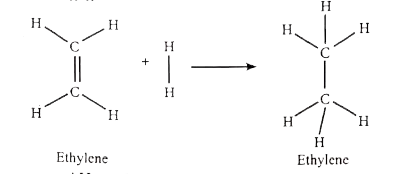 `DeltaH_r=SUM "(Bond energy)"_r -sum "(Bond energy)"_p` `DeltaH_r=(E_(C=C)+4E_(C-H)+E_(H-H))-(E_(C-C) +6E_(C-H))` `DeltaH_r` = (618 + ( 4 x 414 ) + 435 ) -(347 +(6 x 414)) `DeltaH_r`=2709-2831 `DeltaH_r=-122 "kJ mol"^(-1)` |
|
| 40. |
Calculate the enthalpy of hydration of anhydrous copper sulphate (CuSO_(4).5H_(2)O). Given that the enthalpies of solutions of anhydrous copper sulphate and hydrated copper sulphate are -66.5 and +11.7 KJ mol^(-1) respectively |
|
Answer» Solution :We are given (i) `(CuSO_(4).5H_(2)O)` `Delta_("sol")H=-66.5KJmol^(-1)` (II) `CuSO_(4).5H_(2)O_((s))+aqrarrCuSO_(4)(aq)` `Delta_("sol")H=-66.5KJmol^(-1)` (ii) `CuSO_(4).5H_(2)O_((s))+aqrarrCuSO_(4)(aq)` `Delta_(sol)H=+11.7KJmol^(-1)` We need `CuSO_(4(s))+5H_(2)O_((l))rarrCuSO_(4).5H_(2)O_((s)),Delta_(hyd)H=?` Substracting equation (ii) from equation (i). we get `CuSO_(4(s))+5H_(2)O_((l))rarrCuSO_(4).5H_(2)O_((s))` `Delta_(hyd)H=-78.2KJmol^(-1)` |
|
| 41. |
Calculate the enthalpy of hydration of anhydrouscopper sulphate ( CuSO_(4)) into hydrated copper sulphate (CuSO_(4). 5H_(2)O). Given that the enthalpies of solutionsof anhydrous copper sulphate and hydrated copper sulphate are - 66.5 and + 11.7 kJ mol^(-1) respectively. |
|
Answer» Solution :We are given (i) `CuSO_(4)(s) + aq rarr CuSO_(4)(aq), Delta_(sol)H= - 66.5 kJ mol^(-1)` (ii) `CuSO_(4) . 5H_(2)O(s) +aq rarr CuSO_(4)(aq), Delta_(sol) H= + 11.7 kJ mol^(-1)` we aim at`CuSO_(4) (s) + 5H_(2)O(l) rarr CuSO_(4).5H_(2)O(s), Delta _(HYD) H= ?` Eqaution (i) can be written in two steps as`:` `(ii) CuSO_(4) (s) +5H_(2)O(l) rarr CuSO_(4).5H_(2)O(s) , Delta H= Delta H_(1) kJ mol^(-1)` (iv)`CuSO_(4). 5H_(2)O(s)+ aq rarr CuSO_(4)(aq) , Delta H = DeltaH_(2) kJ mol^(-1)` According to Hess's law, `Delta H_(1) + Delta H_92) = - 66.5 kJ mol^(-1)` Further, equations (ii) and (iv) are same `:. Delta H_(2) = + 11.7 k J mol^(-1)` Putting this value above, we get `Delta H_(1) + 11.7 = - 66.5 ` or `Delta H_(1) = - 66.5- 11.7 kJ = - 78.2 kJ mol^(-1)` Thus, equation (iii) may be written as `CuSO_(4)(s) + 5H_(2)O(l) rarr CuSO_(4). 5H_(2)O(s), Delta _(hyd) H- 78.2kJ mol^(-1)` This is what we AIMED at . Hence, the required value of the ENTHALPY of hydration is`Delta _(hyd) H = - 78.2k J mol^(-1)`. |
|
| 42. |
Calculate the enthalpyof formation of water, given that the bond energies of H-H, O=O and O-H bond are 433 kJ mol^(-1), 492 kJ mol^(-1) and 464kJ mol^(-1) respectively. |
|
Answer» `433 + (1)/(2) XX 492 ` `2 xx 464` `ubrace("=679kJ" )_("Energy ABSORBED")``ubrace("=928kJ" )_("Energy released")` `:.`Netreleased`= 928- 679 = 249 kJ MOL^(-1) , i.e., Delta _(f) H^(@) = - 249 kJ mol^(-1)` Alternatively , `DeltaH = B.E. (H_(2))+ (1)/(2) B.E. (O_(2))- 2B.E. ( O-H)` `=433 + (1)/(2) xx 492 - 2 xx 464 = - 249 kJ mol^(-1)` |
|
| 43. |
Calculate the enthalpy of formationn of carbon disulphidegiven that the enthalpy of combustion of carbon disulphide is110.2 kJ mol^(-1) and thoseof sulphur and carbon are 297.4 kJ and 394.5 kJ // g atom respectively. |
|
Answer» GIVEN `: (i) CS_(2)(l) + 3O_(2)(G) rarr CO_(2)(g) + 2SO_(2)(g), DELTA H- 110.2 kJ mol^(-1)` (ii)`S(s) + O_(2)(g) rarr SO_(2)(g) , Delta H= - 297.4 kJ mol^(-1)` (iii) `C(s)+O_(2)(g) rarrCO_(2)(g), Delta H =- 394.5 kJ mol^(-1)` Eqn. (iii) ` +2 xx ` Eqn. (ii) - Eqn. (i) gives the required result. |
|
| 44. |
Calculate the enthalpy of formation of methane, given that the enthalpiedof combustion of methane, graphite and hydrogen are 890.2 kJ, 393.4 kJ and 285.7 kJ mol^(-1) respectively. |
|
Answer» SOLUTION :We are given `:(i) CH_(4) + 2O_(2) rarr CO_(2)+ 2H_(2)O,DeltaH== -890.2 kJ mol^(-1)` (II) `C+ O_(2) rarr CO_(2), Delta H = - 393.4 kJ mol^(-1)``(iii) H_(2)+(1)/(2)O_(2) rarr H_(2)O , Delta H = - 285.7 kJ mol^(-1)` We aim at `: C+2 H_(2)rarr CH_(4), Delta H = ?` In order to get thisthermochemical equation, multiplyeqn. (iii) by 2 and it to eqn. (ii) and then subtract eqn. (i) from their sum. We get `:` `C+2H_(2) rarr CH_(4), Delta H = -393.4+2(-285.7) - (-890.2) kJ mol^(-1) = -74.6 kJ mol^(-1)` Hence, the heat of formation of methane is `:Delta _(F) H= -74.6 kJ mol^(-1)` |
|
| 45. |
Calculate the enthalpy of formation of methanol from the following data, CH_(3)OH(l) + (3)/(2)O_(2)(g) rarr CO_(2)(g) + 2H_(2)O(l) ….(i)""Delta H^(@) = -726.4 kJ mol^(-1) C"(graphite)" + O_(2)(g) rarr CO_(2)(g) ….(iii) ""Delta H^(@) = -393.5 kJ mol^(-1) H_(2)(g) + (1)/(2)O_(2)(g) rarr H_(2)O(l) ....(iii) ""Delta H^(@) = -285.8 kJ mol^(-1). |
|
Answer» Solution :Required equation, `C "(graphite)" + 2H_(2)(g) + (1)/(2)O_(2)(g) rarr CH_(3)OH(l)` Reverse Eq. (1) MULTIPLY Eq. (3) by 2 and add to Eq. (2) `{:(CO_(2)(g)+2H_(2)O(l) rarr CH_(3)OH(l)+ (3)/(2)O_(2)(g) "" DELTA H^(@) = +726.4 kJ MOL^(-1)),(2H_(2)(g) + O_(2)(g) rarr 2H_(2)O(l) ""Delta H^(@) = -571.6 kJ mol^(-1)),("C(graphite)" + O_(2)(g) rarr CO_(2)(g) ""Delta H^(@) = -393.5 kJ mol^(-1)):}/("C(graphite)" + 2H_(2)(g) + (1)/(2)O_(2)(g) rarr CH_(3)OH(l)Delta H^(@) = -238.5 kJ mol^(-1))` `Delta_(f)H^(@)` of `CH_(3)OH = -238.5 kJ mol^(1)`. |
|
| 46. |
Calculate the enthalpy of formation of methane from the following data. C_((s))+O_(2_((g)))toCO_(2)(g)DeltaH^(@)=-393.5kJ…………..1 H_(2_((g)))+1/2O_(2(g))toH_(2)O_((l))DeltaH^(@)=-285.8kJ…………2 CH_(4_((g)))+2O_(2_((g))) rarr CO_(2)(g)+2H_(2)O_((l))DeltaH^(@)=-890kJ......................3 |
|
Answer» SOLUTION :required thermochemical equation is `C(S)+2H_(2)(g)toCH_(4)(g)DeltaH^((-))=?, C_((S))+2H_(2(g))toCH_(4(g))` Eqn 1 as it is `C_((s))+O_(2(g))toCO_(2(g))DeltaH^((-))=-393//5kJ` Eqn 2 `X^(2)` eqn Reverse Eqn 3 `2H_(2(g))+2/2O_(2)(g)to2H_(2((l)))DeltaH^((-))=571.6kJ` `CO_(2(g))+2H_(2)O_((l))toCH_(4(g))+2O_(2(g))=-57kJ` `DeltaH^((-1))=+890kJ` `C_((s))+2H_(2(g)toCH_(4(g))DeltaH^((-))=-75kJ` |
|
| 47. |
Calculate the enthalpyof formationof sucrose(C_(12)H_(22)O_(11)) from the following data : (i)C_(12)H_(22)O_(11)+12O_(2) rarr12 CO_(2) + 11H_(2)O,Delta H = - 5200.7 kJ mol^(-1) (ii) C+ O_(2) rarr CO_(2), Delta H = - 395.5 kJ mol^(-1)(iii)H_(2)+ (1)/(2) O_(2)rarr h_(2)O , Delta H = - 285.8 kJ mol^(-1) |
|
Answer» |
|
| 48. |
Calculate the enthalpy of formation of anhydrous Al_(2)Cl_(6) from the following data : (i) 2Al(s) + 6HCl(aq) rarr Al_(2)Cl_(2) + 3H_(2)(g) + 1004.2kJ .kJ mol^(-1) (ii)H_(2)(g) +Cl_(2)(g) rarr 2HCl(g) + 184.1 kJ mol^(-1) (iii) HCl(g) + aq rarr HCl(aq) + 73.2kJ mol^(-1) (iv)Al_(2)Cl_(6)(s) +aq rarr Al__(2)Cl_(6)(aq) +643.1 kJ mol^(-1) |
|
Answer» Eqn. `(I ) + 3 xx `Eqn. (ii) - Eqn. (iv) `+ 6 xx` Eqn. (iii) gives the required result. |
|
| 49. |
Calculate the enthalpy of formation of carbon monoxide (CO) from the following data: (i) C(s) + O(g) rarr CO_(2)(g), Delta_(r)H^(@) = - 393.5 kJ mol^(-1) (ii) CO(g) + (1)/(2) O_(2)(g) rarrCO_(2)(g) , Delta _(r) H^(@) = - 283. 0 kJ mol^(-1) |
|
Answer» Solution :We AIM at` :C(s) +(1)/(2) O_(2)(g) rarr CO(g) , Delta_(f) H^(@) = ?` Subtracting eqn. (ii) fromeqn. (i), we get `C(s) +(1)/(2) O_(2)(g)- CO(g) rarr0, Delta_(R) H^(@) = - 393.5 - (- 283.0) = - 110.5 KJ mol^(-1)` or `C(s) +(1)/(2) O_(2)(g) rarr CO (g) , Delta _(r) H^(@) = - 110.5 kJ` `:. ` Heat of FORMATION of CO is`: Delta _(f) H^(@) = - 110.5 kJ mol^(-1)` |
|