

Saved Bookmarks
This section includes 7 InterviewSolutions, each offering curated multiple-choice questions to sharpen your Current Affairs knowledge and support exam preparation. Choose a topic below to get started.
| 1. |
Calculate the pH of a 0.10 M ammonia solution. Calculate the pH after 50.0 mL of this solution is treated with 25.0 mL of 0.10 M HCl. The dissociation constant of ammonia,K_(b)=1.77xx10^(-5). |
|
Answer» Solution :`(i) NH_(3)+H_(2)OhArrNH_(4)^(+)+OH^(-)` `K_(b)=([NH_(4)^(+)][OH^(-)])/([NH_(3)])=([OH^(-)]^(2))/([NH_(3)]) (.:' [NH_(4)^(+)]=[OH^(-)])` `:. [OH^(-)]=sqrt(K_(b)[NH_(3)])=sqrt((1.77xx10^(-5))(0.10))=1.33xx10^(-3)M` `pOH = - log (1.33xx10^(-3))=3-0.12=2.88` `:. pH=14-pOH = 14 - 2.88 = 11.12` (ii) 50.0 mL of 0.10 M `NH_(3) ` : 25.0 mL of 0.10 M HCl = 2.5 mmol of HCl 2.5 mmol of HCl will NEUTRALIZE 2.5 mmol of `NH_(3) ` FORMING 2.5 mmol of `NH_(4)Cl` and 2.5 mmol of `NH_(3)` will be left un-neutralized. Thus, now the solution contains 2.5 mmol of `NH_(3) and 2.5` mmol of `NH_(4)Cl` Total volume of the solution = 50 + 25 = 75 mL `:. ` In the final solution, we have `[NH_(3)] = 2.5/75 M = 0.033 M, [NH_(4)Cl ] = 2.5/75 M = 0.033M` The DISSOCIATION of `NH_(3)` now will be less due to COMMON ion effect. If x is the amount of `NH_(3) ` now dissociated, then `{:(,NH_(4)Cl ,+,aq,rarr,NH_(4)^(+),+,Cl^(-)),(,,,,,0.033M,,),(,NH_(3),+,H_(2)O,hArr,NH_(4)^(+),+,OH^(-)),("Initial conc.",0.033M,,,,,,),("In presence of "NH_(4)Cl,0.033-x,,,,0.033+x,,x),(,~= 0.033,,,,~= 0.033,,),(,,,,,,,):}` `K_(b)=([NH_(4)^(+)][OH^(-)])/([NH_(3)])` `1.77xx10^(-5)=(0.033(x))/(0.033) :. x= 1.77xx10^(-5)M ` i.e.,`[OH^(-)]=1.77xx10^(-5)` `pOH = - log (1.77xx10^(-5))=5-0.2480 = 4.75 :. pH = 14-4.75=9.25` |
|
| 2. |
Calculate the pH of 10^(-8) M HCl solution. |
|
Answer» SOLUTION : Note. At the first instance, itappears that as `[H^(+)]=10^(-8)`, therefore, pH should be 8. But pH cannot be 8but should be less than 7 because the solutionis acidic. The reason is that from `H_(2)O, [H^(+)]=106(-7)` M which cannot be neglected in comparison to `10^(-8)`M. The pH can be calculated as FOLLOWS : From, acid, `[H^(+)]=[OH^(-)]=x "mol" L^(-1) ` (say)(as in presence of acid, `[H^(+)]` from `H_(2)O ~=10^(-7)M`) THUS, in the solution, now we have `[H^(+)]=(10^(-8)+x)M and [OH^(-)]=x M` But `[H^(+)] [OH^(-)]=K_(W) = 10^(-14)` `:.(10^(-8) +x)(x) = 10^(-14) or x^(2) + 10^(-8) x - 10^(-14) = 0` `x=(-10^(-8)pmsqrt(10^(-16)+4xx10^(-14)))/(2) = (-10^(-8)+sqrt(401)xx10^(-8))/(2)` (Taking +ve value only) `=(19.025xx10^(-8))/(2) = 9.5125xx10^(-8)` i.e, `[OH^(-)]=9.5125xx10^(-8)M` `:. pOH = -log(9.5125xx10^(-8))=8-0.9783~=7.02 " " :. "" pH=14-7.02=6.98` Alternatively, in a simplified manner, we have From acid, `[H^(+)]=10^(-8)M, "From" H_(2)O , [H^(+)]=10^(-7)M` `:. "Total" [H^(+)]=10^(-8)+10^(-7) = 10^(-8) (1+10)=11xx10^(-8)M` `:. pH = -log [H^(+)]=-log(11xx10^(-8))=-[log 11 + log 10^(-8)]` `=-[1.0414-8]=6.9586~~ 6.96` |
|
| 3. |
Calculate the pH of 10^(-8)M HCl solution. |
|
Answer» |
|
| 4. |
Calculate the pH of 10^(-10) M NaOH solution. |
|
Answer» Solution :`[OH^(-)]` from NaOH `=10^(-10)M, [OH^(-)]` from ` H_(2)O=10^(-7)M` total `[OH^(-)]=10^(-10)+10^(-7)=10^(-7)(10^(-3)+1)=1.001xx10^(-7)M` `:. pOH = - log (1.001xx10^(-7))=7-log 1.001=7-0.0004=6.9986` or `pH = 14 - 6.9996 = 7.0004` |
|
| 5. |
Calculate the pH of 0.15 M solution of hypochlorous acid HClO (K_(a)=9.6xx10^(-7)). |
|
Answer» |
|
| 6. |
Calculate the pH of 0.125M of H_(2)SO_(4). |
|
Answer» SOLUTION :`H_(2)SO_(4)to2H^(+)+SO_(4)^(2-)` `[H^(+)]=2[H_(2)SO_(4)]=2xx0.125=0.25` `pH=-log_(10)[H^(+)]=-log_(10)[0.25]=-log_(10)[2.5xx10^(-1)]` `pH=-log2.5-log10^(-1)=-0.3979+1=0.6021`. |
|
| 7. |
Calculate the pH of 0.10 M solution of NH_(4)Cl. The dissociation constant (K_(b)) of NH_(3) is 1.6xx10^(-5). |
|
Answer» Solution :As `NH_(4) Cl` is a salt of weak BASE and strong acid, `K_(h)=(K_(w))/(K_(b))=(10^(-14))/(1.6xx10^(-5))=6.25 XX 10^(-10)` The hydrolysis REACTION will be `NH_(4)^(+) +H_(2)O hArr NH_(3)+H_(3)O^(+)` `{:(or,NH_(4)^(+),hArr,NH_(3),+,H^(+),,),("Initial conc.",cM,,,,,,),("At. eqm.",c-m,,x,,x,,):}` `K_(h)=([NH_(3)][H^(+)])/([NH_(4)^(+)])=(x xx x)/(c-x)~~ (x^(2))/(c) or x = sqrt(K_(h)xxc)=sqrt((6.25xx10^(-10))xx0.1)=7.9xx10^(-6)M` i.e., `[H^(+)] = 7.9 xx 10^(-6) M ` `:. pH = - log [H^(+)] = -log (7.9xx10^(-6))=6-0.90 = 5.10` Alternatively, applying the formula directly, `pH = 7 -(1)/(2) [ pK_(b) + log c ] = 7 - (1)/(2) [ - log K_(b)+log c ]` `=7-(1)/(2) [ - log (1.6xx10^(-5))+log 0.1 ]` `= 7 - (1)/(2) [ 5-0.02041) - 1] = 5.10` |
|
| 8. |
Calculate the pH of 0.1 M solution of acetic if the degree of dissociation of the acid is 0.0132. |
|
Answer» Solution :Acetic acid dissociates as : `CH_(3)CO OH + H_(2)O HARR CH_(3)CO O^(-) + H_(2)O^(+)` If C moles/litre is the INITIAL concentration and `alpha` is the DEGREE of DISSOCIATION, we can write `{:(,CH_(3)CO OH,+H_(2)O,hArr,CH_(3)CO O^(-)+,H_(3)O^(+)),("Initial conc.",C,,,,),("Conc. at eqm.",C-C alpha,,,C alpha,C alpha),(,,,,,):}` Thus, `[H_(3)O^(+)]=C xx alpha = 0.1 xx 0.0132 = 1.32xx10^(-3) M` `:. pH = - log [H_(3)O^(+)]=- log (1.32xx10^(-3)) = - log 1.32 - log 10^(-3) = - 0.1206 + 3 = 2.8794 `. |
|
| 9. |
Calculate the pH of 0.1 M of H_(2)SO_(4) (concentration of hydrogen = 0.1xx2=0.2). |
|
Answer» Solution :`PH=-log_(10)[H^(+)]-log_(10)[0.1xx2]=-log_(10)[0.2]-log_(10)[2xx10^(-1)]=1-log2` pH = 1 - 0.3010 = 0.699. |
|
| 10. |
Calculate the pH of 0.08 M solution of hypochlorous acid, HOCl. The ionization constant of the acid is 2.5xx10^(-5). Determine the percent dissociation of HOCl. |
|
Answer» `K_(a)=(x^(2))/(0.08) or x=sqrt((2.5xx10^(-5))(0.08))=1.41xx10^(-3)` `PH = - log [H_(3)O^(+)]=-log (1.41xx10^(-3))=2.85` Alternatively, directly `pH = (1)/(2) [pK_(a) - log C]` % dissociation = `("Amount dissociated")/("Amount taken")xx100=(1.41xx10^(-3))/(0.08) xx100=1.76%` |
|
| 11. |
Calculate the pH of 0.08 M solution of hypochlorous acid , HOCl. The ionization constant of the acid is 2.5xx10^(-5) . Determine the percent dissociation of HOCl. |
|
Answer» Solution :The ionic equilibrium of weak acid HOCl is as under : `{:("Ionic equili.",HOCl_((aq))+,H_2O_((l)) HARR , H_3O_((aq))^(+), +ClO_((aq))^(-)),("Initial conc.(M)",0.08,-,0.0,0),("Change in reac.(M)",-x,-,+x,+x),("Concentration at equilibrium:",(0.08-x)M,,xM,xM):}` The value of x is very less , 0.08 `gt gt` x So, (0.08-x) M `approx` 0.08 M = 0.08 M `K_a=([H_3O^+][CLO^-])/([HOCl])` `THEREFORE 2.5xx10^(-5)=((x)(x))/0.08` `therefore x^2=0.08xx2.5xx10^(-5)= 2.00xx10^(-6)` `therefore x=(2.0xx10^(-6))^(1/2)` `=1.4142xx10^(-3)` M `pH=-log [H^+]=-log (1.4142xx10^(-3))` =-(0.1505-3.0) =(-2.8495)=2.85 % of dissociation = `"Dissociated [HOCl] x 100"/"Initial [HOCl]"` `=((1.4142xx10^(-3))XX100)/0.08`= 1.768% |
|
| 12. |
Calculate the pH of 0.05 M sodium acetate solution of the pK_(a) of acetic acid is 4.74. |
|
Answer» |
|
| 13. |
Calculate the pH of 0.01 MH_2SO_4 by assuming complete ionisation. |
|
Answer» SOLUTION :`pH=-log[H^(+)]""underset(0.01M)(H_(2)SO_(4))tounderset(0.01xx2)(2H^(+))+SO_(4)^(-2)` `pH=-log[2xx10^(-2)]""[H^(+)]=0.02M` `=1.4990` |
|
| 14. |
Calculate the pH of 0.01 M solution of NH_(4)CN. Given that the dissociation constants are : K_(a) for HCN = 6.2xx10^(-10)and pK_(b) for NH_(3)=1.6xx10^(-5). |
|
Answer» CALCULATE `pK_(a) and pK_(b)`. We get `pK_(a) = 9.21 , pK_(b) = 4.80`. Then `pH = 7 + (1)/(2) [pK_(a) - pK_(b)]` |
|
| 15. |
Calculate the pH of 0.01 M HCl. |
| Answer» SOLUTION :`pH=-log_(10)[H^(+)]=-log_(10)[0.01]=-log_(10)[10^(-2)]=2`. | |
| 16. |
Calculate the pH of 0.001 Maniline. What is the ionisation constant of anilinium cation? (K_b= 3.5 xx10^(-10)) |
|
Answer» SOLUTION :`[OH^(-) ]=sqrt(K_b C ) = sqrt( 3.5xx 10^(-10 ) xx 10^(-3)) = 6 xx 10^(-7) mol L^(-1)` `pOH = -log 6 xx 10^(-7)= 7-log 6` pH = 14 - 7 + log 6 = 7.78 IONISATION constant of anilinium cation is the RATIO of `K_w and K_b` `k_a = (K_w)/(k_b) = ( 1 xx 10^(-14) )/(3.5 xx 10^(-10)) = 2.86 xx 10^(-5)` |
|
| 17. |
Calculate the pH of 0.001 M NaOH.Assuming complete dissociation of base. |
|
Answer» SOLUTION :`[OH^(-)]=10^(-3)M""pOH=-log[10^(-3)]=3` `pH+pOH=14""pH=14-3=11` |
|
| 18. |
Calculate the pH of "0.001 M HCl" solution |
|
Answer» <P> Solution :`P^(H)=-log[H^(+)]""[H^(+)]=0.001=10^(-3)m" "P^(H)=-log(10^(-3))=-{-3log10}""P^(H)=3` |
|
| 19. |
Calculate the pH of 0.001 M aqueous solution of ZnCl_2, K_a for the equilibrium, Zn^(2+)+H_(2) O hArrZn (OH)^(+)+H^(+)is1 xx 10^(-9) |
Answer» Solution : `[H^(+)] = C XX h = c sqrt(K_H // C)= sqrt(K_H xxC ) = sqrt(10^(-9) xx 0.001 ) = 10^(-6)` `pH =- log [10^(-6) ]=6` |
|
| 20. |
Calculate the pH of 0.00025 M HNO_(3). |
|
Answer» Solution :`pH=-log_(10)[H^(+)]-log_(10)[0.00025]=-log_(10)[H^(+)]-log_(10)[2*5XX10^(-4)]=4-log2.5` = 4 - 0.3979 = 3.6021. |
|
| 21. |
Calculate the pH of 0.0001 M of HNO_(3). |
| Answer» SOLUTION :`pH=-log_(10)[H^(+)]-log_(10)[0.0001]=-log_(10)[10^(-4)]=4`. | |
| 22. |
Calculate the pH at which Mg(OH)_(2) begins to precipitate from asolution containing 0.10 M Mg^(2+) ions. K_(sp) of Mg(OH)_(2)=1xx10^(-11). |
|
Answer» Solution :Minimum `[OH^(-)]` after which `Mg (OH)_(2)` BEGINS to PRECIPITATE can be calculated from `[Mg^(2+)][OH^(-)]^(2)=K_(sp) ` of `Mg(OH)_(2)` `(0.10)[OH^(-)]^(2) = 10^(-11) or [OH^(-)]^(2) = 10^(-10) or [OH^(-)]=10^(-5) or [H^(+)]=10^(-9) or pH = 9` |
|
| 23. |
Calculate the pH at which an acid indicator with K_a =1.0 xx 10^(-5) changes colour when the indicator concentration is 1.0 xx 10^(-3) M. |
|
Answer» |
|
| 24. |
Calculate the pH and concentration of all species present at equilibrium in 0.1 M H_(3)PO_(4) solution. K_(a_(1))=7.5xx10^(-3), K_(a_(2))=6.2xx10^(-8), K_(a_(3))=4.2xx10^(-13) |
|
Answer» |
|
| 25. |
Calculate the pH at equivalence point when a solution of 0.10 M acetic acid is titrated with a solution of 0.10 M NaOH solution . K_(a)for acetic acid = 1.9xx10^(-5) |
|
Answer» Solution :At the EQUIVALENCE point, `CH_(3)CO ON a` is formed asn its concentration `=(0.1)/(2) M = 0.05 M`. It is a slat of weak acid and strong base. The formula for finding the pH of such a SALT is `pH = - (1)/(2) [log K_(w) + log K_(a) - log c]` `:. pH = - (1)/(2) [log 10^(-14)+log (1.9xx10^(-5))-log(5xx10^(-2))]` `=-(1)/(2) [-14 + (-5+0.2788)-(-2+0.6990)]=(1)/(2) (14+5-0.2788-2+0.6990)=(17.42)/(2) = 8.71` |
|
| 26. |
Calculate the perimeter of given plane in HCP unit cell (Given that radius of atoms = R Å) |
|
Answer» 6.437R |
|
| 27. |
Calculate the percentage of oxalte ions in a given sample of oxalte salt 3.0 of which has been disolve per litre of the solution 10 mL of the oxalate salt solution required 8 mL of 0.01 M KMnO_(4) solution complete oxidation |
|
Answer» `2MnO_(4)^(-)+16H^(+)+5C_(2)O_(4)^(2-)rarr2Mn^(2+)+10CO_(2)+8H_(2)O` applying molaritye equation `(M_(1)xx10)/(5)(C_(2)O_(4)^(2-))=(0.01xx8)/(2)(MnO_(4)^(-)) or M_(1)=0.02` M Mol wt of `C_(2)O_(4)^(2-)=88` `%C_(2)O_(4)^(2-)=(1.76xx100)/(3)=58.67` |
|
| 28. |
Calculate the percentage of p-character in the orbitals formingP-P bonds in P_(4)molecule. |
|
Answer» Solution :In` P_(4)`MOLECULE , each P ATOM is `sp^(3)` hybridisedwith one position occupied by a lone PAIR on each atom. Hence . % p-character ` = (3)/(4) xx100 = 75 %` 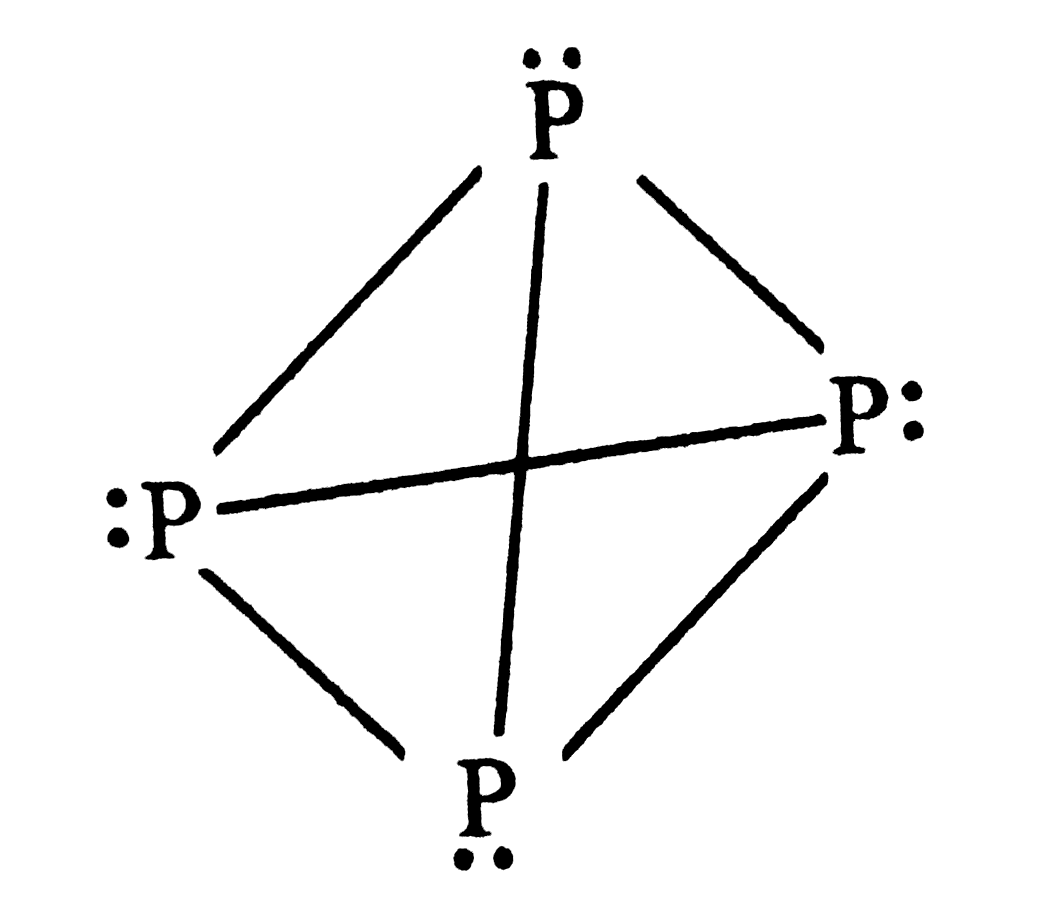
|
|
| 29. |
Calculate the percentage of ionic character of HF. Given that the dipole moment of HF is 1.91 D and its bonding length is 0.92Å. |
|
Answer» Solution :If HF is 100% ionic, each atom would CARRY a charge equal to one unit, ie.., `4.8xx10^(-10)` esu. As the bond length of HF is 0.92 Å, itsdipoel moooment for 100% ionic CHARACTER would be `p_("ionic")=qxxd=4.8xx10^(-10)esuxx0.92xx10^(-8)CM` `=4.416xx10^(-18)esu*cm=4.416D` `[because 10^(-18)esu*cm=1D]` `therefore%` ionic character`=(mu_("observed"))/(mu_("ionic"))xx100=(1.91xx100)/(4.416)=43.25` |
|
| 30. |
Calculate the percentage of hydrolysis in 0.003 M queous solution of NaOCN ( K_(a) for HOCN = 3.3xx10^(-4)M). |
|
Answer» Solution :NAOCN is a SALT of weak acid-strong base. HENCE, `K_(h) = (K_(W))/(K_(a))=(10^(-14))/(3.3xx10^(-4))=(10^(-10))/(3.33) :. H= sqrt((K_(h))/(c))=sqrt((10^(-10))/(3.33)xx(1)/(3xx10^(-3)))=sqrt(10^(-8))=10^(-4)` `:.` % age hydrolysis `= 10^(-4)xx100=0.01` |
|
| 31. |
Calculate the percentage of Cr in a sample of dichromate ore if 1.0 g of the sample after fusion is treated with 60 " mL of " 0.1 N FeSO_(4).(NH_(4))_(2)SO_(4) and the excess of Fe^(2+) requires 11.2 " mL of " K_(2)Cr_(2)O_(3) in the sample. |
|
Answer» Solution :`6e^(-)+Cr_(2)O_(7)^(2-)to2Cr^(3+)(n=6)` `Fe^(2+)TOFE^(3+)+e^(-)(n=1)` `m" Eq of "K_(2)Cr_(2)O_(7)` in 1 mL`=m" Eq of "Fe` `=(0.006)/(56)xx10^(3)=(6)/(56)` m" Eq of "`K_(2)Cr_(2)O_(7)` in 11.2 mL`=(6)/(56)xx11.2=1.2` ltBrgt mEw of `Fe^(2+)` LEFT UNUSED`=m" Eq of "K_(2)Cr_(2)O_(7) used=1.2` Now, `m" Eq of "FeSO_(4).(NH_(4))_(2)SO_(4) added =60xx0.1=6` `m" Eq of "FesO_(4).(NH_(4))_(2)SO_(4)` left unused`=6-1.2=4.8` m" Eq of "`Cr=4.8`(`thereforeEw of Cr=(52)/(3))` `(E)/((52)/(3))xx10^(3)=4.8` `W_(Cr)=(4.8xx52)/(10^(3)xx3)=0.0832g` `% of Cr=(0.0832)/(1.0)xx100=8.32%` Also, m" Eq of "`Cr_(2)O_(3)=4.8` `(becauseEw of Cr_(2)O_(3)=(52xx2+48)/(6)=(156)/(6))` `(W_(Cr_(2)O_(3))/((152)/(6))xx10^(3)=4.8` `W_(Cr_(2)O_(3))=(4.8xx152)/(6xx1000)=0.1216g` `% of Cr_(2)O_(3)=(0.1216)/(1.0)xx100=12.16%` |
|
| 32. |
Calculate the percentage composition of the elements present in magnesium carbonate. How many kilogram of CO_(2) can be obtained by heating 1 kg of 90 % pure magnesium carbonate. |
|
Answer» Solution :The balanced chemical equation is `MgCO_(3)rarr` MgO + `CO_(2)` MOLAR mass of `MgCO_(3)` is 84 g `mol^(-1)` . 84 g `MgCO_(3)`contain 24 g of Magnesium. `:.`100 g of `MgCO_(3)` contain = ` (24 g MG)/(84 gMgCO_(3)) xx 100 g MgCO_(3) ` = 28.57 g Mg i.e. percentage of magnesium = 28.57 % . 84 g `MgCO_(3)` contain 12 g of carbon 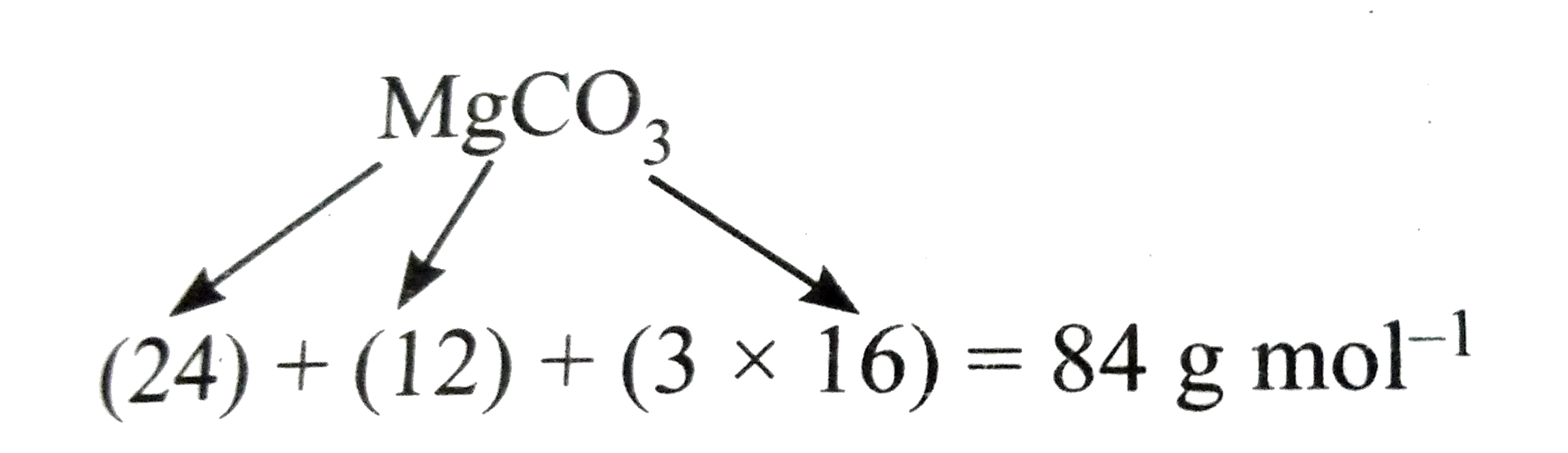 `:. ` 100g `MgCO_(3)` contain `(12 g C)/(84 g MgCO_(3)) xx 100 g MgCO_(3)` = 14.29 g of carbon `:. ` percentage of carbon =14.29% 84 g `MgCO_(3)` contains 48 g of oxygen `:.` 100 g `MgCO_(3) `contains `(48 g O)/(84 g MgCO_(3)) xx 100g MgCO_(3)` = 57.14 g of oxygen `:.` percentage of oxygen = 57.14% As per the stoichiometric equation, 84 g 100% pure `MgCO_(3)` on heating gives 44 g of `CO_(2)` `:. ` 1000 g of 90% pure `MgCO_(3)` gives `(44 g)/(84 g xx 100%)xx 90% xx 1000`g = 471.43 g of `CO_(2)` = 0.471 kg of `CO_(2)` |
|
| 33. |
Calculate the percentage composition of the elements present in magnesium carbonate. How many Kg of CO_(2) can be obtained from 100 Kg of is 90% pure magnesium carbonate |
|
Answer» Solution :MOLAR mass of MgCO3 = 84.32 g `mol^(-1)` Percentage of Mg = `24/84.32 xx 100 = 28.46%` Percentage of C =`12/84.32 xx 100` = 14.23% Percentage of `O_(3) =48/84.32 xx 100 = 57.0%` `MgCO_(3) rarr MgO + CO_(2)` 84.32 g of 100% pure `MgCO_(3)` gives 44g of `CO_(2)` `:.100xx10^(3)` g of 100 % pure `MgCO_(3)` gives =`44/84.32 xx 100 xx 10^(3)` = `52.182 xx 10^(3)` g`CO_(2)` 100% pure` MgCO_(3)` gives `52.182 xx 10^(3)gCO_(2)` `:.` 90% pure `MgCO_(3)` will give`(52.182xx10^(3))/100 xx 90` = 46963.8 g `CO_(2)` = 46.96 KG `CO_(2)`. |
|
| 34. |
Calculate the percentage composition of the elements present in lead nitrate. How many Kg of O_(2) can be obtained from 50 kg of 70% pure lead nitrate? |
|
Answer» Solution :Lead nitrate = `Pb(NO_(3))_(2)` Molecular mass of lead nitrate = 207 + (14`xx`2)+ (16`xx` 6) = 207 + 28 + 96 = 331 G / mol. 331 g of lead nitrate contains 96 g of oxygen. `:.` `50xx10^(3)` g of lead nitrate will contain `96/331 xx 50 xx 10^(3)` = 14501.5 g = 14.501 Kg of oxygen. 100 % PURE lead nitrate contains 14.501 Kg of oxygen. 70 % pure lead nitrate will contain `14.501/100 xx 70` = 10.15 Kg of oxygen. `:.` 70 % pure lead nitrate will contain 10.15 Kg of oxygen. |
|
| 35. |
Calculate the percentage composition of potassium hydrogen sulphate (KHSO_(4)) |
|
Answer» Percentage of potassium `= ((39u))/((136u))xx100=28.68%` Percentage of HYDROGEN `= ((1U))/((136u))xx100=0.735%` Percentage of SULPHUR `= ((32u))/((136u))xx100=23.53%` Percentage of OXYGEN `= ((64u))/((136u))xx100=47.06%`. |
|
| 36. |
Calculate the percent weight loss suffered by sodium bicarbonate on strong heating? |
|
Answer» Solution :On strong heationg sodium bicarbonate decomposes and loses carbondioxide and water. `2NaHCO_(3) to Na_(2)CO_(3)+H_(2)O+CO_(2)` 2 moles of `NaHCO_)(3)="1 mole of "CO_(2)+"1 mole of "H_(2)O` `(2 xx 84)" grams of "NaHCO_(3)-=(44+18)` gramsweight loss 100 grams of `NaHCO_(3)-=?` The percent weight loss suffered by sodium carbonate on calcination `=(100)/(2 xx 84)xx 62=36.9%` |
|
| 37. |
Calculate the percent ionic character of HCL . Given that the observed dipole moment is 1 . 0 3Dand bondlength of HCl is 1 .275 Å. |
|
Answer» Solution :If HClwere 100% ionicand would carry charge equal to one unit, VIZ, ` 4.8 xx10^(-10)` esu. As bond LENGTH of HCl is ` 1.275Å` ,its dipole moment for 100% ionic character would be `mu_("ionic") = qxxd = 4.8xx10^(10) esu xx 1.275xx10^(-8) cm = 6 . 12 xx10^(18)` "esu cm "= 6.12 D `mu_("observed")= 1 . 0 3D ("Given")` ` therefore% ` ionic character= `(mu_("observed"))/(mu_("ionic"))xx 100 = (1.03)/(6.12) xx100 = 16.83 %` |
|
| 38. |
Calculate the partial pressures of O_2 and H_2 in a mixture of 3 moles of O_2 and 1 mole of H_2 at S.T.P. |
|
Answer» <P> SOLUTION :`p_(O_(2)) = 0.1876` ATM ,` p_(H_(2)) = 0.0625` atm |
|
| 39. |
Calculate the partial pressures N_2 and H_2 in a mixture of two moles of N_2 and two moles of H_2 at STP. |
|
Answer» SOLUTION :`p_(N_(2)) = ("number of moles of" H_(2))/(V)xx RT` `p_(H_(2)) = ("number of moles of" H_(2))/(V) = xx RT` MOLE FRACTION of `N_2 = X_(N_(2)) = (2)/(2 +2)` `= (2)/(4) = 0.5` `therefore X_(H_(2)) = 0.5 (X_(N_2) + X_(H_2) = 1.0)` But `P = (RT)/(V)` . For 1 mole `V = 22.4` litres For 4 moles V = `4 xx 22.4 ` litres and `R = 0.821` lit - atm `K^(-1) mol^(-1)` `P = (0.0821 xx 273)/(4 xx 22.4) =0. 2501` atm `p_(N_2) =0.2501 xx 0.5 = 0.1251` atm `p_(H_2) = 0.2501 xx 0.5 = 0.1251 ` atm |
|
| 40. |
Calculate the packing fractionand density of diamond if a = 3.57Å . Diamondcrystallizes in fcc lattice with some more carbon atoms in alternate tetrahedral voids. |
|
Answer» Solution :C-atoms per cell of fcc lattice =4 No .of tetrahedal voids = 4 As C -atoms are present in ALTERNATE TETRAHEDRAL voids. no. of C-atoms in tetrahedrl voids = 4 Total no. of C -atoms in the unit cell of diamed= 4+ 4=8 ,i.e.,Z=8 packing fraction =` ("Volume occupied by spheres")/("Volume of the unit cell") = (8 xx 4/3 pi r^(3))/a^(3)= 8 xx 4/3xx (pir^(3))/a^(3)` As alternate tetrahedralvoids are also occupied by C-atoms , it canby seen that ` sqrt3 a = 8r or a = (8r)/sqrt3` packing effeiciency = `(8 xx 4/3 pi r^(3))/ ((8r)/sqrt3)^(3) = 32/3 xx 22/7 xx (3SQRT3)/( 8 xx8xx8) = 0.43` density` p = (ZM)/(a^(3)N_(0)) = ( 8 xx 12)/((3.57xx10^(-8))^(3) (6.023 xx 10^(23)) = 3.5"g/cm"^(3)` |
|
| 41. |
Calculate the packing fraction and density of diamond if a=3.57 Å. Diamond crystallizes in fcc lattice with some more carbon atoms in alternate tetrahedral voids. |
|
Answer» Solution :c-atoms PER unit cell of fcc LATTICE =4 `therefore` No. of tetrahedral voids =8 As C-atoms are present in alternate tetrahedral voids, no. of C-atoms in tetrahedral voids=4 `therefore` Total no. of C-atoms in the unit cell of DIAMOND =4+4=8 i.e., Z=8 Packing fraction=`"Volume occupied by SPHERES"/"Volume of the unit cell"=(8xx4/3pir^3)/a^3=8xx4/3xx(pir^3)/a^3` As alternate tetrahedral voids are also occupied by C-atoms, it can be seen that `sqrt3` a =8r = a=`"8r"/sqrt3` `therefore` Packing efficiency =`(8xx4/3pir^3)/(("8r"/sqrt3)^3)=32/3xx22/7xx(3sqrt3)/(8xx8xx8)`=0.34 Density, `rho="ZM"/(a^3N_0)` =`(8xx12)/((3.57xx10^(-8))^3 (6.023xx10^23))=3.5 g//cm^3` |
|
| 42. |
Calculate the packing efficiency of a fcc crystal in which all the tetrahedral and octahedral voids are occupied by the largest spheres without disturbing the lattice. |
|
Answer» SOLUTION :fcc has 4 atoms per UNIT cell No. of tetrahedral voids=8 No.of octahedral voids=4 If R is the radius of the atoms in the packing. Radius of tetrahedral void =0.225 R Radius of octahedral void =0.414 R For Fcc, `a=2sqrt2r =2sqrt2R` (`because` Here, r=R) Packing efficiency =`"Volume occupied by spheres"/"Volume of the unit cell"` `=(4xx4/3piR^3+8xx4/3pi(0.225R)^3+4xx4/3pi(0.414R)^3)/((2sqrt2R)^3)=0.81` |
|
| 43. |
Calculate the packingeffeciency of a fcc crystal in which all the tetrahedraland octahedral voids are occupied by the largest spheres withoutdisturibing thelattice. |
|
Answer» SOLUTION :FCC has 4 atoms per unit cell No. of tetrahedral voids = 8 No. of octadedral VOILDS = 4 If Ris theradius of the atoms in the packing Radius of tetahedral void = 0.225 R RADIUSOF octahedral void = 0.414 R for fcc,` a = 2 sqrt2 r = 2sqrtR` packing efficiency` = (" Volume occupied by allspheres")/("Volume of the unit cell") ` ` = (4 xx 4/3 PI R^(3)+ 8 xx 4/3pi ( 0.225 R)^(3) + 4 xx 4/3 pi ( 0.414 R)^(3))/((2sqrt2R)^(3))`= 0.81 |
|
| 44. |
Calculate the oxygen requirement for the removal of organic pollutants. |
|
Answer» SOLUTION :Organic MATTER contains CARBON and is to be removed by oxidation `C+C_(2)rarrCO_(2)` 12 GRAMS of carbon are oxidised by 32 gram of oxygen . One gram of carbon requires 2.67 grams of oxygen for it removal . |
|
| 45. |
Calculate the oxidation number of underlined elements in the following.(i) KMnO_(4) (ii) Cr_(2)O_(7)^(2-) |
|
Answer» Solution :(i) `KMnO_(4)` 1 (+1) + X + 4(-2) = 0 x-7 =0 x = +7 Oxidation state of Mn = +7. (II) `Cr_(2)O_(7)^(2-)` 2X + 7 (-2) = -2 2x - 14 =-2 2x =+12 `:.` x = +6 Oxidation state of Cr = +6 |
|
| 46. |
Calculate the oxidation number of the underlined element in the following molecules. Na_(3)ul(P)O_(4) |
|
Answer» Solution :`Na_(3)PO_(4)` : SUPPOSE, the oxidation number of P in `Na_(3)PO_(4)` is X. The oxidation number of each NA atom is + 1 while that of each O atom is-2. Since `Na_(3)PO_(4)` is a neutral molecule, we have `(+1)xx3+(x)+(-2)xx4=0` or x=+5 Hence, the oxidation number of P in `Na_(3)PO_(4)` is + 5. |
|
| 47. |
Calculate the oxidation number of underlined elements in the following species. ul(C)O_2 , ul(Cr_2)O_7^(2-) , ul(Pb_3) O_4 , ul(P)O_4^(3-) |
|
Answer» Solution :1. C in `CO_2 `Let oxidation number of C be x. Oxidation number of each O ATOM = -2. Sum of oxidation number of all ATOMS = x+2 (-2) `implies`x - 4. As it is neutral MOLECULE, the sum must be equal to zero. `:.` x-4=0 (or) x= +4 2. `Cr " in " Cr_2O_7^(2-)`Let oxidation number of Cr = x. Oxidation number of each oxygen atom = -2. Sum of oxidation number of all atoms `2 x + 7(-2) = 2 x -14` Sum of oxidation number must be equal to the charge on the ion. THUS , 2x -14 =-2 ` 2x = + 12 ` `x = 12//2` `x = 6` |
|
| 48. |
Calculate the oxidation number of the underlined element in the following molecules. ul(C)HCl_(3) |
|
Answer» Solution :`CHCl_(3)` : Suppose, the oxidation NUMBER of C in `CHCl_(3)` is X. The oxidation number of H is +1 while that of each cl atom is -1 (because Cl is a halogen and is ATTACHED to a less electronegative atom C ). Since `CHCl_(3)` is a neutral molecule, we have `(x)+(+1)XX1+(-1)xx3=0` or x=+2 Hence the oxidation number of C in `CHCl_(3)` is +2. |
|
| 49. |
Calculate the oxidation number of the underlined element in the following molecules. Na_(2)ul(S_(4))O_(6) |
|
Answer» SOLUTION :`Na_(2)S_(4)O_(6)` : Suppose, the OXIDATION number of each S atom in `Na_(2)S_(4)O_(6)` is x. The oxidation number of each Na atom is +1 while that of oxygen atom is -2. Since `Na_(2)S_(4)O_(6)` is a neutral molecule, we have `(+1)xx2+(x)xx4+(-2)xx6=0` or `2+4x-12-2=+10` or `4x=+12-2=+10` or `x=+(10)/(4)=(5)/(2)` HENCE, the oxidation number of each S atom in `Na_(2)S_(4)O_(6)` is `+(5)/(2)` |
|
| 50. |
Calculate the oxidation number of the underlined element in the following molecules. K_(2)ul(Cr_(2))O_(7) |
|
Answer» Solution :`K_(2)Cr_(2)O_(7)` Suppose the OXIDATION NUMBER of Cr in `K_(2)Cr_(2)O_(7)` is x. The oxidation number of each K atom is +1 while that of O atom is -2. Since K `Cr_(2)O_(7)` is a neutral MOLECULE, we have `(+1)xx2+(x)xx2+(-2)xx7=0` or `2x=+14-2=+12` or x=+6 Hence, the oxidation number of each Cr atom in `K_(2)Cr_(2)O_(7)` is +6. |
|