

Saved Bookmarks
This section includes 7 InterviewSolutions, each offering curated multiple-choice questions to sharpen your Current Affairs knowledge and support exam preparation. Choose a topic below to get started.
| 1. |
Calculate the enthalpy of formationof acetic acid if the enthalpy of combustionto CO_(2)(g) and H_(2)O(l) is - 867.0 kJ mol^(-1) and enthalpies of formation of CO_(2)(g) and H_(2)O(l)are respectively -393.5 and -285.9 kJ mol^(-1) |
|
Answer» |
|
| 2. |
Calculate the enthalpy of combustion of ethylene at 300K at constant pressure if its enthalpy of combustion at constant volume is -"1406 kJ mol"^(-1). |
|
Answer» Solution :The complete ethylene combustion reaction can be written as, `C_(2)H_(4(g))+3O_(2(g))rarr 2CO_(2(g))+2H_(2)O_((l))` `DeltaH=DELTAE+RT Deltan_((g))`, where `Deltan_((g))=n_(p(g))-nP_(r(g))`. `therefore""Deltan_((g))=2-(3+1)=-2`. Enthalpy of combustion at constant VOLUME `=DeltaE=-"1406 kJ mol"^(-1)` `therefore` Overall enthalpy of combustion `=DeltaH_(c)=-1406+(-2xx8.134xx10^(-3)xx300)` `=-1406-4.9884` `DeltaH_(c )=-1410.9kJ mol^(-1)`. |
|
| 3. |
Calculate the enthalpy of combustion of benezene from the following data:- (i)6C(s) + 3H_(2)(g) rarr C_(6)H_(6) (l), DeltaH =49.0 kJ mol^(-1) (ii) H_(2) (g) + (1)/(2) O_(2)(g) rarrH_(2)O(l), DeltaH = - 285.8 kJ mol^(-1) (iii) C(s) + O_(2) (g) rarr CO_(2)(g) , DeltaH = - 389. 3 kJ mol^(-1) |
|
Answer» `6 xx `Eqn. (ii)`+ 3 xx `Eqn. (ii) `- `Eqn. (i) gives the REQUIRED result. |
|
| 4. |
Calculate the enthalpy of combustion of acetic (1) when burnt in excess of O_(2) in a bomb calorimeter. Given that DeltaH_(f)^(@), H_(2)O_((l))=-285.84" KJ mol"^(-1) and Delta_(f)H^(@), CO_(2(g))=-"393.52 KJ mol"^(-1), Delta_(f)H^(@)CH_(3)COOH_((l))=-"463 Kj mol"^(-1). |
| Answer» SOLUTION :`Delta_(c )H^(@)=-"895.72 KJ. MOL"^(-1)` | |
| 5. |
Calculate the enthalpychangewhen 2.38 g of carbonmonoxide ( CO)vaporize at its normal boiling point.Given thatthe enthalpy of vaporisationof carbon monoxide is6.04 kJ mol^(-1) at its normal boiling point of 82.0 K. |
|
Answer» `:. `Enthalpy change for vaporisation of2.38 g `= ( 6.04) /( 28) xx2.38 kJ = 0.5134 kJ= 513.4 J` |
|
| 6. |
Calculate the enthalpy change when 6.80g of NH_(3) is passed over heated CuO. The standard heat enthalpies of NH_(3(g)),CuO_((s)) and H_(2)O_((l)) are -46.0,-155.0 and -285.0kJ mol^(-1) respectively and the change is NH_(3)+(3)/(2)CuO rarr (1)/(2) N_(2(g))+(3)/(2) H_(2)O_((l))+(3)/(2)Cu_((s)) . |
|
Answer» |
|
| 7. |
Calculate the enthalpy change on freezing of 1.0 mol of water at 10.0°c to ice at -10.0°c. Delta_("fus") H= 6.-03 "kJ mol"^(-1) "at " 0^(@) C C_(p) [H_(2) O_((l)) ]= 75.3 "J mol"^(-1) K C_(p) [H_(2) O_((s))] =36.8 "J mol"^(-1) K |
|
Answer» Solution :`Delta_("FUS") H= 6030 "J/mol"` `DeltaH=C_(p) [H_(2) O_((L)) ] xx Delta T + (Delta H)/( T_(f) ) + C_(p) [H_(2) O _((s)) ] xx Delta T` `= (75.3) (0-10) K + (-6.03) "J mol"^(-1) - 368 "J mol"^(-1)` `=-7151 "J/mol"= -7.151 "kJ/mol"` |
|
| 8. |
Calculate the enthalpy change on freezing 1.0 mol of water at 10.0^(@)C to ice at - 10.0 ^(@)C, Delta_(fus) H= 6.03 kJ mol^(-1) mol^(-1) at 0^(@)C C_(p) [H_(2)O(l)]= 75.3J mol^(-1) K^(-1) C_(p)[ H_(2)O(s)] = 36.8 J mol^(-1) K^(-1) |
|
Answer» Solution :Total `DeltaH = ` ( 1 mol water at `10^(@)C rarr ` 1 mol of waterat `0^(@)C) + (` 1 mol water at `0^(@)C rarr 1 `mol ice at `0^(@)C )+(` 1 mol ice at `0^(@) Crarr `1 mol ice at `- 10^(@)C) ``(DeltaT = T_(2) - T_(1))` `=C_(p) [H_(2)O(l) ]xx DeltaT + DeltaH _("freezing") +C_(p)[H_(2)O (s) ] xx DeltaT ` `= ( 75.3J K^(-1) mol^(-1) ) ( 0- 10) K( - 6.03 kJ mol^(-1)) + ( 36.8 J K^(-1) mol^(-1) ) ( - 10 K) ( DeltaH_("freezing" ) =-DeltaH_("fusion") )` `=-753 J mol^(-1) - 603 kJ mol^(-1) - 368 J mol^(-1)` `= - 0.753 kJ mol^(-1) - 6.03 kJ mol^(-1) -0.368kJ mol^(-1) kJ mol^(-1) =-7.151kJ mol^(-1)` Note `:` Directly also, as in each STEP , heat is evolved,each step will have a NEGATIVE SIGN with `DeltaH`. |
|
| 9. |
Calculate the enthalpy change for the reaction H_(2)(g)+I_(2)(g) rarr 2HI(g) Given that the bond energies of H-H,I-I and H-I are433, 151 and 299 kJmol^(-1) respectively. |
|
Answer» |
|
| 10. |
Give the following information, calculate the lattice enthalpy of the sodium chloride lattice: Delta ("atomisation Na") = +107 kJ mol^(-1) "" DeltaH (1^(st) "ionisation Na") = + 496 kJ mol^(-1) Delta H ("bond dissociation " CI_(2)) = +242 kJ mol^(-1) "" Delta (1^(st) "electron affinity CI") =-349 kJ mol^(-1) DeltaH( NaCI) =-411 kJ mol^(-1) |
| Answer» SOLUTION :-367 kJ/mol | |
| 11. |
Calculate the enthalpy change for the reaction H_(2)(g) + Br_(2)rarr 2HBr (g) Give that the bond enthalpies ofH-H,Br-Br and H-Br are435, 192 and 364kJ mol^(-1) respectively. |
|
Answer» Solution :Energy absorbed for dissociation of 1 mole of H-H bonds =`435 KJ` Energy absorbed for dissociation OF1 mole of Br -Br bonds `= 192kJ` TOTAL energy absorbed `=435+ 192 = 627kJ` Energy released in the formationof1 mole of H- Br bonds= 364kJ `:.`Energy released in the formationof 2 moles of H - Br bonds `= 2 xx 364 kJ = 728 kJ` Energy released ` gt` Energy absorbed Hence, net result is the release of energy Energy released `= 728 kJ - 627 kJ = 101 kJ ` i.e., for the given reaction , `Delta_(r) H = - 101kJ` Alternatively, the problem may be solved by applying Hess's lawor by applying the following RELATION directly`Delta_(r) H = Sigma` B.E. ( Reactants ) `- Sigma ` B.E. ( Products) `=[B.E. (H_(2)) + ` B.E. ` (Br_(2))] - 2 B.E. ( HBr) = 435 + 192 - 2 xx 364 = - 101 kJ` |
|
| 12. |
Calculate the enthalpy change for the reaction C_(2)H_(4)(g) + H_(2)(g) to C_(2)H_(6)(g) using the data given below : C_(2)H_(4)(g) + 3O_(2)(g) to 2CO_(2)(g) + 2H_(2)O(l)DeltaH = -1415 kJ C_(2)H_(6)(g) + 7/2O_(2)(g) to 2CO_(2)(g) + 3H_(2)O(l)DeltaH = -1566 kJ H_(2)(g) + 1/2 O_(2)(g) to H_(2)O(l)DeltaH = -286 kJ |
|
Answer» `-437` kJ (ii) `C_(2)H_(6)(g) + 7/2O_(2)(g) to 2CO_(2)(g) + 3H_(2)O(l)DeltaH = -1566 kJ` (iii) `H_(2)(g) + 1/2O_(2)(g) to H_(2)O(l) DeltaH = -286 kJ` Adding eq.(i) and (iii) `C_(2)H_(4)(g) + 7/2O_(2)(g) + H_(2)(g) to 2CO_(2)(g) + 3H_(2)O(l)DeltaH = -1701 kJ` Subtracting eqn (ii) from eqn (IV) `C_(2)H_(4)(g) + H_(2)(g) to C_(2)H_(6)(g) DeltaH = -135 kJ` |
|
| 13. |
Calculate the enthalpy change for the reaction Fe_2O_3 +3CO to 2Fe +3CO_2 from the following data. 2Fe +3/2 O_2 to Fe_2O_3 , DeltaH=-741 kJ C+1/2O_2 to CO , DeltaH=-137 kJ C+O_2 to CO_2 , DeltaH=-394.5 kJ |
|
Answer» Solution :Given : `DeltaH_f(Fe_2O_3)=-741 "KJ mol"^(-1)` `DeltaH_f(CO)=-137 "kJ mol"^(-1)` `DeltaH_f(CO_2)=-394.5 "kJ mol"^(-1)` `Fe_2O_3 + 3CO to 2FE + 3CO_2 "" DeltaHr`=? `DeltaH_r=sum(DeltaH_f)_"products"-sum (DeltaH_f)_"reactants"` `DeltaH_r=[2DeltaH_f(Fe)+3DeltaH_f(CO_2)]-[DeltaH_f (Fe_2O_3) + 3DeltaH_f (CO)]` `DeltaH_r` =[0+3(-394.5)]-[-741+3(-137)] `DeltaH_r`=-1183.5 +1152 `DeltaH_r=-31.5 "kJ mol"^(-1)` |
|
| 14. |
Calculate the enthalpy change for the reaction between CO_(2) and H_(2)O to produce one mole of glucose (C_(6)H_(12)O_(6)) . What wouldbe enthalpy change for the production of 18g of glucose ? The enthalpy of combustion of glucoseis 2840 kJmol^(-1). |
|
Answer» Aim `:` Reverse Reaction for which`Delta_(r) H = + 2840 kJ mol^(-1)` This is the enthalpy change for PRODUCTIONOF 1 MOLE ( 180g) of glucose. HENCE, for 18 g glucose, `Delta H = + 284kJ` |
|
| 15. |
Calculate the enthalpy change for the process "CC"I_(4(g)) + C_((g)) + 4CI_((g)) and calculate bond enthalpy of C - CI in "CC"_(4(g)) Delta_("vap")H^( Theta ) ("CC"I_(4) ) = 30.5 "kJ mol"^(-1) Delta_(f) H^( Theta ) ("CCI"_(4) ) = -135.5 "kJ mol"^(-1) Delta_(a) H^( Theta ) (C) = 715.0 "kJ mol"^(-1) where Delta_(a) H^( Theta ) is enthalpy of atomisationDelta_(a) H^( Theta ) (CI_(2) ) = 242 "kJ mol"^(-1) |
|
Answer» SOLUTION :As per the given information. (i) `"CCI"_(4(l)) to "CCI"_(4(G)) , Delta H = 30.5 "kJ/mol"` (ii) `C_((s)) + 2CI_(2(g)) to "CCI"_(4(l)), DeltaH = -135.5 "kJ /mol"` (III) `C_((s)) to C_((g)) , Delta H = 715 "kJ/mol"` (iv) `CI_(2(g)) to 2CI_((g)) , Delta H = 242 "kJ/mol"` Now, for `"CCI"_(4(g)) to C_((g)) + 4CI_((g))` `DeltaH= [715 + 2(242)] - [30.5 +(-135.5)]` `=1304 "kJ/mol"` `therefore` Bond enthalpy of `C- CI=(1304)/(4)=326 "kJ/mol"` |
|
| 16. |
Calculate the enthalpy change for the process C Cl_(4)(g) rarrC(g) +4Cl(g) and calculate bond enthalpyofC-Cl in C Cl_(4)(g) Given :V_(vap) H^(@) (C C l_(4)) =30.5 kJ mol^(-1), Delta_(f)H^(@) (C C l_94))= -135.5 kJ mol^(-1) Delta_(a)H^(@) ( C ) = 715.0 kJ mol^(-1)whereDelta_(a)H^(@)is enthalpyof atomisation Delta_(a) H^(@)( Cl_(2)) = 242 kJ mol^(-1) |
|
Answer» Solution :The given data imply as under `:(i)C Cl_(4) (l) rarr C C l_(4)(g) , DeltaH= 30.5 kJ mol^(-1)` (II)`C(s) + 2Cl_(2)(g) rarrC C l_(4)(l) , DeltaH =-135.5 kJ mol^(-1)` (iii) `C(s)rarr C(g) , DeltaH= 715 .0 kJ mol^(-1)` (IV) `Cl_(2)(g) rarr2Cl(g), DeltaH = 242 kJ mol^(-1)` AIM`:C C l_(4)(g)rarr C(g) + 4Cl(g) , DeltaH = ?` Eqn. (iii)`+2 xx` Eqn. (iv) - Eqn. (i). Eqn. (ii) gives the requiredequation with `DeltaH=715.0+ 2 ( 242)-30.5 - ( - 135.5) kJ mol^(-1) = 1304 kJ mol^(-1)` Bond enthalpy ofC-Cl in `C C l_(4)` ( average value)`= ( 1304)/( 4) = 326 kJ mol^(-1)` |
|
| 17. |
Calculate the enthalpy change for the isomerization reaction as given: CH_(2)=CH-CH_(2)-CH=CH-CH=CH_(2) (A) (NaNH_(4))/(Delta)CH_(2)=CH-CH=CH-CH=CH-CH_(3) (B) "Use the following data": DeltaH_(f)^(@)(C_(2)H_(4))=-2275.5KJ//mol DeltaH_(f)^(@)(C_(2)H_(6))=-2839.2 KJ//mol Resonance energy of A=50Kj/mol Resonance energy of B=70KJ/mol |
|
Answer» `-1692.6KJ//mol` |
|
| 18. |
Calculate the enthalpy change accompanying the transforming of C (graphite) to C(diamond) . Given that theenthalpies of combustion of graphite and diamond are 393.5 and 395.4 kJ mol^(-1) respectively. |
|
Answer» Solution :We are given (i) C (GRAPHITE) `+ O_(2)(g) rarr CO_(2)(g) , Delta _(c ) H^(@)= - 393.5 KJ mol^(-1)` (ii) C (diamond) `+ O_(2)(g) rarr CO_(2)(g), Delta _(c ) H^(@) = - 395.4 kJ mol^(-1)` We aim at C( graphite ) `rarr ` C ( diamond) `, Delta _("trans") H^(@) = ?` Subtracting eqn. (ii) from eqn. (i), we get ORC(graphite)- C (diamond) `rarr 0 , Delta _(r) H^(@) = - 393.5 - ( - 395.4) = + 1.9 kJ` |
|
| 19. |
Calculate the energy with 5th orbit of hydrogen atom. |
|
Answer» Solution :`E=(-2.18xx10^(-18)Z^(2))/(a^(2))""z=1 n=5` `(-2.18xx10^(-18)XX1)/25=8.72xx10^(-20)J` |
|
| 20. |
Calculatethe energy requiredto convert all theatoms of magnium to magnesium ions present in 24 mg ofmagnesium vapours : First and second ionization enthalpies of Mg are737.76 and1450.73 kJ mol^(1) respectively. |
|
Answer» SOLUTION :According to THEDEFINITION of successiveionizationenthalpies. `Mg (g)+ Delta_(i) H_(1)to Mg^(+) (g) + e^(-) (g) ,Delta_(i) H_(1) 737.76 kJ mol^(-1)` `Mg^(+) (g)+ Delta_(i) H_(2) to Mg^(2+)(g) + e^(-) (g),Delta_(i) H_(2)= 1450 .73 kJ mol^(-1)` `:.` Totalamountof energyneededto CONVERT Mg (g)atom into `Mg^(2+) (g) ion = Delta_(i) H_(1) + Delta_(i) H_(2)` `=737.76 + 1450.73 kJ mol^(-1) =m 2188.49 kJ mol^(-1)` 24 mg of mg `=(24)/(1000) g= (24)/(1000xx 24) " mole " = 10^(-3) `mole `:.` Amountof energyneededto ionize`10^(-3)` mole ofMgvapours `=2188.49 xx 10^(-3) =2.188 kJ` |
|
| 21. |
Calculatethe energyrequiredfor theprocess He_(g)^+ to He_(g)^(2+)+ e^(-) theionizationenergyfor the Hatom in thegroundstateis 2.18 xx 10^(-18)J atom^(-1) |
|
Answer» Solution :Energyof norbitatom for`(H , He^(+) Li^(2+) ` is`E_(N))` `E_(n) = (2.18 XX 10^(18) Z^(2))/( n^(2)) J atom^(1)` for HZ-1and n=1 IP`2.18 xx 10^(18) J atom^(-1)` ionizationof`He^(+)` is`He^(+)to He^(2) + e^(-)` Hereionizationfor `He^(+)` `n_(1)1 ` ASND `n_(2)= PROP`z=-2 `Delta E = 2.18xx 10^(18) (2^(2))/(1^(2)) (1)/( 1^(2))- (1)/(prop^(2))` `=2.18 xx 10^(18) (4)` ionizationenertgy of `He^(+)` `=He^(+) to He^(2+)e^(-)`reactionenergy |
|
| 22. |
Calculate the energy required for the process.He_(g)^(+)rarrHe_(g)^(2+)=e^(-)The ionization energy for the H atom in its ground state is -13.6eV atom^(-) |
|
Answer» SOLUTION :The ionization energy for the H ATOM in Its ground STATE`=13.6eV "atom"^(1)` Ionization energy`=13.6z^(2)/(n^(2)eV)` z=atomic number n=principal quantum number or shell number For He,n=1,z=2 `I.E.=(-13.6xx2^(2))/(1^(2))eV` I.E. of`He^(+)` to `He^(2+)`=-54.4eV |
|
| 23. |
Calculate the energy required for the process. He_(g)^(+) rarr He_((g))^(2+) + e^(-) The ionisation energy for the H atom in its ground state is -13.6 eV atom^(-1). |
|
Answer» Solution :The ionization energy for the H ATOM in its GROUND state `= -13.6 eV "atom"^(-1)` Ionization energy = `(-13.6)/(n^2) z^2 eV` Z = atomic NUMBER n = PRINCIPLE QUANTUM number or shell number For `He n = 1, Z = 2` I.E = `(-13.6 xx 2^2)/(1^2) eV` I.E of the `He^(2+) = -54.4 eV`. |
|
| 24. |
Calculate the energy required for the process He^(+) (g) rarr He^(2+) (g) + e^(-). The ionization energy for the H atom in the ground state is 2.18 xx 10^(-18) J "atom"^(-1) |
|
Answer» Solution :For H-like particles, `E_(n) = - (2PI^(2) m Z^(2) e^(4))/(n^(2) h^(2))` For H-atom, I.E. `= E_(oo) - E_(1) = 0 - (-(2pi^(2) me^(4))/(1^(2) xx h^(2))) = (2pi^(2) me^(4))/(h^(2)) = 2.18 xx 10^9-18) J "atom"^(-1)` (Given) For the given PROCESS, Energy REQUIRED `= E_(oo) - E_(1) = 0 = (-(2pi^(2) m xx 2^(2) xx e^(4))/(1^(2) xx h^(2))) = 4 xx (2pi^(2) me^(4))/(h^(2)) = 4 xx 2.18 xx 10^(-18) J` `= 8.72 xx 10^(-18) J` |
|
| 25. |
Calculate the energy requiredfor the processHe^(+) (g) to He^(2+) (g) + e^(-)The ionization energy for the H atom in the ground state is2.18 xx 10^(-18)J "atom"^(-1) |
|
Answer» |
|
| 26. |
Calculate the energy released by the reaction 4Fe(s)+3O_(2)(g)to2Fe_(2)O_(3)(s) when a 55.8 g sample of iron reacts ccompletely with 1.00 moleof oxygen . The enthalpy ofiron reacts complately with 1.00 mole of Oxygen. Theenthalpy of formation (DeltaH_(f)^(@))"Of" Fe_(2)O_(3)(s),"is"-826 KJxxmol^(-1): |
|
Answer» 206KJ |
|
| 27. |
Calculate the energy of one mole of photons of radiations whose frequency is 3 xx 10^(12) Hz |
|
Answer» Solution :`E=h upsilon=6.625xx10^(-34)" JS "xx3xx10^(12)s^(-1)` `=1.9875xx10^(-21)"J for one photon "` `"ENERGY of one MOLE of photons is"` `="Energy of one photon"XX"AVOGADRO number "` `=1.9875xx10^(-21)Jxx6.023xx10^(23)` `=1.1970xx10^(3)" J mol"^(-1)` |
|
| 28. |
Calculate the energy of one mole of photon of radiation whose frequency is 5xx10^(14)Hz(Given h=6.626xx10^(-34)Js). |
|
Answer» SOLUTION :`E=h gamma` `E=6.626xx10^(-34)xx5xx10^(-14)=3.313xx10^(-19)J` `:.` ENERGY of 1 MOLE of photons `=3.313xx10^(-19)xx6.022xx10^(23)=199.51kJ"mol"(-1)` |
|
| 29. |
Calculatethe energyrequiredfor theprocess He_(g)^e to He_(g)^(2+)+ e^(-) theionizationenergyfor the Hatom in thegroundstateis 2.18 xx 10^(18)J atom^(-1) |
Answer» SOLUTION :
|
|
| 30. |
Calculate the energy of C-Cl bond from the following data : CH_(4)(g) + Cl_(2)(g) rarr CH_(3)(g) + HCl(g) +HCl(g), DeltaH=- 100 .3 kJ The bond energyof C-H, Cl- Cl and H-Cl bonds are 413, 243 and 431 kJ mol^(-1) respectively. |
|
Answer» Solution :`H - underset( H ) underset(|)OVERSET( H) overset(|) (C) - H (g) + Cl- Cl(g) rarr H - underset(H) underset(|) overset(H) overset(|) (C) -Cl( (g) + H- Cl( g) , Delta H= - 100.3 KJ` `Delta H =[ 4 xx B.E. ( C-H) + B.E. ( Cl- Cl) -[ 3 xx B.E. ( C-H) + B.E.( C- Cl) + B.E. ( H -Cl)]` `=B.E. ( C-H)+ B.E. ( Cl- Cl) - B.E. ( C- Cl) - B.E. ( H- Cl) ` `:. -100.3 = 413 + 243 - B.E. ( C-Cl) - 431` or`B.E. ( C-Cl) = 413 + 243 - 431 + 100.3 = 325.3 kJ mol^(-1)` |
|
| 31. |
Calculate the energy of a mole of photons of radiations whose frequency is 5 xx 10^(14)Hz ? |
|
Answer» SOLUTION :Energy of ONE photon, `E = hv = (6.626 XX 10^(-34) Js) (5 xx 10^(14) s^(-1)) = 3.313 xx 10^(-19) J` `:.` Energy of one mole of PHOTONS `= (3.313 xx 10^(-19)J) xx (6.022 xx 10^(23) mol^(-1)) = 19951 J mol^(-1)` `= 19.951 kJ mol^(-1)` |
|
| 32. |
Calculate the energyin joulesrequired toconvert allthe atoms of sodiumtosodium ionspresentin 2.3mg or sodiumvapours : Ionizationenthalpy of sodiumis 495 kJ mol^(-1) (Atomic mass of Na =23) |
|
Answer» `:.` REQUIRED energy=1 xx ` 10^(-4) xx 495 xx 10^(3)= 49.5 J` |
|
| 33. |
Calculatethe energyof1 moleof photonwhosefrequencyis 5xx 10^(14) Hz |
|
Answer» 19.951 *KJ |
|
| 34. |
Calculate the energy in joule corresponding to light of wavelength 45 nm (Planck's constant, h = 6.63 xx 10^(-34)Js, speed of light = 3 xx 10^(8) ms^(-1)) |
|
Answer» `6.67 XX 10^(15)` `:. E = ((6.63 xx 10^(-34) Js) (3 xx 10^(8) ms^(-1)))/((45 xx 10^(-9) m))` `= 4.42 xx 10^(-18) J` |
|
| 35. |
Calculate the energy in corresponding to light of wavelength 45 nm. (Planck’s constant h = 6.63 xx 10^(-34) JS, Speed of light C = 3 xx 10^(8)ms^(-1) ) |
|
Answer» `6.67xx10^(15)` |
|
| 36. |
Calculate the energy associated with the first orbit of He^+. What isthe radius of this orbit? |
|
Answer» |
|
| 37. |
Calculate the energy associated with the first orbit of He^(+). What is the radius of this orbit ? |
|
Answer» Solution :`E_(N) = - (2.18 XX 10^(-18) Z^(2))/(n^(2))J " atom"^(-1)` For `He^(+), n = 1, Z = 2 " " :. E_(1) = - ((2.18 xx 10^(--18) J) (2^(2)))/(12) = - 8.72 xx 10^(-18) J` Radius of H-like particles is given by `r_(n) = ((0.0529)n^(2))/(Z)nm` For `He^(+), n = 1, Z = 2 " " :. r_(1) = (0.0529 xx 1^(2))/(2^(2)) = 0.02645 nm` |
|
| 38. |
Calculate the energy and frequency of the radiation emitted when an electron jumps from n = 3 to n = 2 in a hydrogen atom |
|
Answer» Solution :`bar(v) = 109677 cm^(-1) ((1)/(2^(2)) - (1)/(3^(2))) = 109677 xx (5)/(36) = 15232.9 cm^(-1)` `Delta E = HV = h (c)/(LAMDA) = HC bar(v) = (6.626 xx 10^(-34) Js) (3.0 xx 10^(10) cm s^(-1)) (15239.9 cm^(-1)) = 3.028 xx 10^(-19) J` `v = c bar(v) = 3.0 xx 10^(10) cm s^(-1) xx 15232.9 cm^(-1) = 4.57 xx 10^(14) s^(-1)` |
|
| 39. |
Calculate the E.N. of CI from the bond energy of CIF (61 K Cal//"mol"). Given that bond energies of F_(2) and CI_(2) are 38 and 58 Kcal//"mol" respectively. Given: Electrongativity of F = 4eV. |
|
Answer» |
|
| 40. |
Calculate the empirical andmolecular formula of the compound containing 80% Carbon, 20%Hydrogen. If the molecular mass of the compound is 30 then determinethe molecular formula. |
|
Answer» Solution :For `C rArr 80//12 = 6 . 6` For ` H rArr 20//1 = 20`now divide 6.6 and 20 by 6.6 to GET simple whole no. ratio of C and H which will come 1:3 so emperical FORMULAIS `CH_(3)`and its mass is 15 Nowto calculate N we have 30/15 = 2 somolecular formula is `CH_(3) xx 2 = C_(2) H_(6)` |
|
| 41. |
Calculate the empirical and molecular formula of a compound containing 76.6% carbon, 6.38 % hydrogen and rest oxygen its vapour density is 47 |
Answer» Solution :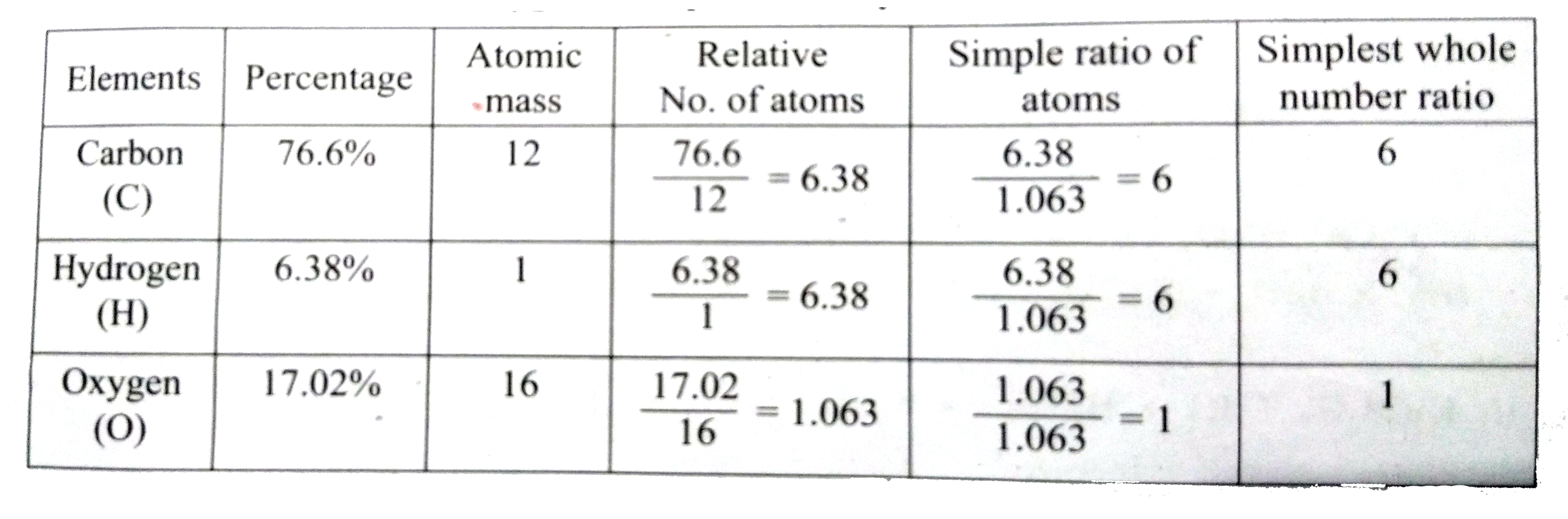 Emperical formula=`C_(6(H_(6)O` VAPOUR DENSITY=47 `:.`Molecular mass= `2 xx` vapour density `=2xx47=94` Molecular formula= Empirical formula `xx n` `n=("molecular mass")/("Emperical frmular mass")=94/94=1` `:.` Molecular formula=`C_(6)H_(6)O` |
|
| 42. |
Calculate the Effective nuclear charge of helium. |
|
Answer» SOLUTION :`Z_("EFF")=Z-S` `Z_("eff")=2-0.30("for" 1se^(-)=0.30)` `Z_("eff")=1.70` |
|
| 43. |
Calculate the effective nuclear charge of the last electron in an atom whose configuration is1s^(2)2s^(2)2p^(6)3s^(2)3p^(5) |
|
Answer» Solution :Given:Z=17 `Z^(**)=Z-S` `=17-[(0.35xx"No"`.Of other electrons in `n^(TH)"SHELL")++(0.85xx"No"`.Of electrons in `(n-1)^(th)"shell")+(1.00xx"TOTAL number of electrons in the inner shells")]` `=17-[(0.35xx6)+(0.85xx8)+(1xx2)]` `=17-10.9=6.1` `Z^(**)=6.1`. |
|
| 44. |
Calculate the effective molecular weight of air |
|
Answer» Solution :Air is a homogenous MIXTURE. It has 79% NITROGEN and 21% OXYGEN by volume. If we take ONE mole of air, it WOULD contian 0.79 mole of nitrogen and 0.21 mole of oxygen. The weight of one mole of air `=0.79 xx 28+0.21 xx 32` =28.84 Effective molecular weight of air is 28.84 |
|
| 45. |
Calculate the distance of separation between the second and third orbits of hydrogen atom |
|
Answer» SOLUTION :For H-atom, the radius of NTH ORBIT is given by : `r_(n) = 0.529 XX n^(2) Å` `:. r_(3) - r_(2) = 0.529 (3^(2) - 2^(2)) Å = 0.529 xx 5 = 2.645 Å` |
|
| 46. |
Calculate the distance between (111) planes in a crystal of calcuim . Repeat the calculation for (222) planes . Which planes are closer? (a=0.556 nm) |
|
Answer» SOLUTION :`d=a/(sqrt(h^2+k^2+l^2))` `d_111=0.556/(sqrt(1^2+1^2+1^2))=0.556/sqrt3`=0.321 nm `d_222=0.556/(sqrt(2^2+2^2+2^2))=0.556/sqrt12`=0.161 nm Thus (222) planes are CLOSER and their distance of separation is HALF of that of (111) planes |
|
| 47. |
Calculate the dissociation constant of water at room temperature |
|
Answer» Solution :DISSOCIATION of water is given as, `H_2 O hArr H^(+)_OH^(-)` Dissociation constant `K_a` is given as `K_a ([H^(+)][OH^(-)])/([H_2 O]) = (k_w )/( [H_2O]) =(1XX 10^(-14))/( 55.5 )` Dissociation constant of acid `= 1.8 xx10^(-16)mol L^(-1)` |
|
| 48. |
Calculate the difference between DeltaE and DeltaH values for the combustion reaction of ethylene at 300K |
|
Answer» |
|
| 49. |
Calculate the density of SO_2 " at " 27^@Cand 1.5 atm pressure. |
| Answer» SOLUTION :`3.9 G L^(_1)` | |
| 50. |
Calculate the density of silver which crystallizes in a face-centred cubic structure. The distance between the nearest silver atoms in this structure is 287 pm.(Molar mass of Ag =107.87" g mol"^(-1), N_A=6.02xx10^23 "mol"^(-1)) |
|
Answer» `RHO=(ZxxM)/(a^3xxN_0)=(4xx107.87 "g mol"^(-1))/((406xx10^(-10) CM)^3xx(6.02xx10^23mol^(-1)))=10.71 g cm^(-3)` |
|